http://www.uem.br/acta ISSN printed: 1806-2636 ISSN on-line: 1807-8672
Doi: 10.4025/actascianimsci.v38i4.32147
Acta Scientiarum. Animal Sciences Maringá, v. 38, n. 4, p. 389-393, Oct.-Dec., 2016
Morphogenesis and structure of Tifton 85 cultivated in subtropical
climate and fertilized with nitrogen
Diego Daniel Tiecher, Marta Gomes da Rocha, Luciana Pötter, Paulo Roberto Salvador*, Tuani Lopes Bergoli and Gabriela Descovi Milanesi
Universidade Federal de Santa Maria, Avenida Roraima, 1000, 97105-900, Santa Maria, Rio Grande do Sul, Brazil. *Author for correspondence. E-mail: [email protected]
ABSTRACT. The experiment evaluated the morphogenesis and structure of Tifton 85 (Cynodon spp.) cultivated in subtropical climate and fertilized with nitrogen (N). The experiment was a completely randomized design with four levels of N (Zero; 75; 150 or 225 kg ha-1) in nine replicates per area. The
experimental animals were Suffolk female lambs. The grazing method was continuous to maintain the sward height at 15 cm ± 10%. The stem expansion increased by 0.000027 cm degree-days-1 to each kg N
applied (linear model). According to nonlinear model, the highest stem expansion (0.0226 cm degree-days-1)
was observed with the use 220.1 kg ha-1 N. The leaf lifespan fitteda linear regression model, with increase
of 50 degree-days leaf -1, comparing the levels zero and 225 kg ha-1 of N. According to nonlinear regression
model, the longest leaf lifespan (407.1 degree-days) was observed with the use 208.8 kg ha-1 N. With the
maintenance of sward height at approximately 15 cm, we recommended to use 200 kg ha-1 N in Tifton 85
cultivated in subtropical climate.
Keywords: Cynodon spp., phyllochron, marked tillers, urea.
Morfogênese e estrutura do Tifton 85 cultivado em clima subtropical e adubado com
nitrogênio
RESUMO.Objetivou-se estudar a morfogênese e a estrutura do Tifton 85 (Cynodon spp.) cultivado em clima subtropical e adubado com nitrogênio (N). O delineamento experimental foi o inteiramente casualizado com quatro níveis de N (Zero; 75; 150 e 225 kg ha-1) em nove repetições por área. Os animais
experimentais foram borregas das raças Suffolk. O método de pastejo foi o contínuo para manter a altura do dossel em 15 cm ± 10%. A taxa de expansão de colmos aumenta 0,000027 cm graus-dia-1 para cada kg de N
aplicado (modelo linear). De acordo com o modelo não linear, o maior valor de taxa de expansão (0,0226 cm graus-dia-1) foi observado com 220,1 kg ha-1 de N. A duração de vida das folhas ajustou-se ao modelo de
regressão linear, com aumento de 50 graus-dia folha-1 comparando-se às doses de 0 e 225 kg ha-1 de N.
Conforme o modelo não linear, o maior valor de duração de vida da folha (407,1 graus-dia) foi atingido com 208,8 kg ha-1 de N. Com a manutenção da altura do dossel em aproximadamente 15 cm de altura,
recomenda-se utilizar 200 kg ha-1 de N em Tifton 85 cultivado em clima subtropical.
Palavras-chave: Cynodon spp., filocrono, perfilhos marcados, ureia.
Introduction
Low production rates in pasture areas are one of the causes of low profitability and competitiveness of animal production systems compared to other agricultural production systems (Moreira et al., 2015). The use of nitrogen fertilization in grass pastures is an alternative to intensify production systems by increasing the production of biomass. Forage accumulation process can be better understood through the effect of nitrogen fertilization on the morphogenesis of plants.
The amount of nitrogen (N) to be used, however, must respect the physiological limit of
plant growth to reduce costs of fertilizers and the environmental contamination risk (Primavesi, Primavesi, Corrêa, Silva, & Cantarella, 2006). The availability of N to plants may vary depending on the amount of organic matter in the soil, which is higher in subtropical regions due to lower mineralization rate. The effect of using N can be measured by herbage accumulation rate and the consequent total production of dry matter (Salvador et al., 2016). The magnitude of this response, however, can be better understood when the measurements are performed on individual tillers.
strategies. The use of nitrogen fertilization and irrigation in tropical climate tend to increase dry matter production of Tifton 85, allowing higher stocking rate (Pereira et al., 2011; Ribeiro & Pereira, 2011). Nevertheless, in subtropical climate, few studies have evaluated the response of the morphogenesis of Tifton 85 tillers to nitrogen fertilization strategies. Gomes et al. (2015) observed positive effect of irrigation and application of zero, 20, 40 or 60 kg ha-1 after each grazing cycle on the
dry matter production. Thus, this study aimed to evaluate the effect of nitrogen levels on morphogenesis and structure of Tifton 85 cultivated in subtropical climate.
Material and methods
The experiment was conducted at the Department of Animal Science, Federal University of Santa Maria (UFSM), at coordinates 29º43’ S, 53º42’ W. The climate is Cfa, humid subtropical, according to the Köppen and Geiger (1928). The soil is classified as Paleudalf presenting the following values: pH-H2O: 4.6; clay: 22%; P: 18 mg L-1; K:
128 mg L-1; OM: 2.6%; CEC pH 7: 12.1.
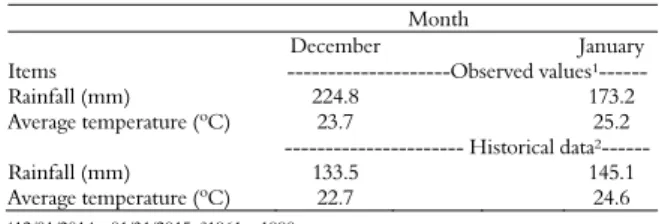
Meteorological data for the months that comprised the trial period were obtained from the Weather Station of UFSM (Table 1).
Table 1. Average monthly rainfall and temperature during the study period and normal historical data. Santa Maria, state of Rio Grande do Sul.
Month
December January
Items ---Observed values¹---Rainfall (mm) 224.8 173.2 Average temperature (ºC) 23.7 25.2 --- Historical data²---Rainfall (mm) 133.5 145.1 Average temperature (ºC) 22.7 24.6
¹12/01/2014 - 01/31/2015; ²1961 – 1990.
The experiment comprised 10,000 m2 total area
divided into nine paddocks of similar size. In the experimental area (one hectare), with nine subdivisions (paddocks), Tifton 85 (Cynodon spp.) was stablished in January 2013. The experimental animals were Suffolk female lambs. The grazing method was continuous with variable stocking rate to maintain the sward height at 15 ± 10% cm. Three Suffolk lambs were stocked per paddock and a variable number of “put and take” animals were used to adjust the sward height. The stocking rate (SR; kg ha-1 body weight) was calculated by the sum
of the average weight of experimental ewes, added to the average weight of each regulator ewe multiplied by the days they remained in the paddock and
divided by the total evaluation days. In each paddock, we marked four sites of one m2 each, in
which nitrogen (N) was applied. The levels utilized were: zero; 75; 150 and 225 kg ha-1 N as urea,
manually applied in a single dose on the first day of the study period.
For determination of morphogenetic and structural variables, we used the marked tiller technique (Carrere, Louault, & Soussana, 1997). On the sites where N levels were applied, ten tillers were marked and identified with colored plastic rings. We measured, in cm, the size of the expanded leaves, expanding and senescent, sward height and the stem length. The expanded leaves were measured from the ligule, while expanding leaves were measured from ligule of the last expanded leaf. Senescent leaves were measured only for the green part of the leaf blade. Evaluations of morphogenesis were held twice a week between 22/12/14 and 29/01/15.
The sward height was considered as the distance (cm) from ground surface to the average height of folding leaves. The stem length was measured from the ground to the height of the ligule of the last expanded leaf. The number of green leaves per tiller was determined by manual counting. The thermal sum was calculated using the equation: ST = Ʃ(Tmd) – 10 ºC, where Ʃ(Tmd) is described as the sum of daily maximum and minimum temperatures of the period and ten is the basal temperature of growth for tropical grasses. The leaf appearance was calculated using the slope of the regression between the number of emerged leaves and the thermal accumulation of the period. Phyllochron was considered as the inverse value of the leaf appearance. The leaf lifespan was calculated by the product of phyllochron and the average number of green leaves per tiller. Leaf expansion and senescence (cm degree day-1) were calculated by the
ratio between the average elongation or senescence of the leaf between two consecutive evaluations and the thermal sum in the same period.
The experimental design was completely randomized, with four treatments (zero, 75, 150 and 225 kg ha-1 N) and nine repetitions per area. To
Acta Scientiarum. Animal Sciences Maringá, v. 38, n. 4, p. 389-393, Oct.-Dec., 2016
performed using the software Statistical Analysis System [SAS] (2004).
Results and discussion
The average temperature and monthly rainfall were 24.4°C and 199 mm, respectively, during the months that comprised the experimental period. Meteorological data showed that the average temperature observed was similar to the historical average temperature (23.6ºC). Rainfall values were higher than historical averages by 68% (91.3 mm; December) and 19.3% (28.1 mm; January). Temperature and rainfall were not limiting for the development of Tifton 85.
The sward height was maintained at 14.3 ± 1.1 cm and similar in all paddocks used to evaluate N levels (p > 0.05) and was in agreement with the experimental protocol. This sward height does not enable limitation in forage intake by sheep grazing on Tifton 85 (Carnevalli et al., 2001). To keep the height of the sward similar in all paddocks, we maintained a stocking rate of 2,039 kg ha-1 body
weight.
The stem expansion of Tifton 85 fitted to the linear model (Figure 1) and broken line according to N levels (Table 2). In the broken line model, the highest stem expansion (0.0226 cm degree-day-1)
was found when applied 220.1 kg ha-1 N (r² = 0.25).
The adjustment of stocking rate to keep the sward height similar in all paddocks can probably explain the similar length of stems (11.0 ± 2 cm; p > 0.05). Because of this effect of N on the stem expansion, the increase in stocking rate after nitrogen fertilization can represent a management strategy to prevent the accumulation of this component in the forage mass.
The stem expansion estimated by linear regression is 0.0164 and 0.0224 cm degree-1
according to levels zero and 225 kg ha-1 N,
respectively. The value of stem expansion estimated by linear model (225 kg ha-1 N) is similar to the
maximum value determined by the Broken line model (0.0226 cm degree-day-1). This effect of N on
stem expansion in Tifton 85 was expected. It was
observed that, even without using additional N, the stoloniferous growth of this grass was maintained, with the internodes and leaf blades comprising the aerial organs of the plant. The N available in the soil allowed a stem expansion at 0.015 cm degree-day-1,
equivalent to 0.4 cm day-1, according with the
average temperature in the period.
Leaf expansion and senescence, leaf appearance and phyllochron of Tifton 85 have not changed with the use of N (Table 2). The duration of leaf elongation (126.7 ± 14.6 degree-1 days) of Tifton 85
was similar in all levels of N. The length of the expanded leaf blades (5.6 ± 1.0 cm) was not changed with the use of N (p > 0.05).
The similarity found in leaf appearance and phyllochron was expected because N has little effect on these characteristics, which are more dependent on temperature. Indirectly, the largest input of N could increase the leaf appearance with a reduction in phyllochron caused by the acceleration in the stem expansion. When there is high availability of N and increased stem expansion, leaf appearance is increased because a new leaf is pushed out of the sheath of the previous leaf. This effect of stem expansion on leaf appearance, however, was not observed and the amount of organic matter present in soil, equivalent to 26 kg of organic matter for each ton of soil may be a possible explanation. This amount of organic matter with mineral N available in the soil may have provided a sufficient N availability to allow stem expansion at a rate of 0.015 cm degree-day-1, resulting in similar leaf appearance
and phyllochron.
The lack of effect of N on leaf expansion may be related to the stoloniferous growth of Tifton 85, which results in increased production of stems per unit N absorbed at the expense of leaf elongation. The increase in leaf expansion is usual in species with tufted growth habit, the main effect of N observed in those species. The value of the stem expansion in the absence of nitrogen fertilization can confirm the hypothesis that the N available in the soil did not limit the leaf expansion, indicating that in the partition of absorbed N, it was intended for the expansion of stems.
Table 2. Morphogenetic and structural variables of Tifton 85 fertilized with nitrogen.
---Levels of N¹---
Variable 0 75 150 225 L2
BL2
CV3
Leaf expansion4 0.028 0.030 0.032 0.032 ns ns 19.7
Leaf lifespan5
356.5 375.2 392.7 407.1 0.0048 0.0197 10.9
Stem expansion4 0.015 0.019 0.019 0.022 0.0020 0.0089 24.0
Leaf appearance6 0.0175 0.0173 0.0176 0.0168 ns ns 6.5
Phyllochron5 59.8 60.9 59.4 61.9 ns ns 7.2
Leaf senescence4 0.015 0.019 0.019 0.022 ns ns 19.9
p w t t p h b f 2 t f w g T t The main under differe responsible fo and duration confirmed by leaf senescenc cm increase radiation incid sward is dep increased com leaf senescenc
In additio senescence m additional N increased avai expansion, the plant leaf tissu of N, due to and consequ Probably, the stem expans remobilization rather from th et al. (2011) with increasin this effect to l remobilization The obser expansion wit the maintenan paddocks. Th height of stem between the a formed by Nascimento J 2011), requiri the leaf to co found in the l expansion of T leaf blades in N. This hypo Santos et al. (2 stems at the increase of 74 when the swar The life (Figure 1) and levels (Table greatest value achieved when The number (1.5 ± 0.2), ex number (8.0 ± the use of N leaves of tille
ntenance of t ent levels o r maintaining of leaf elonga Pereira et al. ce increased by of sward he dent on leaf bla pendent on t mpetition for l
e.
on to the sw may explain
on the leaf ilability of N ere may be in ues, thus increa the greater de uently increa
N used by t ion has not n of N from he root N upta found a redu ng nitrogen fer
longer leaf life n of N. rved similarity th N fertilizat nce of the sa his height, wh ms, may have apical meriste
sheaths of Júnior, Silva, ing similar th omplete its ex leaf expansion Tifton 85 resu
tillers subject othesis is con 2011), who ob highest swar 4% in the fin rd height rang
lifespan fitte d broken line
2). With b of leaf lifespan n applied 208.
of expanding xpanded (4.5 ± ± 0.6) of leave
(p > 0.05). P ers was prim
the same swa f N may h the same leaf ation. This hy (2011), who y 0.30 mm day
eight. The a ades at the bot the sward h light results in
ard height, s the lack of f expansion.
results in inc ncreased rene asing the inter emand for thi asing senesce the plant to in t been deri m the older l ake from the s ction in leaf rtilization, and espan and low
y in the durat tion can be ex ame sward he hich resulted
provided sim m and end o
older leaves Euclides, & M hermal accumu xpansion. The n and the durat ulted in simila
ted to differen nsistent with t bserved a longe rd heights, re nal length of ed from 10 to ed to linear
models accor roken line m n (407.1 degre .8 kg ha-1 N (
g (2.0 ± 0.1), ± 0.6) leaves an
es were not ch Probably the arily influenc ard height have been senescence ypothesis is found that y-1 for each
amount of ttom of the
eight, and n increased imilar leaf effect of When the creased leaf
wal of the rnal cycling is nutrient, ence rate. ncrease the ived from leaves, but oil. Pereira senescence d attributed wer internal
tion of leaf xplained by eight in all in similar milar length
of the stem (Difante, Montagner, ulation for e similarity tion of leaf ar length of nt levels of the data of er length of esulting in
the leaves 40 cm.
regression rding to N model, the ee-day) was
r² = 0.21). , senescent nd the total
anged with number of ced by the
genotype o confirmed b claimed that a characteris
Figure 1. Stem in subtropical c
The grea day, 16.6 da was similar days) estima 225 kg ha-1 N
the duration the leaf sen the model, o of leaves is e
The use zero of N, c the leaf life model, equi the average days, respec with the us harvest of increases th Gastal and L utilization o produced by animals befo
of Tifton 85 by Gomide a t the number stic that tends t
m expansion and l climate and fertiliz
atest value of l ays) estimated
to the value ated by the li N. The magni n of the leave
escence rate o only 20% of th explained by N of 225 kg ha
-caused an incr espan, as estim ivalent to abou
temperature o ctively). The in
se of N can leaf blade b he likelihood Lemaire (2015 of the leaf as th
y the plant, wh ore the onset o
5. This hyp and Gomide of living leave to be constant
leaf lifespan of Ti zed with nitrogen
leaf lifespan (4 by the broken
(407.8 degre inear model w
itude of the ef es was not eno
of Tifton 85. A he variation in N levels.
1 N, compared
rease of 50 de mated by linea ut two days, ac of the period ( ncrease in the increase the by grazing an
of collection 5) defined the
he proportion hich is harveste of senescence.
pothesis was (2000), who es per tiller is
.
ifton 85 cultived .
407.1 degree-1
n line model ee day-1, 16.7
when applied ffect of N for ough to alter According to n the lifespan
d to the level egree-1 day in
ar regression ccording with
(16.6 vs. 14.6 e leaf lifespan efficiency of nimals, as it
Acta Scientiarum. Animal Sciences Maringá, v. 38, n. 4, p. 389-393, Oct.-Dec., 2016
The efficiency of utilization of the leaf was assessed when heifers were maintained exclusively on Alexandergrass, in which the leaves are grazed 7.14 times before the onset of the senescence process (Eloy et al., 2014). Using this value determined by these authors on the possible number of grazing cycles before the leaf blade start the senescence process, the increase of two days in leaf lifespan of Tifton 85 allows each leaf blade to be grazed more 0.3 times, allowing more efficient collection of leaf blades.
The longer leaf lifespan provided by the use of N can increase the interval between consecutive occupations in the same paddock when working with intermittent grazing, using the leaf lifespan as a management criterion, without increasing the losses by senescence. The increase in leaf lifespan when applied higher levels of N could be accompanied by a greater number of green leaves of Tifton 85 allowing the tiller to achieve the highest number of green leaves when reached the longest leaf lifespan. Nevertheless, this was not verified, because, regardless of the N level, the number of leaves of different types was kept similar in tillers.
Conclusion
The stem expansion and leaf lifespan of Tifton 85 cultivated in subtropical climate increase with 210 kg ha-1 of nitrogen fertilization. Phyllochron, leaf
appearance, leaf expansion rate and structural characteristics of Tifton 85 are not changed by nitrogen fertilization. With sward height at approximately 15 cm, it is recommended to use 200 kg ha-1 N in Tifton
85 cultivated in subtropical climate.
References
Carnevalli, R. A., Silva, S. C., Fagundes, J. L., Sbrissia, A. F., Carvalho, C., Pinto, L., & Pedreira, C. (2001). Desempenho de ovinos e respostas de pastagens de Tifton 85 (Cynodon spp.) sob lotação contínua. Scientia Agricola, 58(1), 7-15.
Carrere, P., Louault, F., & Soussana, J. F. (1997). Tissue turnover within grass-clover mixed swards grazed by sheep. Methodology for calculating growth, senescence and intake fluxes. Journal of Applied Ecology, 34(2), 333-348.
Difante, G. S., Nascimento Júnior, D., Silva, S. C., Euclides, V. P. B., & Montagner, D. B. (2011). Características morfogênicas e estruturais do capim-marandu submetido a combinações de alturas e intervalos de corte. Revista Brasileira de Zootecnia, 40(5), 955-963.
Eloy, L. R., Rocha, M. G. d., Pötter, L., Salvador, P. R., Stivanin, S. C. B., & Hampel, V. d. S. (2014). Biomass
flows and defoliation patterns of alexandergrass pasture grazed by beef heifers, receiving or not protein salt. Acta Scientiarum. Animal Sciences, 36(2), 123-128. Gastal, F., & Lemaire, G. (2015). Defoliation, shoot
plasticity, sward structure and herbage utilization in pasture: Review of the underlying ecophysiological processes. Agriculture, 5(4), 1146-1171.
Gomes, E. P., Rickli, M. E., Cecato, U., Vieira, C. V., Sapias, J. G., & Sanches, A. C. (2015). Produtividade do capim Tifton 85 sob irrigação e doses de nitrogênio. Revista Brasileira de Engenharia Agrícola e Ambiental, 19(4), 317-323.
Gomide, C. A. M., & Gomide, J. A. (2000). Morfogênese de cultivares de Panicum maximum Jacq. Revista Brasileira de Zootecnia, 29(2), 341-348.
Köppen, W., & Geiger, R. (1928). Klimate der Erde. Gotha: Verlag Justus Perthes. Wall-map 150cmx200cm. Moreira, A. L., Fagundes, J. L., Yoshihara, E., Backes, A.
A., Barbosa, L. T., Oliveira Júnior, L. F. G., ... Santos, M. A. d. S. A. (2015). Acúmulo de forragem em pastos de Tifton 85 adubados com nitrogênio e manejados sob lotação contínua. Semina: Ciências Agrárias, 36(3), 2275-2286.
Pereira, O. G., Rovetta, R., Ribeiro, K. G., Santos, M. E. R., Fonseca, D. M., & Cecon, P. R. (2011). Características morfogênicas e estruturais do capim-Tifton 85 sob doses de nitrogênio e alturas de corte.
Revista Brasileira de Zootecnia, 40(9), 1870-1878. Primavesi, A. C., Primavesi, O., Corrêa, L. d. A., Silva, A.
G. d., & Cantarella, H. (2006). Nutrientes na fitomassa de capim-marandu em função de fontes e doses de nitrogênio. Ciencia e Agrotecnologia, 30(3), 562-568.
Ribeiro, K. G., & Pereira, O. G. (2011). Produtividade de matéria seca e composição mineral do capim-tifton 85 sob diferentes doses de nitrogênio e idades de rebrotação. Ciência Agrotecnologia, 35(4), 811-816. Salvador, P. R., Pötter, L., Rocha, M. G., Hundertmarck,
A. P., Sichonany, M. J. O., Amaral Neto, L. G., ... Moterle, P. H. (2016). Sward structure and nutritive value of Alexandergrass fertilized with nitrogen. Anais da Academia Brasileira de Ciencias, 88(1), 1-11.
Santos, M. E. R., Fonseca, D. M., Braz, T. G. S., Silva, S. P., Gomes, V. M., & Silva, G. P. (2011). Características morfogênicas e estruturais de perfilhos de capim-braquiária em locais do pasto com alturas variáveis. Revista Brasileira de Zootecnia, 40(3), 535-542. Statistical Analysis System [SAS]. (2004). SAS/STAT User
guide, Version 9.1.2. Cary, NC: SAS Institute Inc.
Received on June, 2, 2016. Accepted on July, 7, 2016.