THE UN IN CONFLICT RESOLUTION: THE CASE OF EAST TIMOR
Francisco Proença Garcia
[email protected] Reserve Lieutenant Colonel. Associate Professor with Aggregation at the Institute of Political Studies of Universidade Católica Portuguesa (Portugal). Invited Professor at the Faculty of Law of Universidade Nova de Lisboa and at Instituto Universitário Militar. He was Planning Officer of the PKF/UNTAET Central Sector Command Headquarters in East Timor (2001). He is Director of Sociedade de GeografiaMónica Dias
[email protected]Coordinator of the Doctoral Programme at Institute of Political Studies, Universidade Católica Portuguesa (Portugal). PhD in Political Science and International Relations, conducts research in Conflict and Peace Studies, Democracy Studies, Contemporary International Politics and Human Rights. Taught at University of Cologne and United States Information Agency Summer School.
Raquel Duque
[email protected]Ph.D. in Political Science and International Relations: Security and Defence, Master in International Security and Terrorism. Invited Assistant Professor at the Institute of Political Studies, Universidade Católica Portuguesa, Portugal) and at the Instituto Superior de Ciências Policiais e Segurança Interna. Researcher at the ICPOL Research Centre, at the Research Centre of the Institute for Political Studies and at the Centre for Administration and Public Policy, ISCSP.
Abstract
The involvement of the United Nations in East Timor can be divided into four periods, including the anti-colonial period (1955-1974), the reaction period (1975-1982), the attenuation period (1983-1998) and the commitment period (from 1999). It is about this last period that this paper will focus by analysing the decisive steps of the UN, as a multilateral organization with a security mandate, in resolving the Timorese conflict and peacebuilding in that territory. This analysis will be guided by the proposals of the document "An Agenda for Peace" presented in 1992 by Boutros Boutros-Ghali, then Secretary-General of the United Nations, and the expectations he created in the field of peace operations. We are particularly interested in looking at the design of post-conflict peacebuilding missions and assessing the extent to which the (expected) capital gains from these operations compared to conventional peacekeeping missions would come to fruition or not. Thus, it is important to examine how the main missions were carried out, with special focus on the different actors, as well as to make a critical balance with some historical distance. In this context, it seems to us that the case of East Timor will be a good example to understand the need for a new approach to peacebuilding, as advocated in this Report, but which at a distance of more than 25 years becomes even more evident. The perception of peace as a continuous process that involves a whole sustainability network, and that depends above all on fostering and developing competences for peace (involving multiple and distinct actors facing constant coordination and negotiation challenges), therefore allows demanding greater commitment on the part of the Security Council, but also on that of the General Assembly in carrying out this difficult task in the context of the new world (dis) order.
Keywords
Peace Studies, International Organizations, Peacekeeping Operations, Governance and State Building, Timor-Leste
How to cite this article
Garcia, Francisco Proença; Dias, Mónica; Duque, Raquel (2019). "
The UN in Conflict
Resolution: the case of East Timor
". JANUS.NET e-journal of International Relations, Vol. 10, N.º 2, November 2019-April 2020. Consulted [online] on the date of the last visit,https://doi.org/10.26619/1647-7251.10.2.1
2
THE UN IN CONFLICT RESOLUTION: THE CASE OF EAST TIMOR12
Francisco Proença Garcia
Mónica Dias
Raquel Duque
I. The UN in conflict resolution
The last decade of the twentieth century witnessed remarkable changes in the field of geopolitics that have shifted the artificial peace between the eastern bloc and the western bloc to a globe fragmented in a growing number of sovereign states and non-state actors with a high transnational role (especially for example, economic and financial groups, non-governmental organizations with the most diverse claims, organized crime networks or terrorist groups). These transformations were accompanied by major technological advances in various sectors such as communications, information, and military, which saw the evolution of armed and unarmed conflicts, notably in cyberspace war. The prevention of conflict between states was a central objective of the United Nations. However, the governing charter of this organization does not specify conflicts within the states which, in the post-Cold War environment, have been prevalent, with complex situations such as the Balkan war or the genocide in Rwanda, and have required a response from key actors in the international space.
Faced with an accelerated and complex international dynamic in the webs of interdependencies that are generated among the multiple actors of the new (and uncertain) world order, the then UN Secretary-General Boutros Boutros-Ghali understood the need to provide an answer adjusted to the new context, requiring the commitment of all states to the goal of peace. The Agenda for Peace. Preventive Diplomacy, Peacemaking and Peace-Keeping Report (United Nations, 1992)3 embodies
Boutros-Ghali's vision and proposes to transform the pathways leading to peace - in a manner complementary to the UN Charter that already provided for peacekeeping operations in Chapter VI and peace enforcement operations in Chapter VII.
Twenty-six years later, the UN remains the most recognized and comprehensive international forum for peacemaking, and Boutros-Ghali's legacy endures in stimulating
1 The translation of this article was co-funded by Instituto Camões in the framework of the 1st International Conference on Conflict Resolution and Peace Studies. Text translated by Carolina Peralta.
2 Special issue of articles presented at the 1st International Conference on Conflict Resolution and Peace Studies that took place at UAL on the 29th and 30th of November 2018.
3
new conceptions of conflict resolution. Perhaps an element that underpins the durability of the Agenda still in 2018 is the innovative formula for post-conflict peace building, which encourages the development of research in peace studies and yields effective results on the ground. On the one hand, this document has declared a crucial premise for any peace debate in the new international system that traditional means of ending wars would be inappropriate to the configurations of modern conflicts. In this way, the
Agenda for Peace seeks to establish a solid starting point for peace maintenance and,
furthermore, introduces a new peace paradigm: peace as a mission that cannot be done but rather developed through the commitment of all those who have been affected by the conflict, that is, in a commitment extended to the whole of society.
In the wake of Immanuel Kant, a more complex foedus pacificum (1795) overlaps a
pactum pacis and thus the peace solution advocated by the Agenda goes beyond mere
political truce and advances towards the inclusion (i) of political institutions’ reform ii) security, iii) rebuilding infrastructure, as well as economic, social and cultural capacities that empower people, stimulate civil society, foster cooperation within the community and the regions and eliminate the causes of extreme poverty, fear, oppression, hatred and resentment. On the other hand, the Agenda for Peace acted as an alarm that sounded at the highest levels of the UN itself, namely the Security Council and the General Assembly, to demonstrate that conventional UN Peace Missions - more positive in interstate rather than intrastate conflicts (Branco, 2004: 108-109) - will not be able to respond to new threats to peace and will have to adjust to contemporary conflicts. Here, of course, we have to point out that the notion of conflict has changed decisively, posing new challenges for those seeking to relieve tensions. Areas of violent conflict have emerged in border regions and at an intrastate or sub-state level, creating true “enclaves” of war (urban or regional) in peaceful spaces (Manwaring, 2005). But it is especially in regions where the state no longer (or not yet) has a monopoly on the legitimate use of force, nor is it capable of fulfilling the most basic governance tasks that this type of conflict breaks out. These regions are often in a phase of reconstruction after long periods of war in which (re-)conciliation efforts have not yet overcome the culture of violence, but also during independence processes following the fall of dictatorial regimes in which the transfer of power has not yet been consolidated or regulated. However, it is important to note that these “new wars” (Creveld, 1991; Duffield, 2001; Kaldor, 2001; Kalyvas et al., 2008; Münkler, 2003) can also be understood as a return to the old forms of violent conflict that have marked societies for thousands of years and which, in fact, have only recently changed, largely from a culture of war that the “euroworld” has imposed (Keegan, 1993; Münkler, 2003).4
In any case, the idea of post-conflict peacebuilding already reflects this “new context” (Boutros-Ghali, 1992) in that it points to a whole different approach to peacebuilding, which requires greater involvement not only during the conflict, but also in the moments preceding and following the escalation of violence, integrating in this post-conflict phase the reconstruction of key areas for sustainable and appropriate peace throughout society. We can observe two orientations of this paradigm shift, one concerning the concept of peace, the other concerning the practice of peace missions, both interconnected and concerned about peace as the possible mission that can be achieved in a medium-term strategy. According to the first guideline, in the Boutros-Ghali statement, peace is
4
understood as a composite or comprehensive value. Drawing on innovative and critical studies of peace studies, developed by experts such as Johan Galtung (1969) or Dieter Senghaas (1971), peace is conceived not only as the absence of direct violence or war, but above all as the possibility of life without indirect violence (such as political and social repression) and with full participation in free and fair institutions (including forms of education) that generate civil capacities for tolerance, consensus building through pluralistic and competitive debate and conflict resolution. Senghaas' conflict management proposal, called Zivilisierung - which is today a cornerstone of peace studies - seems particularly relevant to us, as it implies an integrated vision of appeasement that is reflected in the political and social coexistence of the communities to be rebuilt in the post-war world. It is worth recalling, briefly, the “civilizational hexagon” model (Senghaas, 1971) developed by this author as part of his ideas on peacebuilding. Thus, peace is essentially seen as a project of civilization that corresponds to a course of individual and collective appeasement5. In the theoretical debate, the civilizational
hexagon represents, figuratively, the interdependence between six factors considered essential to the possibility of peace. The first factor would be the monopoly of violence. Only this legitimate monopoly (that is, according to precise laws) of state violence, which would require the disarmament of the population and the general prohibition of non-state-dependent armed groups, could ensure discursive conflict management in the public space, gradually eliminating the use of force as a combat pattern and stimulating argumentative forms in the defence of confronting particular interests. The second factor would underline the imperative of the rule of law, in that the monopoly of state violence presupposing transparent, regulated and controlled mechanisms would not be sufficient. For Senghaas, the whole political architecture of a state committed to peace is based on respect for a constitution that enshrines the division of power, equality before the law and all the other principles that characterize what we understand today as a democratic rule of law state. The third factor draws attention to the control of passions. In an open society, moderation is, as a domestication of impulses, a way of peacefully managing conflict and replacing violence with tolerance. Social and political peace thus presupposes individual competences for self-control and moderation of the passions. Democratic
participation emerges as a fourth factor, highlighting not only the importance of political
participation, but also thorough learning of democratic rules that require commitment, cooperation and accountability. In the context of modern societies strongly marked by permanent changes and re-adaptations, critical and active collaboration is all the more important. Social justice is the fifth factor in Senghaas’ model. Drawing on several examples of states in which serious violent conflicts have arisen, the author highlights the importance of social justice as a political fair play that guarantees equal opportunities and solidarity, enabling trust and hope in the state - values that give rise to the availability of cooperation and peaceful conflict management. Finally, constructive
conflict management is outlined as a sixth factor. Following the above factors, regarding
the ability to choose nonviolent ways to confront and work conflicts, Senghaas points to a whole culture of peaceful conflict regulation that is already a result of previous conditions or learning. It presupposes habits and good examples, and probably certain characteristics considered as “virtues” (tolerance, moderation, empathy, commitment, respect for social and political rules, willingness to trust, etc.) that facilitate a peaceful coexistence in plural and multicultural societies. This last factor already points to the
5 It should be noted that in applying the concept of “civilization” to peace studies, Senghaas was greatly influenced by the concept of “civilizational process” coined by Norbert Elias (1994).
5
synergy of all the factors that constitute the “hexagon” that would thus allow a culture of peace as an act of moralization, humanization or “civilization”.
Returning to the second paradigm shift orientation mentioned above and related to the practice of peacekeeping, it must be said that post-conflict peacebuilding must increase and deepen the maintenance of traditional peace on the ground. It is not intended as a replacement or upgrade for peacekeeping missions, but as a natural complement that can provide a stronger scope for the increasingly complex (and networked) UN work. Thanks to the impact of an Agenda for Peace, which anticipated many trends in the international political arena, peacekeeping missions have expanded greatly since 1992. A simple analysis of the number and nature of missions, but also of the resources involved (including financing, materials, structures and labour) attests their growing strength. This is particularly true when we consider the UN's ability to involve non-governmental organizations in peace operations and to promote military, paramilitary and civilian cooperation on the ground. For an overview of this work we highlight the universe of UN peacekeeping missions revealing the peace effort: a total of 71 missions, with 14 active missions around the world6.
It is also important to mention the UN's willingness to integrate different concepts of peacebuilding that derive not only from a general and universal idea of peace (which is in line with Western culture) and that it intends to impose “from above downwards”- but which stem precisely from the local traditions of undeveloped communities (“bottom up”), as explained, for example, by the works of John Paul Lederach and Janice Jenner (2002) or Wolfgang Dietrich (2005). The authors understand peace as a plural concept, of varied materializations, but always integrating a strong notion of civic participation of the affected population. In this regard, they also warn for the need for each peace operation to be different, depending on pre and post-conflict conditions, the intensity of the conflict and the parties involved, the remaining resources and infrastructure at the end of the escalation of violence, and previous culture and political organization.
All these meanings fed (and later fed themselves) on Boutros-Ghali’s Agenda for Peace. Conceptually, this document we are discussing here has opened the door to new reflection on peace and ways and means to implement it on the ground. In this regard, we mention the comprehensive approach developed in NATO operations or, previously, the innovations introduced by Security Council Resolution 1325 on Women, Peace and Security of 31 October 2000.
If we follow the ideas of Michael Doyle and Nicholas Sambanis in their attempt to assess United Nations peacekeeping operations in 2006 - as well as their critical but nonetheless constructive concerns - the overall conclusions are encouraging (Doyle and Sambanis, 2006). Thus, despite their many imperfections, the positive results achieved in just a generation, reaching millions of lives and peoples, reveal these operations as a world stronghold of hope. In this regard, we can conclude that, rather than responding to the Security Council's request to make recommendations to strengthen peacebuilding and peacekeeping in the post-Cold War era, the Agenda for Peace has revitalized all of the
6 As of writing this paper, the field missions are as follows: Haiti (MINUJUSTH), Mali (MINUSMA), Golan (UNDOF), Abyei (UNISFA), India and Pakistan (UNMOGIP), Western Sahara (MINURSO), Democratic Republic of the Congo (MONUSCO), Cyprus (UNFICYP), Kosovo (UNMIK), Middle East (UNTSO), Central African Republic (MINUSCA), Darfur (UNAMID), Lebanon (UNIFIL) and South Sudan (UNMISS).
6
UN’s peace work, bringing peacekeeping operations to a broader level with high impact and long-term return.
After the Agenda, other documents and ideas followed and contributed to the updating of UN action in conflicting territories and their missions, namely the Brahimi Report (2000), Capstone Doctrine (2008), or the New Horizon Process (2009).
In an effort to take stock of the then six decades of missions and to present written guidelines for action in complex crises, the United Nation Peacekeeping Operations -
Principles and Guidelines, also known as the Capstone Doctrine7, was published in 2008.
In 100 pages, the biggest challenges for UN operations are exposed, as well as the relevance of the ongoing dialogue between the various actors involved in the mission scenarios for adjustments whenever situations require it. Thus, the Capstone Doctrine systematizes seemingly obvious elements, such as the normative framework within which UN peacekeeping operations are supported, while exposing strategic and operational elements, such as deployment and placement phases, or hand over and withdrawal periods.
The New Horizon process, which began in 2009 and aimed at developing a forward-looking agenda for partnership-based, broad dialogue-based UN peacekeeping operations, benefited from the launch of an internal document entitled A New Partnership
Agenda: Charting a New Horizon for UN Peacekeeping8, which has been shared with
Member States and other partners.
In this set of initiatives leading to as effective as possible peace missions, it is also relevant to mention the UN High-Level Independent Panel on Peace Operations, created in October 2014 during Ban Ki-moon's mandate, composed of 16 individuals (including José Ramos Horta of Timor-Leste, who chaired the meeting). The purpose of this Panel was not only to conduct a comprehensive assessment of peace operations, but also to assess future needs and the role of the UN, following the changes and developments in the conflicts themselves. The report was finalized in June 2015 and was delivered to both the General Assembly and the Security Council, which have attempted to assimilate and accommodate the 166 recommendations covering nine strategic areas.
In order to demonstrate the contribution of the UN Missions and the steps to effect a peacebuilding process, which was already implicit in the (now expanded) peacekeeping operations, we would like to present the case study of East Timor.
II. The case of East Timor
The UN has a long-term involvement in East Timor. However, we will narrow the analysis of this work to the period after 1999 and include Indonesia, as the internal situation in this country had significant repercussions on East Timor. The 1997 Asian financial crisis that affected Indonesia, among other countries, was so serious that it involved the intervention of the International Monetary Fund with a $11.4 billion aid package for a three-year period (International Monetary Fund, 2000).
7 United Nations (2008). United Nation Peacekeeping Operations – Principles and Guidelines, Department of Peacekeeping Operations and Department of Field Support, New York.
8 United Nations (2009). A New Partnership Agenda: Charting a New Horizon for UN Peacekeeping, Department of Peacekeeping Operations and Department of Field Support, New York.
7
The internal situation worsened and General Shuarto left the scene after three decades in power, giving way in 1998 to a new President, General Habibie, who embarked on a set of political reforms, including a change of attitude regarding Timor. Indeed, on 5 May 1999, an agreement was reached in New York between Portugal and Indonesia with a view to (i) holding a popular consultation with the Timorese people under the aegis of the UN, and (ii) establishing Indonesia's responsibility for peace and safety in East Timor, to ensure consultation in a peaceful environment free from pressure or intimidation. However, even before the popular consultation, there were episodes of great violence, codenamed Operasi Sapu Jagad, deliberately led by militias of the East Timorese and Indonesian military of the TNI (Tentarra Nasional Indonesia/Indonesian Armed Forces). The UN has kept a close eye on developments, and in order for this consultation to take place without interference, the Security Council approved the establishment of a mission to organize and conduct the process of consultation with the population in East Timor, UNAMET (United Nations Mission East Timor) through Resolution 1246 of 11 June 1999 and with a mandate from June to October 1999. The popular consultation took place on 30 August of that same year and had significant independence-friendly results (78.5 % of the votes), which surprised the Indonesian power (which considered that the option of special autonomy within Indonesia would be the most voted) and which led to an unprecedented wave of violence by the integrationist militias.
As UNAMET was a political mission and the occurrence of violence multiplied, the Security Council, through Resolution 1264 of 15 September 1999, created an international force, the International Force in East Timor (INTERFET), to restore the law and order in the country, to protect and support UNAMET and to facilitate humanitarian assistance. On 20 September, INTERFET, under Australian command and with Indonesian consent, started its command in Dili with a military force of approximately 7,500 men from 12 countries. An important step in the construction of this new country was taken by Indonesia when it revoked the annexation of the 27th Province, East Timor, on 19 October 1999. A few days later, on 25 October, the Security Council established, by Resolution 1272, the UNTAET (United Nations Transitional Administration in East Timor) as a multidimensional peacekeeping operation, whose mandate ranged from October 1999 to May 2002. The central objective of peacekeeping operations was to create conditions for the stability of a country, in such a way that it was possible, in a peaceful environment, to invest in human resources training and institutional development, thus contributing to the legitimacy of the (new) state. Indeed, UNTAET was active on three fronts: a transitional UN administration of East Timorese territory, with powers to exercise all legislative and executive functions, including the administration of justice and public order with the police forces; security functions and maintenance of military order; and the coordination of humanitarian assistance.
East Timor became an independent country on 20 May 2002, when UNTAET was replaced by UNMISET ((The United Nations Mission of Support in East Timor) by Resolution 1410 of 17 May 2002. This new peacekeeping mission had an initial mandate of one year and was committed to ensuring the security and stability of East Timor, notably in assisting administrative structures critical to the political viability and stability of the country; supporting public security and police development; and maintaining East Timor's external security. UNMISET has had its mandate renewed until 20 May 2005 as a means of securing and consolidating the achievements of UNTAET and until the Timorese authorities assumed their responsibilities autonomously.
8
In May 2005, with the end of UNMISET's term of office, a political mission, called the United Nations Office in Timor-Leste (UNOTIL), was created to assist in the development of basic Timorese state institutions, including police forces, and to provide training in democratic governance and human rights. With an expected duration of one year (until May 2006), the UNOTIL delegation was on the ground until August of that year due to the worsening of the political, humanitarian and security situation. The conditions worsened to the extent that on 11 June 2006, the country's highest political authorities, namely the President of the Republic, the President of Parliament and the Prime Minister, sent a letter to the UN Secretary-General requesting him to propose to the Security Council the establishment of a United Nations police force in East Timor to maintain order until the reorganization of the national police. Indeed, the Secretary-General recommended a multidimensional and integrated UN mission to support the Timorese government in various aspects, namely national reconciliation, electoral processes for president and parliament, security and institutional capacity building in the region, and monitoring the promotion and protection of human rights.
The last United Nations peacekeeping mission in East Timor, the United Nations Integrated Mission in Timor-Leste (UNMIT), was established by Resolution 1704 of 25 August 2006 and had its mandate extended until 31 December 2012. During this period, it was important to consolidate what had been achieved and to ensure stability, democratic governance and political dialogue between the various actors of Timorese society for a process of national reconciliation and solid national cohesion. This mission was ground-breaking and consisted of the creation of a joint plan between the government and UNMIT (Joint Transition Plan) outlining 129 activities that met the priorities and objectives for the transitional period from September 2011 to the end of the UNMIT mandate in December 2012.
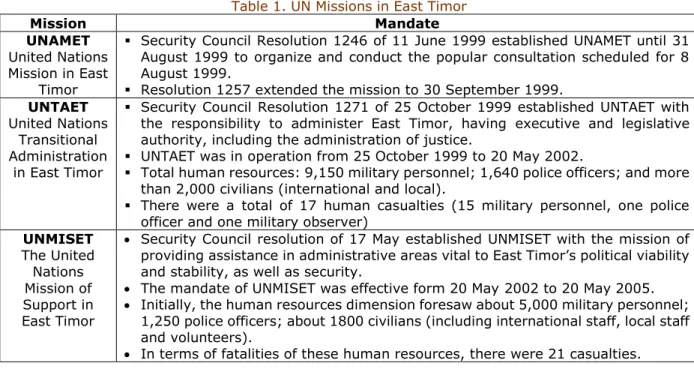
Table 1 summarizes the missions referred to in the paragraphs above, as well as their mandates.
Table 1. UN Missions in East Timor
Mission Mandate
UNAMET
United Nations Mission in East
Timor
▪ Security Council Resolution 1246 of 11 June 1999 established UNAMET until 31 August 1999 to organize and conduct the popular consultation scheduled for 8 August 1999.
▪ Resolution 1257 extended the mission to 30 September 1999.
UNTAET
United Nations Transitional Administration
in East Timor
▪ Security Council Resolution 1271 of 25 October 1999 established UNTAET with the responsibility to administer East Timor, having executive and legislative authority, including the administration of justice.
▪ UNTAET was in operation from 25 October 1999 to 20 May 2002.
▪ Total human resources: 9,150 military personnel; 1,640 police officers; and more than 2,000 civilians (international and local).
▪ There were a total of 17 human casualties (15 military personnel, one police officer and one military observer)
UNMISET The United Nations Mission of Support in East Timor
• Security Council resolution of 17 May established UNMISET with the mission of providing assistance in administrative areas vital to East Timor’s political viability and stability, as well as security.
• The mandate of UNMISET was effective form 20 May 2002 to 20 May 2005. • Initially, the human resources dimension foresaw about 5,000 military personnel;
1,250 police officers; about 1800 civilians (including international staff, local staff and volunteers).
9 UNOTIL
United Nations Office in Timor-Leste
▪ Security Council Resolution 1599 of 28 April 2005 established UNOTIL with a mandate of one year (until 20 May 2006). It consisted of a special political mission to accompany and support the development of state institutions in the areas of police training, border patrol, military advice, human rights, and democratic governance. UNMIT United Nations Integrated Mission in Timor-Leste
▪ Security Council Resolution 1704 of 25 August 2006 established UNMIT with an
initial term of six months, renewable for equal periods, with a sphere of action in support of government and institutions relevant to the consolidation of stability, strengthening the culture of democratic governance and facilitating political dialogue between Timorese actors in their efforts for national reconciliation and social cohesion, as well as supporting the 2007 (presidential and parliamentary) electoral processes.
▪ The authorized force comprised 1,608 police officers, 34 military liaison officers
and civilians. Since 2006, 5,119 police officers, 262 military personnel and around 3,000 civilians and volunteers have taken over the mission.
▪ There were a total of 17 casualties (9 police officers, 4 local civilians and 4 international civilians).
Source: Authors’ own based on the aforementioned Resolutions.
The efforts made by the UN and summarized here constitute, in our view, a very important factor not only for the pacification of East Timor, but also for its development and gradual but nevertheless increasing prosperity. Different reports and international rankings prove the improvement of living conditions, as well as an increase of freedom. The Global Peace Index places East Timor at the 53rd place (out of 163) in 2018. According to the Freedom House's assessment of the “state of freedom” in each country, East Timor has improved its position from “partially free” to “free” last year, which seems to us a very positive development.
Conclusion
The presence of the UN in East Timor was a set of essential elements to lead the country to a peaceful environment, namely commitment and monitoring of situations. This small country that was asserting itself in the international community was testament to the success of the United Nations, which contributed substantially to the rehabilitation of public infrastructure, the restoration of social harmony, administrative and community structures, and the establishment of democratic governance. In addition, the Timorese case virtually integrates all types of operations of the Agenda for Peace, inasmuch as the intervention started with peace enforcement, under Chapter 7, with INTERFET; it was followed by a multidimensional peacekeeping/peacebuilding operation9; and culminated
in the country's own appropriation of competences for its normal and expected development. Indeed, there has been a transformation of the conflict, typical of peace operations, into a structured product of various interventions undertaken by official and unofficial actors working at all levels of society - and with society. During the UN missions, the integrated military component made a decisive contribution to global stability and a
9 Peacebuilding, either post-violence, post-settlement (comprehensive settlement) or as an effort to prevent reemergence from conflict, depends on the ability to transform the conflicting situation of potential/current mass violence into a peaceful and cooperative relationship capable of promoting reconciliation and reconstruction and sustainable development over time. Peacekeeping is a conflict management tool to contain violence, while peacebuilding is the means to establish viable and inclusive democratic governance in a post-conflict society, usually through free and fair elections, independent legislative and judicial functions, responsible transparency and governance, access to political and economic opportunities, and equitable sharing of wealth.
10
secure environment within the territory, particularly in border areas. However, in addition to the indispensable presence of the military, which ensures the security environment and is fundamental to the development and well-being of the population, the post-conflict peace building operations enabled thinking and finding broader (and more effective) responses to the challenges that the new conflicts pose not just for a community but for an entire region. It will therefore be in the ability of the UN to adjust to the changing conflicts in a globalized world, and in its courage to continue and extend its missions, that the key to win peace again and day after day, lies.
References
Boutros-Ghali, Boutros (1996) “Challenges of Preventive Diplomacy: The Role of the ONU and Its Secretary-General”, in Cahill, Kevin M. (ed.), Stopping Wars before they Start:
Preventive Diplomacy, New York: Basic Books.
Branco, Carlos M. (2004). “A ONU e o processo de resolução de conflitos: Potencialidades e limitações”, Relações Internacionais, no 4: 105-125.
Security Council, Resolution 1704 (2006). United Nations Organization. [8 October 2018]. Available at: https://undocs.org/S/RES/1704(2006).
Security Council, Resolution 1257 (1999). United Nations Organization. [8 October
2018]. Available at:
http://www.un.org/ga/search/view_doc.asp?symbol=S/RES/1257(1999)
Security Council, Resolution 1246 (1999. United Nations. [8 October 2018]. Available at: http://unscr.com/files/1999/01246.pdf
Creveld, Martin Van (1991). The Transformation of War, New York: Simon & Schuster. Dietrich, Wolfgang (1997). A Call for Many Peaces, Peace Center Burg Schlaining. Doyle, Michael e Sambanis, Nicholas. (2006). Making War & Building Peace. United
Nations Peace Operations. Princeton: Princeton University Press.
Duffield, Mark (2001), Global Governance and the New Wars. London: Zed Books. Elias, Norbert (1994). The Civilizing Process. Malden: Blackwell
International Monetary Fund (2000). Recovery from the Asian Crisis and the Role of the
IMF. [12 October 2018]. Available at:
https://www.imf.org/external/np/exr/ib/2000/062300.htm#box3
Kaldor, Mary (2001). New and Old Wars: Organized Violence in a Global Era, Stanford: Stanford University Press.
Kalyvas, Stathis N., Ian Saphiro et. al. (ed.) (2008). Order, Conflict & Violence, Cambridge: Cambridge University Press.
Keegan, John (1993). A History of Warfare, Vintage.
Manwaring, Max G. (2005). “Street Gangs: The New Urban Insurgency”, Strategic Studies Institute, U.S. Army War College, (http://www.carlisle.army.mil/ssi/pdffiles/ PUB597.pdf)
11
Lederach, John Paul and Jenner, Janice Moomaw (2002). A Handbook of International
Peacebuilding: Into The Eye Of The Storm, San Francisco: Jossey-Bass.
United Nations (2015). Report of the High-Level Independent Panel on United Nations
Peace Operations, UN Doc. A/70/95–S/2015/446, 17 June 2015.
United Nations (2009). A New Partnership Agenda: Charting a New Horizon for UN
Peacekeeping, Department of Peacekeeping Operations and Department of Field Support,
New York.
United Nations (2008). United Nation Peacekeeping Operations – Principles and
Guidelines, Department of Peacekeeping Operations and Department of Field Support,
New York.
United Nations (1992). An Agenda for Peace. Preventive Diplomacy, Peacemaking and
Peace-Keeping. [8 October 2018]. Available at:
http://www.un-documents.net/a47-277.htm
United Nations Peacekeeping, United Nations Integrated Mission in Timor Leste. [9 October 2018]. Available at:
https://peacekeeping.un.org/mission/past/unmit/index.shtml
United Nations Peacekeeping, United Nations Integrated Mission in Timor-Leste completes its mandate – Fact Sheet. [9 October 2018]. Available at:
https://peacekeeping.un.org/sites/default/files/past/unmit/documents/unmit_fact_shee t_11dec2012_2.pdf
United Nations Peacekeeping, United Nations Mission of Support in East Timor. [10 October 2018]. Available at: https://peacekeeping.un.org/mission/past/unmiset/
United Nations Peacekeeping, United Nations Transitional Administration in East Timor.
[10 October 2018]. Available at:
https://peacekeeping.un.org/mission/past/etimor/etimor.htm
United Nations Peacekeeping, East Timor – UNTAET Fact and figures. [9 October 2018]. Available at: https://peacekeeping.un.org/mission/past/etimor/UntaetF.htm