M
olecularidentificationofsixspeciesofc
alliphoridae(d
iptera)
withforensicinterestinB
ogotá, c
oloMBiaa
ngelas
aBrinaM
árquez-a
cero¹
J
uanM
anuelV
idal-g
arcia²
l
uisf
ranciscoB
ecerrag
alindo³⁴
a
lexanderg
arcíag
arcía³⁵
ABSTRACT
Taxonomic identification of the species involved in the processes of cadaveric decomposition is a fundamental procedure in forensic entomological analysis. Among the species involved in the processes of decay, those of the Calliphoridae family are particularly important because they come to the body in the early stages of decomposition. The aim of this research is to identify six species of Calliphoridae (Calliphora nigribasis, Calliphora vicina, Compsomyopsis
ver-ena, Sarconesiopsis magellanica, Chrysomia albiceps and Roraimomusca roraima) with
forensic interest found in Bogotá. For that, sequences of 599 bp from mitochondrial gene COII wereas obtained. The identification was made by analysis of genetic distances under Jukes-Cantor model. The results showed levels of interspecific distances greater than 3.7%, while intraspecifics levels does not exceed 2.3%. The genetic distances obtained were used to construct a phenogram under the Maximum Likelihood model and the topology of that tree agrees with the current taxonomic organization for the family Calliphoridae family.
Key-Words: Forensic entomology; Barcode; mtDNA; COII.
analysis (Wells et al., 2001; Zehner et al., 2004). The
correct taxonomic identification makes possible to obtain biological and ecological data useful to deter-mine the post-mortem interval (PMI). That is why forensic entomologists must ensure that each speci-men found in a crime scene, either larva, pupa or adult, to be properly identified up to the species level. INTRODUCTION
After obtaining the entomological evidence present in a corpse, taxonomic identification is the first step (Wells & Sperling, 2001; Yusseff, 2006;
Sai-gusa et al., 2009) and is considered the most
impor-tant procedure performed in entomological forensic
www.mz.usp.br/publicacoes www.revistas.usp.br/paz
ISSN impresso: 0031-1049
ISSNon-line:1807-0205
Museu de Zoologia da Universidade de São Paulo
Papéis Avulsos de Zoologia
http://dx.doi.org/10.11606/0031-1049.2017.57.12 Volume 57(12):141‑147, 2017
1. Universidade de São Paulo (USP), Museu de Zoologia (MZ). Avenida Nazaré, 481, Ipiranga, CEP 04263-000, São Paulo, SP, Brasil. E-mail: [email protected].
2. Universidade de São Paulo (USP), Instituto de Matemática e Estadistica (IME). Rua do Matão, 1.010, Butantã, CEP 05508-090, São Paulo, SP, Brasil. E-mail: [email protected].
3. Universidad Distrital Francisco José de Caldas. Carrera 4a # 26b-54 Macarena B, Bogotá, Colombia. 4. E-mail: [email protected].
Within the entomofauna that participates in the processes of cadaverous putrefaction, the family Calli-phoridae is of particular interest because their carrion habits makes it one of the main decomposers groups
(Segura et al., 2009). In Colombia, Amat et al., 2008
recorded 12 genera and 29 species of blowflies (not including Mesembrinellidae). Of which at least 13
species represent medico legal importance (Pape et al.,
2004; Florez & Wolff, 2009) and the identification by morphological characters has had in recent years significant advances. Unfortunately, in many cases the morphological identification is very difficult or impossible to perform due to lack of experience in a given taxonomical group, or by the high degree of similarity between species of the same genus, or even by loss of morphological characters during procedures of collection, preservation and packaging the entomo-logical samples. In such circumstances, the molecular identification is particularly important because it al-lows identifying species from fragments of adult indi-viduals, immatures and even empty pupae (Benecke,
1998; Harvey et al., 2003).
This methodological alternative is already being used in several countries from all continents (Cainé et al., 2009; Meiklejohn et al., 2011; Park et al., 2009). In Latin America however, the progress of forensic en-tomology is slow and although we can highlight the achievements of countries like Brazil or Colombia
(Buenaventura et al., 2009; Carvalho & Mello-Patiu,
2008), the fact is that there is a lag generalized. In
Colombia for example, only until 2011 Giraldo et al.
(2011) published the first work that uses mitochon-drial genes as potential use for the identification of species with forensic relevance.
Among the major genes used for identifying insects, mitochondrial genes are widely accepted. Of these, the Cytochrome Oxidase I (COI) is by far the
most used gene (Hebert et al., 2003; Tuccia et al.,
2016). However, authors like Wells et al., (2007) and
Whitworth et al. (2007) warn about possible errors
and even the inability of the COI gene to identify species of forensic interest mainly from the family Calliphoridae. Under these circumstances, the same authors point out the need to evaluate mitochondrial regions differents from COI, like COII or ND5.
Given the importance of molecular studies for identification of forensic interest species and lack of studies of this kind in Colombia, the objective of this work is to determine the molecular variability of a segment of mitochondrial gene COII like an alternative to identify six species of the family Cal-liphoridae with forensic interest present in Bogotá, Colombia.
MATERIAL AND METHODS
Obtaining specimens
Individuals were obtained by modified trap of Ferreira (1978), baited with 200 g of beef liver and pork in fresh state. The traps were placed in two dif-ferent locations within the urban area of Bogotá and were checked at intervals of three days during one month. The collected individuals were preserved in 70% alcohol at a temperature of 4°C until extraction process. Taxonomic identification by morphological characters was performed following the work of Amat et al. (2008) and Whitworth (2010).
DNA extraction
DNA extraction was performed from a similar
protocol to that proposed by Castalanelli et al., 2010,
which is based on the alkaline hydrolysis of proteins. The procedure consists of introducing the complete specimen into a micro test tube with 100 mL of an alkaline solution and then heating for a period not exceeding 30 minutes at temperatures between 70°C and 98°C, depending on the size of the specimen. After this process, the alkaline reaction is stopped by the addition of a stabilizer tris-HCL solution. These products were verified by spectrophotometry and used to performing a PCR reaction.
PCR AMPLIFICATION AND SEQUENCING
Sequence analysis
The sequences obtained were compared with those previously reported in the National Center for Biotechnology Information (NCBI) using the BLAST tool. Alignments were performed in Clustal
W (Thompson et al., 1994) and the analysis of intra
and interspecific variability from Jukes-Cantor model (Jukes & Cantor, 1969) were made in MEGA 4.0
soft-ware (Tamura et al., 2007). External sequences were
included (Table 1) to construct a graphical representa-tion of the levels of similarity from genetic distances, using the criterion of Maximum Likelihood (ML).
RESULTS
The species Calliphora nigribasis Macquart,
Cal-liphora vicina Robineau-Desvoidy, Compsomyopsis
ver-ena (Walker), Sarconesiopsis magellanica (Le Guillou),
Chrysomia albiceps (Wiedemann) and Roraimomusca roraima Townsend, are into the principal entomofau-na with forensic interest present in Bogotá, Colombia
(Camacho, 2005; Segura et al., 2009). For these, the
extraction protocol yielded good DNA quality with concentrations between 50 ng/uL to 200 ng/uL. That
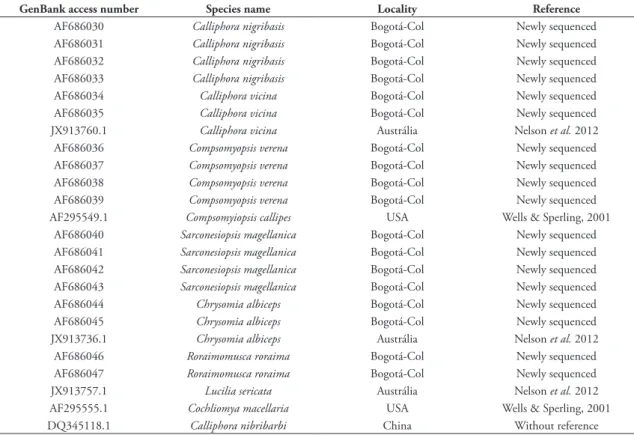
DNA was used to obtain 18 sequences available for identifying and differentiate these six species based in their genetics distances (Table 1).
Comparison of the sequences in BLAST tool al-lowed verify their similarity with previously reported sequences from COII gene in Calliphoridae. The seg-ment has 599 base pairs and is located in the region 3,104-3,702 from complete mitochondrial genome of Chrysomia albiceps (JX913736.1). The nucleotide sequence composition present the normal pattern de-scribed for mitochondrial genes in insects (Junqueira et al., 2004; Oliveira et al., 2008), where thymine and adenine have over 70% of total base pairs (Table 2).
The distance matrix for COII gene (Table 3) reveals intraspecific variation ranging from 0.1% to 1.8%; while interspecific variation reach values
rang-TABLE 1: Information of species used in this study.
GenBank access number Species name Locality Reference
AF686030 Calliphora nigribasis Bogotá-Col Newly sequenced
AF686031 Calliphora nigribasis Bogotá-Col Newly sequenced
AF686032 Calliphora nigribasis Bogotá-Col Newly sequenced
AF686033 Calliphora nigribasis Bogotá-Col Newly sequenced
AF686034 Calliphora vicina Bogotá-Col Newly sequenced
AF686035 Calliphora vicina Bogotá-Col Newly sequenced
JX913760.1 Calliphora vicina Austrália Nelson et al. 2012
AF686036 Compsomyopsis verena Bogotá-Col Newly sequenced
AF686037 Compsomyopsis verena Bogotá-Col Newly sequenced
AF686038 Compsomyopsis verena Bogotá-Col Newly sequenced
AF686039 Compsomyopsis verena Bogotá-Col Newly sequenced
AF295549.1 Compsomyiopsis callipes USA Wells & Sperling, 2001 AF686040 Sarconesiopsis magellanica Bogotá-Col Newly sequenced AF686041 Sarconesiopsis magellanica Bogotá-Col Newly sequenced AF686042 Sarconesiopsis magellanica Bogotá-Col Newly sequenced AF686043 Sarconesiopsis magellanica Bogotá-Col Newly sequenced
AF686044 Chrysomia albiceps Bogotá-Col Newly sequenced
AF686045 Chrysomia albiceps Bogotá-Col Newly sequenced
JX913736.1 Chrysomia albiceps Austrália Nelson et al. 2012
AF686046 Roraimomusca roraima Bogotá-Col Newly sequenced
AF686047 Roraimomusca roraima Bogotá-Col Newly sequenced
JX913757.1 Lucilia sericata Austrália Nelson et al. 2012
AF295555.1 Cochliomya macellaria USA Wells & Sperling, 2001
DQ345118.1 Calliphora nibribarbi China Without reference
TABLE 2: Nucleotide composition in percent
SPECIES T C G A
Calliphora nigribasis 38.06 14.02 13.52 34.39
Calliphora vicina 37.73 14.19 14.52 33.56
Compsomyopsis verena 38.23 14.86 15.36 31.55
Sarconesiopsis magellanica 40.40 13.19 13.19 33.22
Chrysomia albiceps 38.90 14.02 14.52 32.55
Roraimomusca roraima 37.40 14.86 14.19 33.56
1 2 3 4 5 6 7 8 9 10 11 12 13 14 15 16 17 18 19 20 21 22 23 24
1 1. C. vicina — 0 69 69 69 69 58 60 32 30 30 33 74 72 67 68 67 68 53 53 51 44 27 11
2 2. C. vicina 0.0 — 69 69 69 69 58 60 32 30 30 33 74 72 67 68 67 68 53 53 51 44 27 11
3 1. C. verena 11.5 11.5 — 0 0 0 53 55 76 76 76 77 37 35 36 36 36 36 22 46 50 61 70 72
4 2. C. verena 11.5 11.5 0.0 — 0 0 53 55 76 76 76 77 37 35 36 36 36 36 22 46 50 61 70 72
5 3. C. verena 11.5 11.5 0.0 0.0 — 0 53 55 76 76 76 77 37 35 36 36 36 36 22 46 50 61 70 72
6 4. C. verena 11.5 11.5 0.0 0.0 0.0 — 53 55 76 76 76 77 37 35 36 36 36 36 22 46 50 61 70 72
7 1. C. albiceps 9.7 9.7 8.8 8.8 8.8 8.8 — 2 62 60 60 63 64 62 58 58 58 58 41 42 12 55 53 57
8 2. C. albiceps 10.0 10.0 9.1 9.1 9.1 9.1 0.3 — 64 62 62 65 61 64 60 60 60 60 43 44 14 57 55 59
9 1. C. nigribasis 5.3 5.3 12.6 12.6 12.6 12.6 10.3 10.6 — 4 4 4 85 83 79 80 79 80 61 57 57 52 25 35
10 2. C. nigribasis 5.0 5.0 12.6 12.6 12.6 12.6 10.0 10.3 0.6 — 0 8 83 81 77 78 77 78 61 55 55 52 23 35
11 3. C. nigribasis 5.0 5.0 12.6 12.6 12.6 12.6 10.0 10.3 0.6 0.0 — 8 83 81 77 78 77 78 61 55 55 52 23 35
12 4. C. nigribasis 5.5 5.5 12.8 12.8 12.8 12.8 10.5 10.8 0.6 1.3 1.3 — 86 84 80 81 80 81 62 58 58 53 26 36
13 1. R. roraima 12.3 12.3 6.1 6.1 6.1 6.1 10.6 11.2 14.1 13.8 13.8 14.3 — 2 25 25 25 25 37 57 63 69 71 77
14 2. R. roraima 12.0 12.0 5.8 5.8 5.8 5.8 10.3 10.6 13.8 13.5 13.5 14.0 0.3 — 23 23 23 23 35 55 61 67 71 77
15 1. S. magellanica 11.1 11.1 6.0 6.0 6.0 6.0 9.6 10.0 13.1 12.8 12.8 13.3 4.2 3.8 — 6 0 6 26 48 54 59 66 69
16 2. S. magellanica 11.3 11.3 6.0 6.0 6.0 6.0 9.6 10.0 13.3 13.0 13.0 13.5 4.2 3.8 1.0 — 6 0 26 48 54 60 67 70
17 3. S. magellanica 11.1 11.1 6.0 6.0 6.0 6.0 9.6 10.0 13.1 12.8 12.8 13.3 4.2 3.8 0.0 1.1 — 6 26 48 54 59 66 69
18 4. S. magellanica 11.3 11.3 6.0 6.0 6.0 6.0 9.6 10.0 13.3 13.0 13.0 13.5 4.2 3.8 1.0 1.1 0.0 — 26 48 54 60 67 70
19 C. callipes(GB) 8.8 8.8 3.7 3.7 3.7 3.7 6.8 7.1 10.1 10.1 10.1 10.3 6.1 5.8 4.3 4.3 4.3 4.3 — 26 35 42 50 52
20 C. macellaria (GB) 8.8 8.8 7.6 7.6 7.6 7.6 7.0 7.3 9.5 9.1 9.1 9.6 9.5 9.2 8.0 8.0 8.0 8.0 4.3 — 33 48 50 54
21 C. albiceps(GB) 8.5 8.5 8.3 8.3 8.3 8.3 2.0 2.3 9.5 9.1 9.1 9.6 10.5 10.2 9.0 9.0 9.0 9.0 5.8 5.5 — 48 46 50
22 L. sericata (GB) 7.3 7.3 10.1 10.1 10.1 10.1 9.1 9.5 8.6 8.6 8.6 8.8 11.5 11.2 9.8 10.0 9.8 10.0 7.0 8.0 8.0 — 41 41
23 C. nigribarbi (GB) 4.5 4.5 11.6 11.6 11.6 11.6 8.8 9.1 4.1 3.8 3.8 4.3 11.8 11.9 11.0 11.1 11.0 11.1 8.3 8.3 7.6 6.8 — 24
24 C. vicina (GB) 1.8 1.8 12.0 12.0 12.0 12.0 9.5 9.8 5.8 5.8 5.8 6.0 12.8 12.9 11.5 11.6 11.5 11.6 8.6 9.0 8.3 6.8 4.0 —
Már
q
ue
z-Acer
o, A.S.
et
al
:
C
OII identifica
tion of bl
o
w-flies fr
om Bogo
ing from 3.7% to 14.3%. From the fragments se-quenced in this study, the higher intraspecific
variabil-ity occurs in the sequences of C. nigribasis with 1.3%,
representing a variation of eight nucleotides between 599 obtained. Unlike these, sequences obtained for C. verena and C. vicina present no nucleotide change. Chrysomia albiceps and R. roraima presents changes in
two nucleotides, and S. magellanica have variability in
six nucleotides.
Regarding interspecific relationships, the high-est percentages of variation are present for the
com-parision of all species againts R. roraima, being the
largest difference is between R. roraima and
C. nigri-basis with 14.3%. Conversely, the lower values occur
between C. vicina and C. nigribasis with maximum
percentages 5.3%, which means changes in 33 of the 599 nucleotides sequenced. The comparison of the se-quences obtained with those reported in others study for the same gene, show intraspecific differences of
1.8% between the C. vicina, and 2.0% between the
C. albiceps. Intraspecific variation between C. verena and C. callipes is 3.7% and between C. nigribasis and C. nigribarbis is 3.8% (Table 3).
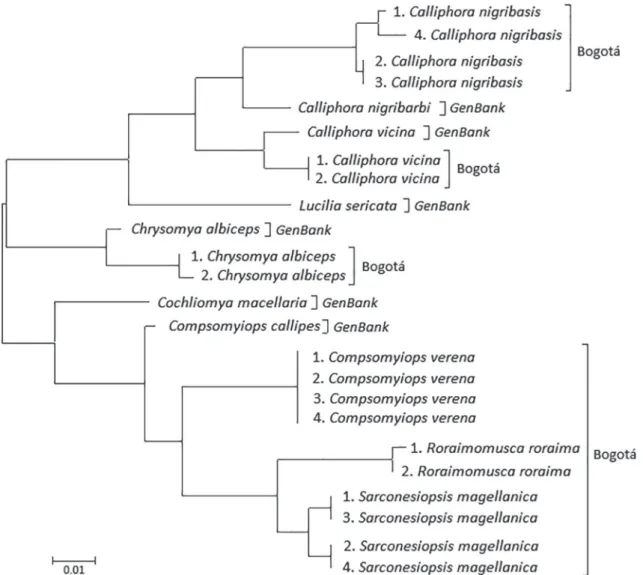
The topological representation of genetic dis-tance shows taxonomic relationships of the species compared in this study (Fig. 1). In a level of genus, Compsomyiops includes species C. callipes and
C. ver-ena in one group; Calliphora grouped species
C. vic-ina, C. nibribasis and C. nigribarbi, while Chrysomya
contains all three individuals of C. albiceps.
Roraimo-musca, Sarconesiopsis and Cochliomya are located in separated taxonomic groups.
DISCUSSION
In addition to the phylogenetic reconstruction, genetic distance analyses have become an important
FIGURE 1: Phenogram distances created under the maximum likelihood model (ML).
mechanism for taxonomic identification when using molecular data (Desmyter & Gosselin, 2009). The
Barcode initiative (Hebert et al., 2003) focused the
attention to use a segment of COI gene; however, in some cases – not only in forensic entomology –, this gene has shown some problems to identify
spe-cies (Elias et al., 2007; Wells & Stevens, 2008). These
difficulties have made it necessary to use alternative genes in the procedures of identification and phylog-eny. In the case of forensic entomology, the COII, ND1, ND5 and CYTB genes are being used
(Ales-sandrini et al., 2008; Wells & Stevens, 2008; Zehner
et al., 2004).
In this research, the use of mitochondrial gene COII fragment allowed taxonomically identification of six species from the family Calliphoridae forensic interest present in Bogotá. This fragment of mito-chondrial genome can be used for identify not just adult stages but also larvae or pupae stages as
pro-posed by Boehme et al., 2010.
Hebert et al., 2003 and Meiklejohn et al., 2011
indicates that rates of genetic diversity of 3% are suf-ficient for identifying species using the COI gene,
however Boehme et al., 2012 and Nelson et al., 2007
discovered lower interspecific variation than 3% for
segments COI in species of Lucilla and Chrysomya.
In this research, the values of diversity in gene COII are in all cases higher than 3% and reach peak levels of 14.3% with 86 nucleotide changes. These results could indicate the importance of COII gene for dif-ferentiating species of forensic interest that are close-ly related and which are difficult to identify using COI.
Intraspecific differences shown in Table 3, never
exceed interspecific values. For C. albiceps, the
com-parison between the newly obtained and the previ-ously sequenced GenBank shows the highest values of the entire table (2.3%). This variability may be in-dicative of the presence of different haplotypes within the same species that respond to the geographical distance between individuals of whom are from the sequences (Colombia and Austrália).
CONCLUSSION
Six species of the family Calliphoridae with fo-rensic interest present in Bogotá were identified from a 599 bp fragment of the mitochondrial gene COII. For all the six species analyzed the percentages of in-traspecific and interspecific variability show that this fragment of COII gene can be used as alternative for identifying species of Calliphoridae.
RESUMEN
La identificación taxonómica de las especies envueltas en los procesos de descomposición cadavérica es una etapa fundamental en los análisis de la entomología forense. Dentro de las especies que participan en los procesos de descomposición, aquellos que pertenecen a la familia Ca-lliphoridae son de particular importancia por ser coloni-zadores durante los primeros estados de descomposición. El objetivo de este estudio es identificar seis especies de Calliphoridae (Calliphora nigribasis, Calliphora vici-na, Compsomyopsis verevici-na, Sarconesiopsis
magella-nica, Chrysomia albiceps y Roraimomusca roraima)
con interés forense presentes en Bogotá, Colombia. Por tanto fueron obtenidas secuencias de 599pb del gen mitocondrial COII. La identificación fue realizada a través del análisis de distancias genéticas con el modelo
Jukes-Cantor. Los resultados muestran niveles de
distan-cias interespecificas mayores de 3,7%, mientras que las intraespecificas no exceden 2,3%. Las distancias gené-ticas obtenidas fueron utilizadas para construir un fe-nograma con el modelo de Maximum Likelihood y la topología del árbol concuerda con la organización taxo-nómica aceptada para la familia Calliphoridae.
Palabras-Clave: Entomología forense; Barcode; mtDNA; COII.
ACKNOWLEDGMENT
To Colciencias, Departamento Administrativo de
Ciencia, Tecnología e Innovación de Colombia; to the
researches groups in Molecular Biology (Biomol) and
Entomology (Kumangui) from the Universidad
Dis-trital Francisco José de Caldas by funding this project through the Scholarship “Young Researchers and In-novators”.
REFERENCES
Alessandrini, F.; Mazzanti, M.; Onofri, V.; Turchi, C. & Tagliabracci, A. 2008. MtDNA analysis for genetic identification of forensically important insects. Forensic Science International: Genetics, Supplement Series, 1:584-585. Amat, E.; Velez, M. & Wolff, M. 2008. Clave ilustrada para la
identificación de los géneros y las especies de califóridos (Dip-tera: Calliphoridae) de Colombia. Caldasia, 30(1):231-244. Benecke, M. 1998. Six forensic entomology cases: description
and commentary. Journal of Forensic Sciences, 43:797-805; 43:1303.
approach to molecular phylogenetics and diagnostics of blowflies (Diptera: Calliphoridae). Gene, 511(2):131-142. Oliveira, M.; Barau, J.; Martins, A.; Feijão, P.; Coelho da
Rosa, A.; Abreu, C.; Azeredo-Spin, A. & Lessinger, A. 2008. Structure and evolution of the mitochondrial genomes of Haematobia irritans and Stomoxys calcitrans: The Muscidae (Diptera: Calyptratae) perspective. Molecular Phylogenetics and Evolution, 48:850-857.
Pape, T.; Wolff, M. & Amat, E. 2004. Los califóridos, éstridos, rinofóridos y sarcofágidos (Diptera: Calliphoridae, Oestridae, Rhinophoridae, Sarcophagidae) de Colombia. Biota Colombia-na, 5(2):201-208.
Park, S.; Zhang, Y.; Piao, H.; Ha Yu, D.; Jeong, H.; Young Yoo, G.; Tae-Ho, J.O. & Hwang, J. 2009. Sequences of the Cytochrome C Oxidase Subunit I (COI) gene are suitable for species identification of Korean Calliphorinae flies of forensic importance (Diptera: Calliphoridae). Journal of Forensic Sciences, 54(5):1131-1134.
Saigusa, K.; Matsumasa, M.; Yashima, Y.; Takamiya, M. & Aoki, Y. 2009. Practical applications of molecular biological species identification of forensically important flies. Legal Medicine,
11(Supplement 1):344-347.
Segura, N.; Usaquen, W.; Sanchez, M.; Chuaire, L. & Bello, F. 2009. Succession pattern of cadaverous entomofauna in a semi-rural area of Bogotá, Colombia. Forensic Science international, 187:66-72.
Tamura, K.; Dudley, J.; Nei, M. & Kumar, S. 2007. MEGA4: molecular evolutionary genetics analysis (MEGA) software version 4.0. Molecular Biology and Evolution, 24:1596-1599. Thompson, J.; Higgins, D. & Gibson, T. 1994. Clustal W:
improving the sensitivity of progressive multiple sequence alignment through sequence weighting, position-specific gap penalties and weight matrix choice. Nucleic Acids Research,
22:4673-4680.
Tuccia, F.; Giordani, G. & Vanin, S. 2016. A general review of the most commom COI primers for Calliphoridae identification in forensic entomology. Forensic Science International: Genetics,
24:e9-e11.
Wells, J. & Sperling, F. 2001. DNA-based identification of forensically important Chrisomyinae (Diptera: Calliphoridae).
Forensic Science International, 120:110-115.
Wells, J. & Stevens, J. 2008. Application of DNA-Based Methods in Forensic Entomology. Annual Review of Entomology, 53:103-20. Wells, J.; Pape, T. & Sperling, F. 2001. DNA-Based Identification and Molecular Systematics of Forensically Important Sarcophagidae (Diptera). Journal of Forensic Science, 46(5):1098-1102. Wells, J.; Wall, R. & Stevens, J.R. 2007. Phylogenetic analysis of
forensically important Lucilia flies based on cytochrome oxidase I sequence: a cautionary tale for forensic species determination.
International Journal of Legal Medicine, 121:229-233. Whitworth, T. 2010. Keys to the genera and species of blow flies
(Diptera: Calliphoridae) of the West Indies and description of a new species of Lucilia Robineau-Desvoidy. Zootaxa, 2663:1-35. Whitworth, T.; Dawson, R.; Magalon, H. & Baudry, E. 2007.
DNA barcoding cannot reliably identify species of the blowfly genus Protocalliphora (Diptera: Calliphoridae). Proceedings of the Royal Society of London B, 274:1731-1739.
Yusseff, S. 2006. Entomología forense: los insectos en la escena del crimen. Revista Luna Azul, 23:1-10.
Zehner, R.; Amendt, J. & Shutt, S. 2004. Genetic identification of forensically important flesh flies (Diptera: Sarcophagidae).
Journal of Legal Medicine, 118:245-247.
Aceito em: 21/11/2016 Publicado em: 16/03/2017 Editor Responsável: Carlos José Einicker Lamas Boehme, P.; Amendt, J.; Disney, H. & Zehner, R. 2010.
Molecular identification of carrion-breeding scuttle flies (Diptera: Phoridae) using COI barcodes. International Journal of Legal Medicine, 124(6):577-581.
Buenaventura, E.; Camacho, G.; García, A. & Wolff, M. 2009. Sarcophagidae (Diptera) de importancia forense en Colombia: claves taxonómicas, notas sobre su biología y distribución.
Revista Colombiana de Entomología, 35(2):189-196.
Cainé, L.; Corte, F.; Saloña-Bordas, M.; Pancorbo, M.; Lima, G.; Magalhaes, T. & Pinheiro, F. 2009. DNA typing of Diptera collected from human corpses in Portugal. Forensic Science International, 184:21-23.
Camacho, G. 2005. Sucesion de la entomofauna cadaverica y ciclo vital de Calliphora vicina (Diptera: Calliphoridae) como pri-mera especie colonizadora, utilizando cerdo blanco (Sus scrofa)
en Bogotá. Revista Colombiana de Entomología, 31(2):189-197. Carvalho, C. & Mello-Patiu, C. 2008. Key to the adults of the
most common forensic species of Diptera in South America.
Revista Brasileira de Entomologia, 52(3):390-406.
Castalanelli, M.; Severtson, D.; Brumley, C.; Szito, A.; Foot-tit, R.; Grimm, M.; Munyard, K. & Groth, D. 2010. A rapid non-destructive DNA extraction method for insects and other arthropods. Journal of Asia-Pacific Entomology, 13:243-248. Desmyter, S. & Gosselin, M. 2009. COI sequence variability
between Chrysomyinae of forensic interest. Forensic Science International: Genetics, 3(2):89-95.
Elias, M.; Hill, R.; Willmott, K.; Dasmahapatra, K.; Brower, A.; Mallet, J. & Jiggins, C. 2007. Limited performance of DNA barcoding in a diverse community of tropical butterflies.
Proceedings of the Royal Society of London B, 274:2881-2889. Ferreira, M.J.M. 1978. Sinantropia de dípteros muscóideos em
Curitiba, Paraná. I. Calliphoridae. Revista Brasileira de Biolo-gia, 38:445-454.
Florez, E. & Wolff, M. 2009. Descripción y clave de los estadios inmaduros de las principales especies de Calliphoridae (Dipte-ra) de importancia forense en Colombia. Neotropical Entomo-logy, 38(3):418-429.
Giraldo, P.; Uribe, S. & López, A. 2011. Análisis de secuen-cias de ADN mitocondrial (Cytb y ND1) en Lucilia eximia
(Diptera: Calliphoridae). Revista Colombiana de Entomología,
37(2):273-278.
Harvey, M.; Dadour, I. & Gaudieri, S. 2003. Mitochondrial DNA Citochrome oxidase I gene: potential for distinction between immature stages of some forensically important fly species (Diptera) in western Austrália. Forensic Science International, 131:134-139.
Hebert, P.D.N.; Cywinska, A.; Ball, S.L. & de Waard, J.R. 2003. Biological identifications through DNA barcodes. Proceedings of the Royal Society of London B, 270:313-321.
Jukes, T.H. & Cantor, C.R. 1969. Evolution of protein molecules.
(Munro H N, eel.) Mammalian protein metabolism. III. New York, Academic Press. p. 21-132.
Junqueira, A.; Lessinger, A.; Torres, T.; Rodrigues da Sil-va, F.; Vettore, A.; Arruda, P. & Azeredo, A. 2004. The mitochondrial genome of the blowfly Chrysomya chloropyga (Diptera: Calliphoridae). Gene, 339:7-15.
Meiklejohn, K.; Wallman, J. & Dowton, M. 2011. DNA-based identification of forensically important Australian Sarcophagidae (Diptera). International Journal of Legal Medicine, 121(1):27-32.
Nelson, L.; Wallmann, J. & Dowton, M. 2007. Using COI barcodes to identify forensically and medically important blowflies. Medical and Veterinary Entomology, 21:44-52. Nelson, L.A.; Lambkin, C.L.; Batterham, P.; Wallman, J.F.;
Dowton, M.; Whiting, M.F.; Yeates, D.K. & Cameron, S.L. 2012. Beyond barcoding: A mitochondrial genomics Publicado com o apoio financeiro do Programa de
Apoio às Publicações
Científicas Periódicas da USP
Produzido e diagramado na Seção de Publicações do
Museu de Zoologia da
Universidade de São Paulo
Os periódicos Papéis
A
vulsos de Zoologia
e
Arquivos de Zoologia estão licenciados sob uma Licença CC-BY
da Creative Commons.