A
r
ti
c
le
0103 - 5053 $6.00+0.00
*e-mail: [email protected]
Synthesis and Antimicrobial Evaluation of some New Pyrazole, Pyrazoline and
Chromeno[3,4-c]pyrazole Derivatives
Nada M. Abunada,*,aHamdi M. Hassaneen,b Ahmed S. M. Abu Samahac and Omar A. Miqdada
aDepartment of Chemistry and cDepartment of Biology, Faculty of Applied Sciences,
Al-Aqsa University, 76888 Gaza, Palestine
bDepartment of Chemistry, Faculty of Science, Cairo University, Cairo, Egypt
Alguns novos derivados de pirazol-5-carbonitrila 8,9 e pirazol-5-carboxamida 13 foram sintetizados pela reação de cicloadição de nitriliminas 3,4 a α-cianocinamonitrilas 5a-f e α-cianocinamamida 12a,b, respectivamente. Por outro lado, a adição de 3,4 a α-cianocinamato de etila 14a-f leva à produção de derivados de 2-pyrazoline-5-carboxilato de etila, 15, 16. Também, a cicloadição de 3,4 à 3-cianocumarina 19a ou à 3-fenilsulfonilcumarina 19b ou à 3-bromocumarina
19c leva à produção de derivados do cromeno[3,4-c]pirazol-4(3H)-ona, 20. A cicloadição de 3,4
à 3-acetilcumarina, 22 e 3-benzoilcumarina, 23, produz o correspondente diidrocromeno[3,4-c] pirazol-4(3H)-ona, 24 e 25, respectivamente. A oxidação de 24 e 25 produz 20. A maioria dos compostos preparados mostrou boa a moderada atividade antibacteriana e antifúngica.
Some new pyrazole-5-carbonitrile derivatives 8,9 and pyrazole-5-carboxamide 13 were synthesized by the cycloaddition reaction of nitrilimines 3,4 to α-cyanocinnamonitriles 5a-f and α-cyanocinnamamide 12a,b respectively. On the other hand 3,4 add to ethyl α-cyanocinnamate
14a-f to give ethyl 2-pyrazoline-5-carboxylate derivatives 15,16. Also, cycloaddition of 3,4
to 3-cyanocoumarin 19a or 3-phenylsulphonylcoumarin 19b or 3-bromocoumarin 19c give chromeno[3,4-c]pyrazol-4(3H)-one derivatives 20. In the same direction, the cycloaddition of 3,4 to 3-acetylcoumarin 22 and 3-benzoylcoumarin 23 gives the corresponding dihydrochromeno[3,4- ] pyrazol-4(3H)-one 24 and 25 respectively. Oxidation of 24 and 25 give 20. Most of the prepared compounds showed good to moderate antibacterial and antifungal activities.
Keywords: nitrilimines, pyrazole, pyrazoline, chromeno[3,4-c]pyrazole
Introduction
Pyrazole and heterocyclic fused pyrazole derivatives represent an important class of heterocyclic compounds that have many applications. Some of these compounds are employed as anti-inflammatory compounds,1-3 as blood platelet aggregation inhibitors,1 as adenosine antagonists,4,5 and as controlling herbicides.6 They also show antimicrobial and antiparasitic activities.7,8 Also, pyrazoline derivatives have been found to possess antifungal,9 antidepressant10-13 anticonvulsant,12,13 antiinflammatory,14 antibacterial15 and anti-tumor16 activities. Chromenopyrazoles exhibit high activity against gram positive and gram negative bacteria.17 Moreover, many selectively fluoro-substituted organic compounds show a peculiar pharmacological and
agrochemical properties.18-23 Therefore, as a connection of our interest in the chemistry of the preparation of heterocyclic compounds from hydrazonoyl halides24-29 and the above-mentioned findings, the present work is aimed at the preparation of new pyrazole, pyrazoline and their chromene fused derivatives incorporating fluorine and chlorine substituents into these derivatives hoping that it would potentiate their expected biological activities.
Experimental
were recorded in potassium bromide pellets on a Pye Unicam SP 3-300 and Shimadzu FT-IR 8101 PC infrared spectrophotometer. NMR spectra were recorded at 200 (1H) and 50 (13C) MHz in (DMSO-d6) on a GEMINI-200 spectrometer. Chemical shifts (d) are reported relative to TMS as the internal standard. Mass spectra were measured on a GCMS-QP 1000 EX spectrometer operating at an ionization potential of 70 eV.
Synthesis of 3,4-diaryl-1-(4-nitrophenyl)-1H-pyrazole-5-carbonitriles 8,9
Triethylamine (0.7 mL, 5 mmol) was added to a stirred solution of the appropriate hydrazonoyl bromides 1,2 and the appropriate α-cyanocinnamonitrile derivatives 5a-f
(5 mmol) in benzene (40 mL) at room temperature. The mixture was refluxed for 8 h as indicated by TLC. The precipitated triethylamine hydrobromide was removed by filtration and the filtrate was evaporated, and then triturated with methanol. The solid that formed was collected by filtration and crystallized from the suitable solvent to give
8,9 respectively.
3-(4-Fluorophenyl)-1-(4-nitrophenyl)-4-phenyl-1H-pyrazole-5-carbonitrile 8a
Obtained as pale yellow crystals; yield: 1.07 g (56%); mp214-6 oC (from dioxane-ethanol); IR (KBr)ν
max/cm -1:
3119.0, 3083.1 (CH-aromatic), 2235.5 (C≡N), 1659.2 (C=N), 1592.7 (C=C); 1H NMR (DMSO-d
6) d7.04-8.54 (m, 13H, ArH’s); 13C NMR (DMSO-d
6) d161.28 (d, J 256.4 Hz, C-F), 146.38 , 146.14 (C=N, C-p-NO2), 143.10, 138.83, 135.12, 129.76 (d, J 8.3 Hz, C-m-F), 129.25, 127.97, 125.72, 126.52, 125.14, 124.86 (d, J 3.1 Hz, C-p-F), 124.71, 115.50 (d, J 22.1 Hz, C-o-F), 110.61 (C≡N); MS, m/z: 385 (M++1, 88.8), 384 (M+, 100.0), 338 (10.3), 337 (15.0), 196 (10.4), 75 (14.5), 63 (13.4). Anal. Calc. for C22H13FN4O2 (Mr = 384.36): C, 68.74; H, 3.40; N, 14.57%; Found: C, 68.62; H, 3.39; N, 14.34%.
3-(2,4-Dichlorophenyl)-1-(4-nitrophenyl)-4-phenyl-1H-pyrazole-5-carbonitrile 9a
Obtained as off white solid; yield: 1.13 g (52%); mp 160-162 oC (from acetic acid); IR (KBr) ν
max/cm -1:
3085.3 (CH-aromatic), 2228.1 (C≡N), 1652.5 (C=N), 1595.1 (C=C); 1H NMR (DMSO-d
6) d 7.01-8.54 (m, 12H, ArH’s); 13C NMR (DMSO-d
6) d 147.30, 146.38 (C=N, C-p-NO2), 145.14, 138.83, 135.12, 133.36, 132.45, 130.33, 130.08, 129.98, 129.45, 129.25, 127.97, 125.72, 126.52, 125.14, 124.71, 110.61 (C≡N); MS, m/z: 436 (M++2, 46.3), 434 (M+, 68.1), 401 (38.4), 399 (100.0), 355 (16.4), 353 (48.3), 319 (6.3), 317 (18.7), 246 (17.0),
216 (15.0), 190 (18.6), 127 (23.5), 75 (53.1), 50 (39.2). Anal. Calc. for C22H12Cl2N4O2 (Mr = 435.26): C, 60.70; H, 2.77; N, 12.87; Cl, 16.29%; Found: C, 60.58; H, 2.87; N, 12.69; Cl, 16.31%.
3-(4-Fluorophenyl)-4-(4-methylphenyl)-1-(4-nitrophenyl)-1H-pyrazole-5-carbonitrile 8b
Obtained as off white solid; yield: 1.01 g (51%); mp 163-165 oC (from acetic acid); IR (KBr)ν
max/cm
-1: 3116.1,
3080.6 (CH-aromatic), 2924.1, 2854.2 (CH-aliphatic), 2233.1 (C≡N), 1650.6 (C=N), 1597.0 (C=C); 1H NMR (DMSO-d6)d 7.02-8.58 (m, 12H, ArH’s),2.25 (s, 3H, CH3); 13C NMR (DMSO-d
6) d 161.30 (d, J 256.4 Hz, C-F), 146.39, 146.10 (C=N, C-p-NO2), 143.13, 138.77, 135.09, 129.78 (d, J 8.3 Hz, C-m-F), 129.28, 128.48, 126.92, 126.51, 125.22, 124.88 (d, J 3.1 Hz, C-p-F), 122.85, 115.52 (d, J 22.1 Hz, C-o-F), 110.58 (C≡N), 20.39 (CH3); MS,
m/z: 399 (M++1, 71.4), 398 (M+, 100.0), 383 (13.5), 351 (10.8), 76 (14.9), 75 (23.2). Anal. Calc. for C23H15FN4O2 (Mr = 398.38): C, 69.34; H, 3.79; N, 14.06%; Found: C, 69.14; H, 3.82; N, 13.96%.
3-(2,4-Dichlorophenyl)-4-(4-methylphenyl)-1-(4-nitrophenyl)-1H-pyrazole-5-carbonitrile 9b
Obtained as off white solid; yield: 1.16 g (52%); mp 195-197 oC (from acetic acid); IR (KBr)ν
max/cm
-1: 3081.2
(CH-aromatic), 2920.3, 2854.8 (CH-aliphatic), 2226.9 (C≡N), 1653.1 (C=N), 1595.0 (C=C); 1H NMR (DMSO-d
6)
d 7.02-8.54 (m, 11H, ArH’s), 2.26 (s, 3H, CH3); 13C NMR (DMSO-d6) d 147.32, 146.39 (C=N, C-p-NO2), 146.10, 138.77, 135.09, 133.40, 132.44, 130.30, 130.10, 129.96, 129.43, 129.28, 128.48, 126.92, 126.51, 125.22, 122.85 (15C, ArC’s), 110.58 (C≡N), 20.36 (CH3); MS, m/z: 450 (M++2, 76.8), 448 (M+, 100.0), 413 (82.8), 378 (48.1), 367 (42.6), 257 (10.9), 230 (12.6), 165 (11.2), 140 (27.8), 103 (14.7), 90 (21.7), 75 (49.1). Anal. Calc. for C23H14Cl2N4O2 (Mr = 449.28): C, 61.48; H, 3.14; N, 12.47; Cl, 15.78%; Found: C, 61.42; H, 3.21; N, 12.39; Cl, 15.69%.
3 ( 4 F l u o ro p h e n y l ) 4 ( 4 m e t h o x y p h e n y l ) 1 ( 4 -nitrophenyl)-1H-pyrazole-5-carbonitrile 8c
Obtained as off white solid; yield: 1.01 g (49%); mp 194-196 oC (from acetic acid); IR (KBr) ν
max/cm -1:
3120.7, 3089.4 (CH-aromatic), 2936.5 (CH-aliphatic), 2231.1 (C≡N), 1651.8 (C=N), 1598.6 (C=C); 1H NMR (DMSO-d6) d 7.03-8.58 (m, 12H, ArH’s), 3.77 (s, 3H, OCH3); 13C NMR (DMSO-d
(C≡N), 55.18 (OCH3); MS, m/z: 414 (M+, 100.0), 399 (9.3), 75 (19.8), 74 (17.9). Anal. Calc. for C23H15FN4O3 (Mr = 414.38): C, 66.66; H, 3.64; N, 13.52%; Found: C, 66.43; H, 3.61; N, 13.49%.
3-(2,4-Dichlorophenyl)-4-(4-methoxyphenyl)-1-(4-nitrophenyl)-1H-pyrazole-5-carbonitrile 9c
Obtained as off white solid; yield: 1.11 g (48%); mp 147-149 oC (from acetic acid); IR (KBr)ν
max/cm
-1: 3082.6
(CH-aromatic), 2933.8 (CH-aliphatic), 2224.6 (C≡N), 1652.4 (C=N), 1596.6 (C=C); 1H NMR (DMSO) d 7.01-8.55 (m, 11H, ArH’s), 3.78 (s, 3H, OCH3); 13C NMR (DMSO-d6) d 159.33 (C-OCH3), 148.02, 146.50 (C=N, C-p-NO2), 141.91, 134.69, 133.41, 133.21, 131.43, 129.00, 128.84, 128.43, 127.39, 124.94, 122.99, 119.88, 114.20, 112.15 (14C, ArC’s), 110.78 (C≡N), 54.75 (OCH3); MS,
m/z: 466 (M++2, 62.1), 464 (M+, 100.0), 394 (17.5), 76 (18.2), 75 (41.7), 63 (17.4), 62 (16.4), 50 (17.7). Anal. Calc. for C23H14Cl2N4O3 (Mr = 465.28): C, 59.37; H, 3.03; N, 12.04; Cl, 15.23%; Found: C, 59.15; H, 3.11; N, 12.14; Cl, 15.31%.
4-(4-Chlorophenyl)-3-(4-fluorophenyl)-1-(4-nitrophenyl)-1H-pyrazole-5-carbonitrile 8d
Obtained as off white solid; yield: 1.06 g (51%); mp 160-2 oC (from acetic acid); IR (KBr)ν
max/cm
-1: 3113.3,
3079.5 (CH-aromatic), 2231.6 (C≡N), 1656.3 (C=N), 1594.6 (C=C) ; 1H NMR (DMSO-d
6) d7.03-8.54 (m, 12H, ArH’s); 13C NMR (DMSO-d
6) d 161.33 (d, J 256.4 Hz, C-F), 146.42 , 146.16 (C=N, C-p-NO2), 143.18, 137.55, 135.11, 130.09, 129.76 (d, J 8.3 Hz, C-m-F), 128.88, 126.89, 126.50, 125.20, 124.88 (d, J 3.1 Hz, C-p-F), 121.05, 115.53 (d, J 22.1 Hz, C-o-F), 110.61 (C≡N); MS, m/z: 419 (M++1, 84.1), 418 (M+, 100.0), 371 (10.9), 338 (12.4), 230 (12.6), 95 (10.7), 75 (26.0), 63 (15.7), 50 (19.2). Anal. Calc. for C22H12ClFN4O2 (Mr = 418.80): C, 63.09; H, 2.88; N, 13.37; Cl, 8.46%; Found: C, 62.89; H, 2.94; N, 13.29; Cl, 8.52%.
4-(4-Chlorophenyl)-3-(2,4-dichlorophenyl)-1-(4-nitrophenyl)-1H-pyrazole-5-carbonitrile 9d
Obtained as white solid; yield: 1.10 g (47%); mp 168-170 oC (from acetic acid); IR (KBr)ν
max/cm
-1: 3087.7
(CH-aromatic), 2228.7 (C≡N), 1655.3 (C=N), 1596.6 (C=C); 1H NMR (DMSO-d
6) d 7.32-8.56 (m, 11H, ArH’s); 13C NMR (DMSO-d
6) d 148.08, 146.42 (C=N, C-p-NO2), 146.16, 137.55, 135.11, 133.45, 132.67, 131.87, 130.62, 130.09, 129.87, 129.74, 128.88, 126.89, 126.50, 125.20, 121.05 (15C, ArC’s), 110.61 (C≡N); MS, m/z: 470 (M++2, 100.0), 468 (M+, 92.1), 433 (56.1), 400 (36.8), 387 (41.9), 386 (21.3), 317 (28.1), 289 (19.4), 277 (45.5), 216 (28.9),
177 (22.1), 163 (20.9), 136 (23.3), 100 (26.9), 90 (22.5), 75 (89.7), 63 (83.0), 51 (41.5), 50 (96.8). Anal. Calc. for C22H11Cl3N4O2 (Mr = 469.70): C, 56.25; H, 2.36; N, 11.92; Cl, 22.64%; Found: C, 56.29; H, 2.35; N, 11.94; Cl, 22.66%.
3,4-Di-(4-fluorophenyl)-1-(4-nitrophenyl)-1H-pyrazole-5-carbonitrile 8e
Obtained as yellow crystals; yield: 0.96 g (48%); mp 178-180 oC (from acetic acid); IR (KBr)ν
max/cm
-1: 3114.6,
3079.9 (CH-aromatic), 2231.8 (C≡N), 1657.1 (C=N), 1595.1 (C=C); 1H NMR (DMSO-d
6) d 7.04-8.58 (m, 12H, ArH’s); 13C NMR (DMSO-d
6) d 164.40 (d, J 255.8 Hz, C-F), 161.30 (d, J 256.4 Hz, C-F), 146.39 , 146.10 (C=N, C-p-NO2), 143.13, 135.09, 132.74 (d, J 8.2 Hz, C-m-F), 129.78 (d, J 8.3 Hz, C-m-F), 129.2, 126.51, 125.22, 124.88 (d, J 3.1 Hz, C-p-F), 123.72 (d, J 3.2 Hz, C-p-F), 116.89 (d, J 22.4 Hz, C-o-F), 115.52 (d, J 22.1 Hz, C-o-F), 110.58 (C≡N); MS, m/z: 403 (M++1, 98.3), 402 (M+, 100.0), 356 (10.0), 355 (12.6), 214 (11.9), 75 (19.6). Anal. Calc. for C22H12F2N4O2 (Mr = 402.35): C, 65.67; H, 3.00; N, 13.92%; Found: C, 65.46; H, 2.96; N, 13.87%.
3-(2,4-Dichlorophenyl)-4-(4-fluorophenyl)-1-(4-nitrophenyl)-1H-pyrazole-5-carbonitrile 9e
Obtained as off white solid; yield: 1.04 g (46%); mp 170-172 oC (from acetic acid); IR (KBr)ν
max/cm
-1: 3113.3,
3087.4 (CH-aromatic), 2228.1 (C≡N), 1655.9 (C=N), 1596.4 (C=C); 1H NMR (DMSO-d
6) d 7.31-8.59 (m, 11H, ArH’s); 13C NMR (DMSO-d
6) d164.40 (d, J 255.8 Hz, C-F), 148.47, 146.39 , 146.10 (C=N, C-p-NO2), 135.09, 133,65, 132.46, 132.74 (d, J 8.2 Hz, C-m-F), 130.45, 130.21, 129.88, 129.48, 129.2, 126.51, 125.22, 123.72 (d, J 3.2 Hz, C-p-F), 115.52 (d, J 22.1 Hz, C-o-F), 110.58 (C≡N); MS, m/z: 454 (M++2, 80.8), 452 (M+, 100.0), 417 (63.0), 371 (46.8), 335 (16.2), 264 (31.8), 208 (37.0), 145 (35.2), 107 (30.5), 75 (54.7), 63 (45.3), 50 (51.0). Anal. Calc. for C22H11Cl2FN4O2 (Mr = 453.25): C, 58.29; H, 2.44; N, 12.36; Cl, 15.64%; Found: C, 58.31; H, 2.46; N, 11.34; Cl, 15.66%.
3-(2,4-Dichlorophenyl)-1,4-di-(4-nitrophenyl)-1H-pyrazole-5-carbonitrile 9f
Obtained as brown crystals; yield: 1.05 g (44%); mp 220-222 oC (from acetic acid); IR (KBr) ν
max/cm -1:
479 (M+, 100.0), 398 (92.3), 351 (21.8), 317 (18.5), 215 (21.5), 76 (28.1), 75 (38.1), 63 (29.6), 50 (37.2).Anal. Calc. for C22H11Cl2N5O4 (Mr = 480.25): C, 55.01; H, 2.47; N, 14.64; Cl, 14.76%; Found: C, 55.00; H, 2.46; N, 14.65; Cl, 14.77%.
Synthesis of 3,4-diaryl-1-(4-nitrophenyl)-1H-pyrazole-5-carboxamides 13
This reaction was carried out by the same method described for the preparation of the previous pyrazoles
8,9 using α-cyanocinnamamide derivatives 12a,b in place of α-cyanocinnamonitrile derivatives 5a-f. The prepared compounds 13a,b together with their physical and spectral data are listed below.
3-(2,4-Dichlorophenyl)-1-(4-nitrophenyl)-4-phenyl-1H-pyrazole-5-carboxamide 13a
Obtained as off white solid; yield: 1.04 g (46%); mp 233-235 oC (from acetic acid); IR (KBr) ν
max/cm -1:
3354.9, 3254.1 (NH2), 3083.4 (CH-aromatic), 1669.6 (C=O amide), 1627.2 (C=N), 1597.0 (C=C); 1H NMR (DMSO-d6) d 7.18-8.46 (m, 14H, ArH’s, NH2); 13C NMR (DMSO-d6) d 167.78 (C=O amide), 149.38, 145.63 (C=N, C-p-NO2), 145.12, 133.38, 132.39, 130.03, 129.82, 129.77, 128.39, 127.78, 127.67, 127.02, 126.69, 125.09, 124.87, 124.38, 123.78 (15C, ArC’s); MS, m/z: 454 (M++2, 65.1), 452 (M+, 95.4), 400 (77.8), 354 (51.6), 356 (25.8), 351 (33.7), 190 (26.6), 168 (19.8), 163 (21.2), 115 (26.2), 90 (22.0), 89 (100.0), 76 (36.6), 63 (33.9), 50 (34.5). Anal. Calc. for C22H14Cl2N4O3 (Mr = 453.27): C, 58.29; H, 3.11; N, 12.36; Cl, 15.64%; Found: C, 58.31; H, 3.12; N, 12.38; Cl, 15.66%.
3-(2,4-Dichlorophenyl)-1,4-di-(4-nitrophenyl)-1H-pyrazole-5-carboxamide 13b
Obtained as pale yellow solid; yield: 1.12 g (45%); mp 182-184 oC (from acetic acid); IR (KBr) ν
max/cm -1:
3301.4, 3228.6 (NH2), 3117.5, 3092.1 (CH-aromatic), 1711.0 (C=O amide), 1591.0 (C=C); 1H NMR (DMSO-d
6)
d 7.42-8.52 (m, 11H, ArH’s), 6.25 (s, br., 2H, NH2); 13C NMR (DMSO-d6) d 167.77 (C=O amide), 149.72, 145.61 (C=N, C-p-NO2), 145.40, 136.16, 133.38, 132.32, 129.82, 129.79, 128.39, 127.76, 127.53, 127.09, 126.31, 126.23, 124.89, 124.37, 121.78 (15C, ArC’s), 21.38 (CH3); MS,
m/z: 499 (M++2, 71.5), 497 (M+, 100.0), 462 (12.6), 418 (13.5), 416 (30.5), 362 (16.9), 360 (12.4), 190 (16.0), 88 (11.3), 76 (19.3), 63 (14.4), 50 (17.1). Anal. Calc. for C22H13Cl2N5O5 (Mr = 498.27): C, 53.02; H, 2.62; N, 14.05; Cl, 14.23%; Found: C, 53.00; H, 2.64; N, 14.07; Cl, 14.22%.
Synthesis of ethyl 5-cyano-3,4-diaryl-1-(4-nitrophenyl)-2-pyrazoline-5-carboxylates 15,16
This reaction was carried out by the same method described for the preparation of the previous pyrazoles 8,9
using ethyl α-cyanocinnamate derivatives 14a-f in place of α-cyanocinnamonitrile derivatives 5a-f. Compounds 15,16
with their physical and spectral data are listed below.
Ethyl 5-cyano-3-(4-fluorophenyl)-1-(4-nitrophenyl)-4-phenyl-2-pyrazoline-5-carboxylate 15a
Obtained as yellow crystals; yield: 1.19 g (52%); mp 214-215 oC (from acetic acid); IR (KBr) ν
max/cm -1:
3107.7, 3088.4 (CH-aromatic), 2984.3 (CH-aliphatic), 1762.6 (C=O ester), 1592.9 (C=C); 1H NMR (DMSO-d
6)
d 7.13-8.42 (m, 13H, ArH’s), 6.20 (s, 1H pyrazoline), 4.08 (q, 2H, J 7.0 Hz, COOCH2CH3), 0.93 (t, 3H, J 7.0 Hz, COOCH2CH3); 13C NMR (DMSO-d
6) d 165.17 (d,
J 256.1 Hz, C-F), 164.38 (C=O ester), 148.26, 146.25 (C=N, C-p-NO2), 143.43, 132.65, 130.40, 129.37, 129.20 (d, J 8.3 Hz, C-m-F), 127.25 (d, J 3.1 Hz, C-p-F), 127.04, 124.73, 120.97, 115.97 (d, J 22.2 Hz, C-o-F), 111.02 (C≡N), 70.92 (C-5 pyrazoline), 63.35 (C-4 pyrazoline), 61.31 (OCH2CH3), 12.91 (OCH2CH3); MS, m/z: 459 (M++1, 17.4), 458 (M+, 17.0), 386 (100.0), 385 (94.0), 340 (21.2), 339 (21.9), 90 (5.3), 76 (6.6), (21.9), 90 (5.3), 76 (6.6), 51 (4.5), 50 (4.6). Anal. Calc. for C25H19FN4O4 (Mr = 458.44): C, 65.49; H, 4.17; N, 12.22 ; Found: C, 65.56; H, 4.26; N, 12.45%.
Ethyl 5-cyano-3-(2,4-dichlorophenyl)-1-(4-nitrophenyl)-4-phenyl-2-pyrazoline-5-carboxylate 16a
Obtained as yellow crystals; yield: 1.29 g (51%); mp 203-204 oC (from acetic acid); IR (KBr)ν
max/cm
-1: 3066.3
(CH-aromatic), 2995.8, 2926.0 (CH-aliphatic), 1742.7 (C=O ester), 1655.0 (C=N), 1592.6 (C=C); 1H NMR (DMSO-d6) d 7.12-8.43 (m, 12H, ArH’s), 6.21 (s, 1H pyrazoline), 4.17 (q, 2H, J 7.2 Hz, COOCH2CH3), 0.95 (t, 3H, J 7.2 Hz, COOCH2CH3); 13C NMR (DMSO-d
6)
Ethyl 5-cyano-3-(4-fluorophenyl)-4-(4-methylphenyl)-1-(4-nitrophenyl)-2-pyrazoline-5-carboxylate 15b
Obtained as yellow crystals; yield: 1.27 g (54%); mp 187-190 oC (from acetic acid); IR (KBr)ν
max/cm
-1: 3188.7
(CH-aromatic), 2983.3, 2961.1 (CH-aliphatic), 1747.1 (C=O ester), 1589.0 (C=C); 1H NMR (DMSO-d
6) d 7.14-8.44 (m, 12H, ArH’s), 6.21 (s, 1H pyrazoline), 4.07 (q, 2H,
J 7.0 Hz, COOCH2CH3), 2.26 (s, 3H, CH3), 0.91 (t, 3H,
J 7.0 Hz, COOCH2CH3); 13C NMR (DMSO-d
6) d 165.17 (d, J 256.1 Hz, C-F), 164.38 (C=O ester), 148.26, 146.25 (C=N, C-p-NO2), 143.43, 137.86, 130.88, 129.20 (d, J 8.3 Hz, C-m-F), 128.16, 127.25 (d, J 3.1 Hz, C-p-F), 126.54, 124.73, 120.99, 115.97 (d, J 22.2 Hz, C-o-F), 111.02 (C≡N), 70.92 (C-5 pyrazoline), 63.35 (C-4 pyrazoline), 61.31 (OCH2CH3), 21.06 (CH3), 12.91 (OCH2CH3); MS,
m/z: 473 (M++1, 11.7), 472 (M+, 13.8), 400 (89.4), 399 (100.0), 354 (17.6), 353 (20.8), 76 (12.3), 63 (10.7). Anal. Calc. for C26H21FN4O4 (Mr = 472.46): C, 66.09; H, 4.48; N, 11.85%; Found: C, 65.89; H, 4.39; N, 11.76%.
Ethyl 5-cyano-3-(2,4-dichlorophenyl)-4-(4-methylphenyl)-1-(4-nitrophenyl)-2-pyrazoline-5-carboxylate 16b
Obtained as yellow crystals; yield: 1.36 g (52%); mp 200-203 oC (from acetic acid); IR (KBr)ν
max/cm
-1: 3063.7
(CH-aromatic), 2982.3 (CH-aliphatic), 1761.1 (C=O ester), 1651.8 (C=N); 1H NMR (DMSO-d
6) d 7.11-8.42 (m, 11H, ArH’s), 6.21 (s, 1H, pyrazoline), 4.11-4.21 (q, 2H, J 7.2 Hz, COOCH2CH3), 2.27 (s, 3H, CH3), 0.98 (t, 3H, J 7.2 Hz, COOCH2CH3); 13C NMR (DMSO-d
6) d 163.37 (C=O ester), 148.61, 146.15 (C=N, C-p-NO2), 143.86, 135.66, 134.10, 133.28, 132.45, 130.89, 130.34, 129.48, 129.16, 127.03, 126.82, 124.96, 121.81 (13C, ArC’s), 112.86 (C≡N), 70.82 (C-5 pyrazoline), 64.31 (C-4 pyrazoline), 61.27 (OCH2CH3), 21.34 (CH3), 12.84 (OCH2CH3); MS,
m/z: 522 (M+, 14.1), 451 (81.4), 449 (100.0), 403 (18.0), 76 (18.0), 75 (15.9), 63 (13.9), 62 (13.3), 50 (12.2). Anal. Calc. for C26H20Cl2N4O4 (Mr = 523.36): C, 59.66; H, 3.85; N, 10.70; Cl, 13.54%; Found: C, 59.58; H, 3.82; N, 10.68; Cl, 13.49%.
Ethyl 5-cyano-3-(4-fluorophenyl)-4-(4-methoxyphenyl)-1-(4-nitrophenyl)-2-pyrazoline-5-carboxylate 15c
Obtained as yellow crystals; yield: 1.19 g (49%); mp 183-184 oC (from acetic acid); IR (KBr)ν
max/cm
-1: 3076.8
(CH-aromatic), 2983.3 (CH-aliphatic), 1764.5 (C=O ester), 1597.7 (C=C); 1H NMR (DMSO-d
6)d 7.14-8.43 (m, 12H, ArH’s), 6.20 (s, 1H pyrazoline), 4.08 (q, 2H, J
7.2 Hz, COOCH2CH3), 3.76 (s, 3H, OCH3), 0.90 (t, 3H, J
7.2 Hz, COOCH2CH3); 13C NMR (DMSO-d
6) d 165.17 (d,
J 256.1 Hz, C-F), 164.38 (C=O ester), 158.10 (C-OCH3), 148.26, 146.25 (C=N, C-p-NO2), 143.43, 129.20 (d, J 8.3
Hz, C-m-F), 128.23, 127.25 (d, J 3.1 Hz, C-p-F), 126.54, 124.73, 123.17, 121.10, 115.97 (d, J 22.2 Hz, C-o-F), 111.02 (C≡N), 70.92 (C-5 pyrazoline), 63.35 (C-4 pyrazoline), 61.31 (OCH2CH3), 54.40 (OCH3), 12.91 (OCH2CH3); MS, m/z: 489 (M++1, 5.4), 488 (M+, 13.1), 416 (91.5), 415 (100.0), 370 (4.1), 369 (14.2), 77 (10.9), 75 (9.6). Anal. Calc. for C26H21FN4O5 (Mr = 488.46): C, 63.92; H, 4.33; N, 11.47%; Found: C, 63.79; H, 4.26; N, 11.41%.
E t h y l 5 c y a n o 3 ( 2 , 4 d i c h l o ro p h e n y l ) 4 ( 4 - methoxyphenyl)-1-(4-nitrophenyl)-2-pyrazoline-5-carboxylate 16c
Obtained as yellow crystals; yield: 1.26 g (47%); mp 182-184 oC (from acetic acid); IR (KBr)ν
max/cm -1:
3071.8 (CH-aromatic), 2974.7 (CH-aliphatic), 1763.4 (C=O ester), 1651.1 (C=N), 1591.7 (C=C); 1H NMR (DMSO-d6) d 7.13-8.44 (m, 11H, ArH’s), 6.23 (s, 1H pyrazoline), 4.18 (q, 2H, J 7.2 Hz, COOCH2CH3), 3.77 (s, 3H, OCH3), 0.96 (t, 3H, J 7.2 Hz, COOCH2CH3); 13C NMR (DMSO-d6) d163.39 (C=O ester), 158.79 (C-OCH3), 148.58, 146.13 (C=N, C-p-NO2), 143.83, 134.05, 133.26, 132.48, 130.37, 129.47, 128.63, 126.88, 126.49, 124.96, 124.03, 121.78 (12C, ArC’s), 112.98 (C≡N), 70.71 (C-5 pyrazoline), 64.25 (C-4 pyrazoline), 61.24 (OCH2CH3), 54.50 (OCH3), 12.84 (OCH2CH3); MS, m/z: 540 (M++2, 10.9), 538 (M+, 14.1), 467 (70.1), 465 (100.0), 421 (8.2), 419 (13.0), 77 (8.4), 76 (11.1), 63 (8.8), 50 (7.4). Anal. Calc. for C26H20Cl2N4O5 (Mr = 539.36): C, 57.89, H, 3.73; N, 10.38; Cl, 13.14%; Found: C, 57.70; H, 3.78; N, 10.29; Cl, 13.09%.
Ethyl 4-(4-chlorophenyl)-5-cyano-3-(4-fluorophenyl)-1-(4-nitrophenyl)-2-pyrazoline-5-carboxylate 15d
Obtained as yellow crystals; yield: 1.15 g (47%); mp 202-203 oC (from acetic acid); IR (KBr)ν
max/cm
-1: 3078.7
(CH-aromatic), 2981.4 (CH-aliphatic), 1758.7 (C=O ester), 1589.0 (C=C); 1H NMR (DMSO-d
6) d 7.13-8.42 (m, 12H, ArH’s), 6.34 (s, 1H pyrazoline), 4.01 (q, 2H, J 7.1 Hz, COOCH2CH3), 0.90 (t, 3H, J 7.1 Hz, COOCH2CH3); 13C NMR (DMSO-d
Ethyl 4-(4-chlorophenyl)-5-cyano-3-(2,4-dichlorophenyl)-1-(4-nitrophenyl)-2-pyrazoline-5-carboxylate 16d
Obtained as yellow crystals; yield: 1.38 g (51%); mp 202-204 oC (from acetic acid); IR (KBr)ν
max/cm
-1: 3064.3
(CH-aromatic), 2983.2 (CH-aliphatic), 1760.2 (C=O ester), 1652.2 (C=N), 1591.1 (C=C); 1H NMR (DMSO-d
6)
d 7.14-8.43 (m, 11H, ArH’s), 6.23 (s, 1H pyrazoline), 4.18 (q, 2H, J 7.2 Hz, COOCH2CH3), 0.98 (t, 3H, J 7.2 Hz, COOCH2CH3); 13C NMR (DMSO-d
6) d 163.41 (C=O ester), 148.55, 146.11 (C=N, C-p-NO2), 143.84, 134.05, 133.68, 133.26, 132.48, 131.54, 131.28, 130.37, 129.47, 128.50, 126.88, 124.96, 121.78 (13C, ArC’s), 112.88 (C≡N), 70.70 (C-5 pyrazoline), 64.27 (C-4 pyrazoline), 61.22 (OCH2CH3), 12.83 (OCH2CH3); MS, m/z: 546 (M++4, 3.9), 544 (M++2, 12.5), 542 (M+, 10.8), 473 (34.9), 471 (100.0), 469 (98.2), 427 (5.1), 425 (17.0), 423 (18.0), 76 (11.0), 75 (11.3), 63 (8.9), 50 (9.9). Anal. Calc. for C25H17Cl3N4O4 (Mr = 543.78): C, 55.21; H, 3.15; N, 10.30; Cl, 19.55%; Found: C, 55.23; H, 3.21; N, 10.19; Cl, 19.48%.
Ethyl 5-cyano-3,4-di-(4-fluorophenyl)-1-(4-nitrophenyl)-2-pyrazoline-5-carboxylate 15e
Obtained as yellow crystals; yield: 1.47 g (62%); mp 211-213 oC (from acetic acid); IR (KBr)ν
max/cm
-1: 3082.9
(CH-aromatic), 2983.4 (CH-aliphatic), 2993.2 (CH-aliphatic), 1758.0 (C=O ester), 1653.9 (C=N), 1591.7 (C=C); 1H NMR (DMSO-d6) d 7.14-8.43 (m, 12H, ArH’s), 6.36 (s, 1H pyrazoline), 4.03-4.14 (q, 2H, J 7.0 Hz, COOCH2CH3), 0.91 (t, 3H, J 7.0 Hz, COOCH2CH3); 13C NMR (DMSO-d
6)
d 165.17 (d, J 256.1 Hz, C-F), 164.38 (C=O ester), 161.90 (d, J 256.3 Hz, C-F), 148.26, 146.25 (C=N, C-p-NO2), 143.43, 130.12 (d, J 8.3 Hz, C-m-F), 129.20 (d, J 8.3 Hz, C-m-F), 126.25 (d, J 3.1 Hz, C-p-F), 124.73, 124.62 (d,
J 3.1 Hz, C-p-F), 120.97, 115.97 (d, J 22.2 Hz, C-o-F), 115.64 (d, J 22.0 Hz, C-o-F), 111.02 (C≡N), 70.92 (C-5 pyrazoline), 63.35 (C-4 pyrazoline), 61.31 (OCH2CH3), 12.91 (OCH2CH3); MS, m/z: 476 (M+, 13.7), 403 (100.0), 357 (22.7), 76 (10.2), 75 (7.2), 63 (8.0), 50 (6.0). Anal. Calc. for C25H18F2N4O4 (Mr = 476.43): C, 63.02; H, 3.80; N, 11.76%; Found: C, 62.97; H, 3.85; N, 11.87%.
Ethyl 5-cyano-3-(2,4-dichlorophenyl)-4-(4-fluorophenyl)-1-(4-nitrophenyl)-2-pyrazoline-5-carboxylate 16e
Obtained as yellow crystals; yield: 1.55 g (59%); mp 210-212 oC (from dioxane - ethanol); IR (KBr)ν
max/cm -1:
3069.3 (CH-aromatic), 2991.2 (CH-aliphatic), 1747.6 (C=O ester), 1595.1 (C=C); 1H NMR (DMSO-d
6) d 7.11-8.42 (m, 11H, ArH’s), 6.36 (s, 1H, 4-H pyrazoline), 4.08-4.19 (q, 2H, J 7.2 Hz, COOCH2CH3), 0.92-0.99 (t, 3H, J 7.2 Hz, COOCH2CH3); 13C NMR (DMSO-d
6) d 163.39 (C=O ester), 161.89 (d, J 256.3 Hz, C-F), 148.58, 146.13 (C=N, C-p-NO2),
143.83, 134.05, 133.26, 132.48, 130.37, 130.05 (d, J 8.3 Hz, C-m-F), 129.47, 126.88, 124.96, 124.53 (d, J 3.2 Hz, C-p-F), 121.78, 115.45 (d, J 22.1 Hz, C-o-F), 112.98 (C≡N), 70.71 (C-5 pyrazoline), 64.25 (C-4 pyrazoline), 61.24 (OCH2CH3), 12.84 (OCH2CH3); MS, m/z: 528 (M++2, 9.7), 526 (M+, 15.4), 455 (68.9), 453 (100.0), 407 (23.5), 107 (10.1), 76 (10.7), 63 (12.1). Anal. Calc. for C25H17Cl2FN4O4 (Mr = 527.33): C, 56.93; H, 3.24; N, 10.62; Cl, 13.44%; Found: C, 56.97; H, 3.25; N, 10.60; Cl, 13.46%.
Ethyl 5-cyano-3-(4-fluorophenyl)-1,4-di-(4-nitrophenyl)-2-pyrazoline-5-carboxylate 15f
Obtained as yellow crystals; yield: 1.33 g (53%); mp 176-178 oC (from acetic acid); IR (KBr)ν
max/cm
-1: 3079.0
(CH-aromatic), 2986.3 (CH-aliphatic), 1764.8 (C=O ester), 1654.5 (C=N), 1596.2 (C=C); 1H NMR (DMSO-d
6) d 7.13-8.43 (m, 12H, ArH’s), 6.36 (s, 1H pyrazoline), 4.09 (q, 2H, J
7.2 Hz, COOCH2CH3), 0.90 (t, 3H, J 7.2 Hz, COOCH2CH3); 13C NMR (DMSO-d
6) d 165.17 (d, J 256.1 Hz, C-F), 164.38 (C=O ester), 148.26, 146.25 (C=N, C-p-NO2), 143.43, 129.20 (d, J 8.3 Hz, C-m-F), 127.25 (d, J 3.1 Hz, C-p-F), 124.73, 120.97, 115.97 (d, J 22.2 Hz, C-o-F), 111.04 (C≡N), 70.92 (C-5 pyrazoline), 63.35 (C-4 pyrazoline), 61.31 (OCH2CH3), 12.91 (OCH2CH3); MS, m/z: 503 (M++1, 17.4), 476 (62.3), 430 (100.0), 384 (21.1), 76 (20.1), 63 (12.7), 50 (12.5). Anal. Calc. for C25H18FN5O6 (Mr = 503.43): C, 59.64; H, 3.60; N, 13.91%; Found: C, 59.49; H, 3.64; N, 13.87%.
Synthesis of 1-aryl-3-(4-nitrophenyl)chromeno[3,4-c] pyrazol-4(3H)-ones 20
To a mixture of hydrazonoyl bromides 1,2 (5 mmol) and 3-cynocoumarin 19a or 3-phenylsulphonylcoumarin 19b or 3-bromocoumarine 19c (5 mmol), in dry benzene (50 mL) at room temperature, triethylamine (0.7 mL, 5 mmol) was added. The mixture was refluxed till the hydrazonoyl bromide disappeared (8 h) as indicated by TLC analysis. After cooling to room temperature, the precipitated triethylamine hydrobromide was filtered and the solvent evaporated. Trituration of the residue with a small amount of methanol gave a crude solid. The latter was collected, washed with methanol and dried. Crystallization from suitable solvent gave the corresponding chromenopyrazoles
20a,b in good yield. The prepared compounds together with their physical and spectral data are listed below.
1-(4-Fluorophenyl)-3-(4-nitrophenyl)chromeno[3,4-c] pyrazol-4(3H)-one 20a
Obtained as brown solid; yield: 0.96 g (48%); mp 310-312 oC (from dioxane); IR (KBr)ν
max/cm
-1: 3089.6
(C=C); 1H NMR (DMSO-d
6) d 7.32-8.45 (12H, ArH’s); 13C NMR (DMSO-d
6) d 164.32 (d, J 256.4 Hz, C-F), 156.16 (C=O lactone), 154.31 (C-O), 147.51, 146.24 (C=N, C-p -NO2), 142.40, 132.91, 131.29, 129.24 (d, J 8.3 Hz, C-m-F), 128.92, 126.81, 125.58 (d, J 3.1 Hz, C-p-F), 125.17, 124.24, 121.62, 116.12 (d, J 22.2 Hz, C-o-F), 115.91, 112.15; MS,
m/z: 401 (M+, 100.0), 355 (5.9), 257 (49.2), 211 (11.6), 187 (11.7), 163 (18.1), 136 (26.8), 123 (25.5), 90 (52.7), 76 (16.7), 75 (22.1), 63 (43.5), 50 (16.4). Anal. Calc. for C22H12FN3O4 (Mr = 401.34): C, 65.83; H, 3.01; N, 10.47%; Found: C, 65.81; H, 3.00; N, 10.49%.
1-(2,4-Dichlorophenyl)-3-(4-nitrophenyl)chromeno[3,4-c] pyrazol-4(3H)-one 20b
Obtained as brown solid; yield: 1.15 g (51%); mp 232-234 oC (from acetic acid); IR (KBr)ν
max/cm
-1: 3085.3
(CH-aromatic), 1744.2 (C=O lactone), 1654.8 (C=N), 1592.1 (C=C); 1H NMR (DMSO-d
6) d 7.32-8.45 (11H, ArH’s); 13C
NMR (DMSO-d6) d 156.16 (C=O lactone), 154.31 (C-O), 147.51, 146.24 (C=N, C-p-NO2), 142.40, 133.63, 132.91, 131.54, 131.29, 129.51, 129.49, 128.92, 128.55, 128.42, 126.81, 125.17, 124.24, 121.62, 115.91, 112.17 (16C, ArC’s); MS, m/z: 453 (M++2, 61.0), 451 (M+, 100.0), 206 (11.3), 177 (14.5), 76 (46.7), 75 (49.9), 63 (19.6), 62 (21.5), 51 (13.8), 50 (48.3). Anal. Calc. for C22H11Cl2N3O4 (Mr = 452.24): C, 58.42; H, 2.45; N, 9.29; Cl, 15.67%; Found: C, 58.17; H, 2.47; N, 9.39; Cl, 15.65%.
Synthesis of 3a-acetyl(benzoyl)-1-aryl-3-(4-nitrophenyl)-3a,9b-dihydrochromeno[3,4-c]-pyrazol-4(3H)-ones 24, 25
This reaction was carried out by the same method described for the reaction of hydrazonoyl bromides 1,2
with 3-cyanocoumarin 19a using 3-acetylcoumarin 22
and 3-benzoylcoumarin 23 in place of 3-cyanocoumarin
19a. Crystallization from the suitable solvent gave the corresponding dihydrochromeno[3,4-c]pyrazole derivatives
24a,b and 25a,b respectively in good yield. The prepared compounds together with their physical and spectral data are listed below.
3a-Acetyl-1-(4-fluorophenyl)-3-(4-nitrophenyl)-3a,9b-dihydrochromeno[3,4-c]-pyrazol-4(3H)-one 24a
Obtained as off white solid; yield: 1.13 g (51%); mp 288-290oC (from dimethylformamide-ethanol); IR (KBr) νmax/cm
-1: 3107.7 (CH-aromatic), 2985.6 (CH-aliphatic),
1734.8 (C=O lactone), 1712.9 (C=O acetyl), 1595.0 (C=C); 1H NMR (DMSO-d
6) d 7.14-8.31 (m, 11H, ArH’s), 6.07 (s, 1H), 2.57 (s, 3H, CH3 acetyl); 13C NMR (DMSO) d 201.55 (C=O acetyl), 164.18 (d, J 256.1 Hz, C-F), 163.85 (C=O lactone), 150.87 (C-O), 149.34, 148.66 (C=N,
C-p-NO2), 140.70, 130.17, 130.84 (d, J 8.3 Hz, C-m-F), 127.11, 125.21, 125.00, 124.57 (d, J 3.1 Hz, C-p-F), 116.90, 115.54 (d, J 22.2 Hz, C-o-F), 115.96, 112.80, 78.27 (C-3 coumarin), 54.83 (C-4 coumarin), 25.10 (CH3 acetyl); MS,
m/z: 427 (M+-18), 401 (100.0), 354 (14.1), 206 (11.5), 76 (30.2), 75 (21.8), 63 (13.0), 50 (20.6). Anal. Calc. for C24H16FN3O5 (Mr = 445.39): C, 64.71; H, 3.62; N, 9.43%; Found: C, 64.70; H, 3.64; N, 9.42%.
3a-Acetyl-1-(2,4-dichlorophenyl)-3-(4-nitrophenyl)-3a,9b-dihydrochromeno[3,4-c]-pyrazol-4(3H)-one 24b
Obtained as yellow solid; yield: 1.31 g (53%); mp 196-197 oC (from acetic acid); IR (KBr) ν
max/cm
-1: 3107.7
(CH-aromatic), 2989.8 (CH-aliphatic), 1778.0 (C=O), 1712.6 (C=O acetyl), 1590.9 (C=C); 1H NMR (DMSO-d
6) d 7.12-8.27 (m, 11H, ArH’s),6.09 (s, 1H, 4-H coumarin), 2.57 (s, 3H, CH3 acetyl); 13C NMR (DMSO) d 201.53 (C=O acetyl), 163.48 (C=O lactone), 150.68 (C-O), 149.39, 148.09 (C=N, C-p-NO2), 140.64, 135.71, 133.54, 132.48, 130.64, 129.72, 129.40, 127.72, 127.24, 125.41, 125.30, 116.86, 114.41, 112.52 (14C, ArC’s), 79.19 (C-3 coumarin), 54.84 (C-4 coumarin), 25.02 (CH3 acetyl); MS, m/z: 497 (M++2, 4.2), 495 (M+, 6.7), 454 (66.6), 453 (83.1), 452 (83.3), 451 (100.0), 409 (10.7), 408 (15.4), 407 (9.9), 406 (11.8), 373 (17.4), 178 (12.4), 76 (32.7), 50 (30.4). Anal. Calc. for C24H15Cl2N3O5 (Mr = 496.29): C, 58.08; H, 3.04; N, 8.46; Cl, 14.28%; Found: C, 57.72; H, 3.06; N, 8.58; Cl, 14.34%.
3a-Benzoyl-1-(4-fluorophenyl)-3-(4-nitrophenyl)-3a,9b-dihydrochromeno[3,4-c]-pyrazol-4(3H)-one 25a
Obtained as pale yellow solid; yield: 1.21 g (48%); mp 271-273 oC (from dioxane); IR (KBr)ν
max/cm
-1: 3089.4
(CH-aromatic), 1735.3 (C=O), 1655.8 (CO benzoyl), 1594.5 (C=C); 1H NMR (DMSO-d
6) d 7.15-8.13 (m, 17H, ArH’s), 6.38 (s, 1H, 4-H coumarin); 13C NMR (DMSO)
d 197.55 (C=O benzoyl), 164.18 (d, J 256.1 Hz, C-F), 162.85 (C=O lactone), 150.92 (C-O), 149.23, 148.68 (C=N, C-p-NO2), 140.70, 132.63, 131.87, 131.31, 130.17, 130.84 (d, J 8.3 Hz, C-m-F), 127.73, 127.10, 125.18, 125.02, 124.57 (d, J 3.1 Hz, C-p-F), 116.90, 116.27 (d, J 22.2 Hz, C-o-F), 115.96, 112.87, 78.27 (C-3 coumarin), 54.83 (C-4 coumarin); MS, m/z: 507 (M+, 53.0), 401 (11.9), 257 (100.0), 211 (12.6), 163 (20.0), 136 (28.2), 123 (66.7), 105 (20.9), 90 (39.3), 77 (34.7), 63 (25.1), 51 (16.1), 50 (13.4). Anal. Calc. for C29H18FN3O5 (Mr = 507.46): C, 68.63; H, 3.57; N, 8.28%; Found: C, 68.60; H, 3.56; N, 8.27%.
3a-Benzoyl-1-(2,4-dichlorophenyl)-3-(4-nitrophenyl)-3a,9b-dihydrochromeno[3,4-c]-pyrazol-4(3H)-one 25b
Obtained as yellow solid; yield: 1.31 g (47%); mp 193-195 oC (from dioxane); IR (KBr)ν
max/cm
(CH-aromatic), 1769.3 (br., C=O lactone, benzoyl), 1671 (C=N), 1586.1 (C=C); 1H NMR (DMSO-d
6) d 7.13-8.24 (m, 16H, ArH’s), 6.36 (s, 1H, 4-H coumarin); 13C NMR (DMSO)
d 197.53 (C=O benzoyl), 162.85 (C=O lactone), 150.52 (C-O), 149.20, 148.13 (C=N, C-p-NO2), 140.72, 135.69, 133.31, 132.91, 132.66, 131.76, 131.30, 130.81, 129.76, 129.68, 127.96, 127.70, 126.87, 125.32, 125.12, 116.93, 115.82, 112.73 (18C, ArC’s), 78.27 (C-3 coumarin), 54.83 (C-4 coumarin); MS, m/z: 559 (M++2, 3.2), 557 (M+, 10.1), 453 (66.2), 451 (100.0), 405 (11.7), 307 (8.3), 206 (15.5), 178 (18.0), 177 (19.1), 151 (18.9), 105 (30.1), 76 (75.4), 75 (83.8), 63 (31.2), 51 (31.9), 50 (79.1). Anal. Calc. for C29H17Cl2N3O5 (Mr = 558.36): C, 62.37; H, 3.06; N, 7.52; Cl, 12.69%; Found: C, 62.38; H, 3.06; N, 7.51; Cl, 12.68%.
Oxidation of chromeno[3,4-c]pyrazol-4(3H)-one derivatives 24 and 25
General procedure
A suspension of the products 24a or 25a (5 mmol) in aqueous potassium hydroxide (10 mL, 10%) was refluxed for 12 h. The reaction mixture was cooled, poured into water (50 mL) and acidified with hydrochloric acid (4 mL, mol L-1). The crude product was filtered, washed with water, dissolved in toluene (10 mL) and refluxed for 2 h. After cooling, the product that precipitated was collected and crystallized from suitable solvent. The pure products were identical in all aspects (mp, mixed mp and spectroscopic data) with 20a. Similarly, oxidation of 24b
or 25b gave compound 20b.
Results and Discussion
1,3-Dipolar cycloaddition of nitrilimines 3,4, prepared
in situ from hydrazonyl bromides 1,2 in dry benzene in the presence of triethylamine, to α-cyanocinnamonitriles 5a-f
was carried out at reflux for 8 h,24 and gave exclusively 3,4-diaryl-1-(4-nitrophenyl)pyrazole-5-carbonitriles 8a-e,
9a-f respectively (Scheme 1).
The intermediate pyrazolines 6,7 were not detected in any case. The structures of the isolated products 8,9 were elucidated by their elemental analyses and spectroscopic data. The 1H NMR revealed, in each case, the absence of signals assignable to the 4-CH and 5-CH protons of the corresponding pyrazoline derivatives 6,7 and 10,1132 and the IR spectra of the products 8,9 show a nitrile absorption band at about 2224-2235 cm-1. This finding suggests that the 5,5-dicyano-2-pyrazoline derivatives 6,7 are easily aromatized by thermal elimination of hydrogen cyanide to give 8,9. Such elimination is analogous to the thermal elimination of hydrazoic acid33 from
5-azido-5-benzoyl-1,3,4-triphenyl-2-pyrazolin and of benzenesulfinic acid32 from 5-benzenesulfonyl-1,3,4-triphenyl-2-pyrazoline.
The signals of 13C NMR spectra of 8b and 9c are compatible with the proposed structure. Thus, they display a signal of methyl carbon at 20.39 and of methoxy carbon at 54.75 ppm. The C≡N signals appear at 110.58 and 110.78 ppm respectively.
The regiochemistry of 8,9 was confirmed by comparison of the properties of 8a with the pertinent regioisomer 3-(4-fluorophenyl)-1-(4-nitrophenyl)-5-phenylpyrazole-4-carbonitrile 7, which was prepared from the reaction of
1 with phenacyl cyanide.34
Similarly, the reaction of 1,2 with α-cyanocinnamamide
12a,b in benzene at reflux temperature gave the corresponding pyrazole derivatives 13a,b (Scheme 1). Like the previous reaction, thermal elimination of hydrogen cyanide took place. The structures of the products were confirmed considering the correct elemental analyses and spectroscopic data (Experimental part).
The 1H NMR spectra of the products 13 showed no signal due to 4-CH characteristic of 2-pyrazoline derivative (Experimental part). This result confirms the elimination of hydrogen cyanide.
The reaction of the ethyl α-cyanocinnamates 14a-f
with the 1,2 when carried out in a similar manner, gave the corresponding 2-pyrazoline derivatives 15,16 (Scheme 2).
The thermal elimination of hydrogen cyanide from the reaction products 15,16 was not observed. The structure of the products was in agreement with their elemental analyses and spectroscopic data. Although compounds 15,16 bear a nitrile group its IR absorption band does not appear similar to the case of aliphatic nitriles activated by a nitrogen or oxygen atom in the α-position.35,36 This similarity of the absence of the nitrile absorption in the IR spectra together with the chemical shift value 6.2 ppm observed for the methine proton also exclude the possibility of the other regioisomer 17,18 for the isolated product. This is because compounds of type 17,18 are expected to exhibit strong nitrile absorption in their IR spectra37 and their methine chemical shift at the 5-position would appear at upper field (5.1 ppm).38 The decisive evidence for the existence of the nitrile group is provided by the 13C NMR of compounds
15,16. Undoubtedly the signals at 112.02-112.98 ppm are attributed to nitrile carbon atoms. The mass spectra of compounds 15,16 show the correct molecular ions and the most important fragmentation pathways of the molecular ion involve generation of [M – 73 (COOC2H5)]+ ions (base peaks). Another common fragment results from loss of NO2 and give [M−73−46]+ ions.
presence of triethylamine gave only one isolable product in each case 20a and 20b which analyzed correctly for the proposed structures. The 1H NMR spectra of 20a,b revealed the absence of the methine 9b hydrogen in the cycloadducts 21a,b (Scheme 3) and the IR spectrum showed the absence of the cyano group absorption band. These results indicate that the cycloadducts 21a,b undergo simultaneous elimination of hydrogen cyanide as soon as it is formed to give 1-aryl-3-(4-nitrophenyl)chromeno[3,4-c] pyrazol-4(3H)-one derivatives 20a,b.
The products 20a,b were also formed via cycloaddition of the nitrilimines 3,4 to 3-phenylsuphonylcoumarin
19b or 3-bromocoumarin 19c. The products 20a,b result undoubtedly via thermal elimination of benzenesulfinic acid and hydrogen bromide from the corresponding cycloadducts (Scheme 3).
The reaction of hydrazonoyl bromides 1,2 with acetylcoumarin 22 and benzoylcoumarin 23 in refluxing benzene in the presence of triethylamine afforded the 1,3-dipolar cycloadducts
1-aryl-3-(4-nitrophenyl)-3aR-Scheme 1. Comp. R1 R2 X
8a F H H 8b F H Me 8c F H OMe 8d F H Cl
8e F H F Comp. R1 R2
1, 3 F H
2, 4 Cl Cl
Comp. X
5a H 5b Me 5c OMe 5d Cl 5e F 5f NO2
N N
C6H4-X
H
CN
CN R1
R2
NO2
N N R1
R2
NO2
C6H4-X
CN 4-XC6H4CH=C(CN)2
N N
CN CN
H
C6H4-X
R1
R2
NO2
N N R2 R1
NO2
4-XC6H4CH=C(CN)CONH2
-HBr Br
N NH R2
R1
NO2
N N R1
R2
NO2
C6H4-X
CONH2
1, 2
3, 4
(5a-f)
6, 7
10, 11
(12a,b)
13a,b
TEA
8a-e 9a-f
Comp. X 12a H 12b Me
Comp. R1 R2 X
9a Cl Cl H 9b Cl Cl Me 9c Cl Cl OMe 9d Cl Cl Cl 9e Cl Cl F 9f Cl Cl NO2
Comp. R1 R2 X
Scheme 2.
N N
C6H4-X
H
CN
COOEt R1
R2
NO2
Comp. R1 R2 X
15a F H H 15b F H Me
15c F H OMe 15d F H Cl
15e F H F
15f F H NO2
Comp. R1 R2 X
16a Cl Cl H
16b Cl Cl Me
16c Cl Cl OMe 16d Cl Cl Cl
16e Cl Cl F
Comp. R1 R2
3 F H
4 Cl Cl
Comp. X
14a H 14b Me 14c OMe 14d Cl 14e F 14f NO2
N N R2 R1
NO2
N N
COOEt CN
H
C6H4-X
R1
R2
NO2
4-XC6H4CH=C(CN)COOEt
3, 4
(14a-f)
15a-f 16a-e
17, 18
Scheme 3.
O O
Y O
O O
N N
COY H
Ar
Ar'
Ar N N Ar'
O O
N N Ar
Ar'
O G
O
O O
N N
G H Ar
Ar'
3, 4
- HG toluene, KOH
heat
22, 23 19a-c
21 20a, b
24a, b 25a, b
a: Ar = 4-FC6H4; b: Ar = 2,4-Cl2C6H3;
Ar' = 4-NO2C6H4
G: 19a, CN; 19b, SO2Ph; 19c, Br 22, 24, Y = CH3
3a,9b-dihydrochromeno[3,4-c]pyrazole-4(3H)-ones
24a,b and 25a,b respectively (Scheme 3). The assigned structures 24a,b and 25a,b were supported by analytical and spectroscopic data (Experimental part). In their 1H NMR spectra, they have characteristic signals due to 9b proton resonance near 6.0 and 6.3 ppm, respectively. The chemical shifts seem to be compatible with the assigned structures 24a,b and 25a,b and exclude the possibility of the other regioisomer. The 13C NMR of compound 24b taken as example, displays two characteristic signals of carbonyl carbon of acetyl group and lactone at 201.53 and 163.48 ppm respectively. The signals at 79.19, 54.84 and 25.02 are attributed to C-3a, C-9b and methyl carbon of acetyl group. The structures of the products were also confirmed by their conversion to 20a,b. Thus, by refluxing 24a,b or
25a,b in aqueous potassium hydroxide (10%) followed by heating the crude product in toluene gave, in both cases,
20a,b (Scheme 3).
Biological activity
Antibacterial and antifungal screening was carried out using the agar diffusion technique.39 Most of the newly
synthesized compounds were tested for their antibacterial activity in vitro against several pathogenic bacterial strains such as gram-negative, Escherichia coli, Enterobacter aerogenes, Pseudomonas aeruginosa, Klebsiella oxytocca, gram-positive, Staphylococcus aureus, and their antifungal activity against the fungi Candida albicans and
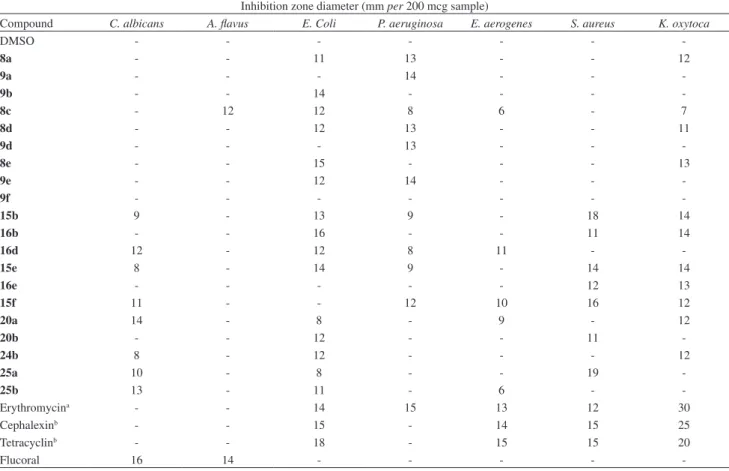
Aspergillus flavus at a concentration 200 µg mL-1 using DMSO as a solvent. DMSO showed no inhibition zone. Erythromycin (Himedia, India, LOT NO.0000008821), Cephalexin (Himedia, India, LOT NO.0000010511), Tetracycline, (Himedia, India, LOT NO.0000014267) and Flucoral were used as reference substances. The results are illustrated in Table 1 as average diameter of inhibition zone in mm.
As shown in the table most of the tested pyrazoles and pyrazolines showed low to moderate activities against E. coli. Against P. aeruginosa the pyrazole derivatives were found to have higher activity than pyrazoline derivatives. It is noticed that only pyrazoline derivatives possess moderate to high activity against S. aureus, and among them the compounds have fluorophenyl group at position 3 of pyrazole or at position 1 of chromeno[3,4-c]pyrazole were more effective than those that have dichlorophenyl group. Also,
Table 1. Antimicrobial screening result of the tested compounds
Inhibition zone diameter (mm per 200 mcg sample)
Compound C. albicans A. flavus E. Coli P. aeruginosa E. aerogenes S. aureus K. oxytoca
DMSO - - -
-8a - - 11 13 - - 12
9a - - - 14 - -
-9b - - 14 - - -
-8c - 12 12 8 6 - 7
8d - - 12 13 - - 11
9d - - - 13 - -
-8e - - 15 - - - 13
9e - - 12 14 - -
-9f - - -
-15b 9 - 13 9 - 18 14
16b - - 16 - - 11 14
16d 12 - 12 8 11 -
-15e 8 - 14 9 - 14 14
16e - - - 12 13
15f 11 - - 12 10 16 12
20a 14 - 8 - 9 - 12
20b - - 12 - - 11
-24b 8 - 12 - - - 12
25a 10 - 8 - - 19
-25b 13 - 11 - 6 -
-Erythromycina - - 14 15 13 12 30
Cephalexinb - - 15 - 14 15 25
Tetracyclinb - - 18 - 15 15 20
Flucoral 16 14 - - - -
the activity against C. albicans and E. aerogenes was noticed for pyrazolines and fused pyrazolines rather than pyrazoles or fused pyraozles. On the other hand, most of the tested pyrazoles and pyrazolines exhibited moderate activity against
K. oxytoca, but it is obvious that among pyrazole derivatives, the active compounds were the fluorinated ones. None of the tested compounds except 8c inhibits the growth of A. flavus. Compound 9f showed no inhibitory effect against any of the tested organisms. It is important to mention that compound
9f is the only pyrazole derivative that have nitro group on phenyl substituent at position 4.
Conclusions
Different pyrazole derivatives, as well as pyrazoline derivatives and their chromenofused derivatives were synthesized, completely characterized and evaluated for their antibacterial and antifungal activities.
The test results have evidenced that the pyrazoline and fused pyrazoline compounds have higher activities than the pyrazole and fused pyrazole ones.
Concerning the substitution in pyrazole 8a, 8c, 8d, 8e,
15b, 15e, 15f and pyrazoline compounds 9a, 9b, 9d, 9e,
9f, 16b, 16e at the phenyl group in 3-position demonstrated that the fluorosubstituted compounds are more effective than the chlorosubstituted analogues, and compound 16d
was exception to this trend.
References
1. Sado, T.; Inoue, A.; Jpn. Kokai Tokkyo Koho90 101 0781990.
(CA 113: 78422k)
2. Bekhit, A. A.; Ashour, H. M. A.; Abdel Ghany, Y. S.; Bekhit, A. E. A.; Baraka, A.; Eur.J. Med. Chem. 2008, 43, 456. 3. Bekhit, A. A.; Abdel-Aziem, T.; Bioorg. Med. Chem. 2004, 12,
1935.
4. Akahane, A.; Kuroda, S.; Itani, I.; Tabuchi, S.; Sato, Y.; Matsuoda, N.; Tada, M.; Matsuka, H.; Oku, T.; Tanaka, A.;
PCT Int. Appl. 69 pp. CODEN: PIXXD2 WO 2001040230 Al
20010607,2001. (CA 135: 33489a).
5. Akahane, A.; Minagawa, M.; Tanaka, A.; (Fujisawa Pharmaceutical Co., Ltd Japan) A. PCT Int. Appl. 63 pp. Pub.
No.: WO 2003045950 A1 2320032002, (CA 138: 24732a).
6. Int. Appl., 34 pp. CODEN: P1XXD2 WO 2002100864 A1
20021219 Designated States, 2002; Takabe, F.; Shibayama,
A.; Yamaguchi, M.; Yamaji, M.; Hanai, R.; Sadohara, H.; Jpn.
Kokai Tokkyo Kono97 59 2761997. (CA 126: 277477a).
7. El-Emary, T. I.; El-Dean, A. M. K; El-Kashef, H. S.; Il Farmaco
1998, 53, 383.
8. El-Kashef, H. S.; El-Emary, T. I.; Gasquet, M.; Timon-David, P.; Maldonado, J.; Vanelle, P.; Pharmazie2000, 55, 572.
9. Korgaokar, S. S.; Patil, P. H.; Shah, M. J; Parekh, H. H.; Indian J. Pharm. Sci.1996, 58, 222.
10. Palaska, E.; Aytemir, M.; Uzbay, IT.; Erol, D.; Eur. J. Med. Chem. 2001, 36, 539.
11. Rajendra, P. Y.; Lakshmana, R. A.; Prasoona, L.; Murali, K.; Ravi, K. P.; Bioorg. Med. Chem. Lett. 2005, 15, 5030. 12. Ozdemir, Z.; Kandilici, H. B.; Gumusel, B.; Calis, U.; Bilgin,
A A.; Eur. J. Med. Chem. 2007, 42, 373.
13. Ruhogluo, O.; Ozdemir, Z.; Calis, U.; Gumusel, B.; Bilgin, A
A.; Arzneimittelforschung2005, 55, 431.
14. Udupi, R. H.; Kushnoor, A. S.; Bhat, A. R.; Indian J. Heterocycl. Chem. 1998, 8, 63.
15. Nauduri, D.; Reddy, G. B.; Chem. Pharm. Bull. (Tokyo)1998,
46, 1254.
16. Taylor, E. C.; Patel, H. H.; Tetrahedron1992, 48, 8089. 17. El-Saghier, A. M. M.; Naili, M. B.; Rammash, B. Kh.; Saleh,
N. A.; Kreddan, K. M.; Arkivoc2007, xvi, 83.
18. Koga, H.; Itoh, A.; Murayama, S.; Suzue, S.; Irikura, T.; J. Med. Chem. 1980, 23, 1358.
19. Wilkinson, J. A.; Chem. Rev. 1992, 92, 505.
20. Wise, R.; Andrews, J. M.; Edwards, L. J.; Antimicrob. Agents Chemother. 1983, 23, 559.
21. Hagen, S. E.; Domagala, J. M.; Heifetz, C. L.; Johnson, J.;
J. Med. Chem. 1991, 34, 1155.
22. Matsumoto, J.; Miyamoto, T.; Minamada, A.; Mishimuna, Y.; Egawa, H.; Nisimira, H.; J. Med. Chem. 1984, 27, 292. 23. Hayakawa, I.; Hiramitsu, T.; Tanaka, Y.; Chem. Pharm. Bull.
(Tokyo), 1984, 32, 4907.
24. Hassaneen, H. M; Shawali, A. S.; Elwaln, N. M.; Abunada, N. M.; Algharib, M. S.; Arch. Pharmacal Res. 1992, 15, 292. 25. Hassaneen, H. M.; Hilal, R. H.; Elwan, N. M.; Harhash, A.;
Shawali, A. S.; J. Heterocycl. Chem.1984, 21, 1013. 26. Hassaneen, H. M.; Mousa, H. A. H.; Shawali, A. S.;
J. Heterocycl. Chem. 1987, 24, 1665.
27. Hassaneen, H. M.; Mousa, H. A. H.; Abed, N. M.; Shawali, A. S.; Heterocycles 1988, 27, 695.
28. Hassaneen, H. M.; Harhash, A. E.; Abunada, N. M.; Abdallah, T. A.; Algharib, M. S.; J. Chem. Res. 1993, 194.
29. Abunada, N. M.; Hassaneen, H. M.; Jordan J. Chem.2008, 3, 1.
30. Hegarty, A. F.; Scott, F. L.; J. Chem. Soc. 1966, 672. 31. Shawali, A. S.; Hassaneen, H. M.; Tetrahedron 1972, 29,
121.
32. Shimizu, T.; Hayashi, Y.; Miki, M.; Teramura, K.; J. Org. Chem.
1985, 50, 904.
33. L’abbe, G. L.; Mathys, G.; J. Heterocycl. Chem. 1974, 11, 613.
34. Abunada, N. M.; Hassaneen, H. M.; Kandile, N. G.; Miqdad, O. A.; Molecules2008, 13, 1501.
36. Jesson, J. P.; Thompson, H. W.; Spectrochim. Acta1958, 13, 217.
37. Thomas, B. H.; Orville-Thomas, W. J.; J. Mol. Struct. 1971, 7, 123.
38. Shimizu, T.; Hayashi, Y.; Nishio, T.; Teramura, K.; Bull. Chem. Soc. Jpn. 1984, 57, 787.
39. Bauer, A. W.; Kirby, W. M. M.; Sgerris, J. C.; Turck, M.;
Am. J. Clin. Path. 1966, 45, 493.
Received: July 21, 2008