0103 - 5053 $6.00+0.00
Article
* e-mail: [email protected]
Two Clerodane Diterpenes and Flavonoids from
Croton brasiliensis
Sebastião F. Palmeira Jr.a, Lucia M. Conserva*,a and Edilberto R. Silveirab
a
Departamento de Química, Universidade Federal de Alagoas, 57072-970 Maceió-AL, Brazil
b
Departamento de Química Orgânica e Inorgânica, Universidade Federal do Ceará, 60021-970 Fortaleza-CE, Brazil
Dois novos diterpenos do tipo clerodano, crotobrasilina A e crotobrasilina B, foram isolados juntamente com quatro 3-metoxiflavonas conhecidas: casticina, penduletina, crisosplenol-D e artemetina, das folhas e caule de Croton brasiliensis. A elucidação estrutural destes compostos foi feita com base na análise dos dados espectroscópicos, especialmente RMN, incluindo técnicas bidimensionais (COSY, HMQC, HMBC e NOESY).
Two new clerodane diterpenes, crotobrasilin A and crotobrasilin B, were isolated in addition to four known 3-methoxyflavones: casticin, penduletin, chrysosplenol-D and artemetin from leaves and stems of Croton brasiliensis. The structural elucidation of these compounds was made on the basis of spectroscopic data analyses, especially NMR, including 2D techniques (COSY, HMQC, HMBC and NOESY).
Keywords:Croton brasiliensis, clerodane diterpenes, 3-methoxyflavones
Introduction
The genus Croton (Euphorbiaceae), which comprises
about 700 species, is widely distributed in all regions of Brazil.1 Many of these species are known in the Brazilian
Northeast region as ‘capixingui’ and ‘marmeleiro’1 and
have been used in folk medicine for a large number of applications.2 Previous phytochemical investigations
show that this genus possess alkaloids,2 flavonoids,3-6
triterpenoids,4,7,8 and a large number of diterpenoids.5,6,9-11
In this paper, we report the isolation and structural elucidation of two new clerodane diterpenes and four known 3-methoxyflavones from leaves and stems of C. brasiliensis Mull. Arg.
Results and Discussion
The dichloromethane extracts from leaves and stems of C. brasiliensis after chromatography fractionation and
recrystallizations afforded two clerodane diterpenes (1-2)
in addition to four known 3-methoxyflavones (3-6).
Compound 1, isolated as a white amorphous powder,
mp 198.5-201.4 °C, by EIMS showed a molecular ion at
Croton brasiliensis
suggested C23H28O7 as the molecular formula, in accordance with the observed molecular weight. The FT– IR spectrum indicated the presence of ester and lactone carbonyls (1734 cm-1), β-substituted furan ring (1490 and
816 cm-1), and double bond (1665 cm-1). The 13C NMR
spectra (CPD, DEPT and HMQC) showed 23 carbon signals (four methyls, four methylenes, eight methines, and seven non-hydrogenated), consistent with substi-tuted diterpene skeleton. The NMR spectra, including
1H-1H COSY, NOESY, HMQC and HMBC, showed signals
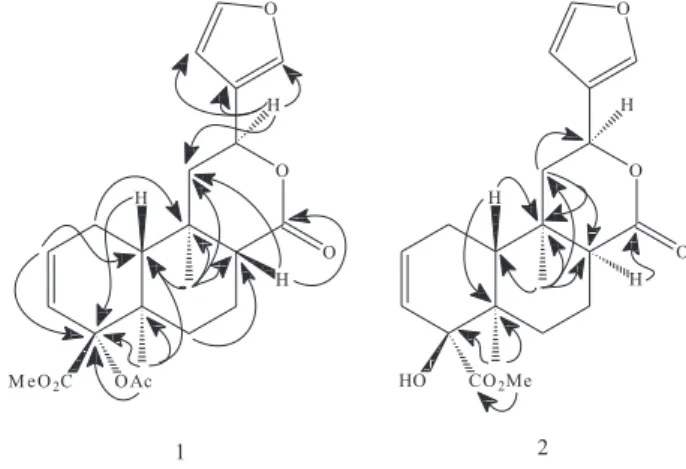
for a cis-disubstituted double bond [δH 5.81 (m, H-2) and 6.40 (d, J 10.3 Hz, H-3); δC 131.1 (C-2) and 125.9 (C-3)], a β-substituted furan ring [δH 6.21 (br s, H-14), 7.15 (br s, H-16) and 7.16 (br s, H-15); δC 109.4 14), 126.7 (C-13), 139.9 (C-16) and 144.0 (C-15)], two angular methyl groups [δH 0.80 (s,Me-20) and 1.13 (s, Me-19); δC 15.6 (Me-20) and 16.8 (Me-19)], a carbonyl methyl ester group [δH 3.49 (s,OMe); δC 52.4 (OMe) and 170.6 (C-18)], and signals for an acetyl group [δH 1.80 (s); δC 21.4 and 170.3], whose correlations observed in the HMBC spectrum (Figure 1), specially for H-6ax (δ 1.37), H-10 (δ 1.94), and Me-19 (δ 1.13) with C-4 (δ 87.8) defined its position in this carbon. Moreover, also were observed signals for sp3
oxymethine carbon [δH 5.06 (dd, J 5.1 and 11.6 Hz,
H-12); δC 71.7 (C-12)], which chemical shifts and multiplicities are characteristic of hydrogen attached to a carbon involved in a δ-lactone moiety [δC 171.0 (C-17)]. Correlations observed in the HMBC spectrum (Figure 1) between H-12 (δ 5.06) and C-13 (δ 126.7), C-14 (δ 109.4), and C-16 (δ 139.9) evidenced the relationship between the furan ring and δ-lactone moiety. The remaining NMR data showed characteristic chemical shifts for two methines, four methylenes, and three non-hydrogenated carbons (Table 1). Thus, on the basis in the evidence of the spectral data and comparison with those reported for cordatin (7) and epi-cordatine
(8), two β-furan clerodane diterpenes isolated from
Aparisthmium cordatum12 and Burasia madagas-carensis,13 respectively, structure of a β-furan clerodane diterpene was proposed.
NOESY experiment deduced the relative configurations at asymmetric centers (Figure 2). Dipolar-dipolar correla-tions between H-12 (δ 5.06) and Me-20 (δ 0.80), and this later with Me-19 (δ 1.13), as well as for H-6ax (δ 1.37) and H-8 (δ 1.73) with H-10 (δ 1.94) demonstrated a 1,3-cis
relationship among these hydrogens and suggested that 1
have A/B and B/C trans ring junctions. These relative
configurations were also supported by comparison of the NMR data of 1, exactly when recorded also in CDCl3, with
those of 7, whose structure was determined by X-rays
diffraction analysis and possessA/B trans and B/C cis
ring junctions. In particular, compound 1 exhibited
significant differences in the chemical shifts of C-8, C-11, and C-17 and showed signals for H-8, H-10 and H-11 at upfield (Table 1). These differences in the chemical shifts these hydrogens can be explained if ring C to adopt a skew-boat conformation, with the ring furan in β -equa-torial. Thus, compound 1, named here crotobrasilin A,was
proposed to be the (5R,8R,9R,10R)-4R-acetoxy-15,16-epoxy-neo
-cleroda-2,13(16),14-trien-17,12S-olide-18-oate methyl.
Compound 2 was isolated as yellowish oil, in a
mixture with 1. Due to the small quantity of the mixture,
we have not attempted to separate both compounds in order to avoid any loss of material. However, its NMR data were discernable since furnished different intensities of the signals for both compounds [ratio 2.5:1 (2): (1)].
So, all assignments of the chemical shifts for 2 were
inferred (Table 1). In a similar way that compound 1, the
NMR spectral data of 2 also showed signals for a β -substituted furan ring [δH 6.48 (br s, 14), 7.47 (br s, H-15) and 7.53 (br s, H-16); δC 109.9 (C-14), 125.2 (C-13), 141.0 (C-16) and 144.9 (C-15)], a cis-disubstituted
double bond [δH 5.99 (m, H-2) and 5.37 (d, J 9.4 Hz, H-Figure 1. Selected HMBC correlations for 1 and 2.
3); δC 131.4 (C-2) and 129.7 (C-3)], two angular methyl groups [δH 1.16 (s, Me-19) and 1.39 (s,Me-20); δC 16.1 (Me-19) and 25.8 (Me-20)], a carbonyl methyl ester [δH
3.85 (s); δC 54.8 (OMe) and 177.3 (C-18)], a δ-lactone [δH
5.31 (dd, J 5.5 and 13.5 Hz); δC 71.2 and 175.3], besides
signals for two methines, four methylenes, and three non-hydrogenated carbons. The 13C NMR spectra (CPD, DEPT
and HMQC) displayed 21 carbon signals assignable to three methyls, four methylenes, eight methines, and five non-hydrogenated carbons. In the general mode, the NMR spectral data of 2 were closely similar to those of 1, except
for the absence of the signals for an acetyl group, which was replaced by a hydroxyl group [1: δC 87.8 (C-4) and 2: δC 82.1 (C-4)], suggesting that 2 may be the
4-deacetyl-derivative. In fact, the deacetylation to yield the hydroxyl group caused the expected upfield shift of the C-4 (∆δ = -5.7 ppm). Extensive use of NMR techniques, including
1H-1H COSY, HMQC, and HMBC (Figure 1), supported
the unambiguous assignments of all 1H and 13C shift
values (Table 1).
Although some of the NMR assignments of cordatin (7)12 must be revised, comparison of the 13C NMR data of 2
with those of 7 were very similar, except for the chemical
shifts of the C-3 (2: δC 129.7; 7: δC 123.2, value interchanged in the paper with C-2) and C-18 (2: δC 177.3;
7: δC 173.7), suggesting that two compounds are epimers at C-4. However, when compared with those of epi
-cordatine (8),13 which possess A/B and B/C cis ring
junctions, revealed that the two compounds are not identical since differences in the chemical shifts of the several carbons were observed (Table 1). Therefore, compound 2 was proposed to be the
(5R,8S,9R,10R)-4S-hydroxy-15,16-epoxy-neo
-cleroda-2,13(16),14-trien-17,12S-olide-18-oate methyl, a clerodane diterpene with A/B trans and B/C cis ring junctions, named here
crotobrasilin B.
Several structurally distinct clerodane-type diterpenes have been found in Croton species, but to our knowledge,
this is the first report of the occurrence of crotobrasilin A and crotobrasilin B from natural sources.
The IR, 1H and 13C NMR spectral data for casticin
(3),14,15 peduletin(4),14 artemetin(5)16 and
chrysosplenol-D (6)16 were in accordance with those reported in the
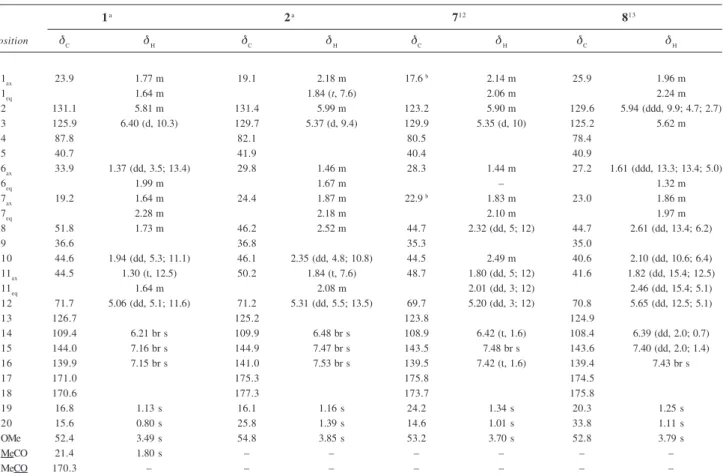
literature. Several structural types of flavonoids have been Table 1. NMR data (1H: 500; 13C: 125 MHz, J in Hz) for compounds 1 (C
6D6), 2 (CDCl3), and the models 7 and 8 (CDCl3)
1a 2a 712 813
Position δC δH δC δH δC δH δC δH
1ax 23.9 1.77 m 19.1 2.18 m 17.6 b 2.14 m 25.9 1.96 m
1eq 1.64 m 1.84 (t, 7.6) 2.06 m 2.24 m
2 131.1 5.81 m 131.4 5.99 m 123.2 5.90 m 129.6 5.94 (ddd, 9.9; 4.7; 2.7)
3 125.9 6.40 (d, 10.3) 129.7 5.37 (d, 9.4) 129.9 5.35 (d, 10) 125.2 5.62 m
4 87.8 82.1 80.5 78.4
5 40.7 41.9 40.4 40.9
6ax 33.9 1.37 (dd, 3.5; 13.4) 29.8 1.46 m 28.3 1.44 m 27.2 1.61(ddd, 13.3; 13.4; 5.0)
6eq 1.99 m 1.67 m – 1.32 m
7ax 19.2 1.64 m 24.4 1.87 m 22.9 b 1.83 m 23.0 1.86 m
7eq 2.28 m 2.18 m 2.10 m 1.97 m
8 51.8 1.73 m 46.2 2.52 m 44.7 2.32 (dd, 5; 12) 44.7 2.61 (dd, 13.4; 6.2)
9 36.6 36.8 35.3 35.0
10 44.6 1.94 (dd, 5.3; 11.1) 46.1 2.35 (dd, 4.8; 10.8) 44.5 2.49 m 40.6 2.10 (dd, 10.6; 6.4) 11ax 44.5 1.30 (t, 12.5) 50.2 1.84 (t, 7.6) 48.7 1.80 (dd, 5; 12) 41.6 1.82 (dd, 15.4; 12.5)
11eq 1.64 m 2.08 m 2.01 (dd, 3; 12) 2.46 (dd, 15.4; 5.1)
12 71.7 5.06 (dd, 5.1; 11.6) 71.2 5.31 (dd, 5.5; 13.5) 69.7 5.20 (dd, 3; 12) 70.8 5.65 (dd, 12.5; 5.1)
13 126.7 125.2 123.8 124.9
14 109.4 6.21 br s 109.9 6.48 br s 108.9 6.42 (t, 1.6) 108.4 6.39 (dd, 2.0; 0.7)
15 144.0 7.16 br s 144.9 7.47 br s 143.5 7.48 br s 143.6 7.40 (dd, 2.0; 1.4)
16 139.9 7.15 br s 141.0 7.53 br s 139.5 7.42 (t, 1.6) 139.4 7.43 br s
17 171.0 175.3 175.8 174.5
18 170.6 177.3 173.7 175.8
19 16.8 1.13 s 16.1 1.16 s 24.2 1.34 s 20.3 1.25 s
20 15.6 0.80 s 25.8 1.39 s 14.6 1.01 s 33.8 1.11 s
OMe 52.4 3.49 s 54.8 3.85 s 53.2 3.70 s 52.8 3.79 s
MeCO 21.4 1.80 s – – – – – –
MeCO 170.3 – – – – – – –
Croton brasiliensis
reported from Croton species.3-6 However, all the
3-methoxyflavones related in this work are described for the first time in this genus.
Experimental
Instrumental and chromatography materials
The melting point was measured using an MQAPF-302 apparatus and is uncorrected. Optical rotation was measured on a Perkin-Elmer 341 polarimeter. The NMR spectra were recorded either on a Bruker DRX-500 or Mercury-Varian 200 operating at 500 and 200 MHz, respectively, for 1H and 125 and 50.3 MHz, respectively,
for 13C, in C
6D6 or CDCl3, and DMSO-d6 solutions with
TMS as internal standard. IR spectra were obtained on a FT-IR 1750 Perkin-Elmer spectrometer. EIMS were measured at 70 eV on a HP 5990/5988A spectrometer. Silica gel (70-230 and 230-400 mesh, Merck) and Sephadex LH-20 (Pharmacia) were used for column chromatography separations.
Plant material
The leaves and stems of C. brasiliensis Mull. Arg. (syn. C. polyandrus Spreng) were collected in November 1999,
in the Área de Proteção Ambiental de Santa Rita (Mucuri), Marechal Deodoro, Alagoas, Brazil, and was identified by Rosangela P. de Lyra Lemos of the Departamento de Botânica do Instituto do Meio Ambiente do Estado de Alagoas (IMA-AL), where a voucher specimen was deposited (MAC-10752).
Extraction and isolation of the constituents
The air-dried and powdered leaves (1300 g) and stems (900 g) were extracted with acetone followed by 90% EtOH at room temperature. The crude extracts [leaves: acetone (142.8 g); stems: acetone (23.9 g) and EtOH (16.2 g)] were suspended in MeOH-H2O (3:2) solution and extracted successively with C6H14, CH2Cl2 and EtOAc. The CH2Cl2 residue of the acetone extract from leaves (16.7 g) was filtrated on silica gel with C6H14-CH2Cl2 1:1 (7.3 g, A), CH2Cl2 (0.9 g, B), CH2Cl2-EtOAc 1:1 (2.9 g, C), EtOAc (1.06 g, D) and MeOH (1.51 g, E). Fractions A (7.3 g), B (0.9 g) and C (2.9 g) were chromatographed on silica gel column using C6H14 with increasing amounts of CH2Cl2. The subfractions obtained after gel permeation on Sephadex LH-20 (MeOH) and successive recrystallizations from MeOH afforded 1 (33 mg), 3 (21
mg), 4 (40 mg), and 5 (108 mg).
The CH2Cl2 residues from stems (5.0 g) were submitted to silica gel filtration with C6H14-CH2Cl2 1:1 (1.2 g, A), CH2Cl2 (1.21 g, B), CH2Cl2-EtOAc 9:1 (0.94 g, C), EtOAc (1.35 g, D) and MeOH (0.08 g, E). Fraction A (1.2 g), after gel permeation on Sephadex LH-20 (MeOH) and successive recrystallizations from MeOH, afforded a mixture 2.5:1 containing 1 and 2 (16 mg), and 6 (18 mg).
(5R,8R,9R,10R)-4R-Acetoxy-15,16-epoxy-neo-cleroda-2,13(16),14-trien-17,12S-olide-18-oatemethyl ( Croto-brasilin A, 1)
White amorphous powder, mp 198.5-201.4 °C; [α]D20 +
25.1° (CHCl3, c 0.0052). IR (KBr) νmax/cm-1: 2953, 1734,
1665, 1490, 1450, 1374, 1267, 1134, 1076, 1020, 876, 816, 785; EIMS, 70 eV m/z (rel. int.): 416 [M](2), 401
(M-CH3, 2), 357 (M-OAc, 10), 374 (M-C2H2O, 3), 342 (M-C3H6O2, 2), 315 (100), 297 (5), 247 (3), 203 (10), 153 (20), 121 (10), 105 (21), 91 (22); 1H (500 MHz) and 13C
(125 MHz, C6D6) NMR spectra (see Table 1).
(5R,8S,9R,10R)-4S-Hydroxy-15,16-epoxy-neo-cleroda-2,13(16),14-trien-17,12S-olide-18-oate methyl ( Croto-brasilin B, 2).
Yellowish oil. 1H (500 MHz) and 13C (125 MHz, CDCl 3)
NMR data are given in Table 1.
Acknowledgments
The authors are grateful to FAPEAL, CNPq, and Ministério da Ciência e Tecnologia-Instituto do Milênio do Semi-Árido (MCT-IMSEAR) for financial support and research fellowships, to Vicente Carlos C. de Oliveira (LTF, Universidade Federal da Paraíba), Daniel Esdras de Andrade Uchoa (CENAUREMN, Universidade Federal do Ceará), and Dr Daniela F. Navarro (Depto Química, Universidade Federal de Pernambuco) for the NMR and MS spectra.
References
1. Schultz, A.R.H.; Introdução à Botânica Sistemática, 4ª ed.,
Editora da Universidade: Porto Alegre, 1984.
2. Farnsworth, N.R.; Blomster, R.N.; Messmer, W.M.; King, J.C.; Persinos, G.J.; Wilkes, J.D.; Lloydia 1969, 32, 1.
3. Peres, M.T.L.P.; Monache, F.D.; Cruz, A.B.; Pizzolatti, M.G.; Yunes, R.A.; J. Ethnopharmacol. 1997, 56, 223.
5. Graikou, K.; Aligiannis, N.; Skaltsounis, A.L.; Chinou, I.; Michel, S.; Tillequin, F.; Litaudon, M.; J. Nat. Prod. 2004, 67,
685.
6. Guadarrama, A.B.A.; Rios, M.Y.; J. Nat. Prod. 2004, 67, 914.
7. Peres, M.T.L.P.; Monache, F.D.; Pizzolatti, M.G.; Santos, A.R.S.; Beirith, A.; Calixto, J.B.; Yunes, R.A.; Phytother. Res. 1998, 12, 209.
8. Barbosa, P.R.; Fascio, M.; Martins, D.; Guedes, M.L.S.; Roque, N.F.; Biochem. Syst. Ecol. 2003, 31, 307.
9. McChesney, J.D.; Silveira, E.R.; Fitoterapia 1990, 61, 172.
10. El Mekkawy, S.; Meselhy, M.R.; Nakamura, N.; Hattori, M.; Kawahata, T.; Otake, T.; Phytochemistry 2000, 53, 457.
11. Giang, P. M.; Son, P.T.; Lee, J.J.; Otsuka, H.; Chem. Pharm. Bull. 2004, 52, 879.
12. Dadoun, H.; Mueller, A.H.; Cesário, M.; Guilhem, J.; Pascard, C.; Phytochemistry 1987, 26, 2108.
13. Mambu, L.; Ramanandraibe, V.; Martin, M.T.; Blond, A.; Grellier, P.; Frappier, F.; Planta Med. 2002, 68, 377.
14. Wang, Y.; Hamburger, M.; Gueho, J.; Hostettemann, K.;
Phytochemistry1989, 28, 2323.
15. Sharaf, M.; Mansour, R.M.A.; Saleh, N.A.N.; Biochem. Syst. Ecol.1992, 20, 443.
16. Agrawal, P.K.; Thakur, R.S.; Bansal, M.C. In Carbon-13 NMR of Flavonoids; Agrawal, P.K., ed., Elsevier: New York, 1989,
ch. 3.