X-ray and Neutron Emission Studies in a
New Filippov Type Plasma Fous
A.R.Babazadeh 1;2
, M.V. Roshan 2
, H. Habibi 2
, A. Nasiry 2
, M.Memarzadeh 2
,
A. Banoushi 1;2
, M. Lamehi 2
,and S.M. Sadat Kiai 1;2
1
TehnialUniversityofAmirkabir,
Depatmentof Physis,Tehran15875-4413.
2
NulearFusionResearhCenter,A.E.O.I,
P.O.Box14155-1339,Tehran,Iran
Reeivedon26June,2001
Wehaveperformedexperimentalomparativestudiesofthex-rayandneutronemissiongenerated
bythenewFilippov-typeplasmafous\Dena",(90kJ,25kV,288F)inthepressurerangeof0.6-1
torr. Time-integratedand time-resolveddetetors, togetherwithanx-raypin-hole amera,along
withaBelterof10mthiknesshavebeenused.Foraworkinggasofneonandaatinsertanode,
themaximumsoftandhardx-rays(SXR-HXR)yieldobtainedwas16Vand1.5V/shotovera4
solidangle,respetively,forahargingvoltagerangeof16-20kV.Asfortheargongas,thesimilar
resultssuhas3.5and 2V/shothavebeenfound,leadingtoatotal onversioneÆienyofx-ray
emissionof0.09%(forneon)and 0.03%(forargon)ofthestoredenergy. TheseeÆienieshave
beenimprovedbytheemploymentofaoniinsertanodeupto0.4%and0.1%. Withdeuterium
puÆnggas and aatinsert anode,the maximumemission yieldhas beenfound to be 2.5 V for
SXRand 1Vfor HXR/shotwhihprodueanultimateemissionprolewidth(FWHM)of70-90
nsforx-raysandneutrons,givingrisetoamaximumneutronyieldof1:210 9
. Nevertheless,the
maximumyieldhasbeeninreasedupto5.5timeswiththeoniinsertanode. Inordertoinrease
theneutronyield,wehaveintroduedakryptonadmixturetothedeuteriumllinggasandfound
that,forakryptonpressureofabout0.1 torr,theneutronyieldinreasesbyafatorof3.5forthe
atinsertand1.5fortheoniinsertanodes.
I Introdution
Sine itsdevelopment in the1960's, the plasmafous
dishargeisreognizedasapowerfulandexellent
de-vieintheprodutionofthreeprinipalkindsof
radia-tion, suh asfastneutronsproeedingfrom deuterium
nulear fusion reations, intense x rays, oming from
dierent lling gasesand the anodes in the disharge
hamber and, energeti harged partiles suh as ions
andeletrons.
Regarding the need to improvethe harateristis
ofthese radiations,inreentyearstherehasbeen
on-siderable eortin developingand enhaningthe basi
mehanisms of the phenomena related to the plasma
fousfailities. Forthispurpose, therearemany
inde-pendent laboratory works published in the literature,
someofwhih wewillbeonsideredhere.
In2000,Castilloetal. [1℄investigatedthepossible
oexistene of thermal and non thermal mehanisms
throughmeasurementoftheneutronyield,in
ompar-soft and hard x-ray radiations. The paper onluded
thatthereisaoexisteneofbothmehanisms
ompet-ingfortheneutronyieldintheirplasmafousdevie.
Bostiketal. [2℄onsideredtheorrelationsbetween
ionbeamintensity,whihisdependentonthedisharge
gaspressure,andneutronyield, and hardx-ray
inten-sity. They found that the maximum radiation of ion
beam and the related neutron yield inrease with the
hardx-rayintensity.
The x-rayemission from plasma fous devies was
reportedbyHarrieset al. [3℄. Theystated thatx-rays
withlowandhighenergyoriginatebothintheplasma
andontheanodesurfae,respetively.
Heroldetal. [4℄workedonthegeometryand
stru-tureoftheinnerandoutereletrodes,thematerialand
ongurationof theinsulator. Their paper pointsout
thatthesputteredmaterialfromtheeletrodethatgets
intotheurrentsheath,produesplasmaimpurity
on-taminationand onsequentlyresultsin adeterioration
the anodes erosion was investigated by Routel et al.
[5℄. Theyshowedthattheneutronyieldobtainedwhen
usingatungsten-opperalloyanodewasalmosttwie
asmuhasforanaluminumanode.
Zakaullahetal. [6℄employeddierentanodeshapes
with argon llinggas and reported that the radiation
yieldandthegaspressureneededforgoodfousingare
foundtobestronglydependentontheanodeshape.
Severalresearhworkshavebeendevotedto
inves-tigatetheeetofgasadmixtureonthebehaviorofthe
fousedplasma[7-10℄. Morereently,Babazadehetal.
[11℄workedonanexperimentalstudyofx-rayradiation
yield in anew Filippov-type plasma fous (25 kV, 90
kJ)operatedwithlowpressureneonandneon-krypton
admixturegases. Theresult oftheirinvestigationwas
that the krypton admixture gas generally auses the
softx-ray yieldto derease down to zero,whereasthe
hardx-ray emissionyieldattains amaximumvalueat
theoptimumpressureofkryptongas.
This work seekstond outiftheplasmaradiation
intensityvarieswithanodeshapeandthetypeofgases
used. Inthisonnetion,oneoftheobjetivesisto
mea-surethe intensity ofthe softand hard x-raytogether,
aswellastheneutronyield.
In thisartile wefousourattentiononthe useof
twotypesofinsertanodes,i.e. atoroni,with
dier-entgivengasesto evaluateaomparativestudyofthe
radiatedintensities. Theeeton radiationofusing a
kryptonadmixture in the deuterium lling gasis also
onsidered.
II Experimental setup
Theexperimentshavebeenperformedin the new
Fil-ippov type \DENA" plasma fous system, with a so
alled at geometry of eletrodes, whih provides an
opportunitytovarytheoperatingdishargeonditions
onalargesale(forFilippovtypeplasmafousseefor
example[12-13℄). Thedishargeispoweredbya288F
apaitorbank, at operatingvoltagesupto25 kV(90
kJ),givingapeak disharge urrentofabout2.8MA.
Fig. 1 shows the eletrodes assembly of the plasma
fous system. The spark gap is used at a pressureof
about 1:210 2
torr, to transfer the harge through
the transmissionlines of 18 nH indutane, to the
fo-usanode,This sparkgaphasalowindutane0.2
nH whih we ignore, asompared to the total
indu-tane of the system; 23 nH inluding 2 nH from the
apaitor bank and 3nH from the disharge hamber
indutane. The disharge urrent rise time is about
2.8 s, with aneetive impedaneof 910 3
Ohm.
Theanodeisplaedattheenterofthevauum
ham-ber. It isa disof 50 m diameter and 15.5m high,
madeofopper,andatitsenter,thereisaoniinsert
anodemadeofopper-tungstenalloy,thatanbeeasily
replaed. Theanodeissurroundedbyaathodemade
of stainless steel of 71.5m inner diameter, insulated
from the anode by porelain with a height of 12 m,
andadiameterof48m.
The disharge urrent and its derivative are
mea-suredbyaRogowskioilwith1115turnsandaoilwith
20 turns, respetively. A magneti probe, loated on
thesideoftheathoderingmonitorstheurrentsheath
strutureduring therundownphaseoftheplasma
dis-harge. Thetime-resolved softx-rayemission is
mea-suredbyaPINdiode(SPPDtype)witha10mthik
berylliumlter,inordertominimizetheeetofvisible
lightoftheplasma. This detetorisloatedona
side-on position at 90 Æ
from the axis. Thetime-integrated
softx-rayimagesof theplasmaolumn were obtained
with a pinhole amera with a small 10-100 m
aper-ture. The time-integrated measurement of hard x-ray
intensity wasregistered bya NaI- sintillator oupled
to aphoto elementoaxial(PhEC)detetor plaedon
top of the devie. The time-resolved hard x-ray and
neutron emission was measured by a photomultiplier
(PM-53 type) oupled to a NE-102 plasti sintillator
with a 5 ns resolution. A Geiger-Muller ounter
ov-eredbyanindiumfoil,with 0.23mm thiknessplaed
in apolyethylene moderator; measures the numberof
neutrons. We havealso used time-integrated
thermo-luminesent(TLD)dosimeters,madeofLiF,tomonitor
thehardx-rayemissions.
A four-hannel omputer with exeuting data
a-quisitionsystemtogetherwithtwoGPIBosillosopes,
withamaximumresolutionof5nsforeahhannelare
responsibleforsignalaquisition.
III Results and disussion
For the purpose of a omparative study, we onsider
rst, the x-ray emissionfor the twoinsertanode
on-gurations with neon and argonlling gases. For the
disharges, the working gas pressure, inluding
deu-terium,rangesfrom0.6to1.0torr,usingharging
volt-ages between 16 to 20 kV. For eah seleted voltage,
we have registered the optimum gas pressure related
tothemaximumx-rayemissionsandusedthemin the
experiments. Inordertoreduetheeetofplasma
im-purities ontamination,the hamberwaspumped out
18
7
8
5
6
11
13
4
17
15
3
10
9
12
1
16
14
1. Upper flange of the vacuum cha
2. Capacit
or energy storage
3. Porcelain insulator
4. Anode
5. Ring-like spark gap switch
6. Collector plate
7. Insulation
8. Matching inductance
9. Liner
10.
Rogowski
coil
11. Magnetic probe
12. Pinhole camera
13. SXR detector (SPPD-type)
14. Detector-monitor of i
ntegral
HXR(PhEC)
15. Scintillation detector with m
16. Detector of integral neutron
17. Plasma-current sheath
18.
conic
insert anode
2
6.9cm
7.5cm
2cm
60
6cm
Conic insert anode
Figure1. Ashematidiagramshowing theplasmafouseletrodesanddiagnostis.
Time (
1
µ
sec/div)
(5
V/div)
(5
V/div)
Figure2.Atypialosillosopesignalusingdeuteriumling
gas with aatanode showing four simultaneous
measure-ments(from top to bottom): soft x-ray pulse, hardx-ray
and neutron pulses, total disharge urrent and the total
urrentderivative.
obtained from deuterium lling gas. This gure
dis-plays signals of the soft x-ray, hard x-ray and
neu-tron emissions from the PIN diode and
sintillator-photomultiplier detetor, respetively, the total
dis-hargeurrentfromtheRogowskioil,andtheurrent
derivative(dI/dt). Fromthe urrentderivativesignal,
the existene of zones with suÆient width for time
measurementsofthefouspinhdurationanbenoted.
Itis generallyaeptedthat the negativepeakof
ur-rentderivativetime,orrespondstotheminimumpinh
diameter[14℄. Fromonsiderationoftheorresponding
streakphotographofapinh (seeforexample[15℄), it
isprobablypossibleto assoiatetwotimezonesin the
dI/dt signal. The rst time zone orresponds to the
beginningof thepinh, whendI/dt ismaximum,until
dI/dt= 0. Inthis region thediameter ofthe pinh is
fairlyonstant. Theseondtimezone isfrom dI/dt=
0untiltheappearaneofthespikeinthedisharge
ur-rent. Fromthistimeon,aburstinthepinh,ausesa
suddeninreaseinitsdiameter.
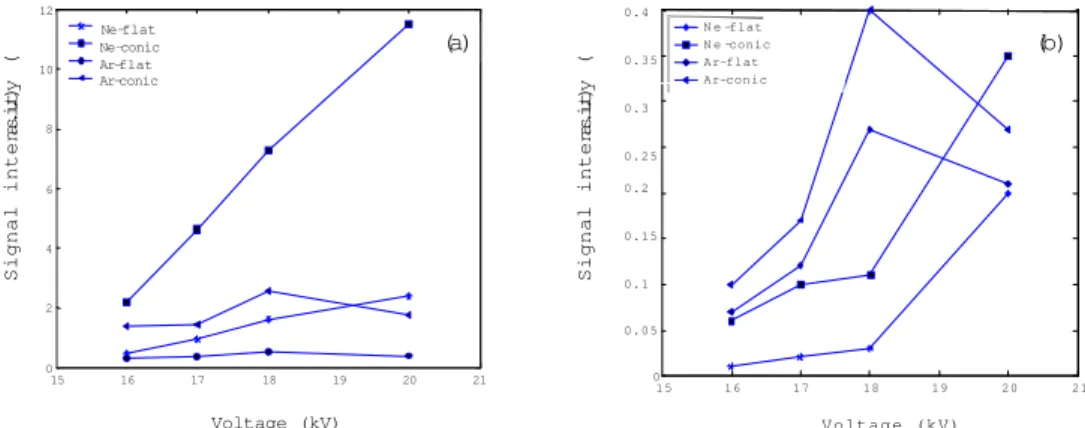
We havedisplayed in Fig.3 the experimental
mea-surementsofthesoftandhardx-rayintensitiesagainst
thedierentdishargevoltages. Inthisexperimentat
andoniinsertanodeswereusedwithneonandargon
signiant inrease in the values of the soft x-ray
in-tensitiesisobservedfrombothgaseswiththeoni
in-sertanode. Wehaveobtainedmaximumvaluesofsoft
andhardx-rayyieldsabout16Vand1.5V/shotin 4
geometry, respetively, with the at insertanode and
neonworkinggas. Forargonllinggasthesevaluesare
3.5V and 2V/shot, respetively. The results obtained
indiate a total onversioneÆieny of x-ray yield of
about0.09 % (forneonat 20 kV)and 0.03% (for
ar-gon at 18 kV) of the disharge stored energy. These
eÆienies havebeen improved bythe employmentof
the oni insertanodeup to 0.4% (forneon)and 0.1
% (forargon).
The present investigation onrms the important
fat that theshapeand thematerial ofthe anode has
signianteet ontheprodution ofx-rayemissions.
However,withtheneonandargongaseswehavefound
a maximum inrement fator of about 5 for the soft
x-ray intensity with oni anode, as ompared to the
resultsusingtheatinsertanode. Theequivalent
om-parisonforthehardx-raysis1.5.
15
16
17
18
19
20
21
0
0.05
0.1
0.15
0.2
0.25
0.3
0.35
0.4
N e -flat
N e -conic
Ar-flat
Ar-conic
Voltage (kV)
15
16
17
18
19
20
21
0
2
4
6
8
10
12
Ne-flat
Ne-conic
Ar-flat
Ar-conic
Voltage (kV)
(b)
(a)
Signal intensity (
a.u
.)
Signal intensity (
a.u
.)
Figure3. (a)SoftX-rayand(b)hardX-raysignalintensitiesagainstthedishargevoltagesfromneonandargonllinggases
withthetwoanodeongurations.
Fig. 4showstwosoft x-raypin-hole images ofthe
fous plasma for neon lling gas, but dierent insert
anodes;(a)atanode,and(b)oniinsertanode. Fig.
4(b) learlyindiatesawideremittingregion dueto a
betterpinh ofthefousplasma.
a
b
Figure4. TimeintegratedpinholeimagesofsoftX-ray
emis-sionfromneonfous with(a)at,and(b)onianodes.
Inmorereentwork,wehavestudied thebehavior
of theneutronyield throughan experimentsimilar to
thepreviousone,exeptinonease,wehaveexamined
theeetofkryptonadmixturegasontheneutronand
x-rayemissions. In thisstudy, rstwehaveusedonly
thesoftandhardx-rayintensities. Wehavefound
max-imumvaluesof2.5 V/shotforsoftx-raysand1V/shot
for hard x-raysovera 4 solid angle, and ameasured
maximumneutronyieldof1:210 9
.
The neutron yield was measured using a
Geiger-Mullerounteroveredbyanindiumfoilwith0.23mm
thiknesswhih was alibratedby aCf standard
neu-tronsoure. Theneutronyieldenhanementhasbeen
improvedbyafatorof5.5usingaoniinsertanode.
However,anultimateemission prolewidth (FWHM)
of 70-90 ns was measured for the x-ray and neutron
emissions. Fig. 2 shows the neutron pulse appeares
50 ns after thehard x-ray signal, asmeasured by the
plasti sintillator-photomultiplier detetor. This
de-lay timeorrespondsto thetimeof ightof2.45MeV
neutrons from the outgoingdisharge to the
sintilla-tor. The eet of gas admixture on the intensities of
the soft x-ray, hard x-ray and neutron emissions was
studied byadding0.1torrof kryptongas. Theresults
obtainedwiththeatinsertanodearepresentedinFig.
5. Theintensitiesofsoftandhardx-rayswereinreased
with thekryptonadmixture, nevertheless, thehard
forhardx-rayand1.5 forsoftx-rayintensities. Fig. 6
presents thesoft x-raypin-hole images; (a) only
deu-terium, and(b)deuteriumkryptonadmixture.
15
16
17
18
19
20
21
0
0.2
0.4
0.6
0.8
1
1.2
1.4
D
2
-soft
D
2
-hard
D
2
+Kr-hard
D
2
+Kr-soft
Signal inten
sity(a.u.)
Voltage (kV)
Figure 5. Soft and hard X-ray signal intensities against
disharge voltages fromdeuteriumand deuterium-krypton
admixturewithatanode.
a
b
Figure6.TimeintegratedpinholeimagesofsoftX-ray
emis-sionfrom(a)deuterium(b)deuterium-kryptonadmixture.
Finally,regardingtheneutronyield,theeetofthe
krypton admixturegas produed aninrease fatorof
3.5 (at anode) and 1.5 (oni anode). Fig. 7 shows
theneutronyieldversusdishargevoltages
orrespond-ingtothedeuterium anddeuterium-kryptonwithtwo
anodeongurations.
15
16
17
18
19
20
21
0
1
2
3
4
5
6
7
8
9
10
D
2
-flat
D
2
-conic
D
2
+Kr-flat
D
2
+Kr-conic
Voltage (kV)
Neutron yield (
×
10
9
)
Figure 7. Neutronemission versus the disharge voltages
fromdeuteriumanddeuterium-kryptonadmixturewiththe
twoanodeongurations.
IV Conlusions
Comprehensive plasma emissions by means of
dier-ent anode shapes, working gases, gas admixtures and
disharge voltages, whih have been disussed in
re-entyears,ouldbeeasilyinvestigatedexperimentally
inthisworkonthebehaviorofthefousplasma. With
thehelp of softand hardx-rayand theneutron
emis-sionsfromneon,argonanddeuteriumllinggases,one
isabletoobtainsomeimportantinformationaboutthe
plasmaradiationyieldphenomena.
Studiesofthesoftx-raysfromtheseworkinggases,
with the employment of a oni anode in a new
Filippov-type plasma fous devie, have revealed the
fatthatthesignalintensitiesshowhigheryield
perfor-manes(with respet to the at anode), ompared to
thehardx-rayintensities.
Theadditionofkryptonadmixturetothedeuterium
working gas, in the ase of a at insert anode, also
inreased the maximum yield of the soft and hard
x-ray emissions. Nevertheless, this inrement is muh
higher for the hard x-ray signals. However, we ould
notahievethismaximumyieldfortheoniinsert
an-ode,beausethedeuteriumpressurewaslow(lessthan
1torr),thismightbethesubjetoffuturestudy.
The eet of krypton admixture to the deuterium
llinggashasalsoenhanedtheneutronyieldbya
fa-torofabout3.5fortheaseofaatanodeand1.5for
aoniinsertanode.
Referenes
[1℄ F.Castillo, M.Milanese, R.Moroso andJ. Pouzo, J.
Phys.D:Appl. Phys.33,141(2000).
[2℄ W.H. Bostik, H. Kili, V.Nardi and C.W. Powell,
Nul.Fusion33,413(1993).
[3℄ W.L.Harries,J.H.LeeandD.R.MFarland,Plasma
Phys.20,95(1978).
[4℄ H. Herold, A. Jerzykkiewz, M. Sadowski and H.
Shmidt,Nul.Fusion29,1255(1989).
[5℄ R.K.Rout,A.ShyamandV.Chitra,Ann.Nul.
En-ergy18,357(1991).
[6℄ M.Zakaullah,A.OmarImtiazAhmad,G.Mortazaand
M.M.Beg,PlasmaSouresSi.Tehnol.5,544(1996).
[7℄ J. S.Brzosko and V. Nardi, Phys. Lett. A 155, 162
(1991).
[8℄ J.S.Brzosko,N.Nardi,J.R.BrzoskoandGoldstein,
Phys.Lett.A192,250(1991).
[9℄ M. Favre, P. Silvia, P. Choi, H. Chuaqui, C.
[10℄ L. Jakubowski, M. Sadowski, J. Zebrowski and E.
Baronova,SINSAnnualReport(1995)p.96.
[11℄ A.R.Babazadeh,H.Habibi,A.Nasiry,M.V.Roshan
and S. M. Sadat kiai, aepted paper for
publia-tion in the proeedings of the International
Sympo-siumPLASMA-2001,19-21September,2001,Warsaw,
Poland.
[12℄ N. V. Filippov, Review of Experimental Works on
Study of Plasma Fous performed in Kurhatov
In-stitute, Fizika Plazmy (Sov. J. Plasma Phys.) 9, 24
(1983).
[13℄ N.V.Filippov,T.I.Filippova,M.A.Karakin,et.al.,
FillipovTypePlasmaFousasIntenseSoureofHard
X-rays,IEEETrans.PlasmaSiene24,1215(1996).
[14℄ F. M. Castillo-Mejia, M. Milanese, R. Morosoand J.
Pouzo,J.Phys.D:Appl.Phys.30,1499(1997).
[15℄ J.D.Sethian,A.E.Robson,K.A.Gerber,andA.W.