
Non Gravitational Black Holes
V. A. De Lorenci and R. Klippert
Instituto de Ciˆencias Exatas, Universidade Federal de Itajub´a,Av. BPS 1303 Pinheirinho, 37500-903, Itajub´a, MG, Brazil
Received on 23 January, 2004
Analogue models of general relativity have recently been considered with great interest by the scientific commu-nity. They connect branches of physics as different as gravitation, condensed matter physics, electrodynamics, acoustics, and quantum field theory. One of the main expectations about such models lies on the possibility of testing in laboratory some aspects of quantum field theory in curved spacetimes. For instance, it seems to be possible to probe the existence of Hawking radiation by means of analogue models in the context of certain condensed matter systems. We briefly report the present day status of this topic of research. Some specific models are considered, particularly those presenting analogue event horizons as solutions. The issue of thermal emission (analogue Hawking radiation) is also discussed.
1
Introduction
The general relativity theory predicts that a bounded region in space from which nothing can scape appears as an ex-ternal solution for the gravitational field associated with a spherically symmetric configuration for matter. Such exo-tic object is known as a black hole and it is delimited by a one-way surface called event horizon. However, semi-classical analysis revels that black holes are expect to emit thermal radiation with a Planckian spectrum with tempera-tureTH =~c
3/8πk
BGM [1]. The energy radiated in this process comes from the massM of the black hole which is thus continuously diminished by a small amount. In other words, black holes evaporate. For a black hole with mass
M =γMJ (whereMJ denotes the solar mass) the
Haw-king temperature will be
TH ≈
6×10⁻⁸
γ K, (1)
a temperature which is rather low and unlikely to be measu-red from astrophysical events (γ≥1).
In 1981 Unruh [2] proposed a hydrodynamical model in which the kinematic properties of a back hole could in principle be verified under laboratory conditions. Since then considerable efforts have been performed in the construction of alternative models where the kinematic properties of gra-vitation could be reproduced in laboratory. Such models are usually known as analogue models for general relativity [3]. The first work presenting an analogue model was published by Gordon [4] in 1923 where a dielectric medium was des-cribed by means of an effective geometry. Before 1981 there were also some other related works, mainly those based on electrodynamics (see Refs. [5-7] for a revision).
Analogue models have been constructed in several bran-ches of physics. It deals with acoustics [2,8-18], optics [19-27], among others [28-35]. These are only representative
references.
The experimental construction of analogue black holes represents the most interesting topic in the broad area of analogue gravity, but the effective built-up of such struc-tures is still an open problem. Black holes are considered to be fundamental in the understanding of quantum gravity phenomena, and the examination of analogue models can throw some light on its kinematic aspects (including the is-sue of thermal emission of radiation near the event horizon). No fundamental dynamics (as Einstein’s equations) is ex-pect to apply for analogue geometries, however. Thus, dy-namical aspects of gravitation theory (like the entropy of a black hole) are unlikely to be found in analogue models.
We work in Minkowski spacetime employing a Carte-sian coordinate system. The background metric is denoted byηµν, which is defined bydiag(+1,−1,−1,−1). Units are such thatc= 1.
2
Analogue models from
electrodyna-mics in material media
The electromagnetic properties of a moving medium are determined by the tensors εα
β and µαβ which relate the electromagnetic excitation (Dµ, Bµ) and the field strength (Eµ, Hµ) by means of the generalized constitutive laws [38]
Dα = ηαβµνVβuµHν+εαβ(Eβ−ηβλµνVλuµBν)(2)
Bα = −ηαβµνVβuµEν+µαβ(Hβ+ηβλµνVλuµDν), (3) whereVµ represents the velocity 4-vector of an arbitrary observer anduµ the velocity 4-vector of the medium. The Levi-Civita tensorηβλµνis defined such thatη0123= +1.
In the absence of free sources, Maxwell’s theory can be summarized by the equations
¡
VµDν−VνDµ−ηµναβVαHβ¢,ν = 0 (4)
¡
VµBν−VνBµ+ηµναβVαEβ¢,ν = 0, (5) together with the constitutive laws (2) and (3).
2.2
Geometrical optics
In order to determine the propagation of waves associated to the electromagnetic field, we consider the eikonal appro-ximation of electrodynamics, making use of the Hadamard method of field discontinuities [39]. We denote the surface where the dynamical equations may present discontinuities byZ(t, ~x) = 0. This surface, except from its border (if any) is denoted byΣ. An arbitrary pointP ∈ Σthus has a neighborhoodU which is cut byΣin three disjoint regi-onsU = U+
∪U−∪Uo, withUo = U ∩Σ, whereU± respectively contains pointsP±such thatZ(P+) >0
and Z(P−) < 0. We supposeΣ to be an orientable surface, from which the regionsU±are defined in a globally consis-tent way. The discontinuity of an arbitrary functionf(t, ~x) atP∈Σis given by
[f(t, ~x)]Σ:= lim {P±}→P
£
f(P+
)−f(P−)¤
. (6)
The electric and magnetic fields derivative are continuous acrossΣ. Since Maxwell’s equations (4)-(5) are of first or-der, however, the derivatives behave as
[Eµ,ν]Σ=e
µK
ν; [Hµ,ν]Σ=h
µK
ν (7)
whereeµ andhµ represent the discontinuities of the fields acrossΣandKλ =∂Σ/∂xλdenotes the wave vector. Ap-plying these conditions to the field equations, one obtains the eigen-vector equation
Zαβeβ= 0, (8) whereZα
β lies in the rest space of the observerVµ (i.e., its ‘time’ components are zero) and each of its components is quadratic inKλ. The generalized Fresnel equation repre-sents non-trivial solutions of this equation and is given by det|Zα
β|= 0, whose solutions can be written in the form
g±µνKµKν = 0, (9)
the effective geometries associated with the wave propaga-tion, and the symbol±indicates that, in general, there will be two possible distinct metrics, one for each polarization mode. For the particular case of electromagnetic waves in vacuum bothg±µνreduce toηµν, as expected.
2.3
Optical horizon
Let us consider the flow of a dielectric material in a spheri-cally symmetric configuration, with 4-velocityuµgiven in spherical coordinates as
uµ=γ(1, b,0,0), (10) whereγ:= (1−b2)−1/2
andF01=E
r, withEr=Er(r) andb=b(r). It can be shown [40] that the radial coordinate of the photon changes with the time coordinate as
dr dt =
nb±1
n±b , (11)
wheren= (ǫµ)−1/2
, which coincides with the refraction in-dex of the medium in the linear limit. By considering matter flowing in-wards (b <0), out-going light apparently freezes (dr/dt= 0) at the radiusrH such that
nb|rH =−1. (12) ThusrH is identified with the radius of an analogue event horizon (the optical horizon), and the solution will represent an optical black hole [23, 40].
From the above analysis, which agrees with previous calculations [23], we find that either an ultra-relativistic mo-tion of the matter or a highly refringent medium [41, 42], as it is found in Bose-Einstein condensates (see, however, a relevant discussion in Refs. [31, 22]), is needed in order to display such a horizon structure. Highly refringent media are usually quite dispersive, and thus the effective horizon would occur in this case only for a narrow range of frequen-cies. A practical realization of the analogue black hole con-figuration requiresb=b(r)and possiblyn=n(r)also.
Recently, it has been proposed that Hawking tempera-ture is a purely kinematic effect that is generic to Lorentzian geometries containing event horizons [43], and thus being dependent only on the effective metric structure (see howe-ver Ref. [22]). For the spherically symmetric solution the Hawking temperatureTHof the analogue black hole would be given by [40]
TH =
¯ ¯ ¯ ¯
~γ2
bn
2πkB
µ
∂b ∂r +
bǫ′ 2ǫE
∂E ∂r
¶¯ ¯ ¯ ¯r
h
, (13)
Optical horizon
b b>v
b<v Ordinary
ray Extraordinary
ray
P
w
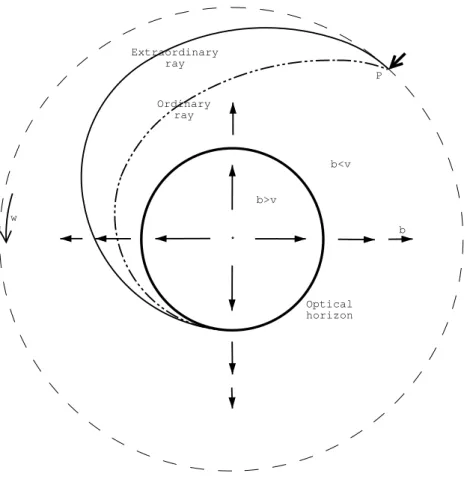
Figure 1. The in-coming light path for both polarization modes are shown for the cylindrical configuration. We assume in the plot a rigid rotation withw = 10−4
, and the refraction index isn= 103
. The figure corresponds to a dielectric fluid flowing out-wards, with radial velocityb(ρ) = 10−2
/ρ, andµǫ′ = 1010
. The unpolarized light ray enters the rotating condenser region (dashed lines) at the pointP. The solid line depicts the extraordinary ray, whereas the dotted line represents the ordinary ray. The thicker line corresponds to the optical horizon, andvdenotes the light velocity with respect to the medium.
should also be noted, however, that the complete unders-tanding of the physical meaning of the Hawking tempera-ture associated with an analogue black hole is still an open question [31, 22], and it can be settled only after a detailed analysis of the radiation processes at the horizon. It should be stressed that the approximation of geometrical optics be-comes unreliable for the modes whose wavelengths are com-parable with the size of the horizon, as occurs in Hawking radiation processes. Furthermore, Hawking radiation from analogue black holes should also face the problem of the possible difference between signal velocity and phase velo-city.
Experimentally though, it appears to be a rather diffi-cult task to maintain a stationary spherically symmetric and inhomogeneous flow. In order to exhibit a more realistic configuration, we will now focus on the cylindric symmetry. A particular case of such a configuration is the vortex matter flow which was discussed recently [24, 44, 45]. Let us consi-der a more general situation of a rotating dielectric body sub-jected to an electric fieldEz(ρ)directed along the axiszof rotation (this configuration corresponds to the experimental situation of a rotating condenser). The background metric is then of the formds2
η =dt
2 −dρ2
−ρ2
dϕ2 −dz2
. The
electro-magnetic field has the only non-zero componentF03 =E
z and we denoteǫ′ := E(dǫ/dE), whereE = |E
z|. For the matter 4-velocity we have uµ = γ(1, b, w,0), with
γ = (1−b2
−ρ2w2)−1/2
, whilewandbbeing arbitrary functions of the radial coordinateρ.
In this case, the analogue (cylindric) event horizon is lo-cated atρ=ρhdefined from
³
nb±p1−ρ2w2´
ρh
= 0. (14)
Note that purely vortical motion of the fluid (withb = 0) does not produce an analogue event horizon [32], sinceρh from Eq. (14) would lie beyond the limit of applicability of a rigid body model in special relativity.
We note thatdϕ/dρdiverges at the surface defined by Eq. (14). As a result, the incoming geodesic light rays spiral towards a horizon radiusρh, as can be explicitly demons-trated by the numerical integration of dϕ/dρ, see Fig. 1. Therefore, we conclude that, for a given stationary flow con-figuration, the analogue horizon structure is of geometrical nature, as soon as it depends neither on the initial conditions nor on the polarization of the propagating light rays [40].
experimen-derstood in terms of the parametersn, b, w which describe the dielectric and kinematic properties of the medium. We expect that such horizons can be observed for stationary inhomogeneous kinematic configurations of the dielectric matter flow. The cylindrical configuration is favored due to the combined effect of both the refraction indexnand also of the vorticitywof the medium which yield a smaller th-reshold for the radial velocityb. The horizon structures in both spherical and cylindrical cases are shown to be inde-pendent of the presence of nonlinearities in the permittivity tensor.
The present scheme may provide room also for the for-mation of sonic horizons [2] for the cases in which ultra-sonic velocities are achieved.
3
Analogue models from
hydrodyna-mics
The mathematical description of a moving fluid is perfor-med by means of the velocity field~v(t, x, y, z)and two ther-modynamic state function, which are assumed to be the mat-ter densityρ(t, x, y, z)and pressurep(t, x, y, z). The beha-vior of a perfect fluid is determined by the continuity equa-tion
~
∇ ·(ρ ~v) +∂ρ
∂t = 0, (15)
and the Euler equation (in the absence of external fields)
∂~v
∂t + (~v·∇~)~v=−
1
ρ∇~p. (16)
By considering an irrotational fluid~v=∇~Φ, the Euler equa-tion leads to the Bernoulli equaequa-tion
∂Φ
∂t +
1 2v
2
+h(ρ) = 0, (17) whereh(ρ)represents the enthalpy density (h = R
dp/ρ). Let us now introduce small perturbations ofΦandρabout the background flow by defining
Φ→Φo+δΦ := Φo+φ (18)
ρ→ρo+δρ:=ρo+ρoψ. (19) Thus, from Eqs. (15) and (17) the field perturbations lead to
✷BLφ= 0, (20)
where ✷BL is the effective Beltrami-Laplace operator, which can be written as
✷BL= 1 √
−g ∂ ∂xµ
µ
√
−ggµν ∂ ∂xν

, (21) with the effective geometrygµνgiven by
gµν =ρo
µ
1−v2/c2
S v i/c
S
vi/c
S −δij

, (22) wherecS:=∂p/∂ρis the sound velocity in the fluid.
Thus, linearized perturbations of an irrotational flowing fluid can be described by means of massless scalar fields propagating in an effectively curved spacetime whose me-tricgµνis determined by the background fluid fields [2].
Acoustic horizon v<c
v>c v=c
v
s
s
s
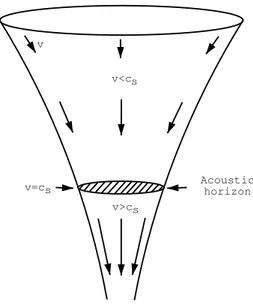
Figure 2. A toy model exhibiting an acoustic horizon. The arrows indicate the fluid flow velocity, with longer arrows for faster flow. The analogue event horizon (acoustic event horizon) occurs when the fluid velocity becomes equal to the sound velocity.
A simple example of this proposal can be understood in the following simplified toy model. Let us consider a fluid flowing through a funnel (Fig. 2) in such way that the fluid velocity increases as the funnel throat gets smaller. Thus, there will be a surface where the fluid velocity becomes equal to the sound velocity, and after it the waves travel with velocity smaller than the fluid velocity. Consequently, this surface will be an one-way surface with respect to the field perturbations (sound) and should be thought as an acoustic event horizon. The acoustic black holes introduced by Un-ruh [2] are usually called dumb holes.
3.1
Acoustic black-hole
Let us assume the case of a radial flow, with~v = v(r)ˆr. By adopting spherical coordinates and applying a coordinate transformation in the time variable as
τ=t+
Z
dr v c2
S−v
2 (23)
we obtain from (23) a line element of the form
ds2
=ρo
" µ
1−v 2
c2
S

dτ2 −
µ
1−v 2
c2
S
¶−1
dr2 −r2
dΩ2
#
,
(24) wheredΩ2
represents the 2-sphere line element. In the par-ticular case wherev =cS(rH/r)
1/2
assumes the form of the Schwarzschild metric (up to the conformal factorρo) withrH identified with the radius of the acoustic horizon, which makes the role of2GM in the general relativity black-hole.
The quantization of the sound fieldφcan be performed, as usual, by means of the field equation (20), and the same arguments leading to the prediction of radiation emission of a black hole also predict that a thermal spectrum of sound waves should be given out from the acoustic horizon in su-personic fluid flow. Thus, an acoustic event horizon will emit analogue Hawking radiation in the form of a thermal bath of phonons at temperature [2]
TH= ~
2πkB
∂v ∂r
¯ ¯ ¯ ¯r
H
. (25)
It should be stressed that the smooth background flow bre-akdown at scales of∼10−8cm
, just as for gravity at Planck scale∼10−33
cm. (See however Ref. [8] where the effects of high frequencies on acoustic black hole evaporation were taken into account). Related subjects can be found in Refs. [46, 47, 48]
By assuming a toy model where
∂v ∂r
¯ ¯ ¯ ¯r
H = cS
rH
, (26)
withcS ≈10
2
m/sandrH ≈1mm, the temperature associ-ated with the phonon radiation resultsTH ≈10−
7K
. Due to the small value of the temperature, and the very poor detec-tion technology for sound waves (among several other dif-ficulties associated with classical fluids), the experimental verification of this result seems to be unrealistic. However, as it will be presented in the next section, there exist special kinds of fluids (quantum fluids) where the above results are expected to be verified in laboratory.
4
Analogue
models
from
Bose-Einstein Condensates
A Bose-Einstein Condensate (BEC) corresponds to a confi-guration in which most of the bosons lie in the same single-particle quantum state. In a dilute gas, the hydrodynamic theory of superfluids in the collisionless regime at zero tem-perature can be derived from the Gross-Pitaevskii equation [49]
i~∂ψ(t, x)
∂t =
·
−~ 2
2m∇
2
+Vext(x) +λ|ψ(t, x)|2
¸
ψ(t, x),
(27) whereψ(t, x)represents the wave function of the conden-sate,Vextis an external confining potential, andλis a para-meter related with the scattering lengthaasλ= 4π~2a/m. By means of the Madelung representation for the condensate wave functionψ=ρ1/2exp (imΘ/~), the Gross-Pitaevskii
equation can be separated in terms of a continuity equation
~
∇ ·(ρ~∇Θ) +∂ρ
∂t = 0, (28)
and a quantum analogue of the Bernoulli equation
∂Θ
∂t +
1
2∇~Θ·∇~Θ+
λρ m+
Vext
m −
~2
2m2√ρ∇ 2√
ρ= 0. (29)
It should be noted that the above set of equations descri-bes an irrotational fluid with velocity~v =∇~Θ. The quan-tum potentialVQ=−~2∇2ρ1/2/2m2ρ1/2can be neglected when the density profiles become smooth.
From the above results we concluded that the Gross-Pitaevskii equation is equivalent to a hydrodynamic equa-tion for superfluid flow, which (for most situaequa-tions) is si-milar to a classical hydrodynamic equation for irrotatio-nal fluids with the particular form for the enthalpy density
h=λρ/m. In this prescription, the sound velocity is given bycS = (~/m)(4πaρ)
1/2
. Thus, analogue models from BEC’s can be performed in the same way as it is done in the case of classical hydrodynamics. (See Ref. [35] for a more complete treatment of analogue gravity from Bose-Einstein condensates.)
Experimental realizations of BEC’s were firstly done in 1995 for alkali atoms [50, 51, 52] and since then several works reporting BEC’s in the laboratory have been appea-red in the literature.
Some interesting configurations of BEC’s were recently proposed in the literature [10, 11, 35, 53] as a way to cons-truct analogue models. In Ref. [11] a ring-shaped confi-guration and a cigar-shaped conficonfi-guration (both adjusted by the external potential) were proposed as possible experimen-tal backgrounds where acoustic black/white holes could be constructed (see Fig. 3 for the cigar-shaped configuration). In Ref. [35] it was proposed that the external potential could be replaced by geometrical constraints. The Laval nozzle device was presented as a possible mechanism to produce black/white holes.
In fact, the use of BEC’s as the physical systems to cons-truct analogue models for general relativity seems to be very promising. As an example, let us analyse the case of a con-densate based on87
Rb. By using the valuea≈6×10⁻⁹m
for the scattering length [55], the sound velocity in the con-densate results to becS ≈6×10−
3
m/s, which is one of the smaller values for the sound velocity ever found in physical systems. From such results (it was considered a system with an acoustic horizon of order of1µm), a crude estimate le-ads to an analogue Hawking temperatureTH ≈7nK. Des-pite the small value for this temperature, it should be noted that the temperature required to form the condensate is about
T ≈10−8
−10−7K
.
5
Conclusion
Acoustic horizons
Outcoupled atom laser beam
Outcoupler beam
v v
Figure 3. The cigar-shaped configuration [11] with two acoustic horizons. An output coupler is used to obtain an atom laser from the condensate, which leads the condensate to flows towards the ‘singularity’. The arrows represent the magnitude of the conden-sate flow velocity. (See Ref. [54] for outcoupler details.)
We have analysed the wave propagation in moving ma-terial media. Two solutions presenting analogue event ho-rizons were examined, the spherically symmetric configu-ration (with a radial flowing dielectric fluid) and a cylin-drically symmetric configuration (with a radial and vorti-cal flowing dielectric fluid). The cylindric configuration is experimentally preferred due to the vortical motion of the fluid, which makes it possible to set smaller thresholds for the radial velocity. Analogue black and white holes can thus possibly be set in moving dielectric media. For optical sys-tems the issue of thermal emission of radiation (analogue Hawking radiation) is not yet well understood.
Analogue models from quantum fluids (in particular, BEC’s based on alkali atoms) seem to be the most promi-sing systems exhibiting acoustic event horizons to be built in laboratory in order to investigate the existence of analo-gue Hawking temperature. Bose-Einstein condensates were experimentally constructed since 1995, and the most attrac-tive feature in such systems lies on the very low condensa-tion temperature. For the case of condensates based on87
Rb the estimated analogue Hawking temperature differs from the typical condensate temperature roughly by only two or-ders of magnitude. Therefore, it seems to be feasible in the near future to probe in laboratory some interesting aspects of quantum field theory in curved spacetimes by means of analogue models.
Acknowledgments
This work was partially supported by the Brazilian rese-arch agencies CNPq and FAPEMIG.
References
[1] S. W. Hawking, Commun. Math. Phys.43, 199 (1975).
[3] in Analog models for general relativity, Rio de Janeiro, October 16-20 (2000), information available at the address
http://www.cbpf.br/˜bscg/analog
[4] W. Gordon, Ann. Phys. Leipzig72, 421 (1923).
[5] J. Plebanski, Phys. Rev.118, 1396 (1960).
[6] F. de Felice, Gen. Rel. Grav.2, 347 (1971).
[7] M. Schenberg,Revista Brasileira de Fisica,1, 91 (1971).
[8] W. G. Unruh, Phys. Rev. D51, 2827 (1995).
[9] M. Visser, Class. Quantum Grav.15, 1767 (1998).
[10] L. J. Garay, J. R. Anglin, J. I. Cirac, and P. Zoller, Phys. Rev. Lett.85, 4643 (2000).
[11] L. J. Garay, J. R. Anglin, I. I. Cirac, and P. Zoller, Phys. Rev. A63, 023611 (2001).
[12] P. O. Fedichev and U. R. Fischer;cond-mat/0304342.
[13] C. Barcel´o, S. Liberati, and M. Visser;
cond-mat/0307491.
[14] S. Matarrese, Proc. R. Soc. Lond. A401, 53 (1985).
[15] T. Jacobson, Phys. Rev. D44, 1731 (1999).
[16] T. Jacobson, Phys. Rev. D48, 728 (1993).
[17] S. Liberati, S. Sonego, and M. Visser, Class. Quantum Grav.
17, 2903 (2000);
[18] D. Hochberg and J. P´erez-Mercader, Phys. Rev. D55, 4880 (1997).
[19] V. A. De Lorenci and R. Klippert, Phys. Rev. D65, 064027 (2002).
[20] V. A. De Lorenci and M. A. Souza, Phys. Lett. B512, 417 (2001); V. A. De Lorenci, Phys. Rev. E65, 026612 (2002).
[21] M. Novello and J. M. Salim, Phys. Rev. D63, 083511 (2001).
[22] W. G. Unruh and R. Sch¨utzhold, Phys. Rev. D68, 024008 (2003).
[23] R. Sch¨utzhold, G. Plunien, and G. Soff, Phys. Rev. Lett.88, 061101 (2002).
[24] U. Leonhardt and P. Piwnicki, Phys. Rev. A60, 4301 (1999).
[25] U. Leonhardt and P. ¨Ohberg, Phys. Rev. A67, 053616 (2003).
[26] B. Reznik, Phys. Rev. D62, 044044 (2000).
[27] S. Corley and T. Jacobson, Phys. Rev. D59, 124011 (1999).
[28] P. F. Gonz´alez-Diaz and C. L. Singuenza, Phys. Lett. A248, 412 (1998).
[29] T. Jacobson, Phys. Rev. D58, 064021 (1998).
[30] G. E. Volovik;cond-mat/9806010.
[31] I. Brevik and G. Halnes, Phys. Rev. D65, 024005 (2002).
[32] M. Visser, Phys. Rev. Lett.85, 5252 (2000); U. Leonhardt and P. Piwnicki, Phys. Rev. Lett.85, 5253 (2000).
[33] C. Barcel´o, S. Liberati, and M. Visser;gr-qc/0305061.
[34] G. E. Volovik;gr-qc/0301043.
[35] C. Barcel´o, S. Liberati, and M. Visser, Class. Quantum Grav.
[36] Y. N. Obukhov and F. W. Hehl, Phys. Lett. B458, 466 (2000); F. W. Hehl, Y. N. Obukhov and G. F. Rubilar,
gr-qc/9911096; G. F. Rubilar, Y. N. Obukhov and F. W. Hehl,gr-qc/0109012.
[37] Y. N. Obukhov, T. Fukui and G. F. Rubilar, Phys. Rev. D62, 44050 (2000); A. Gross and G. F. Rubilar,
gr-qc/0102022.
[38] L. Landau, E. Lifchitz, in Electrodynamique des Milieux´ Continus(Mir, Moscow, 1969).
[39] J. Hadamard, inLec¸ons sur la propagation des ondes et les ´equations de l’hydrodynamique(Ed. Hermann, Paris, 1903); J. Plebanski, inLectures on non-linear electrodynamics (Nor-dita, Copenhagen, 1968); G. Boillat, J. Math. Phys.11, 941 (1970);
[40] V. A. De Lorenci, R. Klippert, and Yu. N. Obukhov Phys. Rev. D68, 061502(R) (2003).
[41] O. Kocharovskaya, Y. Rostovtsev, and M. O. Scully, Phys. Rev. Lett.86, 628 (2001).
[42] D. F. Phillips, A. Fleischhauer, A. Mair, R. L. Walsworth, and M. D. Lukin, Phys. Rev. Lett.86, 783 (2001).
[43] M. Visser, Phys. Rev. Lett.80, 3436 (1998).
[44] U. Leonhardt and P. Piwnicki, Phys. Rev. Lett. 84, 822 (2000).
[45] M. Marklund, D. Anderson, F. Cattani, M. Lisak, and L. Lundgren, Am. J. Phys.70, 680 (2002).
[46] T. Jacobson, Phys. Rev. D44, 1731 (1991).
[47] S. Corley and T. Jacobson, Phys. Rev. D54, 1568 (1996).
[48] B. Reznik, Phys. Rev. D5, 2152 (1997).
[49] F. Dalfovo, S. Giorgini, L. P. Pitaevskii, and S. Stringari, Rev. Mod. Phys.71, 463 (1999).
[50] M, H, Anderson, et al., Science269, 198 (1995).
[51] C. C. Bradley, et al., Phys. Rev. Lett.75, 1687 (1995).
[52] K. B. Davis, et al., Phys. Rev. Lett.75, 3969 (1995).
[53] M. Visser, C. Barcel´o, and S. Liberati;gr-qc/0111111.
[54] I. Bloch, T. W. H¨ansch, and T. Esslinger, Phys. Rev. Lett.82, 3008 (1999).
![Figure 3. The cigar-shaped configuration [11] with two acoustic horizons. An output coupler is used to obtain an atom laser from the condensate, which leads the condensate to flows towards the](https://thumb-eu.123doks.com/thumbv2/123dok_br/18980317.456785/6.892.107.484.101.365/figure-shaped-configuration-acoustic-horizons-coupler-condensate-condensate.webp)
