RESUmo
A incapacidade relacionada à dor lombar crônica (DLC) é um fenômeno complexo e
mulifatorial. O objeivo desse estudo foi ideniicar a prevalência e os fatores asso
-ciados à incapacidade em pacientes com dor lombar crônica. Estudo transversal com amostra composta por 177 pacientes com DLC, de três serviços de saúde; que respon
-deram ao formulário com dados demográ
-icos, ao Inventário de Depressão de Beck, às Escalas Oswestry Disability Index, de au
-toeicácia para dor crônica, Tampa de Cine
-siofobia e de Fadiga de Piper. A prevalência de incapacidade foi de 65% (IC95%: 57,5 – 72,0) e era de moderada a grave em 80,7% dos pacientes. O modelo de regressão múl
-ipla ideniicou três fatores independente
-mente associados à incapacidade: ausên
-cia de trabalho remunerado, autoeicá-cia baixa e depressão. Os fatores associados à incapacidade ideniicados são modii
-cáveis. Intervenções como recolocação no trabalho, tratamento para a depressão e reconceitualização da crença de autoeicá
-cia podem ter um impacto importante na prevenção e redução de incapacidade. DEScRitoRES
Dor lombar
Prevalência
Pessoas com deiciência Trabalho
Depressão Autoeicácia
Disability related to chronic low back pain:
prevalence abd associated factors
*O
riginal
a
r
ticle
AbStRAct
Disability related to chronic low back pain (CLBP) is a complex and mulidimensional phenomenon. The aim of the study was to idenify the prevalence of disability and factors associated with disability outcome in 177 CLBP adults. Respondents were recruited from three health care service centers and answered quesions from: De
-mographic Ideniicaion Form, Oswestry Disability Index, Chronic Pain Self-eicacy Scale, Tampa Scale Kinesiophobia, Beck De
-pression Inventory, and the Revised Piper Faigue Scale. The prevalence of disability among the respondents was 65% (95% CI: 57.5 – 72.0), and disability was moderate to severe in 80.7% of them. The muliple regression model ideniied three factors as independently associated with disabi
-lity: work situaion, low self-eicacy and depression. The factors ideniied to be associated with disability are modiiable. Intervenions such as work relocaion, de
-pression treatment and re-conceptualiza
-ion of self-eicacy may have an important impact in prevening and reducing disabili
-ty in chronic low back pain paients. DEScRiPtoRS
Low back pain Prevalence Disabled persons Work
Depression Self eicacy
RESUmEn
La discapacidad relacionada con el dolor lumbar crónico (DLC) es complejo y muli
-factorial. El objeivo fue ideniicar la pre
-valencia y factores asociados a la discapa
-cidad en pacientes con DLC. Estudio trans
-versal con 177 pacientes de tres servicios de salud; que respondieron al formulario con los datos demográicos, Inventario de Depresión de Beck, Escala de discapacidad de Oswestry, autoeicacia para el dolor cró
-nico, Tampa kinesiophobia and Piper faiga. La prevalencia de la discapacidad fue del 65% (IC 95%: 57,5 a 72,0) y de moderada a severa en 80,7% de los pacientes. El mo
-delo de regresión se ideniicó tres factores independientemente asociados con la dis
-capacidad: la falta de trabajo, baja autoei
-cacia y la depresión. Los factores ideniica
-dos son modiicables. Intervenciones como el trabajo de susitución, el tratamiento de la depresión y la reconceptualización de la creencia de la autoeicacia puede tener un impacto importante en la prevención y re
-ducción de la discapacidad.
DEScRiPtoRES Dolor de la región lumbar Prevalencia
Personas con discapacidad Trabajo
Depresíon Autoeicacia
marina de Góes Salvetti1, cibele Andrucioli de mattos Pimenta2, Patrícia Emília braga3, claudio Fernandes corrêa4
IncapacIdade relacIonada à dor lombar crônIca: prevalêncIa e fatores assocIados
IncapacIdad relacIonada con el dolor lUmbar crÓnIco: prevalencIa Y factores asocIados
*taken from the dissertation “disability in patients with chronic low back pain: prevalence and predictive factors”, University of são paulo school of nursing, 2010. 1rn. ph.d. in nursing. professor, nursing department, school of medical sciences, campinas state University. campinas, sp, brazil. mgsalvetti@
hotmail.com 2rn. ph.d., full professor, medical-surgical nursing department, University of são paulo school of nursing. são paulo, sp, brazil. parpca@
usp.br 3mathematician. ph.d. in epidemiology. post-doctoral degree, University of são paulo school of nursing. são paulo, sp, brazil. 4neurosurgeon.
intRoDUction
Disability related to chronic low back pain (CLBP) is a complex and mulifactorial phenomenon, associated with high social and health costs(1). This complexity can be ex
-plained by the interacion among the many variables that determine disability. The high costs are associated with producivity losses, leaves of absence from work and health system spending.
The prevalence of chronic low back pain ranges be
-tween 9% and 21% and many authors consider that this pain is responsible for most cases of disability and leave of absence from work(2-4). Disability in chronic low back pain
paients varies between 11% and 76%(5-6) and this great
variaion is due to the disability concepts adopted as well as the diferent methods used to measure this phenom
-enon. This variaion makes comparisons among studies diicult. In this research, pain-related disability refers to diiculies to perform aciviies of daily living at home or at work(7).
Literature has shown that factors unrelated to the disease itself can parially explain disability.
Psychosocial and occupaional factors like fear and diiculies in the work environment are considered possible determinants of disability. No consensus exists, however, on the main disability-related factors in CLBP paients(2,5,8). Some authors consider pain
intensity as the main factor, and others af
-irm that psychosocial factors are the most disabling(8-10). Evidence exists that psycho
-social factors can be more important than physiological aspects in the development of chronic pain and disability(8).
Cogniive aspects have demonstrated to be of great importance in the chronic pain experience. Beliefs inlu
-ence the pain experi-ence: its appreciaion, atribuion of meaning to the experience and subsequent behaviors(7-10).
In view of the social importance of chronic low back pain, the resuling disability and gaps on the factors in
-volved in this disability, especially the role of beliefs, the aim in this study was to idenify the prevalence of disabil
-ity in chronic low back pain paients and to verify the fac
-tors associated with disability in this paient group.
mEtHoD
Characterisics
Cross-secional study of a non-probabilisic sample, including 177 paients with chronic low back pain – with a duraion of more than six months. Data were collected at three health services in Sao Paulo State (two public and one private) between January and November 2008. Approval for the study was obtained from the Research
Ethics Commitee at the University of São Paulo School of Nursing (No. 684/2007/CEP-EEUSP).
Inclusion criteria: low back pain for at least six months, age between 18 and 65 years, at least six years of educa
-ion and preserved comprehens-ion and communica-ion abiliies.
Exclusion criteria: presence of cancer and acute health condiions that could alter the percepion of pain-related disability.
The principal invesigator applied the form and scales to 90% of paricipants. Two research aids (undergraduate nursing students) who had been trained to use the re
-search instruments applied the remainder.
Study paricipants
During the data collecion period, 292 paients com
-plied with the inclusion criteria, 177 of whom agreed to paricipate in the study, with an acceptance rate of 60.6%. The main reason for refusal in 115 paients was lack of ime to answer the research instruments (85.0%). No sig
-niicant diference was found between pa
-ients who agreed and refused to paricipate in the study with regard to sex (p=0.75), age (p=0.47), educaion (p=0.05) and pain dura
-ion (p=0.05).
Data collecion procedures, variables and instruments
Data were collected at a specialty out
-paient clinic, at a center specialized in pain treatment and at an occupaional health re
-ferral center. These health services atend to paients with varying complaints and di
-agnoses. Physicians at these services (neurologists, neu
-rosurgeons or orthopedists) were informed of the study and its inclusion criteria. During data collecion, paients with low back pain were forwarded for assessment by the researcher, who explained about the study objecives, as
-sessed paricipants’ eligibility and obtained their informed consent in case they accepted to paricipate.
In this research, as pain-related disability refers to dif
-iculies to accomplish aciviies of daily live at home or at
work(7), the disability outcome was deined with the Os
-westry Disability Index (ODI) and the duraion of the pa
-ient’s absence from work because of the pain during the year before the study.
Individuals with a paid job were considered disabled if they scored > 20 on the ODI and had been on leave at
least 30 days the year before. For individuals without a paid job (on leave, unemployed, reired and housewives), only the ODI score > 20 was used to indicate disability. The independent variables were: sex, age, marital status, edu
-caion, family income, work situaion, pain duraion, pain the prevalence of
chronic low back pain ranges between 9%
and 21% and many authors consider that this pain is responsible
for most cases of disability and leave of
intensity, body mass index (BMI), depression, faigue, self-eicacy and pain-related fear.
Paricipants answered the following research instru
-ments:
• Demographic ideniicaion form – age, sex, marital sta
-tus, educaion, work situaion, family income, weight and height, besides pain characterisics.
• Visual Numerical Pain Scale - scale from 0 to 10, with 0 indicaing no pain and 10 unbearable pain or the worst pain imaginable.
• Oswestry Disability Index (ODI), version 2.0 – assessed disability, is focused on the impact of pain on aciviies of daily living. The scale contains 10 items ranging from 0 to 5: the irst assesses pain intensity, and the remainder the consequences of pain on daily living. The score ranges from 0 (absence of disability) to 100 (maximum disabil
-ity)(11). The validaion of the scale in Portuguese showed
very good internal consistency (Cronbach’s alpha = 0.87) and excellent reliability based on the test-retest (0.99)(11).
In this study, reliability according to Cronbach’s alpha equaled 0.89.
• Beck Depression Inventory (BDI)(12) - contains 21 items,
with answers scored between 0 and 3 that relect the in
-tensity of depressive symptoms. The minimum score is 0 and the maximum 63. The cut-of points for populaions without a previous depression diagnosis range between: 16–20 for dysphoria and >21 for depression(12). The psy
-chometric properies of the BDI in Portuguese were tested and its internal consistency according to Cronbach’s alpha equaled 0.81(12). In this study, the instrument’s reliability,
tested using Cronbach’s alpha, corresponded to 0.92.
• Revised Piper Faigue Scale (rPFS)(13) – this mulidimen
-sional and self-reported instrument consists of four do
-mains (sensory, afecive, cogniive-emoional and behav
-ioral) and 22 items, scored between 0 and 10. The total score also varies from 0 to 10 and represents the mean item score. The Portuguese version showed good validity and reliability. Cronbach’s alpha ranged between 0.84 and 0.94 and the test-retest corresponded to 0.60 (p <0.001)(13).The reliability of the rPFS, tested in the present study sample with the help of Cronbach’s alpha, equaled 0.94 for the total scale and between 0.83 and 0.92 for the domains. Four was adopted as the cut-of point, based on the 25th
percenile. Paients scoring > 4 were considered faigued. • Chronic Pain Self eicacy Scale (CPSS) – self-eicacy was assessed through the Portuguese version of the Chronic Pain Self eicacy Scale (CPSS). The scale was developed to measure the perceived self-eicacy and ability to cope with the consequences of pain in chronic pain paients(14).
The scale consists of 22 items and three domains, for which the respondents indicate their percepion of the ability to perform speciic aciviies or obtain results re
-lated to pain control, coping and funcionality. The sum of
the three domains represents the total scale score, which ranges between 30 and 300. The psychometric properies of the Portuguese version were tested and showed good validity and reliability rates (Cronbach’s alpha ranged be
-tween 0.76 and 0.92 for the domains and equaled 0.94 for the total scale)(14).In this study sample, Cronbach’s alpha
ranged between 0.87 and 0.89 for the domains and corre
-sponded to 0.94 for the total scale. The original self-eica
-cy scale (CPSS) has no deined cut-of points. In the pres
-ent study, a cut-of point was deined through the analysis of the ROC (Receiver Operator Characterisic) curve. The ROC curve area obtained for self-eicacy equaled 0.86, and the cut-of point was set at 185, sensiivity at 0.76 and speciicity at 0.83. Self-eicacy scores <185 were consid
-ered low and >185 high.
• Tampa Scale for Kinesiophobia (TSK) – is one of the most used instruments to assess the fear of movement and pain avoidance(15).The scale consists of 17 items and the
score ranges between 17 and 68. The higher the score, the greater the fear and pain avoidance. The reliability of the Portuguese version was assessed using Rasch’ analy
-sis and revealed a reliability coeicient of 0.95, indicaing excellent construct validity(15). In this study, the reliability
of the scale equaled 0.96 (Cronbach’s alpha). The original TSK scale has no deined cut-of point. Here, the analysis of the ROC curve was used to deine a cut-of point and resulted in an area of 0.80, with 42 as the cut-of point, 0.75 speciicity and 0.75 sensiivity. Scores < 42 were con
-sidered low levels and scores > 42 high levels of fear of
movement and pain avoidance.
The decision to set cut-of points for scale that did not possess this was due to the desire to work with individuals with manifestaions of faigue and clinically relevant be
-liefs related to pain-related fear and self-eicacy.
Staisical analysis
Data were included in an SPSS (version 13) database and analyzed using STATA 9.0 sotware. The prevalence of disability and its respecive conidence interval were cal
-culated (95%). In this study, due to the high prevalence of observed disability (65.0%), the Prevalence Raio (PR) and its respecive conidence intervals (95% CI) were esi
-mated for the sake of a univariate analysis of the relaion between the independent variables and the disability out
-come. Variables with p-value < 0.25 were selected for the muliple analysis. Cox’ regression model with robust vari
RESULtS
Most study paricipants: were between 46 and 65 years of age (57.6%); female (72.3%); had a partner (67.8%); secondary educaion level (71,2%); monthly fam
-ily income of up to U$1,350.00 (76.3%); overweight or obesity (63.3%); and referred intense pain (61.6%), which persisted for more than four years (63.3%). As regards work, most subjects (67.8%) had no paid job at the ime of data collecion (on leave, reired, unemployed and house
-wives) (Table 1).
In terms of depressive symptoms, 36.7% of parici
-pants obtained scores compaible with dysphoria or de
-pression. Among the paricipants, 33.3% were faigued. A predominance of paients with low self-eicacy (67.2%) and high levels of fear-avoidance beliefs were observed (61.0%), according to the adopted cut-of points in this study.
The mean disability score measured by the ODI was 33.2 (SD=13.3) and 80.7% of paricipants revealed scores compaible with moderate to severe disability. Accord
-ing to the criteria adopted to characterize disability (ODI score and duraion of absence from work), 115 individuals were classiied as disabled. Hence, the prevalence of dis
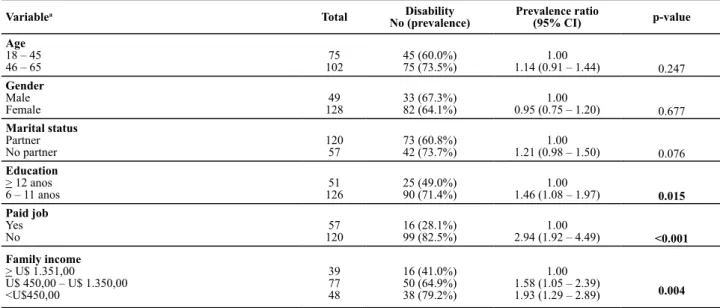
-ability corresponded to 65.0% (95% CI: 57.5 – 72.0). Univariate analysis showed that paients with up to 11 years of educaion (p=0.015), paients without a paid job during the study period (p<0.001) and with a monthly family income of up to U$450.00 (p<0.004) showed higher disability prevalence raios than the others (Table 2).
Table 1 – Sample characteristics - Sao Paulo, 2008
Characteristics N % Mean (SD*)
Age
18 – 45 46 – 65
75 102 42.4 57.6 46.9 (9.6) Gender Male Female 128 49 72.3 27.7 Marital status Partner No partner 120 57 67.8 32.2
Education (in years)
6 – 11
≥ 12 12651
71.2 28.8
11.0 (3.7)
Employment situation
Paid job No paid job
57 120
32.2 67.8
Monthly family income (n = 164) ≥ U$ 1.351,00
U$ 451,00 – U$ 1.350,00 U$ 450,00 39 77 48 23.8 47.0 29.3 1.290.50 (1.741.55) BMI Underweight/normal Overweight/obesity 65 112 36.7 63.3 27.2 (5.4) Pain intensity
Mild (1 – 4) Moderate (5 – 7) Intense (8 – 10)
12 56 109 6.8 31.6 61.6 7.8 (2.0)
Pain duration (months) 6–18 19–48 ≥49 23 42 112 13.0 23.7 63.3 97.8 (91.7)
Total 177 100
* sd = standard deviation
Table 2 – Prevalence ratio of disability for sociodemographic variables - São Paulo, 2008
Variablea Total Disability
No (prevalence)
Prevalence ratio
(95% CI) p-value
Age
18 – 45 46 – 65
75 102
45 (60.0%) 75 (73.5%)
1.00
1.14 (0.91 – 1.44) 0.247
Gender Male Female 49 128 33 (67.3%) 82 (64.1%) 1.00
0.95 (0.75 – 1.20) 0.677
Marital status Partner No partner 120 57 73 (60.8%) 42 (73.7%) 1.00
1.21 (0.98 – 1.50) 0.076
Education
> 12 anos 6 – 11 anos
51 126
25 (49.0%) 90 (71.4%)
1.00
1.46 (1.08 – 1.97) 0.015
Paid job Yes No 57 120 16 (28.1%) 99 (82.5%) 1.00
2.94 (1.92 – 4.49) <0.001
Family income
> U$ 1.351,00
U$ 450,00 – U$ 1.350,00 <U$450,00 39 77 48 16 (41.0%) 50 (64.9%) 38 (79.2%) 1.00 1.58 (1.05 – 2.39)
1.93 (1.29 – 2.89) 0.004
an = 177 for all variables except income, for which n = 164.
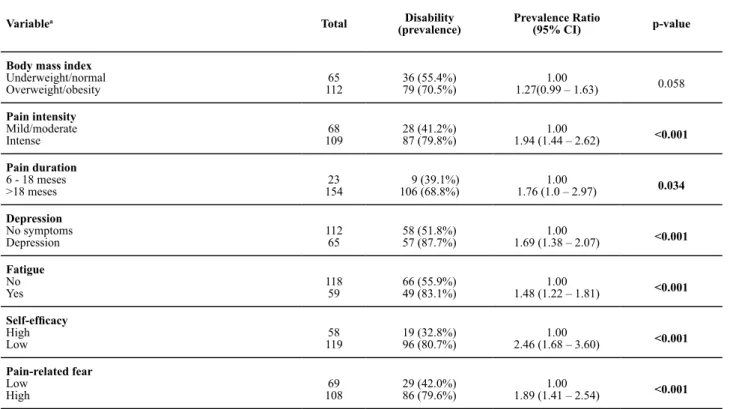
Also, a higher disability prevalence raio was observed among paients with intense pain (p<0.001), longer pain duraion (p=0.034), depressive symptoms (p<0.001) and
Table 3 – Prevalence ratio of disability for body mass index, pain characteristics, symptoms and beliefs - Sao Paulo, 2008
Variablea Total Disability
(prevalence)
Prevalence Ratio
(95% CI) p-value
Body mass index Underweight/normal
Overweight/obesity 11265
36 (55.4%) 79 (70.5%)
1.00
1.27(0.99 – 1.63) 0.058
Pain intensity Mild/moderate
Intense
68 109
28 (41.2%) 87 (79.8%)
1.00
1.94 (1.44 – 2.62) <0.001
Pain duration
6 - 18 meses >18 meses
23 154
9 (39.1%) 106 (68.8%)
1.00
1.76 (1.0 – 2.97) 0.034
Depression No symptoms
Depression
112 65
58 (51.8%) 57 (87.7%)
1.00
1.69 (1.38 – 2.07) <0.001
Fatigue
No Yes
118 59
66 (55.9%) 49 (83.1%)
1.00
1.48 (1.22 – 1.81) <0.001
Self-eficacy
High
Low 11958
19 (32.8%) 96 (80.7%)
1.00
2.46 (1.68 – 3.60) <0.001
Pain-related fear Low
High 10869
29 (42.0%) 86 (79.6%)
1.00
1.89 (1.41 – 2.54) <0.001
an = 177 for all variables.
Thus, the univariate analysis ideniied the following potenial risk factors for disability in the study sample: educaion, employment situaion, income, pain intensity, duraion of pain, faigue, depression, self-eicacy and pain-related fear.
To idenify the variables that were independently as
-sociated with disability, Cox’ muliple regression analysis was used. The muliple regression model, adjusted for pain-related fear and pain intensity, showed that disability was independently associated with low self-eicacy, de
-pression and absence of paid work (Table 4).
Table 4 – Estimated prevalence ratios of disability accor
-ding to Cox multiple regression model - São Paulo, 2008
Variables RPbr RPaj (IC 95%) valor de p
Self-eficacy
High
Low 1.003.14
1.00 1.73 (1.23 – 2.44)
0.002
Pain-related fear Low
High 1.001.92
1.00 1.27 (0.99 – 1.63)
0.055
Depression No symptoms
Depression
1.00 2.30
1.00 1.22 (1.03 – 1.44)
0.022
Paid job
Yes No
1.00 4.39
1.00 2.45 (1.64 – 3.65)
<0.001
Pain intensity Mild/moderate
Intense
1.00 1.81
1.00 1.21 (0.98 – 1.50)
0.071
an = 177 for all variables; cpr: crude prevalence ratio; apr: adjusted
prevalence ratio.
The chance of disability was 1.7 imes higher among paients with low self-eicacy than among paients with high self-eicacy (p=0.002). Likewise, the chance of dis
-ability was 1.2 imes higher among paient with depres
-sive symptoms than among individuals without these symptoms (p=0.022). It was also observed that paients without a paid job revealed a 2.5 imes higher chance of disability than paients who were employed (p<0.001).
DiScUSSion
The analysis of descripive characterisics in the study sample showed the predominance of a low-income and low-educaion populaion, relecing the Brazilian reality, even in the country’s large metropolitan centers. Informa
-ion from the Brazilian Insitute of Geography and Stais
-ics (IBGE)(a) showed that 64.3% of people in the produc
-ive age range in Brazil had less than 12 years of formal educaion in 2004, similar to the present study sample, in which 71.2% of paients had less than 12 years of educa
-ion. Low income levels also predominated in this sample, as 76.3% of paricipants gained a monthly family income of up to U$1,350.00. As this study was accomplished at two Public Health Services and one Private Health Service, the predominance of paients with these characterisics was expected.
The prevalence raio of disability observed in this re
-search was high (65.0%), and higher than the reports of
other authors who analyzed adults and elderly people with CLBP and observed prevalence raios between 40%
and 56%(2,16). The variaion found between the disability
prevalence ideniied in this and other studies can be ex
-plained by the diferent deiniions of disability. It should be highlighted, however, that the highly disabling poten
-ial of chronic low back pain was conirmed. Further re
-search is due to evaluate whether disability prevenion or reducion intervenions can minimize this problem, im
-proving these paients’ funcionality.
Pain-related disability afects diferent aspects of daily life and provokes mental sufering. Individuals who face diiculies to accomplish daily aciviies and are unable to keep up their professional aciviies tend to take distance from social contact and avoid leisure aciviies. Social iso
-laion and avoidance of pain-related aciviies can reduce self-eicacy and increase the chance of developing de
-pressive and disability symptoms.
Besides the emoional impact, the presence of disabil
-ity overburdens the health system. Individuals who feel disabled by pain go through many consultaions, examina
-ions and surgeries, in search of answers and oten with
-out reaching the expected results. Disability-related social costs are also huge, considering that people disabled by pain present reduced producivity, absence from work and frequent leaves of absence, factors that put a signii
-cant strain on the social security system.
In this study, 80.7% of paricipants experience mod
-erate to severe disability, a high level when compared to studies that evaluated disability in workers with musculo
-skeletal disorders and found 49% of workers with moder
-ate to severe disability(17).The high frequency of moder
-ate to severe disability found can be explained by the fact that the sample exclusively comprised people with CLBP, a condiion with a highly disabling potenial. In addiion, this sample consisted of people atended at health servic
-es, as opposed to the study that included acive workers with diferent forms of low back pain(17).
The mean ODI score observed indicates moderate dis
-ability, similar to indings in a study of a populaion with CLBP(11).
Disability showed an associaion with many variables studied in the univariate analysis but, in the muliple analysis, only the variables self-eicacy, depression and employment situaion remained as factors independently associated with disability (Table 4).
The chance of disability was 1.7 imes higher among paricipants with low self-eicacy than among those with high self-eicacy. Low self-eicacy was also associated with disability in studies that assessed chronic pain pa
-ients(8,10,16,18). The present study results conirm the im
-portance of self-eicacy beliefs in the relaion between pain and disability. A longitudinal study that invesigated paients with CLBP concluded that improving self-eicacy
beliefs mediated part of the relaion between pain and disability over a 12-month period(18).
Disability is inluenced by self-eicacy beliefs, as indi
-viduals with low levels do not get efecively involved in treatment, tend to have a more passive aitude and eas
-ily give up their objecives when obstacles are present. On the other hand, individuals with high self-eicacy ad
-here to treatment beter, tend to be more persistent and, in general, maintain most of their aciviies, despite the pain. Idenifying paients with low self-eicacy and inter
-vening in the improvement of this belief can be an efec
-ive strategy to improve treatment results. Longitudinal intervenion studies should test this hypothesis.
A greater trend towards disability was also observed among paricipants with more intense pain (p=0.055), al
-though no staisically signiicant relaion was revealed in the muliple analysis. The fact that pain intensity did not reveal to be a factor independently associated with dis
-ability reinforces the importance of psychosocial factors like beliefs and emoional factors in pain-related disability.
Pain-related fear showed an associaion with disability in diferent studies that assessed CLBP paients(19-20). In the
present research, however, fear showed to be associated with disability in the univariate analysis only, conirming other authors’ indings that have shown self-eicacy as a more important factor than fear to explain disability in chronic pain paients(8,18).
Paients with depressive symptoms revealed a 1.2 imes higher chance of disability than paients without these symptoms, which conirmed the indings by other authors that found an associaion between the presence of depressive symptoms, worse adjustment to pain and disability(10,20-21).
The relaion between depression and disability can be explained by the fact that individuals who are unable to perform their aciviies because of pain feel disabled and powerless towards it. Besides, depressed paients tend to get more isolated and less moivated to involve in acive treatment strategies. Negaive thoughts and faigue, fre
-quent symptoms in depression, can also interfere in the form of coping with pain and contribute to the presence of disability. Therefore, treaing depressive symptoms can be an efecive strategy to minimize disability.
Finally, the chance of disability was 2.5 imes higher among individuals without a paid job than among employ
-ees. Other studies that analyzed paients with acute and chronic low back pain also showed that people without a paid job have a greater chance of geing disabled(9,20).
The greater chance of disability among individu
-als without a paid job can be explained by the fact that, far from professional aciviies, individuals tend to focus more on pain, oten feeling socially devalued. One pos
pain, with a view to promoing reallocaion in the job mar
-ket. Performing physically feasible professional aciviies can help to recover these paients’ self-esteem and im
-prove their quality of life, besides the potenial to reduce perceived disability.
This study ofers important contribuions to our real
-ity as well as to the internaional context: the prevalence raio of disability was determined in paients with chronic low back pain, based on strict and well-established crite
-ria, which few studies have done. This research ideniied factors independently associated with disability in CLBP paients, suggesing that these factors should be taken into account in intervenions aimed at prevening or re
-ducing disability.
The ideniicaion of self-eicacy beliefs as associated with disability is a relevant inding. Beliefs are precon
-ceived ideas, learned concepions and, if dysfuncional (beliefs that are of no help in the person’s recovery/ad
-aptaion), they can be relearned, as strategies exist to idenify and re-signify beliefs proposed in the Cogniive-Behavioral Model, which nurses can learn and use(22).
Also, the contribuion of this study should be high
-lighted, in that it very strictly established cut-of points for faigue, self-eicacy and fear-avoidance beliefs, which did not exist. This decision contributed to include paients in
the study who experienced the situaion (faigue, low self-eicacy and high pain-related fear) in a more enhanced way and contributed to clinical pracice, as it allowed professionals to adopt a criical viewpoint, which should serve as an alert for paient care decisions.
The study has limitaions. The cross-secional design did not permit causal inferences and a convenience sam
-ple was used, which limits the generalizability of results. This research included paients from diferent health ser
-vices, which can also be considered a limitaion. Never
-theless, this strategy was used to include paients with diferent degrees of low back pain and disability. These limitaions should be overcome in future studies.
concLUSion
These research results entail several clinical implica
-ions, in view of the high prevalence raio and the fact that the factors ideniied to be independently associ
-ated with disability are modiiable. Speciic intervenions like work reallocaion, modiicaion of dysfuncional beliefs (low self-eicacy) and depression treatment can modify the ideniied factors. Further research is needed to verify whether intervenions focused on these factors can reduce or prevent disability in chronic low back pain paients.
REFEREncES
1. Luo X, Pietrobon R, Sun SX, Liu GG, Hey L. Esimates and pat
-terns of direct health care expenditures among individuals with back pain in the United States. Spine. 2003; 29(1):79-86.
2. Webb R, Brammah T, Lunt M, Urwin M, Allison T, Symmons D. Prevalence and predictors of intense, chronic, and disabling neck and back pain in the UK general populaion. Spine. 2003;28(11):1195-202.
3. Freburger JK, Holmes GM, Agans RP, Jackman AM, Darter JD, Wallace AS, et al. The rising prevalence of chronic low back pain. Arch Intern Med. 2009;169(3):251-8.
4. Sá KN, Bapista AF, Matos MA, Lessa I. Chronic pain and gen
-der in Salvador populaion, Brazil. Pain. 2008;139(3):498-506.
5. Wynne-Jones G, Dunn KM, Main CJ. The impact of low back pain on work: a study in primary care consulters. Eur J Pain. 2008;12(2):180-8.
6. Côté P, Baldwin ML, Johnson WG, Frank JW, Butler RJ. Paterns of sick-leave and health outcomes in injured workers with back pain. Eur Spine J. 2008;17(4):484-93.
7. Leeuw M, Goossens MEJB, Linton SJ, Crombez G, Boersma K, Vlaeyen JWS. The fear-avoidance model of musculoskel
-etal pain: current state of scieniic evidence. J Behav Med. 2007;30(1):77-94.
8. Woby SR, Urmston M, Watson PJ. Self-eicacy mediates the relaion between pain-related fear and outcome in chronic low back pain paients. Eur J Pain. 2007;11(7):711-8.
9. Swinkels-Meewisse IEJ, Roelofs J, Oostendorp RAB, Verbeek ALM, Vlaeyen JWS. Acute low back pain: pain-related fear and pain catastrophizing inluence physical performance and per
-ceived disability. Pain. 2006;120(1-2):36-43.
10. Sardá JJ, Nicholas MK, Asghari A, Pimenta CAM. The contri
-buion of self-eicacy and depression to disability and work status in chronic pain paients: a comparison between Aus
-tralian and Brasilian samples. Eur J Pain. 2009;13(2):180-95.
11. Vigato R, Alexandre NMC, Correa Filho HR. Development of a Brazilian Portuguese version of the Oswestry Disability In
-dex: cross-cultural adaptaion, reliability and validity. Spine. 2007;32(4):481-6.
12. Gorestein C, Andrade L. Inventário de Depressão de Beck: propriedades psicométricas da versão. Rev Psiquiatr Clin. 1998;25(5):245-50.
13. Mota DDCF, Pimenta CAM, Piper BF. Faigue in Brazilian can
-cer paients, caregivers, and nursing students: a psychomet
-ric validaion study of the Piper Faigue Scale-Revised. Sup
14. Salvei MG, Pimenta CAM. Validação da Chronic Pain Self-Eicacy Scale para a língua portuguesa. Rev Psiquiatr Clin. 2005;32(4):202-10.
15. Siqueira FB, Teixeira-Salmela LF, Magalhães LC. Análise das propriedades psicométricas da versão brasileira da Escala Tampa de Cinesiofobia. Acta Ortop Bras. 2007;15(1):19-24.
16. Barry LC, Guo Z, Robert DK, Duong BD, Reid MC. Func
-ional self-eicacy and pain-related disability among older veterans with chronic pain in a primary care seing. Pain. 2003;104(1-2):131-7.
17. Walsh IAP, Oishi J, Coury HJCG. Clinical and funcional as
-pects of work-related musculoskeletal disorders among ac
-ive workers. Rev Saúde Pública. 2008;42(1):108-16.
18. Costa LCM, Maher CG, McAuley JH, Hancock MJ, Smeets RJEM. Self-eicacy is more important than fear of move
-ment in mediaing the relaionship between pain and dis
-ability in chronic low back pain. Eur J Pain. 2011;15(2):213-9.
19. Leeuw M, Houben RMA, Severeijns R, Picavet HSJ, Schouten EGW, Vlaeyen JWS. Pain-related fear in low back pain: a prospecive study in general populaion. Eur J Pain. 2007;11(3):256-66.
20. Grotle M, Foster NE, Dunn KM, Crot P. Are prognosic indi
-cators for poor outcome diferent for acute and chronic low back pain consulters in primary care? Pain. 2010;151(3):790-7.
21. Linton SJ, Nicholas MK, MacDonald S, Boersma K, Bergbom S, Maher C, et al. The role of depression and catastrophizing in musculoskeletal pain. Eur J Pain. 2011;15(4):416-22.
22. Turner JA, Holtzman S, Mancl L. Mediators, moderators, and predictors of therapeuic change in cogniive-behavioral therapy for chronic pain. Pain. 2007;127(3):276-86.
Acknowledgements
Acknowledgements to CAPES – Coordinaion for the Improvement of Higher Educaion Personnel and CNPq – Naional Council for Scieniic and Technological Development for the funding received