Abstract— In the present paper, we have investigated the high-pressure structural phase transition of cerium monopnictide. The three-body potential model has been used to study the structural properties of this compound. Phase transition pressures are associated with a sudden collapse in volume. The phase transition pressures and associated volume collapses obtained from present potential model show a generally good agreement with available experimental data than others.
Index Terms— Pnictides, volume collapse, crystal structure, phase transition.
I. INTRODUCTION
High-pressure research on structural phase transformations and behavior of materials under compression based on their calculations or measurements have become quite interesting in the recent few years. An example can be found in the rare earth (RE) chalcogenides and pnictides, where the structural optical and electrical properties at high pressure have been extensively studied [1-4]. The rare-earth pnictides have drawn considerable interest, both theoretically and experimentally because of their interesting semi conducting properties and various practical applications in the field of non-linear optics, electro-optic components, glass-making, grinding alloys, composites lasers, phosphors lasers, and electronics [1-6]. The rare-earth pnictides are considered to be part of the green technology industry, helping to improve energy efficiency in magnets, batteries, glass and computers.Due to the relatively gradual decrease in ionic size with increasing atomic number, the rare earth elements have always been difficult to separate. The rare earth (RE) chalcogenides and pnictides (REX; X =O, S, Se, Te and REY; Y =N, P, As, Sb and Bi) under go a phase transition from six fold coordinated NaCl to more closed eight fold coordinated CsCl structure [1-6].
In Cerium chalcogenides and pnictide compounds, only CeP has been found to undergo a first order phase transition (isomorphous) at about 10 GPa [2,3]. The theoretical work by Svane et al. [4] has further widened the scope of future theoretical and accurate experimental investigations of electronic and crystallographic transitions for these groups of compounds. In CeAs no iso-structural transition due to pressure induced valence change from 3p to 4p state of Ce-ion has been observed [5], and CeSb shows B1 to tetragonal phase transition, while CeBi transforms into
Purvee Bhardwaj is a Women Scientist ‘A’ Department of Science and Technology New Delhi, in Department of Physics, Barkatullah University, Bhopal 462026, India (e-mail: [email protected]).
Sadhna Singh is Reader in Department, of Physics Barkatullah University, Bhopal 462026, India (e-mail: [email protected]).
CsCl structure at high pressure [6]. Further the smaller value of bulk modulus in CeBi and in CeTe as compared to other Cerium chalcogenides and pnictide compounds has also been ascribed to volume dependent Kondo effect [6]. Only a few theoretical papers and a little experimental work have been devoted to the study of structural and electronic properties of this series of rare earth pnictides.
Looking at the fact that these compounds are less explored, we applied our extended interaction potential (EIP) model to these compounds to study high pressure phase transition and other properties. The need of inclusion of three body interaction forces was emphasized by many workers for the betterment of results [7-9]. Earlier calculations for B1-B2 transitions were based on two-body potential mainly. They concluded that possible reasons for disagreements include the failure of the two body potential model. Since these studies were based on two body potentials and could not explain Cauchy violations (C12 ≠C44). They remarked that
results could be improved by including the effect of non-rigidity of ions in the model.
It is seen from the current literature that three body potential model (TBP) used and developed by Singh and coworkers [10-13] has been found to be remarkably successful in giving the unified descriptionof structural and elastic properties of ionic and semi conducting crystals. In this TBP model, the three body interactions owe their origin to the quantum mechanical foundation and also to the phenomenological approach [10,14] in terms of the transfer (or exchange) of charge between the overlapping electron shells of the adjacent ions in solids. This TBP approach has been extended to include the Hafemeister-Flygare (HF) type [15] overlap repulsion operative upto the second neighbour ions for describing, the lattice static and mechanical properties of binary ionic solids and alloys. Also, Tosi and coworkers [16] have demonstrated the significance of vander Waals (vdW) attraction due to the dipole-dipole (d-d) and dipole-quadruple (d-q) interactions to describe the cohesion in ionic solids and they are generally ignored in the first principle calculations.
Motivated from the above mentioned success of the TBP model in III-V and II-VI compound semiconductor, we thought it pertinent to apply three body potential (TBP) model for the prediction of phase transition pressures and associated volume collapses in rare earth pnictides.
We have studied phase transition phenomena to study the phase transition in NaCl type cerium bismuth compound using three-body potential model, which includes long range Coulombic, three-body interaction and short-range overlap repulsive interactions. It is felt that this potential model is suitable for this group of compounds. The
High Pressure Structural Properties of Cerium
Monopnictide
Purvee Bhardwaj and Sadhna Singh
Proceedings of the World Congress on Engineering 2011 Vol III WCE 2011, July 6 - 8, 2011, London, U.K.
ISBN: 978-988-19251-5-2
ISSN: 2078-0958 (Print); ISSN: 2078-0966 (Online)
formulation of the present potential model and the method of calculations are described in section II. The results are presented and discussed in section III.
II. POTENTIALMODELANDMETHODOF CALCULATION
Application of pressure directly results in compression leading to the increased charge transfer of the overlapping of electron shells of the adjacent ions (or non-rigidity of ions) in solids [10]. These effects have been incorporated in the Gibbs free energy (G = U+PV-TS) as a function of pressure and three body interactions (TBI), which are the most dominant among the many body interactions. Here, U is the internal energy of the system equivalent to the lattice energy at temperature near zero and S is the entropy. At T=0 K temperatures the Gibbs free energies for rock salt (B1, real) and CsCl (B2, hypothetical) structures are given by:
)
2
(
)
154
.
1
(
)
(
)
1
(
)
0
.
2
(
)
(
3 2 , 3 2 2 1 1 1r
PV
r
U
G
r
PV
r
U
G
B B B B B B
Where first term, in above Esq. (1) and (2) represent lattices energies UB1 for B1 and UB2 for B2 structure,
respectively. The expressions of lattices energies UB1
and UB2 are given:
)
3
(
/
41
.
1
2
exp(
6
)
/
41
.
1
2
exp(
6
)
/
exp(
6
)
(
12
2 2 2 1
r
r
b
r
r
b
r
r
r
b
r
r
f
Ze
r
e
Z
U
j jj i ii j i ij M M B
)
4
(
)
/
154
.
1
2
exp(
3
)
/
154
.
1
2
exp(
3
)
/
exp(
8
)
(
16
2 2 2 2
r
r
b
r
r
b
r
r
r
b
r
r
f
e
Z
r
e
Z
U
j jj i ii j i ij M M B
Here, first and second terms represent long-range Coulomb and TBI interactions. Third term corresponds to overlap repulsion given by Hafemeister Flygare [HF]with αM and
αM΄ are the Madelung constant for B1 and B2 structures,
respectively, βij is the Pauling coefficients, Ze is ionic charge
with e as the electronic charge; b and ρ are the range and hardness parameters, f(r) and f’(r΄) are TBI parameters for B1 (B2) phase. The TBI expressed as f (r) = foexp (-r/ ρ) with
fo as a constant.
Elastic properties of solids are closely related to many fundamental solid-state properties, such as equation of state (EOS), specific heat thermal expansion, Debye temperature, Gru¨neisen parameter, melting point and so on. From the elastic constants, one can obtain valuable information about the binding characteristic between adjacent atomic planes, and about the anisotropic character of the bonding and structural stability.
The knowledge of SOEC’s and their pressure derivatives are important for the understanding of the interatomic force in solids. The expressions of second order elastic constants are as follows:
)]
(
'
3204
.
9
2
/
)
(
))
(
12
(
112
.
5
)[
4
/
(
2 2 1 4 2 11r
zaf
B
A
A
r
f
Z
Z
a
e
C
)]
(
'
3204
.
9
4
/
)
5
(
))
(
12
(
226
.
0
)[
4
/
(
2 2 1 4 2 12r
zaf
B
A
B
r
f
Z
Z
a
e
C
4
/
)
3
(
))
(
12
(
556
.
2
)[
4
/
(
2 2 1 4 2 44B
A
B
r
f
Z
Z
a
e
C
Using model parameter (b, , f(r)), pressure derivatives of bulk modulus have been computed whose expressions are as follows:
1 1 2 2
1
2
13.980 ( 12 ( )) 3 3
(3 )
167.7648 ( ) 41.9420 ( )]
Z Z f r C A C A dB
dp zaf r za f r
11 12
11 121 2
1
1
2
,
(
)
3
2
2.330 (
12 ( ))
21.9612
( )
B
C
C
S
C
C
and
Z Z
f r
A
A
zaf r
The values of Ai, Bi, and Ci (i =1, 2) have been evaluated
from the knowledge of b, ρ and vdW coefficients.
III. RESULTSANDDISCUSSION
The three-body potential model described in previous section contains three model parameters [b, ρ, f(r)], namely the hardness, range and three body force parameter. The values of these parameters have been evaluated using the first and second order space derivatives of the cohesive energy (U) expressed as:
0
]
/
[
dU
dr
rr Proceedings of the World Congress on Engineering 2011 Vol IIIWCE 2011, July 6 - 8, 2011, London, U.K.
ISBN: 978-988-19251-5-2
ISSN: 2078-0958 (Print); ISSN: 2078-0966 (Online)
B
kr
dr
U
d
2/
2]
9
0[
and the procedure prescribed in our earlier work [17-19]. The present potential model contain three model parameters [b, ρ, f (r)], namely hardness, range and three body force parameter. The input crystal data and calculated model parameters for the present compound are given in Table 1.
Table-1 Input parameters and generated model parameters for cerium pnictide.
As, the stable phase is associated with minimum free energy of the crystal, we have followed the technique of minimization of Gibbs free energies of real and hypothetical phases. We have minimized GB1 (r) and GB2 (r’) given by
Eqns. (3) and (4) at different pressures in order to obtain the interionic separations r and r’corresponding to B1 and B2
phases associated with minimum energies. The phase transition occurs when ∆G approaches zero (∆G→0).
The phase transition pressure (Pt) is the pressure at
which ∆G approaches zero. Fig.1 shows our present computed phase transition from NaCl-type [B1] to CsCl-type
[B2] structure. The experimental value of phase transition
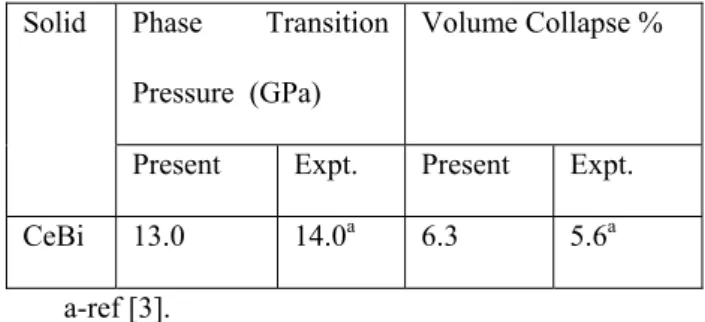
pressure is 14.0 GPa and our calculated value of phase transition for CeBi is 13.0 GPa. The solid square (■) represents the experimental value of phase transition.
Table-2 Phase transition and volume change of cerium pnictide.
a-ref [3].
Relative volume changes V (p)/V (0) have been
plotted against pressure and depicted in Fig.2 for CeBi. At Pt
these compounds undergo a (B1-B2) transition associated with a sudden collapse in volume showing a first order phase transition. The values of volume collapse (%) are given in Table-2. It is clear from Table 2 and Fig 2 that our calculated volume collapses - V (p)/V(0) for CeBi is 6.3 while the
experimental value of volume collapse for CeBi is 5.6. The –ve sign shows the compression in crystal. In Fig:2, solid lines with open circles represent the real B1 and B2 phase, dash line represent the hypothetical B1 and B2 phase for the present study. The solid square (■) represents the experimental values of B1 and B2 phase for the present compound.
The study of elastic behavior under pressure is well known to supply useful information about change in the character of the covalent and ionic forces induced in the crystal as it is subjected to the phase transformation. We have calculated the second order elastic constants of the materials under study.
Solid Input Parameters Model Parameters r0 (Å) BT (GPa) b(10-12
ergs)
ρ f (r)
CeBi 3.275 50.0 160.91 0.321 0.113
Solid Phase Transition Pressure (GPa)
Volume Collapse %
Present Expt. Present Expt.
CeBi 13.0 14.0a 6.3 5.6a
0 4 8 12 16
-20 0 20 40 60 80 100 120
B2 B1
Pt
Pt
This work Expt.
CeBi
Vol
ume ch
ange
Pressure (GPa)
Fig: 1 Variation of G (KJ/mol) with pressure for CeBi.
0 2 4 6 8 10 12 14 16 18
0.60 0.65 0.70 0.75 0.80 0.85 0.90 0.95 1.00
B2 B1
This work Expt.
Volume change
Pressure (GPa)
Fig: 2 Variation of volume changes VP/V0 with pressure
for CeBi.
Proceedings of the World Congress on Engineering 2011 Vol III WCE 2011, July 6 - 8, 2011, London, U.K.
ISBN: 978-988-19251-5-2
ISSN: 2078-0958 (Print); ISSN: 2078-0966 (Online)
Table-3 Elastic constants of CeBi.
Compound C11 C12 C44 dB/dP
CeBi (Present) (Others)
102.26 -
21.36 -
11.85 -
5.689 2.1a
a-ref [3].
It is found that C11 varies largely under the effect of
pressure as compared with the variations in the C12 and C44.
Since the elastic constant C11 represents elasticity in length.
A longitudinal strain produces a change in C11. The elastic
constants C12 and C44 are related to the elasticity in shape,
which is a shear constant. A transverse strain causes a change in shape without a change in volume. The second order elastic constants (SOEC’s) and pressure derivatives of rare earth pnictide (CeBi) have been calculated by using equation (5), (6), (7) and (8) and they are given in Table-3. Our present values of SOEC’s are close to available theoretical data [3]. The experimental values of second order elastic constants are not available.
An overall assessment of our results shows that the values obtained from the present potential model are in good agreement with the available experimental data [3]. Finally, we can conclude that the present potential model has successfully revealed the description of the high-pressure phase transition and allied properties of cerium bismuth compound.
ACKNOWLEDGEMENT
One of the authors (PB) is grateful to the Department of Science & Technology (DST), New Delhi for the financial support to this work.
REFERENCES
[1] J. Rossat-Mignod, D. delacote, J. M. Effantic, C. Vettier and O. Vogt, “A neutron Study of the Magnetic excitations in CeBi” Physica B+C 120 (1983) 163-166.
[2] J.M. Leger, “Chalcogenides and nitrides of cerium and uranium under high pressure” Physica B 190 (2002) 84-91.
[3] J .M. Leger, “Structural and elastic properties of rare earth nitrides at high pressure” Physica B 190 (1993) 84-89.
[4] A. Svane, P. Strange, W.M. Temmerman, Z. Szotek, H. Winter, L. Petit, “Pressure-Induced Valence transitions in Rare Earth Chalcogenides“, Phys. Status Solidi. B 223 (2001) 105-116.
[5] A. Warner, H.D. Hochheimer, R.L. Meng, E. Bucher, “ Absence of pressure-induced valence change in CeAs“ Phys.Lett. 97A (1983) 207-209.
[6] Vedel, K. Oki, A.M. Redon, J.M. Leger, “Electronic transitions induced by pressure in cerium monochalcogenides and monopnictides” Physica B 139 and 140 (1986) 361-363.
[7] C.E. Sims, G.D. Barrera and N. L Allan, “Thermodynamics and mechanism of the B1-B2 phase transition in group-I halides and group-II oxides” Phys. Rev. B, 57(1998) 11164-11172.
[8] B. S. Rao and S. P Sanyal , “High pressure structural phase transition in BaSe and BaTe”Phys. Stat. Sol. (b) 165 (1991) 369-375.
[9] S. Froyen and M.L Cohen, “Structural properties of NaCl and KCl under pressure” J. Phys. C 19 (1983) 2623-2632.
[10] R. K Singh “Many body interactions binary ionic solids”, Phys. Reports vol. 85 (1982) pp. 259-401.
[11] R.K. Singh and S. Singh, “Structural phase transitions and high pressure elastic behavior of III-V semiconductors” Phys. Rev. B 39 (1989) 671; “High pressure phase transition and variation of elastic constants of some II-VI semiconductors” Phase Transit. 15(1989) 127. [12] R.K Singh and S. Singh, “High pressure elastic behavior of aluminum
compound semiconductors” Phys. Rev. B, 45 (1992) 1019-1022. [13] S. Singh. R.K Singh, R. Rai, and B. P Singh “Study of phase transition
and equation of state for rubidium halides” J. phys. Soc. Jpn. 68 (1999) 1269.
[14] P. O. Lowdin, “Note an the Separability Theorem for Electron Pairs” J. Chem. Phys. 35 (1961) 78-81 .
[15] D W Hafemiester and H F Flygare “Outer‐Shell Overlap Integrals as a Function of Distance for Halogen—Halogen, Halogen—Alkali, and Alkali—Alkali Ions in the Alkali Halide Lattices” J. Chem. Phys. 43 (1965) 795-801.
[16] M P Tosi and F G Fumi, “Born model treatment of the polymorphic transitions of the alkali halides” J. Phys. Chem. Solids 23 (1962) 359-366; M P Tosi “Cohesion of the ionic solids in the Born model” Solid State Physics 16 (1964) 1-120.
[17] P. Bhardwaj, S Singh, N. K. Gaur, “Phase transition, mechanical properties and stability of strontium chalcogenides under high pressure” J. of Molecular Structure: THEOCHEM, 897 (2009) 95-99. [18] P. Bhardwaj, S. Singh, N. K. Gaur, “structural, elastic and thermo
physical properties of divalent metal oxides with NaCl structure” Mat. Res. Bull., 44 (2009)1366-1374.
[19] P. Bhardwaj, S. Singh, N. K. Gaur, “Structural and elastic properties of barium chalcogenides (BaX; X=O, Se, Te) under high pressure” J. Cetr. Euro. J. Phys., 6, 2 (2008) 223-229.
Proceedings of the World Congress on Engineering 2011 Vol III WCE 2011, July 6 - 8, 2011, London, U.K.
ISBN: 978-988-19251-5-2
ISSN: 2078-0958 (Print); ISSN: 2078-0966 (Online)