PB
105
ABSTRACT: Cadmium (Cd) present in the air, drinking water and food has the potential to affect the health of peo-ple, mainly those who live in highly industrialized regions. Cd affects placental function, may cross the placental barrier and directly modify fetal development. It is also excreted into milk. The body is particularly susceptible to Cd exposure during perinatal period. The effect on rat oral epithelium (floor of the mouth) after continuous expo-sure to drinking water containing low levels of Cd during lactation was studied. Female rats were supplied with
ad libitum drinking water containing 300 mg/l of CdCl2 throughout the whole lactation period. Control animals
received a similar volume of water without Cd. Lactating rats (21 day-old) were killed by lethal dose of anesthetic. The heads were retrieved, fixed in “alfac” solution (alcohol, acetic acid and formaldehyde) for 24 h, serially sec-tioned in frontal plane, at the level of the first molars. The 6 µm sections were then stained with hematoxylin and eosin. Nuclear epithelium parameters were estimated, as well as cytoplasm and cell volume, nucleus/cytoplasm ratio, numeric and surface densities, and epithelial thickness. Mean body weight was 34.86 g for the control group and 18.56 g for the Cd-treated group. Histologically, the floor of the mouth epithelium was thinner in the treated group, with smaller and more numerous cells. In this experiment, Cd induced epithelial hypotrophy, indicating a direct action in oral mucosa cells, besides retarded development of the pups.
DESCRIPTORS: Mouth mucosa; Microscopy, polarization; Cadmium; Morphometry; Stereology.
RESUMO: O cádmio (Cd) do ar, da água e dos alimentos tem o potencial de afetar a saúde das pessoas, princi-palmente daquelas que vivem em regiões altamente industrializadas. O Cd afeta a função placentária, podendo atravessar a barreira placentária e provocar distúrbios no desenvolvimento fetal. Pode, também, ser excretado pelo leite. O organismo é particularmente susceptível à exposição ao Cd no período perinatal. Foi estudado o efeito da intoxicação por Cd no epitélio do soalho da boca de ratos expostos a baixos níveis do metal na água de bebedouro, durante a lactação. As ratas receberam água ad libitum contendo 300 mg/l de CdCl2 durante toda a lactação. Os
animais controle receberam um volume similar de água sem Cd. Os filhotes foram sacrificados por sobredosagem anestésica no 21° dia. As cabeças dos animais foram separadas, fixadas em solução de “alfac” (álcool, ácido acético e formaldeído) por 24 h, seccionadas seriadamente em planos frontais ao nível dos primeiros molares, e os cortes de 6 µm foram corados com hematoxilina-eosina. Foram estimados os parâmetros nucleares do epitélio, assim como os volumes citoplasmático e celular, a relação núcleo/citoplasma, as densidades numérica e superficial e a espessura epitelial. O peso corporal médio do filhote foi de 34,86 g no grupo controle e 18,56 g no tratado. Histolo-gicamente, o epitélio dos animais tratados mostrou-se adelgaçado, constituído de células abundantes e menores. Neste experimento, o Cd ocasionou um quadro de hipotrofia epitelial, indicando uma ação direta nas células epi-teliais da mucosa oral, além de retardar o desenvolvimento dos filhotes intoxicados.
DESCRITORES: Mucosa bucal; Microscopia de polarização; Cádmio; Morfometria; Estereologia.
* Professor, Department of Health, Discipline of Morphology, School of Dentistry, University Nove de Julho.
** Professor, Department of Anatomy, Discipline of Anatomy, Biomedical Science Institute; ***Professors, Department of Mor-phology, Stomatology and Physiology, Discipline of Diagnosis II and III, School of Dentistry of Ribeirão Preto – University of São Paulo.
**** Professor, Department of Endodontics, School of Dentistry, University of Franca.
Effect of cadmium on the floor of the mouth on rats
during lactation
Efeito do cádmio no soalho da boca de ratos durante
a lactação
Lara Cristina Picoli*
Ii-Sei Watanabe**
Ruberval Armando Lopes***
Miguel Angel Sala***
106
107
106
107
INTRODUCTION
At present, Cadmium is considered one of the
major environmental pollutants due to its
exten-sive use in industry and to its long biological
half-life. Animal studies have shown that the highest
cadmium levels after a single intravenous injection
of CdCl
2(109 cadmium) were found in the liver
and kidney, and also in the pancreas and salivary
glands in mice
1. During pregnancy, cadmium is
re-tained in the placenta, which acts as an important,
but not complete, barrier to protect the fetus from
cadmium exposure. It has been shown in rodents
27as well as in humans
12. Cadmium transfer via milk
is reported to be low in rats and mice, which might
be due to the binding of cadmium to
metallothio-nein in the mammary tissue
17. Metallothioneins
are a group of low-molecular-weight, highly
induc-ible proteins that maintain intracellular zinc
ho-meostasis and protect against cadmium-induced
hepatotoxicity
24.
Since the toxic effects of pollutants are often
correlated with their concentration in individual
tissues and organs, the purpose of the present
investigation was to study the effects of cadmium
on the epithelium of the floor of the mouth of the
rat, during lactation.
MATERIAL AND METHODS
Female Wistar rats were mated and kept in
separate cages. Standard pellet diet (Purina,
Nuvi-tal, Colombo, PR, Brazil) and tap water were given
ad libitum
. On the day of parturition, defined as day
1, the litters were reduced to eight pups. Cadmium
was administered in the drinking water (300 mg/l
of CdCl
2,
Carlo Erba Reagenti, Milano, Italy) during
21 days (lactation). All pups were sacrificed with
3% Hypnol (3% sodium pentobarbital, Fonto Veter,
São Paulo, Brazil) at the end of day 21. The heads
were separated from the bodies, fixed in a
fixa-tive solution consisting of 85 ml of 80% ethanol,
10 ml of formalin and 5 ml of glacial acetic acid,
for 24 h, embedded in paraffin, cut frontally into
semi-serial 6 µm thick sections and stained with
hematoxylin and eosin.
The following karyometric parameters of the
different layers of the floor of the mouth epithelium
were estimated according to Sala
et al.
18(1994):
the longest axis (D), the shortest axis (d),
geomet-ric mean axis, ratio of the longest to the shortest
axis (D/d ratio), perimeter, area, volume, ratio of
volume to area (V/A ratio), shape factor, contour
index and eccentricity.
The following stereologic parameters of the
dif-ferent layers of the floor of the mouth epithelium
were determined: cytoplasmic volume, cell volume,
nucleus/cytoplasm ratio and cell number density,
epithelial surface density and thickness of the
epi-thelium and of the keratin layer
19.
Data were analyzed statistically by the
Mann-Whitney’s non-parametric test.
RESULTS
The pups from dams that had received
cad-mium during lactation showed significantly lower
(p < 0.01) body weight (18.56 g) than the control
pups (34.86 g).
Histopathological analysis revealed that the
lining epithelium of the floor of the mouth of treated
pups was thinner and consisted of basal, spinous
and granulous cells of smaller volume. The
num-ber of cells per mm
3had greatly increased, and the
keratin layer was thinner (Figures 1 and 2).
The general measurements of the nuclei
(long-est, shortest and mean axis, perimeter, area,
vol-ume and V/A ratio) of cells of the basal and spinous
layers of the floor of the mouth showed a
statisti-cally significant reduction in the treated group. The
eccentricity, contour index and shape factor of the
nuclei showed similar values (Table 1).
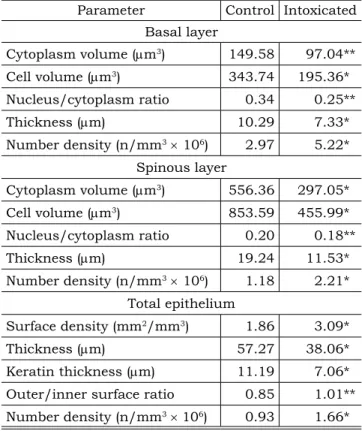
The cytoplasm and cell volumes, the nucleus/
cytoplasm ratio and the thickness of basal cells
and spinous cells layers were significantly reduced
in the floor of the mouth. The cell number density
of both layers was significantly increased in treated
pups (Table 2).
The epithelium and keratin were thinner in
treated pups (p < 0.01). The surface density,
out-er/inner surface ratio and cell numerical density
showed significantly higher values in treated pups
(Table 2).
DISCUSSION
In this study, a significant lower body weight
of pups of animals intoxicated with cadmium was
observed. Reduced pup weight was also observed
in rats by Crowe, Morgan
6(1997), in mice by
Whel-ton
et al
.
28(1988), and in newborn lambs by Floris
et al
.
7(2000).
106
107
106
107
cadmium absorption
9and consequently reduces
body weight gain. Increased dietary intake of both
iron and cadmium was accompanied by impaired
growth rate. In the case of cadmium, growth
re-striction is considered to be an effect of the toxicity
of the metal
3.
In this study, the epithelium of the floor of
the mouth of intoxicated pups was thinner, with
smaller and more numerous cells, characterizing
cellular hypotrophy.
The histometric data shows that the
epitheli-um of the floor of the mouth was thinner in treated
pups. The cellular layers were thinner, with
nu-merous small cells, as observed after stereology,
when it was possible to observe a reduced total
epithelium thickness, associated with higher
sur-face density, as well as small cytoplasm and cell
volumes with a significantly larger cell number
density. The nuclei were smaller in the basal layer,
as observed by the lower values for the longest,
smallest and mean diameters, perimeter, area,
volume and V/A ratio. The nuclear shape was not
altered, as demonstrated by similar values for
ec-centricity, shape factor and contour index. The
spinous layer was similar to the basal one. The
granulous and keratin layers were thinner.
Cadmium is toxic to cellular processes by
dis-rupting mitochondrial function
14and can interfere
with the transportation and metabolism of many
essential metals, such as iron, copper and zinc
4.
Adequate availability of both zinc and copper is
essential for normal growth and development.
In-sufficient zinc availability in fetal or early
postna-tal life retards growth
20. Cadmium directly
inter-feres with iron absorption through the intestine,
possibly by competing with iron in the absorptive
process
21, and inducing iron-deficiency anemia.
Crowe, Morgan
6(1997) observed that this anemia
begins during the nursing period, retarding growth
of the pups.
Cadmium is found bound to metallothionein
(MT) in the liver. Concentrations of MT can be
found in the liver of mice in the postnatal period
29.
Lucis
et al.
13(1972) found significant levels of
cad-mium in the liver and intestines of the neonate.
The neonatal intestine accumulated increasing
amounts of cadmium with time, containing 17
times more cadmium than the liver after 11 days
of lactation.
Cadmium exposure in postnatal life induced
Cd-MT synthesis and consequent displacement
of zinc and copper of the MT channels
16. When
the metal exceeds the amount of MT, it begins its
toxicant effects, as observed in this paper.
The perfusion of isolated hepatic systems as
well as
in vitro
studies showed that cadmium
in-hibits the synthesis of proteins. It also interfers in
mRNA transcription binding with specific sites of
chromatine. Cadmium breaks up polyribosomic
structures
8increasing the effect on mRNA
tran-scription and, finally, it leads to peroxidation in
lipids
23which can affect the synthesis of excretory
proteins.
Cadmium in excess or free in cytoplasm binds
with cell organelles and with nuclei, altering their
function. Cadmium is also a genotoxic that causes
DNA to break up, leading
5to mutations
2and
chro-FIGURE 1 - Micrography showing floor of the mouth108
109
108
109
mosomic aberrations
10. It acts on genes playing
multiple roles in apoptosis
30.
Cadmium is also known to cause adverse
ef-fects on numerous and important cell processes
from lead metabolism interruption to the eventual
death of cells
15. Cd has high affinity for membranes
of the sulfhydryl group
11which may account for
the cell membrane disorganization
25. Cadmium
inhibits Na
+/K
+-ATPase
11as well as Ca
2+-ATPase
leading to an increase in intracellular calcium
concentration
25,26. Vorbrodt
et al.
26(1994) showed
that cadmium inhibits Ca
2+-ATPase in endothelial
cell cultures and is specifically pronounced in the
interendothelial fissures, that are junctional
for-mation sites.
Calcium interacts with many heavy metals
22and may be an important factor in pathophysiologic
mechanisms. The increase in intracellular calcium
concentration caused by cadmium results from an
increase in permeability in the plasmic membrane
demonstrated in the Ca
2+-ATPase inhibition
medi-ated by calcium efflux
25. These facts may account
for the results observed in this study.
CONCLUSIONS
Intoxication caused by cadmium in pups
dur-ing lactation led to slowed growth and reduced
body weight. The epithelium of the floor of the
mouth was significantly thinner, with smaller and
more numerous cells, showing cell hypotrophy.
ACKNOWLEDGMENTS
This study was supported by grants from
CNPq (National Council for Scientific and
Tech-nological Development) and UNIFRAN (University
of Franca).
REFERENCES
1. Berlin M, Ullberg S. The fate of Cd109 in the mouse. Arch
Environ Health 1963;21:686-93. 2. Biggart NW, Murphy EC Jr. Analysis of metal-induced mu-tations altering the expression or structure of a retroviral TABLE 1 - Karyometric parameters of epithelial cells
of the floor of the mouth in control (C) and cadmium-intoxicated (I) pups. Mann-Whitney test.
Parameter Basal layer Spinous layer
C I C I
Longest axis (µm) 8.38 6.59* 9.68 8.03*
Shortest axis (µm) 6.19 5.01* 7.12 5.66*
Mean axis (µm) 7.18 5.72* 8.27 6.71*
D/d ratio 1.37 1.33 1.38 1.44
Perimeter (µm) 23.05 18.34* 26.60 21.72*
Area (µm2) 40.81 26.11* 54.17 35.81*
Volume (µm3) 198.53 102.46* 302.91 163.69*
V/A ratio 4.79 3.81* 5.51 4.48*
Shape factor 0.96 0.96 0.95 0.94
Contour index 3.62 3.61 3.63 3.65
Eccentricity 0.62 0.57 0.62 0.66
*Statistically significant at p < 0.01. D/d ratio: ratio of the longest to the shortest axis. V/A ratio: ratio of volume to area.
TABLE 2 - Mean stereological parameters of the floor of
the mouth epithelium in control and cadmium-intoxi-cated pups. Mann-Whitney test.
Parameter Control Intoxicated
Basal layer
Cytoplasm volume (µm3) 149.58 97.04**
Cell volume (µm3) 343.74 195.36*
Nucleus/cytoplasm ratio 0.34 0.25**
Thickness (µm) 10.29 7.33*
Number density (n/mm3× 106) 2.97 5.22*
Spinous layer
Cytoplasm volume (µm3) 556.36 297.05*
Cell volume (µm3) 853.59 455.99*
Nucleus/cytoplasm ratio 0.20 0.18**
Thickness (µm) 19.24 11.53*
Number density (n/mm3× 106) 1.18 2.21*
Total epithelium
Surface density (mm2/mm3) 1.86 3.09*
Thickness (µm) 57.27 38.06*
Keratin thickness (µm) 11.19 7.06*
Outer/inner surface ratio 0.85 1.01**
Number density (n/mm3× 106) 0.93 1.66*
108
109
108
109
17. Petersson Grawe K, Oskarsson A. Cadmium in milk and mammary gland in rats and mice. Arch Toxicol 2000; 73:519-27.
18. Sala MA, Komesu MC, Lopes RA, Maia Campos G. Karyometric study of basal cell carcinoma. Braz Dent J 1994;5:11-4.
19. Sala MA, Lopes RA, Matheus M. Método morfológico para análisis cuantitativa de los tejidos. Determinación de los parámetros normalis para el hepatocito de rata. Arch Fac Med Zaragoza 1992;32:29-31.
20. Sandstead HH, Gillespie DD, Brady RN. Zinc de-ficiency: effect on brain of the suckling rat. Pediatr Res 1972;6:119-25.
21. Schafer S, Elsenhans B. Iron retention and distribu-tion in the cadmium-induced iron deficiency. Ecotoxicol Environ Saf 1985;10:128-41.
22. Shamoo AE. Biological target sites of mercurials. In: Eccles CU, Annau Z. The toxicity of methyl mercury. Bal-timore: Johns Hopkins University Press; 1987. p. 13-23. 23. Stacey NH, Klaassen CD. Cadmium uptake by isolated
rat hepatocytes. Toxicol Appl Pharmacol 1980;55:448-55.
24. Templeton DM, Cherian MR. Toxicological significance of metallothionein. Methods Enzymol 1991;205:11-24. 25. Visser GJ, Peters PHJ, Theuvenet APR. Cadmium
ion is a non-competitive inhibitor of red cell Ca2+-ATPase
activity. Biochim Bhiophys Acta 1993;1152:26-34. 26. Vorbrodt AW, Trowbridge RS, Dobrogowska DH.
Cyto-chemical study of the effect of aluminium on cultured brain microvascular endothelial cells. Histochem J 1994;26:119-26.
27. Webster WS. Cadmium-induced fetal growth retarda-tion in the mouse. Arch Environ Health 1978;33:36-42. 28. Whelton BD, Bhattacharyya MH, Carnes BA, Moretti
ES, Peterson DP. Female reproduction and pup survival and growth for mice fed a cadmium-containing purified diet through six consecutive rounds of gestation and lactation. J Toxicol Environ Health 1988;24:321-43.
29. Wong KL, Klaassen CD. Neurotoxic effects of cadmium in young rats. Toxicol Appl Pharmacol 1982;83:330-7. 30. Yonish-Rouach E, Gnsberg D, Oren M. The role of
tumour suppressor genes in apoptosis. In: Lavin M, Wa-ters D. Programmed cell death: the cellular and molecular biology of apoptosis. Chur: Harwood Academic Publishers; 1993. p. 187-203.
Received for publication on Aug 01, 2003 Accepted for publication on Apr 29, 2004 gene in a mammalian cell line. Mutat Res
1988;198:115-29.
3. Britton RS, Tavill AS, Bacon BR. Mechanisms of iron tox-icity. In: Brock JH, Halliday JW, Pippard MJ. Iron me-tabolism in health and disease. London: Saunders; 1994. p. 311-51.
4. Cheng L. The concept of direct and indirect neurotoxicity and the concept of toxic metal/essential element interac-tions as a common biomechanism underlying metal toxic-ity. Bull Brain Environ Risks 1992;2:61-82.
5. Coogan TP, Bare RM, Waalkes MP. Cadmium-induced DNA strand damage in cultured liver cells: reduction in cadmium genotoxicity following zinc pretreatment. Toxicol Appl Pharmacol 1992;113:227-33.
6. Crowe A, Morgan EH. Effect of dietary cadmium on iron metabolism in growing rats. Toxicol Appl Pharmacol 1997;145:136-46.
7. Floris B, Bomboi G, Sechi P, Pirino S, Marongiu ML. Cadmi-um chronic administration to lactating ewes: reproductive performance, cadmium tissue accumulation and placental transfer. Ann Chim 2000;90:703-8.
8. Gamulin S, Car N, Narancsik P. Effect of cadmium on polyribosome structure and function in mouse liver. Ex-perimentia 1977;33:1144-5.
9. Goyer RA. Toxic effects of metals. In:Doull MO. Doull’ s toxicology. The basic science of poisons. 4th ed. New York:
Pergamon Press; 1991. p. 623-80.
10. Hartwig A. Role of DNA repair inhibition in lead- and cadmium-induced genotoxicity: a review. Environ Health Perspect 1994;102(3 Suppl):45-50.
11. Lijnen P, Staessen J, Fagard R, Amery A. Effect of cad-mium on the transmembrane Na+ and K+ transport systems
in human erythrocytes. Br J Ind Med 1991;48:392-8. 12. Loiacomo NJ, Graziano JH, Kline JK, Popavac D,
Ah-medi X, Gashi E, et al. Placental cadmium and birthweight in women living near a lead smelter. Arch Environ Health 1992;47:250-5.
13. Lucis OJ, Lucis R, Shaikh ZA. Cadmium and zinc in pregnancy and lactation. Arch Environ Health 1972;25:14-22.
14. Miccadei S, Floridi A. Sites of inhibition of mitochon-drial electron transport by cadmium. Chem Biol Interact 1993;89:159-67.
15. Morselt AF. Environmental pollutants and diseases. A cell biological approach using chronic cadmium expo-sure in the animal model as a paradigm case. Toxicology 1991;70:1-32.