Licença
DOI: http://dx.doi.org/10.5007/1980-0037.2016v18n4p460
Male aging symptoms: the positive inluence of
moderate and total physical activity
Sintomas do envelhecimento masculino: a inluência
positiva da atividade física moderada e total
Melissa de Carvalho Souza Vieira1
Allana Alexandre Cardoso1
Adriana Coutinho de Azevedo Guimarães1
Abstract – he aim of the research was to analyze the association of physical activity (PA) intensity and duration with male aging symptoms. his is a cross-sectional study of probabilistic sample involving 416 men from two cities in southern Brazil. Data collec-tion used a quescollec-tionnaire divided into six parts: sample characteristics; anthropometric measurements; economic level by the Brazilian Institute of Geography and Statistics (IBGE); International Physical Activity Questionnaire (IPAQ short-version); Behavioral Risk Factors Surveillance System Questionnaire (BRFSS) and Male Aging Symptoms Scale (AMS). he sample was divided into two groups: with and without male aging symptoms, making use of descriptive and inferential statistics. he presence of male aging symptoms was identiied in 61.6% of men, especially somatic and psychological symptoms. Most were considered suiciently active (60.1%), highlighting men without male aging symptoms (p = 0.026), with a possible efect of moderate and total PA on low-intensity symptoms (p = 0.027; p = 0.015). his study identiied relationships between PA duration and intensity and intensity of male aging symptoms. PA practice with speciic intensity and duration is suggested in order to obtain health beneits related to male aging symptoms.
Key words: Physical activity; Men; Symptoms.
Resumo – O objetivo da pesquisa foi analisar a associação da intensidade e duração da atividade física (AF) com sintomas do envelhecimento masculino. Caracterizando-se como um estudo transversal, de amostra probabilística em que participaram 416 homens, de duas cidades no sul do Brasil. Para a coleta de dados utilizou-se um questionário dividido em seis partes: características da amostra; medidas antropométricas; estrato econômico pelo Instituto Braisleiro de Geograia e Estatística (IBGE); Questionário Internacional de Atividade Física (IPAQ-versão curta); Behavioral Risk Factors Surveillance System Questionaire (BRFSS); Escala dos Sintomas do Envelhecimento Masculino (AMS). A amostra foi dividida em dois grupos: com e sem sintomas do envelhecimento masculino, fazendo-se uso da estatística descritiva e inferencial. A presença dos sintomas do envelhecimento masculino foi identiicada em 61,6% dos homens, com destaque para os sintomas somáticos e psicológicos. A maioria foi considerada suicientemente ativa (60,1%), sobressaindo os homens sem sintomas do envelhecimento masculino (p= 0,026). Percebendo-se uma possível inluência da AF moderada e total na sintomatologia de intensidade leve (p= 0,027; p=0,015). O presente estudo identiicou relações entre duração e intensidade de AF com a intensidade dos sintomas do envelhecimento masculino. Sugere-se a necessidade da prática de AF com intensidade e duração especiica a im de se obter benefícios à saúde relacionada aos sintomas do envelhecimento masculino.
1 State University of Santa Catarina. Department of Health Sciences and Sports. Florianópolis, SC. Brazil.
INTRODUCTION
Male aging symptoms afect men from the age of 40 years1, which is a
period comprising functional, physiological and psychological changes taking place as part of aging, and the main indings are observed in the sexual aspect, mainly by decreased blood levels of testosterone2. Studies
have suggested that symptoms associated with this process with diferent intensities3,4 can be divided into three blocks: psychological, somatic and
sexual symptoms, thus characterizing the overall symptoms of male aging, i.e., the set of signs and symptoms observed in this period. In this process, there is a signiicant distinction with menopause, equivalent process in women, especially at physiological and hormonal level. his is because, while for women, there is a speciic symptom marking the transition that is the disruption of the menstrual cycle, in men aging symptoms occur in a slowly progressive condition4. Worldwide, approximately 20% of men
from the age of 40 years have the above symptoms and, at the age of 50, the prevalence exceeds 50%4. In Brazil, approximately 44.1% of
middle-aged men already report some symptoms1.
Epidemiological studies have shown measures to minimize the oc-currence of these symptoms, with the use of drugs and hormone replace-ment5-7. Some results have shown that in addition to these measures, PA
(physical activity) can be considered as an important means to mitigate the negative efects of these symptoms on the health of men8,9, demonstrating
to be efective in controlling psychological, somatic and sexual aspects9 .
However, there is lack of knowledge regarding the relationship between PA duration and intensity and male aging symptoms.
hus, there is need to investigate how male aging symptoms behave against diferent PA intensities and durations and maximize the beneits of PA to the health of men experiencing this process. Based on the above, the present study aimed to analyze the association between PA level, intensity and duration and male aging symptoms.
METHODOLOGICAL PROCEDURES
Study characterization
his is an exploratory analytical observational study with cross-sectional design, which is part of a more comprehensive research that examines the prevalence of male aging symptoms and its association with PA and qual-ity of life related to health in middle-aged men. All participants signed the Informed Consent Form and the study was approved by the Ethics Research Committee in Human Beings (CEPSH) of the State University of Santa Catarina, under Protocol No. 535,729.
Population and sample
Study participants were middle-aged men (40-59 years)10 from
and over 200 thousand inhabitants11. Florianópolis has 51,740 middle-aged
men and São José 20,939, making the study population of 72,679 men. he population was stratiied by economic level conglomerates accord-ing to the IBGE classiication11. To calculate the sample size, according
to Luiz and Magnanini12, prevalence of 20% of male aging symptoms for
men aged 40 years and over13, tolerable error of four percentage points, 95%
conidence level and 1.5 efect design were adopted. In addition, 10% were added for losses and refusals, and the inal sample was composed of 631 men.
Exclusion criteria were: individuals with diseases (cancer, cardiovas-cular diseases, diabetes, hypertension and paraplegia), institutionalized (resting homes, prisons, hospitals and barracks), and also those with in-ability to understand the questionnaire. For statistical analysis purposes, the sample was divided in two groups, with male aging symptoms and without male aging symptoms.
Research Tools
For data collection, a standardized questionnaire was used, which was divided into seven parts.
a) General sample characteristics:
In order to obtain information regarding the sample characteristics, questions related to age, marital status, educational level, occupation, presence of diagnosed diseases, smoking and use of drugs for diseases and sexual performance were asked.
b) Anthropometric measures:
Anthropometric data were collected in a self-reported way. Body mass index (BMI) was obtained by the ratio between body weight and squared height (kg / m2), and participants were classiied according to protocol of the World Health Organization14. For statistical purposes,
categories have been grouped into: not overweight (underweight and normal weight) and overweight (overweight and obesity).
c) Economic class:
he IBGE11 criteria were used, classifying the population according
to the average monthly family income, and for statistical analysis, data were grouped into high (A and B), intermediate (C) and low economic class (D and E).
d) Health Perception:
Health perception was obtained according to the Behavioral Risk Fac-tors Surveillance System Questionnaire (BRFSS)15, which ranks the
answers on a “Likert” scale ranging from 1 to 5, where 1 is excellent; 2 very good; 3 good; 4 regular; 5 poor. Answers 1 to 3 were grouped into very good and answers 4 and 5 into poor.
e) Physical activity:
Brazil16. For PA classiication according to Pardini et al.16, the number
of times in which an individual made at least 10 continuous minutes of walking, moderate or vigorous activity in the last week in the oc-cupational, domestic, leisure and commuting context was quantiied. PA was divided into walking, moderate, moderate + vigorous, vigorous and total in minutes / day. he sum of the duration and frequency of diferent activities was carried out to establish the following criteria: active: a) vigorous PA ≥ 3 days / week and ≥ 20 minutes / session; b) moderate ≥ 5 days / week and ≥ 30 minutes / session; c) any added activity: ≥ 5 days / week and ≥ 150 min / week; very active: a) vigor-ous ≥ 5 days / week and ≥ 30 min / session; b) vigorvigor-ous ≥ 3 days / week and ≥ 20 min / session + moderated ≥ 5 days / week and ≥ 30 min / session. For statistical purposes, individuals were grouped into suiciently active (active + very active) and insuiciently active (those who did not meet the above criteria).
Total PA measured by IPAQ considers those with minimum require-ment of 3.3 METs and therefore relates to moderate intensity activity17.
f) f) Male aging symptoms:
For evaluation of male aging symptoms, the Aging Male Symptoms Scale in the Portuguese version13 was used, which consists of 17
ques-tions divided into three blocks of symptoms: psychological, somatic and sexual. he overall symptom score was categorized, and subjects with score ≥ 12 points were classiied as having psychological symp-toms; those with score ≥ 13 points with somatic symptoms, and ≥ 8 points as sexual symptoms. To analyze the overall score, those with score ≥ 27 points were classiied as having aging symptoms, and lower values as no symptoms. hose with score between 27 and 36 points were considered with “mild symptoms”; between 37 to 49 points, with “moderate symptoms”; and greater than or equal to 50 points, with “severe symptoms”13.
Data collection
To collect data, a team of seven individuals with at least complete high school was trained. he zip codes of each neighborhood of Florianopolis and São José were cataloged in a spreadsheet in the Microsoft Excel soft-ware version 2010, according to economic classes. his softsoft-ware was used to draw zip codes, representing the street to be traveled.
Later, the irst domicile to be included in the study was selected. he interval between domiciles was according to the number of domiciles found on every street in which men aged 40-59 years could be found. Domiciles were considered excluded from the study after the third attempt to contact or refusal to provide data. his process was reproduced in all economic classes.
were found. hus, a cluster sample was randomly composed of 416 men with mean age of 49 ± 6 years, 24 of economic class A, 89 of economic class B, 234 of economic class C and 69 of economic class D, representing 66% of the necessary sample of 631 men.
he questionnaire was applied in an interview format; however, in the block of sexual symptoms in the scale of male aging symptoms, the participant could answer individually, if he felt embarrassed due to the intimate nature of questions.
Statistical analysis
Data were analyzed using the Statistical Package for Social Sciences (SPSS) - version 20.0 and Bioestat version 5.3. Descriptive analysis was performed by calculating the mean, standard deviation and percentage values. Data normality was veriied by the Kolmogorov-Smirnov test. he associations of the sample characteristics and PA levels among men with and without symptoms were performed by the Chi-square test. To compare PA intensi-ties among men with and without symptoms, the Mann-Whitney U test was used. he comparison of PA intensities and intensity of symptoms was performed by the Kruskal-Wallis test with post hoc Student-Neuman-Keuls test. he signiicance level was 5%.
RESULTS
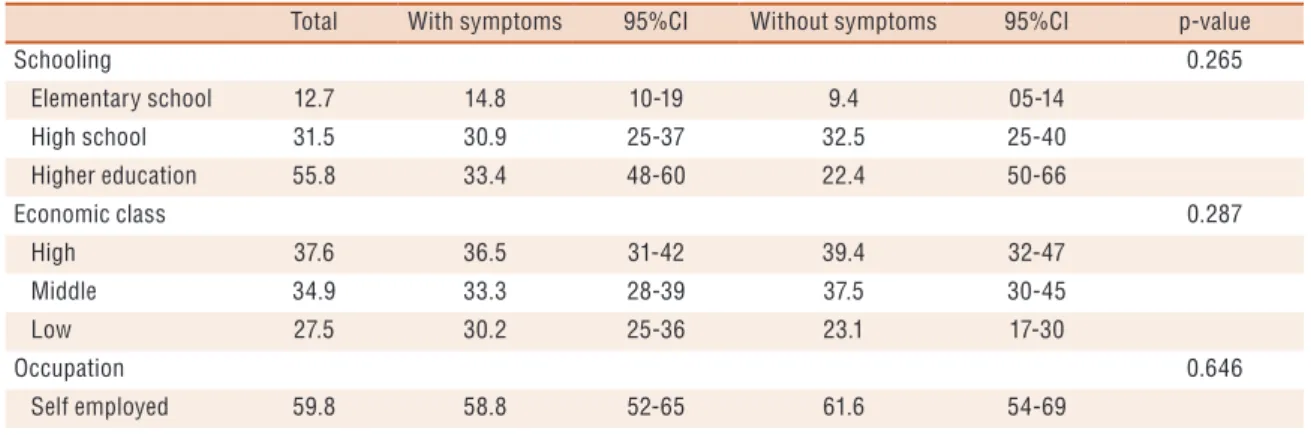
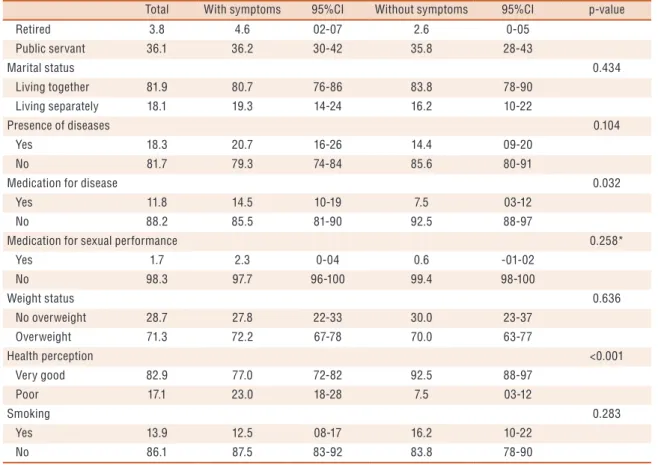
Table 1 shows the characteristics of participants with and without male aging symptoms. here were signiicant diferences in variables use of drugs for diseases and health perception (p = 0.032; p <0.001). Men without symptoms used fewer medications (92.5%) and perceived their health as very good (92.5%). he remaining variables showed no diferences; however, the group without symptoms had complete high school (32.5%) belonged to the high economic class (39.4%) were self-employed (61.6%) lived with a partner (83.8%), showed no disease (85.6%), did not used medication to improve sexual performance (99.4%) had normal weight (30%) and did not smoke (83.8%).
Table 1. Sample characteristics according to male aging symptoms (%). Florianópolis and São José 2014 (n = 416)
Total With symptoms 95%CI Without symptoms 95%CI p-value
Schooling 0.265
Elementary school 12.7 14.8 10-19 9.4 05-14
High school 31.5 30.9 25-37 32.5 25-40
Higher education 55.8 33.4 48-60 22.4 50-66
Economic class 0.287
High 37.6 36.5 31-42 39.4 32-47
Middle 34.9 33.3 28-39 37.5 30-45
Low 27.5 30.2 25-36 23.1 17-30
Occupation 0.646
Self employed 59.8 58.8 52-65 61.6 54-69
Total With symptoms 95%CI Without symptoms 95%CI p-value
Retired 3.8 4.6 02-07 2.6 0-05
Public servant 36.1 36.2 30-42 35.8 28-43
Marital status 0.434
Living together 81.9 80.7 76-86 83.8 78-90
Living separately 18.1 19.3 14-24 16.2 10-22
Presence of diseases 0.104
Yes 18.3 20.7 16-26 14.4 09-20
No 81.7 79.3 74-84 85.6 80-91
Medication for disease 0.032
Yes 11.8 14.5 10-19 7.5 03-12
No 88.2 85.5 81-90 92.5 88-97
Medication for sexual performance 0.258*
Yes 1.7 2.3 0-04 0.6 -01-02
No 98.3 97.7 96-100 99.4 98-100
Weight status 0.636
No overweight 28.7 27.8 22-33 30.0 23-37
Overweight 71.3 72.2 67-78 70.0 63-77
Health perception <0.001
Very good 82.9 77.0 72-82 92.5 88-97
Poor 17.1 23.0 18-28 7.5 03-12
Smoking 0.283
Yes 13.9 12.5 08-17 16.2 10-22
No 86.1 87.5 83-92 83.8 78-90
Chi-square test * Fisher’s exact test.
Table 2. Prevalence of male aging symptoms according to intensity (%). Florianópolis and São José 2014 (n = 416).
Symptoms None Mild Moderate Severe Total*
General symptoms 38.5 39.2 17.8 4.6 61.5
P
syc
h
o
lo
gi
ca
l Irritability 30.1 37.3 24.3 8.2 69.9
Restlessness 32.0 37.0 22.6 8.4 68.0
Anxiety 49.6 28.7 14.0 7.6 50.4
Depressed mood 61.8 23.9 11.4 2.9 38.2
Feeling exhausted 65.4 22.6 9.1 2.9 34.6
S
o
m
at
ic
Muscle and joint pain 22.6 35.8 32.2 9.4 77.4
Excessive sweating 65.6 18.8 12.0 3.6 34.4
Sleeping problems 43.0 24.5 22.8 9.6 57.0
Increased need for sleep 38.6 32.0 24.0 5.3 61.4
Physical exhaustion 41.0 35.9 16.9 6.3 59.0
Decreased muscle strength 38.1 36.9 21.9 3.1 61.9
Reduced welfare sensation 38.0 36.8 23.3 1.9 62.0
S
ex
u
al
Sensation to have reached the peak 51.6 29.0 15.8 3.6 48.4
Decreased beard growth 85.3 8.4 5.5 0.7 14.7
Decreased sexual performance 47.4 33.3 17.1 2.2 52.6
Decreased number of morning erections 51.2 27.3 18.8 2.7 48.8
Decreased libido 59.4 23.3 14.4 2.9 40.6
Table 2 shows male aging symptoms and their intensities. Most men showed general symptoms (61.5%). here was a higher prevalence of so-matic symptoms such as muscle and joint pain (77.4%); reduced welfare sensation (62%); decreased muscle strength (61.8%); increased need for sleep (61.3%) and physical exhaustion (58.9%); followed by psychological symptoms such as irritability (69.7%) and restlessness (68.0%). he only sexual symptom was decreased sexual performance (52.6%). All symptoms, including general symptoms, often occurred in mild intensity.
PA level showed a signiicant diference (p = 0.026), in which the majority of men were classiied as suiciently active (60.1%), especially those without male aging symptoms (66.9%) (Figure 1).
Figure 1. PA level according to male aging symptoms (%). Florianópolis and São José 2014 (n = 416). Chi-square test; p = 0.02
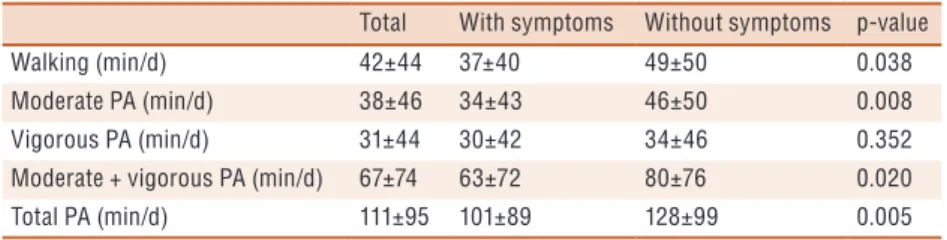
Based on results of Table 3, men without symptoms showed higher walking time (49 ± 50 min / day) moderate PA (46 ± 50 min / day) mod-erate + vigorous PA (80 ± 76 min / day) and total PA (128 ± 99 min / day) with signiicant diference (p = 0.038; p = 0.008; p = 0.020; p = 0.005).
Table 3. Comparison of physical activity duration and time spent sitting among men with and without symptoms (mean and standard deviation). Florianópolis and São José 2014 (n = 416)
Total With symptoms Without symptoms p-value
Walking (min/d) 42±44 37±40 49±50 0.038
Moderate PA (min/d) 38±46 34±43 46±50 0.008
Vigorous PA (min/d) 31±44 30±42 34±46 0.352
Moderate + vigorous PA (min/d) 67±74 63±72 80±76 0.020
Total PA (min/d) 111±95 101±89 128±99 0.005
PA: Physical Activity. Mann-Whitney U test. Min / d: Minute / day
Table 4. Comparison of PA intensity with the intensity of male aging symptoms of men with symptoms (mean and standard deviation). Florianópolis and São José 2014 (n = 256)
Male aging symptoms
PA MildA ModerateB SevereC p-value Post hoc
Walking (min/d) 38±37 35±43 41±50 0.806
-Moderate PA (min/d) 39±46 25±37 20±34 0.027 A>C,B
Total PA (min/d) 113±94 83±79 67±73 0.015 A>C,B
Kruskal Wallis test - Post hoc Student Newman Keuls. A = Mild; B = Moderate; C = Severe.
DISCUSSION
Based on the results above, it was observed that the frequency of general symptoms were present in most men. High prevalence of somatic and psychological symptoms was identiied, corroborating a population-based study conducted in 18 state capitals in Brazil1.
Regarding somatic symptoms, most complaints reported in this study were related to muscle and joint pain, which afected more than 70% of the sample. In the prevalence of psychological symptoms, most men reported irritability and restlessness of mild intensity. hese symptoms have also been reported by other male populations aged over 40 years in national and international studies1,19.
his study showed a signiicant association between symptoms and health-related characteristics such as use of medications and health percep-tion, thus identifying that most men do not use drugs and perceive their health as very good, showing no symptoms. Similarly to a study carried out in southern Brazil, where Corrêa et al.20 found that men with negative
health perception had severe male aging symptoms. Health perception is identiied as a predictor of mortality and associated to chronic diseases in men21. hus, those who perceive their health in a positive way are possibly
healthy men, justifying the lower prevalence of symptoms in this group. It is noteworthy that the general male aging symptoms are composed of somatic, psychological and sexual aspects, and PA practice corroborates these aspects in general22, making it possible to infer that it is able to reduce
the prevalence of male aging symptoms20. Regarding somatic aspects, it was
observed that PA mitigates the negative efects of aging on muscle strength 23.
In longitudinal analysis, it was speciied that the high prevalence of PA practice in individuals aged 50 years serves as a protective measure for the development of depression, reducing the risk by up to 94%24. Related
to sexual aspect, Cheng and Ng25 highlight the important beneits of PA
to the erectile function, thus inluencing in sexual performance. Regarding the PA level of the study participants, it was observed that most of them were suiciently active, with signiicant association between PA level and male aging symptoms. his result corroborates the indings of Corrêa et al.9,20, who used the same scale used in this study to evaluate the
Although the results obtained indicate signiicant associations between PA level and male aging symptoms, it is noteworthy that there is still no evidence associating PA intensity and duration with symptoms. hus, based on the results obtained, it was identiied that longer time of moderate and total PA (39 ± 46min / day: 113 ± 94min / day) is associated with lower intensity of symptoms.
A study with Brazilian men found that the PA practice at moderate intensity lasting at least 180 minutes per week has been linked to health beneits, as a discriminator of absence of arterial hypertension, thus aiding in the control of cardiovascular comorbidities26. In middle-aged individuals,
this practice can reduce from 20 to 40% mortality due to cardiovascular diseases27. Speciically for the male population at this age group, the beneits
of moderate PA may be similar to higher intensity PA, since throughout life, individuals maintain a high PA level 27.
According to literature data and the results obtained in this study, the practice of moderate and total PA can be beneicial to middle-aged individuals, positively acting on male aging symptoms and the intensity in which they occur. hus, these beneits can mitigate the negative efects of aging regarding the somatic, psychological and sexual aspects.
However, the results of this study should be interpreted with caution because the sample did not reach the population representativeness. here was diiculty in inding individuals in their domiciles, since the age group of interest is considered active in the labor market, and when the contact was made after business hours, many claimed to be tired or did not show interest in participating in the study. here were also other limitations such as the cross-sectional design, due to the possibility of reverse causality.
his study is highlighted due to the use of a probabilistic sampling design, allowing the sample randomization. he study used standardized questionnaires such as the Scale of Male Aging Symptoms, which is the tool most widely used in national and international studies9, as well as the
IPAQ , the instrument used to evaluate PA most widely used in Brazil28.
Finally, the fact of researching a topic little explored in the national lit-erature enables a better understanding of the health of middle-aged men related to male aging symptoms and highlights the importance of PA practice as a measure of prevention and / or treatment of general symptoms for this population.
CONCLUSION
his study found relationships between PA duration and intensity and the intensity of male aging symptoms. Men with mild symptoms spend more time in moderate and total PA.
REFERENCES
1. Abdo CHN, Aif-Abdo J. Estudo populacional do envelhecimento (EPE): primei-ros resultados masculinos. Rev Bras Med 2007; 74(8):379-83.
2. Rohden F. A “criação” da andropausa no Brasil: articulações entre ciência, mídia e mercado e redeinições de sexualidade e envelhecimento. Psicol Conocimiento soc 2012; 2(2):196-219.
3. Cairoli CED. Deiciência androgênica no envelhecimento masculino (DAEM). Rev AMRIGS 2004; 4(48):291-9.
4. Heinemann LA. Aging Males’ Symptoms scale: a standardized instrument for the practice. J Endocrinol Invest. 2005; 28(11):34-38.
5. Cunningham GR. Andropause or Male Menopause? Rationale for Testosterone Replacement herapy in Older Men with Low Testosterone Levels. Endocr Pract 2013; 19(5):847-52.
6. Hohl A, Marques MO, Coral MH, Walz R. Evaluation of late-onset hypogonadism (andropause) treatment using three diferent formulations of injectable testosterone. Arq Bras Endocrinol Metab 2009; 53(8): 989-95.
7. Lang PO, Samaras D, Samaras N. Testosterone Replacement herapy in Re-versing “Andropause”: What Is the Proof-of-Principle? Rejuvenation Res 2012; 15(5):453-65.
8. Cheng JY, NG EM. Body mass index, physical activity and erectile dysfunction: An U-shaped relationship from population-based study. Int J Obes 2007; 31(10): 1571-8.
9. Corrêa LQ , Silva MC, Rombaldi AJ. Associação entre nível de atividade física nos diferentes domínios e sintomas do envelhecimento masculino. Rev Bras Ativ Fís Saúde 2014; 19(2): 186-94.
10. Andrews M. he seductiveness of agelessness. Ageing Soc 2000; 19(3):301-18.
11. Instituto Brasileiro de Geograia e Estatística/IBGE. Projeção da população do Brasil/censo 2010; Disponível em: http//www.ibge.gov.br. [2013 set 02].
12. Luiz M, Magnanini MMF. A lógica da determinação do tamanho da amostra em investigações epidemiológicas. Cad Saúde Coletiva 2000; 8(2):9-28.
13. Heinemann LAJ, Saad F, Zimmermann T, Novak A, Myon E, Badia X, Potthof P, T’Sjoen G, Pöllänen P, Goncharow NP, Kim S, Giroudet C. he Aging Males’ Symptoms (AMS) scale: update and compilation of international versions. Health Qual Life Outocomes 2003; (1).
14. World Health Organization/ WHO. he International Classiication of adult underweight, overweight and obesity according to BMI, 2004; Disponível em: http://apps.who.int/bmi/index.jsp?introPage=intro_3.html. [2013 jul 23].
15. Center for Disease Control and Prevention/CDC. Behavioral risk factor suveillance system questionnaire. Altanta: CDC; 1999.
16. Pardini R, Matsudo S, Matsudo V, Araújo T, Andrade E, Braggion G, et al. Validation of international physical activity questionnaire (IPAQ ): pilot study in brazilian young adults. Med Sci Sports Exerc 1997; 29(6):S5-S9.
17. Ainsworth BE, Haskell WL, Whitt MC, Irwin ML, Swartz AM, Strath SJ, et al. Compendium of Physical Activities: an update of activity codes and MET intensities. Med Sci Sports Exerc 2000; 31(suppl.9):S498-S504.
18. Salazar A, Paravic T, Barriga OA. Percepción de los hombres y sus parejas sobre la calidad de vida en el climaterio masculino. Rev Chil Obste Ginecol 2012; 77(1): 11-17.
19. Ichioka K, Nishiyama H, Yoshimura K, Itoh N, Okubo K, Terai A. Aging males’ symptoms scale in Japanese men attending a multiphasic health screening clinic. Urology 2006; 67(3): 589-93.
CORRESPONDING AUTHOR
Melissa de Carvalho Souza Rua Júlio Dias, 614, apto 405, Coqueiros,
Florianópolis, Santa Catarina, Brasil.
CEP: 88080-060
E-mail: [email protected]
21. Asfar T, Ahmad B, Rastam S, Mulloi TP, Ward KD, Maziak W. Self-rated health and its determinants among adults in Syria: a model from the Middle East. BMC Public Health 2007; 7: 177.
22. Hearon BA, Quatormoni PA, Mascoop JL, Otto MW. he role of anxiety sensi-tivity in daily physical acsensi-tivity and eating behavior. Eat Behav 2014; 15(2):255-8.
23. Hansen AW, Beyer N, Flensborg-Madsen T, Gronbaek M, Helge JW. Muscle strength and physical activity are associated with self-rated health in an adult Danish population. Prev Med 2013; 57(6):792-8.
24. Pereira SMP, Geofroy MC, Power C. Depressive symptoms and physical activity during 3 decades in adult life: bidirectional associations in a prospective cohort study. JAMA Psychiatry 2014; 71(12):1373-80.
25. Cheng JY, Ng EM. Body mass index, physical activity and erectile dysfunction: An U-shaped relationship from population-based study. Int J Obes 2007; 31(10):1571-8.
26. Pitanga FJG, Almeida LAB, Freitas MM, Pitanga CPS, Beck CC. Atividade física como discriminador da ausência de hipertensão arterial em homens adultos. Rev Bras Med Esporte 2014; 20(6):456-60.
27. Ramírez-Velez R, González-Ruíz K, García S, Agredo-Zúñiga RA. Sex diferences in the relationship between vigorous vs moderate intensity exercise and risk markers of overweight and obesity in healthy adults. Endocrinol Nutr 2012; 59(8):491-5.