Artigo
18(2): 155-159, Abr./Jun. 2008 Received 10 February 2008; Accepted 7 May 2008Antidiarrhoeal property of the hydroethanolic extract of the
fl
owering tops of
Anthocephalus cadamba
M. Ashraful Alam,
1Raushanara Akter,
1Nusrat Subhan,
2M. Mostafi zur Rahman,
1Muntasir
M. Majumder,
1Lutfun Nahar,
3Satyajit D. Sarker
*
,31Department of Pharmacy, Stamford University, Dhaka, Bangladesh, 2Department of Pharmacy, Northern University, Dhaka, Bangladesh,
3Department of Pharmacy and Pharmaceutical Sciences School of Biomedical Sciences, University of
Ulster, Cromore Road, Coleraine BT52 1SA,Co. Londonderry, Northern Ireland, UK
RESUMO: “Propriedade antidiarréica do extrato hidroetanólico dos topos fl oridos de
Anthocephalus cadamba”. A propriedade antidiarréica do extrato hidroetanólico dos topos fl oridos de Anthocephalus cadamba foi avaliada em animais experimentais. O extrato hidroetanólico seco (250-500 mg/kg massa corpórea, v.o.) exibiu uma diminuição dose-dependente do número total de excrementos na diarréia induzida por óleo de castor em camundongos. O extrato também causou uma redução signifi cativa (p < 0.01) e dose-dependente do acúmulo de fl uidos intestinais e do trânsito gastrointestinal de 64,59% e 71,19% nas doses de 250 e 500 mg/kg. As taxas de redução foram de 37,85% e 74,91%, respectivamente, com o grupo controle e da droga padrão.
Unitermos: Anthocephalus cadamba, Rubiaceae, antidiarréica, óleo de castor, trânsito gastrointestinal.
ABSTRACT: The antidiarrhoeal property of the hydroethanolic extract of the fl owering tops of Anthocephalus cadamba was assessed on experimental animals. The dry hydroethanolic extract (250-500 mg/kg body mass, p.o.) exhibited a dose-dependent decrease in the total number of faecal droppings in castor oil-induced diarrhoea in mice. The extract also produced a signifi cant (p < 0.01) and dose-dependent reduction in intestinal fl uids accumulation and in the gastrointestinal transit from 64.59 % and 71.19% at doses of 250 and 500 mg/kg. The reduction rates were 37.85% and 74.91%, respectively, with the control and standard drug group.
Keywords: Anthocephalus cadamba, Rubiaceae, Antidiarrhoeal, Castor oil, Gastrointestinal transit.
INTRODUCTION
Diarrhoea is one of the major causes of mortality and morbidity in children, especially under the age of 5 years, in Bangladesh and other third world countries. Diarrhoea takes a heavy toll in Bangladesh, which is criss-crossed by waterways and routinely affected by fl oods, cyclones and, recently, droughts. Each year, some 20 million children suffer an average of 3.5 episodes of diarrhoea. After acute respiratory infections, it is the second leading cause of death among children (Alam et al., 2001). While in Bangladesh, about 17% of all children admitted to the paediatrics ward die of diarrhoea, about 5-8 million deaths each year in infants and children below 5 years old are caused by diarrhoea worldwide (Fauci et al., 1998). The need for newer, more effective, and most importantly, cheaper antidiarrhoeal drugs has become a paramount issue to tackle this present situation. A number of Bangladeshi medicinal plants have been used by traditional healers to treat diarrhoea and related complications. However, the effectiveness of many of these antidiarrhoeal traditional
medicines has not been scientifi cally evaluated.
Anthocephalus cadamba (Roxb.) Miq. [Syn.
Neolamarckia cadamba (Roxb.) Bosser] of the family Rubiaceae is widely distributed throughout Bangladesh, Nepal, India, Myanmar, Sri Lanka, the Philippines, Indonesia, and Papua New Guinea (Banerji, 1977; 1978; Sahu et al., 2000; GRIN Databases, 2007). Various parts of this plant have traditionally been used as an antidiuretic, in the treatment of fever, anaemia and tumour, and for the improvement of semen quality (Umachigi et al., 2007; Dr. Duke’s Phytochemical and Ethnobotanical Databases, 2007). While previous bioactivity studies on this plant revealed its antimicrobial, antioxidant and wound healing properties, antimalarial and antihepatotoxic activities (Umachigi et al., 2007), the phytochemical investigations resulted in the isolation of indole alkaloids, secoiridoids, triterpenes and saponins from this plant (Banerji, 1977; 1978; Brown and Chapple, 1976; Kitagawa et al., 1996; Sahu et al., 1999; 2000).
plants (Uddin et al., 2005, 2007a-c; Saha et al., 2007; Datta et al., 2007), we now report on the antidiarrhoeal property of Anthocephalus cadambafl owering tops.
MATERIAL AND METHODS
Plant material
The fl owering tops of Anthocephalus cadamba
(Roxb.) Miq. were collected from Siddeswari campus, Stamford University, Bangladesh in June 2007, and identifi ed by Professor Abdul Ghani (Stamford University, Dhaka, Bangladesh), and a voucher specimen (SU-MAA-2007-2) for this collection has been retained in the Pharmacognosy Laboratory, Stamford University, Dhaka, Bangladesh.
Extraction
Shade-dried and powdered fl owering tops of A. cadamba (200 g) were Soxhlet-extracted using 70% aqueous ethanol. The extract was concentrated by evaporation under reduced pressure at 40 °C using a Buchi rotary evaporator to yield a concentrate of reddish black extract (yield appx. 6.32%).
Drugs and chemicals
Atropine sulphate and loperamide (standard reference antidiarrhoeal drugs), castor oil (laxative agent), normal saline solution (0.9% NaCl), charcoal meal (10% activated charcoal in 5% tragcanth) and vehicle (distilled water) were used.
Animals
Swiss albino mice weighing 20-25 g of both sexes were obtained from the Animal House of the International Centre for Diarrhoeal Disease and Research, Bangladesh (ICDDR, B). The animals were housed under standard laboratory conditions (relative humidity 55-65%, r.t. 23.0 ± 2.0 oC and 12 h light:dark cycle). The animals were fed with standard diet and water ad libitum.
Effect of extract on castor oil-induced diarrhoea
The method described by Uddin et al. (2005) and Awouters et al. (1978) was adopted to study the effect of the A. cadamba extract on castor oil-induced diarrhoea. Mice were weighed and grouped into 4 groups (n = 5). Group 1 received distilled water, group 2 and 3 were administered 250 and 500 mg/kg extract orally while group 4 received loperamide (5 mg/kg) orally. Each animal was then given 0.5 mL of castor oil orally after 30 min of treatment and placed in transparent cages to observe for consistency of faecal matter and frequency
of defecation for 3 h. Faeces were collected with an absorbent sheet of paper placed beneath the transparent cages (Mukherjee et al., 1998). The wet faeces were read at the end of the experiment by lifting up the upper part of the cage containing the sheet of paper and animals. The percent (%) inhibition of defecation was measured using the following formula.
% Inhibition of defecation = [(A - B) / A] x 100 A = Mean number of defecation caused by castor oil B = Mean number of defecation caused by drug or extract
Effect of extract on castor oil-induced intestinal fl uid accumulation
This was determined as described by Robert et al. (1976) and Dicarlo et al. (1994). Briefl y, the mice were fasted for 24 h but allowed free access to water. The mice were randomised and placed in 3 cages of 4 rats per cage each. Group 1 was administered distilled water, while groups 2 and 3 were pre-treated with 25 and 50 mg/kg of the extract, respectively. After 30 min, each rat was administered 2 mL of castor oil. The rats were anaesthetised 30 min later by inhalation of chloroform. The small intestine from the pylorus to caecum was dissected out and its content expelled into a measuring cylinder to measure the volume of the fl uid.
Study of small intestinal transit
This was carried out according to the method outlined by Uddin et al. (2005) and Mujumdar (1998) using charcoal meal as a diet marker. The mice were divided into 4 groups of 6 animals each. The fi rst group (the control group) was orally administered the vehicle (0.5% Tween 80 in distilled water). The second and third groups orally received CGAE, 375 mg/kg and 750 mg/kg body weight, respectively. The fourth group also orally received the standard drug, atropine sulphate (5 mg/kg body weight). Thirty minutes after administration, each animal was given 1 mL of charcoal meal orally (10% activated charcoal in 5% gum acacia). After 30 min, each animal was sacrifi ced and the distance covered by the charcoal meal in the intestine, from the pylorus to the caecum was measured and expressed as a percentage of distance moved.
Statistical analysis
Experimental values were expressed as Mean
± SEM. Independent Sample t-test was carried out for statistical comparison. Statistical signifi cance was considered to be indicated by a p value < 0.05 in all cases.
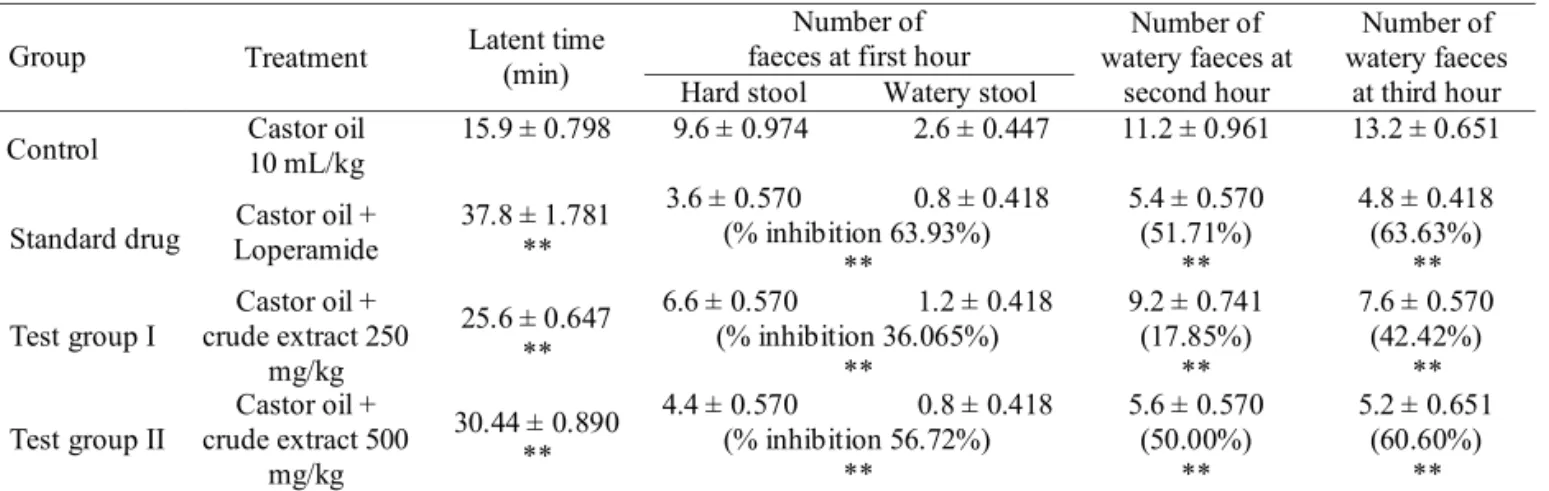
In the castor oil-induced diarrhoea experiment, the mice group that did not receive the plant extract showed typical diarrhoeal signs and symptoms such as watery and frequent defecation. The hydroethanolic extract of A. cadamba produced a notable antidiarrhoeal effect in mice (Table 1). Both doses of the extract signifi cantly decreased (p < 0.05) the total number of wet faeces produced by administration of castor oil (7.6 ± 0.570 at the dose of 250 mg/kg and 5.2 ± 0.651 at the dose of 500 mg/kg) as compared to the castor oil-treated control group (13.2 ± 0.651) at third hour of observation. The percentage of inhibition of castor oil-induced diarrhoea in the extract-treated mice was 42.42 and 62.62%, respectively, at the doses of 250 and 500 mg/kg. The effect of the extract was similar to that of the standard drug, loperamide (3 mg/kg), which produced an inhibition of 63.63% (Table 1).
The average volume of faeces in the control group was 1.108 ± 0.072 mL. Treatment with both doses of the extract signifi cantly reduced (p < 0.05) the volume of faeces to 0.074 ± 0.037 mL and 0.082 ± 0.041 mL, respectively, at the doses of 250 and 500 mg/kg
(Table 2).
The administration of the extract also slowed down the propulsion of charcoal meal through the gastrointestinal tract when compared to the castor oil-treated mice. The percentage inhibition of intestinal length travelled by charcoal meal in the extract-pre-treated (250 and 500 mg/kg) and castor oil-extract-pre-treated mice was 64.590 ± 1.543; 71.190 ± 1.264 and 37.854 ± 2.539, respectively. Atropine on its part produced a marked decrease in the propulsive movement and the intestinal length travelled by charcoal meal and the percentage inhibition of transit was 74.916 ± 1.028 (Table 3).
The castor oil test has been used extensively to screen and evaluate antidiarrhoeal properties of drugs in mice. Within 1 h of oral administration of the oil, the animals begin to evacuate watery stools (Awouters et al., 1975; Santos et al., 2007). Castor oil causes diarrhoea due to its active metabolite, ricinolic acid (Ammon and Thomas, 1974; Watson and Gordon, 1962), which stimulates peristaltic activity in the small intestine, leading to changes in the electrolyte permeability of the intestinal mucosa. Its action also stimulates the release
Group Treatment Latent time (min)
Number of faeces at first hour
Number of watery faeces at
second hour
Number of watery faeces
at third hour Hard stool Watery stool
Control Castor oil 10 mL/kg
15.9 ± 0.798 9.6 ± 0.974 2.6 ± 0.447 11.2 ± 0.961 13.2 ± 0.651
Standard drug Loperamide Castor oil + 37.8 ± 1.781 **
3.6 ± 0.570 0.8 ± 0.418 (% inhibition 63.93%)
**
5.4 ± 0.570 (51.71%)
**
4.8 ± 0.418 (63.63%)
**
Test group I
Castor oil + crude extract 250
mg/kg
25.6 ± 0.647 **
6.6 ± 0.570 1.2 ± 0.418 (% inhibition 36.065%)
**
9.2 ± 0.741 (17.85%)
**
7.6 ± 0.570 (42.42%)
**
Test group II
Castor oil + crude extract 500
mg/kg
30.44 ± 0.890 **
4.4 ± 0.570 0.8 ± 0.418 (% inhibition 56.72%)
**
5.6 ± 0.570 (50.00%)
**
5.2 ± 0.651 (60.60%)
**
Group Treatment Volume of fluid accumulated in the intestine (mL) Control Castor oil 10 mL/kg 1.108 ± 0.072
Standard drug Castor oil + Loperamide 0.274 ± 0.017 Test group I Castor oil + crude extract 250 mg/kg 0.074 ± 0.037 Test group II Castor oil + crude extract 500 mg/kg 0.082 ± 0.041
Group Treatment Length of the Intestine (cm)
Length of intestinal transit (cm)
% inhibition of transit Control Distilled water + Charcoal meal 78.186 ± 2.755 48.6 ± 2.706 37.854 ± 2.539 Standard drug Atropine sulphate + Charcoal meal 70.168 ± 1.897** 17.6 ± 0.836** 74.916 ± 1.028** Test group I Charcoal meal + crude extract 250 g/kg 80.124 ± 1.934** 28.4 ± 1.604** 64.590 ± 1.543** Test group II Charcoal meal + crude extract 500 g/kg 79.16 ± 0.182 22.8 ± 0.961** 71.190 ± 1.264**
Table 1. Effect of the hydroethanolic extract of A. cadamba on castor oil-induced diarrhoea in mice.
Effect of the extract on castor oil-induced diarrhoea in mice. Extracts were administered per orally 45 minutes before castor oil administration. Values are expressed as mean ± SEM, n = 5; **Signifi cant relative to control (p < 0.05).
Table 2. Effect of the hydroethanolic extract of A. cadamba on castor oil-induced fl uid accumulation in mice.
Effect of the extract on castor oil-induced fl uid accumulation in mice. Extracts were administered per orally 45 min before castor oil administration. Values are expressed as mean ± SEM, n = 5; **Signifi cant relative to control (p < 0.05).
of endogenous prostaglandin (Galvez et al., 1993). Loperamide, apart from regulating the gastrointestinal tract, is also reported to slow down transit in the small intestine, reduce colon fl ow rate, and consequently any effect on colonic motility (Theoderau et al., 1991; Salgado et al., 2005).
In this study, the hydroethanolic extract of A. cadamba displayed a signifi cant and dose-dependent antidiarrhoeal property. The results were similar to that of the standard drug loperamide (3 mg/kg) with regard to the severity of diarrhoea. The extract signifi cantly reduced intestinal transit as observed by the decrease in intestinal motility of charcoal meal, and also led to a marked reduction in the volume of the intestinal contents.
The antidiarrhoeal property of the hydroalcoholic extract of A. cadamba found in the present study could be owing to the presence of indole alkaloids, secoiridoids, triterpenes and saponins in this plant. Previous studies showed that antidysenteric and antidiarrhoeal properties of medicinal plants were mostly due to tannins, alkaloids, saponins, fl avonoids, sterol and triterpenes (Galvez et al., 1991, 1993; Longanga et al., 2000).
The results obtained in this study established the antidiarrhoeal property of the hydroethanolic extract of the fl owers tops of A. cadamba.
ACKNOWLEDGMENTS
The authors would like to thank Professor Abdul Ghani (Stamford University) for taxonomical identification of the plant sample, and Stamford University, Bangladesh for providing necessary fundings and logistics.
REFERENCES
Alam NH, Faruque AS, Dewan N, Sarker SA, Fuchs GJ 2001. Characteristics of children hospitalized with severe dehydration and persistent diarrhoea in Bangladesh. J Health Popul Nutr19: 18-24.
Ammon PJ, Thomas PS 1974. Effects of oleic and recinoleic acids net jejunal water and electrolyte movement J Clin Invest53: 374-379.
Awouters F, Neimegeers CJE, Lenaert FM, Janssen PAJ 1978. Delay of castor oil diarrhoea in rats; A new way to evaluate inhibitors of prostaglandin’s biosynthesis. J Pharm Pharmacol30: 41-45.
Awouters F, Niemegeers CJE, Kuyps KJ, Janseen PAJ 1975. Loperamide antagonism of castor oil - induced diarrhoea in rats: A quantitative study. Arch Int Phar 217: 29-37.
Banerji N 1978. Structure of 2 new saponins from stem bark of Anthocephalus cadamba MIQ. J Indian Chem Soc 55: 275-278.
Banerji N 1977. New saponins from stem bark of Anthocephalus cadamba MIQ. Indian J Chem B 15: 654-655. Brown RT, Chapple CL 1976. Anthocephalus alkaloids:
cadamine and isocadamine. Tetrahedron Lett 19: 629-630.
Datta BK, Nahar L, Rahman MM, Gray AI, Auzi AA, Sarker SD 2007. Polygosumic acid, a new cadinane sesquiterpene, from Polygonum viscosum inhibits the growth of drug-resistant Escherichia coli and Staphylococcus aureus (MRSA) in vitro. J Nat Med 61: 391-396.
Dicarlo GD, Mascolo N, Izzo AA, Capasso F 1994. Effect of quereetine on the gastrointestinal tract in rats and mice. Phytother Res 8: 42-45.
Dr. Duke’s Phytochemical and Ethnobotanical Database 2007. ARS, National Genetic Resources Program. Germplasm Resources Information Network - (GRIN), National Germplasm Resources Laboratory, Beltsville, Maryland. Available on-line at: http:// www.ars-grin.gov/cgi-bin/duke/ethnobot.pl
Fauci AS, Bravnwold E, Isselpacker K, Wilson JD, Kasper DL, Hauser SL, Longo DL 1998. Harrison’s Principles of Internal Medicine. New York, McGraw Hill Company, vol 1, pp. 236-242.
Galvez J, Zarzuelo A, Crespo ME 1991. Antidiarrhoeic activity of Scleroarya birrea bark extract and its active tannin constituent in rats. Phytother Res5: 276-278. Galvez J, Zarzuelo A, Crespo ME, Lorente MD, Ocete MA,
Jimenez J 1993. Antidiarrhoeic activity of Euphorbia hirta extract and isolation of an active fl avonoid constituent. Planta Medi59: 333-336.
GRIN Taxinomy Databases 2007. USDA, ARS, National Genetic Resources Program. Germplasm Resources Information Network - (GRIN), National Germplasm Resources Laboratory, Beltsville, Maryland. Available on-line at: http://www.ars-grin.gov/cgi-bin/npgs/html/taxon.pl?3575
Kitagawa I, Wei H, Nagao S, Mahmud T, Hori K, Kobayashi M, Uji T, Shibuya H 1996. Indonesian medicinal plants. XIV. Characterisation of 3’-O-caffeoylsweroside, a new secoiridoid glucoside, and kelampayosides A and B, two new phenolic apiglucosides from the bark of Anthocephalus chinensis (Rubiaceae). Chem Pharm Bull44: 1162-1167.
Longanga OA, Vercruysse A, Foriers A 2000. Contribution to the ethnobotanical, phytochemical and pharmacological studies of traditionally used medicinal plant in the treatment of dysentery and diarrhoea in Lomela area, Democratic Republic of Congo (DRC). J Ethnopharmacol71: 411-423. Mujumdar AM 1998. Antidiarrhoeal activity of Azadiachta
indica leaf extract. Indian Drugs35: 417-420. Mukherjee PK, Saha K, Murugesan T, Mandal SC, Pal M, Saha
BP 1998. Screening of antidirrhoeal profi le of some plant extracts of a specifi c region of West Bengal. Indian J Ethnopharmacol60: 85-89.
Robert A, Nezarmis JE, Lancaster C, Henchar AI, Kleppre MS 1976. Enteropooling Assay: A test for diarrhoea produced by prostaglandins. Prostaglandins 11: 809-814.
Saha A, Masud MA, Bachar SC, Kundu JK, Nahar L, Datta BK, Sarker SD 2007. Analgesic and anti-infl ammatory activities of the extracts of Phyllanthus reticulatus in mice model. Pharm Biol 45: 355-359.
Anthocephalus cadamba. J Chem Res S 22-23. Sahu NP, Koike K, Jia ZH, Achari B, Banerjee S, Nikaido T
1999. Structure of two novrel isomeriv triterpene saponins from Anthocephalus cadamba. Magn Reson Chem37: 837-742.
Salgado HRN, Roncari AFF, Moreira RRD 2005. Antidiarrhoeal effects of Mikania glomerata Spreng. (Asteraceae) leaf extract in mice. Rev Bras Farmacogn 15: 205-208.
Santos VL, Costa VBM, Agra MF, Silva BA, Batista LM 2007. Pharmacological studies of ethanolic extracts of Maytenus rigida Mart (Celastraceae) in animal models. Rev Bras Farmacogn 17: 336-342.
Theoderau V, Fioramont J, Hachet T, Bueno L 1991. Absorptive and motor components of anti-diarrhoeal action of loperamide: an in vivo study in pigs, Gut 32: 1355-1359.
Uddin SJ, Sjilpi JA, Alam SMS, Alamgir M, Rahman MT, Sarker SD 2005. Antidiarrhoeal activity of the methanol extract of the barks of Xylocarpus moluccensis in castor oil- and magnesium sulphate-induced diarrhoea models in mice. J Ethnopharmacol 101: 139-143.
Uddin SJ, Shilpi JA, Rouf R, Ferdous MM, Nahar L, Sarker SD 2007a. Neuropharmacological properties of Xylocarpus molucensis. Fitoterapia78: 107-111. Uddin SJ, Nahar L, Shilpi JA, Shoeb M, Borkowski T,
Gibbons S, Middleton M, Byres M, Sarker SD 2007b. Gedunin, a limonoid from Xylocarpus granatum inhibits the growth of CaCo2 colon cancer cell line in vitro. Phytother Res21: 757-761.
Uddin SJ, Shilpi JA, Byres M, Middleton M, Shoeb M, Nahar L, Sarker SD 2007c. Swarnalin and cis-swarnalin, two new tetrahydrofuran derivatives with free radical scavenging activity, from the aerial parts of Cuscuta refl exa. Nat Prod Res21: 663-668.
Umachigi SP, Kumar GS, Jayaveera KN, Kishore DVK, Ashok-Kumar CK, Dhanpal R 2007. Antimicrobial, wound healing and antioxidant activities of Anthocephalus cadamba, African Journal of Traditional, Complementary and Alternative Medicines 4: 481-487.