ISSN 0102-695X DOI: 10.1590/S0102-695X2012005000143 Received 30 Jun 2012 Accepted 17 Oct 2012 Available online 4 Dec 2012
HPLC analytical methodologies applied for
quantii cation of l avonoids from leaves of
Bauhinia forfi cata
Graziella S. Marques,
1Waleska F. Leão,
2Magaly A. M. Lyra,
1Monize S. Peixoto,
1Rebeka P. M. Monteiro,
2Larissa A. Rolim,
1Haroudo S. Xavier,
1,2Pedro J. R. Neto,
1,2Luiz A. L. Soares
*,1,21Programa de Pós-graduação em Ciências Farmacêuticas, Universidade Federal de Pernambuco, Brazil,
2Departamento de Ciências Farmacêuticas, Universidade Federal de Pernambuco, Brazil.
Abstract: Spectrophotometric determinations (direct dilution or after acid hydrolysis) of l avonoid content in leaves of Bauhinia fori cata Link, Fabaceae, from two different regions from Brazil were compared with contents of kaempferitrin quantii ed by HPLC analysis. The absence of kaempferitrin peak in one sample denotes the risk of LC-method failure. On the other hand, the both spectrophotometric assays showed satisfactory performance and do not underwent inl uence from absence of kaempferitrin. Since several l avonoids are present in the herbal material, different content of l avonoids were observed for each analytical procedure. However, a strong positive association could be detected among methods (R2>0.99). Although a conversion factor should
be adopted to compare procedures, the data showed that the spectrophotometric methods remain as an important tool for analysis of complex matrices such herbal drugs, notably when there aren't any pharmacological or chemical marker established for the species. Moreover, it’s possible to suggest that the techniques studied in this work exhibit similar performance under the conditions employed. Nevertheless, before the adoption of kaempferitrin as an analytical marker by HPLC for Bauhinia species, the pharmacological knowledge should be better developed. In this cases, the use of spectrophotometric assay provide higher assurance of the reproducibility of the efi cacy and safety.
Keywords: Bauhinia forficate flavonoids, HPLC quantification UV/Vis
Introduction
Flavonoids, an important class of polyphenols from secondary metabolism in plants, are chemical and pharmacological markers of great importance for the quality control of medicinal plants and phytopharmaceuticals (Petry et al., 2001; Soares et al., 2003; Xu et al., 2005; Silva et al., 2009; Fernandes et al., 2012; Marques et al., 2012). A variety of analytical methods can be used to quantify these compounds, however UV/Vis spectroscopy and high
performance liquid chromatography (HPLC) are the most
prominent techniques (Komarova et al., 2009; Luo et al., 2011; Obmann et al., 2012).
The UV/Vis spectrophotometric determination is
one of the most widely used methods for quantii cation of total l avonoids in raw plant materials due to its simplicity,
low cost of implementation and wide availability in laboratories for quality control (Lombard et al., 2002;
Popova et al., 2004; Chabariberi et al., 2009; Komarova
et al., 2009; Silva et al., 2009; Luo et al., 2011). On the
other hand, the HPLC analysis is an analytical procedure
more sensitive and selective in the area of natural products to quantify isolated substances and is widely used for all
classes of l avonoids (Lombard et al., 2002; César et al.,
2007; Komarova et al., 2009; Luo et al., 2011).
Despite the wide applicability of the both techniques mentioned above, some questions about the
specii city and comparability of their results have been
done in view of the broad structural variability presented by
the l avonoid compounds, as well as limitations inherent in each methodology. Accordingly, several scientii c studies conducted with both procedures have shown conl icting results (Popova et al., 2004; Chabariberi et al., 2009;
Müller et al., 2005; Pinheiro et al., 2006).
Moreover, the choice to quantify a set of compounds or isolated compounds in biological matrices such as herbal materials is a very controversial point in the analysis and quality control. This is because, unlike
Article
synthetic drugs, the pharmacological activity from herbal drugs or phytopharmaceuticals is a result of joint action of a group of substances (Popova et al., 2004; Pinheiro et al.,
2006; Chen et al., 2007).
Furthermore, there is great dificulty to relate
the concentration of a single or a few substances to the
activity of herbal drugs. Several scientiic studies make
clear that many natural products exhibit higher biological activity than their isolated active components (Popova et
al., 2004; Chen et al., 2007; Wagner, 2011; Weerakkody et
al., 2011).
Faced with these analytical obstacles, the aim of this paper is to evaluate comparatively, the
analytical performance of procedures by HPLC and
spectrophotometry, for the quantification of flavonoids from leaves of Bauhinia forficata Link, Fabaceae.
Widely known in Brazilian traditional medicine
as “pata-de-vaca” (cow's hoof), the leaves of the species are used as antidiabetic agent which property has been attribute to the flavonol glycosides from quercetin and kaemperol, especially the 3,7-di-O
-α-L-ramnopiranosilkanferol (kaempferitrin), reported in the literature as chemical marker for this herbal drug
(Jorge et al., 2004; Pinheiro et al., 2006; Da Cunha et
al., 2010).
Material and Methods
Plant material
The leaves of Bauhinia foricata Link, Fabaceae, were obtained from two different regions of Brazil: Viçosa-MG and Telêmaco Borba-PR. The drug material was collected in Viçosa in December/2009 at Vila Gianetti,
whose identiication was performed by Professor José
Fernandes Martins and a voucher specimen was deposited
at Herbarium VIC, Department of Herbal Biology,
Federal University of Viçosa, under registration nº. 32513. Regarding the plant material originated from Telêmaco Borba, it was collected at Monte Alegre Farm in April/2010 and kindly provided by Klabin Paraná Forest Products Ltd.,
whose identiication and deposit of voucher specimen were performed at Herbarium of State University of Maringá,
under registration nº. 150. The identities of both samples
were conirmed in the Botanical Garden of Rio de
Janeiro-RJ, Brazil, by the expert in the genus Bauhinia, Angela Vaz. Both sample of the raw herbal materials were dried
under 45 °C for 72 h and then pulverized in knife mill.
Reagents and glassware
All reagents were of analytical grade: ethanol,
aluminum chloride (Vetec Fine Chemicals®, Rio de
Janeiro, Brazil), acetone, hydrochloric acid, ethyl acetate,
methanol, acetic acid (Contemporary Chemical Dynamics®,
São Paulo, Brazil ) and methenamine (Merck®, Darmstadt,
Germany). For analysis by liquid chromatography acetonitrile chromatographic grade was employed (Merck®,
Darmstadt, Germany), ultrapuriied water obtained by
Milli-Q Millipore® (Milli-Q System, Massachusetts, USA),
phosphoric acid (Chemical Dynamics® Contemporary, São
Paulo, Brazil) and kaempferitrin standard, kindly supplied
by Prof. Dr. Maique Weber Biavatti (Federal University of Santa Catarina, Florianópolis, Brazil). Calibrated volumetric lasks were used with calibration certiicate
from Satelit®.
Spectrophotometric determination of total lavonoids
content in leaves of B. foricata
The total lavonoid contents (TFC) in the leaves of
B. foricata were determinated by two spectrophotometric
methods: direct dilution (DDM) or after acid hydrolysis
of lavonoid glycosides (AHM), according methodologies
developed and validated by Marques et al (2012).
HPLC analysis of kaempferitrin from leaves of B.
foricata
Extractive solution
The extractive solution was obtained by extraction of drug material provide from Telêmaco Borba-PR under
relux with hydroalcoholic solution, in according to the
procedure described by Petry et al (1998). Thus, the dried and powdered leaves (1.0 g) were extracted with 30 mL
of ethanol:water 40% (v/v), under relux on a water bath
for 30 min. The extract was cooled to room temperature
and iltered through cotton. The residue (cotton and drug
material) was re-extracted (10 min) twice. After cooling, the
extracts were iltered and the volume adjusted to 100.0 mL volumetric lask with ethanol: water 40% (v/v), obtaining
the extractive solution (10 mg/mL; drug/solvent). The hydroalcoholic extractive solution was injected without dilution.
Reference standard
An ethanolic solution containing 0.05 mg/mL of kaempferitrin was prepared. Aliquots of this solution were diluted in ethanol to obtain concentrations corresponding to 0.003; 0.005; 0.007; 0.01 and 0.013 mg/mL.
Chromatographic conditions
Chromatographic analysis to quantify
kaempferitrin in the extractive solution were conducted on a Shimadzu® liquid chromatography (UFLC, Japan)
controlled by the LC Software Solution 1.0 and with
and diode array detector (DAD) SPD-M20A. A Restek®
C18 column (250 mm x 4.6 mm, 5μm) was used under 40 °C and protected by a pre-column Restek C18® (10 mm
× 4 mm, 5 mm). The standards and samples were eluted using a gradient mobile phase consisting of phosphoric
acid: water 0.02% (pH 2.5) (A) and acetonitrile (B). The
gradient conditions were: 0-5 min 85% A, 5-30 min 70% A, 30-32 min 80% A, 32-35 min 85% A, followed by wash
up with 100% of B for 15 min. The low was 1.0 mL/
min and injection volume of 20.0 µL. The kaempferitrin in plant material was determined by external standard method for 0.003; 0.005; 0.007; 0.01 and 0.013 mg/mL. The computer program Excel (Microsoft®) was used to
adjust the regression curve and calculate the corresponding
determination coeficient. All samples and standards were iltered through membranes with porosity of 0.22 μm
(Millipore®) and injected in triplicate.
Validation of liquid chromatographic method
The LC-method was validated according to the parameters required by the speciic resolution nº 899/03
of the National Agency for Sanitary Surveillance (Anvisa,
2003) and recommended by the International Conference on Harmonization (ICH Q2B, 1995): linearity, precision
(repeatability and intermediate precision) and accuracy. All tests were performed in triplicate.
The linearity was determined by the analysis of three authentic curves, constructed with extractive solutions (drug material from Telêmaco Borba), in six levels of concentration ranged from 2.5 to 15.0 mg/mL (drug/solvent). The curves were constructed by plotting the average values of the areas according to the concentration. The results were statistically analyzed by calculating the
linear regression by PLS method in order to deine the determination coeficient (R2).
The method precision was evaluated at two levels using extracts of 10 mg/mL (drug/solvent):
precision (repetitivity or repeatability): performed by six individual extracts examined on a single day; and,
intermediate precision: performed by two analysts on two consecutive days. The results were expressed as relative standard deviation (RSD%) or standard deviation (SD). Additionally, the results were statistically treated by two-way analysis of variance (two-two-way ANOVA).
The accuracy was evaluated by recovery experiments by adding known amount of the diluted extractive solution to the samples at 100% of the test concentration, expressed by the ratio of the average concentration determined experimentally and the corresponding theoretical concentration.
For the chromatographic method, 10.0 mL of a spiked extractive solution (12.5 mg/mL) were added to the extractive solution of 10.0 mg/mL, resulting in three replicates with 11.25 mg/mL.
Comparative evaluation of the analytical procedures
For comparative evaluation of the techniques
for quantiication of lavonoids, extractive solutions were
prepared with 0.5; 1.0 and 1.5 g of the powdered leaves
of B. foricata. The lavonoid content was determined by
spectrophotometry (direct dilution and after hydrolysis)
and by HPLC. All lavonoid concentrations obtained were
converted to the same unit (mg/mL), so if they could be compared by obtainment the linear regression line.
Results and Discussion
The most common procedure to determine the
total lavonoid content is a UV/Vis spectrophotometric
assay, based on the formation of a complex between the aluminum cation, Al (III), and the carbonyl and
hydroxyl groups of the lavonoid (Glasl & Becker, 1984;
Popova et al., 2004). The aluminum cation acts forming
stable complexes with lavonoids, with bathochromic
effect thus avoiding interference from other phenolic
compounds (Petry et al., 1998, Souza & Giovani, 2005; Silva et al., 2009). Nevertheless, the use of HPLC is the
method of choice for qualitative and quantitative analysis
of lavonoid markers, due to its higher sensitivity and accuracy. Highlighting the use of reverse phase columns and gradient elution systems to this purpose (Chabariberi
et al., 2009; Obmann et al., 2012).
In this paper, spectrophotometric methods employing direct dilution or after acid hydrolysis and using aluminum chloride as a reagent, were comparatively
investigated with a HPLC method for kaempferitrin as
chemical marker for leaves of B. foricata. The ability
of spectrophotometric procedures for the quantiication of total lavonoid content in leaves of B. foricata was previously studied and validated (Marques et al., 2012).
On the other hand, the HPLC procedure was evaluated
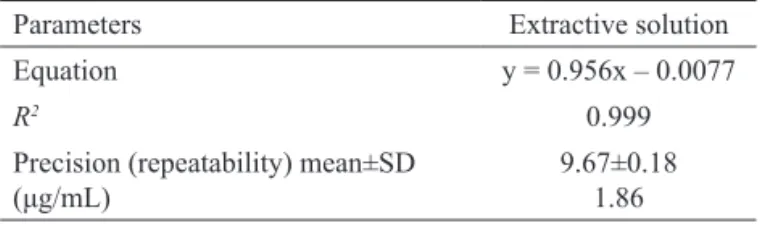
before the comparative approach. The resulting data are summarized in Tables 1, 2 and 3.
Linearity pattern was checked by analyzing standard curves of the extractive solution and kaempferitrin. The linear regression analysis by least squares method
showed a coeficient of determination (R2) higher than
0.99 for the both procedures, indicating linearity within the range of concentration. The method also showed accuracy in two analyzed levels: precision (repeatability) and intermediate precision. Regarding the precision parameter,
the coeficient of variation was lower than the preconized
by guidelines (5%), proving the suitability of the procedure (Anvisa, 2003).
Concerning the intermediate precision, the
Table 1. Results of linearity and precision assays for determination of kaempferitrin by HPLC in extractives from leaves of Bauhinia foricata supplied from Telêmaco Borba-PR.
Parameters Extractive solution
Equation y = 0.956x – 0.0077
R2 0.999
Precision (repeatability) mean±SD
(μg/mL) 9.67±0.18 1.86
SD: standard deviation; RSD: relative standard deviation.
Table 2. Intermediary precision assay for determination of kaempferitrin by HPLC in Bauhinia foricata extractives.
Day 1 (mg/mL) mean±SD (RSD%)
Day 2 (mg/mL) mean±SD (RSD%) Analyst 1 0.00978±0.0013 (1.33) 0.00993±0.0005 (0.47) Analyst 2 0.00980±0.0017 (1.69) 0.00975±0.0009 (0.95) Results expressed as kaempferitrin. SD: standard deviation; RSD: relative standard deviation.
The accuracy was evaluated by the recovery assay and the result was appropriated in accordance com legal requirements for such matrix (Anvisa, 2003).
Table 3. Recovery result (%) for determination of kaempferitrin by HPLC in Bauhinia foricata extractives.
Data Theoretic concentration (mg/mL) 0.01066 Experimental concentration (mg/mL) 0.01044±0.00004
Recovery (%) 97.89
After validation, both spectrophotometric
procedures were employed for the quantiication of lavonoids in the samples of leaves of B. foricata. The
lavonoid contents are presented in Table 4 and the results
were comparatively evaluated. According to the results, there were no statistically differences in the performance of each analytical procedure (Table 4). On the other hand, it was observed that the data from obtained by the method after acid hydrolysis were higher for both herbal samples in comparison with the other procedures. This result can
be explained by the speciicity for lavonoid aglycones.
Thus, the procedure allows quantifying free aglycones and aglycones derived from of O-glycosyl lavonoids (release
after hydrolysis and partition), reducing the interferences from other polyphenolic compounds on the method
response, improving the speciicity to the group. However,
the presence of C-glycosyl lavonoids should be take in
to account, since they cannot undergo hydrolyses and can be discarded in the aqueous phase at the partition step
(Schmidt & Ortega, 1993; Petry et al., 1998; Müller et al., 2005; César et al., 2007).
Table 4. Total Flavonoids content in leaves of Bauhinia foricata by spectrophotometric methods.
Sample DDM (mg/mL)
mean±SD
AHM(mg/mL) mean±SD
Viçosa 0.04255±0.017 0.15881±0.00139
Telêmaco Borba 0.04665±0.048 0.15710±0.00096 Result expressed as quercetin; DDM: Direct Dilution Method; AHM: After Hydrolysis Method; SD: standard deviation.
Unlike analytical procedures by
spectrophotometry, the LC-methodologies have as major
characteristic the ability to separate the substances allowing quantifying each compound individually and therefore they are much more accurate (Lombard et al., 2002; Popova et al., 2004). Furthermore, the use of PDA (photodiode
array) detectors provides the UV proile of each compound improving the eficiency on their identiication (Popova et al., 2004). Thus, the importance of RP-LC methods for the
quality control of plant raw materials either qualitative,
through establishment of chemical proiles (ingerprints), or quantitative analysis, is unquestionable. However, the higher selectivity and speciicity of LC methods may
be considered a negative factor for complex biological matrices such as medicinal plants, particularly for species in which group(s) of active ingredient(s) is still unclear (Popova et al., 2004).
As can be seen in the chromatogram obtained for the samples of B. foricata used in this study (Figure 1), the procedure developed was able to separate and detected the peak corresponding to kaempferitrin. Although this
lavonoid has been considered by several authors the
mainly analytical marker for B. foricata (Pinheiro et al.,
2006; Da Cunha et al., 2010), our results revealed that
it could be observed only to one of the samples studied. Thus, the adoption of such marker for the quality control
may undermine the use of HPLC as an analytical tool and
lead to mistaken uncorrected conclusions about the quality of the samples.
The questioning of the right marker for the specie has been previously reported (Arigony, 2005), and was not the initial objective of this study, but the results of this study highlighted a major challenge for the development of herbal medicine in Brazil, since the chemical variability of samples associated with the absence of an appropriate marker, can be misleading assessment that limit the use
of the species. It was evident, therefore, the dificulty to
adopt very selective methods for herbal drugs, especially for those who are not clinically investigated as is the case of several Brazilian native species.
The lack of studies about the correlation between the chemical composition and the evidence of the therapeutic property of several herbal drugs can lead to mischose chemical markers that have little or no relationship
to pharmacological activity. Thus, quality speciications
for herbal materials could be established based on these
ineficient markers. So, until there is the indisputable
active/clinical marker, the variations in the concentration of unique compound, such as kaempferitrin for leaves of
B. foricata, will be not enough to assure the quality in terms of their use in therapy. In such cases, the quantitative assays of class of compounds seem to be more appropriate since they are much more robust to individual variations in quantitative and qualitative composition of compounds
in the mixture. However, regardless the principle of the
analytical method, the procedure should not jeopardize the analytical performance. It means that after choosing the chemical marker for the specie, the quantitative performance of the procedures should be similar to the reference substance. In spite of each analytical technique showed responses of different magnitudes, the presence
of signiicant correlation among procedures suggest the
possibility of comparison of their results.
Regarding the case of B. foricata, the analysis by
HPLC showed kaempferitrin in reasonable concentration
only for one sample (Figure 1). Although the antidiabetic properties of kampferitrin are related in the literature (Jorge et al., 2004), there are no reports about the activity from
other glycosides of kaempferol. Thus, the HPLC usage
for quality control remains limited to the species and the method can failure if there are variations in the proportion of the chemical marker in the mixture. Moreover, liquid chromatography plays an important role to evaluate the performance of general assay by spectrophotometry. Since the chemical marker present the physicochemical properties of its group of metabolites, the comparative investigation of
selective methods (HPLC) and methods for quantiication
of groups (UV-VIS), may provide greater reliability to the second techniques if the response of such procedures shows close correlation. In this context, the performances of spectrophotometric methods were compared with the
LC-proile of kaempferitrin in. The results are comparable
with previously report of Lombard et al. (2002), who also
study the correlation between UV-VIS e LC methods for
quercetin in onion extracts.
Although the absence of kaempferitrin in one sample does not invalidate the hypothesis of similar
performance for the group of lavonoids, the comparative
study was carried out by using the drug sample containing kaempferitrin. The procedures were compared to another at three different concentrations levels and analyzed by
regression parameter (coeficients of determination, slopes and conidence limits for intersections). The results for the
regression parameters are summarized in Table 5.
An important linear correlation was observed for all correlations performed among the three analytical methods. Thus, the concentration of kaempferitrin
obtained by HPLC showed a strong correlation with the
both spectrophotometric methods either by direct dilution
(DDM) or after acid hydrolysis (AHM). Additionally, the high values obtained for the coeficient of determination
(R2), indicated that more than 99% of the experimental variance could be explained by linear equations and thus, the responses could be attributed mainly to the variations
on the concentration of lavonoids/kaempferitrin (Table
5). In this way, the spectrophotometric responses were appropriated to be use as representative from concentrations of the kaempferitrin.
Regarding the conidence limits for the
intersections, a slight shift to higher values could be observed for both spectrophotometric methods in comparison to
HPLC. Although these results are typical to presence of
constant systematic errors, it can be easily explained by the complex nature of spectrophotometric samples. Thus, the overlapping of spectrums such as kaempferol derivates and similar aglycones, probably increase the spectrophotometric response. Better correlation between spectrophometric
and HPLC assays for lavonoids were previously related (Lombard et al., 2002). However, it was only possible when all peaks of lavonoids in the chromatogram were summed. Considering that kaempferitrin represents only one of the compounds among the different lavonoids
present in the matrix of B. foricata, it is understandable
Table 5. Statistical parameters for comparative analysis of the analytical methods.
R2 sd α CL
low CLup t
DDM vs HPLC 0.9990 1.63 4.19 -4.80 19.34 22.62
AHM vs HPLC 0.9997 3.56 13.89 2.28 47.15 40.28
AHM vs MDD 0.9998 3.21 3.31 -19.48 20.99 51.67
that the responses of spectrophotometric methods are far
superior to the results observed for HPLC.
Despite the difference expected for both
spectrophotometric methods provided by their speciicity
(Table 5), close correlation was observed and total absence
of proportional errors was conirmed by the conidence
limits of interception.
Taking into account the discussion above, as well as the advantages of UV-VIS techniques (such as simplicity and low cost of implementation); it could be concluded that the spectrophotometry remains as valid tool
for analysis of total lavonoids in herbal materials. This
approach becomes more critical due to the high cost or absence of reference substance needed for determination
of individual lavonoids (César et al., 2007; Hoffmann-Ribani & Rodriguez-Amaya., 2008).
In spite of the close correlation observed in this study among analytical methods by spectrophotometry and liquid chromatography, before the adoption of this concept to other herbal drugs and/or secondary metabolites, a careful study is required in order to identify and quantify critical steps in the procedure that may compromise the performance.
Acknowledgements
The authors thank Professor Msc. Clébio Pereira
Ferreira and Klabin Paraná Forest Products Ltd. for supplying the plant material and to Profa. Dra. Maique
Weber Biavatti due to kindly supply of the standard of kaempferitrin. This study was supported by CNPq (470179/2009-0; 483870/2011-0), FACEPE and PIBIC/
UFPE.
References
Anvisa 2003. Agência Nacional de Vigilância Sanitária, Resolução nº 899 de 29 de Maio de 2003. URL [http:// www.anvisa.gov.br/legis/resol/2003/re/899_03re.htm]; accessed Jul 2011.
Arigony ALV 2005. Determinação química e biológica de
Bauhinia foricata Link subespécie pruinosa (pata-de-vaca - Leguminosae). Rio Grande do Sul, 122p. Dissertação de Mestrado, Programa de Pós-graduação em Ciências Farmacêuticas Produtos Naturais, Universidade Federal do Rio Grande do Sul.
César IC, Braga FC, Soares CDV, Nunan EA, Barbosa TAF, Campos LMM 2007. Determinação de daidzeína, genisteína e gliciteína em cápsulas de isolavonas por cromatograia em camada delgada (CCD) e cromatograia líquida de alta eiciência (CLAE). Rev Bras Farmacogn 17: 616-625.
Chabariberi RAO, Pozzi ACS, Zeraik ML, Yariwake JH 2009. Determinação espectrométrica dos lavonóides das folhas de Maytenus (Celastraceae) e de Passilora
(Passiloraceae) e comparação com método CLAE-UV.
Rev Bras Farmacogn 19: 860-864.
Chen XJ, Guo BL, Li SP, Zhang QW, Tu PF, Wang YT 2007. Simultaneous determination of 15 lavonoids in
Epimedium using pressurized liquid extraction and high-performance liquid chromatography. J Chromatogr A 1163: 96-104.
Da Cunha AM, Menon S, Menon S, Couto AG, Urger CB, Biavatti MW 2010. Hypoglycemic activity of dried extracts of
Bauhinia foricata Link. Phytomedicine 16: 6-7. Fernandes AJD, Ferreira MRA, Randau KP, De Souza TP, Soares
LAL 2012. Total lavonoids content in the raw material and aqueous extractives from Bauhinia monandra Kurz (Caesalpiniaceae). The Scientiic World Journal 2012: Article ID 923462.
Glasl H, Becker H 1984. Flavonol-O-Glykoside: photometrische Gehaltsbestimmung. Dtsch Apoth Ztg 124: 2147-2152. Hoffmann-Ribani R, Rodriguez-Amaya DB 2008. Otimização
de método para determinação de lavonóis e lavonas em frutas por Cromatograia Líquida de Alta Eiciência utilizando Delineamento Estatístico e Análise de Superfície de Resposta. Quim Nova 31: 1378-1384. ICH 1995. International Conference on Harmonisation,
Validation of Analytical Procedures: Methodology, Q2B (CPMP/ICH/281/95).
Jorge AP, Horst H, Sousa E, Pizzolatti MG, Silva FRMB 2004. Insulinomimetic effects of kaempferitrin on glycaemia and on 14C-glucose uptake in rat soleus muscle. Chem Biol Interact 149: 89-96.
Komarova NI, Rogachev AD, Chernyak EI, Morozov SV, Fomenko VV, Salakhutdinov NF 2009. Quantitative HPLC determination of main lavonoid content of
Rhododendron adamsii leaves and stems. Chem Nat Compd 45: 26-29.
Lombard KA, Geoffriau E, Pefley E 2002. Flavonoid quantiication in onion by spectrophotometric and igh Performance Liquid Chromatography analysis.
Hortscience 37: 682-685.
Luo C, Zou X, Li Y, Sun C, Jiang Y, Wu Z 2011. Determination of lavonoids in propolis-rich functional foods by reversed phase high performance liquid chromatography with diode array detection. Food Chem 127: 314-320. Marques GS, Monteiro RPM, Leão WF, Lyra MAM, Peixoto MS,
Rolim-Neto PJ, Xavier HS, Soares LAL 2012. Avaliação de procedimentos para quantiicação espectrofotométrica de lavonoides totais em folhas de Bauhinia foricata
Link. Quim. Nova, 35: 517-522.
Müller SD, Vasconcelos SB, Coelho M, Biavatti MW 2005. LC and UV determination of lavonoids from Passilora
alata medicinal extracts and leaves. J Pharm Biomed Anal 37: 399-403.
Obmann A, Purevsuren S, Zehl M, Kletter C, Reznicek G, Narantuya S; Glasla S 2012. HPLC Determination of lavonoid glycosides in Mongolian Dianthus versicolor
by UV spectrophotometry. Phytochem Anal 23: 254-259.
Petry RD 1998. Doseamento do teor de lavonóides totais em extratos hidroalcoólicos de Passilora alata Dryander (maracujá). Rev Bras Farm 79: 7-10.
Petry RD, Ortega GG, Silva WB 2001. Flavonoid content assay: inluence of the reagent concentration and reaction time on the spectrophotometric behaviour of the aluminium chloride - lavonoid complex. Die Pharmazie 56: 465-470.
Pinheiro TSDB, Johansson LAP, Pizzolatti MG, Biavatti MW 2006. Comparative assessment of kaempferitrin from medicinal extracts of Bauhinia foricata Link. J Pharm Biomed Anal 41: 431-436.
Popova M, Bankova V, Butovska D, Petkov V, Damyanova BN, Sabatini AG, Marcazzan GL, Bogdanov S 2004. Validated methods for the quantiication of biologically active constituents of poplar-type Propolis. Phytochem Anal 15: 235-240.
Schmidt PC, Ortega GG 1983. Passionsblumenkraut. bestimmung des gesamtlavonoidgehaltes von Passilorae herba.
Deutsche Apotheker Zeitung 133, 17-26.
Silva KGH, Xavier Júnior FH, Farias IEG, Silva AKA, Caldas Neto JA, Souza LCA, Santiago RR, Alexandrino Júnior F, Nagashima Júnior T, Soares LAL, Santos-Magalhães NS, Egito EST 2009. Stationary cuvette: a new approach to obtaining analytical curves by UV-VIS spectrophotometry. Phytochem Anal 20: 265-271
Soares LAL, Bassani VL, Ortega GG, Ros Petrovick P 2003. Total lavonoid determination for the quality control of aqueous extractives from Phyllanthus niruri L. Lat Am J Pharm 22: 203-207.
Souza RFV, Giovani WF 2005. Synthesis, spectral and electrochemical properties of Al(III) and Zn(II) complexes with lavonoids. Spectrochim Acta A 61: 1985-1990.
Wagner H 2011. Synergy research: Approaching a new generation of phytopharmaceuticals. Fitoterapia 82: 34-37. Weerakkody NS, Cafin N, Lambert LK, Turner MS, Dykes
GA 2011. Synergistic antimicrobial activity of galangal (Alpinia galanga), rosemary (Rosmarinus oficinalis) and lemon iron bark (Eucalyptus staigerana) extracts. J Sci Food Agric 91: 461-468.
Xu X, YE H,Wang W, Chen G 2005. An improved method for the quantitation of lavonoids in Herba Leonuri by capillary electrophoresis. J Agric Food Chem 53: 5853-5857. *Correspondence
Luiz Alberto Lira Soares
Laboratorio de Farmacognosia, Departamento de Ciências Farmacêuticas, Universidade Federal de Pernambuco
Av. Prof. Arthur de Sá, s/n, Cidade Universitária, 50740-521 Recife-PE, Brazil