
Index and Generalized Impact Factor: An Improvement
over Existing Models
Ash Mohammad Abbas*
Department of Computer Engineering, Aligarh Muslim University, Aligarh, India
Abstract
In this paper, we describe some bounds and inequalities relatingh-index,g-index,e-index, and generalized impact factor. We derive the bounds and inequalities relating these indexing parameters from their basic definitions and without assuming any continuous model to be followed by any of them. We verify the theorems using citation data for five Price
Medalists. We observe that the lower bound forh-index given by Theorem 2,h~V
t
g{e 2g
s
,g§1, comes out to be more accurate as compared to Schubert-Glanzel relation h!C23P{
1
3 for a proportionality constant of 1, whereC is the
number of citations andP is the number of papers referenced. Also, the values ofh-index obtained using Theorem 2 outperform those obtained using Egghe-Liang-Rousseau power law model for the given citation data of Price Medalists. Further, we computed the values of upper bound ong-index given by Theorem 3,gƒ(hze), whereedenotes the value of e-index. We observe that the upper bound ong-index given by Theorem 3 is reasonably tight for the given citation record of Price Medalists.
Citation:Abbas AM (2012) Bounds and Inequalities Relatingh-Index,g-Index,e-Index and Generalized Impact Factor: An Improvement over Existing Models. PLoS ONE 7(4): e33699. doi:10.1371/journal.pone.0033699
Editor:Neil R. Smalheiser, University of Illinois-Chicago, United States of America
ReceivedJanuary 26, 2012;AcceptedFebruary 15, 2012;PublishedApril 4, 2012
Copyright:ß2012 Ash Mohammad Abbas. This is an open-access article distributed under the terms of the Creative Commons Attribution License, which permits unrestricted use, distribution, and reproduction in any medium, provided the original author and source are credited.
Funding:No current external funding sources for this study.
Competing Interests:The author has declared that no competing interests exist.
* E-mail: [email protected]
Introduction
A lot of research is carried out by people working in different areas. Sometimes, one needs to evaluate the quality of the research produced by individual authors or groups of authors. The quality of research produced by authors is, generally, evaluated in terms a ranking parameter which is, generally, based on the number of citations received by the papers produced by the authors. There are many types of ranking parameters presented in the literature for evaluating the quality of research such ash-index [1],g-index [2], e-index [3], and impact factor [4]. The impact factor in the long term becomes the average number of citations per paper. This long term impact factor is termed as thegeneralized impact factor.
While one has computed an index for evaluating the quality of research, one would like to get an indication about the other types of indices. To have such an indication, one needs to know how an index is related to other indices. The relationships amongh-index, g-index, and e-index are described in [5]. However, in [5], the indices are assumed to follow a continuous distribution. A relation between h-index and impact factor is described in [6] using a power law model called the Lotka’s model.
In this paper, we describe the bounds for the h-index and g-index in terms of the indices and the generalized impact factor. We derive these bounds from the very basic definitions of the indices and the generalized impact factor without assuming any model or any continuous distribution to be followed by any of these indices. We verify the theorems for citation records of five Price Medalists.
Also, we compare the values ofh-index with those obtained using Schubert-Glanzel formula and Egghe-Liang-Rousseau’s power law model. Further, we discuss the tightness of the upper bound on g-index for Price-Medalists.
In what follows, we present an analysis of the indices and the generalized impact factor.
Analysis
In this section, we wish to analyze the relationships among the indices and the generalized impact factor. To do so, we first present an overview of the indices and the generalized impact factor, and then we shall analyze the relationships among them.
Overview of Indices and Impact Factor
In this subsection, we briefly define the generalized impact factor and different types of indices.
Theh-Index. Suppose the papers are arranged in descending order of the number of citations. Letcibe the number of citations of a paper numberedi. Theh-index [1], when papers are arranged in descending number of their citations, can be defined as follows.
h~max(i):ci§i: ð1Þ
Theg-Index. According to the definition of g-index, if the papers are arranged in the descending order of their number of citations,gis the largest number such that the summation of the number of citations is at leastg2. In other words, when papers are arranged in descending order of their citations, g-index can be defined as follows.
g~max(i):X i
ci§i2: ð2Þ
Note thatg-index is the largest numberisuch thatP
ici§i2. The e-Index. The e-index is defined in [3] to serve as a complement for theh-index. The definition ofe-index is as follows.
e2~X h
i~1 ci{h ð Þ
~ X
h
i~1 ci
! {h2:
ð3Þ
Alternatively, (3) can be written as follows.
Xh
i~1
ci~h2ze2: ð4Þ
Remark:In the definitions ofh-index (as given by (1)) and that of g-index (as given by (2)), we have intentionally ignored the timeTat which we are considering their values. This is done to keep their definitions simple, and defining so there is no loss of generality as far as the discussion in this work is concerned. For precise definitions of the indices incorporating the time, one is referred to [7]. The same is true for thee-index. Secondly, while defining the indices and the impact factor, we assume that the number of papers,P§1, and the numbers of citations received byith paper, ci§1. This is also true for the theorems proved in this paper.
Generalized Impact Factor. Let ci§1 be the number of citations of the paper numberedi, and letP§1be the number of papers. Thegeneralized impact factoris defined as follows.
If~
PP
i~1 ci
P
~C P:
ð5Þ
Note that thegeneralized impact factoris simply calledimpact factorin [6]. We have added the prefix ‘‘generalized’’ to differentiate it from the impact factor that uses a time window constraint. Actually, the impact factor given by (5) (and also that given in [6]) denotes the average number of citations received per paper.
Analysis of Relationships
In this subsection, we describe how indices and generalized impact factor are related to one another.
Impact Factor, h-Index and e-Index. We state the following theorem that relates these parameters.
Theorem 1LetP§1be the number of papers and letci§1be the numbers of citations received by ith paper. Theh-index,e-index and impact factor are related by the following inequality.
h§
t
If{ e2P
s
: ð6ÞProof. Using (5), the total number of citations can be written as follows.
XP
i~1
ci~IfP: ð7Þ
The citations appearing in the L.H.S. of (7) can be broken into two parts, one from1toh and the other fromhz1toP, as given below.
Xh
i~1 ciz
XP
i~hz1
ci~IfP: ð8Þ
Using (4) and (8), we have,
h2ze2z X P
i~hz1
ci~IfP: ð9Þ
Now, we have,
chz1ƒh chz2ƒh
:::ƒ:::
cPƒh:
ð10Þ
Therefore, we have,
XP
i~hz1
ciƒ(P{h)h: ð11Þ
Using (9) and (11), we have,
h2ze2z(P{h)h§I fP
e2zPh§I fP:
ð12Þ
In other words, we have,
h§If{ e2
P: ð13Þ
Sincehis a whole number, therefore, we can write,
h§tIf{ e2 Ps:
In other words, we can say that
h~V
t
If{ e2P
s
ð14Þ
where, V denotes the lower bound. For definitions of different types of bounds, we refer the readers to [8].
Theg-Index,h-Index, ande-Index. We state the following theorem that provides an inequality relating these indices.
h§
t
g{e 2g
s
: ð15ÞProof. Let the the papers are arranged in the descending order of their citations. From the definition ofg-index, as given in (2), we have,
g~max(i):X i
ci§i2: ð16Þ
Ati~g, we have,
Xg
i~1
ci§g2: ð17Þ
Breaking the number of citations in the L.H.S. of (17) into parts, we have,
Xh
i~1 ciz
Xg
i~hz1
ci§g2: ð18Þ
Using (4) and (18), we have,
h2ze2z X
g
i~hz1
ci§g2: ð19Þ
In other words,
g2{h2ze2
ƒ X
g
i~hz1
ci: ð20Þ
Now, we have,
chz1ƒh chz2ƒh
:::ƒ:::
cgƒh:
ð21Þ
Therefore, we have,
Xg
i~hz1
ciƒ(g{h)h: ð22Þ
Using (20) and (22), we have,
g2{h2ze2
ƒ(g{h)h: ð23Þ
Or,
g2{e2ƒgh: ð24Þ
Rearranging (24), we have,
h§g{e 2
g: ð25Þ
Since all these indices,h,g, andeare integers, therefore, (25) can be written as follows.
h§
t
g{e 2g
s
:In other words, Theorem 2 provides a lower bound forh-index in terms of theg-index and thee-index.
h~V
t
g{e 2g
s
: ð26Þ
We have the following lemma that provides a bound for the g-index.
Lemma 1.An upper bound forg-index is as follows.
g~O
t
hze 2h
s
: ð27Þ
Proof. From (20), we have,
g2{h2ze2
ƒ X
g
i~hz1 ci:
In (21), if we putgat the R.H.S. forhz1ƒiƒg,ciƒg, we get,
X
g
i~hz1
ciƒ(g{h)g: ð28Þ
Therefore, from (20), we have,
g2{h2ze2ƒ(g{h)g: ð29Þ
Or,
h2ze2{gh§0: ð30Þ
Or,
h2ze2§gh
: ð31Þ
This gives us,
gƒhze 2
h: ð32Þ
Again, all these indices are whole numbers, therefore, we can write,
gƒ
t
hze 2h
s
: ð33ÞAlternatively,
g~O
t
hze 2h
s
:
Theorem 3. An upper bound forg-index in terms ofh-index and e-index is as follows.
g~O(hze): ð34Þ
Proof. Using (24), we have,
g2{gh{e2ƒ0: ð35Þ
This resembles to the quadratic equationax2zbxzc~0, whose roots are as follows.
ri2i~1~
{b+pffiffiffiffiffiffiffiffiffiffiffiffiffiffiffiffiffib2{4ac
2a :
ð36Þ
Here, we have,a~1,b~{h,c~{e2, therefore, the only root for g-index is,
gƒh
zpffiffiffiffiffiffiffiffiffiffiffiffiffiffiffiffih2z4e2
2 : ð37Þ
Now, we know that(hz2e)2~h2z4e2z4eh. In other words, we have,
h2z4e2ƒ(hz2e)2: ð38Þ
This implies that
ffiffiffiffiffiffiffiffiffiffiffiffiffiffiffiffi h2z4e2 p
ƒhz2e: ð39Þ
Using (37) and (39), we have,
gƒhz(hz2e) 2
ƒhze:
ð40Þ
In other words,g~O(hze).
Theh-Index,g-Index, and Impact Factor. We state the following theorem that relates these parameters.
Theorem 4. The generalized impact factor,g-index, andh-index are related as per the following inequality.
Ifƒ 1
P Xg
i~1
ciz(P{g)h
" #
: ð41Þ
Proof. From (5), we have,
XP
i~1
ci~IfP: ð42Þ
Breaking the number of citations in the L.H.S. of (42), we have,
X
g
i~1 ciz
XP
i~gz1
ci~IfP: ð43Þ
Now, we have,
cgz1ƒh cgz2ƒh
:::ƒ:::
cPƒh:
ð44Þ
Therefore, we have,
XP
i~gz1
ciƒ(P{g)h: ð45Þ
Using (43) and (44), we have,
Xg
i~1
ciz(P{g)h§IfP: ð46Þ
Or,
Ifƒ 1
P X
g
i~1
ciz(P{g)h
" #
:
In other words, Theorem 4 states an upper bound for the generalized impact factor which is as follows.
If~O 1
P Xg
i~1
ciz(P{g)h
" #!
: ð47Þ
Utility of Bounds. We wish to point out that lower and upper bounds are very common in the area of Computer Science and Engineering. They are useful when either one cannot find exact expressions or it is difficult to derive the exact expressions. Using the bounds, one can say that the parameter lies above it (for a lower bound) or below it (for an upper bound). To the best of our knowledge, the exact relationships among theh-index,g-index, e-index, and impact factor have not been described by any researcher till date. In the absence of such exact expressions, we suggest to use the lower and upper bounds, and it forms the motivation behind the derivation of bounds and inequalities presented in this paper. In our view, one can realize where the value of an indexing parameter lies given another set of parameter(s) without going through the whole citation database (of an author, a journal, an institution, a country or a region).
Existing Relationship Models
In this subsection, we briefly describe the existing models that relate some of the indices.
Schubert-Glanzel Formula. LetPbe the number of papers referenced and C be the number of citations. According to Schubert-Glanzel model [9], thehindex is given by the following expression.
h!C23P{13
~cC 2 3P{13
ð48Þ
Schubert-Glanzel formula is,
h! C
P 23
P13
!If 2 3P13
ð49Þ
which is equivalent to that given by (48), however, (49) is in terms of the generalized impact factor.
The major drawback of Schubert-Glanzel formula is that it does not say anything about the value of the proportionality constant. In [10], the proportionality constant cis assumed to be 0:9for
journals and1for other sources. In the absence of a specific value of the proportionality constant, we assume it to be equal to1.
Egghe-Liang-Rousseau Model. A relationship between h-index and generalized impact factor, If, is presented by Egghe, Liang and Rousseau in [6], which is based on power law model and is as follows.
h(C,If)~ C 1{ 1
If
2If
If{1
: ð50Þ
Since h-index is an integer, therefore, it is better to consider the ceiling of the R.H.S. of (50). In [6], it has been argued that when If tends to?,htends to
ffiffiffiffi C
p
.
In what follows, we verify the theorems and lemma proved in the previous section and compare them with the existing models.
Results and Discussion
In this section, we first verify our theorems using citation data for a set of scientists, for example, a set of five Price Medalists, and then compare them with the existing models. We collected the citation data for the given set of Price Medalists usingscHolar index [11], which is based on Google Scholar. The numbers of citations of each referenced paper of Price Medalists are given in Medalist S1, S2, S3, S4, and S5.
Table 1 shows the number of citations (C), the number of papers referenced (P),h-index, g-index, and generalized impact factor (If) for Price Medalists as per the citation data given in Medalist S1, S2, S3, S4, and S5. The values ofh-index,g-index, and generalized impact factor shown in Table 1 are the actual values. In what follows, we verify the theorems for Price Medalists.
Verification of Theorems
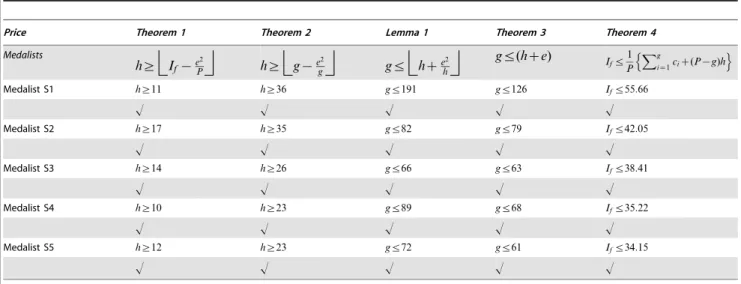
Table 2 shows a verification of Theorems for Price Medalists. The first row of the table shows the statements of each theorem and lemma. The symbolHunder the bound shows that the given theorem is verified. For example, consider Medalist S1 for whom Ph
ici~8567, and therefore,e2~6542. Theorem 1 givesh§11, and the value of h-index for Medalist S1 is 45. Since 11ƒ45, therefore, Theorem 1 is verified. Theorem 2 givesh§36, which is less than45, therefore, Theorem 2 also is verified. Lemma 1 gives gƒ191, and the value ofg-index for Medalist S1 is101. Since101
is less than191, therefore, Lemma 1 is verified. Theorem 3 gives gƒ126, and since 101is less than 126 therefore, Theorem 3 is Table 1.The number of citations (C), number of papers
referenced (P),h-index,g-index, and generalized impact factor (If) for a set of five Price Medalists.
Price Medalists C P h-Index g-Index If
Medalist S1 12674 520 45 101 24.37
Medalist S2 4861 180 38 62 27.01
Medalist S3 2701 110 30 48 24.55
Medalist S4 3556 176 27 54 20.20
Medalist S5 2785 130 26 48 21.42
doi:10.1371/journal.pone.0033699.t001
Table 2.Verification of theorems for the given set of Price Medalists.
Price Theorem 1 Theorem 2 Lemma 1 Theorem 3 Theorem 4
Medalists
h§
t
If{e 2P
s
h§t
g{e2
g
s
gƒt
hze2 h
s
gƒ(hze) I
fƒ1 P
Xg
i~1ciz(P{g)h
n o
Medalist S1 h§11 h§36 gƒ191 gƒ126 Ifƒ55:66
H H H H H
Medalist S2 h§17 h§35 gƒ82 gƒ79 Ifƒ42:05
H H H H H
Medalist S3 h§14 h§26 gƒ66 gƒ63 Ifƒ38:41
H H H H H
Medalist S4 h§10 h§23 gƒ89 gƒ68 Ifƒ35:22
H H H H H
Medalist S5 h§12 h§23 gƒ72 gƒ61 Ifƒ34:15
H H H H H
doi:10.1371/journal.pone.0033699.t002
Table 3.The supplemental data in terms of intermediate parameters for the given set of Price Medalists.
Price Medalists Ph
i~1ci e2 Pghz1ci Pgi~1ci
Medalist S1 8567 6542 1521 10088
Medalist S2 3085 1641 740 3825
Medalist S3 1956 1056 409 2365
Medalist S4 2381 1652 524 2905
Medalist S5 1855 1179 453 2308
verified. For verification of Theorem 4, we have,Ph
i~1ci~8567, andPg
i~hz1ci~1521. Therefore,Pgici~Phi~1cizPghz1ci~ 8567z1521~10088. Theorem 4 givesIfƒ55:66, and sinceIffor
Medalist S1 is 24:37, which is smaller than 55:66, therefore, Theorem 4 is verified. Similarly, we can verify the theorems and lemma proved in this paper for other Price Medalists. The supplement data in terms of the values of intermediate parameters needed to verify the theorems and lemma is shown in Table 3.
Tightness of Bounds
Note that there are two lower bounds forh-index, the one given by Theorem 1 and the other given by Theorem 2. Using Table 2, we see that the lower bound on h-index given by Theorem 2 is closer to the actual values as compared to that given by Theorem 1. Similarly, there are two upper bounds forg-index, the one given by Lemma 1 and the other given by Theorem 3. We observe from Table 2 that the upper bound ong-index given by Theorem 3 is closer to the actual values ofg-index as compared to those given by Lemma 1. In other words, the bounds given by Theorem 2 and Theorem 3 are more tight as compared to those given by Theorem 1 and Lemma 1, respectively.
Table 4 shows the actual values ofg-index and the values of g-index obtained using Theorem 3. Also, we computed the errors in the values given by Theorem 3 as compared to the actual values of g-index for Price Medalists. We observe that the upper bound on theg-index given by Theorem 3 is reasonably tight.
Improvements over Schubert-Glanzel and Egghe-Liang-Rousseau Models
We computed theh-index using Theorem 2. Also, we computed the values of h-index for Price Medalists using Schubert-Glanzel formula given by (48) and using Egghe-Liang-Roussea’s power law
model given by (50). Note that the values ofh-index using any of these three models are approximate values. To study closeness of these approximate values to the exact values, we computed the percentage errors in the approximate values of h-index with respect to the exact values, which are shown in Table 5. We observe that the percentage error in case of the values obtained using Theorem 2 is significantly less as compared to those obtained using either Schubert-Glanzel formula or Egghe-Liang-Rousseau power law model. For example, for Medalist S1, the exact value of h-index is 45, the lower bound given by Theorem 2 is36. The values ofh-index obtained using Schubert-Glanzel formula is68
and that obtained using Egghe-Liang-Rousseau’s power law model is100. The error using Theorem 2 is20%and the error in the value obtained using Schubert-Glanzel formula is51%. The error in the value ofh-index using Egghe-Liang-Rousseau’s model is
122:22%. Similarly, one can see from Table 5 that Theorem 2
provides a significant improvement over both Schubert-Glanzel formula and Egghe-Liang-Roussea’s power law model.
Conclusion
Finding the relationships among indexing parameters for determining the quality of research is a challenging task. In this paper, we described some inequalities relatingh-index,g-index, e-index, and generalized impact factor. We derived the inequalities from the very basic definitions of these indexing parameters and without assuming any continuous model to be followed by any of them. However, the relationships in the form of bounds and inequalities among the indices are not trivial, and to the best of our knowledge, we are the first ones to present such kinds of relationships.
We verified the theorems and lemma presented in this paper for citation records of Price Medalists. We observed that the lower bound onh-index given by Theorem 2 is more tight as compared to that given by Theorem 1. The upper bound ong-index given by Theorem 3 is more tight as compared to that given by Lemma 1. We compared the values ofh-index obtained using Theorem 2 with the values ofh-index obtained using either Schubert-Glanzel formula or Egghe-Liang-Rousseau model. We observed that the values ofh-index obtained using Theorem 2 are significantly closer to the exact values as compared to those obtained using either Schubert-Glanzel formula or Egghe-Liang-Rousseau’s power law model. This enables us to conclude that Theorem 2 provides significant improvements over both Schubert-Glanzel formula as well as Egghe-Liang-Rousseau’s model.
Further, we computed the upper bound given by Theorem 3 which states that gƒ(hze), where e denotes the e-index. We observed that the upper bound ong-index given by Theorem 3 is reasonably tight for the given citation record of Price Medalists. In Table 4.Errors in theg-index using Theorem 3 for the given
set of Price Medalists.
Price Medalists g-index g-index (Theorem 3)
Value Error(%)
Medalist S1 101 126 24.75
Medalist S2 62 79 27.41
Medalist S3 48 63 31.25
Medalist S4 54 68 25.92
Medalist S5 48 61 27.08
doi:10.1371/journal.pone.0033699.t004
Table 5.Errors in theh-index using Theorem 2, Schubert-Glanzel model, and Egghe-Liang-Rousseau’s power law model [6] for the given set of Price Medalists.
Price Medalists h-Index Lower Bound Schubert-Glanzel Egghe et al
Value Error(%) Value Error(%) Value Error(%)
Medalist S1 45 36 20.00 68 51.11 100 122.22
Medalist S2 38 35 7.89 51 34.21 64 68.42
Medalist S3 30 26 13.33 41 36.66 47 56.66
Medalist S4 27 23 14.81 42 51.85 53 96.30
Medalist S5 26 23 11.54 40 53.85 47 80.77
future, one may propose more tight bounds for eitherh-index or g-index.
Supporting Information
Medalist S1 Citation data for Price Medalist 1 using scHolar index [11], which is based on Google Scholar. Includes the numbers of citations of each referenced paper of Price Medalist 1.
(DOC)
Medalist S2 Citation data for Price Medalist 2 using scHolar index [11], which is based on Google Scholar. Includes the numbers of citations of each referenced paper of Price Medalist 2.
(DOC)
Medalist S3 Citation data for Price Medalist 3 using scHolar index [11], which is based on Google Scholar. Includes the numbers of citations of each referenced paper of Price Medalist 3.
(DOC)
Medalist S4 Citation data for Price Medalist 4 using scHolar index[11], which is based on Google Scholar. Includes the numbers of citations of each referenced paper of Price Medalist 4.
(DOC)
Medalist S5 Citation data for Price Medalist 5 using scHolar index[11], which is based on Google Scholar. Includes the numbers of citations of each referenced paper of Price Medalist 5.
(DOC)
Acknowledgments
I thank anonymous reviewers for their helpful suggestions.
Author Contributions
Conceived and designed the experiments: AMA. Performed the experi-ments: AMA. Analyzed the data: AMA. Contributed reagents/materials/ analysis tools: AMA. Wrote the paper: AMA.
References
1. Hirsch JE (2005) An index to quantify an individual’s research output. Proceedings of National Academy of Sciences 102: 16569–16572.
2. Egghe L (2006) An improvement of the h-index: the g-index. ISSI Newsletter 2: 8–9.
3. Zhang CT (2009) The e-index, complementing the h-index for excess citations. PloS One 4.
4. Garfield E (2006) The history and meaning of the journal impact factor. The Journal of the American Medical Association 295: 90–93.
5. Zhang CT (2010) Relationship of the h-index, g-index, and e-index. Journal of the American Society for Information Science and Technology 61: 625–628.
6. Egghe L, Liang L, Rousseau R (2009) A relation between h-index and impact factor in the power-law model. Journal of the American Society for Information Science and Technology 60: 2362–2365.
7. Burrell QL (2009) On hirsch’s h, egghe’s g, and kolsmulski’s h(2). Scientometrics 79: 79–91.
8. Cormen TH, Leiserson CE, Rivest RL, Stein C (2009) Introduction to algorithms. Cambridge, USA: MIT Press.
9. Schubert A, Glanzel W (2007) A systematic analysis of hirsch-type indices for journals. Journal of Informetrics 1: 179–183.
10. Ye FY (2009) An investigation on mathematical models of the h-index. Scientometrics 81: 493–498.
![Table 5. Errors in the h-index using Theorem 2, Schubert-Glanzel model, and Egghe-Liang-Rousseau’s power law model [6] for the given set of Price Medalists.](https://thumb-eu.123doks.com/thumbv2/123dok_br/18389503.357361/6.918.95.833.916.1078/table-errors-theorem-schubert-glanzel-egghe-rousseau-medalists.webp)
