REVIEW
Nuffield Department of Surgery, John Radcliffe Hospital, University of Oxford - Oxford, England, UK.
Received for publication on September 10, 2007. Accepted for publication on October 10, 2007.
NON HEART-BEATING DONORS IN ENGLAND
Eleazar Chaib
Chaib E. Non heart-beating-donors in England. Clinics. 2008;63(1):121-34.
When transplantation started all organs were retrieved from patients immediately after cardio-respiratory arrest, i.e. from non-heart-beating donors. After the recognition that death resulted from irreversible damage to the brainstem, organ retrieval rapidly switched to patients certified dead after brainstem testing. These heart-beating-donors have become the principal source of organs for transplantation for the last 30 years. The number of heart-beating-donors are declining and this is likely to continue, therefore cadaveric organs from non-heart-beating donor offers a large potential of resources for organ transplantation. The aim of this study is to examine clinical outcomes of non-heart-beating donors in the past 10 years in the UK as an way of decreasing pressure in the huge waiting list for organs transplantation.
KEYWORDS: Transplantation. Liver. Kidney. Donors.
The imbalance between supply of organs for transplan-tation and demand for them is widening all over the world. In the United Kingdom (UK) the figures are not different, by the end of December 2004 there were over 6000 peo-ple on the active waiting list for organ transplantation. Re-cent data suggest that over 400 of these people will die each year before a new organ becomes available.1
When transplantation started all organs were retrieved from patients immediately after cardio-respiratory arrest, i.e. from non-heart-beating donors (NHBDs). After the recog-nition that death resulted from irreversible damage to the brainstem by Harvard Medical Committee2 and the
subse-quent introduction in 19763 of direct brainstem testing to
de-termine when death has occurred, organ retrieval rapidly switched to patients certified dead after brainstem testing. These heart-beating-donors (HBDs) have become the prin-cipal source of organs for transplantation for the last 30 years. The number of HBDs are declining and this is likely to continue for two major reasons: fewer young people are dying as a result of severe injury or cathastrophic
cerobro-vascular events4, and improvements in diagnosis and
man-agement of severe brain injuries mean that fewer fulfil the brainstem testing criteria.
Although numbers of NHBDs are slowly increasing, they still accounted for only 85 of 750 (11.3%) UK cadav-eric donors in 2004-2005.5
The fundamental problem with NHBDs is warm ischemia which may lead to suboptimal transplanted organ function. Developments in organ protection will only lead to more successful outcomes from NHBD if strategies can be divised to keep warm ischaemia times as short as pos-sible.
The aim of this study is to examine clinical outcomes of NHBDs in the past 10 years in the UK as an way of decreasing pressure in the huge waiting list for organs trans-plantation.
A literature review was performed based on a Medline (Pubmed from 1997 to 2006) search to identify articles on clinical NHBDs in the UK.
Information on the rates of primary non-function (PNF), delayed graft function (DGF), acute rejection, graft and patient survival were registred. Also NHBDs technique, perfusion and recipient immunosupression were mentioned. All centres have developed programmes based on the Maastricht protocol,6 which includes the following
1. approval by local medical ethics committee,
2. diagnosis of death by doctors who are independent of the transplant team,
3. the 10-min rule (after declaration of cardiac death, the body is left untouched for a period of 10 min prior in-tervention),
4. rapid in situ cooling using a catheter inserted into the
aorta, and organ retrieval using standard surgical tech-niques. Declaration of cardiac death implies irrevers-ible cessation of heart function and the 10-min hands-off period ensures the process of irreversible brain death has begun.
We also recorded the criteria for exclusion of NHBDs, the Maastricht classification, the current criteria for both brain-stem death for HBDs and cardiac death for NHBDs, and finally ethics and legal issues involved in the NHBDs transplantation.
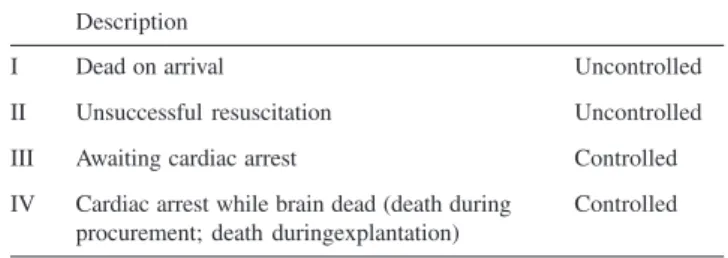
The first International Workshop in Maastricht7 defined four categories of NHBD:
UNCONTROLLED
Category I – includes victims of accident and suicide ( some centers exclude suicide victims from their programs ) who are found dead at the scene and resuscitation is deemed pointless (e.g. fatal cervical spine fracture). These are the worst group of potential donors because of the un-known primary warm ischemic time.
Category II – donors are mostly victims of sudden car-diac (the majority) or cerebral catastrophe who are brought to emergency departments while being resuscitated by am-bulance personnel or who died in the department. Other sources include patients suffering isolated brain injury, an-oxia and stroke, and victims of major trauma who died soon after hospital admission.
CONTROLLED
Category III – encompasses patients who are dying, often on an intensive care unit. These are the patients await-ing cardiac arrest where the treatawait-ing clinicians have decided to withdraw treatment and not commence resuscitation for various reasons.
Category IV – comprises patients who suffer unex-pected cardiac arrest during or after determination of brain death.
Ethics and Legal Issues
There is an increasing worldwilde discrepancy between
Table 1 - Non-Heart-Beating Donors - Maastricht classification7
Description
I Dead on arrival Uncontrolled
II Unsuccessful resuscitation Uncontrolled
III Awaiting cardiac arrest Controlled
IV Cardiac arrest while brain dead (death during Controlled procurement; death duringexplantation)
Table 2 - Criteria for exclusion of non-heart-beating donors8
1. Cardiac and circulatory arrest does not last longer than 40 minutes. 2. The patient is between 16 and 60 years old.
3. The patient does not belong to a high risk group for immunodeficiency virus (HIV), or hepatitis B or C infection. There should be no signs of intravenous drug abuse.
4. The patient has no history of primary kidney disease, uncontrolled hypertension, or complicated insulin-induced diabetes mellitus (IDDM). There are no signs of intravascular coagulation with anuria and no signs of malignancy other than a primary (non-metastatic) cerebral tumor. 5. There are no signs of sepsis or serious infection.
6. Patients who have died after assisted suicide or euthanasia are excluded from some protocols.
Table 3 - Criteria for brainstem death apply to heart-beating donors8
1. The underlying pathologic lesion should be understood;
2. There should be no pharmacologic, metabolic, or hormonal influence; 3. Pupillary, corneal, occulo-cephalic, vestibule-occular, and gag reflexes
should be absent;
4. No pain response to stimulation in the distribution of the fifth cranial nerve; and
5. A re-breathing test with 100% oxygen should be delivery to maintain satisfactory oxygenation, while ventilation is switched off. The rise in arterial pCO2 should not stimulate respiration.
# These tests are performed by two experienced clinicians on two separate occasions.
Table 4 - Criteria for cardiac death apply for non-heart-beating donors8
1. Deep coma 2. Absence of pulse 3. ECG evidence of asystole
# Cardiac death in the context of potential organ donation is defined as occurring after 30 minutes of unsuccessful cardiopulmonary resuscitation under hospital conditions.
# Resuscitation must include external cardiac massage, intubation, ventilation, defibrillation (if indicate), and appropriate intravenous medication.
the availability of, and need for organs allografts. It has been estimated that the number of donor organs could rise by 25% through the expanded use of NHBD 9 making it
inevitable in an era of universal shortage of donors. All transplant procurement strategies come with an ethi-cal dimension but this particular process raises multiple concerns, not least of which is ambiguity as to the timing and definition of death.
The principal ethical issues concerning NHBDs pro-grams are the use of in situ perfusion to consent the
diag-nosis of death by cardiac rather than brain-stem criteria, and at what time after pronouncement of death the in situ cooling should be started (dead donor rule).
English law does not require consent for prolonged ven-tilator support or placement of the double-balloon triple-lumen (DBTL) catheter, but catheter placement is an in-vasive procedure and the family members may not wish for this10.
The dead donor rule11 is pivotal to NHBD organ
dona-tion and states that the donor should not be killed by the act of donation (i.e. the donor must be dead by cardiac cri-teria at the time of retrieval). This became relevant when a decision is taken to discontinue life support measures in a patient who does not meet the criteria for brain-stem death and raises the question of when death should be pro-nounced after cardiac arrest 12.
There is a period when the patient is dead by cardiac criteria but not by brain-stem criteria13 and 10 minutes is
considered sufficient for the discrepancy to be corrected. There has been considerable debate over the length of time that the patient should be left14. For ideal preservation the
kidneys should be perfused as soon as the 10-minute wait-ing period is over.
These considerations were taken into account at the Maastricht workshop (1995). The conclusions of this dis-cussions was that it was safer to apply the dead-donor rule only after a 10-minute period of asystole7,15. There can be
little doubt that after normothermic ischaemia for this pe-riod, it would be impossible to restore myocardial func-tion and there will be irreversible loss of all neurological function. Then, the criteria for cardiac and brain death will have been satisfied simultaneously.
Warm Ischaemia Renal Injury
The period of warm ischaemia is usually defined as the time between cardiac arrest and the start of cardiopulmo-nary resuscitation.
This could more accurately be described as the abso-lute warm time because there may be other less obvious periods of warm ischaemia. The efficacy of external
car-diac massage is achieving renal perfusion is not definitely known and will vary according to how well resuscitation is performed. It is likely that a degree of renal warm is-chaemia is common during cardiopulmonary resuscitation and this could be described as relative warm time.
Conversely cardiac massage and ventilation which are effective in oxygenating the kidneys after a period of cir-culatory standstill, may also be deleterious by initiating the reperfusion injury syndrome.
Warm ischaemia is known to be a major determinant of renal function after kidney transplantation. However, the amount of reversible warm ischaemic injury that the hu-man kidney can sustain is still not known for certain. Most human NHBD kidney transplant protocols exclude kidneys which such prolonged warm times, the usual cutoff being in the of 30 to 45 minutes16,17.
Renal allografts from controlled NHBDs sometimes function immediately suggesting that the human kidney tol-erates short periods of warm ischaemia quite well18. In
un-controlled NHBDs the warm time is not always accurately known. It may need to be determined by taking a history from relatives, ambulance staff, and medical personnel and in some cases this will provide only an approximate esti-mate.
Surgical Technique
1. Leicester Model for NHBD
(In situ kidney perfusion/Cooling and kidney retrieval in NHBD)
NHBDs kidneys were perfused and cooled in situ
us-ing a DBTL aortic catheter placed via femoral artery cut-down in the groin. The technique as described originally by Garcia-Rinaldi et al19, involves insertion of the DBTL
catheter into the abdominal aorta via femoral arteriotomy. Inflation of the caudal balloon at the aorta bifurcation and inflation of the cranial balloon isolates the segment of aorta from which the renal arteries originate (vertebral level L1). A plain abdominal radiograph can be taken to show the position of the catheter, which is radio-opaque.
Wheatley et al20 modification is to mix a small amount
of Conray (May and Baker, Dagenham, UK) radio-contrast dye with saline injected into the balloons to allow easier identification of the balloons on radiography. Using a mix-ture of Conray and saline in a ratio 1:10 rather than neat Conray makes injection of the viscous liquid much easier.
The balloons were inflated with radiographic contrast medium, and the positioning checked by plain abdominal x-ray20.
the inferior vena cava via the right femoral vein. Follow-ing in situ renal perfusion the NHBD was transferred to
an operating theatre for bilateral donor nephrectomy. The perfusion fluid used for NHBD was a 10 to 20 L Marshall’s hyperosmolar citrate solution at 4 C infused un-der gravity and all kidneys were held in static ice storage before transplantation.
2. Newcastle upon-Tyne Model for NHBD (NHBD retrieval ; pumping perfusion system)
In situ organ perfusion was performed by cannulating the femoral artery using a DBTL cannula (TXF Medical, High Wycombe, UK). The preservative solution was cold (4-8 C) heparinized (1000 IU/L) Marshall’s solution. The venous venting was through placement of a cannula into the femoral vein. No radiological confirmation of place-ment was done. After retrieval the kidneys were cold stored and transported to the Hospital where machine perfusion and viability assessment were carried out21.
Pumping perfusion system
A Belco BL 760 blood pump module was used for perfusion. One pump in the system provided fluid to the renal artery and the other retrieved it through a heat ex-changer. The temperature of the system was maintained between 4 and 9 C. The pump was capable of delivering a flow rate of 28-480ml/min and pressure were maintained at 45-60 mm Hg. Thus a closed system of perfusion was achieved.
A viable kidney tends to have a flow rate of more than 50 ml perfusate/minute per 100 g of kidney and a glutath-ione S-transferase level less than 200 IU/L per 100 g kid-ney22.
3. Cambridge Model for NHBD
Following certification of death on the ward, the donor was transported to the operating theatre. Laparotomy was performed, a large bore (22F) aortic cannula inserted and the kidneys were perfused in situ with at least 3L of cold
University of Wiscosin (UW) solution containing 20 000 units of heparin per litre.
The supra-coeliac aorta was cross-clamped to facilitate perfusion of the kidneys and the venous system was de-compressed via inferior vena cava. To provided additional cooling, 2 L of crushed frozen saline were applied around the kidneys during perfusion. Donor nephrectomy was then performed23.
4. London Model for NHBD
An interval of 15 minutes after cardiac arrest was al-ways allowed before cold in situ perfusion or crash retrieval was commenced. All donors were cooled using Soltran Kid-ney Perfusion Solution (Baxter Medical, Houston, TX, USA) with an additive of 20,000 IU of heparin via femo-ral access using a DBTL inserted into the femofemo-ral artery. Cannulas were placed only after consent of relatives was given.
The kidneys of the controlled donors were perfused via rapid aortic cannulation after laparotomy or crash retrieved with no flush and thereafter perfused with ice-cold solu-tion on the bench 24.
Pulsatile kidney perfusion with the RM3 pump (Water Medical Systems, Rochester, MN, USA) for organ assess-ment and preservation of up to 12 hours was used.
RESULTS
During ten-year period analysed, NHBDs were used mainly for kidney transplantation in four centres in the UK as summarized in (Table 5).
NHBDs in the UK centres according to the Maastricht classification are shown in (Table 6).
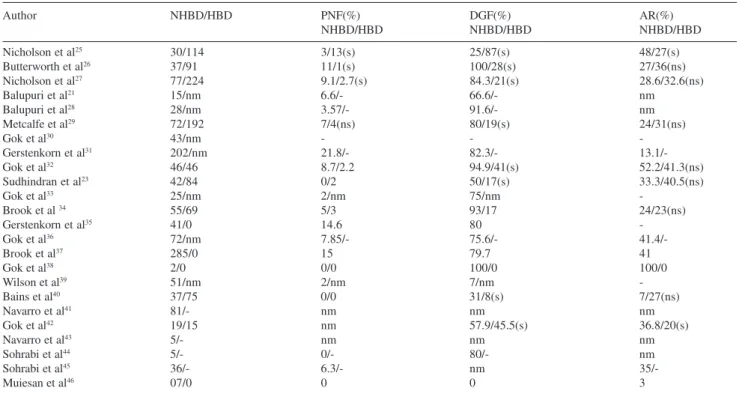
Comparing NHBD with HBD the results of PNF, only 3 out of 24 articles have shown significant differences. As far as DGF is concern 8 out of 24 articles have shown sig-nificant differences. Acute rejection was reported signifi-cant in only 1 out of 24 articles (Table 7).
Graft survival was equal for 1, 2,3 and 5 years when comparing NHBD with HDB except in 1 article that has shown significant differences in 3 and 5 years time, (Ta-ble 8).
Patient survival was equal in 1, 3 and 5-years when comparing NHBD with HBD as shown in (Table 9).
United Kingdom centres and variations of NHBDs tech-nique, use of double-ballon triple-lumen, machine perfusion, type of organ perfusion solution as well as immunossupression are demonstrated in (Table 10).
DISCUSSION
Cadaveric organs from NHBD have been used for dec-ades. Since the introduction of “brain-stem death” criteria in 1968, NHBDs have been largely abandoned in favor of brain-dead donors47
dis-card rate of kidneys from NHBD is significant, with esti-mates ranging from 50 to 65% with uncontrolled donors48.
NHBD programs remain unpopular despite the poten-tial to increase the donor pool by up to 30%49. A number
of legal, ethical and logistic reasons as well as medical con-cerns are responsible for this and have even compromised existing NHBD programs50.
Legal and ethical issues such as cannulation of the femoral vessels for in situ cooling prior to consent by the
relatives and an undefined interval of no-touch between cardiac arrest, declaration of death and organ resuscitation/ preservation efforts remain an unsolved problem in the United Kingdom. If relatives were present the consent rate for organ donation after cardiac arrest was more than 70%. In addition, the logistic requirements for a successful, financially efficient NHBD program are immense and
re-quire good planning, management and organization. Trans-plant surgeons and coordinators must be within close reach of potential donor locations in emergency departments, in-tensive care units, hospital wards, and hospices. Further-more a sufficient number of trained staff members are re-quired to share a rota for ininterrupted on-call cover. This might be possible only for a large transplant units or par-ticularly dedicated centers. Organ preservation by perfusion is an additional issue that requires further expertise and is expensive21,51 but it might be the only reliable technique for
assessing the viability of NHBD kidneys and marginal do-nors organs52
The 125 NHBD transplants performed in 2005-2006 (82 kidneys only; 36 kidney/liver; 1 kidney, thoracic & liver, 2 kidney, liver & pancreas and 4 liver only) rose 44% com-paring with 87 NHBD in 2004-2005 but still represent a Table 6 - Non-heart-beating donors in England centres according to the Maastricht classification.
Centre NHBD* not mentioned NHBD Uncontrolled NHBD Controlled NHBD Total
category (n=365) Category I e II (n=575) Category III e IV (n=398) (n=1334)
Cambridge - 0 42 42
Leicester 144 144 20 308
London 202 8 40 250
Newcastle upon-Tyne 19 178 201 398
Cambridge, Leicester, London, - 217 68 285
Newcastle upon-Tyne
Leicester, Newcastle upon-Tyne - 24 27 51
*NHBD-non-heart-beating donor
Table 5 - England non-heart-beating donors transplant details
Author Year Centre No. patients Organ
Nicholson et al25 1997 Leicester 30 Kidney
Butterworth et al26 1997 Leicester 37 Kidney
Nicholson et al27 2000 Leicester 77 Kidney
Balupuri et al 21 2000 Newcastle upon-Tyne 15 Kidney
Balupuri et al 28 2001 Newcastle upon-Tyne 28 Kidney
Metcalfe et al 29 2001 Leicester 72 Kidney
Gok et al30 2002 Newcastle upon-Tyne 43 Kidney
Gerstenkorn et al31 2002 London 202 Kidney
Gok et al32 2002 Newcastle upon-Tyne 46 Kidney
Sudhindran et al23 2003 Cambridge 42 Kidney
Gok et al33 2003 Newcastle upon-Tyne 25 Kidney
Brook et al34 2003 Leicester 55 Kidney
Gerstenkorn et al35 2003 London 41 Kidney
Gok et al36 2004 Newcastle upon-Tyne 72 Kidney
Brook et al37 2004 * 285 Kidney
Gok et al38 2004 Newcastle upon-Tyne 02 Kidney
Wilson et al 39 2005 Newcastle upon-Tyne and Leicester 51 Kidney
Bains et al40 2005 Leicester 37 Kidney
Navarro et al 41 2006 Newcastle upon-Tyne 05 Kidney
Gok et al42 2006 Newcastle upon-Tyne 19 Kidney
Navarro et al 43 2006 Newcastle upon-Tyne 81 Kidney
Sohrabi et al44 2006 Newcastle upon-Tyne 05 Kidney
Sohrabi et al 45 2006 Newcastle upon-Tyne 36 Kidney
Muiesan et al46 2006 London 07 Liver
small proportion of the total transplant activity on the UK53.
The average NHBD retrieval rate for 2001 was 1.3 mil-lion population (pmp) for the four centres reported here. This compares with an average national rate for HBD kid-neys of 23.5 pmp (United Kingdom Transplant Data54.
Al-though the number of NHBD transplants is small the po-tential is greater; the most encouraging figures come from Daemen et al (55) who report 40% of their kidneys were
ac-counted for by NHBDs.
Varty et al49 reported 38% of donors were NHBD in
1991 and later Nicholson56 reported that NHBD accounted
for 21% of transplant activity. Light et al57stated that the
number of NHBD transplant opportunities equals that of HBD whilst other authors have suggested that there are Table 7 - Comparation of the results of NHBD/HBD in England relating to primary non-function, delayed graft function and acute rejection.
Author NHBD/HBD PNF(%) DGF(%) AR(%)
NHBD/HBD NHBD/HBD NHBD/HBD
Nicholson et al25 30/114 3/13(s) 25/87(s) 48/27(s)
Butterworth et al26 37/91 11/1(s) 100/28(s) 27/36(ns)
Nicholson et al27 77/224 9.1/2.7(s) 84.3/21(s) 28.6/32.6(ns)
Balupuri et al21 15/nm 6.6/- 66.6/- nm
Balupuri et al28 28/nm 3.57/- 91.6/- nm
Metcalfe et al29 72/192 7/4(ns) 80/19(s) 24/31(ns)
Gok et al30 43/nm - -
-Gerstenkorn et al31 202/nm 21.8/- 82.3/-
13.1/-Gok et al32 46/46 8.7/2.2 94.9/41(s) 52.2/41.3(ns)
Sudhindran et al23 42/84 0/2 50/17(s) 33.3/40.5(ns)
Gok et al33 25/nm 2/nm 75/nm
-Brook et al 34 55/69 5/3 93/17 24/23(ns)
Gerstenkorn et al35 41/0 14.6 80
-Gok et al36 72/nm 7.85/- 75.6/-
41.4/-Brook et al37 285/0 15 79.7 41
Gok et al38 2/0 0/0 100/0 100/0
Wilson et al39 51/nm 2/nm 7/nm
-Bains et al40 37/75 0/0 31/8(s) 7/27(ns)
Navarro et al41 81/- nm nm nm
Gok et al42 19/15 nm 57.9/45.5(s) 36.8/20(s)
Navarro et al43 5/- nm nm nm
Sohrabi et al44 5/- 0/- 80/- nm
Sohrabi et al45 36/- 6.3/- nm
35/-Muiesan et al46 07/0 0 0 3
s-significant; ns- not statistically significant; nm- not mentioned; nhbd-non-heart-beating donor;hbd-heart-beating donor; pnf-primary non-function;dgf-delayed graft function;ar-acute rejection.
Table 8 - Graft survival in NHBD in England.
1 y(%) 2 y(%) 3 y(%) 5 y(%)
Nicholson et al25 NHBD 78 75 73
-HBD 90 85 82
Butterworth et al26 NHBD 73 73 73
-HBD 83** 79** 77**
Nicholson et al27 NHBD 85** 87** 87** 79**
HBD 85 82 80 75
Balupuri et al21 NHBD 91.7 - -
-Balupuri et al28 NHBD 88.1 - -
-Metcalfe et al29 NHBD 81 - 77 73
HBD 86** 78** 65**
Gok et al30 NHBD 89.6 - -
-HBD 91.4**
Gerstenkorn et al31 NHBD 86.9 - 75.5 65.5
Gerstenkorn et al35 NHBD - - 82.9
-Brook et al34 NHBD 79 - 75 69
Gok et al 32 NHBD 89.6 - 89.6
-HBD 91.4** 91.4**
Sudhindran et al23 NHBD 84 - 80 74
HBD 89** 85** 80**
Brook et al37 NHBD 88 - 84 84
HBD 82** 73* 62*
Gok et al 36 NHBD 92.1 - -
-Sohrabi et al45 NHBD - - 95
-Muiesan et al46 NHBD 84 - -
-** not statistically significant; * statistically significant;nhbd-non-heart-beating donor;hbd-heart-significant;nhbd-non-heart-beating donor; y-year.
Table 9 - Patient survival in NHBD in England.
1 y(%) 3 y (%) 5 y(%)
Gok et al30 NHBD 87.9 87.9
-HBD 89.7 89.7
Gerstenkorn et al31 NHBD 93.1 85.3 76.2
Sudhindran et al23 NHBD 91 91 84
HBD 94 92 90
Gok et al36 NHBD 92.1 -
-Muiesan et al46 NHBD 87 -
twice as many potential NHBD as there are HBD 58. It has
been suggested that if all potential NHBD kidneys were retrieved waiting lists for kidney transplantation could be eliminated59.
Two methods of harvesting of NHBDs have been ad-vocated to decrease ischemic insult: 1. procurement meth-ods include in situ intravascular cooling (universal),
intra-peritoneal lavage and cooling (used in the United States), hypothermic and normothermic partial cardiopulmonary bypass (used in Spain) and hypothermic extracorporeal membrane oxygenation (used in Taiwan); and 2. machine preservation methods include: pulsatile intermittent perfusion and continuous-and-constant perfusion.
Ischemic injury is almost inevitable in NHBD renal grafts and primarily results from prolonged hypotension, cardiac arrest and warm ischemia during the primary warm ischaemia time (WIT). Development of allograft dysfunc-tion can result in DGF and PNF.
As far as the NHBD for liver transplantation is concern Muiesan et al46 based their donor selection on several
fac-tors including age less than 40 years, short intensive care unit stay, normal liver function tests, short interval from withdraw of therapy to cardiac arrest, short WIT and good appearance and perfusion of the liver, as judged by an ex-perienced transplant surgeon. When the majority of these parameters were satisfied they provided organs suitable for bench segmental reduction.
They started the procedure of reduction/spltting as soon as the recovery team had returned to their centre. Care was taken to keep the temperature of the University of Wiscon-sin (UW) solution at 4 C and to avoid re-warming of the graft. One split procedure was performed. The left lateral segment was transplanted with 7 h of cold ischemia and provided excellent immediate function with an International Normalized Ratio of 1.2 on the second post-operative day. The adult recipient who received the right lobe split was transplanted sequentially with a cold ischemia time of 14.3 h and experienced PNF. He died of multi-organ failure af-ter emergency re-transplantation. Subsequent reduction of NHBD grafts was performed with transplantation only of
the left lateral segment or left lobe in children46.
The recent largest retrospective study comparing out-comes of adults recipients of NHBD and HBD hepatic allografts between 1993 and 2001 based on the United Net-work of Organ Sharing database confirmed their greater vulnerability to cold ischemia and the higher incidence of PNF among a group of 144 NHBD livers60.
Abt et al61 have emphasized the importance of short cold
ischemic time for liver grafts. When the cold ischemic time was less than 8 h there was 10.8% of graft failure within 60 days of transplantation which increased to 30.4% and 58.3% when the cold ischemia time was greater than 8 and 12 h, respectively. The combination of warm and cold ischemia in NHBDs appears to make these grafts more sus-ceptible to biliary complications. A higher incidence of ischemic cholangiopathy has been reported61,62.
D’Alessandro et al63 also recognized increased incidence
of ischaemic biliary complications in NHBD liver graft re-cipients from donors older than 40 years of age.
To date there have been no vascular complications and no evidence of major biliary complications with particular reference to ischaemic cholangiopathy in these children af-ter a mean follow-up of 19 months46.
Reddy et al64 described various cytoprotective strategies
involving administration of drugs before cardiac arrest that have been successfully used in NHBD liver transplantation. Kidneys from different Maastricht categoriesrecovered at different rates although they were all similar at 3 months. Kidneys from NHBDs have undergone more ischemic in-sult than kidneys from HBDs.This occurs because of the prolonged early (primary) warm ischemia.
For Maastricht category II donors this the period be-tween collapse and effective resuscitation, variably effec-tive resuscitation and the “no-touch” period before perfusion.
For category III donors after withdrawal of support there can be an agonal period of hypotension followed by the “ no-touch” period and then perfusion.
Category IV donors are known to be brainstem dead and are the closest to HBDs. They often arrest in theatre, there-Table 10 - England centres and variations of non-heart-beating donors programmes.
Centre NHBD technique In situ Perfusion Immunossupression
Cambridge Laparotomy + aortic cannula UW CSA/AZA/PRED
Leiscester Femoral arteriotomy + DBTL catheter Marshall’s CSA/AZA/PRED or TAC/MMF/PRED
London Kidney-femoral arteriotomy +DBTL Marshall’s CSA/AZA/PRED
Liver- PV cannulation UW TAC/PRED
fore the primary ischemic time does not include the “no-touch” period. Thus the primary warm ischemic insult is likely to be maximal for category II and minimal for IV with III in-between (II greater than III greater than IV)36.
With maximal primary warm ischemic damage comes the increasing chance of in situ thrombosis, greater
oxy-gen debt, and increasing acidosis and reduction of cellular adenosine triphosphate. Viability testing excludes those or-gans that are so badly damaged they are not likely to func-tion. As a consequence the prolonged warm ischemia and reperfusion syndrome is likely to be more severe for kid-neys from category II donors as opposed to III or IV.
A contrary argument has been put forward that a per-son who is hospitalized and in an intensive therapy unit for a protracted period is more likely to have inotropic sup-port and sepsis which may result in unmeasured hypoperfusion of kidneys. Therefore, kidneys from a sud-den collapse (category II) are possibly healthier than those from a hospitalized patient8.
Gok et al36 demonstrated that the PNF rate is slightly
higher for category II donors (13.5%) than category III (2.2%) and category IV (0%, p<0.05). In addition DGF in-cidence is greatest for category II donors (83.8%), less for category III (67.4%) and best for category IV (0%).
The introduction of pulsatile hypothermic machine-perfusion of NHBD kidneys, along with viability testing has resulted in a viable grafts acceptable survival rates with DGF in recipients. The main advantages of machine perfusion are the provision of metabolic support via replen-ishment of ATP by high energy yielding phosphate bonds from the perfusate (UW solution). Apart from the mechani-cal flush provided by continuos perfusion, the natural ischemia-induced capillary vasoconstriction is reversed as demonstrated by the reduction of intra-renal vascular re-sistance. This in turn is reflected in lower incidence of de-layed graft function. Machine perfusion also allows moni-toring and assessment of viability in an NHBD kidney graft. Opelz and Terasaki concluded no added advantage of machine perfusion in HBD65. Machine perfusion fell into
disrepute due to its complex logistics needs66,67,68. It was
also reported in some cases that machine-perfusion was damaging to the graft69.
Renewed interest in this method of preservation came about through the use of marginal organs and improved pre-servative solutions (UW). With the improved solutions, the incidence of DGF could be reduced using kidneys from HBDs or those with prolonged cold ischaemia70,71.
Increased demand for viable organs has led to a recent upsurge in retrieval from the NHBDs. The difficulty expe-rienced here was the viability of such kidneys. As the pri-mary warm ischaemia times are prolonged with such
do-nors, viability assessment and organ modulation have been done by machine perfusing the NHBD kidneys before trans-plantation 72,73,74,75.
The measurement of intra-renal vascular resistance and alpha GST is practiced by the Maastricht group, who have increased their donor pool by 20% 76. Most of the studies
have demonstrated a beneficial effect of pulsatile perfusion in NHBD kidneys77,78. Machine perfusion has been shown
to improve the graft function in cases of marginal kidneys as well as those with prolonged cold ischaemic times78.
In the setting of NHBD kidney transplantation, PNF represents the transplant of an organ irreparably damaged by warm ischemia. WIT correlates well with graft damage and there is a point at which organs become non-viable.There is no strict maximum WIT in NHBDs beyond which transplantation is contraindicated. Limits of 30 min79,
35 min 25 and 45 min80 have been advocated. Functional
recovery in animal models has been achieved after substan-tially longer periods of 120 min79 and 140 min81.
Renal transplants with prolonged WIT, that is primary warm ischemia, demonstrated a relative increase in free radical generation during NHBD renal transplantation. Use of traditional tissue injury markers LDH, AST and lactate and the specific markers of tissue injury Ala-AP and FABP during kidney transplantation complemented the finding of free radical injury in NHBD renal transplants. Combined markers enabled the monitoring of different types of cell injury. This correlates with the high incidence of acute tu-bular necrosis and subsequent DGF in NHBD renal trans-plants.
Reperfusion injury is such that antioxidant strategies may be of benefit. Potential measures that could be used are nitric oxide addition82 and free radical scavengers (eg
allopurinol, superoxide dismutase, catalase and dimethyl sulfoxide) with antioxidant supplementation ( eg gluthatione, vitamin E and gingko biloba)83,84,
cytokine-chemokine suppressors, adhesion molecule blockers85,86 and
neutrophil-endothelial cell blockade87,88.
The role of free radicals in the pathophysiology of is-chaemia-reperfusion injury in transplantation is increas-ingly recognized. Free radical formation appears to occur in 2 phases, characterized as reperfusion mediated injury (early and short-lived, that is seconds to minutes) and neu-trophil mediated injury (late and long-lived, that is min-utes to an hour). In reperfusion mediated injury adenosine triphosphate depletion during hypoxia results in the accu-mulation of hypoxanthine which is coverted to free radi-cals ( superoxide and hydrogen peroxide radiradi-cals) upon reperfusion by xanthine oxidase activation89. In neutrophil
cals (superoxide, hydrogen peroxide and hydroxyl radi-cals)90.
In kidney allograft free radicals can be formed through-out the renal parenchyma in the intracellular, intravascu-lar and injury compartments. Ischaemia-reperfusion injury consist of 2 injury mechanisms namely ischemia charac-terized as oncotic necrosis and reperfusion injury. In the clinical setting this damage may delay the recovery of re-nal function prolong or complicate postoperative recovery or precipitate immunological reactions involved in the sub-sequent rejection reaction42.
In practice allowable maximum WIT varies in a quali-tative manner i.e. a young and previously fit donor may be allowed a longer WIT than an older donor. The PNF average rate in the current study was 6.17% which is con-sistent with the 8 – 15 % reported previously from NHBDs55,91. This is higher than 2-5% quoted for HBD
kid-neys26,92. Shiroki et al93 claimed that PNF rate is highest in
those NHBD kidneys with warm time of > 30 min. Tanabe et al94 disagreed stating that warm time bore no
relation-ship to PNF rate but no WIT was > 30 min in their study. Brook et al 5 showed no episode of PNF in controlled
do-nors with a 20% PNF rate in uncontrolled NHBD kidneys, indicating an association of warm time with PNF.
The reported incidence of PNF after transplantation us-ing kidney from NHB donors varies from 4 to 40%, although most studies do not make distinction between kidneys from controlled and non-controlled NHB donors when describing the incidence of PNF22,27,58,75,91,94-99. The PNF is probably a
consequence of ischaemic cortical necrosis5
The perceived risk of PNF and poor graft outcome has limited the adoption of NHB donor programmes to a rela-tively small number of transplant centres. Some of these have used machine perfusion preservation to try and reduce the risk of PNF, although direct evidence as to its effec-tiveness is lacking48.
In Newcastle upon-Tyne the introduction of machine perfusion coincided with a fall in the incidence of PNF from 54 to 7%21,22. This most probably reflects the ability
to perform viability testing and in Newcastle and other cen-tres, kidneys are discarded if during machine perfusion in-tra-renal resistance measurements or levels of S-transferase are abnormal21,22,74.
DGF occurs more frequently in NHBD (50-100%)92,94
than in HBD (20-60%) kidneys57,91,100. This increased DGF
rate in NHBD kidney is likely to be a consequence of acute tubular necrosis (ATN) secondary to warm ischaemic dam-age. Not all DGF is due to ATN, although ATN is the most common cause and it is not therefore surprising that NHBD kidneys have a higher incidence of ATN than those from HBD101.
Brook et al37 showed in controlled donors 48% of DGF
in both NHBD and HBDs whilst the uncontrolled donors had a significantly higher rate ((88%). It is important to note that warm time is not the only variable that influences DGF; duration of pre-transplant dialysis and recipient body weight also correlate with post-transplant early graft func-tion 102.
The influence of DGF o kidney allograft survival is con-troversial. A number of studies have demonstrated poorer survival in HBDs with DGF 103,104,105 compared with HBDs
with immediate function, while others authors have re-ported no such effect, independent of acute rejection106,107.
Brook et al37 demonstrate that serum creatinine is
sta-ble in recipients of kidneys from NHBDs from 3 months to 7 yr post-transplant. There is disagreement in the litera-ture over NHBD post-transplant renal function. In some studies NHBD kidneys achieved early serum creatinine lev-els in the normal range26,49,58,108,109whist others studies
re-ported poor graft function than HBD in both the short and medium term73,91.
NHBDSs kidneys in the medium term achieve a good level of renal function with a mean serum creatinine at 12 months of 174 umol/L 76 and a median of 199 umol/L at
18 months49. So far, there is no evidence of accelerated
de-terioration of NHBDs kidneys because of a reduced func-tioning glomerular mass due to initial ischaemic damage.
Acute rejection is thought to occur more frequently and with greater severety in kidneys with prolonged ischaemia and DGF110. This may be a result of the increased rate of
detection of sub-clinical rejection because biopsies are taken more frequently in the presence of DGF111.
Brook et al34, demonstrated for the first time that the
high rate of DGF associated with renal transplantation from NHBDs does not lead to poor graft survival when compared with HBDs with DGF.
In recent years there has been a re-evaluation of the use of NHBDs for renal transplantation. While some studies have shown poorer graft survival for NHBD kidneys103,105,
others have demonstrated favourable graft survival com-pared with HBDs25,91,112,113. This is despite the detrimental
effects of warm ischaemic damage in NHBDs with conse-quent high rates of DGF.
Brook et al37 reported that despite the detrimental
ef-fects of long WIT in NHBD with consequent high rates of PNF and DGF, there have been favourable comparisons with HBD in terms of graft survival also demonstrating that NHBD kidneys display parity with HBD meeting the Brit-ish Transplant Society guidelines114 for HBD allograft
sur-vival at 1 and 5 yr of 80 and 60% respectively.
DGF. Later NHBD grafts appear to perform at least as well as those from HBDs.
Finally, as previously published there are many ways to make transplantation demand compatible with organ sup-ply 115,116,117,118,119,120. We have always to bear in mind that
the gap between demand and supply of organs for trans-plantation continues to grow. One solution to this problem has been to return to the practice of using grafts from NHBDs. The challenge of NHBD transplantation is to mini-mize the first period of warm ischaemia and the consequent reperfusion injury.
CONCLUSION
NHBDs kidney transplants are associated with allograft dysfunction as PNF and DGF which is related to primary warm ischaemic injury. This warm ischaemia is more del-eterious in uncontrolled than controlled NHBDs.
Kidney transplant from NHBDs can be performed suc-cessfully. The significant degree of warm ischemic injury suffered by NHBD kidneys leads to a high incidence of DGF but the data available so far suggest that this does not adversely influence long-term graft survival.
REFERENCES
1. UK transplant. More transplants, New Lives. Transplant Activity in the UK 2003-2004. Bristol: UK transplant, 2004.
2. A definition of irreversible coma. Report of the Ad Hoc Committee of the Harvard Medical School to Examine the Definition of Brain Death. JAMA. 1968;205:337-40.
3. Conference of Medical Royal Colleges and their Faculties in the United Kingdom. Diagnosis of brain stem death. Lancet. 1996;ii:1069-70. 4. Death rate trends for RTAs and CVAs. WHO European Health for All
database – http://www.euro.who.int/hfadb.
5. Brook NA, Walter JR, Richardson AC, Bradley JA, Andrews PA, Koffman G et al. A report on the activity and clinical outcomes of renal non-heart-beating donor transplantation in the United Kingdom. Clin Transplantation. 2004;18:627-33.
6. Daemen JW, Kootstra G, Wijnen RM, Yin M, Heineman E. Nonheart-beating donors:the Maastricht experience. Clin Transpl. 1994;7;303-6.
7. Kootstra G, Daemen JHC, Oomen APA. Categories of non-heart-beating donors. Transpl Proc. 1995;27:2893-2894.
8. Brook NR, White SA, Waller JR, Veitch PS, Nicholson ML. Non-Heart beating Donor kidneys with delayed graft function have a superior graft survival compared with conventional heart-beating donor kidneys that developed delayed graft function. Am J Transplantation. 2003;3:614-8.
9. Van der Werf WJ, D’Alessandro AM, Hoffmann RM. Procurement, preservation, and transport of cadaver kidneys. Surg Clin North Am. 1988;78:570-2.
10. Brook NR, Waller JR, Nicholson ML. Nonheart-beating kidney donation: current practice and future developments. Kidney Int. 2003:63:1516.
11. Robertson JA: relaxing the death standard for organ donation in paediatric situations, in Mathieu D (ed): Organ Substitution Technology: Ethical, Legal and Public Policy Issues. Boulder, Westview, 1988, p. 69.
12. Nicholson ML. Renal transplantation from non-heart-beating donors: opportunities and challenges. Transpl Rev. 2000;14:1-17.
14. Heineman E, Daemen JHC, Kootstra G. Non heart-beating donors: Methods and techniques. Transpl Proc. 1995;29:2895-97. 15. Kootstra G, Arnold RM, Bos MA. Round table discussion on
non-heart-beating donors. Transpl Proc. 1995;27:2935.
16. Daemen JHC, Oomen APA, Belgers EHJ. Procurement and transplantation of kidneys from non-heart-beating donors – an overview. Dig Surg. 1997;14:333.
17. Dunlop P, Varty K, Veitch PS. Non-heart-beating donors: The Leicester experience. Transpl Proc. 1995;27:2940.
18. Kozaki M, Matsuno N, Tamaki T. Procurement of kidney Grafts from non-heart-beating donors. Transpl Proc. 1991;23:2575.
19. Garcia-Rinaldi R, Lefrak EA, Defore WW. In situ preservation of cadáver kidneys for transplantation: laboratory observations and clinical application. Ann Surg. 1975;182:576-84.
20. Wheatley TJ, Doughman TM, Veitch PS, Nicholson ML. Kidney retrieval from asystolic donors using an intra-aortic balloon catheter. Br J Surg. 1996;83:962-3
21. Balupuri S, Buckley P, Mohamad M, Chidambaram V, Gerstenkorn C, Sen B et al. Early results of anon-heratbeating donor (NHBD) programme with machine perfusion. Transpl Int. 2000;13(1):S255-S58.
22. Balupuri S, Buckley P, Snowden C. The troble with kidneys derived from non-heart-beating donor: a single center 10-year experience. Transplantation. 2000;15(69):842.
23. Sudhindran S, Pettigrew GJ, Drain A, Shroti M, Watson CJE, Jamieson NV et al. Outcome of transplantation using kidneys from controlled (Maastrich category 3) non-heart-beating donors. Clin Transplantation. 2003;17:93-100.
24. Gerstenkorn C. Non-heart-beating donors: renewed source of organs for renal transplantation during the twenty-first century. World J Surg. 2003;27:489-493.
25. Nicholson ML, Horsburgh T, Doughman TM, Wheatley TJ, Butterworth PC, Veitch PS. Comparison of the results of renal transplants from conventional and non-heart-beating cadaveric donors. Transpl Proc. 1997;29:1386-87.
26. Butterworth PC, Taub N, Doughman TM, Horsburgh T, Veitch PS, Bell PRF et al. Are kidneys from non-heart-beating donors second class organs ? Transpl Proc. 1997;29:3567-68.
27. Nicholson ML, Metcalfe MS, White SA, Waller JR, Doughman TM, Horsburgh T et al. A comparison of the results of renal transplantation from non-heart-beating, conventional cadaveric, and living donors. Kidney Int. 2000;58:2585-91.
28. Balupuri S, Mantle D, Mohamed M, Shenton B, Gok M, Soomro N et al. Machine perfusion and viability assessment of Non-Heart-Beating Donor kidney – A single centre result. Transpl Proc. 2001;33:1119-1120.
29. Metcalfe MS, Butterworth PC, White SA, Saunders RN, Murphy GJ, Taub N et al. A case-control comparison of the results of renal transplantation from heart-beating and non-heart-beating donors. Transplantation. 2001;71:1556-59.
30. Gok MA, Shenton BK, Buckley PE, Balupuri S, Soomro N, Manas DM et al. Long-term renal function in kidneys from non-heart-beating donors: a single-center experience. Transplant Proc. 2002;34:2598-99.
31. Gerstenkorn C, Deardon D, Koffman CG, Papalois VE, Andrews PA. Outcome of renal allografts from non-heart-beating donors with delayed graft function. Transpl Int. 2002;15:660-3.
32. Gok MA, Buckley PE, Shenton BK, Balupuri S, El-Sheik MAF, Robertson H et al. Long-term renal function in kidneys from non-heart-beating donors: a single-center experience. Transplantation. 2002;74:664-69.
33. Gok MA, Shenton BK, Buckley PE, Peaston R, Cornell C, Soomro N et al. How to improve the quality of kidneys from non-heart-beating donors: a randomized controlled trial of thrombolysis in non-heart-beating donors. Transplantation. 2003;76:1714-19.
34. Brook NR, White SA, Waller JR, Veitch PS, Nicholson ML. Non-Heart beating Donor kidneys with delayed graft function have a superior graft survival compared with conventional heart-beating donor kidneys that developed delayed graft function. Am J Transplantation. 2003;3:614-8.
35. Gerstenkorn C. Non-heart-beating donors: renewed source of organs for renal transplantation during the twenty-first century. World J Surg. 2003;27:489-493.
36. Gok MA, Asher JF, Shenton BK, Rix D, Soomro NA, Jaques BC et al. Graft function after kidney transplantation from non-heart-beating donors according toaastricht category. The Journal of Urology. 2004;172:2331-34.
37. Brook NA, Walter JR, Richardson AC, Bradley JA, Andrews PA, Koffman G et al. A report on the activity and clinical outcomes of renal non-heart-beating donor transplantation in the United Kingdom. Clin Transplantation. 2004;18:627-33.
38. Gok MA, Gupta A, Olschewski P, Bhatti A, Shenton BK, Robertson H et al. Renal transplants from non-heart-beating paracetamol overdose donors. Clin Transplantation. 2004;18:541-6.
39. Wilson CH, Brook NR, Gok MA, Asher JF, Nicholson L, Talbot D. Randomized clinical trial of daclizumab induction and delayed introduction of tracolimus recipients of non-heart-beating kidney transplants. Br J Surg 2005;92:681-87.
40. Bains JC, Sandford RM, Brook NR, Hosgood SA, Lewis GRR, Nicholson ML. Comparison of renal allograft fibrosis after transplantation from heart-beating and non-heart-beating donors. Br J Surg. 2005;92:113-8.
41. Navarro AP, Sohrabi S, Wilson C, Sanni A, Wyrley-Birch H, Vilayanand D et al. Renal transplants from category III non-heart-beating donors with evidence of pre-arrest acute renal failure. Transpl Proc. 2006;38:2635-6.
42. Gok MA, Shenton BK, Pelsers M, Whitwood A, Mantle D, Cornell C et al. Ischemia-reperfusion injury in cadaveric nonheart beating, cadaveric heart beating and live donor renal transplants. The Journal of Urology. 2006;175:641-47.
43. Navarro AP, Sohri S, Wyrley-Birch H, Vilayanand D, Wilson C, Sanni A et al. Dual renal transplantation from kidneys from marginal non-heart-beating donors. Transpl Proc. 2006;38:2633-34.
44. Sohrabi S, Navarro A, Wilson C, Sanni A, Wyrley-Birch H, Anand V et al. Diabetic donors as a source of non-heart-beating renal transplants. Transpl Proc. 2006;38:3402-3.
46. Muiesan P, Jassem W, Girlanda R, Steinberg R, Vilca-Melendez H, Mieli-Vergani G et al. Segmental liver transplantation from non-heart-beating donors- An early experience with implications for the future. Am J Transplantation. 2006;6:1012-6.
47. Beecher HK. A definition of irreversible coma. Report of the ad hoc committee of the Harvard Medical School to examine the definition of brain death. JAMA. 1968;205:337.
48. Metcalfe MS, Nicholson ML – Non-heart-beating donors for renal transplantation. Lancet. 2000;356:1853.
49. Varty K, Veitch PS, Morgan JDT, Bell PRF. Kidney retrieval from asystolic donors: a valuable and viable source of additional organs. Br J Surg. 1994;81:1459.
50. Laskowski IA, Pratschke J, Wilhelm MJ. Non-heartbeating kidney donors. Clin Transpl. 1999:13:281-6.
51. Alvarez-Rodrigues J, Barrio-Yesa R, Torrente-Sierra J. Post-transplant long-term outcome of kidneys obtained from asystolic donors maintained under extracorporeal cardiopulmonary bypass. Transpl Proc. 1995;27:2903-05.
52. Tesi Rj, Elkammas EA, Davies EA. Pulsatile kidney perfusion and evaluation: use of high risk kidney donors to expand the donor pool. Transpl Proc. 1993;25:3099-4100.
53. UK Transplant Activity 2005/2006. htpp://www.uktransplant.org.uk/ statistic/transplant_activity/uk_trans_ activity2006.
54. UK Transplant Activity 2001. htpp://www.uktransplant.org.uk/ statistics/transplant_activity/uk_trans_activity2001.
55. Daemen JW, de Wit RJ, Bronkhorst MW, Yin M,Heineman E, Kootstra G. Non-heart-beating donor program contributes 40% of kidneys for transplantation. Transpl. Proc. 1996;28:105.
56. Nicholson ML. Kidney transplantation from asystolic donors. Br J Hosp Med. 1996;55:51.
57. Light JA, Sasaki TM, Aquino AO, Barhyte DY, Gage F. Excellent long-term graft survival with kidneys from the uncontrolled non-heart-beating donor. Transpl Proc. 2000;32:186.
58. Cho YM, Terasaki PI, Cheka JM, Gjertson DW. Transplantation from donors whose hearts have stopped beating. N Engl J Med 1998;338:221. 59. Terasaki PI, Cho YM, Cheka JM. Strategy for eliminating the kidney
shortage. Clin Transpl. 1997;267:132.
60. Abt PL, Desai NM, Crawford MD. Survival following liver transplantation from non-heart-beating donors. Ann Surg. 2004;239:87-92.
61. Abt P, Crawford M, Desai N, Markmann J, Olyhoff K, Shaked A. Liver transplantation from controlled non-heart-beating donors: An increased incidence of biliary complications. Transplantation. 2003;75:1659-63.
62. Garcia-Valdecasas JC, Tabet J, Valero R. Evaluation of ischemic injury during liver procurement from non-heart-beating donors. Eur Surg Res. 1999;31:447-56.
63. D’Alessandro AM, Hoffmann RM, Knechtle SJ. Liver transplantation from controlled non-heart-beating donors. Surgery. 2000;128:579-588. 64. Reddy S, Zilvetti M, Brockmann J, McLaren A, Friend P – Liver Transplantation fron Non-Heart-Beating Donors: Current status and future prospects. Liver Transplantation. 2004;10:1223-1232.
65. Opelz G, Terasaki PI. Advantage of cold storage over machine perfusion for preservation of cadaver kidneys. Transplantation. 1981;33:64-68.
66. Baxby K, Taylor RM, Anderson M, Johnson RW, Swinney J. Assessment of cadaveric kidneys for transplantation. Lancet. 1974;2:977.
67. Johnson RW. The effect of ischaemic injury on kidneys preserved for 24 h before transplantation. Br J Surg. 1972;59:765.
68. Scott DF, Morley AR, Swinney J. Canine renal preservation following hypothermic perfusion and subsequent function. Br J Surg. 1969;56:688.
69. Newman CP, Baxby K, Hall R, Taylor RM. Letter machine-perfused cadaver kidneys Lancet. 1975;2:614.
70. Burdick JF, Rosendale JD, McBride MA, Kauffman M, Bennet LE. National impact of pulsatile perfusion on cadaveric kidney transplantation. Transplantation. 1997;64:1730.
71. Kwiatkosk A, Danielewicz R, Polak W, Michalak G, Paczek, Walaszewski J et al. Storage by continuous hypothermic perfusion for kidney harvested from hemodynamically unstable donors. Transpl Proc. 1996;28:306
72. Backman L, Appelkvist EL, Ringden O, Dallner G. Glutathione transferase in the urine: a marker for post-transplant tubular lesions. Kidney Int 1988;33:571-77.
73. Casavilla A, Ramirez C, Shapiro R, Nghiem D, Miracle K, Fung JJ et al. Experience with liver and kidney allografts from non-heart-beating donors. Transplantation. 1995;59:197.
74. Daemen JW, Oomen APA, Janssen MA, Schoot LVD, Kreel BK, Heineman E et al.. Glutathione S transferase as predictor of functional outcome in transplantation of machine preserved non-heartbeating donor kidneys. Transplantation. 1997;63:89-93.
75. Kootstra G, Kievit JK, Heineman E, The non-heart beating donor Br Med Bull. 1997;53:844
76. Kootstra G, Wijnen R, van Hooff JP, Vad der Linden CJ. Twenty percent more kidneys through a nonheart beating program. Transpl Proc. 1991;23:910-11.
77. Matsuno N, Sakurai E, Uchiyama M. Role of machine perfusion preservation in kidney transplantation from non-heart-beating donors. Clin Transpl. 1998;12:1-4.
78. Van der Vliet JA, Vroemen PAM, Cohen B, Kootstra G. Comparison of cadaver kidney preservation methods in Eurotransplant. Transpl Proc 1984;16:180-181.
79. Haisch C, Green E, Brasile L. Predictors of graft outcome in warm ischemically damaged organs. Transpl Proc. 1997;29:3424. 80. Light JA, Kowalski AE, Ritchie WO. New profile of cadaveric donors:
what are the kidney donor limits ? Transpl Proc. 1996 ;28:17. 81. Matsumo N, Sakurai E, Tamaki I. Effectiveness of machine perfusion
preservation as a viability determination method for kidneys procured from non-heart-beating donors. Transpl Proc. 1994;26:2421. 82. Thabut G, Brugiere O, Leseche G, Stern JB, Fradj K, Herve P – Preventive
83. Biasi F, Poli G, Salizzoni M, Cerutti E, Battista S, Mengozzi G. Effect of perioperative infusion of antioxidants on neutrophil activation during liver transplantation in humans. Transpl Proc. 2002;34:755. 84. Schauer RJ, Kalmuk S, Gerbes AL, Leiderer R, Meissner H, Schildberg
FW. Intravenous administration of glutathione protects parenchymal and non-parenchymal liver cells against reperfusion injury following rat liver transplantation. World J Gastroenterol. 2004;10:864. 85. Selzner N, Rudiger H, Graf R, Clavien P. Protective strategies against
ischemic injury of the liver. Gastroenterology. 2003;125,917. 86. Mallick IH, Yang W, Winslet MC, Seifalian AM.
Ischemia-reperfusioninjury of the intestine and protective strategies against injury. Dig Dis Sci. 2004;49:1359.
87. Ortiz AM, Troncoso P, Kahan BD. Prevention of renal ischemic reperfusion injury using FTY 720 and ICAM-1 antisense oligonucleotides. Transpl Proc. 2003;35:1571.
88. Demertzis S, Langer F, Graeter T, Dwenger A, Georg T, Schafers HJ. Amelioration of lung reperfusion injury by L- and E-selectin blockade. Eur J Cardiothor Surg. 1999;16:174.
89. Castaneda MP, Swatecka-Urban A, Mitsnefes MM, Feuerstein D, Kaskel FJ, Tellis V. Activation of mitochondrial apoptotic pathways in human renal allografts after ischemia reperfusion injury. Transplantation. 2003;76, 50.
90. Lichtman SN and Lemasters JJ. Role of cytokines and cytokine-producing cells in reperfusion injury to the liver. Semin Liver Dis. 1999;19:171.
91. Wijnen RM, Booster MH, Stubenitsky BM, de Boer J, Heineman E, Kootstra G. Outcome of transplantation of non-heart-beating donors kidneys. Lancet. 1995;345:1067.
92. Schlumpf R, Weber M, Weinreich T, Spahn D, Rothlin M, Candinas D. Transplantation of kidneys from non-heart-beating donors: protocol, cardiac death diagnosis and results. Transpl Proc. 1996;28:107.
93. Shiroki R, Hoshinaga K, Higuchi T. Prolonged warm ischemia affects long-term prognosis of kidney transplant allografts from non-heart-beating donors. Transpl Proc. 1998;30:111.
94. Tanabe K, Oshima T, Tokumoto T. Long-term renal function in on non-heart-beating donor kidney transplantation: a single centre experience. Transplantation. 1998;66:1708.
95. Weber M, Dindo D, Demartines N, Ambuhl PM, Clavien PA. Kidney trasplantation from donors without a heartbeat. N Engl J Med. 2002;347:248.
96. Matesanz R and Miranda B. Outcome of transplantation of non-heart-beating kidneys. Lancet. 1995;346:53
97. Hoshinaga K, Shiroki R, Fujita T, Kanno T, Naide Y. The fate of 359 renal allografts harvested from non-heart-beating cadáver donors at a single center. In: Terasaki PI, Cecka JM eds. Clinical Transplantation. Los Angeles:UCLA Tissue Typing Laboratory, 1998.
98. Daemen JH, de Vries B, Oomen AP, Demeester J, Kootstra G. Effect of machine perfusion preservation on delayed graft function in non-heart-beating donor kidneys-early results. Transpl Int. 1997;10:317. 99. Olson L, Castro VL, Ciancio G. Twelve years experience with
non-heart-beating cadaveric donors. J Transpl Coord. 1996;6:196.
100. Alvarez J, Barrio R, Martin M. Factors influencing short and long-term survival of kidneys transplanted from non-heart-beating donors. Transpl Proc. 1997;29:3490.
101. Castelao AM, Grino JM, Gonzalez C. Update o four experience in long-term renal function of kidneys transplanted from non-heart-beating cadáver donors. Transpl Proc. 1993;25:1513.
102. Yokoyama I, Uchida K, Hayashi S. Factors affecting graft function in cadaveric renal transplantation from non-heart-beating donors using a double balloon catheter. Transpl Proc. 1996;28:116.
103. Yokoyama I, Uchida K, Kobayashi Y, Orihara A, Takagi H. Effect of prolonged delayes graft function on long-term graft outcome in cadaveric kidney transplantation. Clin Transplant .1994;8:101-06. 104. Pfaff WW, Howard RJ, Patton PR, Adams VR, Rosen CB, Reed AL.
Delayed graft function after renal transplantation. Transplantation. 1998;65:219-223.
105. Feldman HI, Gaynaer R, Berlin JR. Delayed function reduces renal allograft survival independent of acute rejection. Nephrol Dial Transpl. 1996;11:1306-13.
106. Troppman C, Gillinham KJ, Gruesnerr WG. Delayed graft function in the absence of rejection has no long-term impact. A study of cadaver kidneys recipients with good graft function at 1 year after transplantation. Transplantation. 1996;61:1331-1337.
107. Marcen R, Orfino L, Pascual J. Delayed graft function does not reduce the survival of renal transplant allografts. Transplantation. 1998;66:461-466.
108. Hoshinaga K, Fujita T, Naide Y. Early prognosisof 263 renal allografts harvested from non-heart-beating cadavers using an in situ cooling technique. Transpl Proc. 1995;27:703.
109. Guillard G, Rat P, Haas O, Letourneau B, Isnardon JP, Favre JP. Renal harvesting after in situ cooling by intra-aortic double balloon catheter. Transpl Proc. 1993;25:1505.
110. Shoskes DA and Halloran PF. Ischaemic injury induces altered MHC, gene expression in kidney by an interferon-gamma dependent pathway. Transpl Proc. 1991;27:599.
111. Nicholson ML, Wheatley TJ, Horsburgh T, Edwards CM, Veitch PS, Bell PRF – The relative influence of delayed graft function and acute rejection on renal transplant survival. Transpl Int. 1996;9:415-419. 112. Gonzalez-Segura C, Castelao AM, Torras J. A good alternative to
reduce the kidney shortage – kidneys from non-heart-beating donors. Transplantation. 1998;65:1465-1470.
113. Kofmann CG, Bewick M, Chang RWS. Comparative study of the use of systolic and asystolic kidney donors between 1988 and 1991. Transpl Proc. 1993;25:1527-1529.
114. The British Transplantation Society. Towards standards for organ and tissue transplantation in the United Kingdom. Richmond: BTS, 1998. 115. Chaib E, Bertevello P, Saad WA, Pinotti HW, Gama-Rodrigues J.The main hepatic anatomic variations for the purpose of split-liver transplantation. Hepatogastroenterology. 2007;54:688-92. 116. Chaib E and Massad E. Liver transplantation: waiting list dynamics
117. Bertevello PL and Chaib E. Hepatic artery system variations correlated to split-liver surgery: anatomic study in cadavers. Arq Gastroenterol. 2002;39:81-5.
118. Chaib E, Bertevello P, Pinto FC, Ferreira CEH, Nagahama CI, Cahari RB et al. Principais variações do sistema biliar extra-hepatico e sua aplicação na técnica de transplante de fígado chamada “split-liver”. Rev Hosp Clin Fac Med S Paulo. 1995;50:311-13.
119. Chaib E, Antonio LGM, Ishida RY, Feijó LFA, Morales MM, Rodrigues MB et al. Estudo do sistema venoso hepático e sua aplicação na técnica de transplante de fígado chamada “ split-liver”. Rev Hosp Clin Fac Med S Paulo. 1995;50,49-51.