Double-blind trial of the efficacy of
pentoxifylline
vs
thalidomide for the
treatment of type II reaction in leprosy
1Laboratório de Hanseníase, Fundação Oswaldo Cruz, Rio de Janeiro, RJ, Brasil
2Departamento de Tecnologia da Informação e Educação em Saúde,
Faculdade de Ciências Médicas, Universidade do Estado do Rio de Janeiro, Rio de Janeiro, RJ, Brasil
A.M. Sales1, H.J. de Matos2, J.A.C. Nery1, N.C. Duppre1, E.P. Sampaio1 and E.N. Sarno1
Abstract
Type II reaction in leprosy, or erythema nodosum leprosum (ENL), is often characterized by severe clinical symptoms together with nerve function impairment leading to permanent disabilities. Thalidomide has been shown to be a highly effective drug for the treatment of ENL. It is, however, contraindicated for women of childbearing age due to its teratogenicity. On the other hand, pentoxifylline, used to treat hypercoagulable states, is not teratogenic and, like thalidomide, can inhibit the synthesis of tumor necrosis factor-α and other cytokines. In the present randomized double-blind clinical study we compared the effectiveness of orally administered pentoxifylline vs thalidomide in
treating type II reaction in 44 patients. Daily doses of 300 mg thalidomide or 1.2 g pentoxifylline were administered for 30 days to multibacillary leprosy patients undergoing type II reaction. Randomly chosen patients were included in the study before, during, and after specific multidrug therapy. Clinical evaluations were performed on the 1st, 7th, 14th, 21st, and 30th days of treatment and laboratory tests were carried out on the 1st and 30th days. As expected, overall, thalidomide proved to be more effective in the treatment of type II leprosy reaction. Nevertheless, continuous treatment with pentoxifyl-line was effective in relieving the clinical signs of ENL, especially limb edema and systemic symptoms, in 62.5% of the patients.
Correspondence E.N. Sarno
Laboratório de Hanseníase FIOCRUZ
Av. Brasil, 4365
21045-900 Rio de Janeiro, RJ Brasil
Fax: +55-21-2270-9997 E-mail: [email protected]
Research supported by UNDP/World Bank/TDR-WHO.
Received May 31, 2005 Accepted September 27, 2006
Key words
•Leprosy
•Reactional episodes
•Therapy
•Pentoxifylline
•Thalidomide
Introduction
Reactional states are acute inflammatory events that commonly occur in leprosy dur-ing the course of the disease. Reactions are classified as type I, or reversal reaction, and type II, or erythema nodosum leprosum (ENL) (1). Rarely severe enough to require hospitalization, both types have been found
to cause nerve inflammation (neuritis), rep-resenting the primary cause of irreversible deformities.
ENL (2). Type II reaction, characterized by the appearance of tender, erythematous, sub-cutaneous nodules located on apparently normal skin, is frequently accompanied by systemic symptoms such as fever, malaise, enlarged lymph nodes, anorexia, weight loss, arthralgia, and edema (3,4). Additional or-gans, including the testes, joints, eyes, and nerves, may also be affected. Furthermore, a patient may present significant leukocytosis that typically recedes after the reactional state has subsided (5). Some reports have con-firmed the presence of high levels of proin-flammatory cytokines such as tumor necrosis factor-α (TNF-α), IL-6, and IL-1 in the sera of ENL patients, suggesting that these pleiotro-pic inflammatory cytokines may be at least partly responsible for the clinical manifesta-tions of type II reaction (6,7).
The treatment of ENL has been a contro-versial topic for many years (8). While clearly very effective, thalidomide has a teratogenic effect, causing it to be banned in many coun-tries. However, although prohibited for women of childbearing age, the drug has been officially recommended by the Brazil-ian Leprosy Program of the Ministry of Health to treat type II leprosy reaction (9). In contrast, corticosteroids are the drugs of choice for ENL leprosy patients suffering from neuritis. The WHO has recommended the anti-inflammatory clofazimine (10) for chronic and severe ENL that does not re-spond satisfactorily to corticosteroid treat-ment or in cases in which the risk of toxicity is high. Many studies performed during the last 10 years have shown that thalidomide not only is a potent modulator of the immune response but also has a substantial beneficial effect in blocking the effects of TNF-α, most probably a critical factor in the control of ENL (11,12). It is known that the recognized side effects of thalidomide do not represent a serious threat and that peripheral neuropathy only rarely occurs.
Pentoxifylline, a methylxanthine deriva-tive with potent hemorheologic-like
proper-ties, was initially marketed to treat patients with intermittent claudication (13). Pentoxi-fylline, believed to have a potentially crucial effect on the control of ENL, blocks the synthesis of TNF-α messenger RNA by in-hibiting gene transcription (14). In non-con-trolled studies, pentoxifylline has been found to be both well tolerated and effective in reducing local and systemic symptoms of ENL (15). Its key advantage is that it has been shown to have no teratogenic effects and, hence, can be taken by female patients of childbearing age without concern.
The present randomized, double-blind trial was carried out to determine the effi-cacy and safety profiles of pentoxifylline vs
thalidomide in treating ENL.
Patients and Methods
A randomized, double-blind trial was carried out on two groups of patients to compare the results of treatment regimens consisting of 300 mg thalidomide vs 1.2 g pentoxifylline. The study was conducted at the Oswaldo Cruz Foundation (FIOCRUZ), Rio de Janeiro, RJ, Brazil, from February 1998 to June 2001 and was approved by the Ethics Committee of FIOCRUZ. All sub-jects gave informed written consent to par-ticipate in the study.
The following inclusion criteria were applied: 1) a diagnosis of multibacillary lep-rosy, 2) males between 18-60 years of age and females over 49 (postmenopausal), 3) clinical and histopathological data demon-strating the occurrence of a type II reaction, defined as inflammatory cutaneous nodules or polymorphic cutaneous lesions (erythema multiforme), 4) nerve examinations per-formed by an experienced neurologist that excluded any sign of acute neuritis requiring corticosteroid therapy, and 5) patients giv-ing informed written consent.
immune-defi-ciencies related to HIV or not were excluded from the study.
Patients who showed no improvement after 15 days of treatment, or who presented any severe adverse effects related to inges-tion of the medicainges-tion, i.e., gastrointestinal disturbances (vomiting, diarrhea), headaches, and dizziness, or developed acute neuritis, were removed from the study. These pa-tients were treated with regular regimen rec-ommended by the Ministry of Health with thalidomide or corticosteroids. Furthermore, all patients were clinically evaluated on the 1st, 7th, 14th, 21st, and 30th days of treat-ment. Blood was collected for tests that in-cluded a complete blood cell count and as-sessment of C-reactive protein (CRP) levels at the beginning and at the end of the study. Clinical evaluation was based on the fol-lowing parameters: axillary temperature and the presence of reactional cutaneous lesions, enlarged peripheral lymph nodes, edema, and other symptoms (nausea, vomiting, ady-namia, headaches, arthralgia, myalgia). Pa-tients were considered to be reaction free when, at the end of 30 days of treatment, the following criteria were satisfactorily met: complete elimination of type II reactional skin lesion inflammation, normal body tem-perature and/or regression of systemic symp-toms.
Analyses were based on intention to treat. The resulting data were analyzed statisti-cally using the Epi-Info 6.04 software pro-gram (Centers for Disease Control and Pre-vention, Atlanta, GA). The significance of the difference between proportions was tested by the Yates-corrected chi-square test. A P value of less than 5% was used as the level of statistical significance.
An outside observer assigned to periodi-cally evaluate the results interrupted the study when a significant difference was found be-tween the effects of the drugs.
After rigorous screening, 44 leprosy pa-tients were selected for the study. Two were included twice since two independent
reac-tional episodes were observed in these pa-tients at separate 3-month intervals. Twenty group 1 patients received thalidomide and 24 group 2 patients were given pentoxifyl-line. In the thalidomide group, 19 of the 20 patients completed the full 30-day treatment while in the pentoxifylline group, only 17 of the 24 patients were able to complete treat-ment.
Patients excluded during the treatment
Of the 7 patients taking pentoxifylline, 1 had gastrointestinal intolerance to the drug in the form of nausea and intense vomiting; 2 had taken other medications (1 ingested pentoxifylline on his own and the other de-veloped acute neuritis during the course of the protocol when corticosteroids were in-troduced); 3 presented fever and continuing lesion inflammation after 2 weeks of treat-ment; 1 pentoxifylline-treated patient did not return for weekly visits; 1 thalidomide-treated patient did not complete treatment. All of these patients were removed from follow-up and categorized as treatment non-responders.
Results
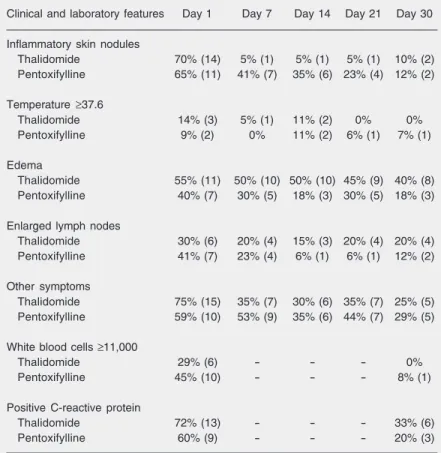
lesion regression after 7 days. The analysis of other symptoms occurring during the re-action revealed that 74% of all patients suf-fered from nausea, vomiting, headaches, adynamia, myalgia, and/or arthralgia. It was also found that among the 75% of thalido-mide-treated patients presenting other symp-toms at diagnosis (day 1), only 25% pre-sented these same symptoms on day 30. Likewise, in pentoxifylline-treated patients, among the 59% presenting other symptoms at diagnosis, only 29% maintained the same symptomatology at the end of the study.
The results of white blood cell count and the positivity of CRP levels were found to vary more frequently. In about 45% of tha-lidomide-treated and 29% of pentoxifylline-treated patients, leukocytosis (more than 11,000 white blood cells/mm3) was observed at the initial examination even though re-gression occurred in both groups. CRP lev-els were found to be positive in 72% of group 1 and 60% of group 2 patients, whereas on day 30 the percentage of thalidomide-treated and pentoxifylline-thalidomide-treated patients presenting a positive test had sharply de-clined to 33 and 20%, respectively.
To evaluate the performance of each drug and compare the respective data, analyses were carried out to measure their effective-ness after 2 weeks and at the end of treat-ment. Table 3 summarizes and grades the results as follows: 1) partial improvement when 1 or more symptoms were manifested; 2) total improvement when 100% improve-ment occurred after a type II reactional epi-sode; 3) general improvement considering both groups together (partial improvement + total improvement). As shown by an inten-tion to treat analysis, at the end of 2 weeks patients taking thalidomide showed a gen-eral improvement rate of 95% while those taking pentoxifylline obtained a 75% rate. However, at the end of 4 weeks, whereas the general improvement rate of the thalidomide group remained at 95%, that of the pentoxi-fylline group dropped to 62.5%. When these
Table 2. Clinical and laboratory features of type II reaction upon initial examination and their evolution during treatment.
Clinical and laboratory features Day 1 Day 7 Day 14 Day 21 Day 30
Inflammatory skin nodules
Thalidomide 70% (14) 5% (1) 5% (1) 5% (1) 10% (2)
Pentoxifylline 65% (11) 41% (7) 35% (6) 23% (4) 12% (2)
Temperature ≥37.6
Thalidomide 14% (3) 5% (1) 11% (2) 0% 0%
Pentoxifylline 9% (2) 0% 11% (2) 6% (1) 7% (1)
Edema
Thalidomide 55% (11) 50% (10) 50% (10) 45% (9) 40% (8) Pentoxifylline 40% (7) 30% (5) 18% (3) 30% (5) 18% (3)
Enlarged lymph nodes
Thalidomide 30% (6) 20% (4) 15% (3) 20% (4) 20% (4)
Pentoxifylline 41% (7) 23% (4) 6% (1) 6% (1) 12% (2)
Other symptoms
Thalidomide 75% (15) 35% (7) 30% (6) 35% (7) 25% (5)
Pentoxifylline 59% (10) 53% (9) 35% (6) 44% (7) 29% (5)
White blood cells ≥11,000
Thalidomide 29% (6) - - - 0%
Pentoxifylline 45% (10) - - - 8% (1)
Positive C-reactive protein
Thalidomide 72% (13) - - - 33% (6)
Pentoxifylline 60% (9) - - - 20% (3)
Data are reported as percent with number of patients in parentheses. Laboratory tests were carried out only at the beginning and the end of the study.
Table 1. Characteristics of patients before treatment with thalidomide or pentoxifylline.
Thalidomide (N = 20) Pentoxifylline (N = 24)
Age 18-69 (average) 37.1 years 33.4 years
Gender
Male 85% (17) 87.5% (21)
Female 15% (3) 12.5% (3)
Disability grade
0 40% (8) 45.8% (11)
1 35% (7) 29.2% (7)
2 25% (5) 25% (6)
Clinical form
BL 30% (6) 16.7% (4)
LL 70% (14) 83.3% (20)
Bacillary index (average) 2.39 2.42
data were compared by the Yates-corrected chi-square method at 4 weeks, there was a statistically significant difference between the drugs(P = 0.02).
Most of the adverse reactions caused by each drug, especially those related to gas-trointestinal complaints and nausea, occurred during the first week, tending to completely disappear over the remaining weeks of treat-ment. Only 1 pentoxifylline patient discon-tinued treatment due to the severity of these adverse effects. No significant difference in the occurrence of adverse reactions was de-tected between the two drugs (at the end of the first week and at the end of the third week; see Table 4).
Discussion
It is clear that the results of this double-blind controlled study strongly support the beneficial effects of pentoxifylline in treat-ing ENL (15,16). However, at the end of 1 month of treatment, the clinical results showed that the overall response to thalido-mide was significantly superior to the re-sponse to pentoxifylline. At the end of treat-ment, the improvement rate of patients tak-ing pentoxifylline was a noteworthy 62.5% compared to 95% for those taking thalido-mide. Furthermore, thalidomide acted more rapidly in reducing skin lesions. By day 7, only 5% of the patients presented skin le-sions vs 41% of those taking pentoxifylline.
In agreement with these results, in a clinical trial with thalidomide and acetylsalicylic acid, Iyer et al. (17) demonstrated that, by day 8, skin lesions had disappeared in 73% of the ENL reactional patients treated with thalidomide. In our study, pentoxifylline also contributed remarkably to the regression of edema and lymph node enlargement.
It is known that ENL patients often pres-ent severe leukocytosis capable of attaining a maximum of 30,000/mm3, characteristic of a leukemoid reaction (6). Oliveira et al. (18) have shown that, in ENL patients,
poly-morphonuclear neutrophils participated in the acute inflammatory response as an addi-tional source of TNF-α, correlating to the intense neutrophil infiltrate in these lesions. In the present study, the leukocyte count similarly regressed as a consequence of treat-ment with both drugs.
Foss et al. (19) have reported high CRP levels along with a positive correlation (95%) between elevated TNF-α and CRP levels in the serum of ENL patients. In the present study, on day 1, a high percentage of the ENL patients in both groups presented high serum levels of CRP (72% of group 1 and 60% of group 2) that regressed by day 30. Taken together, leukocytosis and CRP could be considered as laboratory parameters to be used to follow up the systemic inflammatory response and the decrease in serum TNF-α levels (18,19).
Table 3. Comparison of the effectiveness of treatment on the clinical signs and symptoms of leprosy type II reaction between thalidomide-treated and pentoxifylline-treated patients.
15 days 30 days
PI TI GI (PI + TI) PI TI GI (PI + TI)
Thalidomide 60% 35% 95% 50% 45% 95%*
Pentoxifylline 58.3% 16.7% 75% 29.2% 33.3% 62%
In this intention to treat analysis, the randomized schedule was followed rigorously. PI = partial improvement; TI = total improvement; GI = general improvement. *P = 0.02, comparison of the two groups at 30 days (t-test).
Table 4. Adverse reactions to thalidomide and pentoxifylline at the end of weeks 1 and 3.
Adverse reactions End of 1st week End of 3rd week
Thalidomide Pentoxifylline Thalidomide Pentoxifylline
(N = 20) (N = 23) (N = 19) (N = 18)
Presence 5 (25%) 7 (30.4%) 3 (15.8%) 2 (11.1%)
Absence 15 (75%) 16 (69.6%) 16 (64.2%) 16 (88.9%)
The present results obtained in the clini-cal evaluations carried out at the end of 30 days of treatment clearly indicated that the overall response to thalidomide was signifi-cantly better than the response to pentoxifyl-line. However, pentoxifylline could repre-sent a good alternative treatment for ENL patients for whom thalidomide is contraindi-cated.
Acknowledgments
We would especially like to thank Rita Maria de Oliveira Pereira and Denise Vieira de Moura for technical assistance through-out the study, and Judy Grevan for editing the text. But, most of all, we would like to extend our gratitude to the patients them-selves, who unfailingly gave their full and abiding cooperation whenever solicited.
References
1. Jolliffe DS. Leprosy reactional states and their treatment. Br J Dermatol 1977; 97: 345-352.
2. Nery JA, Vieira LM, de Matos HJ, Gallo ME, Sarno EN. Reactional states in multibacillary Hansen disease patients during multidrug therapy. Rev Inst Med Trop São Paulo 1998; 40: 363-370. 3. Sehgal VN. Reactions in leprosy. Clinical aspects. Int J Dermatol
1987; 26: 278-285.
4. Stanley JN, Pearson JM, Ridley DB. Episodic edema in type 2 lepra reaction can be caused by transient lymphatic obstruction in the lymph node. Int J Lepr Other Mycobact Dis 1986; 54: 231-235. 5. Rea TH, Levan NE. Erythema nodosum leprosum in a general
hospital. Arch Dermatol 1975; 111: 1575-1580.
6. Parida SK, Grau GE, Zaheer SA, Mukherjee R. Serum tumor necro-sis factor and interleukin 1 in leprosy and during lepra reactions. Clin Immunol Immunopathol 1992; 63: 23-27.
7. Sampaio EP, Sarno EN, Galilly R, Cohn ZA, Kaplan G. Thalidomide selectively inhibits tumor necrosis factor alpha production by stimu-lated human monocytes. J Exp Med 1991; 173: 699-703.
8. Pannikar V. The return of thalidomide: new uses and renewed concerns. Lepr Rev 2003; 74: 286-288.
9. Fundação Nacional da Saúde. Guia de controle da hanseníase. 2nd edn. Brasília: Ministério da Saúde; 1994.
10. WHO. WHO Expert Committee on Leprosy. Technical report series 874. Geneva: WHO 7th report; 1998.
11. Moreira AL, Sampaio EP, Zmuidzinas A, Frindt P, Smith KA, Kaplan G. Thalidomide exerts its inhibitory action on tumor necrosis factor alpha by enhancing mRNA degradation. J Exp Med 1993; 177: 1675-1680.
12. Sampaio EP, Kaplan G, Miranda A, Nery JA, Miguel CP, Viana SM,
et al. The influence of thalidomide on the clinical and immunologic manifestation of erythema nodosum leprosum. J Infect Dis 1993; 168: 408-414.
13. Samlaska CP, Winfield EA. Pentoxifylline. J Am Acad Dermatol
1994; 30: 603-621.
14. Sarno EN, Nery JA, Garcia CC, Sampaio EP. Is pentoxifylline a viable alternative in the treatment of ENL? Int J Lepr Other Mycobact Dis 1995; 63: 570-571.
15. De Carsalade GY, Achirafi A, Flageul B. Pentoxifylline in the treat-ment of erythema nodosum leprosum: results of an open study. Acta Leprol 2003; 12: 117-122.
16. Guinto RS, Tolentino JG, Malabay MC. Observations on erythema nodosum leprosum: Clinical evaluation studies in lepromatous lep-rosy. Int J Lepr Other Mycobact Dis 1963; 31: 81-94.
17. Iyer CG, Languillon J, Ramanujam K, Tarabini-Castellani G, De las Aguas JT, Bechelli LM, et al. WHO co-ordinated short-term double-blind trial with thalidomide in the treatment of acute lepra reactions in male lepromatous patients. Bull World Health Organ 1971; 45: 719-732.
18. Oliveira RB, Moraes MO, Oliveira EB, Sarno EN, Nery JA, Sampaio EP. Neutrophils isolated from leprosy patients release TNF-alpha and exhibit accelerated apoptosis in vitro. J Leukoc Biol 1999; 65: 364-371.