Quality of care provided to the hospitalized child from the
perspective of the companion
Qualidade da assistência à criança hospitalizada sob a ótica do acompanhante
Ylana Karine Fonseca de Medeiros1, Deborah Dinorah de Sá Mororó1, Juliana Teixeira Jales Menescal Pinto1, Nadja de Sá Pinto Dantas Rocha1, Gleiciane da Silva Fonseca1
Objective: to assess the companion’s satisfaction with the quality of care provided to the hospitalized child.
Methods: this is an evaluative study, carried out in a pediatric hospitalization unit of a University Hospital. Seventy companions of hospitalized children met the inclusion criteria and answered to the data collection instrument, composed of a form with socioeconomic information and another adapted to assess user satisfaction from the National Health Services Evaluation Program. Results: 45.7% reported some delay in care during the child’s hospitalization. There was satisfaction with the communication of information about the patient (88.6%), visit time (75.7%), cleaning of the environments (75.7%), but 65.7% did not know where to make complaints or suggestions and 44.3% did not know the name of the professional who would see their child. Conclusion:
in general, companions’ satisfaction regarding the quality of care for hospitalized children was evidenced, and opportunities for improvement regarding users’ rights were highlighted.
Descriptors: Health Evaluation; Quality of Health Care; Patient Satisfaction; Child Health.
Objetivo: avaliar a satisfação do acompanhante quanto à qualidade da assistência à criança hospitalizada.
Métodos: estudo avaliativo, realizado numa unidade de internação pediátrica de um Hospital Universitário. Setenta acompanhantes de crianças internadas atenderam aos critérios de inclusão e responderam ao instrumento de coleta de dados, composto por um formulário com informações socioeconômicas e outro adaptado de satisfação dos usuários do Programa Nacional de Avaliação dos Serviços de Saúde. Resultados:
45,7% relataram relativa demora no atendimento durante a internação da criança. Houve satisfação com o repasse de informações sobre o paciente (88,6%) e com o tempo de visita (75,7%), limpeza dos ambientes (75,7%), porém 65,7% não sabiam onde fazer reclamações ou sugestões e 44,3% desconheciam o nome do profissional que atendera seu filho. Conclusão: no geral, evidenciou-se a satisfação dos acompanhantes quanto à qualidade da assistência à criança internada, destacando-se oportunidades de melhoria referentes aos direitos dos usuários.
Descritores: Avaliação em Saúde; Qualidade da Assistência à Saúde; Satisfação do Paciente; Saúde da Criança.
1Universidade Federal do Rio Grande do Norte. Natal, RN, Brazil.
Introduction
Evaluative surveys of health actions and servi-ces, with the support of information derived from user satisfaction, are essential strategies for improving the quality of health care and consequent improvement of the health system(1-2).
The National Health Services Assessment Pro-gram is an instrument used by the Brazilian Ministry of Health to encourage assessment of establishments and its general objective is to evaluate the efficiency, efficacy and effectiveness of structures, processes and results related to access, risk and user satisfaction to-wards public health services, seeking resolution and quality care in outpatient clinics and medium and high complexity hospitals(3).
This process follows the benchmarks for qua-lity definition, according to the Donabedian systemic model, which sets health care from the triad: structu-re - corstructu-responding to the characteristics of structu-resources, instruments, physical and organizational conditions employed in health care; process - referring to the description of activities, goods and health services provided; and outcome - related to the observation of changes in the health status of patients, as well as those aimed at the satisfaction of those involved in the care(4).
User satisfaction survey, as an element of outco-me evaluation, covers distinct dioutco-mensions involving health care and encompasses from the professional--patient relationship to the quality of care and facili-ties of the service(3). It allows, in addition to a feedba-ck of the work process, users’ political participation in health care and shared construction, as proposed by the humanization policy and by the organic laws of the Unified Health System.
Despite the recent increase in national research production on the quality of hospital care, most stu-dies have targeted the adult population(5). Thus, given the few studies in the pediatric area, it is necessary to
publish such research to elucidate the reality of servi-ces and to supply the need for information about the health system - its mode of functioning, quality, effec-tiveness and safety - as well as to discuss and list pro-blems to be solved.
In view of the particularities of the pediatric universe, parents and/or caregivers of hospitalized children are the mediators of the therapeutic rela-tionship and, therefore, the best sources of informa-tion regarding satisfacinforma-tion in child care(6).
Therefore, in view of the need for a feedback on the quality of care provided in the Pediatric Hospita-lization Unit of a University Hospital in northeastern Brazil and considering the assumption that structure and relational processes are directly associated to the companion’s satisfaction about the care provided to the hospitalized patient, the following guiding ques-tion was raised: are the companions of hospitalized children satisfied with the quality of health care pro -vided?
From this perspective, the present study aimed to evaluate the companion’s satisfaction regarding the quality of care provided to the hospitalized child.
Methods
This is an evaluative study, carried out in the pediatric hospitalization unit of a General University Hospital in Natal, Rio Grande do Norte state, Brazil, which is a specialized referral unit with 30 beds avai-lable for medium and high complexity care of indivi-duals aged zero to 15 years 11 months and 29 days.
excluded. Data collection was performed from July to September 2014 through a structured interview con-ducted at the pediatric unit.
A form with socioeconomic information (age, gender, race, marital status, education, occupation and family income) was used to characterize the com-panions as well as a user satisfaction survey form contained in the National Health Services Assessment Program(3), adapted to the population of this study and composed of closed questions.
Questions covered access and agility in care, welcoming, environment indicators, quality of health care, users’ rights and their expectations regarding the health facility. In total, 15 questions were applied to the companions in the hospitalization service, in or-der to meet the objectives of the study.
After collection, the database was built and sta-tistical analysis was performed using Stasta-tistical Pro-duct and Service Solutions, version 20.0 for Windows. In the descriptive analysis, the quantitative variables were presented by mean and standard deviation, whi-le the categorical variabwhi-les were presented by absolu-te and relative frequencies, in the form of tables.
In order to compare the differences in the pro-portion of socioeconomic variables and the satisfac-tion of the companions in relasatisfac-tion to the outcome “Overall Expectation of Service”, the Pearson’s Chi--square test (X2) was applied, with analysis of the ad-justed and standardized residues to identify the best associations. Throughout the analysis, authors adop-ted a standard p-value of 0.05 and a confidence inter -val of 95.0%.
In the analysis of some variables of the compa-nion satisfaction survey instrument, it was necessary to group their options, without compromising data reliability, as in the case of satisfaction questions, in which four options (very satisfied, satisfied, dissa -tisfied and very dissa-tisfied) were grouped into two (satisfied and dissatisfied), and also in the questions on cleaning and comfort evaluation, in which five op -tions (very good, good, fair, poor and very poor) were
grouped into three (good, fair and poor). This way of grouping the data was chosen to facilitate information analysis and to avoid a consequent limitation of sta-tistical tests.
The study complied with the formal require-ments contained in the national and international regulatory standards for research involving human beings.
Results
Among the interviewees, seven (10.0%) were men and 63 (90.0%) were women, with a mean age of 32.2 (±9.2) years, mostly mothers (88.9%), brown--colored (57.1%) and married and/or in stable mari-tal status (41.4%). The predominant occupation was housewife (47.1%), with basic/average level of edu-cation (92.0%) and family income of one to two mini-mum wages (55.7%) - considering that the minimini-mum wage at the time of the study was R$ 724.00 (equiva-lent to US$ 315.00). The mean length of hospital stay of children was 6.6 (± 4.5) days.
Regarding the time elapsed until provision of care, most of the companions (54.3%) reported that the first care provided during hospitalization did not take long after admission. However, some answered that this care took a little time (27.1%), took time (14.3%) and took a very long time (3.0%) to occur af-ter admission, identifying a considerable delay throu-gh the grouping of such answers (45.7%). Table 1 shows the description of some variables related to the companion’s satisfaction regarding the care provided to the child.
Table 1 - Companion satisfaction with care provided to hospitalized children
Variable n (%)
Satisfaction with care (respect/courtesy/interest)
Satisfied 68 (97.1)
Dissatisfied 2 (2.9)
Cleaning of environments
Good 53 (75.7)
Fair 16 (22.9)
Poor 1 (1.4)
Food provided (children)
Satisfied 57 (85.1)
Dissatisfied 10 (14.9)
Information about the patient
Yes 62 (88.6)
No 8 (11.4)
Do you know the professional’s name?
Yes 39 (55.7)
No 31 (44.3)
Do you know where to make a complaint?
Yes 24 (34.3)
No 46 (65.7)
Visit time
It was as I expected 53 (75.7) I did not receive a visit 17 (24.3) Overall Expectation of Service
Better than I expected 51 (72.9) Just as I expected 11 (15.7) I did not have expectations 8 (11.4)
Regarding the environment, the predominant opinions characterized the pediatric hospitalization unit as clean, comfortable and well-signaled, since most of the companions (85.7%) stated that the envi-ronment had signs that facilitated walking inside the hospital. Participants also classified cleaning (75.7%) and the comfort of the rooms (88.6%) as good.
When asked about the supply of clothes, nine participants said they chose not to use them to dress the children and therefore did not answer to such questions. Among those who answered, 41.0% repor-ted lack of providing of clothes during the hospitaliza-tion of the child. The others reported receiving clean (59.0%) and comfortable clothes (50.8), and 94.4% of them reported being satisfied.
On the food provided to the children, regarding the appearance of the food, quantity, temperature and the pre-established meal schedule, most participants (85.1%) stated that they were satisfied. In addition, most of the companions reported having received guaranteed food (92.9%) and satisfactory accommo-dations (95.7%).
Regarding the duration of visit time, most of the companions (75.7%) reported they were as they expected. The others reported not have received vi-sits during hospitalization, so that none of the parti-cipants answered having had a shorter visit time than they expected.
Of all the interviewees, 88.6% reported having been informed about the health status of the hospitali-zed child, but 11.4% said they did not receive such in-formation. In this context, only two questions have not fully reflected a good evaluation of the service. One of them refers to the identification of the professional who had provided assistance to the child, in which 44.3% of the interviewees reported not knowing the name of this professional.
The other question refers to the place where the user can make complaints or suggestions, in whi-ch 65.7% of the participants stated that they did not know about the existence of an environment inten-ded for this purpose, even though the hospital had an ombudsman’s office.
Most companions (72.9%) revealed their ex-pectations were exceeded regarding the service pro-vided in the pediatric hospitalization unit of that uni-versity hospital. The opinions of the others diverged regarding having their expectations met, since some stated that the service was as they imagined (15.7%), and some said they had no expectation whatsoever (11.9%).
Table 2 - Association between the variables informa-tion about the patient and overall expectainforma-tion
Variable
Overall expectation
Total p Better than
I expected n (%)
Just as I expected or I did not have expectations
n (%)
Information about the patient
0.001 Yes 49 (79.0) 13 (21.0) 62 (100.0) No 2 (25.0) 6 (75.0) 8 (100.0) Total 51 (72.9) 19 (27.1) 70 (100.0)
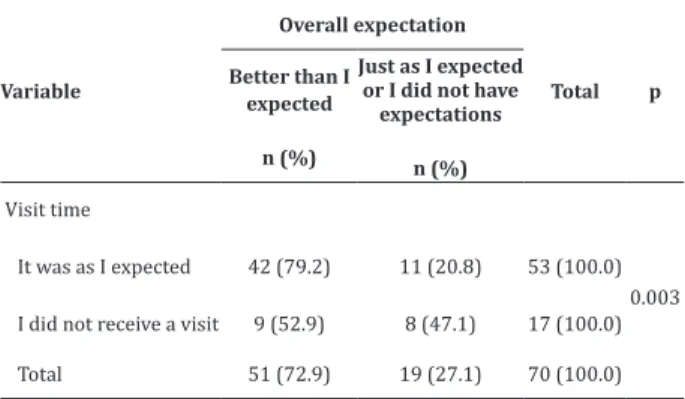
Table 3 - Association between the variables visit time and overall expectation
Variable
Overall expectation
Total p Better than I
expected
n (%)
Just as I expected or I did not have
expectations
n (%)
Visit time
0.003
It was as I expected 42 (79.2) 11 (20.8) 53 (100.0)
I did not receive a visit 9 (52.9) 8 (47.1) 17 (100.0)
Total 51 (72.9) 19 (27.1) 70 (100.0)
Considering the analysis of the adjusted resi-dues, for the variable “information about the patient”, the association evidenced that those companions who received information about the child’s health status (79.0%) reported better evaluation of the service, as their overall expectation about the service was overcome, characterizing it as better than imagined. However, most of the companions who did not receive any information about the child’s clinical condition (75.0%) thought that the care provided was as they expected or they did not have expectations at all.
Regarding the variable “visit time”, the analysis revealed that 79.2% thought that the visit time was in accordance with what they expected and provided a good evaluation of the service (as better than they expected).
Discussion
The study had limitations regarding the size of the sample, which was restricted to a single pediatric unit. However, there is potential for applying it for other services, using the same methodology as reference.
Most of the children’s companions are their pa-rents, and they are considered objects of care because they are experiencing, together with their children, the disease and hospitalization process(6). In the study, most of the companions were mothers and housewi-ves, which reinforces the idea that the hospitalization of a child interferes directly in the family dynamics, especially the mother’s dynamics, since she becomes away from home to accompany the child during hos-pitalization(7).
Regarding the agility in care during hospitaliza-tion, despite few participants mentioned some delays, it is important that services become aware of the wai-ting time of all users and create strategies to impro-ve agility in care, considering that a humanized care should prioritize reduced queues and waiting times, with increased access and welcoming and resolute reception(8).
As for the relationship established between companions, children and the staff, the satisfaction of the interviewees raised reflection on the treatment developed with courtesy and respect by the health professionals, as it makes hospitalization a less pain-ful and more tolerable experience for children and their companions(6,9).
A systematic study of the literature has shown that health institutions have implemented strategies for the construction of warm and harmonious envi-ronments, in order to contribute to the improvement of care for hospitalized children, including the use of architecture as a way to promote well-being to chil-dren and their families(11).
It is essential to provide companions with good conditions for staying with the children. Professionals involved in the care process should contribute to this purpose(6). In line with this, most participants repor-ted having enjoyed satisfactory accommodations and food throughout their stay in the service.
Regarding access to information about the heal-th status of heal-the child, alheal-though most respondents were satisfied, not all participants had had this right assu -red. It should be noted that with the ease of acquiring knowledge through the internet, the health professio-nal may lose credibility if the guidelines given are not consistent with those surveyed by the companions or when the professionals do not demonstrate having experience. Such conditions may result in a fragile re-lation between the caregiver and the user, lack of con-fidence in the professional, as well as non-adherence to the behaviors guided by him/her(12).
In this sense, professionals involved in the care of the hospitalized child should pay special attention to communication and transmission of information to all parents and family members, in simple and clear language, preserving the ethical and legal principles regarding the rights of the companions, minimizing feelings of anguish and enabling positive outcomes(6).
In addition, most caregivers were unaware of the name of the professional who assisted the child, which can be explained by the variety of professionals in the team and also by the turnover of undergradua-tes and residents, considering that that pediatric hos-pitalization unit is inserted in a school hospital that receives students from various health courses and offers medical and multidisciplinary residences.
Most of the interviewees also reported being unaware of the existence of an ombudsman sector.
These spaces enable social participation and contri-bute to the management and supervision of the qua-lity of health services(13). In this context, in order to guarantee this right to users, it is necessary to inform them about the existence of an ombudsman’s office and provide other ways to receive their complaints in an accessible manner, guaranteeing the right to express their complaints, denunciations, needs and suggestions, either through ombudsmen, suggestion boxes or other existing mechanisms.
Given this, it is worth mentioning that the Na-tional Humanization Policy ensures that every user of the Unified Health System will be able to identify who are the professionals who take care of their health, en-suring that the health units will provide information to them, allowing the monitoring of people in their social network with free choice and the fulfillment of their rights(14).
In addition, in order for the hospitalization pro-cess to be less traumatically experienced by children and their caregivers/relatives, it is essential that their needs be met by the service with the shared partici-pation of children and families in health care(15). The expanded and comprehensive conception of the he-alth-disease process is relevant for the development of humanized actions in health care, since all action starts from a pre-existing health concept(16). A view based on the comprehensiveness of the subjects re-quires qualified listening of their complaints.
Overall, the expectations of the companions re-garding the service provided in the university hospi-tal in question have been overcome. Data association showed that there was a direct effect in the overall expectation for those companions who has been in-formed about the health status of the child and also for those who were satisfied about the length of visit time, who said they had their expectations exceeded.
However, those companions who did not recei-ve any information about the child’s clinical condition said that the care provided by the service was as they expected or that they had no expectations.
of health services and to reflect on the difficulties for
the creation of strategies that allow solving the pro-blems listed, guaranteeing a quality care.
In view of the above, this research data are ex-pected to contribute to the improvement of child care, either in the said hospital or in other units, and also to raise awareness of health professionals and resear-chers about discussions and deepening regarding the quality of care to hospitalized child, considering the relevance of humanization and of the triad professio-nal, child and family.
Conclusion
The present study evidenced the satisfaction of the companions as to the quality of care provided to hospitalized children regarding agility in care, re-lationship with and trust in the team, environment, food, clothing provided, length of visit time and condi-tions guaranteed to the companion, such as food and accommodation. However, there are opportunities for improvement regarding users’ rights, identification of the professional that serves the child and lack of kno-wledge of the companions about the existence of an ombudsman office.
Collaborations
Medeiros YKF, Mororó DDS, Pinto JTJM and Ro-cha NSPD contributed to the conception, design and analysis of data. Medeiros YKF performed data col-lection. All authors contributed to the critical review, writing of the article and final approval of the version to be published.
References
1. Arruda CAM, Bosi MLM. Satisfação de usuários da atenção primária à saúde: um estudo qualitativo no Nordeste do Brasil. Interface. 2017; 21(61):321-32. doi: http://dx.doi.org/10.1590/1807-57622015.0479
2. Molina KL, Moura GMSS. Patient satisfaction according to the form of hospital stay at a teaching hospital. Acta Paul Enferm. 2016; 29(1):17-25. doi: http://dx.doi.org/10.1590/1982-0194201600004
3. Ministério da Saúde (BR). Secretaria-Executiva, Departamento de Regulação, Avaliação e Controle de Sistemas. PNASS: Programa Nacional de Avaliação de Serviços de Saúde. Brasília: Ministério da Saúde; 2015.
4. Gardner G, Gardner A, O’Connell J. Using the Donabedian to examine the quality and safety of nursing service innovation. J Clin Nurs. 2014; 23(2):145-55. doi: http://dx.doi.org/10.1111/ jocn.12146
5. Machado JP, Martins ACM, Martins MS. Avaliação da qualidade do cuidado hospitalar do Brasil: uma revisão sistemática. Cad Saúde Pública. 2013; 29(6):1063-82. doi: http://dx.doi.org/10.1590/ S0102-311X2013000600004
6. Torquato IM, Collet NC, Dantas MS, Jonas
MF, Trigueiro JS, Nogueira MF. Assistência humanizada à criança hospitalizada: percepção do acompanhante. Rev Enferm UFPE on line [Internet]. 2013 [citado 2017 jul. 21]; 7(9):5541-9. Disponível em: https://periodicos.ufpe. b r / rev i s t a s / rev i s t a e n fe r m a g e m / a r t i c l e / viewFile/13672/16561
7. Santos LF, Oliveira LMAC, Barbosa MA, Siqueira KM, Peixoto MKAV. Reflexos da hospitalização da criança na vida do familiar acompanhante. Rev Bras Enferm. 2013; 66(4):473-8. doi: http://dx.doi. org/10.1590/S0034-71672013000400002 8. Oliveira KKD, Amorim KKPS, Fernandes APNL,
Monteiro AI. Impact of the implementation of patient engagement with risk classification for professional work of one urgent care unit. REME Rev Min Enferm. 2013; 17(1):157-64. doi: http:// dx.doi.org/10.5935/1415-2762.20130013 9. Barreto TSM, Sakamoto VTM, Magagnin JS, Coelho
10. Petean E, Costa ALRC, Ribeiro RLR. Reper-cussões da ambiência hospitalar na perspec-tiva dos trabalhadores de limpeza. Trab Educ Saúde. 2014; 12(3):615-35. doi: http://dx.doi. org/10.1590/1981-7746-sip00005
11. Ribeiro JP, Gomes GC, Thofehrn MB. Health facility environment as humanization strategy care in the pediatric unit: systematic review. Rev Esc Enferm USP. 2014; 48(3):527-36. doi: http://dx.doi. org/10.1590/S0080-623420140000300020 12. Carvalho S, Martins Filho J. Family relationships
with pediatricians: the maternal views. Rev Paul Pediatr. 2016; 34(3):330-5. doi: http://dx.doi. org/10.1016/j.rppede.2016.03.015
13. Ministério da Saúde (BR). Secretaria de Gestão Estratégica e Participativa. Departamento de Ouvidoria-Geral do SUS. Guia de orientações básicas para implantação de ouvidorias do SUS. Brasília: Ministério da Saúde; 2013.
14. Ministério da Saúde (BR). PNH: Política Nacional de Humanização. Brasília: Ministério da Saúde; 2013.
15. Ribeiro JP, Gomes GC, Silva PA, Thofehrn MB, Oliveira AMN, Tarouco ACMB. Reflecting on the construction of caring in pediatrics. Rev Enferm UFPE on line [Internet]. 2016 [cited 2017 Jul 21]; 10(12):4672-9. Available from: http://www. revista.ufpe.br/revistaenfermagem/index.php/ revista/article/view/9079
16. Oliveira IC, Cutolo LRA. Humanização como