BRIEF COMMUNICATION
Normative data of the Barratt Impulsiveness
Scale 11 (BIS-11) for Brazilian adults
Leandro F. Malloy-Diniz,
1Jonas J. de Paula,
1,2Alina G. Vasconcelos,
1Katie M. de Almondes,
3Rockson Pessoa,
4Leonardo Faria,
5Gabriel Coutinho,
6Danielle S. Costa,
1Victor Duran,
7Thales V. Coutinho,
1Humberto Correˆa,
1Daniel Fuentes,
8Neander Abreu,
7Paulo Mattos
6,91Universidade Federal de Minas Gerais (UFMG), Belo Horizonte, MG, Brazil.2Faculdade de Cieˆncias Me´dicas de Minas Gerais (FCMMG),
Belo Horizonte, MG, Brazil.3Universidade Federal do Rio Grande do Norte (UFRN), Natal, RN, Brazil.4Universidade Federal do Amazonas
(UFAM), Manaus, AM, Brazil.5Pontifı´cia Universidade Cato´lica de Goia´s (PUC Goia´s), Goiaˆnia, GO, Brazil.6Instituto D’Or de Pesquisa e
Ensino (IDOR), Rio de Janeiro, RJ, Brazil.7Universidade Federal da Bahia (UFBA), Salvador, BA, Brazil.8Universidade de Sa˜o Paulo (USP),
Sa˜o Paulo, SP, Brazil.9Universidade Federal do Rio de Janeiro (UFRJ), Rio de Janeiro, RJ, Brazil.
Objective:The Barratt Impulsiveness Scale (BIS-11) is a valid and reliable instrument, and one of the most often used tools to assess impulsivity. This study assesses the performance of a large sample of adults by using a version of BIS-11 adapted to Brazilian Portuguese.
Methods: We assessed 3,053 adults from eight Brazilian states. Internal consistencies and performance data were presented for two correction criteria of BIS-11: original and the two-factor score.
Results:The associations between age, sex, region, and education and the BIS-11 scores present very small effect sizes. Therefore, we provided a percentile rank parameter for the different BIS-11 subscores considering the whole sample. Given the internal consistency of the two correction systems, we found that only the two-factor system fulfills the psychometric criteria of Cronbach’s alpha (cutoff value of at least 0.6).
Conclusion:Our results support the use of the Brazilian adaptation of BIS-11 in different regions of the country as a measure of impulsivity. Since high impulsiveness is a characteristic of several dysfunctional behaviors, the establishment of normative parameters is of utmost relevance and should be extended to other age ranges and populations in future studies.
Keywords: Cognitive neuroscience; diagnosis and classification; impulse control disorders not listed elsewhere; other psychological issues; tests/interviews; psychometric properties
Introduction
Impulsivity is a comprehensive and complex phenotype that encompasses several types of cognitive and beha-vioral expressions. A broad definition of impulsive behavior includes swift action without planning, acts without previous judgment and forethought, and risk-taking.1Of note, impulsivity is not necessarily pathological and may have an adaptive role in several conditions. Dickman2proposes the existence of functional impulsiv-ity, which refers to the tendency to act with relatively little forethought when the subject needs to make fast decisions. For example, according to Lage et al.,3some types of impulsive behaviors are related to better performance in certain contexts (e.g., sports practice). Even in clinical samples, functional impulsivity seems to be related to better functioning of attention, reaction time, and goal-directed behavior.4 Nonetheless, even as an aspect of human nature, impulsivity is overexpressed in
several psychiatric disorders5 and is related to several non-adaptive behaviors such as substance abuse,6 gambling,7 and suicide.8 Therefore, the assessment of impulsive behavior is crucial both for clinical practice and for research in neurosciences and related fields.
The Barratt Impulsiveness Scale (BIS) is a self-report questionnaire that measures different dimensions of impulsivity. Since its first presentation in 1959,9this scale has undergone several changes. The current version (BIS-11) is one of the most often used tools to assess impulsivity, presenting impressive evidence concerning its validity, reliability, and predictive value.10
Briefly, BIS-11 is composed of 30 items scored on a Likert scale (ranging from never¼1 point to very frequently¼4 points). It assesses the three main dimen-sions of impulsive behavior: attentional (a lack of focus on the ongoing task), motor (acting without thinking), and non-planning impulsivity (orientation to the present rather than to the future). According to Patton et al.,11the scale also assesses six first-order factors (attention, cognitive instability, motor, perseverance, self-control, and cognitive complexity); however, most studies report-ing BIS-11 scores have focused on the three second-order factors.10
Correspondence: Leandro Fernandes Malloy-Diniz, Av. Alfredo Balena, 190, CEP 30130-100, Belo Horizonte, MG, Brazil. E-mail: [email protected]
Submitted Oct 27 2014, accepted Mar 20 2015.
Revista Brasileira de Psiquiatria. 2015;37:245–248 Associac¸a˜o Brasileira de Psiquiatria
The BIS-11 scale has been adapted to different languages, including Brazilian Portuguese.12 BIS-11 is reliable (high internal consistency and test/retest stability) and valid, and it has been able to draw associations between inattention and hyperactivity symptoms and smoking habits12 as well as between psychiatric dis-orders. In accordance with most studies, the Brazilian version of BIS-11 presents a two-factor structure (inhibi-tion control and non-planning), rather than the original three-factor version.13
Although psychometric studies have provided evidence of validity and reliability, normative data for BIS-11 for the Brazilian population are lacking. Since high impulsiveness is a characteristic of various problematic behaviors, the establishment of classification and comparison para-meters is thus of utmost relevance. The present study provides data on normative parameters by using BIS-11 in the Brazilian adult population.
Methods
Participants and procedures
We assessed a convenience sample of 3,053 Brazilian adults aged 18 to 84 years (mean: 31.71611.85). Participants were residents of eight Brazilian states: Minas Gerais (n=1,107), Rio de Janeiro (n=170), Santa Catarina (n=296), Rio Grande do Norte (n=202), Bahia (n=404), Amazonas (n=618), Rondoˆnia (n=85), and Goia´s (n=171). All subjects were recruited from schools, universities, leisure centers, and workplaces. Exclusion criteria were age under 18 years, illiteracy, and self-reported neurological or psychiatric disorders. There were more female (n=1,892) than male participants, and most had a full secondary education or were undergraduates (n=2,159), followed by primary education (n=413) and complete college or graduate degrees (n=481). All participants provided informed consent for participation and answered the BIS-11 questionnaire. The study was approved by the local Ethics Committee and was in accordance with the Declaration of Helsinki.
Statistical analysis
To develop the interpretative parameters, we adopted the four most used criteria for BIS-11 correction: total score (a one-factor solution), the traditional three-factor solution (attentional, motor, and non-planning),11 the two-factor solution (inhibition control and non-planning) found for the Brazilian population13and the six first-order factors reported by Patton et al. (attention, cognitive instability, motor, perseverance, self-control, and cognitive complexity).11
Since the BIS-11 data showed a predominant non-parametric distribution (usually leptokurtic curves), nor-mative parameters were presented by using percentile ranks. For the divisions based on sociodemographic measures, we used logarithmic transformations of the BIS-11 scores. These scores were entered into a multi-variate general linear model with education (primary, secondary, and higher), sex (male, female) and Brazilian region (southeast, northeast, north, south, and midwest)
as fixed factors, and age as a covariate. Effect sizes (estimated by the partial eta-squared statistic) were adopted for potential stratification considering these sociodemographic factors, with moderate effect sizes (0.06 or higher) as cutoff values. We also computed the reliability of each score according to Cronbach’s alpha. All procedures were performed by using SPSS version 20.
Results
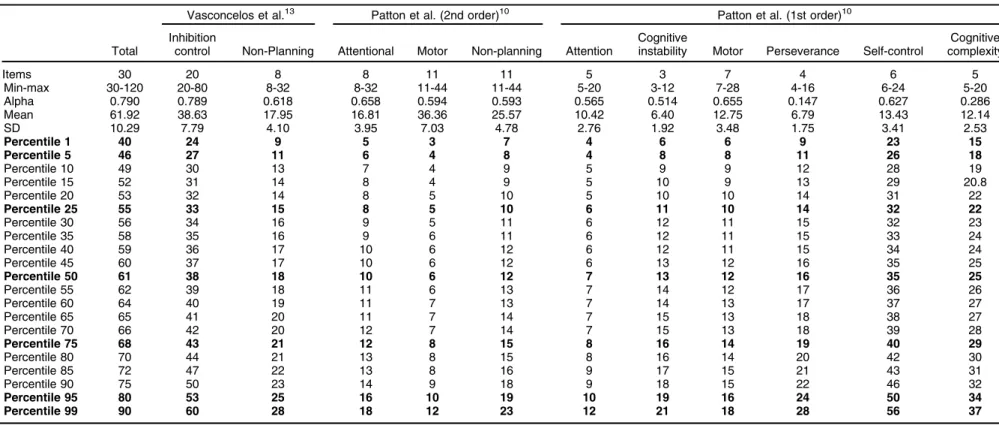
The BIS-11 data, including internal consistency, are shown in Table 1. The internal consistency of the total score was 0.790, while the values of its subscales ranged from very low (0.147 for the motor subscore from Patton et al.’s first-order factor division) to moderate/high (0.789 for inhibition control from Vasconcelos’s two-factor divi-sion). The multivariate general linear models containing the BIS-11 measures as dependent variables were all significant (all po0.001).
Differences in age (F = 3,530, p o0.001) and formal education (w2= 350.62, po0.001) but not sex (w2= 2.99, p = 0.559) were found according to the results of the univariate analysis of variance (ANOVA) and chi-square tests. Participants from the south region were older than those from elsewhere and participants from the southeast and north had a lower formal education. Nonetheless, no individual main effect of age, sex, education or region reached the cutoff value of 0.06 for the normative data divisions (effect sizes ranged from 0.00 to 0.04). There-fore, we did not stratify the sample according to sex, region, and education. Table 1 shows the normative data for all BIS-11 scores in the full sample, divided by the total score, the two-factor solution of Vasconcelos et al.,13and the three-factor (second-order) and six-factor (first-order) solutions of Patton et al.11
Discussion
In this study, we provided percentile ranks for the different components of BIS-11, including the most commonly adopted division11and a two-factor division found in the Brazilian population,13besides the total score. As pointed by Mitrushina et al.,14when considering screening tasks, a Cronbach’s alpha value above 0.6 is considered to be acceptable. In our study, only the two-factor version reached these psychometric properties. The internal consistency for the three- and six-factor divisions fell below this threshold, suggesting that their use in research or clinical settings should be done cautiously.
The two-factor structure showed better reliability and seemed to be more robust for clinical and research purposes. As discussed by Vasconcelos et al.,13 the factor structure of the Brazilian BIS-11 seems to be corroborated by evidence that supports the independence of the inhibition and non-planning (decision-making) components of impulsivity. The neurofunctional correlates of these two aspects are dissociated in the prefrontal cortex, involving the dorsolateral and orbitofrontal cor-tices, respectively.15 While the dorsolateral prefrontal circuit has been associated with the organization of information, including the inhibition of motor responses
Table 1 Performance of Brazilian adults on the BIS-11 scale: interpretative parameters
Vasconcelos et al.13 Patton et al. (2nd order)10 Patton et al. (1st order)10
Total
Inhibition
control Non-Planning Attentional Motor Non-planning Attention
Cognitive
instability Motor Perseverance Self-control
Cognitive complexity
Items 30 20 8 8 11 11 5 3 7 4 6 5
Min-max 30-120 20-80 8-32 8-32 11-44 11-44 5-20 3-12 7-28 4-16 6-24 5-20 Alpha 0.790 0.789 0.618 0.658 0.594 0.593 0.565 0.514 0.655 0.147 0.627 0.286 Mean 61.92 38.63 17.95 16.81 36.36 25.57 10.42 6.40 12.75 6.79 13.43 12.14 SD 10.29 7.79 4.10 3.95 7.03 4.78 2.76 1.92 3.48 1.75 3.41 2.53
Percentile 1 40 24 9 5 3 7 4 6 6 9 23 15
Percentile 5 46 27 11 6 4 8 4 8 8 11 26 18
Percentile 10 49 30 13 7 4 9 5 9 9 12 28 19
Percentile 15 52 31 14 8 4 9 5 10 9 13 29 20.8
Percentile 20 53 32 14 8 5 10 5 10 10 14 31 22
Percentile 25 55 33 15 8 5 10 6 11 10 14 32 22
Percentile 30 56 34 16 9 5 11 6 12 11 15 32 23
Percentile 35 58 35 16 9 6 11 6 12 11 15 33 24
Percentile 40 59 36 17 10 6 12 6 12 11 15 34 24
Percentile 45 60 37 17 10 6 12 6 13 12 16 35 25
Percentile 50 61 38 18 10 6 12 7 13 12 16 35 25
Percentile 55 62 39 18 11 6 13 7 14 12 17 36 26
Percentile 60 64 40 19 11 7 13 7 14 13 17 37 27
Percentile 65 65 41 20 11 7 14 7 15 13 18 38 27
Percentile 70 66 42 20 12 7 14 7 15 13 18 39 28
Percentile 75 68 43 21 12 8 15 8 16 14 19 40 29
Percentile 80 70 44 21 13 8 15 8 16 14 20 42 30
Percentile 85 72 47 22 13 8 16 9 17 15 21 43 31
Percentile 90 75 50 23 14 9 18 9 18 15 22 46 32
Percentile 95 80 53 25 16 10 19 10 19 16 24 50 34
Percentile 99 90 60 28 18 12 23 12 21 18 28 56 37
Higher BIS-11 scores are indicative of higher impulsivity.
Alpha = Cronbach’s alpha; Min-max = minimum-maximum; SD = standard deviation.
Rev
Bras
Psiquiatr
.
2015;37(3)
Normative
data
for
BIS-11
and attentional control, the ventromedial prefrontal circuit is related to the emotional aspects of decision-making.15 As mentioned in the Results section, since the differences between the sociodemographic variables did not reach a high effect size, we did not stratify our sample. However, our sample also did not follow the distribution of the Brazilian population, showing an imbalance with reference to sex and formal education. Although our regression analysis did not show the significant influence of these aspects on the BIS-11 scores, sample selection might have biased our analysis. We also relied on patients’ self-reported data rather than on a structured interview to assess psychiatric symptoms.
Despite the above-mentioned limitations, the present study presented preliminary normative parameters for BIS-11 for Brazilian adults. Future studies could address the applicability of BIS-11 for assessing the clinical population by considering diagnostic purposes and obtaining the normative parameters in a nationally representative sample.
Acknowledgements
This study has received research grants from the National Science and Technology Institute for Molecular Medicine (INCT-MM; FAPEMIG CBB-APQ-00075-09/CNPq 573646/ 2008-2).
Disclosure
The authors report no conflicts of interest.
References
1 Moeller FG, Barratt ES, Dougherty DM, Schmitz JM, Swann AC. Psychiatric Aspects of Impulsivity. Am J Psychiatry. 2001;158:1783-93.
2 Dickman SJ. Functional and dysfunctional impulsivity: personality and cognitive correlates. J Pers Soc Psychol. 1990;58:95-102.
3 Lage GM, Gallo LG, Cassiano GJM, Lobo ILB, Vieira MV, Salgado JV, et al. Correlations between impulsivity and technical performance in handball female athletes. Psych. 2011;2:721-6.
4 Pedrero-Pe´rez EJ, Ruiz Sa´nchez de Leo´n JM, Rojo Mota G, Llanero Luque M, Puerta Garcı´a C. [Neuropsychological characterization of functional and dysfunctional impulsivity in drug addicts: clinical implications]. Adicciones. 2012;24:51-7.
5 Berlin GS, Hollander E. Compulsivity, impulsivity, and the DSM-5 process. CNS Spectr. 2014;19:62-8.
6 Beaton D, Abdi H, Filbey FM. Unique aspects of impulsive traits in substance use and overeating: specific contributions of common assessments of impulsivity. Am J Drug Alcohol Abuse. 2014;40: 463-75.
7 Suomi A, Dowling NA, Jackson AC. Problem gambling subtypes based on psychological distress, alcohol abuse and impulsivity. Addict Behav. 2014;39:1741-5.
8 Malloy-Diniz LF, Neves FS, de Moraes PH, De Marco LA, Romano-Silva MA, Krebs MO, et al. The 5-HTTLPR polymorphism, impulsivity and suicide behavior in euthymic bipolar patients. J Affect Disord. 2011;133:221-6.
9 Barratt ES. Anxiety and impulsiveness related to psychomotor effi-ciency. Percept Mot Skills. 1959;9:191-8.
10 Stanford MS, Mathias C, Dougherty DM, Lake SL, Anderson NE, Patton JH. Fifty years of the Barratt Impulsiveness Scale: an update and review. Pers Individ Dif. 2009;47:385-95.
11 Patton JH, Stanford MS, Barratt ES. Factor structure of the Barratt impulsiveness scale. J Clin Psychol. 1995;51:768-74.
12 Malloy-Diniz LF, Mattos P, Leite WB, Abreu N, Coutinho G, de Paula JJ, et al. Traduc¸a˜o e adaptac¸a˜o cultural da Barratt Impulsiveness
Scale (BIS-11) para aplicac¸a˜o em adultos brasileiros. J Bras
Psi-quiatr. 2010;59:99-105.
13 Vasconcelos AG, Malloy-Diniz L, Correˆa H. Systematic review of psychometric properties of Barratt Impulsiveness Scale Version 11 (BIS-11). Clin Neuropsychiatry. 2012;9:61-74.
14 Vasconcelos AG, Teodoro MLM, Malloy-Diniz L, Coˆrrea H. Impul-sivity components measured by the Brazilian version of the Barratt Impulsiveness Scale (BIS-11). Psicol Reflex Crit. 2015;28:96-105. 15 Mitrushina M, Boone K, Razani J, D’Elia L. Handbook of normative
data for neuropsychological assessment. 2nd ed. New York: Oxford University Press; 2005.