AR
TIGO ORIGINAL / ORIGINAL AR
TICLE
INTRODUCTION
Colonoscopies are currently considered to be the procedures of choice for the investigation of diseases of the large intestine and the ileum in adults and children(2). This is largely due to their diagnostic pre-cision and the possibility of performing therapeutic procedures when abnormalities are found.
Despite technological advances in colonoscopies, ideal intestinal preparation still represents one of the most dificult stages of the process. Inadequate prepa-ration results in an increase in costs and risks. There is a need for repetition of the examination due to the possibility of not detecting lesions, thus increasing the risk of complications(10). There are various methods available for the preparation of the colon, each having its advantages and disadvantages.
BOWEL PREPARATION FOR PERFORMING
A COLONOSCOPY:
prospective randomized comparison
study between a low-volume solution of
polyethylene glycol and bisacodyl versus
bisacodyl and a mannitol solution
Manoel Carlos
VIEIRA
, Claudio Lyoiti
HASHIMOTO
and Flair José
CARRILHO
ABSTRACT – Context - Colonoscopy is currently the gold standard method to examine the colon, the rectum and the terminal ileum. In order to perform the colonoscopy, it is necessary to clean the bowel and use medications that are generally poorly tolerated by the patients. Objective - Compare the tolerability, acceptability, safety and eficacy of two solutions used for intestinal preparation for a colonoscopy. Methods - One hundred patients matched for sex and age were prospective randomized into two groups. Polyethylene glycol group received bisacodyl 10 mg plus 1 L of polyethylene glycol the night before and 1 L on the day of the exam. Mannitol group received bisacodyl 20 mg the day before and 1 L of a 10% mannitol solution on the day of the exam. The diet was the same for both groups. Tolerability and acceptability were measured using previously validated questionnaires. In terms of safety, variations in vital signs before and after the preparation were recorded, in addition to any complications. The quality of the preparation was graded based on the Boston and Ottawa scales. Results - Ninety-six percent (96%) completed the study. As for tolerability, the mannitol preparation group exhibited a signiicantly higher frequency of nausea, vomiting, abdominal pain, and abdominal distension than polyethylene glycol group (P < 0.05). Acceptability was signiicantly better in polyethylene glycol group. The polyethylene glycol solution has also previ-ously been shown to be safer than mannitol. No difference was observed in the quality of the preparation between the two preparation methods. Conclusions - The following conclusions can be made: polyethylene glycol solution had higher tolerability, acceptability, and safety than the mannitol and should be used instead of mannitol. Both preparation solutions have similar eficacy.
HEADINGS – Colonoscopy. Polyethylene glycol. Bisacodyl. Mannitol.
Authors’ Contributions: M.C.V. was responsible for the entire manuscript; F.J.C. helped to draft the text; and C.L.H. contributed to the manuscript. All authors read and approved the final manuscript.
Disclosure - All authors disclosed no financial relationships to this publication.
Diagnostic Center of Gastroenterology, Department of Gastroenterology, Hospital das Clínicas University of São Paulo School of Medicine, São Paulo, SP, Brazil. Correspondence: Dr. Manoel Carlos Vieira - Rua Marquês de Herval, 67 - ap. 1201 - Parque Tamandaré - 28035-013 - Campos dos Goytacazes, RJ, Brazil. E-mail: [email protected]
For colonoscopies to be considered effective, it is fundamental that all mucosa of the organ are visible from the anal margin up to the ileocecal valve. In England, few services have been shown to reach 90% cecal intubation, and one of the main causes cited for incomplete exams is inadequate preparation(14). A similar study performed in France analyzing 7,205 colonoscopies demonstrated that the examination of the colon and the rectum was complete in 96% of the cases, with inadequate preparation responsible for 32.5% of the incomplete examinations(5).
countries and analyzed 5,832 patients concluded that the quality of the intestinal preparation was signiicantly asso-cia ted with the detection of polyps of any size(7).
It is currently acknowledged that the ideal preparation should combine the following qualities: safety, eficacy, usa-bility, tolerausa-bility, and low cost.
Background
This study is justiied by the use of a mannitol solution to prepare the colon in the majority of colonoscopy services in Brazil, although this solution is not recommended by the American Society for Gastrointestinal Endoscopy due to reports of colon explosion and electrolyte disturbances(18).
The primary aim was to analyze the tolerability, accepta-bility, safety and effectiveness of two different solutions for intestinal preparation for colonoscopies: PEG balanced with electrolytes and mannitol.
METHODS
This was a longitudinal, prospective, controlled and randomized study involving individuals undergoing colonos-copies for various indications with outpatient preparation in the Hospital das Clínicas of the School of Medicine of the University of São Paulo, SP, Brazil, from June to December of 2008.
The sample was calculated by estimating an alpha error of 5% and conidence interval with statistical signiicance of 5%, considering the strict exclusion criteria.
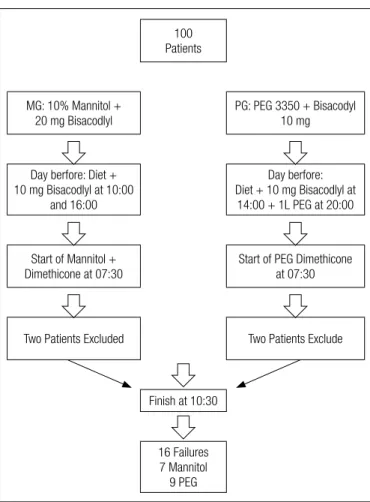
One hundred patients were matched for sex and age at a 1:1 ratio and randomized to receive the mannitol and bisaco-dyl solution or the PEG and bisacobisaco-dyl solution.
All information about the preparation was clearly pro-vided to each patient, and the colonoscopists were blinded about the bowel preparation.
The current study was approved by the Scientiic Ethics Committee of for Analysis of Research Projects (CAPPesq) of the Clinical Board of the Hospital das Clínicas of the University of São Paulo - School of Medicine (research protocol number n0864/08).
This study does not present any conlicts of interest.
Inclusion criteria
Patients between 18 and 85 years of age who underwent a colonoscopy with outpatient preparation and who signed an informed consent form were included in the study.
Exclusion criteria
Patients with adynamic ileus, subacute bowel obstruction, a previous colectomyorcolostomy, grade II to grade IV heart failure as per the New York Heart Association (NYHA) cri-teria, uncontrolled or severe systemic arterial hypertension, decompensate liver disease, severe dehydration, hypersensi-tivity to PEG, pregnancy or suspicion of pregnancy, severe intestinal inlammatory disease, toxic megacolon, presence of intense abdominal pain of unknown origin, chronic kidney disease, or severe constipation (one evacuation within an
interval greater than 5 days) were excluded from the study.
Diet
The patients were instructed to follow a standard diet without solid food the day before the procedure.
Group I: balanced PEG (Muvinlax®) and bisacodyl
The preparation was divided into two stages. The day before the examination, two 5 mg tablets of bisacodyl were given to the patient at 2 PM along with 1 L of the PEG solu-tion at 8 PM on the same day. On the day of the examinasolu-tion, another liter of the solution was ingested, beginning at 07:30 (one of 10 200 mL cups every 10 minutes). Each liter of the PEG solution contained the following composition: 105 g of 3,350 Kd macrogol, 1.42 g of sodium bicarbonate, 2.8 g of sodium chloride, 0.37 g of potassium chloride, and lemon lavor. The consumption of clear liquids and water was freely permitted during the preparation in quantities up to 500 mL.
Group II: mannitol and bisacodyl
The preparation was performed into two stages. The day before the examination, four tablets of 5 mg bisacodyl were taken orally, with two tablets taken at 10 AM and two tablets taken at 4 PM. On the day of the examination, the patient ingested 1 L of a 10% mannitol solution, beginning at 07:30. The consumption of clear liquids or water was freely per-mitted during the preparation in a quantity of up to 500 mL. The use of two bottles of dimethicone (15 mL each at 75 mg/mL) was also included in both preparations.
For cases of abdominal pain, the patients were instructed to use Butylscopolamine 10 mg (Buscopam®), taken orally.
Evaluation methodology of the colon preparation
The patients underwent the colonoscopy when the exit of clear rectal efluents into a toilet was conirmed by the researcher. This criterion is based on the principle of ob-taining the best intestinal preparation possible, to prevent cancellation of the exam.
The team of colonoscopists scored the preparation ac-cording to the Ottawa and Boston preparation scales. The Ottawa scale veriies, in a simpliied manner, the quality of the preparation of each segment individually and addresses the volume of liquid in an overall manner, generating a numeric result from 0 to 14(16). The Boston scale assesses the quality of the preparation of each region separately on a scale of 0 to 3 for a total of up to 9(12).
The preparation time was considered to last from the start of the ingestion of the solutions until the rectal efluent was clear and without fecal residue within a 3-hour time limit. The preparation was considered inadequate when the objective was not reached within this period. Inadequate preparations were complemented with additional doses of the solutions being evaluated.
TABLE 1. Comparisons between the mannitol solution and the PEG solution with regard to the preparation time and the failure index
Preparation time Mannitol PEG Total
Mean ± SD (min) 142.83 ± 61.26 144.67 ± 60.95 143.75 ± 60.79 0.8546**
Median (min) 141 119.5 128
Minimum-Maximum (min) 50 - 340 60 - 320 50 – 340
Total 48 48 96
Failure
No 41 (85.4%) 39 (81.3%) 80 (83.3%) 0.5839*
Yes 7 (14.6%) 9 (18.8%) 16 (16.7%)
Total 48 48 96
*Chi-square test **Mann-Whitney test
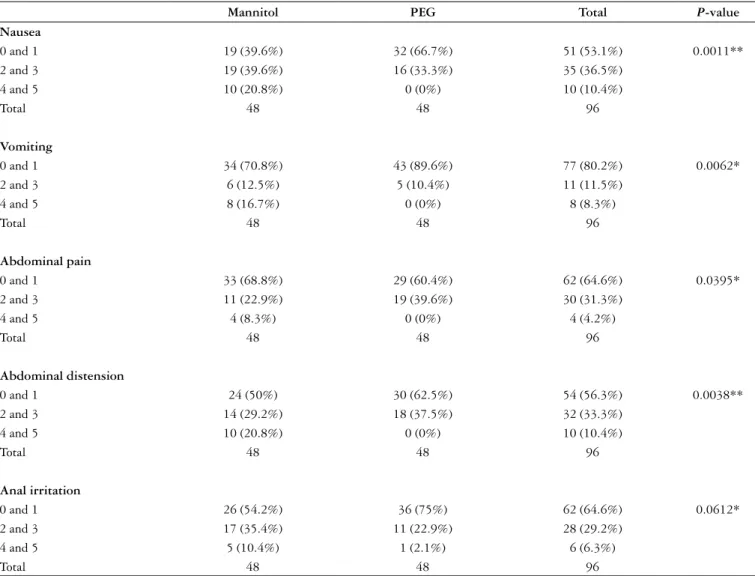
vomiting, abdominal pain, abdominal distension, and anal irritation, was evaluated on a scale from 0 to 5, classiied for the best evaluation in three groups:
0 and 1: absent or light symptoms 2 and 3: moderate symptoms 4 and 5: severe symptoms
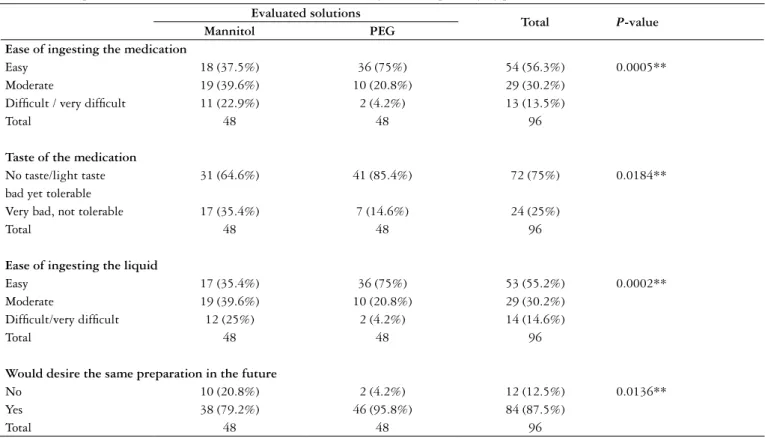
The patients were also asked about the general accepta-bility of the preparation, evaluating the ease of medication ingestion (easy, moderate but tolerable, or very bad/not tolerable), the ease of liquid ingestion (easy, moderate, or dificult/very dificult) and whether they would accept the same type of preparation for a colonoscopy in the future.
With regard to safety, the patients were accompanied from the time they arrived at the hospital until their discharge, with variations in average blood pressure and heart rate evaluated before and after the preparation.
Statistical methodology
In the descriptive analysis, the frequencies and percen-tages were calculated for the categorical variables, and the mean, standard deviation, median, minimum, and maximum were calculated for the continuous variables.
A chi-square test was used to compare the scale for age, sex, diverticular disease, and the identiication of polyps according to the treatment medication. A Mann-Whitney test was used to compare the body mass index (BMI) and bowel habits, as well as the Boston scale, according to the type of preparation.
Chi-square and Fisher’s exact tests were used to compare the following: side effects, the Ottawa and Boston scores, whether the patient would wish to use the same preparation in the future, the ease of ingesting the medication, the taste of the medication, and the ease of ingesting the liquid.
A signiicance level of 5% (P value ≤ 0.05) was used.
RESULTS
Out of a total of 100 patients, 96 completed the study. Four were excluded for not having appropriately completed the preparation (Figure 1).
The groups were evaluated in relation to their distribu-tion by age, BMI, sex, diverticular disease, bowel habits, and the frequency of polyps. Using a chi-square test (χ2), it was concluded that the groups were homogenous.
No signiicant difference was observed when comparing the time used for adequate preparation between the tested solutions. When the index of failure was analyzed, 16 pa-tients needed greater ingestion of medication to complete the preparation (Table 1).
FIGURE 1. One hundred patients were matched for sex and age at a 1:1 ratio and randomized to receive the mannitol and bisocodyl solution or the PEG and bisacodyl solution as demonstrated above. Out of a total of 100 patients, 96 completed the study. When time inished, 16 patients were considerate failed and needed greater ingestion of medication to complete the preparation
100 Patients
MG: 10% Mannitol + 20 mg Bisacodlyl
PG: PEG 3350 + Bisacodyl 10 mg
Day berfore: Diet + 10 mg Bisacodlyl at 10:00
and 16:00
Day berfore: Diet + 10 mg Bisacodlyl at
14:00 + 1L PEG at 20:00
Start of Mannitol + Dimethicone at 07:30
Start of PEG Dimethicone at 07:30
Two Patients Excluded Two Patients Exclude
Finish at 10:30
16 Failures 7 Mannitol
A signiicant difference was observed in the occurrence of nausea, vomiting, abdominal pain, and abdominal disten-sion according to the solution evaluated. The patients who used the mannitol solution had a greater intensity of nausea vomiting, abdominal pain and abdominal distension. No signiicant difference was observed in the occurrence of anal irritation (Table 2).
The analysis of acceptability revealed that the patients in the PEG group had a greater ease of ingesting the medica-tion and the indicated quantity of liquid. They stated that the taste was more palatable in relation to the possibility of a future colonoscopy exam, and 96% would undergo the same preparation with balanced PEG vs 79% with mannitol group (Table 3). All of the results noted are statistically signiicant. Analyzing the variation of the vital signs between the preparation methods, a signiicant difference was observed in relation to the heart rate both before and after prepara-tion, according to the evaluated solution. No hemorrhagic
complication or colon perforation was reported, with a similar number of procedures being performed in both groups (Table 4).
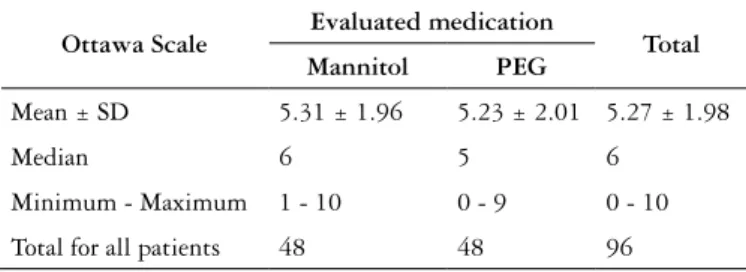
No signiicant difference was observed between the sco-ring in the scales obtained for the evaluation of the quality of the preparation (Tables 5 and 6).
DISCUSSION
Colonoscopy is considered to be the gold standard for the evaluation of the mucosa of the colon, rectum, and terminal ileum(17). Therefore, a continuous search for perfection of the technique is merited for all stages of the colonoscopy.
For decades, the ingestion of PEG for intestinal prepara-tion was considered to be the standard due to the low fre-quency of side effects. The PEG solution, however, requires the ingestion of large volumes, a characteristic that reduces the acceptability and tolerability of the patients(8).
TABLE 2. Comparison between the mannitol and PEG solutions with regard to tolerability by patients
Mannitol PEG Total P-value
Nausea
0 and 1 19 (39.6%) 32 (66.7%) 51 (53.1%) 0.0011** 2 and 3 19 (39.6%) 16 (33.3%) 35 (36.5%)
4 and 5 10 (20.8%) 0 (0%) 10 (10.4%)
Total 48 48 96
Vomiting
0 and 1 34 (70.8%) 43 (89.6%) 77 (80.2%) 0.0062* 2 and 3 6 (12.5%) 5 (10.4%) 11 (11.5%)
4 and 5 8 (16.7%) 0 (0%) 8 (8.3%)
Total 48 48 96
Abdominal pain
0 and 1 33 (68.8%) 29 (60.4%) 62 (64.6%) 0.0395* 2 and 3 11 (22.9%) 19 (39.6%) 30 (31.3%)
4 and 5 4 (8.3%) 0 (0%) 4 (4.2%)
Total 48 48 96
Abdominal distension
0 and 1 24 (50%) 30 (62.5%) 54 (56.3%) 0.0038** 2 and 3 14 (29.2%) 18 (37.5%) 32 (33.3%)
4 and 5 10 (20.8%) 0 (0%) 10 (10.4%)
Total 48 48 96
Anal irritation
0 and 1 26 (54.2%) 36 (75%) 62 (64.6%) 0.0612* 2 and 3 17 (35.4%) 11 (22.9%) 28 (29.2%)
4 and 5 5 (10.4%) 1 (2.1%) 6 (6.3%)
Total 48 48 96
TABLE 3. Comparison between the mannitol and PEG solutions with regard to acceptability by patients
Evaluated solutions
Total P-value
Mannitol PEG
Ease of ingesting the medication
Easy 18 (37.5%) 36 (75%) 54 (56.3%) 0.0005** Moderate 19 (39.6%) 10 (20.8%) 29 (30.2%)
Dificult / very dificult 11 (22.9%) 2 (4.2%) 13 (13.5%)
Total 48 48 96
Taste of the medication
No taste/light taste 31 (64.6%) 41 (85.4%) 72 (75%) 0.0184** bad yet tolerable
Very bad, not tolerable 17 (35.4%) 7 (14.6%) 24 (25%)
Total 48 48 96
Ease of ingesting the liquid
Easy 17 (35.4%) 36 (75%) 53 (55.2%) 0.0002** Moderate 19 (39.6%) 10 (20.8%) 29 (30.2%)
Dificult/very dificult 12 (25%) 2 (4.2%) 14 (14.6%)
Total 48 48 96
Would desire the same preparation in the future
No 10 (20.8%) 2 (4.2%) 12 (12.5%) 0.0136** Yes 38 (79.2%) 46 (95.8%) 84 (87.5%)
Total 48 48 96
**Chi-square test
TABLE 4. Comparison between the mannitol and PEG solutions with regard to patient safety
Evaluated solutions
Total P-value
Mannitol PEG
Increase in HR pre/post (bpm)
Mean ± SD 14.7 ± 8.93 8.79 +- 5.48 11.82 +- 7.94 0.0244***
Median 14 8 8
Minimum - Maximum 2 - 40 3 - 20 2 - 40
Total 20 19 39
Reduction in BP pre/post (mm HG)
Mean ± SD 3.83 ± 5.82 3.17 ± 6.14 3.5 ± 5.96 0.2361***
Median 0 0 0
Minimum - Maximum 0 - 27 0 - 33 0 - 33
Total 48 48 96
Procedure
Biopsies 2 (14.3%) 2 (11.1%) 4 (12.5%) Serial biopsies 2 (14.3%) 0 (0%) 2 (6.3%) Mucosectomy 1 (7.1%) 0 (0%) 1 (3.1%) Cold polypectomy 0 (0%) 2 (11.1%) 2 (6.3%) Polypectomy with forceps 3 (21.4%) 11 (61%) 13 (40.6%) Polypectomy/snare
polypectomy
6 (42.9%) 3 (16.7%) 9 (28.1%)
Total 48 48 96
TABLE 5. Ottawa Scale according to the evaluated medication
Ottawa Scale Evaluated medication Total Mannitol PEG
Mean ± SD 5.31 ± 1.96 5.23 ± 2.01 5.27 ± 1.98
Median 6 5 6
Minimum - Maximum 1 - 10 0 - 9 0 - 10 Total for all patients 48 48 96
Mann-Whitney test: P-value = 0.9433
TABLE 6. Boston Scale according to the evaluated medication
Group
Mannitol PEG Total
Boston
Mean ± SD 8.5 ± 0.97 8.54 ± 0.99 8.52 ± 0.97
Median 9 9 9
Minimum -Maximum 5 - 9 5 - 9 5 - 9 Total for all patients 48 48 96
Mann-Whitney test: P-value = 0.6900
Even though the mannitol solution has been banned in various countries because of reports of cases of colon explosion during the performance of polypectomies(3, 4) it is still widely used in Brazil. The objective of this study was to evaluate the tolerability, acceptability, safety and effectiveness of the PEG solution balanced with electrolytes and mannitol for intestinal preparation for colonoscopies.
There are a few studies comparing the two solutions in different forms of administration. In a study performed by Habr-Gama et al.(8) in 1984, 148 patients were randomized to receive one of the solutions prior to colonoscopy. No signiicant difference was observed in relation to the eficacy or the side effects, such as nausea, vomiting, abdominal pain, abdominal distention, and fainting; however, the side effects were not graded. In a study performed by Beck et al.(1) in 1986, comparing the same solutions that have been described for pre-operative bowel preparation in 80 patients, both methods were observed to be safe and effective with a success index of 70% to 100%.
In the present study, the tolerability was evaluated by applying a graded scale of side effects. In a comparison be-tween the solutions, a signiicant difference was observed in favor of the balanced PEG solution for the following items: nausea, vomiting, abdominal pain, and abdominal disten-sion. A study performed by DiPalma et al.(6), which evaluated 200 patients who were administered the balanced PEG with a protocol similar to that used in the present study, revealed similar results. Lichtenstein et al.(13) obtained a similar result when they evaluated the balanced PEG solution combined with 20 mg of bisacodyl with regard to acceptability, using a questionnaire similar to the one in the present study. In that study, 206 patients were evaluated in the PEG group.
It is known that any solution for colon preparation may cause adverse effects. The most frequent are the following: hydroelectric disturbances, abdominal discomfort, nausea,
and vomiting. In the present study, although the frequency of hydroelectric disturbances was not evaluated in the laboratory, the balanced PEG solution proved to be more tolerable as judged by the majority of questions that were evaluated, corroborating previous information that sug-gests that a balanced PEG solution should be the method of choice for patients with comorbidities, such as renal failure, liver failure, or ascites(11), as it is a non-osmotic and electrolytically balanced solution that does not cause luid exchange between membranes, resulting in a low frequency of systemic electrolyte disturbances; its mechanism of action is explained by the high molecular weight of the macrogol polymer, which leads the solution to be retained in the colon when it is administered, favoring cleanliness of the colon(1). In the evaluation of the safety of the preparation, simpli-ied measurements were used that are available in any medical center, along with simple evaluations of variations in blood pressure and heart rate. The patients who used the mannitol solution obtained a higher variation in their heart rate in rela-tion to pre- and post-prepararela-tion, which indicates a greater possibility of electrolyte disturbances or hypovolemia.
One of the most severe and feared complications, colon explosion during the colonoscopy, initially reported by Bi-gard et al.(3) in 1979, has been the topic of a recent systematic review(11). The literature describes 20 documented cases from 1952 to 2006, with 9 occurring during endoscopic procedures. Of these 9, 4 occurred during the performance of a poly-pectomy, resulting in colon perforation in all cases. Of the 4 cases, 2 were prepared with PEG, 1 win a sodium phosphate enema, and 1 with a mannitol solution. The most frequently used solution overall was mannitol, described in 14 cases, with sorbitol used in 1 case. In all of the cases cited, the risk factor was the production of gases at explosive levels. In the current study, 6 polypectomies with electrocautery were performed in the mannitol group, and 3 were performed in the PEG group, without any complications.
Nunes et al.(15) when comparing the solutions, found re-sults that conlict with the present study, observing greater eficacy in the polyethylene group, with an optimal cleanliness of 90% in comparison to 75% of the mannitol group. In this study, the satisfaction index was similar, although only 55 patients were evaluated.
It should be highlighted that, in the present study, the eficacy of the preparation was evaluated by objective cri-teria through the Ottawa and Boston scales, both of which are current and internationally validated, and no signiicant difference was observed between the two methods.
FINAL CONSIDERATIONS
were randomized according to inclusion and exclusion cri-teria clearly deined. Despite the use of a questionnaire that was not formally validated, it contains questions that are similar to those used in other studies.
The preparation of the colon is usually a dificult stage for patients, and it is not uncommon for a patient to report that the preparation is worse than the exam itself. Thus, the search for an ideal preparation solution remains a goal that has yet to be achieved.
CONCLUSIONS
In this study, we found that colonic preparation was equally eficacious using either a PEG solution or a mannitol
solution. Preparation of the colon with a PEG solution led to a signiicant improvement in tolerability, acceptability, and safety compared to mannitol solution.
CAPSULE SUMMARY
To perform a colonoscopy, it is necessary to use solu-tions to clean the colon that are generally poorly tolerated by patients. The use of mannitol is still common in Brazil, although this use of mannitol for this purpose is banned in the rest of the world. In this study, we conirmed that the polyethylene glycol solution should be used on a large scale in a large country like Brazil because it is better accepted, well-tolerated and safer than the mannitol solution.
Vieira MC, Hashimoto CL, Carrilho FJ. Preparo de cólon para realização de colonoscopia: estudo prospectivo randomizado comparativo entre solução de polietilenoglicol baixo volume mais bisacodil versus solução de manitol mais bisacodil. Arq Gastroenterol. 2012;49(2):162-8.
RESUMO – Contexto - O exame de colonoscopia é atualmente o padrão-ouro para investigação do cólon e íleo terminal. Para sua realização há neces-sidade de limpeza do cólon com soluções que, em geral, são mal toleradas pelos pacientes. Objetivo - Comparar duas soluções de preparo intestinal para colonoscopia quanto à tolerabilidade, aceitabilidade, segurança e efetividade. Métodos - Cem pacientes pareados por sexo e idade foram ran-domizados prospectivamente em dois grupos. O grupo polietilenoglicol recebeu bisacodil 10 mg + 1 litro de polietilenoglicol na véspera e 1 litro no dia do exame. O grupo manitol recebeu bisacodil 20 mg na véspera e 1 litro de manitol 10% no dia do exame. A dieta foi a mesma nos dois grupos. A tolerabilidade e aceitabilidade foram aferidas por questionários previamente validados. Quanto à segurança foram avaliados: variação de sinais vitais antes e após o preparo e complicações, além de quaisquer sinais de complicação. A qualidade do preparo foi graduada através das escalas de Boston e Ottawa. Resultados - Noventa e seis pacientes (96%) completaram o estudo. Quanto à tolerabilidade o grupo manitol apresentou manifesta-ção signiicativamente maior de náusea, vômito, dor abdominal e distensão abdominal do que o grupo polietilenoglicol (P<0,05). Aceitabilidade foi signiicativamente melhor com o grupo polietilenoglicol. O grupo polietilenoglicol também se mostrou mais seguro. Não se observou diferença na qualidade do preparo entre os métodos. Conclusões - A solução de polietilenoglicol apresentou melhor tolerabilidade, aceitabilidade e segurança e deve ser usada ao invés da solução de manitol. Ambas as soluções são semelhantes em eicácia.
DESCRITORES – Colonoscopia. Polietilenoglicóis. Bisacodil. Manitol.
REFERENCES
1. Beck DE, Fazio VW, Jagelman DG. Comparison of oral lavage methods for preoperative colonic cleansing. Dis Colon Rectum. 1986;29:699-703.
2. Belsey J, Epstein O, Heresbach D. Systematic review: oral bowel preparation for colonoscopy. Aliment Pharmacol Ther. 2007;25:373-84.
3. Bigard MA, Gaucher P, Lassalle C. Fatal colonic explosion during colonoscopic polypectomy. Gastroenterology. 1979;77:1307-10.
4. Bond JH, Levy M, Levitt MD. Explosion of hydrogen gas in the colon during proctosigmoidoscopy. Gastrointest Endosc. 1976;23:41-2.
5. Canard JM, Debette-Gratien M, Dumas R, Escourrou J, Gay G, Giovannini M, Greff M, Grimaud JC, Helbert T, Marchetti B, Lapuelle J, Napoleon B, Palazzon L, Ponchon T, Rey JF, Sautereau D, la Société Française d’Endoscopie Digestive (SFED). A prospective national study on colonoscopy and sigmoidoscopy in 2000 in France. Gastroenterol Clin Biol. 2005;29:17-22.
6. DiPalma JA, McGowan J, Cleveland MV. Clinical trial: an eficacy evaluation of reduced bisacodyl given as part of a polyethyleneglycol electrolyte solution preparation prior to colonoscopy. Aliment Pharmacol Ther. 2007;26:1113-9. 7. Froehlich F, Wietlisbach V, Gonvers JJ, Burnand B, Vader JP. Impact of colonic
cleansing on quality and diagnostic yield of colonoscopy: the European Panel of appropriateness of Gastrointestinal Endoscopy European multicenter study. Gastrointest Endosc. 2005;61:378-84.
8. Habr-Gama A, Vieira MJ, Alves PRA, Sousa Junior AHS, Sototuka JK, Gama-Rodrigues JJ, Travassos VHCR. Preparation of the colon for colonoscopy. A prospective study with a 10% mannitol solution and with an electrolyte solution containing polyethylene glycol. GED Gastroenterol Endosc Dig. 1986;5:127-32. 9. Harewood GC, Sharma VK, de Garmo P. Impact of colonoscopy prepara-tion quality on detecprepara-tion of suspected colonic neoplasia. Gastrointest Endosc. 2003;58:76-9.
10. Hendry PO, Jenkins JT, Diament RH. The impact of poor bowel preparation on colonoscopy: a propective single centre study of 10,571 colonoscopies. Colorectal Dis. 2007;9:745-8.
11. Ladas SD, Karamanolis G, Ben-Soussan E. Colonic gas explosion during thera-peutic colonoscopy with electrocautery. World J Gastroenterol. 2007;13:5295-8. 12. Lai EJ, Calderwood AH, Doros G, Fix OK, Jacobson BC. The Boston bowel
preparation scale: a valid and reliable instrument for colonoscopy-oriented research. Gastrointest Endosc. 2009;69:620-5.
13. Lichtenstein GR, Grandhi N, Schmalz M, Lottes SR, Forbes WP, Walker K, Zhang B. Clinical trial: sodium phosphate tablets are preferred and better toler-ated by patients compared to polyethylene glycol solution plus bisacodyl tablets for bowel preparation. Aliment Pharmacol Ther. 2007;26:1361-70.
14. Mitchell RM, McCallion K, Gardiner KR, Watson RG, Collins JS. Successful colonoscopy; completion rates and reasons for incompletion. Ulster Med. J 2002;71:34-7.
15. Nunes BL, Belo SG, Pessoa MH, Lins Neto MA. Comparative evaluation of bowel preparation for colonoscopy using mannitol and polyethylene glycol - a prospective study. Rev Bras Coloproctol. 2008;28:294-8.
16. Rostom A, Jolicoeur E. Validation of a new scale for the assessment of bowel preparation quality. Gastrointest Endosc. 2004;59:482-6.
17. Stengel JZ, Jones DP. Single-dose lubiprostone along split-dose PEG solution with-out dietary restrictions for bowel cleansing prior to colonoscopy: a randomized, double-blind, placebo-controlled trial. Am J Gastroenterol. 2008;103:2224-30. 18. Wexner SD, Beck DE, Baron TH, Fanelli RD, Hyman N, Shen B, Wasco KE;
American Society of Colon and Rectal Surgeons; the American Society for Gas-trointestinal Endoscopy; Society of American GasGas-trointestinal and Endoscopic Surgeons. A consensus document on bowel preparation before colonoscopy: pre-pared by a Task Force From The American Society of Colon and Rectal Surgeons (ASCRS), the American Society for Gastrointestinal Endoscopy (ASGE), and the Society of American Gastrointestinal and Endoscopic Surgeons (SAGES). Gastrointest Endosc 2006;63:894-909.