THE ROLE OF PRE-RECRUITMENT PROCESSES IN THE
MAINTENANCE OF A BARNACLE (Chthamalus challengeri HOEK)
PATCH ON AN INTERTIDAL PEBBLE SHORE IN JAPAN
APOLINÁRIO, M.
Museu Nacional, Departamento de Invertebrados, Carcinologia, Universidade Federal do Rio de Janeiro, CEP 20940-040, Rio de Janeiro, Brazil
Correspondence to: Moacir Apolinário, Departamento de Invertebrados, Carcinologia, Universidade Federal do Rio de Janeiro, CEP 20940-040, Rio de Janeiro, Brazil, e-mail: [email protected]
Received October 17, 1997 – Accepted April 22, 1998 – Distributed June 30, 1999
(With 8 figures)
ABSTRACT
To understand the role of pre-recruitment processes (supply of larvae and recruitment) in the main-tenance of an intertidal barnacle (Chthamalus challengeri Hoek) patch, the availability of cyprid larvae and the recruitment on natural pebble substrata was monitored on the Magarisaki pebble shore (Amakusa, Kyushu, Japan) during 1995 and 1996. Also, a hypothesis that predation and/or bulldozing by mobile intertidal mollusks during the post-recruitment period could be an important factor in mortality of these barnacles was tested. The collapse of the adult population and the consequent disappearance of the patch were observed by the middle of 1995. The larval availability was low (≅ 6 cyprid larvae/100 l), as was the recruitment (≅ 30 recruits/25 cm2). The recruits experienced high
mortality, preventing them becoming adults able to maintain the patch. In 1996, a similar pattern of availability of the cyprid larvae, and even lower recruitment occurring only at the upper intertidal level was observed. A mobile mollusks exclusion experiment failed to detect any significant differences among the treatments, supporting the null hypothesis that the observed pattern of distribution was not caused by predation by mobile mollusks. There is my suggestion that the low availability of larvae and the low level of recruitment caused the non-maintenance of the patch.
Key words: barnacles, Chthamalus challengeri, larval supply, recruitment, Japan.
RESUMO
O papel do recrutamento na manutenção de “patches” de cracas no litoral de Amakusa, Japão
Para entender o papel dos processos pré-recrutamento (suprimento de larvas e recrutamento) na ma-nutenção de um “patch” de uma craca da região entremarés (Chthamalus challengeri Hoek), foram moni-torados a disponibilidade de larvas cipris e o recrutamento em substrato natural no litoral rochoso de Magarisaki (Amakusa, Kyushu, Japão) durante 1995 e 1996. Também foi testada a hipótese de que predação por moluscos móveis durante o pós-recrutamento poderia ser um importante fator na mortalidade destas cracas. Foi observado o colapso da população adulta e o conseqüente desaparecimento do “patch” em 1995. A disponibilidade de larvas foi baixa (≅ 6 larvas cipris /100 l), assim como o recrutamento (≅ 30 recrutas/25 cm2). Os recrutas tiveram alta mortalidade, impedindo-os de se tornarem adultos capazes
de manter o “patch”. Em 1996, foi observado um padrão similar de disponibilidade de larvas cipris e um recrutamento ainda menor, ocorrendo apenas na região do supralitoral. A exclusão dos moluscos móveis não detectou nenhuma diferença significativa entre os tratamentos, suportando a hipótese nula de que o padrão de distribuição observado não é causado por predação por moluscos. É minha sugestão que a baixa disponibilidade de larvas e o baixo recrutamento causaram a não manutenção do “patch” de cracas.
INTRODUCTION
The marine environment is usually divided by benthos and pelagos, with plankton being part of the pelagic world (Boero et al., 1996). The
barna-cles belong, in the early stages of their life cycle, to the plankton and, after successful metamorphosis and recruitment, they “become” benthic invertebra-tes. Their population dynamics are regulated mainly by the agents of mortality that act at each stage of their life history to restrict the number of individuals reaching reproductive maturity, as well as by the dispersal abilities of propagules and by availability of suitable recruitment sites (Minchinton & Schei-bling, 1991). Much research has been done to determine causes of differential mortality after recruitment: competition, predation, and physical disturbance (Connell, 1972, 1975; Paine, 1974, 1977, 1980, 1984; Menge & Sutherland, 1976; Lubchenco & Menge, 1978; Underwood et al.,
1983). However, the barnacles have a larval phase of 2 wk or more, and during that time the larvae are carried away from the system where they were relea-sed. The traditional population model assumes that the adults produce offspring, that become members of the same population as their parents, and so form a closed population, does not fit the above scenario. Several recent studies on the small dispersing larval phase of marine invertebrates life cycles, have re-discovered Thorson’s classic study (Thorson, 1950) and re-emphasized larval supply and early post-recruitment mortality as strong deter-minants of distribution and abundance of marine benthic populations (Yoshika, 1982; Keough, 1983; Underwood & Denley, 1984; Watanabe, 1984; Gaines & Roughgarden, 1985; Roughgarden et al., 1985, 1987; Menge & Sutherland, 1987; Davis, 1988; Underwood & Fairweather, 1989). A more realistic approach to population dynamics of marine invertebrates with pelagic larval phases, should assume that most of these populations are part of a multitude of geographically distant populations or metapopulations, and thus vulnerable of variations in the availability of cyprid larvae (due to oceanographic conditions or discontinuities in larvae release by the sub-populations) over time. This study examined the mechanisms of patch maintenance of an intertidal barnacle (Chthamalus challengeri Hoek) population on a pebble shore.
Since space was not a limiting factor at this intertidal pebble shore, and the barnacles were
observed forming a unique isolated patch from the upper to the middle intertidal levels, there was a wish to know if pre- or post- recruitment processes were regulating the observed pattern of distribution, and if this pattern persisted over time and/or space.
MATERIAL AND METHODS
Study site
The sand spit of Magarisaki, located in Amakusa Shimoshima, West Kyushu, Japan (lat. 32ϒ32’N, long. 130ϒ02’E) (Fig. 1) is formed by oval pebbles, with an average diameter of 20 cm, on corse sand (Takada & Kikuchi 1990, 1991). The patches observed along the shore were of irregular size, extending from the middle to the upper intertidal zone. The shore is relatively protected in summer (June-September), with winds predominantly from south, but exposed during winter when winds are from the north (November-February). Tidal ampli-tudes vary between 0 and 300 cm, with the middle intertidal defined as 150 to 200 cm, and the upper intertidal at 100 to 150 cm below mean high tide level. Mean air and surface seawater temperature range from 6ϒ to 33ϒ, and 13ϒ to 26ϒC, respectively (Fig. 2).
Recruitment
At the upper and middle intertidal levels, ten 25 cm2 quadrats of 3 types were set up to monitor
125 Eo
45 No
40 No
35 No
30 No
130 Eo 135 Eo 140 Eo 145 Eo
JAPAN
AMAKUSA
KYUHSU
32 32'No
32 31'No
132 1'Eo 132 2'Eo 132 3'Eo
0 500 1000(m)
Tomioka Bay Magarisaki
Sand spit Barnacle patch
Amakusa Mar Biol Lab Tomioka Peninsula
In the laboratory, the film was developed, printed and used to calculated the numbers of adults and recruits, as well as the survivorship of the recruits. A digitizing device (USCON SQ 3100R2), connected with a micro-computer (NEC PC-9801), was used to analyze the close-up photographs and to assess the number and size of the barnacles in each quadrat over time.
Data for the number of adults and recruits underwent square root transformation to ensure the equality of the variances before running a two-way ANOVA to assess the significance of the differences between and within intertidal levels and over time. The survivorship was calculated by transforming the numbers of survivors into frequency data.
Larval supply
The density of cyprid larvae was estimated weekly and at 2-3 d intervals during the main
recruitment period, and twice a day (at 10:00 and 16:00) during May 1, 2, 9, and 24. During 1995, estimates were obtained from plankton samples by filtering 100 l of seawater collected at 0.5 m through a 150 µm mesh plankton net with a battery-powered pump (Hitachi 12 V). Three replicate plankton sam-ples were taken during daylight from a boat anchored in front of the recruitment quadrat sites and fixed in 4% buffered formalin. Because of the battery-powered pump’s low filtration capacity, in 1996, the pump was changed to a gasoline-powered model (Makita EPR 230). With the new pump, the plankton was sampled in triplicate from 2 different depths (0.5 and 3.5 m). The difference of filtration power between the 2 pumps was corrected by standardizing the cyprid larvae density to a density of 1 cyprid/ 100 l for both sampling methods.
Cyprid density data underwent square root transformation to ensure the equality of variances before running a one-way (1995, at 0.5 m) and
two-1995 1996
35
30
25
20
15
10
5
0
T
emperature
C
o
J
J F M A M J J A S O N D J F M A M J J A S
Months
Air temperature Surface seawater temperature
Fig. 2 — Mean (SD) air, and surface seawater temperatures for 1995 and 1996, until September.
Type Name Data
Not cleared Control Adult population
Cleared only at the beginning Succession Survivorship of recruits Cleared at the beginning, and after each
photo-sampling Recruits Recruitment
TABLE 1
way (1996, at 0.5 and 3.5 m) ANOVA, to assess the significance of the differences between and within sampling depths, and over time. Kendall’s coefficient rank of correlation (τ), was used to examine the relationship between weekly plank-tonic cyprid densities (CD) for the 2 different depths in the water column during 1995 and 1996, and weekly densities of recruits (RD) at the upper and middle intertidal levels over an 8 wk period (n = 8). The significance of τ for samples sized up to 40 was tested by using the table corrected for ties given in Burr (1960).
Mobile mollusks exclusion’s experiment A 4-fence type experiment was carried out to test the hypothesis that post-recruitment mor-tality, caused by predation by a mobile mollusk (Thais clavigera Küster), is an important factor controlling the population of the barnacle Chtha-malus challengeri Hoek, at the Magarisaki intertidal pebble shore. The fences were set up at the upper and middle intertidal levels, with 4 replicates for each fence type before the main recruitment period (the beginning of March 1996). The fences were made of 40 ∞ 15 ∞ 15 cm plastic boxes cut on the bottom and sides (like windows), and fixed with 2 mm mesh net fixed over those windows. The pebbles were carefully put into the experimental areas without the mobile mollusks (depending on the treatment). During the first weeks, some mobile gastropods (including the carnivorous T. clavigera), could climb the fences into the expe-rimental areas.
To avoid this problem, a third fence type was used, painted on the outside parts with a tin based paint (anti-fouling red paint). To check the effects of the paint on the recruitment, another painted fence without the 2 mm mesh nets (open fence + paint) was set up among the 3 other fence types (Table 2). The efficiency of the tin based paint in preventing the
molluks from climbing the fences into the experi-mental areas was confirmed by field observations. From the start of the recruitment period (early June), 4 replicated, close-up photographs were taken from inside of each fence type, using the same method described above for the recruitment. For each of the 2 observed recruitment peaks, the cohorts were followed until 5-6 wk of age. Data underwent square root transformation to ensure the equality of the variances, before being transformed into frequency data, followed by arcsine transformation to run a two-way ANOVA to assess the significance of the differences between and within the treatments and over time.
RESULTS
Recruitment
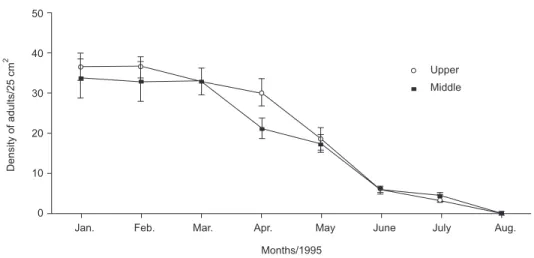
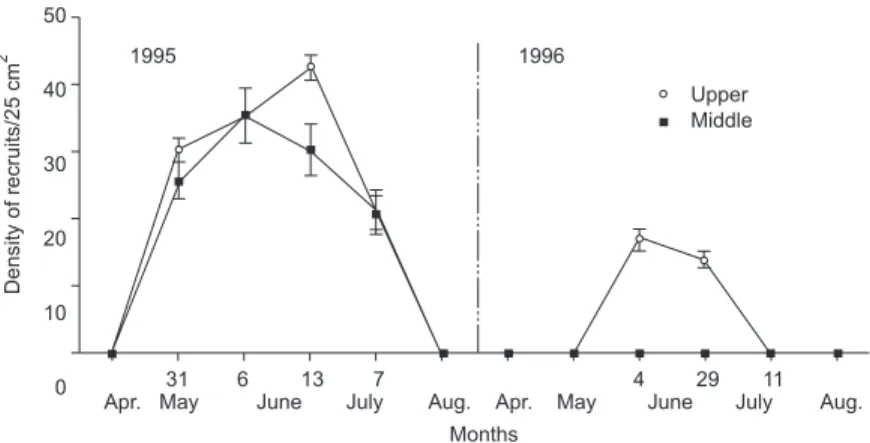
The population density of adults with opercular length greater than 1 mm declined drastically since January 1995 until reaching zero, in August 1995 (Fig. 3). There were no significant differences between the densities of the adults at the upper and middle intertidal levels (Table 3). In 1996, there were no more visible barnacle patches, even though recruitment was observed at both intertidal levels from May to July, 1995, and at the upper intertidal from June to July in 1996; being the peak of the recruitment in June for both years (Fig. 4).
There was a significant difference between the densities of recruits between the 2 intertidal levels, especially in 1996, when there was re-cruitment only at the upper intertidal level (Table 3). The non-recovery of the adult population in 1996 is explained by the high mortality of newcomers recruited in 1995. The 4 followed cohorts (recruited in May 31, June 6, 13, and July 11) experienced high mortality, especially for the latest recruits and just survived until the end of November (Fig. 5).
Treatments Mobile mollusks Effect of the paint Effect of the fence
Febce + Paint (F + P) Excluded Yes Yes
Fence (F) Partially excluded No Yes
Open Fence + Paint (OF + P) Allowed in Yes No
Open (O) Allowed in No No
TABLE 2
Upper Middle
Jan. Feb. Mar. Apr. May June July Aug.
Months/1995 50
40
30
20
10
0
Density
of
adults/25
cm
2
Source df F P
Time 7 58.62 0.0001***
Int. level (Upper vs. Midle) 1 1.82 0.1790 NS
Adult population
Int. level vs. Time 7 0.73 0.6448 NS
Time 11 125.96 0.0001***
Int. level (Upper vs. Midle) 1 28.46 0.0001***
Recruits
Int. level vs. Time 11 6.26 0.0001***
Time 13 11.95 0,0001***
Time 13 22.13 0.0001***
Depths (0.5 m vs. 3.5 m) 1 53.48 0.0001***
Depths vs. Time 13 9.07 0.0001***
Days 6 14.72 0.0001***
Depths (0.5 m vs. 3.5 m) 1 6.30 0.0181* Cyprids larvae
Depths vs. Days 6 1.87 0.1221 NS
Time 9 599.74 0.0001***
Treatments (4 fence types) 3 0.86 0.4608 NS
Treatment vs. Time 27 0.25 0.9999 NS
Time 9 689.21 0.0001***
Treatments (4 fence types) 3 0.52 0.6689 NS Fences
Treatment vs. Time 27 0.36 0.9983 NS
*** Significantly different at 0.001 level, * significantly different at 0.05 level, and NS not significantly different.
– Data from density of cyprid larvae at 0.5 m, in 1995 (Fig. 4a). – Data from density of cyprid larvae at 0.5 m, and 3,5 m, in 1996 (Fig. 4b). – Data from density of cyprid larvae at 0.5 m, and 3.5 m sampled twice a day, during May, 1996 (Fig. 4c).
and – Arcsine transformed data from the two survivorship curves, during the 4 fence types experiment (Fig. 5), respectively.
Fig. 3 — Mean (SD) density of adult barnacles sampled from ten 25 cm2 quadrats (control), at the upper, and middle
in-tertidal levels since January, 1995.
TABLE 3
1996 1995
50
40
30
20
10
0
Density
of
recruits/25
cm
2
Apr. May June July Aug. Apr. May June July Aug.
31 6 13 7 4 29 11
Months
Upper Middle
Recruitment
n = 15 Upper
Recruitment
n = 1 Middle
n = 20 n = 18
n = 25 n = 13
n = 11 n = 10
Months
May June July Aug. Sept. Oct. Nov. May June July Aug. Sept. Oct. Nov.
Survivorship
1.0
0.8
0.6
0.4
0.2
0
0.8
0.6
0.4
0.2
0
0.8
0.6
0.4
0.2
0
0.8
0.6
0.4
0.2
0
Fig. 4 — Mean (SD) density of recruits barnacles sampled from ten 25 cm2 quadrats (recruits), at the upper, and middle
intertidal levels during 1995 and 1996.
Abundances compared
(CD vs. RD) τ p
1995 at 0.5 m vs. Upper 0.84 0.004 vs. Middle 0.49 0.090 1996 at 0.5 m vs. Upper 0.44 0.123
vs. Middle – –
at 3.5 m vs. Upper 0.70 0.015
vs. Middle – –
TABLE 4
Summary of results from Kendall’s coefficient rank of correlation (τ) between weekly planktonic cyprid density (CD) (during 1995 and 1996, at 0.5 and 3.5 m depths), and weekly recruits density (RD), at different
intertidal levels (upper and middle) over an 8 wk period (n = 8). Larval supply
In 1995, cyprid larvae at 0.5 m, were availa-ble from the beginning of May until the beginning of July. The peak of density of cyprid larvae was
≅ 7/100 l, in the middle of June (Fig. 6a). This represents a very low density of cyprid larvae available during the main recruitment period of 1995. For the next year, sampling from both 0.5 and 3.5 m depths, reveled that cyprid larvae was
≅ 9/100 l, in the beginning of May, following a second consecutive year of low availability of cyprid larvae during the main recruitment period (Fig. 6b). There was a significant difference between the densities of cyprids from 0.5 and 3.5 m (Table 3). Actually, very few cyprids were
sam-pled from 3.5 m, confirming the neustonic habitat of the cyprid larvae (Le Fèvre & Bouget, 1992). Also, for the samples taken twice a day, there was a significant difference between the 2 sampling depths, with the cyprid larvae’s density peaking at 16:00 in May 2 (Fig. 6c).
For 1995, weekly cyprids densities at 0.5 m were significantly correlated with weekly recruited densities at the upper intertidal level (Kendall’s coefficient rank of correlation (τ) significant at 0.01 level). Weekly cyprids densities at 3.5 m in 1996 were also significantly correlated (0.05 level) with the densities of recruits at the upper intertidal level, although the number of cyprid larvae at this depth ranged from 0 to 4 (Table 4).
Mobile mollusks exclusion’s experiment In 1996, there was recruitment only at the upper intertidal level. Despite the low recruitment (see Fig. 4), it was possible to assess and follow 2 cohorts, one with its recruitment peak in June 4 and the other in June 29. Both had a very low survivorship with a big drop during the first week, followed by a small tendency to stabilize at 0.21 of the total recruitment by the end of wk 4 or 5 (Fig. 7).
There were no significant differences in survivorship among the 4 fence types, for either cohort (Table 3), and mortality during the first wk represented an average of 50% of the total recruit-ment (Fig. 8). The lack of significant differences among the 4 fence types can be explained by the low density of mobile mollusks during this expe-riment (Table 5), and especially by the low density of the carnivorous T. clavigera, that represents the
most important predator of the barnacle C. challengeri Hoek in this pebble shore.
DISCUSSION
0.5 m depth 3.5 m depth 12
10
8
6
4
2
0
12
10
8
6
4
2
0
12
10
8
6
4
2
0
Density
of
cyprids
larvae/1001
a) 1995
b) 1996
c) 1996 2
Apr. May June July Aug.
9 16 26 1 7 15 20 28 6 15 25
4
Mar. Apr.16 23 1May2 9 24 5June14 18 3July17 Aug.
16:00
Mar 1 May 2 May 9 May 24
10:00 16:00 10:00 16:00 10:00 16:00
Treatments Mean (SD) density of mobile mollusks
T. clavigera L. cronata coreana M. labio Nerita sp.
Fence + Paint (F + P) – – – –
Fence (F) 2 (5) 3 (4) 14 (10) 8 (15)
Open Fence + Paint (OF + P) 8 (6) 7 (3) 13 (6) 20 (5)
Open (O) 6 (4) 5 (6) 10 (4) 16 (2)
TABLE 5
Mean (SD) density of the mobile mollusks at the upper intertidal level inside each fence type (4 replicates), during the main recruitment period.
Recruitment
F + P (n = 12) F + P (n = 15)
F (n = 15) F (n = 18)
OF (n = 14) OF (n = 20)
OF + P (n = 10) OF + P (n = 11) 1.0
0.8
0.6
0.4
0.2
0
1.0
0.8
0.6
0.4
0.2
0
Survivorship
Recruitment
4 13 18 24 29 5 11 18 25 30
June
June July
Fig. 7 — Survivorship of the 2 cohorts (2 recruitment peaks) inside each fence type during the main recruitment period in 1996. The fences are: Fence + Paint (F + P), Fence (F), Open Fence (OF), and Open Fence + Paint (OF + P).
%
mortality
70
60
50
40
30
20
10
0
F + P F OF OF + P
Treatments
First cohort Second cohort
Also reported are interactions with conspecific larvae (Yule & Walker, 1987; Clare et al., 1994),
and with microbial films (Neal & Yule, 1994; Wieczoreck et al., 1995). The photographs taken
to monitor and measure the barnacles, show recrui-tment occurring preferentially in the neighborhood of adult individuals (alive or empty tests) and a tendency to form patches.
The density of cyprid larvae on the water column adjacent to the recruitment sites correlated significantly with the density of recruitment at the upper intertidal level, but it failed to correlate with the recruitment at the middle intertidal level. This difference is due to the differences between the recruitment at the 2 intertidal levels. Both the availability of cyprid larvae and the recruitment were very low when compared with data from other studies; see Minchinton & Scheibling (1991), Gaines & Bertness (1993), and Satchell & Farrell (1993) for data about availability, and Mori (1990), Sutherland (1990), and Satchell & Farrell (1993) for data about recruitment. The following year, the recruitment was lower and occurred only at the upper intertidal level; and the density of cyprid larvae sampled from 0.5 m showed a pattern si-milar to that observed the year before. The signi-ficant correlation between the cyprid larvae sample from 3.5 m, and the recruitment at the upper inter-tidal level, can be explained by the low availability of the cyprid larvae at this depth.
The individuals recruited in 1995 had a high mortality and could maintain neither the population nor the previously observed patch (despite recrui-tment having occurred only within patch limits). This results differs from Carrol (1996), who re-ported high survival to adulthood during a low recruitment year, permitting the maintenance of the population. The mortality of the recruits in 1996 was even higher, with a lost of nearly 50% of the total recruitment by the first week. The fence experiment failed to detect any significant effect of predation and/or bulldozing by gastropods as the main cause of the post-recruitment mortality. Gosselin & Qian (1996) suggest that micro-predators such as protozoan and nematodes could be a potential cause of high mortality during the first days after recruitment, but no experimental data supporting this hypothesis is available. Patterns of mortality can differ significantly between rocky
and pebble shores, with the later being more susceptible to disturbance by wave action and human activity.
Desiccation, especially at the upper intertidal levels, is an important factor of mortality in the post-recruitment period, but is not sufficient to explain alone the decline of an adapted intertidal population. It is my suggestion that pre-recruitment processes, such as the low availability of cyprid larvae during the main recruitment period and the consequent low recruitment, could be potential causes of the decline and non-maintenance of this barnacle patch. Considering that this sub-population is part of a meta-population, we can expect the recover of this patch and/or formation of new patch(es) in subsequent periods. Further studies could determine whether the decline of this sub-population is just a cyclical down phase.
Acknowledgements — I express my sincere gratitude to Prof. Taiji Kikuchi for giving me the chance to develop this project in Japan, and to my advisor Dr. Keisuke Mori for his valuable suggestions and teachings. I also express my gratitude to Mr. Teruo Sameshima for his technical support during the plankton sampling and the making of fences for field experimentation. Thanks to all professors, colleagues, and staff members at the Amakusa Marina Biological Laboratory who helped me to settle in the town and develop my research. Thanks also to Dr. Richard Weisburd and Dr. Jay Maclean for English language revision. The Japanese Ministry of Science and Culture (MONBUSHO) provided financial assistance for my stay in Japan.
REFERENCES
BOERO, F., BELMONTE, G., FANELLI, G., PIRAINO, S. & RUBINO, F., 1996, The continuity of living matter and the discontinuities of its constituents: do plankton and benthos really exist? Tree, 11: 177-180.
BURR, E. J., 1960, The distribution of Kendall’s score S for a pair of tied rankings. Biometrika, 47: 151-171. CARROL, M. L., 1996, Barnacle population dynamics and
recruitment regulation in south-central Alaska. J. Exp. Mar. Bio. Ecol., 199: 285-302.
CLARE, A. S., FREET, R. K. & MCCLARY Jr., M., 1994, On the antennular secretion of the cyprid of Balanus amphitrite amphitrite, and its role as a settlement phero-mone. J. Mar. Biol. Ass. UK., 74: 243-250.
CONNELL, J. H., 1972, Community interactions on marine rocky intertidal shores. Annu. rev. Ecol. Syst., 3: 169-192. CONNELL, J. H., 1975, Some mechanisms producing struc-ture in natural communities: a model and evidence from field experiments. pp. 460-490. In:M. L. Cody &
Dia-mond (eds.), Ecology of evolution and communities,
DAVIS, A. R., 1988, Effects of variation in initial settlement on distribution and abundance of Podoclavella mollucensis
Sluiter. J. Exp. Mar. Bio. Ecol., 117: 157-167.
GAINES, S. & BERTNESS, M.,1993, The dynamics of ju-venile dispersal: why field ecologists must integrate.
Ecology, 74(8): 2430-2435.
GAINES, S., BROWN, S. & ROUGHGARDEN, J., 1985, Spatial variation in larval concentrations as cause of spatial variation in settlement for the barnacle, Balanus glandula. Oecologia (Berlin), 67: 267-272.
GOSSELIN, L. A. & QIAN, P. Y., 1996, Early post-settlement mortality of an intertidal barnacle: a critical period of survival. Mar. Ecol. Prog. Ser., 135: 69-75.
KEOUGH, M. J., 1983, Patterns of recruitment of sessile in-vertebrates in two subtidal habitats. J. Exp. Mar. Bio. Ecol., 66: 213-245.
LE FÈVRE, J. & BOURGET, E., 1992, Hydrodynamics and behavior: transport processes in marine invertebrate larvae. Trends in Ecology and Evolution, 7(9): 288-289.
LUBCHENCO, J. & MENGE, B. A., 1978, Community de-velopment and persistence in a low rocky intertidal zone.
Ecol. Monogr., 48: 67-94.
MENGE, B. A. & SUTHERLAND, J. P., 1976, Species diver-sity gradients: synthesis of the role of predation, compe-tition and temporal heterogeneity. Am. Nat., 110: 351-369.
MENGE, B. A. & SUTHERLAND, J. P., 1987, Community regulation: variation in disturbance, competition and pre-dation in relation to environmental stress and recruitment.
Am. Nat., 130: 730-757.
MINCHINTON, T. E. & SCHEIBLING, R. E., 1991, The in-fluence of larval supply and settlement on the popula-tion structure of barnacles. Ecology, 72(5): 1867-1879. MIRON, G., BOUDREAU, B. & BOURGET, E., 1995, Use of larval supply in benthic ecology: testing correlation between larval supply and larval settlement. Mar. Ecol. Prog. Ser., 124: 301-305.
MIRON, G., BOURGET, E. & ARCHAMBAULT, P., 1996, Scale of observation and distribution of adult conspecific: their influence in assessing passive and active settlement mechanisms in the barnacle Balanus crenatus (Brugière).
J. Exp. Mar. Bio. Ecol., 201: 137-158.
MORI, K., 1990, Vertical variations of larval release and settlement of the intertidal barnacle Chthamalus challengeri Hoek. La Mer, 28: 180-187.
NEAL, A. L. & YULE, A. B., 1994, The interaction between
Elminius modestus Darwin cyprids and biofilms of
Deleya marina NCMB 1877. J. Exp. Mar. Bio. Ecol., 176: 127-139.
PAINE, R. T., 1974, Intertidal community structure: experi-mental studies on the relationship between a dominant competitor and its principal prey. Oecologia (Berlin), 15: 93-120.
PAINE, R. T., 1977, Controlled manipulations in the marine intertidal zone, and their contribution to ecological theory, pp. 245-270. In: C. E. Goulden (ed.), The changing scenes in natural sciences, 1776-1976, Special
publication 12, The Academy of Natural Sciences of Philadelphia, Fulton, Lancaster, Pennsylvania, USA.
PAINE, R. T., 1980, Food webs: linkage, interaction strength and community infra-structure. J. Exp. Mar. Bio. Ecol.,
49: 667-685.
PAINE, R. T., 1984, Ecological determinism in competition for space. Ecology, 65: 1339-1357.
PAWLIK, J. R., 1992, Chemical ecology of the settlement of benthic marine invertebrates. Oceanogr. Mar. Biol. Annu. Rev., 30: 273-335.
ROUGHGARDEN, J., IWASA, Y. & BAXTER, C., 1985, De-mographic theory for an open marine population with space limited recruitment. Ecology, 66: 54-67.
ROUGHGARDEN, J., GAINES, D. & PACALA, S. W., 1987, Supply-side ecology: the role of physical transport pro-cesses, pp. 491-581. In:P. Giller & J. Gee (eds.), Orga-nization of communities: past and present, Proceedings of
the British Ecological Society Symposium, Aberystwyth, Wales (April, 1986), Blackwell Scientific, London, En-gland.
SATCHELL, E. R. & FARRELL, T. M., 1993, Effects of settlement density on spatial arrangement in four inter-tidal barnacles. Mar. Biol., 116: 241-245.
SUTHERLAND, J. P., 1990, Recruitment regulates demo-graphic variation in a tropical intertidal barnacle. Ecol-ogy, 71(3): 955-972.
TAKADA, Y. & KIKUCHI, T., 1990, Mobile molluscan communities in boulder shores and the comparison with other habitats in Amakusa. Publ. Amakusa Mar. Biol. Lab., 10: 145-168.
TAKADA, Y. & KIKUCHI, T., 1991, Seasonal and vertical variation of the boulder shore fauna in Amakusa. Publ. Amakusa Mar. Biol. Lab., 11(1): 1-17.
THORSON, G., 1950, Reproductive and larval ecology of ma-rine invertebrates. Biol. Rev. Cambr. Phil. Soc., 25: 1-45. UNDERWOOD, A. J. & DENLEY, E. J., 1984, Paradigms, explanations and generalizations in models for the struc-ture of intertidal communities on rocky shores, pp. 151-180. In:D. R. Strong, D. Simberloff, L. G. Abele & A.
B. Thistle (eds.), Ecological communities: conceptual is-sues and evidence, Princeton University Press, Princeton,
New Jersey, USA.
UNDERWOOD, A. J. & FAIRWEATHER, P. G., 1989, Sup-ply-side ecology and benthic marine assembles. Tree, 4:
16-20.
WATANABE, J. M., 1984, The influence of recruitment, competition and benthic predation on spatial distributions of three species of kelp forest gastropods (Trochidae:
Tegula). Ecology, 65: 920-936.
WIECZORECK, S. K., Clare, A. S. & Tood, C. D., 1995, In-hibitory and facilitatory effects of microbial films on settlement of Balanus amphitrite amphitrite larvae. Mar. Ecol. Prog. Ser., 119: 221-228.
YOSHIOKA, P. M., 1982, Role of planktonic and benthic factors in the population dynamics of the bryozoan,
Membranipora membranacea. Ecology, 63: 457-468. YULE, A. B. & WALKER, G., 1987, Adhesion in barnacles.
In: A. J. Southward (ed.), Barnacle Biology, Bakema, Rotterdan, 389-402.