DOI: 10.5935/2359-4802.20180023
ORIGINAL ARTICLE
Mailing Address: Maria Silvia Mariani Pires-de-Campos
Rua do Rosário, 1260. Postal Code: 13400-000, Piracicaba, São Paulo, SP - Brazil. E-mail: [email protected]
Acute Effect of Manual Lymphatic Drainage on Natriuresis and Lipolysis in Young Women
Érica A. M. Camargo1; Filipy Borghi1; Aglécio Luiz de Souza2; Denise Maria Marcorin3; Luana de Lima Rodrigues3; Danilo Roberto Xavier de Oliveira Crege4; Larissa Yuri Ishizu1; Priscila Cristina da Silva1; Dora Maria Grassi-Kassisse1; Maria Silvia Mariani Pires-de-Campos3Instituto de Biologia, Universidade Estadual de Campinas (UNICAMP),1 São Paulo, SP - Brazil
Faculdade de Ciências Médicas, Universidade Estadual de Campinas (UNICAMP),2 São Paulo, SP - Brazil
Faculdade de Ciências da Saúde (FACIS), Universidade Metodista de Piracicaba (UNIMEP),3 São Paulo, SP - Brazil
Centro Universitário Padre Anchieta,4 Jundiaí, SP- Brasil
Manuscript received May 18, 2017; revised manuscript October 16, 2017; accepted November 13, 2017.
Abstract
Background: The importance of scientific validation of supporting techniques to various treatments is unquestionable. In this context, the influence of manual lymphatic drainage (MLD) on natriuresis and lipolysis and its interaction with oral contraceptives still need to be investigated.
Objectives: To evaluate the acute effect of MLD on natriuresis and lipolysis in young women using or not oral contraceptives.
Methods: Twenty-nine non-users of oral contraceptives and 29 oral contraceptive users, self-reported healthy, sedentary, normal weight women were enrolled. Analyses were conducted on two different days – control (C), without therapeutic intervention and MLD day. Four urine samples were collected at 60-minute intervals. MLD was performed in lower limbs and abdomen for 45 min following the Leduc method. Urinary flow rate and urinary sodium, glycerol and atrial natriuretic peptide excretion were analyzed. Data normality was tested by the Shapiro-Wilk test. Data without normal distribution were expressed as median and interquartile range (25%-75%), while normally distributed data were expressed as mean ± standard error. Mann-Whitney test was used for unpaired data and Wilcoxon test for paired data. Data with normal distribution were evaluated by the unpaired t-Student test. Statistical significance was set at 5%.
Results: One MLD session had an acute effect on both groups, increasing natriuresis in non-users of oral contraceptives and glycerol and atrial natriuretic peptide excretion in oral contraceptive users.
Conclusion: Oral contraceptives influence the effect of MLD on natriuresis. (International Journal of Cardiovascular Sciences. 2018;31(3)274-281)
Keywords: Musculoskeletal Manipulations; Natriuresis; Lipolysis; Lymphatic System.
Introduction
Manual lymphatic drainage (MLD) was created by the Danish physician Dr. Emil Vodder in 1936 as a supporting therapy, later established as the gold standard for the treatment of lymphedema.1 However, based on beauty
standards currently imposed by society, many women undergo some types of treatments that have no scientific basis for their well-being. In this context, MLD has
become a popular procedure among healthy individuals to reduce body size, and performed by individuals without knowledge about lymphatic system physiology or pathophysiology.
In women, water and electrolyte balance is influenced by ovarian hormones, whose receptors are located in reproductive tissues and in those involved in body fluid regulation, such as hypothalamus, cardiovascular system and renal tubules. These hormones affect capillary dynamics, by increasing renal sodium reabsorption and influencing plasma volume.2,3 Stachenfeld & Taylor4
showed that estradiol increased plasma volume by its effect on capillary endothelial permeability, decreasing the outflow of proteins and water, without affecting extracellular fluid volume. Estrogen can affect capillary filtration and permeability, be it by direct action on capillary endothelium or indirectly by compounds like the atrial natriuretic peptide (ANP) and nitric oxide.4
ANP is an important hormone stored in secretory granules of atrial cells, contributing to water-electrolyte balance. Its secretion depends on atrial distension caused by an increase in venous return, mechanical distension or hypernatremia, which lead to increased natriuresis combined with osmotic diuresis and vasodilation, relaxation of vascular smooth muscle of small arteries, arterioles and metarterioles, and hypotension. Besides, ANP inhibits renin, aldosterone and vasopressin release; it exerts a strong vasodilating action in the kidneys, contributing to increased blood flow and glomerular filtration rate, resulting in natriuresis and increased urine flow.5 In adipocytes, ANP induces lipolysis via
cyclic guanosine monophosphate (cGMP), resulting in activation of protein kinase G type I (GK-I), and degradation of triglycerides by perilipin A and hormone-sensitive lipase (HSL).6
Nelson et al.7 examined plasma concentration of
glycerol and its urinary excretion in 12 young, healthy, trained men. The authors found that plasma glycerol peak concentration coincided with its peak in urinary excretion. Krupek et al.8 evaluated urinary glycerol before
and after twelve sessions of MLD in 3 young healthy women. Urinary glycerol was not increased in this study.
Data on the effects of MLD on natriuresis and lipolysis are scarce and conflicting. Our aim was to assess the acute effect of MLD on natriuresis and lipolysis in young women using or not oral contraceptives.
Material and methods
According to the regulations of researches involving human subjects (resolution number 466/2012, Brazilian National Health Council), the study was approved by the Research Ethics Committee of the School of
Medical Sciences/University of Campinas (CAAE: 24537613.2.0000.5404), Brazilian Registry of Clinical Trials -45c8br. All participants signed the informed consent form.
Sample size was calculated based on a pilot study. GraphPad Statmate software, version 2 was used for calculation of 95% confidence interval and power of 80%. Thus, for statistical power of the sample be considered relevant, 30 volunteers per group would be necessary. This calculation was performed by Prof. Maria Imaculada de Lima Monteselo, specialist in the area. Twenty-nine women, non-users of oral contraceptives (nOCPu 21.5 ± 0.6 years BMI 21.3 ± 0.5 kg/m2) and 29 oral contraceptive users
(OCPu 21.4 ± 0.5 years, BMI 21.8 ± 0.4 kg/m2), sedentary
(international physical activity questionnaire, IPAQ-v8),9
self-reported as healthy, and taking no medications except for OCP were enrolled. Women of the nOCPu group were included in luteal phase of menstrual cycle, whereas women of the OCPu group in the “rest period” from the OCP.
All procedures were performed with volunteers at rest, in supine position, without fluid ingestion in a temperature-controlled room (22-24ºC) and relative humidity between 40 and 60% in the morning. For maintenance of resting metabolism, all volunteers received a standardized diet composed of one Brazilian nut, one nut, two apricots and six almonds without salt or sugar added.
MLD procedure
MLD was performed by the same physiotherapist as proposed by Leduc and Leduc10 Volunteers underwent a 45-minute session on abdomen and lower limbs.11
Participants had previously received instructions for the procedure.
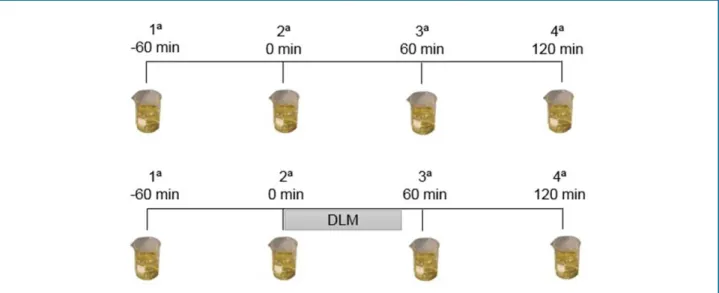
Figure 1 - Urine collection schedule on day without therapeutic intervention (Control) and on day with manual lymphatic drainage (MLD).
In the lower limbs, drainage of inguinal lymph nodes was started by 10 strokes to evacuate the lymph. With the hands contacting the skin, a pressure was put to promote the flow of the lymph towards internal iliac lymph nodes, followed by 10 strokes in each region, from proximal to distal thigh to direct the flow of the lymph to the internal saphenous vein. Ten strokes were performed on the knees, aimed at cleaning popliteal lymph nodes, by dividing the area in two regions (upper and lower). Then, drainage of legs and thighs was performed, promoting lymph to drain toward the anterointernal part of the leg. In the ankles, 10 strokes in the retromalleolar region were made, directing the lymph to the leg, which was repeated on the feet. At the end of the procedure, a clearing motion was performed from the foot to the upper part of the leg, followed by 10 motions on popliteal lymph nodes and one motion toward upper thigh. The procedure was finished by 10 strokes on inguinal lymph nodes.
Urine collection and assessment of urine composition
Urine was collected at four-time points with 60-minute intervals – -60, 0, 60 and 120 minutes. Urine samples were collected using 1000mL beakers in a water closet available by the experiment room. Volunteers were instructed to completely empty the bladder for correct assessment of urine flow. The sample collected at -60min aimed at excluding potential influence of dietary or climate factors on the results. This protocol was followed on two days – one (control) day without therapeutic intervention and one day of MLD, performed between urine collection at 0 and 60 minutes11 (Figure 1).
Urinary excretion of the following compounds was calculated from urinary flow rate (mL/min): sodium, by titration with silver nitrate (mM/min), glycerol (mmol/min) by colorimetric assay (LABORCLIN, SP); and ANP (pg/min) by ELISA (USCNLife Science Inc., Houston, EUA).
Statistical analysis
S t a t i s t i c a l a n a l y s i s w a s p e r f o r m e d u s i n g GraphPadPrism 5.0 software (Inc, La Jolla, CA, USA). Normal distribution was tested by the Shapiro-Wilk test. Data without normal distribution were expressed as median and interquartile range (25%-75%), whereas those with normal distribution as mean ± standard error. For data without normal distribution, the Mann-Whitney test and Wilcoxon test were used for unpaired (different “n”) and paired (same “n”) data, respectively, and normally distributed data were analyzed by the unpaired t-test. Statistical significance was set at 5%.
Results
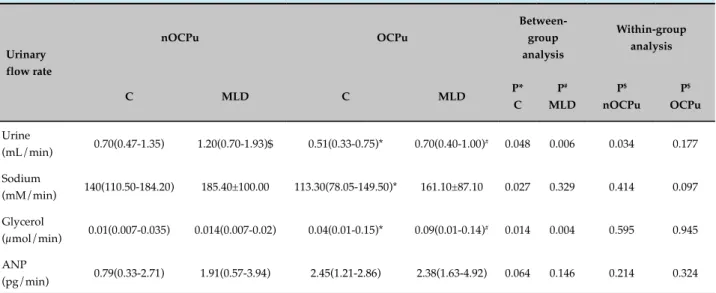
Table 1 - Urinary composition in young women, users (OCPu) or not (nOCPu) of oral contraceptives on manual lymphatic drainage (MLD) day or control (C) day at baseline
Urinary flow rate
nOCPu OCPu
Between-group analysis
Within-group analysis
C MLD C MLD P*
C P#
MLD
P$
nOCPu P$
OCPu
Urine
(mL/min) 0.70(0.47-1.35) 1.20(0.70-1.93)$ 0.51(0.33-0.75)* 0.70(0.40-1.00)
# 0.048 0.006 0.034 0.177
Sodium
(mM/min) 140(110.50-184.20) 185.40±100.00 113.30(78.05-149.50)* 161.10±87.10 0.027 0.329 0.414 0.097
Glycerol
(µmol/min) 0.01(0.007-0.035) 0.014(0.007-0.02) 0.04(0.01-0.15)* 0.09(0.01-0.14)
# 0.014 0.004 0.595 0.945
ANP
(pg/min) 0.79(0.33-2.71) 1.91(0.57-3.94) 2.45(1.21-2.86) 2.38(1.63-4.92) 0.064 0.146 0.214 0.324
Normal distribution was tested by the Shapiro-Wilk test. Data without normal distribution were expressed as median and interquartile range (25%-75%),
whereas those with normal distribution as mean ± standard error. For normally distributed data, the Mann-Whitney test was used for unpaired data (different “n”) and the Wilcoxon test for paired data (same “n”). The unpaired t-test was used for data that failed to pass the normality test. Significance level was set at 5%. ANP: atrial natriuretic peptide.
Urinary flow remained unchanged in nOCPu on both days. However, on control day, OCPs showed an increase in this parameter over time. On MLD day, although urinary flow increased from 0 to 60min, no difference was observed between 120 min and 60 minutes (Table 2).
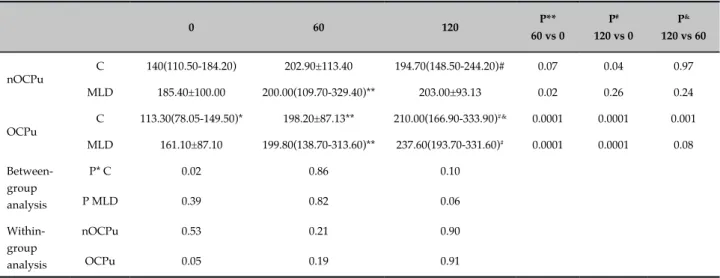
Urinary excretion of sodium increased in nOCPu group on control day only at 120 minutes; however, on MLD day, this increase occurred at 60 min, indicating an acute effect of the therapy on sodium in the body. At 0 on control day, sodium urinary excretion was lower in OCPu
Table 2 - Urinary flow rate in young women, users (OCPu) or not (nOCPu) of oral contraceptives (OCPu) on manual lymphatic drainage (MLD) day or control (C) day at 0, 60 and 120 minutes
0 60 120 P**
60 vs 0
P#
120 vs 0
P&
120 vs 60
nOCPu
C 0.70(0.47-1.35) 1.00(0.70-1.31) 1.00(0.69-1.47) 0.06 0.32 0.38
MLD 0.70(0.49-1.90) 1.20(0.70-1.93) 1.20(0.59-1.40) 0.08 0.86 0.15
OCPu
C 0.51(0.33-0.75)* 0.83(0.58-1.47)** 1.18(0.84-1.80)#& 0.0001 0.0001 0.01
MLD 0.70(0.40-1.00) 1.30(0.69-2.25)** 1.40(0.96-1.80)# 0.0001 0.0009 0.56
Between-group analysis
P* C 0.04 0.51 0.19
P MLD 0.27 0.75 0.07
Within-group analysis
nOCPu 0.18 0.32 0.91
OCPu 0.29 0.13 0.94
Normal distribution was tested by the Shapiro-Wilk test. Data without normal distribution were expressed as median and interquartile range (25%-75%),
whereas those with normal distribution as mean ± standard error. For normally distributed data, the Mann-Whitney test was used for unpaired data (different “n”) and the Wilcoxon test for paired data (same “n”). The unpaired t-test was used for data that failed to pass the normality test. Significance
as compared with the nOCPu group. An increase in this parameter was observed on both study days, suggesting that MLD had no effect on this variable (Table 3).
Glycerol excretion did not change in nOCPu on both study days, and on control day, values of this variable were greater at 0 for OCPu as compared with nOCPu. Although glycerol excretion increased over time in the OCPu group on control day, it was greater in the OCPu group (Table 4).
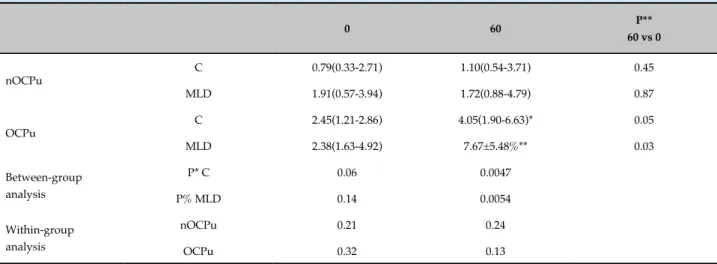
ANP values in nOCPu at 60 min were higher than in OCPu. MLD increased ANP excretion in OCPu only (Table 5).
Discussion
One strength of the protocol proposed in this study was a “control” day, to demonstrate that changes occurring after the MLD were actually caused by the procedure.
When control day of both groups was compared, no difference in urinary excretion was found. Graugaard-Jensen et al.12 investigated 8 healthy, young women with
regular menstrual cycle in low and high estrogen phases. The author showed that hormone levels had no effect on urinary excretion. In addition, although urinary excretion did not change between the two time-points, the authors observed a tendency towards sodium retention when estrogen was high.
Table 3 - Urinary sodium excretion in young women, users (OCPu) or not (nOCPu) of oral contraceptives on manual lymphatic drainage (MLD) day or control (C) day at 0, 60 and 120 minutes
0 60 120 P**
60 vs 0
P#
120 vs 0
P&
120 vs 60
nOCPu
C 140(110.50-184.20) 202.90±113.40 194.70(148.50-244.20)# 0.07 0.04 0.97
MLD 185.40±100.00 200.00(109.70-329.40)** 203.00±93.13 0.02 0.26 0.24
OCPu
C 113.30(78.05-149.50)* 198.20±87.13** 210.00(166.90-333.90)#& 0.0001 0.0001 0.001
MLD 161.10±87.10 199.80(138.70-313.60)** 237.60(193.70-331.60)# 0.0001 0.0001 0.08
Between-group analysis
P* C 0.02 0.86 0.10
P MLD 0.39 0.82 0.06
Within-group analysis
nOCPu 0.53 0.21 0.90
OCPu 0.05 0.19 0.91
Normal distribution was tested by the Shapiro-Wilk test. Data without normal distribution were expressed as median and interquartile range (25%-75%),
whereas those with normal distribution as mean ± standard error. For normally distributed data, the Mann-Whitney test was used for unpaired data (different “n”) and the Wilcoxon test for paired data (same “n”). The unpaired t-test was used for data that failed to pass the normality test. Significance
level was set at 5%.
Based on our protocol, nOCPu responded to MLD with increased sodium excretion and nOCPu with increased urinary excretion when compared with nOCPu, suggesting an acute effect of this technique on natriureis, and hence on urine composition.
Camargo et al.11 showed that one MLD session
promoted an increase in urinary excretion with unaltered sodium excretion or urinary osmolarity in OCP non-users. On the other hand, OCP users were not sensitive to the acute effect of the therapy. These findings suggest an underlying hormonal regulation of these mechanisms. Increased estrogen and progesterone levels were found in OCP users, even though the exact mechanism of these hormones on water-electrolyte balance is still unclear.2,4,13
Stachenfeld & Taylor4 investigated the effects of
gonadotropin-releasing hormone (GnRH) administration, combined or not with 17 beta-estradiol (transdermal patches, 0.1 mg/day) in young, healthy, non-smoking women. The authors found that 17 beta-estradiol caused a reduction in urinary osmolarity by concentration of vasopressin in the plasma at baseline. Stachenfeld & Keefe3 found that estrogen and progesterone in young,
Table 4 - Urinary glycerol excretion in young women, users (OCPu) or not (nOCPu) of oral contraceptives on manual lymphatic drainage (MLD) day or control (C) day at 0, 60 and 120 minutes
0 60 120 P**
60 vs 0
P#
120 vs 0
P&
120 vs 0
nOCPu
C 0.02(0.01-0.03) 0.01(0.01-0.06) 0.02(0.01-0.07) 0.91 0.62 0.52
MLD 0.01(0.01-0.02) 0.03(0.01-0.08) 0.02(0.01-0.07) 0.10 0.19 0.80
OCPu
C 0.05(0.02-0.15)* 0.10(0.04-0.31)* 0.17(0.06-0.56)*# 0.05 0.01 0.23
MLD 0.09(0.01-0.15)% 0.12(0.03-0.32)% 0.17(0.07-0.44)%# 0.10 0.01 0.38
Between-group analysis
P* C 0.01 0.0001 0.0001
P MLD 0.0049 0.0012 0.0001
Within-group analysis
nOCPu 0.59 0.14 0.72
OCPu 0.94 0.86 0.91
Normal distribution was tested by the Shapiro-Wilk test. Data without normal distribution were expressed as median and interquartile range (25%-75%),
whereas those with normal distribution as mean ± standard error. For normally distributed data, the Mann-Whitney test was used for unpaired data (different “n”) and the Wilcoxon test for paired data (same “n”). The unpaired t-test was used for data that failed to pass the normality test. Significance
level was set at 5%.
Table 5 - Urinary atrial natriuretic peptide excretion in young women, users (OCPu) or not (nOCPu) of oral contraceptives on manual lymphatic drainage (MLD) day or control (C) day at 0, 60 and 120 minutes
0 60 P**
60 vs 0
nOCPu
C 0.79(0.33-2.71) 1.10(0.54-3.71) 0.45
MLD 1.91(0.57-3.94) 1.72(0.88-4.79) 0.87
OCPu
C 2.45(1.21-2.86) 4.05(1.90-6.63)* 0.05
MLD 2.38(1.63-4.92) 7.67±5.48%** 0.03
Between-group analysis
P* C 0.06 0.0047
P% MLD 0.14 0.0054
Within-group analysis
nOCPu 0.21 0.24
OCPu 0.32 0.13
Normal distribution was tested by the Shapiro-Wilk test. Data without normal distribution were expressed as median and interquartile range (25%-75%),
whereas those with normal distribution as mean ± standard error. For normally distributed data, the Mann-Whitney test was used for unpaired data (different “n”) and the Wilcoxon test for paired data (same “n”). The unpaired t-test was used for data that failed to pass the normality test. Significance
level was set at 5%.
OCP inhibits renal sensitivity to vasopressin, requiring higher hormone production to obtain the same effects. This is corroborated by our results in OCPu on both days, suggesting that OCP induces greater sensitivity to central osmoreceptors. We believe that resting and temperature-controlled conditions in our study prevented water
loss from the body surface, resulting in dilution in the extracellular compartment and inhibitory stimulus of vasopressin, which, in turn, promoted an increase in urinary excretion in the OCPu group.
function by binding into receptors located in renal tubules and in the glomerular zone of the adrenal glands, inhibiting sodium reabsorption by decreased renin secretion, resulting in lower production of angiotensin II, aldosterone and vasopressin.
Graugaard-Jensen et al.12 reported that changes in
endogenous estrogen have no effects on plasma ANP levels. In contrast, in our study, women of the OCPu had higher estrogen levels and greater urinary ANP excretion.
According to Schlueter et al.,6 ANP lipolytic effect
occurs via GMPc formation, which induces triglyceride degradation. However, MLD did not affect urinary excretion of ANP or glycerol, suggesting that venous return promoted by this procedure was not sufficiently effective to stimulate ANP and exert a lipolytic effect readily observable in the urine.
Our data corroborate those found by Krupek et al.8
These authors reported that 12 sessions of MLD had no effect on urinary glycerol excretion in 3 healthy, young women. However, different from our study, the authors investigated the chronic effect rather than the acute effect of MLD.
One limitation of our study was the fact that urine collection was carried out in the mornings, which limited the participation of many eligible volunteers.
Conclusion
One session of MLD promoted an acute effect on natriuresis in women not taking OCP and glycerol and ANP secretion in OCP users by increasing these parameters.
Acknowledgements
We thank all volunteers who participated in this study; the University of Campinas (UNICAMP) and Methodist University of Piracicaba (UNIMEP) for the facilities; FAPESP (2013/20510-2) and CAPES for the financial support.
Author contributions
Conception and design of the research: Grassi-Kassisse DM, Pires-de-Campos MSM. Acquisition of data: Camargo EAM, Souza AL, Marcorin DM, Rodrigues LL, Crege DRXO, Ishizu LY. Analysis and interpretation of the data: Camargo EAM, Borghi F, Grassi-Kassisse DM, Pires-de-Campos MSM. Statistical analysis: Camargo EAM, Borghi F, Grassi-Kassisse DM, Pires-de-Campos MSM. Obtaining financing: Grassi-Kassisse DM, Pires-de-Campos MSM. Writing of the manuscript: Camargo EAM, Borghi F, Silva PC, Grassi-Kassisse DM, Pires-de-Campos MSM. Critical revision of the manuscript for intellectual content: Camargo EAM, Borghi F, Silva PC, Grassi-Kassisse DM, Pires-de-Campos MSM. Supervision / as the major investigador: Camargo EAM, Grassi-Kassisse DM, Pires-de-Campos MSM.
Potential Conflict of Interest
No potential conflict of interest relevant to this article was reported.
Sources of Funding
This study was funded by CAPES e Fapesp.
Study Association
This article is part of the thesis of master submitted by Érica A. M. Camargo, from Universidade de Campinas (UNICAMP).
Ethics approval and consent to participate
This study was approved by the Ethics Committee of the Faculdade de Ciências Médicas da Unicamp under the protocol number CAAE: 24537613.2.0000.5404. All the procedures in this study were in accordance with the 1975 Helsinki Declaration, updated in 2013. Informed consent was obtained from all participants included in the study.
1. Williams A. Manual lymphatic drainage: exploring the history and evidence base. Br J Community Nurs. 2010;15(4):S18-24. doi: 10.12968/ bjcn.2010.15.Sup5.78111.
2. Stachenfeld NS. Sex hormone effects on body fluid regulation. Exerc Sport Sci Rev. 2008;36(3):152-9. doi: 10.1097/JES.0b013e31817be928.
3. Stachenfeld NS, Keefe DL. Estrogen effects on osmotic regulation of AVP
and fluid balance. Am J Physiol Endocrinol Metab. 2002;283(4):E711-21. doi: 10.1152/ajpendo.00192.2002.
4. Stachenfeld NS, Taylor HS. Progesterone increases plasma volume independent of estradiol. J Appl Physiol (1985). 2005;98(6):1991-7. doi: 10.1152/japplphysiol.00031.2005.
This is an open-access article distributed under the terms of the Creative Commons Attribution License
5. Hodes A, Lichtstein D. Natriuretic hormones in brain function. Front Endocrinol (Lausanne). 2014 Nov 28;5:201. doi: 10.3389/ fendo.2014.00201.
6. Schlueter N, de Sterke A, Willmes DM, Spranger J, Jordan J, Birkenfeld AL. Metabolic actions of natriuretic peptides and therapeutic potential in the metabolic syndrome. Pharmacol Ther. 2014;144(1):12-27. doi: 10.1016/j.pharmthera.2014.04.007.
7. Nelson JL, Harmon ME, Robergs RA. Identifying plasma glycerol concentration associated with urinary glycerol excretion in trained humans. J Anal Toxicol. 2017;35(9):617-23. PMID: 22080901.
8. Krupek T, Oliveira LP, Moraes LR, Vizoni SL. Laboratory analysis of post-lymphatic drainage urine. Revista Saúde e Pesquisa. 2012;5(1):75-85.
9. Matsudo S, Araújo T, Marsudo V, Andrade D, Andrade E, et al. International physical activity questionnaire (IPAQ): study of validity
and reability in Brazil. Rev Bras Ativ Fis Saúde. 2001;6(2):5-18. doi: http://dx.doi.org/10.12820/RBAFS.V.6N2P5-18.
10. Leduc A, Leduc O. Drenagem linfática: teoria e prática. São Paulo: Manole; 2007.
11. Camargo EA, Marcorin DM, Silva BD, Helleno LG, Gomes-Marcondes MC, Grassi-Kassisse DM, et al. Composição urinária de homens e mulheres após drenagem linfática manual. Fisioterapia Brasil. 2015;16(2):148-54.
12. Graugaard-Jensen C, Hvistendahl GM, Frøkiær J, Bie P, Djurhuus JC. The influence of high and low levels of estrogen on diurnal urine regulation in young women. BMC Urol. 2008 Nov 19;8:16. doi: 10.1186/1471-2490-8-16.