UNIVERSIDADE DE LISBOA
FACULDADE DE FARMÁCIA
DEPARTAMENTO DE MICROBIOLOGIA E IMUNOLOGIA
Construction of Ms6 derivative
mutants as tools for interaction
studies with mycobacteria
Sofia Pires de Oliveira Pombo
Dissertação de Mestrado
UNIVERSIDADE DE LISBOA
FACULDADE DE FARMÁCIA
DEPARTAMENTO DE MICROBIOLOGIA E IMUNOLOGIA
Construction of Ms6 derivative
mutants as tools for interaction
studies with mycobacteria
Sofia Pires de Oliveira Pombo
Dissertação de Mestrado
Orientada pela Professora Doutora Madalena Pimentel
MESTRADO EM CIÊNCIAS BIOFARMACÊUTICAS
Agradecimentos
Os meus primeiros votos de gratidão são dirigidos à Professora Madalena Pimentel, sem a qual a realização desta dissertação não seria de todo a mesma. Agradeço-lhe ter aceitado ser minha orientadora, e por ter apostado em mim, sempre depositando confiança nas minhas capacidades, o que decerto foi e sempre será um estímulo. Muito obrigado pelos ensinamentos que me transmitiu, e que contribuíram para fomentar ainda mais o meu gosto pela investigação! Agradeço-lhe mais uma vez, toda a atenção disponibilizada em tudo, e em particular na correcção desta dissertação.
Gostaria também de agradecer ao Professor José Moniz-Pereira, pelo entusiamo e interesse que mostrou durante todo o meu percurso do estágio laboratorial.
A todos os membros do laboratório do Professor Carlos São-José, que são como colegas do mesmo laboratório, ao Adriano, ao Francisco e à Vanessa: Muito Obrigado por tudo! Este agradecimento engloba obviamente toda a experiência e ajuda prestada no laboratório, mas também todos os bons momentos. Obrigado à Sofia pelas longas conversas. E um especial obrigado ao Francisco e ao Adriano, colegas desde o primeiro dia!
Aos membros laboratório do Professor João Gonçalves, e em particular à Sofia, pela partilha de bons momentos e companhia de lanches.
À Juliana, pelas correcções do Inglês: obrigado!
Ao Luís, o meu Muito Obrigado por tudo! Pelo apoio e atenção, amizade, carinho, pelas críticas construtivas e claro, pela paciência! Obrigado pelas correcções e formatações da tese!
Aos Meus Pais e irmã, o meu Muito Obrigado! Por todo o apoio que me dão nas decisões que tomo, pelo incentivo em todos os projectos, pela confiança, amizade e por estarem sempre presentes.
Por último, tenho de agradecer à Sílvia, à minha Salvadora de última hora! Muito obrigado pela ajuda, e pela amizade demonstrada ao longo destes 2 anos!
Abstract
Mycobacteriophage Ms6 is a temperate phage isolated in 1989 from a spontaneously induced culture of Mycobacterium smegmatis. Although several studies regarding lysis and integration have been published, the host range of Ms6 is not known. In this work we observed that incubation of this phage with fast- and slow-growing mycobacteria did not result in plaque or halos formation, as usually happens in infection plaque assay. However, an absence of clearing in a bacterial lawn does not mean that Ms6 in unable to infect the tested mycobacteria apart from its natural host, M. smegmatis. Taking this into consideration, our main goal was to construct Ms6 derivative mutants with reporter genes, and use them as tools to follow the mycobacteriophage replication inside other mycobacteria.
Using the Bacteriophage Recombineering of Electroporated DNA (BRED) technique, we successfully constructed two Ms6 derivative reporter phages, Ms6lysB::egfp and Ms6pin::gfpm2+, by gene replacement. We successfully showed that their reporter proteins, improved green fluorescent proteins (GFP), are respectively expressed in Ms6 lytic and lysogenic life cycle, on M.
smegmatis. Consequently, these new mutant phages are very important and useful tools to be
used in future studies since they permit to follow a lytic or lysogenic cycle. With Ms6lysB::egfp and Ms6pin::gfpm2+, we expect to determine with more accuracy the ability of Ms6 to infect/replicate in other mycobacteria.
Key words: Recombineering; Mycobacteriophage Ms6; Ms6lysB::egfp; Ms6pin::gfpm2+; Mycobacteria; GFP.
Resumo
O micobacteriófago Ms6 é um fago temperado, isolado em 1989 a partir de uma cultura de Mycobacterium smegmatis induzida espontaneamente. Apesar de vários estudos sobre o sistema de lise e integração terem já sido publicados, a gama de hospedeiros do Ms6 não é ainda conhecida. Neste trabalho verificou-se que a incubação deste fago com micobactérias quer de crescimento rápido quer de crescimento lento, não resultou na formação de placas fágicas nem de halos, tal como acontece num ensaio clássico de infecção em placa. No entanto, a ausência de placas fágicas não significa que Ms6 não tenha capacidade de infectar outras micobactérias para além de M. smegmatis, o seu hospedeiro natural. Tendo este facto em consideração, o principal objectivo deste trabalho foi construir fagos Ms6 mutantes com genes repórter, de modo a usá-los como ferramentas para testar a capacidade do Ms6 se replicar noutras micobactérias.
Através da metodologia Bacteriophage Recombineering of Electroporated DNA (BRED), foi possível proceder a uma troca de genes do fago Ms6 por genes repórter e construir, com sucesso, dois fagos recombinantes designados Ms6lysB::egfp e Ms6pin::gfpm2+, capazes de produzir fluorescência quando infectam um hospedeiro sensível. Foi com sucesso que mostrámos que as proteínas verde fluorescentes modificadas (GFP), são expressas em M.
smegmatis no ciclo lítico e lisogénico. Consequentemente, estes novos fagos mutantes
constituem importantes ferramentas que poderão ser usados em estudos futuros, tendo em conta que permitem seguir o ciclo lítico e lisogénico.
Esperamos assim, através dos fagos construídos Ms6lysB::egfp and Ms6pin::gfpm2+, conseguir determinar de uma forma mais precisa, a capacidade de Ms6 infectar/replicar-se em outras micobactérias.
Palavras-chave: Recombinação; Micobacteriófago Ms6; Ms6lysB::egfp; Ms6pin::gfpm2+; Micobactérias; GFP.
Table of contents
Agradecimentos ... I Abstract ... II Resumo ... III Table of contents ... IV Abbreviations ... VI I. Introduction... 11. Bacteriophage’s main features ... 1
2. Bacteriophage receptors in Gram-positive and Gram-negative bacteria ... 4
3. Bacterial Resistance to Phage Infection ... 6
3.1. Adsorption resistance ... 6
3.2. Prevention takeover ... 6
3.3. Abortive infection ... 7
4. Mycobacteria and mycobacteriophages ... 8
4.1. Mycobacteria ... 8
4.2. Mycobacteriophages ... 9
4.3. Mycobacteria receptors for mycobacteriophage adsorption ... 10
4.4. Recombinant mycobacteriophages as genetic tools ... 10
4.5. Mycobacteriophage Ms6... 11
II. Objectives ... 13
III. Material and Methods... 14
1. Bacterial Strains, Bacteriophages and growth conditions ... 14
2. Electrocompetent cells and electroporation ... 15
3. Phage DNA Extraction ... 16
4. Plasmid DNA ... 16
5. DNA Manipulation and Purification ... 16
6. Infection Assay and Spot Test ... 17
7. Construction of Ms6 mutant phages ... 17
8. Fluorescence Detection of M. smegmatis infected with mutant Ms6 derivatives ... 18
9. Isolation of lysogenic cells and Immunity test - Sensibility to Ms6 assay ... 19
10. Transfection Assay ... 19
IV. Results ... 20
2. Construction of Ms6 mutant phages ... 20
2.1. Ms6lysB::egfp ... 21
2.2. Ms6∆pin... 24
2.3. Ms6pin::gfpm2+ ... 25
3. Fluorescence detection of M. smegmatis infected with the mutant Ms6 derivatives ... 28
3.1. Ms6lysB::egfp ... 28
3.2. Ms6pin::gfpm2+ ... 30
4. Transfection assay ... 33
5. Attempts to construct Ms6pin::hyg ... 34
V. Discussion ... 36
VI. Concluding Remarks and Future Perspectives ... 42
Abbreviations
aa
Amino acid
Ala
Alanine
ATCC
American Type Culture Collection
BCG
Bacillus Calmette-Guérin
bp
Base pair
BRED
Bacteriophage Recombineering of Electroporated DNA
CRISPR
Clustered Regularly Interspaced Short Palindromic Repeats
DNA
Deoxyribonucleic Acid
ds
Double stranded
EGFP
Enhanced Green Fluorescent Protein
Fig
Figure
Fw
Forward
GFP
Green Fluorescent Protein
Hyg
Hygromycin
IPP
Institute Pasteur Protection
Kan
Kanamycin
LB
Luria-Bertani broth
LPS
Lipopolysaccharides
mAGP
mycolyl arabinogalactan-peptidoglygan
Met
Methionine
MOI
Multiplicity of infection
nt
nucleotide
OADC
Oleic Albumin Dextrose Catalase
O.D.
Optical density
o.n.
Over-night
ORF
Open reading frame
PBS
Phosphate-buffered saline
PCR
Polymerase Chain Reaction
pfu
Plaque forming units
Pr
primer
RNA
Ribonucleic Acid
rpm
Revolutions per minute
Rv
Reverse
ss
Single stranded
TBE
Tris-Borate-EDTA
tRNA
Transfer RNA
UV
Ultraviolet
I. Introduction
1. Bacteriophage’s main features
Bacteriophages or simply phages, from the Greek “eaters of bacteria”, are viruses that infect bacteria. They were discovered twice, by Frederick William Twort in 1915 who described a glassy transformation of “micrococcus”, and by Félix D’Herelle in 1917 who observed the destruction of Shigella in bacteria cultures. While Twort abandoned his discovery, D’Herelle recognized the potential of this phenomenon, and dedicated his scientific life to bacteriophages and their use in phage therapy (Ackermann, 2011).
As obligate parasites, they use the bacterial cell resources to replicate (Monk et al., 2010) but they also exist in the extracellular environment as supramolecular structures named virions. Bacteriophages are found everywhere in the biosphere, even in volcanic hot springs; however, their main habitats are oceans and soil (Ackermann, 2011).
Estimated in more than 1031 on earth, phages are, until now, the most abundant entity
on earth and are major agents of microbial evolution (Willey et al., 2008). Viral ecologists calculate that there are about 1023 phage infections per second on a global scale, indicating that
their population is not only large but also highly dynamic (Hatfull and Hendrix, 2011).
As wide diverse, bacteriophage families are taxonomically organized on the basis of their morphology and nucleic acid structure. There is no universal criteria for either genus or species. The International Committee on Taxonomy of Viruses (ICTV) currently organizes bacteriophages in one named order and 10 families (Ackermann, 2011).
Their genomes can be single or double-stranded, linear or circular, DNA or RNA molecules. With exception of cystoviruses with three dsRNA molecules, phage genomes are single molecules with sizes ranging approximately from 3,5kb encoding 3 or 4 gene products to, in some cases, genomes of several hundred kilobases encoding hundreds of gene products (Willey et al., 2008; Maniloff, 2012).
morphological features of the tail: Myoviridae (contractile tail), Siphoviridae (non-contractile long) and Podoviridae (short tail). Tailed phages have dsDNA molecules encapsidated in a protein coat (capsid) in the shape of an icosahedron or have elongated heads. At the tail end, these phages can have a base plate, spikes or tail fibers, with specific sites on their tips, that participate in the recognition and attachment to the cell surface of the host (Ackermann, 2006; 2009; 2011; Maniloff, 2012). Polyhedral, filamentous or pleomorphic bacteriophages comprise the others 4%. All their families are small, and are extremely diversified by their basic properties (Ackermann, 2011).
According to the type of infection, bacteriophages can be classified as temperate or virulent. Temperate phages can produce a lysogenic or lytic infection (Fig. 1), unlike virulent phages that are only able to produce lytic infections. In the lytic life cycle, the bacteriophage takes over the host cell biosynthetic machinery for viral nucleic acid replication and proteins synthesis. After encapsidation and production of a certain number of new phages, they accumulate in the cytoplasm until the right moment for their release, which is when they cause lysis of host cell. Once in the environment, the newly formed phages are able to infect new host cells (Hatfull, 2000; Willey et al., 2008; Maniloff, 2012). Lysogenic life cycle happens in certain physiological situations, when some phages integrate their genome (prophage) into the host’s genome, maintaining a stable relationship with the host cell and propagating their genetic material to the host daughter cells during cell division. Bacteria hosting a prophage are said lysogenic. Under some stress conditions, the prophage can be excised from the bacteria genome and “switch” to the lytic cycle. (Willey et al., 2008; Maniloff, 2001).
The expected result of bacterial infections is visible lesions or clear areas in a bacteria lawn called plaques. Plaques result from the initial infection of a bacterial cell present in the lawn by a single viable phage, which multiplies within the infected bacteria and lyses releasing the newly formed phages into the medium, leading to subsequent rounds of infection and lysis of nearby host cells (Fig. 2) (Ellis and Delbrück, 1939; Maniloff, 2012). Furthermore, depending on plaque morphologies, it is sometimes possible to distinguish between temperate or lytic phage infection. Temperate phages infection result in turbid plaques due to lysogens growth within those plaques, contrarily to lytic phages in which all of the infected cells lyse, and consequently plaque formation is characterized by clear areas. However, phages sometimes exhibit an intermediate morphology, in which a phage’s type of infection is not obvious, and, thus, further examination is necessary (Hatfull, 2000).
Independently of the followed replication cycle, since phages do not have their own metabolism, they are obligate intracellular parasites. Therefore, a virus life cycle will only be successful if all infection steps are productively completed. These include the essential first steps of attachment (or adsorption) and penetration (or injection). Attachment begins with random collisions between the phage and the bacterial cell, leading to specific interactions between the virion and the receptors. Penetration or injection phase occurs when the viral genome enters into the host cell (Maniloff, 2012).
2. Bacteriophage receptors in Gram-positive and
Gram-negative bacteria
Host recognition by a bacteriophage, followed by attachment to the cell surface, and phage genome penetration into host cell, are the key events for a successful infection. For some tailed phages, the recognition of a bacterial receptor involves a unique central fiber, while to others a cluster of fibers associated with the tail (Kutter et al., 2005).
In general, bacteriophages attach to host cells using a two-step mechanism. In the first step, attachment is specific but reversible, which allows the phage to diffuse two-dimensionally over the bacterial surface until the second receptor is encountered. This second receptor is then bound irreversibly and, at this point, the phage is immobilised and committed to DNA transfer (Garcia-Doval and van Raaij, 2013).
Bacterial receptors are cellular constituents representing different biochemical families, (Barsom et al., 2008; Willey et al., 2008; Maniloff, 2012) which are eventually different in Gram-positive and Gram-negative bacteria, because these bacteria types differ in their cell structures. Both cell types have a cell wall made up of peptidoglycan and a phospholipid bilayer with membrane proteins (cell membrane). Gram-positive cell wall has a thicker peptidoglycan layer which contain large quantities of teichoic acids; whereas Gram-negative bacteria have a perisplamic space between cell wall and the cell membrane, and also an outer membrane with lipopolysaccharides (LPS), lipoprotein, and porin channels (Willey et al., 2008). Therefore, Gram-positive bacteria potential receptors are peptidoglycan elements, teichoic acids, lipoteichoic acids and their associated proteins, whereas in Gram-negative bacteria are porins, lipopolysaccharides and transport proteins (Kutter et al., 2005). However there is little information available about phage receptors’ structure in Gram-positive bacteria when compared to Gram-negative. Glucosylated polycerol phosphate is the major and essential teichoic acid in the Gram-positive Bacillus subtilis and was reported to be a receptor for several phages including SP01 (Young, 1967). In addition to this, the proteins GamR (Bacillus anthracis), Pip (Lactococcus lactis) and its orthologue YueB (Bacillus subtilis) were also identified as phage receptors (São-José et al., 2004; Kutter et al., 2005). YueB, was the first active virus receptor to be purified, it is a membrane protein from Bacillus subtilis and is also a receptor for irreversible adsorption of bacteriophage SPP1 (São-José et al., 2006).
Porins are protein complexes composed of 3 subunits that form a channel in bacteria outer membrane and are used as receptors for phages that infect Gram-negative bacteria. Major proteins of this type in Escherichia coli cells are OmpC and OmpF. OmpC is the receptor for phages Hy2, ss4 Tulb and T4 and OmpF is the receptor for phage T2 (Kutter et al., 2005; Rakhuba
et al., 2010). Lipopolysaccharides (LPS) are another constituent of the outer membrane in
Gram-negative bacteria, which may also serve as bacteriophage receptors and can be designated as smooth- (S) or rough-type (R). Some bacteriophages might attach to both LPS types, however, phages specific to S-type LPS, display narrow host range specificity determined by large variability of O-antigen structure in bacteria of different taxonomic groups. Bacteriophages recognizing R-type show a broader host range since the structure of LPS core is rather conservative in various species and genera of Gram-negative bacteria. It is well known that receptors for T-phages, specifically T3, T4 and T7 are components of R-type LPS (Rakhuba et al., 2010). The receptor for phage lambda in Escherichia coli K-12 is LamB an outer membrane protein involved in maltose uptake (Randall-Hazelbauer and Schwartz, 1973). These examples are representative of the variety of phage receptors in Gram-negative bacteria. In addition, there are even some tailed phages that have complex adhesins and can recognize both LPS and membrane proteins (Kutter et al., 2005).
In case of a bacteriophage being able to attach, insert its genome and productively infect a specific bacteria, it means that this bacteria is sensitive to that phage, and thus, it will be part of its host-range (Hyman and Abedon, 2010). Some phages have a narrow host range whereas for others it may be broad. The receptor location on the cell surface, their amount and density, are possible determinants for host range specificity (Rakhuba et al., 2010). In addition, bacterial resistance mechanisms have an important and decisive role in a host-range determination.
3. Bacterial Resistance to Phage Infection
Some bacteria have evolved or may evolve to prevent phage attachment. This resistance may include the presence of physical barriers hiding receptor molecules as well as loss of phage receptor molecules on their hosts, also known as adsorption resistance. In addition there are other mechanisms, which interfere with phage infections, such as prevention of host takeover and abortive infection. In a general point of view, phage-resistance mechanisms serve to limit phage host-range, and those mechanisms are described as “Bacteriophage Resistome”. Despite all, phages in response, have evolved to avoid some of those mechanisms (Hyman and Abedon, 2010).
3.1.
Adsorption resistance
Adsorption resistance interferes with the interaction between phage and the host receptor, reducing it. Bacterial receptors for phage adsorptions are molecules with essential roles for the cell maintenance, so, their down regulation or even deletion can be costly to the bacterium. Nevertheless, receptor’s loss or modification are very common. Random mutations leading to receptor’s modification are the most frequent cases, in which a simple alteration can have negative effects on phage binding, without affecting normal functioning of the receptor. In addition, bacteria can also hide phage receptors, including physical barriers such as capsules. Although these barriers consisting of cellular polymers, they might be able to block only certain phages, while other phages display enzymes capable to degrade those polymers (Hyman and Abedon, 2010).
3.2.
Prevention takeover
Prevention takeover includes the mechanisms that avoid the takeover of bacteria metabolism like the phage genome uptake block, restriction modification and CRISPR. Uptake blocks prevent the phage DNA from entering the bacterial cytoplasm. This mechanism can be differentiated into mechanisms associated with bacterial chromosome, plasmids, or prophage genes (Hyman and Abedon, 2010). In the latter, known as superinfection exclusion, a preexisting virus prevents a phage from entering the cell by means of a DNA injection blocking mechanism (McGrath et al., 2002). So this mechanism is not developed by the bacterial cell itself, but by the prophage, aiming the elimination of competitors for host resources (Folimonova, 2012).
Bacterial Restriction-Modification systems function as prokaryotic immune systems that attack foreign DNA entering the cell and involves restriction endonucleases and methyltransferases. Restriction endonucleases cleave the non-self DNA such as phage, plasmids
and foreign DNA which is inactivated. All phages might be susceptible to restriction endonucleases, with exception of those that displayed adaptations like RNA genomes and the mutational loss of those recognition sequences (Hyman and Abedon, 2010).
CRISPR (Clustered Regularly Interspaced Short Palindromic Repeats) is another resistance mechanism, and due to its recent discovery is not completely understood. CRISPR loci consist of several non-contiguous direct repeats, separated by stretches of variable sequences known as spacers. Those spacer sequences are segments of “captured” plasmid or viral sequences. Bacteria cells are then resistant to phages harbouring those corresponding sequences (Horvath and Barrangou, 2010; Hyman and Abedon, 2010). This called bacteria “adaptative immune system” uses small guide RNA, also known as CRISPR-RNA (crRNA), to neutralize invading viruses and plasmids (Horvath and Barrangou, 2010).
3.3.
Abortive infection
Also referred to as phage exclusion mechanisms, in abortive infection, phage multiplication is blocked leading to the release of few or no progeny particles and to the death of the infected cell. The protein synthesis is blocked when nucleases are activated and cleave the anticodon loop of a specific tRNA. In case of death of both phage and bacterium, the rest of the bacterial population is protected from subsequent infection and survives (Chopin et al., 2005; Hyman and Abedon, 2010).
Since resistance may reduce bacteria’s fitness, or in case of the receptor used by the phage be a bacterial virulence determinant, loss of this receptor would dramatically decrease virulence of bacteria (Skurnik and Strauch, 2006). In this case, bacterial evolution to phage resistance would have the benefit of creating mutant bacteria that would no longer be capable of causing disease, and as long as phages are present as selective agents, the resistant, avirulent mutants would replace virulent forms. In addition, phages could even be chosen specifically for this property. Although, there is a possible complication to this hypothesis: subsequent evolution might restore the fitness or virulence of those resistant bacteria, either by selecting susceptibility or by compensatory evolution through second site mutations, as has been observed with antibiotic resistance. For now, it is not yet possible to make a general statement about whether resistance to a single and multiple phages will alter fitness or reduce the virulence of pathogenic bacteria, or even how those alterations will change through subsequent evolution (Levin et al., 2004).
4. Mycobacteria and mycobacteriophages
4.1.
Mycobacteria
The genus Mycobacterium consists of a wide variety of species occupying many ecological niches and displaying very diverse phenotypes (Pavelka Jr, 2000). It designates a group of aerobic, acid-alcohol fast, rod-shaped from the order Actinomycetales (Rastogi et al., 2001).
Mycobacteria is considered as Gram-positive, even though mycobacteria do not retain the Gram stain. Mycobacteria can be divided into slow- and fast- growers. Slow-growing mycobacteria require more than 7 days for the appearance of colonies, and this group includes the pathogenic Mycobacterium tuberculosis. The group of fast-growers which includes opportunist mycobacteria such as Mycobacterium smegmatis, is characterized by visible growth from dilute inoculation within 7 days (Pavelka Jr., 2000).
There are some mycobacteria species characterized as important animal and human pathogens. Mycobacterium tuberculosis and Mycobacterium leprae, are two of those pathogenic species within the genus Mycobacterium, and the causative agents of the two world’s oldest diseases in humans, tuberculosis and leprosy (Hett and Rubin, 2008). One third of the world’s population may be infected with tuberculosis bacillus, even not showing symptoms of the disease, since M. tuberculosis has the ability to remain dormant for decades within an individual (Hett and Rubin, 2008). It is contagious and airborne, and is the second leading cause of death from a single infectious agent, right after the Human Immunodeficiency Virus (HIV). In 2013, 9 million people fell ill and 1.5 million people died with this disease. Due to an increase in antibiotic resistance, in 2013, 480 000 people developed multidrug-resistant tuberculosis (MDR-TB) and 210 000 people died (WHO, 2014). The mycobacteria cell envelope has unique characteristics, making it impermeable to several compounds, so resistance to several drugs, are partially due to this characteristic (Hett and Rubin, 2008).
The cytoplasmatic membrane, that is similar to other bacterial cytoplasmatic membranes, is also surrounded by a peptidoglycan cell wall which, and in contrast with other bacteria is attached to arabinogalactan that is esterified to mycolic acids forming a mycolyl arabinogalactan-peptidoglygan (mAGP) complex. These covalently linked mycolic acids comprise all or part of the inner leaflet of the outer membrane. The outermost leaflet of the outer membrane is composed by glycolipids, phospholipids, and species-specific lipids. Among these constituents, and similarly to Gram-negative bacteria, there are also porins. Outside the outer membrane, mycobacteria have a layer of proteins, polysaccharides and a small amount of lipids, known as capsule (Hett et al., 2008).
4.2.
Mycobacteriophages
Mycobacteriophages are bacteriophages that infect mycobacterial hosts (Hatfull et al., 2008). The first mycobacteriophages were isolated using M. smegmatis as host in the late 1940s, followed by isolation in M. tuberculosis (Hatfull, 2014).
All mycobacteriophages isolated until now are dsDNA with long contractile tails or long non-contractile tails. Although only few mycobacteriophages have been characterized in detail, and the total numbers of mycobacteriophage genomes deposited in GenBank being until this date 422 (The Mycobacteriophage Database, 2014), several hundred of new mycobacteriophages have already been isolated (5604) (The Mycobacteriophage Database, 2014). This interest is due to their important role in the development of genetic and diagnostic tools for pathogenic mycobacteria, including Mycobacterium tuberculosis, which is infected by approximately 10% of those mycobacteriophages. Mechanisms of mycobacteriophage infection and host range determination remain poorly studied and the knowledge about mycobacterial phage receptors is minimal (Hatfull et al., 2008; Chen et al., 2009).
Phage typing studies have revealed that mycobacteriophages can have a wide variety of preferences for bacterial hosts. While some phages like D29 are able to infect different species of mycobacteria, including slow growing mycobacteria such as M. tuberculosis, others like Barnyard have a narrow range, being capable of infecting only M. smegmatis mc2155 (Rybniker
et al., 2006).
In a recent study, Jacobs-Sera et al. (2012) tested the preference of a large collection of mycobacteriophages for M. tuberculosis and other strains of M. smegmatis, and showed that few phages were able to infect this slow-growing species. In contrast, many of the phages tested, infect other strains of M. smegmatis. They also found that there is a correlation between genome type and host range. Only phages from Cluster K and Subclusters A2 and A3 efficiently infected M. tuberculosis.
4.3.
Mycobacteria receptors for mycobacteriophage adsorption
Although mycobacteriophage host preferences are expected to be strongly related to the availability of specific cellular receptors, and mycobacteria phage-resistant mutants can be isolated in a simple manner, few have been identified and little is known about their chemical nature (Furuchi and Tokunaga, 1972; Hatfull, 2010). As previously mentioned, mycobacteria cell envelope is a complex protective barrier for the cell, however, it must contain defined components for both import and secretion of macromolecules, which similarly to other bacteria, might function as receptors for mycobacteriophage adsorption (Barsom et al., 1996).
In 1972, Furuchi et al. purified and characterized the receptor of M. smegmatis for the adsorption of mycobacteriophage D4. It was characterized as an apolar mycoside C of the mycobacteria, although the subsequent events required for contact with the membrane and translocation of the mycobacteriophage genome across the membrane, have not yet been described (Hatfull, 2010). The author also stated in his article, that previous groups have reported that glycolipids may be receptors for the attachment of mycobacteriophage Phlei to the previously designated M. phlei [M. smegmatis ATCC 19249 (Khoo et al., 1996)]; lipopolysaccharides for GS7 and D4 that infect M. smegmatis and phospholipids for D29 mycobacteriophage (Furuchi et al., 1972). In 1996, Barsom and colleagues reported that M.
smegmatis mpr gene overexpression confers resistance to mycobacteriophages L5 and D29,
maybe because it alters the structure of the host cell wall or membrane, thereby inhibiting productive phage DNA injection. In 2010, Hatfull reported that mpr gene normal function, as well as the reason why its overexpression leads to phage resistance, are still completely unknown. An isolated study in 2009 revealed that glycopeptidolypids (GPL) are the receptors for phage I3 in M. smegmatis, and defects in its biosynthesis confer resistance to I3 (Chen et al., 2009). These are all the published studies about mycobacteria receptors for phage infections, which leads to the conclusion that little is known about mycobacteria phage receptors and, in general, all these are quite old and somehow inconclusive.
4.4.
Recombinant mycobacteriophages as genetic tools
Since the discovery of the first mycobacteriophages, due to the lack of efficient tools for molecular genetic analysis, investigations focused on the biology of those known mycobacteriophages and their potential applications. The absence of molecular genetics methods, represented substantial impediments for the development of systems for genetic manipulation of mycobacteria, especially in M. tuberculosis. This was overcome with the
construction of libraries of mycobacterial DNA in E. coli, and later, with the development of vectors that behave as phages in mycobacteria and as large plasmids in E. coli, known as shuttle phasmids (Pelicic and Reyrat, 1998; Hatfull, 2014). Shuttle phasmids were, until recently, the most powerful method for the construction of recombinant mycobacteriophages. However, the relatively large size of mycobacteriophage genomes for shuttle phasmid construction restricts the number of phages for which this technique is applicable. Besides, shuttle phasmid require complex genetic constructions with several steps of manipulation and screening (Marinelli et al., 2008; van Kessel et al., 2008). In 2008, Marinelli and colleagues proposed a novel approach for the construction of mutant mycobacteriophages named BRED – Bacteriophage Recombineering of Electroporated DNA.
Recombineering refers to genetic engineering using proteins required for homologous recombination. This method, is used in E. coli, and takes advantage of λ Red system, or from the Rac profage, in which recE and recT genes enhance significantly the frequencies of homologous recombination (van Kessel et al., 2008)
BRED also refers to recombinant DNA engineering by homologous recombination, where mycobacterial strains constructed for recombineering, contain an extra chromosomal plasmid in which gp60 and gp61 genes are present and under the control of the inducible acetamidase promoter, thus conferring high levels of homologous recombination. This genes encode for an exonuclease (gp60) and its associated recombinase (gp61), are both from mycobacteriophage Che9c and similar to those present in E. coli recE and recT respectively. The principle is the same as the latter, ssDNA substrates used for recombineering only require the recombinase, whereas for dsDNA both exonuclease and its associated recombinase are essential (Marinelli et al., 2008; 2012).
BRED technology allows the construction of unmarked deletions, in-frame internal deletions, insertions, base substitutions, precise gene replacements, between others, and it does not apply the complex construction of cloning systems like shuttle phasmid, nor does it require a selectable marker. (Marinelli et al., 2008; 2012).
4.5.
Mycobacteriophage Ms6
In 1989, the Molecular Microbiology Laboratory of the Pharmacy Faculty of the Universidade de Lisboa isolated the mycobacteriophage Ms6 from a spontaneously induced culture of M. smegmatis HB5688. Ms6 is a temperate phage composed of an isometric polyhedral head, hexagonal in shape and with a long non-contractile tail. Its genome is a double
Although the complete sequence of Ms6 genome is not yet completely annotated, some regions are already characterized including the lysis cassette (Fig. 3). The Ms6 lysis cassette is composed of five genes clustered downstream of a strong promoter region (Garcia et al., 2002). Like all dsDNA phages, Ms6 uses the holin-endolysin strategy to achieve lysis of its host, however, the model of lysis is different from those described so far (Pimentel, 2014).
The gene responsible for endolysin is lysA, and the holin-like genes are gp4 and gp5 (Garcia et al., 2002; Catalão et al., 2011a; 2011b). lysA was shown to translate two proteins which were designated Lysin384 and Lysin241 according to their aminoacids (aa) number (Catalão et al., 2011b). In addition to these, two accessory lysis genes were also identified: gp1 and lysB. gp1 gene, encodes a chaperone-like protein, which is involved in LysA protein delivery to the peptidoglycan, and is necessary to achieve efficient lysis (Catalão et al., 2010). lysB gene product, LysB, is an enzyme with lipolytic activity, which targets the M. smegmatis outer membrane by cleaving the ester bond between mycolic acids and the arabinogalactan of the mAGP complex (Gil et al., 2008, 2010). Accordingly to the lysis genes organization, Ms6 seems to be closely related to phages of cluster F, subcluster F1 (Catalão et al., 2011b).
In addition to the lysis cassette, the genetic elements involved in Ms6 integration were also identified. The integrase gene, which distances around 1.8 kb from gp5 (Fig. 3), encodes a 373 aa protein which is responsible for Ms6 integration into the 3’ end of M. smegmatis tRNAAla
gene. Near the 5’ end of the integrase gene is a 26bp core sequence, where the recombination between the phage DNA and the bacterial genome occurs (Freitas-vieira et al., 1998). Downstream of the integrase, and transcribed in the opposite direction, is pin gene, a 489bp Ms6 gene which encodes a membrane protein with 122 amino acids (aa) and acts in a super-infection exclusion mechanism (Pimentel, 1999). It was suggested that Pin protein blocks the initial phage infection step, between phage adsorption and injection of its DNA, preventing it from reaching the cytoplasm (Pimentel, 1999).
So far, the mycobacteria receptor for phage Ms6 and the ability to infect other mycobacteria is not yet know.
II. Objectives
The main goal of this project was to construct Ms6 derivatives mutants that could be used to study mycobacteriophage-mycobacteria interactions. Our ultimate purpose was to answer some questions regarding the first steps of infection:
Is Ms6 able to infect other mycobacteria?
Is the ability to replicate only dependent on the presence of a phage receptor? To help answer these questions, in this project it was proposed to:
Evaluate Ms6 ability to infect other mycobacteria;
Develop molecular tools that will allow the follow up of a Ms6 infection, by constructing Ms6 reporter phages;
Evaluate their action inside M. smegmatis and other mycobacteria.
The development of mycobacteriophages as genetic tools is unquestionably necessary to help understand the interactions between mycobacteriophages and mycobacteria, and also their possible application as diagnostic and therapeutic agents.
With this project, it was expected to achieve more insights about Ms6 interaction with mycobacteria and provide new genetic tools for future studies.
III. Material and Methods
1. Bacterial Strains, Bacteriophages and growth
conditions
Bacterial strains, phages and plasmids used throughout this study are listed in Table 1.
E. coli was grown at 37°C in Luria-Bertani (LB) broth with shaking or agar, supplemented with
30µg mL-1 kanamycin (Sigma-Aldrich) or 250µg mL-1 hygromycin (Roche), when appropriate. M.
smegmatis mc2155 was grown at 37°C on Middlebrook 7H9 (BD™ Biosciences) with shaking, or
Middlebrook 7H10 medium (BD™ Biosciences), both supplemented with 0.5% Glucose. When necessary, 50 µg mL-1 hygromycin was also added. For induced conditions 15µg mL-1 kanamycin,
0.2% succinate and 0.2% acetamide were added to 7H9.
All other mycobacteria were also grown at 37°C on Middlebrook 7H10 or Middlebrook 7H9 supplemented with 10% OADC (Oleic acid, Albumin, Dextrose, Catalase) (BD™ Biosciences) and 0.05% Tween 80 (Amresco®) with shaking for fast growing mycobacteria. For phage infections Tween 80 was omitted and 1mM CaCl2 included.
When needed, cell concentrations were estimated by measuring the optical density (O.D.) at 600nm (O.D.600) using a spectrophotometer (Biophotometer-Eppendorf).
Phage stocks were prepared, after overnight (o.n.) elution (4°C) of the phages from several confluent lysis plates, with Phage Buffer (1M MgSO4, 0.068M NaCl, 0.1M Tris-HCl [pH
7.5]). Those samples were then filtered and stored at 4°C. Phage titers were determined by making serial dilutions of the appropriate phage stock, incubated with M. smegmatis mc2155 at
Table 1 - List of bacterial strains, phages and plasmids used throughout this study.
Strains, bacteriophages or
plasmids Description Reference
Escherichia coli
DH5α::pMN437 pMN437;Hygr (Song et al., 2008)
JM109::pSMT3
recA1, endA1 gyrA96; thi; hsdR17; supE44; relA1; ∆ (lac-proAB), [F’ traD36, proAB, laqIqZ∆M15]
Stratagene
Mycobacterium smegmatis
mc2155 (wt) High-transformation-efficiency mutant of M.
smegmatis ATCC 607 (Snapper et al., 1990)
mc2155::pJV53 M. smegmatis mc2155 carrying a plasmid
expressing recombinerring functions; Kanr
(van Kessel and Hatfull, 2007)
Fast- and Slow-growing Mycobacteria
Mycobacterium fortuitum American Type Culture
Collection (ATCC) 6841 B
Mycobacterium aurum A+ (Institute Pasteur
Production – IPP)
Mycobacterium vaccae SN 901 (IPP)
Mycobacterium tuberculosis
H37Ra ATCC 25177
Mycobacterium bovis BCG ATCC 35734 (IPP)
Bacteriophages
Ms6 wt Temperate mycobacteriophage isolated from
M. smegmatis (Portugal et al., 1989)
Ms6lysB::egfp Replacement of lysB gene for enhanced
green fluorescen protein (egfp) gene This study
Ms6pin::gfpm2+ Replacement of phage inhibition (pin) gene
for gfpm2+ (green fluorescent protein) gene This study
Plasmids
pEGFP-N1
Expresses Enhanced green fluorescent protein (EGFP), optimized for brighter fluorescence and higher expression; Kanr
(Cormack et al., 1996)
pMN437 Psmyc-mspA; ColE1 origin; PAL5000; Psmyc-
gfpm2+; Hygr
(Song et al., 2008) Addgene plasmid 32362 pSMT3 Shuttle vector for mycobacteria; Hygr O'Gaora, 1998
2. Electrocompetent cells and electroporation
Recombineering M. smegmatis electrocompetent cells were prepared as described previously (van Kessel and Hatfull, 2007). Briefly, M. smegmatis mc2155::pJV53 cells were grown
until O.D.600 of ~0.4 and expression of the recombineering proteins was induced with 0.2%
acetamide for 3h at 37°C with shaking. After 1h30 of incubation on ice, cells were pelleted by centrifugation and washed three times with ice-cold 10% (v/v) glycerol (AppliChem). At the end, the pelleted cells were resuspended in 1/20 volume with ice-cold 10% (v/v) glycerol and 100 µL aliquots were kept at -80°C until use.
All other mycobacteria including M. smegmatis mc2155 were prepared as described in
Parish and Brown (2009). Cells were grown until OD600 0.7-0.8 and after 1h30 of incubation on
ice, the procedure was the same as described above.
All mycobacteria used were electroporated using 2mm cuvettes (VWR®) in a Gene Pulser™ Electroporation System (Bio-Rad) with pulse settings of 2.5Kv, 1000Ω, 25µF and time constants read for quality transformation analysis.
3. Phage DNA Extraction
Phage DNA extraction was adapted from Sambrook and Russell (2001). To the required volume of phage suspension, 50µg mL-1 Proteinase K (AppliChem) and 0.5% SDS were added.
After 1h at 56°C, 3M KCl were added, and after 30min on ice, the mixture was centrifuged at 16,900 xg for 5min at 4°C. The aqueous phase containing the DNA was transferred into a new tube and an equal volume of Phenol/chlorophorm/isoamyl alcohol (25:24:1) mixture (AppliChem) was added thrice, mixed and centrifuged (5 min, 4°C, 16,900 xg) to separate phases. This procedure was repeated once with Chlorophorm. DNA was precipitated by addition of an equal volume of isopropanol, 10% sodium acetate 3M, incubated at-20°C for at least 1h and then centrifuged for 45min (4°C, 16,900 xg). Finally, the DNA pellet was washed with 70% (v/v) ethanol, dried at 37°C and resuspended in an appropriate volume of ultra-pure water. DNA samples were stored at -20°C.
4. Plasmid DNA
Plasmid DNA extractions from E. coli strains were performed using NZYMiniprep kit (NZYTech) and stored at -20°C.
5. DNA Manipulation and Purification
All oligonucleotides and primers (Thermo Scientific) used in this work are listed in the appendix section (Appendix I).
DNA fragments were amplified by PCR using Pfu (Promega) or KOD (Hot Start Master Mix- Novagen®) DNA polymerase for high fidelity synthesis or NZYTaq (2X Green Master Mix – NZYTech) for screenings. All PCR proceedings were made according to manufacturer’s instructions in a standard thermocycler (VWR® DOPPIO Thermal Cycler). Genomic DNA, plasmids, and PCR products were analysed by agarose gel electrophoresis, in 0.7 to 1.5% (w/v) (Sambrook and Russell, 2001) agarose gels (NZYTech), containing 3µL GreenSafe Premium (NZYTech) per 50mL of 0.5X TBE. Their approximate molecular mass was determined using DNA
Ladders (NZYTech; Thermo Scientific) and detected under UV light with the use of a transiluminator or BioRad system with an incorporated camera, for pictures capture.
For subsequent reactions, PCR products were purified using MinElute® PCR Purification Kit (Qiagen®) or by extracting the DNA fragment from agarose gel using Invisorb® (Invitek) and eluted in minimal volumes of ultra-pure water and stored at -20°C. DNA concentrations and purity were determined by spectrophotometry using NanoDrop® (ND-1000 - Thermo Scientific).
6. Infection Assay and Spot Test
M. fortuitum, M. vaccae, M. aurum, M. bovis BCG and M. tuberculosis H37Ra were
grown to an O.D.600 of 0.5-0.8 or until a high cell density was visible reached (turbid). For an
infection assay, cells were pelleted, resuspended in phage suspension at a MOI (Multiplicity Of Infection) of 100, incubated at 37°C for different periods of time and then plated as top agar lawns on 7H10.For the spot assay a turbid cell suspension of each mycobacteria, were plated in top agar lawns in 7H10, and after cooling, 10µL spots were made from different phage dilutions.
7. Construction of Ms6 mutant phages
Mutant phages were constructed using the Bacteriophage Recombineering of Electroporated DNA (BRED) technique in M. smegmatis as described previously (Marinelli et al., 2008). To replace the Ms6 lysB gene with egfp gene (Ms6lysB::egfp), egfp was first amplified by PCR from pEGFP-N1 using the pair of primers Pr egfp 5' Fw / Pr egfp 3' Rv. The egfp gene fragment was then extended by PCR using two 75bp extender primers, Pr repl egfp/lysB Fw1 and Pr repl egfp/lysB Rv1 which have 25bp of homology with the template and add 50bp of homology upstream and downstream of the sequence flanking the lysB gene. A second set of primers, Pr repl egfp/lysB Fw2 and Pr repl egfp/lysB Rv2, was used to extend the previous generated substrate which added additional 50bp of homology flanking the lysB gene on either end of the substrate.
To construct Ms6pin::gfpm2+ and Ms6pin::hyg, the same strategy was used. gfpm2 was amplified from plasmid pMN437 and hyg from pSMT3 with the appropriate primers, Pr gfpm++
Fw / Pr gfpm++ Rv and Pr hyg pSMT3 Fw / Pr hyg pSMT3 Rv respectively. The first set of
extension primers used were Pr repl gfpm2+ Fw / Pr repl gfpm2+ Rv and Pr repl
pin-hyg Fw / Pr repl pin-pin-hyg Rv for Ms6pin:: gfpm2 and Ms6pin::hyg respectively, and the second set of extender primers used were the same for both substrates Pr Ext oligo-del pin Fw / Pr Ext
The final products were purified and co-electroporated with Ms6 genomic DNA, into 100µL of electrocompetent M. smegmatis mc2155:pJV53. Cells were resuspended in 900µL of
7H9 medium supplemented with glucose and CaCl2, incubated at 37°C with shaking for 1h30 and
plated on 7H10 as top agar lawns with M. smegmatis mc2155. After o.n. incubation at 37°C, individual plaques were picked into 100µL phage buffer, incubated at 4°C o.n. and screened by PCR for mutant detection. Pr lysA 3' Fw screen / Pr screen repl lysB/egfp Rv ; Pr screen repl
pin-gfpm2+ Fw / Pr screen del pin Rv and Pr screen repl pin-hyg Fw / Pr screen del pin Rv pair of
primers were used for screening of Ms6lysB::egfp, Ms6pin:: gfpm2 and Ms6pin::hyg, respectively. Mixed primary plaques containing both mutant and wild-type DNA were eluted as described above, and serial dilutions were plated with M. smegmatis mc2155 as top agar lawns on 7H10.
Individual secondary plaques were again picked, eluted and screened. This procedure was repeated until a pure phage mutant was obtained.
8. Fluorescence Detection of M. smegmatis infected
with mutant Ms6 derivatives
M. smegmatis mc2155 cells were grown to an O.D.
600 of 0.6. Then, 10 or 20mL were
pelleted by centrifugation and resuspended in 1 or 2mL of phage suspension (Ms6lysB::egfp or Ms6pin::gfpm+2+) supplemented with 1mM CaCl2, using a MOI of 10 for Ms6lysB::egfp or MOI
100 for Ms6pin::gfpm2+. As a control, the same assay was performed with Ms6 wt. The mixture was incubated for 50min at 37°C for phage adsorption, and then 100µL 0.4% H2SO4 was added
for 5min in order to inactivate non-adsorbed phages. The suspension was neutralized with 100µL 0.4% NaOH and then diluted 1:10 fold with 7H9 medium properly supplemented and pre-warmed, and the incubation was continued for around 300min at 37°C, at low shaking, and every 15 to 30min ~400µL aliquots were collected and kept on ice. Ten microliters of each time point were evaluated by bright field and fluorescence microscopy (Axioscope A1, Carl Zeiss, Germany) with an 63X objective with oil immersion, filter sets suitable for UV and images were analysed using ZEN LITE imaging software acquired by AxioCam HRm (Carl Zeiss, Germany). Optical density (O.D.600) and fluorescence intensity of EGFP or GFPm2+ were evaluated with a microplate
reader (Tecan Infinite® M200, Tecan Austria GmbH) with excitation and emission wavelengths set at 488 and 520nm respectively. Two hundred microliters of each time point were applied to plate wells, and fluorescence optics of the microplate reader were set to top and bottom of the well in addition to multiple reads per well for each sample. Wells with only medium (7H9 supplemented) and with M. smegmatis mc2155 infected with Ms6 wt suspension, were also
subtracting the obtained measurements for the control (M. segmatis mc2155 infected with Ms6
suspension).
9. Isolation of lysogenic cells and Immunity test -
Sensibility to Ms6 assay
To isolate lysogenic cells following an infection with Ms6pin::gfpm2+, an isolated phage plaque formed on M. smegmatis mc2155 lawns, was piqued and Mycobacterium cells were
isolated on a 7H10 medium plate. The resulting isolated colonies, were grown in solid and liquid media and were analysed by fluorescent microscopy
To confirm lysogeny, an immunity assay was performed. Ten microliters of Ms6pin::gfpm2+ phage stock with titer of 4x10¹⁰ pfu mL-1, were drained in line on a 7H10 plate. Perpendicular to this, M. smegmatis cells, were crossed on the media and incubated at 37°C.
10.
Transfection Assay
From 300 up to 1200ng genomic DNA from Ms6 wt, Ms6lysB::egfp or Ms6pin::gfpm2+ were electroporated into electrocompetent cells of M. smegmatis mc2 155, M. fortuitum, M.
vaccae, M. aurum, M. bovis BCG and M. tuberculosis H37Ra, resuspended in 1mL of 7H9 medium
supplemented with glucose plus CaCl2 and incubated o.n. at 37°C, or 3h at 37°C for M. smegmatis
mc2. Cell suspensions were then centrifuged for 20min, resuspended in 1mL of phage buffer,
lysed by sonication (2 cycles of 5s with 30s resting on ice between cycles) and again centrifuged for 20min. The resulting supernatants were filtered (0.2µm, 13mm). Three hundred microliters were incubated then with 200µL of an o.n. culture of M. smegmatis mc2155 for 30 min at 37°C
and plated as top agar lawns on 7H10. From o.n. incubations, 100µL of each mycobacteria suspensions were collected, kept on ice and analysed by fluorescence microscopy.
IV. Results
1. Infection Assay and Spot test
The ability of a bacteriophage to infect and propagate in susceptible bacteria, is experimentally demonstrated by the incubation of that phage with the bacteria, spread the mixtures as top agar lawns on solid medium, and after appropriate incubation conditions, expect to observe plaques formation. (Ellis and Delbrück, 1939; Maniloff, 2001)
To understand if Ms6 is able to infect other mycobacteria besides its host, the first approach was to incubate Ms6 phage with fast- and slow- growing mycobacteria, in two assays, an infection and a spot test, in expectation of plaque or clear spot formation. After 3 days of incubation for fast-growing, and more than 7 for slow-growing mycobacteria, none of them showed any sign of plaque or spot formation, as observed with M. smegmatis mc2155 (wt), used
as control, suggesting that Ms6 is not able to infect those mycobacteria.
2. Construction of Ms6 mutant phages
At the end of the infection cycle, infected cells lyse to release progeny phages, which is visible through plaque formation within the agar (Hatfull, 2000). However, the efficiency of plating can be affected by several factors, including the specific host strain, first steps failure of phage infection and after infection a low number of phage particles produced which would enable visible plaques (Kutter, 2009). Taking these facts into consideration, and since we did not observed the formation of phage plaques, we decided to construct reporter phages and use them to follow a phage infection through the production of fluorescent proteins. To achieve this, we took advantage of the BRED technology (Marinelli et al., 2008). With BRED, it is possible to construct deletions, insertions and point mutations in mycobacteriophage genomes (Marinelli
et al., 2008). Our approach was to construct Ms6 derivative mutants expressing a fluorescent
protein which would allow the monitoring of the infection process. Our strategy was to replace a Ms6 gene for the reporter gene. To make a successful gene replacement, first we needed to be sure that the gene to be replaced is non-essential for phage survival.
disruption to cell metabolism or toxicity. Green Fluorescent Protein (GFP), from the jellyfish
Aequorea victoria (Shimomura et al., 1962), emits green fluorescence when exposed to blue
light (UV) without the substrate or cofactor addiction, revealing to be a very good instrument for gene monitoring and protein expression in living organisms (Chalfie et al., 1994).
F. Gil et al. (2011) has previously shown that the deletion of lysis gene lysB is non-essential for phage viability. However, as mentioned before, lysB is part of the lysis cassette and thus the LysB protein would only be produced if a lytic cycle occurs in a late stage of infection. So it was important to construct an additional mutant phage in which the gene to be replaced would be expressed during lysogeny.
Although the Ms6 genome sequence is not yet completely annotated, in addition to the lysis cassette, the region encompassing the integrase gene was already sequenced and characterized. Gene pin encodes a membrane protein predicted to be involved in a superinfection exclusion mechanism, and thus expected to be expressed during lysogeny.
Regarding this, lysB and pin were the genes chosen to be replaced by a gfp gene. So we used two modified gfp genes, egfp (720bp) and gfpm2+ (735bp) to replace Ms6 non-essential genes, lysB (999bp) and pin (489bp) respectively.
2.1.
Ms6lysB::egfp
The low fluorescence intensity of GFP wild type, lead to Zhang and his colleagues make changes in the GFP coding sequence. The originated Enhanced Green Fluorescent Protein (EGFP) was 35 times brighter than GFP wt, increasing the sensitivity of the reporter protein (Zhang et
al., 1996). On this basis, the first recombineering mutant phage to be constructed would have egfp as reporter gene, in place of lysB gene and under regulation of Ms6 lytic cassette.
After amplification of egfp gene from plasmid pEGFP-N1 (Cormack et al., 1996) the resulting 720bp fragment was then extended with primers Pr repl egfp/lysB Fw1 and Pr repl
egfp/lysB Rv1 to introduce 50bp homologous to the region flanking the sequence to be
replaced, on either side of the DNA segment (Fig. 4.I.). In a second extension round with the pair of primers Pr repl egfp/lysB Fw2 and Pr repl egfp/lysB Rv2, additional 50bp homologous to the flanking region were added to either side of the template (Fig.4.II.) resulting in the final 920bp recombineering substrate (Fig.4.III.). Two hundred nanograms or 400ng of Ms6 genomic DNA (Table 2) were co-electroporated with the recombineering substrate into M. smegmatis mc2155::pJV53 cells previously induced to express the recombineering functions (Fig.4.IV.) at
screened for the desired replacement, using primers Pr lysA 3’ Fw screen, which hybridizes at the end of lysA, an existing gene upstream of lysB, and Pr screen repl lysB/egfp Rv, which hybridizes inside the egfp gene (Fig.4.V.). The desired mutation was only detected in the recombination events where 400ng of Ms6 DNA and 320ng of the recombineering substrate were used. From those primary plaques containing both mutant and wild-type phage DNA, serial dilutions were made, and plated with M. smegmatis wt. Individual secondary plaques were again picked, eluted and screened. After two screening rounds, the desired mutant phage was efficiently recovered from one original mutant-containing plaque. The absence of PCR amplification with a pair of primers within the lysB gene confirmed purify of the obtained mutant phage (Fig.4.V.). This recovered mutant, was tested for the presence of lysB to ensure the its purity (negative control). Only the wt phage used as control resulted in the amplification of a 582bp fragment for lysB gene presence (Fig.4.VI.). A fragment from the mutant phage DNA amplified and sequenced, using Pr lysA 3´ Fw screen and Pr ORF4 3’ HindIII Rv, two primers which hybridize upstream and downstream of the egfp gene (Fig.4.VII.). Sequencing results confirmed the successful recombination.
Table 2 - Amounts of Ms6 DNA and substrate used for co-electroporation, the respective number of phage plaques obtained and mutants detected in primary screenings to obtain Ms6lysB::egfp.
Amount of Ms6 DNA Amount of substrate Number of plaques Positives from screening PCR 400ng (Control) - 36 - 400ng (Control) - 64 - 800ng (Control) - 230 - 800ng (Control) - 270 - 200ng 640 145 - 400ng 640 37 - 400ng 320 42 1 400ng 320 89 2 400ng 60 71 - 400ng 50 200 -
M s 6 ly s B :: e gf p M s6 ly s B :: e gf p M s 6 wt M s 6 wt M s 6 ly s B :: e gf p Pr repl egfp/lysB Fw1 Pr repl egfp/lysB Rv1 50bp 50bp egfp 50bp 50bp egfp Pr repl egfp/lysB Fw2 Pr repl egfp/lysB Rv2
I.
II.
III.
IV.
V.
VI.
VII.
920bp 320bp 582bp Pr lysA 3'Fw screen egfpPr screen rep lysB/egfp Rv
Pr lysB int lysB Pr lysB HindIII Rv Ms6 wt DNA M. smegmatis mc2155:pJV53 920bp egfp egfp Pr lysB int Pr lysB HindIII Rv 999bp 100bp 720bp 100bp lysB egfp Pr lysA 3'Fw screen lysB
Pr screen rep lysB/egfp Rv
egfp
Pr lysA 3´Fw screen
subsequent screenings, with the respective primers. I.- First extension PCR, in which primers added 50bp to each end of the egfp gene. II.- The resulting fragment was then used as template to add other 50bp to each end of the fragment. III.- The fragment obtained from the extension PCR had 100bp of homology to either side of the lysB, the target gene. IV.- This 920bp recombineering substrate was co-electroporated with Ms6 DNA into M. semgmatis mc2155::pJV53
cells. After incubation on a lawn of bacteria, the obtained phage plaques were picked and screened. V.- In case of Ms6lysB::egfp presence, a 320bp fragment was amplified. On the contrary, if only Ms6 wt was present, there was absence in amplification. VI.- The purified Ms6lysB::egfp was screened to confirm lysB inexistence, only the control (Ms6 wt) amplified a 582bp fragment. VII.- A fragment from the purified Ms6lysB::egfp was amplified for sequentiation.
2.2.
Ms6∆pin
In opposition to lysB non-essentiality, there was no previous studies proving that pin was non-essential for Ms6 function. Regarding this fact, before the construction of phage mutants replacing pin gene, it was necessary to confirm that pin was a non-essential gene. For that purpose the first approach was to create a mutant phage lacking this gene (Ms6∆pin), to confirm it. Again, we used the BRED technology to construct Ms6∆pin. The approach was similar to that of gene replacements; however, the initial substrate was not a gene amplified from a plasmid, but a synthetized 100nt oligo with 50nt of homology upstream and downstream of the target region to delete. This oligo would be amplified with 75nt extender primers which would add 50bp of homology to either end of the 100nt oligo, forming a 200bp dsDNA substrate.
After several attempts we could not obtain the expected 200bp fragment, but only a PCR product of approximately 150bp (Fig. 5). Regarding this, we decided to proceed with the construction of Ms6 mutant phages with pin gene replaced by a reporter gene.
Figure 5 - Agarose gel of the originated fragment after 100nt oligo extension PCR for pin delection recombineering substrate. Comparing with molecular DNA ladder (NZYDNA Ladder VI - NZYTech).
2.3.
Ms6pin::gfp
m2+In 2010, Steinhauer et al. constructed a gfp gene with a shorter distance between Shine-Dalgarno sequence and start codon, and two additional mutations to enhance GFP thermostability. These alterations revealed a 2-fold fluorescence increase, when compared with
egfp in M. bovis BCG. This gene was denominated gfpm2+, and revealed to be a superior gfp variant in fast- and slow-growing mycobacteria. For this reason gfpm2+ gene was chosen to replace pin gene in Ms6 genome.
The strategy to construct Ms6pin::gfpm2+ was similar to that of Ms6lysB::egfp. gfpm2+ gene and its optimized Shine-Dalgarno sequence were amplified from plasmid pMN437 (Song
et al., 2008). Then, the amplified gene was extended through two additional PCR rounds
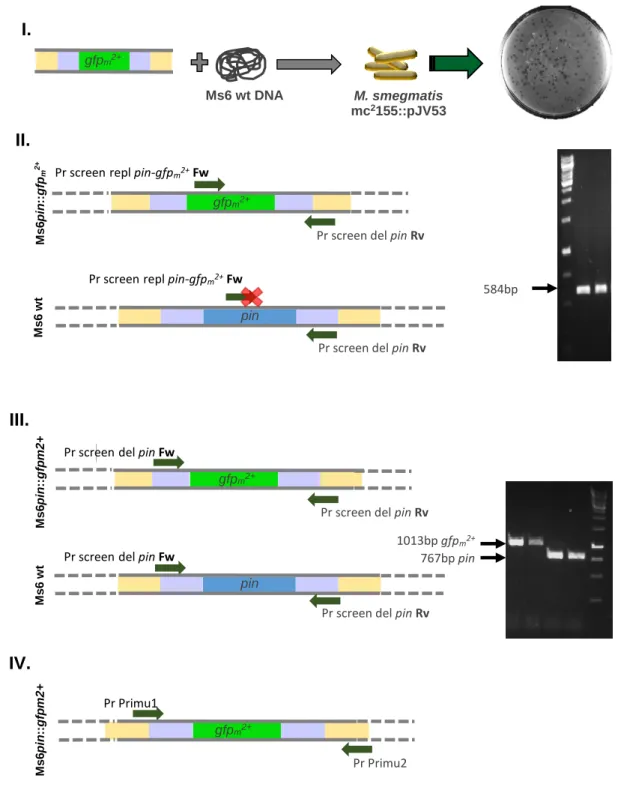
(Fig.6.I-II.) in order to obtain a final recombineering substrate of 935bp with 100bp homology to either ends of pin, the target gene (Fig.6.III.). However, it was not possible to obtain a pure 935 recombineering substrate, and an additional fragment >800bp was always amplified (Fig.6.III.). By reasons that we cannot explain, we could never separate the two fragments, so we decided to proceed with the recombineering event using the mixed fragments. Again, we tested different amounts of the recombineering substrates and genomic DNA for co-electroporation (table 3 for tested conditions; Fig. 7.I. for schematic representation of co-electroporation). After o.n. incubation on a lawn with M. smegmatis wt, the resulting plaques predicted to contain a mixture of mutant and wt phages (Fig. 7.I.). These were piqued and screened with Pr screen repl
pin-gfpm2+ Fw and Pr screen del pin Rv, designed to amplify a DNA segment of 584bp containing
the gfpm2+ gene. In case of gfpm2+ absence, the Fw primer could not hybridize, and the amplification was not verified (Fig.7.II.). From all plaques screened (with exception of controls), the desired PCR product was only obtained when 400ng of Ms6 DNA were co-electroporated with 200ng of the recombineering substrate (Table 3). This positive plaque contained the mutant and the wt phage, so Ms6pin::gfpm2+ was purified by re-plating serial dilutions. We obtained the desired mutant phage after two rounds of purification. This was confirmed by PCR using a pair of primers that flank the replaced region. As observed in figure 7.III., we only obtained the expected 1013bp fragment corresponding to the presence gfpm2+. A fragment of 767bp corresponding to the presence of gene pin was only detected in the Ms6 wt DNA control. (Fig. 7.III.). To confirm the construction of Ms6pin::gfpm2+ we amplified a DNA fragment using primers
Pr Primu1 and Pr Primu2, which flank the replaced region (Fig.7.IV.).
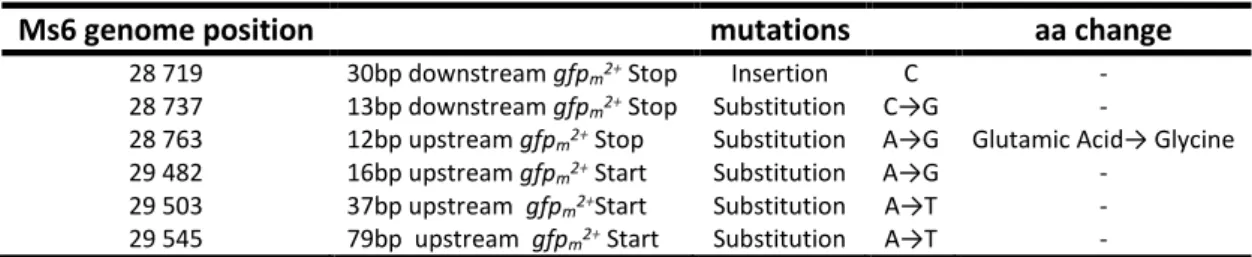
Surprisingly we detected 5 nucleotide substitutions and one nucleotide insertion on the DNA sequenced (appendix 2). However, only one occurred within the gfpm2+ gene, an A/G
occurred out the coding sequences, one downstream and three upstream of the pin gene. The nucleotide insertion was also in a non- coding region, between the pin gene and the integrase gene, thus not affecting the expression of gfpm2+. Table 4 lists all mutations analysed from DNA sequencing results.
Figure 6 - Schematic representation of the strategy used for the replacement of pin gene for gfpm2+ gene. I. First
extension PCR, in which a pair of primers added 50bp to each end of the gfpm2+ gene. II. The resulting fragment was
then used as template to add other 50bp to each end of the fragment. III. The 935bp fragment obtained from the previous extension PCR had 100bp of homology to either side of the pin, the target gene. Additionally a fragment >800bp was also amplified, however it was not possible to separate them.
Table 3 - Amounts of Ms6 DNA and substrate used for co-electroporation, the respective number of phage plaques obtained and mutants detected in primary screenings to obtain Ms6pin::gfpm2+.
Amount of Ms6 DNA Amount of Substrate Number of plaques Positives from screening PCR 200ng (Control) - 14 - 400ng (Control) - 46 - 100ng 200 2 - 100ng 300 4 - 100ng 400 2 - 200ng 200 5 - 200ng 400 9 - 200ng 600 13 - 400ng 200 28 1
Table 4 – Detected mutations in the DNA sequence of the replaced segment in Ms6pin::gfpm2+.
Ms6 genome position mutations aa change
28 719 30bp downstream gfpm2+ Stop Insertion C -
28 737 13bp downstream gfpm2+ Stop Substitution C→G -
28 763 12bp upstream gfpm2+ Stop Substitution A→G Glutamic Acid→ Glycine
29 482 16bp upstream gfpm2+ Start Substitution A→G -
29 503 37bp upstream gfpm2+Start Substitution A→T -
29 545 79bp upstream gfpm2+ Start Substitution A→T -
50bp Pr repl pin-gfpm 2+ Fw 50bp gfpm2+ Pr repl pin-gfpm2+ Rv 900bp 1000bp 935bp >800bp Pr Ext oligo-del pin
Fw
Pr Ext oligo-del pin
Rv 50bp 50bp gfpm2+ 489bp 100bp 735bp 100bp 935bp gfpm2 + pin