Printed version ISSN 0001-3765 / Online version ISSN 1678-2690 http://dx.doi.org/10.1590/0001-3765201720170354
www.scielo.br/aabc | www.fb.com/aabcjournal
6-Gingerol inhibits hair cycle
via
induction of MMP2 and MMP9 expression
CHUN HOU1
, YONG MIAO2
, HANG JI1
, SUSHENG WANG1
, GANG LIANG1, ZHIHUA ZHANG1 and WEIJIN HONG2
1Department of Plastic and Cosmetic Surgery, the First Affiliated Hospital of Guangzhou Medical University, Guangzhou, 510120 Guangdong, P.R. China
2Department of Plastic and Cosmetic Surgery, Nanfang Hospital, Southern Medical University, Guangzhou, 510120 Guangdong, P.R. China
Manuscript received on May 16, 2017; accepted for publication on August 2, 2017
ABSTRACT
6-Gingerol is the major active constituent of ginger. In the current study, we aimed to investigate the mechanisms underlying the effects of 6-Gingerol on hair growth. Mice were randomly divided into five groups; after hair depilation (day 0), mice were treated with saline, or different concentrations of 6-Gingerol for 11 days. The histomorphological characteristics of the growing hair follicles were examined after hematoxylin and eosin staining. The results indicated that 6-Gingerol significantly suppressed hair growth compared with that in the control group. And choose the concentration of 6-Gingerol at 1 mg/ mL to treated with mice. Moreover, 6-Gingerol (1 mg/mL) significantly reduced hair re-growth ratio,
hair follicle number, and hair follicle length, which were associated with increased expression of MMP2
and MMP9. Furthermore, the growth factors, such as EGF, KGF, VEGF, IGF-1 and TGF-β participate in
the hair follicle cycle regulation and regulate hair growth. We then measured the concentrations of them
using ELISA assays, and the results showed that 6-Gingerol decreased EGF, KGF, VEGF, and IGF-1 concentrations, and increased TGF-β concentration. Thus, this study showed that 6-Gingerol might act as
a hair growth suppressive drug via induction of MMP2 and MMP9 expression, which could interfere with the hair cycle.
Key words: MMP2, MMP9, 6-Gingerol, hair growth.
Correspondence to: Chun Hou
E-mail: [email protected]
INTRODUCTION
Hair loss, a common hair disorder resulting from
dysregulation of the hair cycle, is characterized
by a change in hair fiber production. Although
hair loss is not life-threatening, image-distressing
problems because of hair loss can affect the
psychological wellbeing and normal lives of
patients (Trueb 2013). Because hair loss can
critically affect the patients’ social interaction, treatment options have become a central subject
in orthopedic industry (Kiratipaiboon et al. 2016). However, most treatment modalities were proven ineffective owing to the complicated mechanisms involved in hair loss. Thus, exploration of novel effective agents to alleviate the symptoms of hair
isolated from the traditional herbal medicines, such
as green tea (Pazyar et al. 2012), the tuber fleece flower (Polygonum multiflorum Thunb.) (Fulwider
et al. 2007, Park et al. 2012), and ginger (Zingiber
officinale) (Pinski 2014), are capable of preventing hair loss and even promoting hair growth (Patel et al. 2015, Sampath et al. 2016).
Hair growth cycle is modulated by hair
follicles, in which various growth factors, such
as vascular endothelial growth factor (VEGF), insulin-like growth factor 1 (IGF-1), transforming growth factor-β (TGF-β), epidermal growth factor (EGF), and keratinocyte growth factor
(KGF/FGF-7), are expressed (Bassino et al. 2015, Jung et al. 2015, Won et al. 2015). An increasing number of studies have found that hair follicle will produce paracrine signals that stimulate or inhibit the growth
of follicular epithelium when it is stimulated. The paracrine signals contain VEGF and IGF-1 (Itami
et al. 1995). Furthermore, studies also found that
KGF can stimulate hair follicle growth, while EGF and TGF-β can inhibit hair follicle growth
(Fujie et al. 2001, Jindo et al. 1995, Philpott et al. 1994a, Shimaoka et al. 1995, Werner et al. 1994).
Generally, hair growth cycle includes three defined
stages: anagen (the active growth phase), catagen (the intermediate phase), and telogen (the resting phase) (Oh et al. 2016). During the three phases, the extracellular matrix (ECM) has been suggested
to play a structural function (Bayer-Garner et al.
2002), which is related to the functions of the
basement membrane components; type IV collagen (Brakebusch et al. 2000, Tamiolakis et al. 2001), laminin (Rudkouskaya et al. 2014), and other
structural proteins. MMPs are a family of zinc-dependent proteases involved in the degradation
and remodeling of the ECM (Pulkoski-Gross 2015). Among them, MMP2 (type IV collagenases) and MMP9 (type V collagenases) are universally
secreted by several cell types during ECM remodeling (Li et al. 2002, Stamenkovic 2003).
Regarding hair growth cycle, human hair follicles
were shown to spontaneously secrete MMP2 and MMP9 in vitro. Additionally, hair follicle number and hair canal width decreased in MMP9-knockout mice, whereas increased activity of MMP9 contributed to hair bulb involution and remodeling both in vitro and in vivo. In addition, MMP2 has been shown to be involved in the hair cycle, and its
expression is higher than that of MMP9; however,
the exact role of MMP2 in hair growth cycle still needs further investigation (Miao et al. 2013a).
Thus, we aimed to investigate the effects of ginger extract on the activity of MMPs. 6-Gingerol,
the major active constituent of ginger, has been shown to play an important role during hair cycle.
However, the effects of 6-Gingerol on hair growth
are complicated, given the recent findings that
showed that 6-Gingerol could act as a potential
hair growth suppressive drug, which opposes the
promoting effects of ginger extract on hair growth. 6-Gingerol was shown to suppress human hair
growth via its inhibitory and proapoptotic effects
on human dermal papilla cells (DPCs), as well as prolongation of the telogen phase (Miao et al. 2013a).
Therefore, in the current study, we investigated the effects of 6-Gingerol on hair growth and
hair follicle health. In addition, the molecular
mechanisms underlying the effects of 6-Gingerol,
particularly MMP signaling, were explored.
MATERIALS AND METHODS
CHEMICALS
Standard 6-Gingerol was purchased from Sigma
(St. Louis, MO, USA). Other chemicals were commercially available, and were purchased as reagent-grade chemicals from Sinopharm (Shanghai, China).
ANIMAL EXPERIMENTS
and the length of the hair follicles was measured using Image J software.
REAL-TIME POLYMERASE CHAIN REACTION (RT-PCR)
Total RNA was extracted from the skin samples with TRIzol (Thermo Fisher Scientific, Waltham, MA, USA). Then, DNase I was used to remove genomic DNA. RNA (200 ng) of each mouse
was reverse transcribed into complementary
DNA. Then, RT-PCR was performed to measure the mRNA expression levels of MMP2, MMP9,
and glyceraldehyde-3-phosphate dehydrogenase
(GAPDH). Thermal cycles were as follows: 10
min at 95 °C for enzyme activation, denaturation for 15 s at 95 °C, annealing for 60 s at 60 °C, and
extension for 60 s at 72 °C. RT-PCR was performed
for at least 30 cycles. A dissociation curve was generated to assure the absence of nonspecific
products or primer dimers. Relative quantification was conducted using the ΔΔCT method. The
expression levels of the genes of interest were
normalized to that of GAPDH. The specific primers were MMP2 (amplicon size: 176 bp): 5’-CGA TGT CGC CCC TAA AAC AG-3’ (forward), 5’-GCA TGG TCT CGA TGG TGT TC-3’ (reverse); the specific primers were MMP9 (amplicon size: 190 bp): 5’-AAA ACC TCC AAC CTC ACG GA-3’ (forward), 5’-GTG GTG TTC GAA TGG CCT
TT-3’ (reverse).
WESTERN BLOTTING ASSAY
Total protein in different groups was extracted
using a total protein extraction kit, according to the manufacturer’s instructions (Wanleibio,
China). GAPDH was employed as an internal
reference protein. After determination of protein concentrations using the bicinchoninic acid (BCA)
method, 40 μg of the protein sample was subjected
to 10% sodium dodecyl sulfate-polyacrylamide gel
electrophoresis (SDS-PAGE). Then, the proteins
were transferred onto polyvinylidene difluoride
of Southern Medical University (Guangzhou,
China), and randomly divided into 5 groups (n = 8/ group). On day 0, the telogen phase was induced by depilation of skin on the back of the C57BL/6 mice
as previously described (Curtis et al. 2011). Briefly,
hair was removed by topical application of calcium thioglycolate. Starting from the following day (day
1), 0.2 mL of different concentrations (0.1, 0.5, 1, and 2 mg/mL) of 6-Gingerol in 75 % (v/v) ethanol
was applied to the dorsal skin of each mouse twice
daily for 10 days. The control mice received the vehicle alone. The back of each mouse was observed
and photographed on day 11 after depilation. All
mice were sacrificed on day 11 and, the histology
of skin specimens isolated from the back of each mouse was examined after hematoxylin and eosin
(H&E) staining. All experimental procedures were
carried out in accordance with the guidelines of the
National Institute of Health Guide for the Care and
Use of Laboratory Animals, and were approved by the Experimental Animal Ethical Committee of Southern Medical University (no: L2016029).
HAIR RE-GROWTH EVALUATION
Hair re-growth was evaluated routinely. Briefly,
photographs of the mice were regularly taken
during each evaluation. Then, hair re-growth
was evaluated by image analysis according to the following formula: % hair re-growth = hairy (black) area/hair removal area (1).
HISTOLOGICAL ANALYSIS
After mice were euthanized, the skin tissues
were collected. They were fixed in 10% neutral
buffered formalin for 24 h, dehydrated with increasing concentrations of ethanol (70–100%),
and embedded in paraffin wax. Then, sections of 5-μm thickness were prepared. In the H&E-stained
(PVDF) membranes, washed with TTBS for
5 min, and then incubated with skimmed milk powder solution for 1 h. Primary antibodies against
MMP2, MMP9, and GAPDH were incubated with
the membranes 4 °C overnight. After washing
with TTBS four times, secondary horseradish peroxidase (HRP)-conjugated IgG antibodies were
added to the membranes and incubated for 45 min
at 37 °C. After washing with TTBS for six times,
the blots were developed using Beyo enhanced chemiluminescence (ECL) Plus reagent, and the
results were recorded using Gel imaging system. The primary antibodies were anti-GAPDH antibody (Dilution 1:2000; Abcam, ab8245, molecular
weight 37 kDa), anti-MMP2 antibody (Dilution
1:1000; Abcam, ab24331), anti-MMP9 antibody (Dilution 1:1000; Abcam, ab38898, molecular
weight 92 kDa).
ZYMOGRAPHY ASSAY
Activities of MMP2 and MMP9 were detected by zymography assays according to the manufacturer’s instructions (Millipore). Cell culture supernants were separated in a 10% polyacrylamide gel
containing 1 mg/mL gelatin. Gels were washed with 2.5% Triton X-100 for 30 mins, followed by washing once with reaction buff to remove the
SDS, incubated overnight at 37 °C. Next day, the
gels were stained with 0.5% coomassie Blue R-250
(Sigma) for 1 h and de-stained with an appropriate
coomassie R-250 de-staining solution. ENZYME-LINKED IMMUNOSORBENT ASSAY (ELISA) ASSAY
The expression levels of EGF, KGF, VEGF, IGF-1, and TGF-β in culture medium was measured; 500μl
culture supernatant was harvested from the cultured
cells. The activities of EGF, KGF, VEGF, IGF-1, and TGF-β in the culture medium were detected using the ELISA kit (R&D Systems, Minneapolis,
MN, USA) following manufacturer’s instructions. A 96-well plate was coated with monoclonal
anti-EGF, anti-KGF, anti-VEGF, anti-IGF-1, and anti-TGF-β, and then was detected by secondary
antibody conjugated to horseradish peroxidase.
The absorbance was determined at 450 nm using a microtiter reader (Multiskan Go microplate reader, Thermo Scientific, Italy).
STATISTICAL ANALYSIS
All data were expressed as the means ± standard deviations (SD) of three independent experiments. All statistical analyses were conducted using SPSS
13.0 (19.0 IBM Corporation, Armonk, NY, USA).
Differences among experimental groups were evaluated by student’s t-test. Analysis of variance was used for pairwise comparisons. P < 0.05 was
considered statistically significant.
RESULTS
ADMINISTRATION OF 6-GINGEROL DELAYED THE TRANSITION FROM TELOGEN TO ANAGEN in vivo
When the dorsal pelage hair follicles were in the telogen phase, the backs of mice were shaved, and those showing a uniform telogen stage skin were
selected. The dorsal skin was treated with the vehicle alone (control), or with 6-Gingerol at different
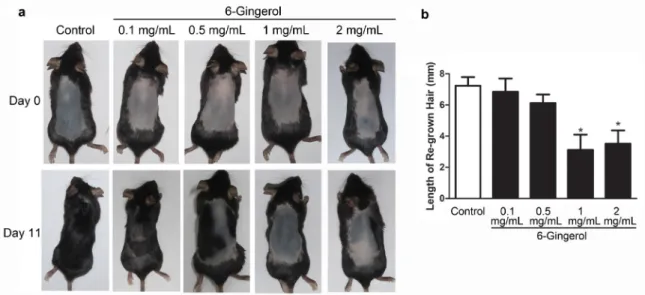
concentrations twice daily for 10 days. As shown in Figure 1a, the hair of mice in the control group
re-grew to the original status, whereas 6-Gingerol
treatment for 10 days after depilation inhibited hair re-growth in a dose-dependent manner. Based on the statistical analysis of the results (Fig. 1b),
application of 1 and 2 mg/mL 6-Gingerol had the strongest inhibitory effects on hair re-growth,
compared with that in the other groups (P < 0.05).
These results were further validated by observation
of the morphological features of hair follicles in
different groups. Topical application of 6-Gingerol significantly and dose-dependently decreased the
Figure 1 - Administration of 6-Gingerol inhibited the transition from telogen to anagen in C57BL/6 mice. After depilation, the skin on the back was treated with the vehicle (right), or 6-Gingerol (left) at different concentrations (0.1, 0.5, 1, and
2 mg/mL) twice daily for 10 days. Photographs of each animal were taken on day 11. Compared to the vehicle-treated
control mice, 6-Gingerol dose-dependently inhibited anagen induction. (a) Day 0 and day 11 after depilation; (b) length of re-grown hair was evaluated in all groups. All experiments were independently repeated three times. *P < 0.05 versus the control group.
re-growth was observed after topical application
of 1 and 2 mg/mL 6-Gingerol. Based on the
results of the hair re-growth assay, which showed
that 1 mg/mL 6-Gingerol exhibited the strongest inhibitory effects, this concentration was used in the subsequent assays. And the number of follicle was less in 6-Gingerol group than the control group. It indicated that 6-Gingerol reduced the
follicle generation.
ADMINISTRATION OF 6-GINGEROL NOT ONLY DECREASED HAIR FOLLICLE NUMBER BUT ALSO REDUCED THE LENGTH OF HAIR FOLLICLES in vivo
As shown in Figure 3a, the hair re-growth ratio
in mice treated with 1 mg/mL 6-Gingerol was significantly lower than that in the control group (P
< 0.05). The number of hair follicles also decreased in mice treated with 1 mg/mL 6-Gingerol (Fig. 3b). Moreover, administration of 6-Gingerol not only
decreased hair follicle number but also restricted the length of hair follicles in mice (Fig. 3c), which
confirmed the inhibitory effects of 6-Gingerol on
hair growth cycle.
ADMINISTRATION OF 6-GINGEROL INDUCED THE EXPRESSION OF MMP2/MMP9 DURING HAIR CYCLE in vivo
The activities of MMP2 and MMP9 fluctuated
during the hair cycle, with a peak at the early anagen phase and then decreased during the
catagen to telogen phases. In this study, the mRNA
expression of MMP2 and MMP9 in the hair
Figure 3 - Administration of 6-Gingerol not only decreased hair follicle number but also restricted the length of hair follicles
in vivo. (a) Hair re-growth ratio determined on day 11 after depilation; (b) number of hair follicles evaluated on day 11 after
depilation; (c) length of hair follicles measured on day 11 after depilation. ***P < 0.001 versus the control group.
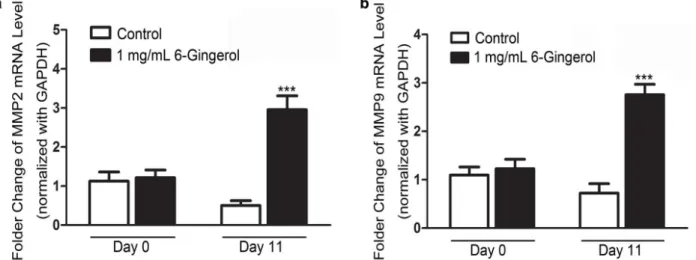
Figure 4 - Administration of 6-Gingerol induced MMP2 and MMP9 mRNA expression. (a) Quantitative analysis results of RT-PCR validation of MMP2; (b) quantitative analysis results of RT-RT-PCR validation of MMP9. All experiments were independently
follicles was examined on day 11 after depilation.
Figure 4 shows that the mRNA levels of MMP2/
MMP9 increased after treatment with 1 mg/mL
6-Gingerol on day 11 after depilation. In addition,
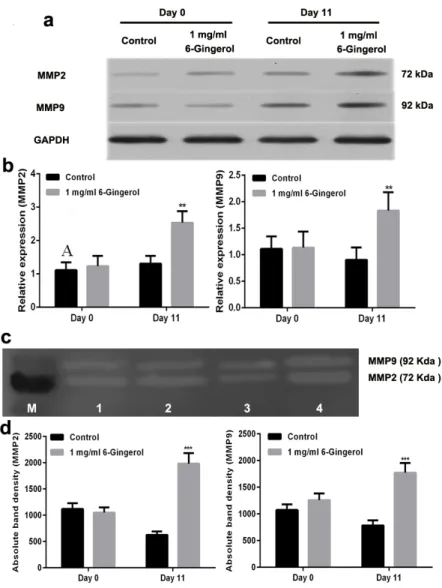
similar changing patterns were observed for MMP2
and MMP9 at the protein level, which confirmed the induction of MMPs by Gingerol (Fig. 5a and
5b). Furthermore, MMP2 and MMP9 activities in cell culture supernatants were measured by zymography assays, and the results indicated that
the activities of MMP2 and MMP9 were increased
after treatment with 1 mg/mL 6-Gingerol on day 11
after depilation (Fig. 5c and 5d).
ADMINISTRATION OF 6-GINGEROL DECREASED EGF, KGF, VEGF, AND IGF-1 CONCENTRATIONS, AND INCREASED TGF-Β CONCENTRATION
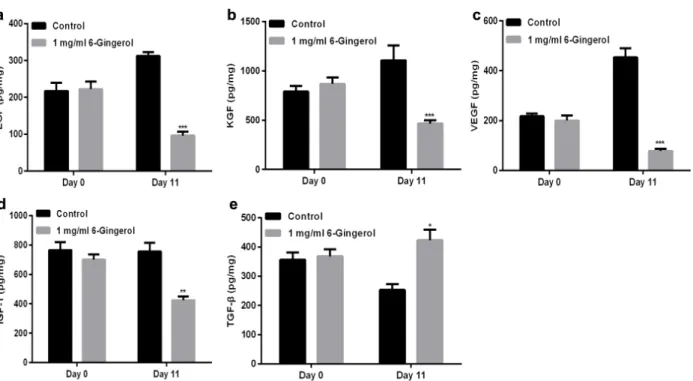
In addition, we further detected the concentrations
of EGF, KGF, VEGF, IGF-1, and TGF-β using ELISA assays, and found that 6-Gingerol decreased
Figure 5 - Administration of 6-Gingerol induced MMP2 and MMP9 protein
expression. (a) Representative images of the western blotting assay; (b) quantitative
EGF (Fig. 6a), KGF (Fig. 6b), VEGF (Fig. 6c), and IGF-1 (Fig. 6d) concentrations, and increased TGF-β concentration (Fig. 6e).
DISCUSSION
Ginger (Z. officinale) is a traditional herb that has been used in East Asia for prevention of hair loss
for centuries (Zhu et al. 2015). However, little
evidence has been found to support the claimed
effects of ginger on hair growth. On the contrary, scientists have recently inferred that 6-Gingerol,
the main active component of ginger, has the potential to inhibit hair growth in vitro and in vivo (Chakraborty et al. 2012, Miao et al. 2013b).
To verify this theory, we investigated the effects of 6-Gingerol on hair growth and the related mechanisms. Our results showed that 6-Gingerol
suppressed hair growth via induction of MMP2
and MMP9 mRNA and protein expression, which
supported the findings that ginger extract could
impair the hair growth cycle, rather than protecting the hair follicles.
6-Gingerol has been shown to induce apoptosis,
mainly through stimulation of the mitochondrial death pathway, which is primarily regulated by Bcl-2 family proteins, particularly the proapoptotic
Bax and antiapoptotic Bcl-2 proteins (Hou et al. 2015). Contrary to the potential protective effects of ginger on hair loss, 6-Gingerol was proven to
suppress human hair growth via its proapoptotic
effects on DPCs in vitro, as well asprolongation of the telogen phase in vivo. In addition, our results
showed that the inhibitory effects of 6-Gingerol on hair growth might be attributed to its effects on
ECM production in the hair growth cycle.
Hair grows in cycles of various phases: anagen is the growth phase; catagen is the involuting or regressing phase; and telogen, the Figure 6 - Administration of 6-Gingerol decreased EGF, KGF, VEGF, and IGF-1 concentrations, and increased TGF-β concentration.
resting or quiescent phase. Each phase has several
morphologically and histologically distinguishable
sub-phases (Geyfman et al. 2015, Plikus et al. 2014).
In anagen phase, the cells in the papilla divide to produce new hair fibers, and the follicle buries itself into the dermal layer of the skin to nourish the strand. In catagen phase, the follicular melanocytes
cause apoptosis. The hair follicle shrinks due to
disintegration and the papilla detaches and “rests,”
cutting the hair strand off from its nourishing blood supply. Finally, the length of the terminal fibers
increases when the follicle pushes them upward. In telogen phase, the epidermal cells continue to grow in the hair follicle without taxing the body’s
resources (Choi et al. 2011, Grinzi 2011, Harkey
1993). At some point, the follicle will begin to grow again, softening the anchor point of the
shaft initially. The hair base will break free from the root and the hair will be shed. The new hair
shaft will begin to emerge once the telogen phase
is complete. The process results in normal hair
loss known as shedding (Lay et al. 2016). Under normal depilation treatment, hair will enter the growing period and appear be a lot of new nipple. In our study, all mouse hair follicles have changed, and produced new hair follicles after dehairing. But the production of new hair follicles and the
growth of hair were inhibited after 6-Gingerol treatment. Therefore, we suggested that 6-Gingerol
can suppress hair shaft elongation and a possible mechanism of inhibiting the growth of hair is by increasing MMP-2 and MMP-9 expressions.
The morphological and physiological functions
of the hair follicles are regulated by the ECM, where its degradation and remodeling is necessary for hair cycle progression and hair follicle development (Chen et al. 2015). A large number of studies have shown that matrix metalloproteinases (MMPs) as a kind of zinc-dependent enzymes, exerts an important function in regulating the degradation of most of the ECM and basement membrane components, and in causing the attenuation of the
organizational structure of membranes (Chopra et
al. 2015, Rohani et al. 2015, Wolf et al. 2013). In
addition, studies demonstrated that MMP-2 and
MMP-9 were associated with hair cycle (Hou et al.
2015, 2016, Jarrousse et al. 2001). Previous studies have indicated that various growth factors are
expressed in the hair follicle, such as EGF, KGF, VEGF, IGF-1, and TGF-β (Danilenko et al. 1996). Among them, VEGF, IGF-1, and KGF stimulated hair growth, whereas EGF and TGF-β suppressed hair growth (Guo et al. 1996, Lachgar et al. 1996,
Philpott et al. 1994b). Furthermore, researches showed that MMP-2 and MMP-9 can regulate
numerous growth factors including VEGF, TGF-β, TNF-α, and IL-1α which play essential roles in hair growth (Gomes et al. 2012, Poyer et al. 2009).
In the present study, we confirmed that
6-Gingerol induced MMP2 and MMP9 expression,
which played an important role in hair cycle progression and hair growth (Ling et al. 2010). MMP2 and MMP9 are typical ECM-degrading enzymes, which were proven to be involved in
hair growth by VEGF, IGF-1, and TGF-β (Hou et al. 2015). In our study, we found that 6-Gingerol decreased EGF, KGF, VEGF, and IGF-1 concentrations, and increased TGF-β concentration.
In conclusion, our findings demonstrated that 6-Gingerol played an important role in regulating
hair growth via induction of MMP2 and MMP9
expression, which suggested that 6-Gingerol not
only cannot treat hair loss, but can restrain hair
growth. Therefore, we suggested that this study
might provide insights into the prevention for hair loss.
ACKNOWLEDGMENTS
This study was supported by funds from the Guangzhou Traditional Chinese Medicine and
REFERENCES
BASSINO E, GASPARRI F, GIANNINI V AND MUNARON
L. 2015. Paracrine crosstalk between human hair follicle dermal papilla cells and microvascular endothelial cells. Exp Dermatol 24: 388-390.
BAYER-GARNER IB, SANDERSON RD AND SMOLLER BR. 2002. Syndecan-1 is strongly expressed in the anagen
hair follicle outer root sheath and in the dermal papilla but expression diminishes with involution of the hair follicle. Am J Dermatopathol 24: 484-489.
BRAKEBUSCH C ET AL. 2000. Skin and hair follicle integrity
is crucially dependent on beta 1 integrin expression on keratinocytes. EMBO J 19: 3990-4003.
CHAKRABORTY D, MUKHERJEE A, SIKDAR S, PAUL A, GHOSH S AND KHUDA-BUKHSH AR. 2012. [6]-Gingerol isolated from ginger attenuates sodium
arsenite induced oxidative stress and plays a corrective
role in improving insulin signaling in mice. Toxicol Lett
210: 34-43.
CHEN P, CESCON M AND BONALDO P. 2015. Lack of Collagen VI Promotes Wound-Induced Hair Growth. J
Invest Dermatol 135: 2358-2367.
CHOI HI ET AL. 2011. Hair greying is associated with active
hair growth. Br J Dermatol 165: 1183-1189.
CHOPRA K, BAVEJA A AND KUHAD A. 2015. MMPs: a novel drug target for schizophrenia. Expert Opin Ther Targets 19: 77-85.
CURTIS A, CALABRO K, GALARNEAU JR, BIGIO IJ AND KRUCKER T. 2011. Temporal variations of
skin pigmentation in C57BL/6 mice affect optical
bioluminescence quantitation. Mol Imaging Biol 13:
1114-1123.
DANILENKO DM, RING BD AND PIERCE GF. 1996. Growth factors and cytokines in hair follicle development
and cycling: recent insights from animal models and the
potentials for clinical therapy. Mol Med Today 2: 460-467. FUJIE T, KATOH S, OURA H, URANO Y AND ARASE
S. 2001. The chemotactic effect of a dermal papilla
cell-derived factor on outer root sheath cells. J Dermatol Sci 25: 206-212.
FULWIDER WK, GRANDIN T, GARRICK DJ, ENGLE TE, LAMM WD, DALSTED NL AND ROLLIN BE. 2007.
Influence of free-stall base on tarsal joint lesions and hygiene in dairy cows. J Dairy Sci 90: 3559-3566.
GEYFMAN M, PLIKUS MV, TREFFEISEN E, ANDERSEN B AND PAUS R. 2015. Resting no more: re-defining
telogen, the maintenance stage of the hair growth cycle.
Biol Rev Camb Philos Soc 90: 1179-1196.
GOMES LR, TERRA LF, WAILEMANN RA, LABRIOLA L AND SOGAYAR MC. 2012. TGF-beta1 modulates the
homeostasis between MMPs and MMP inhibitors through
p38 MAPK and ERK1/2 in highly invasive breast cancer
cells. BMC Cancer 12: 26.
GRINZI P. 2011. Hair and nails. Aust Fam Physician 40:
476-484.
GUO L, DEGENSTEIN L AND FUCHS E. 1996. Keratinocyte growth factor is required for hair development but not for wound healing. Genes Dev 10: 165-175.
HARKEY MR. 1993. Anatomy and physiology of hair.
Forensic Sci Int 63: 9-18.
HOU C, MIAO Y, WANG J, WANG X, CHEN CY AND HU ZQ. 2015. Collagenase IV plays an important role in regulating hair cycle by inducing VEGF, IGF-1, and TGF-beta expression. Drug Des Devel Ther 9: 5373-5383. HOU C, MIAO Y, WANG X, CHEN C, LIN B AND HU Z.
2016. Expression of matrix metalloproteinases and tissue inhibitor of matrix metalloproteinases in the hair cycle.
Exp Ther Med 12: 231-237.
ITAMI S, KURATA S AND TAKAYASU S. 1995. Androgen
induction of follicular epithelial cell growth is mediated via insulin-like growth factor-I from dermal papilla cells.
Biochem Biophys Res Commun 212: 988-994.
JARROUSSE F, BOISNIC S, BRANCHET MC, BERANGER JY, GODEAU G, BRETON L, BERNARD BA AND MAHE YF. 2001. Identification of clustered cells in
human hair follicle responsible for MMP-9 gelatinolytic
activity: consequences for the regulation of hair growth.
Int J Dermatol 40: 385-392.
JINDO T, TSUBOI R, IMAI R, TAKAMORI K, RUBIN JS AND OGAWA H. 1995. The effect of hepatocyte growth
factor/scatter factor on human hair follicle growth. J Dermatol Sci 10: 229-232.
JUNG MK ET AL. 2015. Hair-growth stimulation by
conditioned medium from vitamin D3-activated preadipocytes in C57BL/6 mice. Life Sci 128: 39-46.
KIRATIPAIBOON C, TENGAMNUAY P AND CHANVORACHOTE P. 2016. Ciprofloxacin Improves the Stemness of Human Dermal Papilla Cells. Stem Cells
Int 2016: 5831276.
LACHGAR S, MOUKADIRI H, JONCA F, CHARVERON M, BOUHADDIOUI N, GALL Y, BONAFE JL AND PLOUET J. 1996. Vascular endothelial growth factor is
an autocrine growth factor for hair dermal papilla cells. J Invest Dermatol 106: 17-23.
LAY K, KUME T AND FUCHS E. 2016. FOXC1 maintains
the hair follicle stem cell niche and governs stem cell
quiescence to preserve long-term tissue-regenerating
potential. Proc Natl Acad Sci USA 113: E1506-1515.
LI H, CUI D, TONG X, MA N, GAO Y, CUI X, LU L, WANG D AND LIANG Y. 2002. The role of matrix
metalloproteinases in extracellular matrix remodelling in chronic obstructive pulmonary disease rat models.
LING H, YANG H, TAN SH, CHUI WK AND CHEW EH. 2010. 6-Shogaol, an active constituent of ginger,
inhibits breast cancer cell invasion by reducing matrix metalloproteinase-9 expression via blockade of nuclear factor-kB activation. Br J Pharmacol 161: 1763-1777.
MIAO Y, SUN Y, WANG W, DU B, XIAO SE, HU Y AND HU Z. 2013a. 6-Gingerol inhibits hair shaft growth in
cultured human hair follicles and modulates hair growth in mice. PLoS ONE 8: e57226.
MIAO Y, SUN YB, WANG WJ, ZHANG ZD, JIANG JD, LI ZH AND HU ZQ. 2013b. Inhibition effect of 6-Gingerol on hair growth. Zhonghua Zheng Xing Wai Ke Za Zhi 29:
448-452.
OH JW ET AL. 2016. A Guide to Studying Human Hair
Follicle Cycling in vivo. J Invest Dermatol 136: 34-44.
PARK PJ ET AL. 2012. Hair growth-promoting effect of Aconiti Ciliare Tuber extract mediated by the activation of
Wnt/beta-catenin signaling. Life Sci 91: 935-943.
PATEL S, SHARMA V, CHAUHAN NS, THAKUR M AND DIXIT VK. 2015. Hair Growth: Focus on Herbal Therapeutic Agent. Curr Drug Discov Technol 12: 21-42. PAZYAR N, FEILY A AND KAZEROUNI A. 2012. Green tea
in dermatology. Skinmed 10: 352-355.
PHILPOTT MP AND KEALEY T. 1994a. Effects of EGF on
the morphology and patterns of DNA synthesis in isolated human hair follicles. J Invest Dermatol 102: 186-191.
PHILPOTT MP, SANDERS DA AND KEALEY T. 1994b.
Effects of insulin and insulin-like growth factors on
cultured human hair follicles: IGF-I at physiologic
concentrations is an important regulator of hair follicle growth in vitro. J Invest Dermatol 102: 857-861.
PINSKI KS. 2014. Patient satisfaction following the use
of a hair fiber filler product to temporarily increase the thickness and fullness of thinning hair. Skinmed 12: 278-281.
PLIKUS MV AND CHUONG CM. 2014. Macroenvironmental
regulation of hair cycling and collective regenerative
behavior. Cold Spring Harb Perspect Med 4(1): a015198. POYER F, COQUEREL B, PEGAHI R, CAZIN L, NORRIS
V, VANNIER JP AND LAMACZ M. 2009. Secretion of MMP-2 and MMP-9 induced by VEGF autocrine
loop correlates with clinical features in childhood acute
lymphoblastic leukemia. Leuk Res 33: 407-417.
PULKOSKI-GROSS AE. 2015. Historical perspective of
matrix metalloproteases. Front Biosci (Schol Ed) 7: 125-149.
ROHANI MG AND PARKS WC. 2015. Matrix remodeling by
MMPs during wound repair. Matrix Biol 44-46: 113-121.
RUDKOUSKAYA A, WELCH I AND DAGNINO L. 2014. ILK modulates epithelial polarity and matrix formation in
hair follicles. Mol Biol Cell 25: 620-632.
SAMPATH C, ZHU Y, SANG S AND AHMEDNA M. 2016.
Bioactive compounds isolated from apple, tea, and ginger protect against dicarbonyl induced stress in cultured human retinal epithelial cells. Phytomedicine 23: 200-213.
SHIMAOKA S, TSUBOI R, JINDO T, IMAI R, TAKAMORI K, RUBIN JS AND OGAWA H. 1995. Hepatocyte growth
factor/scatter factor expressed in follicular papilla cells stimulates human hair growth in vitro. J Cell Physiol 165: 333-338.
STAMENKOVIC I. 2003. Extracellular matrix remodelling:
the role of matrix metalloproteinases. J Pathol 200: 448-464.
TAMIOLAKIS D, PAPADOPOULOS N, ANASTASIADIS P, KARAMANIDIS D, ROMANIDIS K, STELLOS K, KOTINI A, POLIHRONIDIS A AND SIMOPOULOS C. 2001. Expression of laminin, type IV collagen and
fibronectin molecules is related to embryonal skin and epidermal appendage morphogenesis. Clin Exp Obstet
Gynecol 28: 179-182.
TRUEB RM. 2013. The difficult hair loss patient: a particular challenge. Int J Trichology 5: 110-114.
WERNER S, SMOLA H, LIAO X, LONGAKER MT, KRIEG T, HOFSCHNEIDER PH AND WILLIAMS LT. 1994. The function of KGF in morphogenesis of epithelium and
reepithelialization of wounds. Science 266: 819-822.
WOLF K ET AL. 2013. Physical limits of cell migration:
control by ECM space and nuclear deformation and tuning by proteolysis and traction force. J Cell Biol 201: 1069-1084.
WON CH, JEONG YM, KANG S, KOO TS, PARK SH, PARK KY, SUNG YK AND SUNG JH. 2015.
Hair-growth-promoting effect of conditioned medium of high integrin alpha6 and low CD 71 (alpha6bri/CD71dim) positive keratinocyte cells. Int J Mol Sci 16: 4379-4391.
ZHU Y, ZHAO Y, WANG P, AHMEDNA M AND SANG
S. 2015. Bioactive ginger constituents alleviate protein
glycation by trapping methylglyoxal. Chem Res Toxicol