Vol.50, n. 6 : pp.1005-1018, November 2007
ISSN 1516-8913 Printed in Brazil BRAZILIAN ARCHIVES OF
BIOLOGY AND TECHNOLOGY
A N I N T E R N A T I O N A L J O U R N A L
Bee Community of a Beach Dune Ecosystem on Maranhão
Island, Brazil
Patricia Maia Correia de Albuquerque1*, João Maria Franco de Camargo2 and José Ângelo Cordeiro Mendonça3
1
Departamento de Biologia; Universidade Federal do Maranhão; Avenida dos Portugueses, s/n; Campus do Bacanga; 65040-080; [email protected]; São Luís - MA - Brasil. 2Departamento de Biologia; Faculdade de Filosofia; Ciências e Letras de Ribeirão Preto; USP; Av. Bandeirantes, 3900; 14040-901; Ribeirão Preto - SP - Brasil. 3Colégio Universitário; Universidade Federal do Maranhão; 65045-070; São Luís - MA - Brasil
ABSTRACT
The bee-plant community in a beach dune ecosystem in north-eastern of Brazil was studied concerning phenology and floral preference. The bees visited thirty-three species of 20 families of plants. The most visited species were
Vernonia arenaria (Asteraceae), Chamaecrista hispidula (Caesalpiniaceae), Passiflora foetida (Passifloraceae) and
Turnera melochioides (Turneraceae). Fifty-five percent of plants presented an annual or long flowering period (from 5 to 7 months). The largest number of species blooming was observed from March to August (dry season), corresponding to the period of greatest abundance and diversity of bees. Based on the range of floral sources used by the dominant bees, three guilds of bees were noted: bees with a restricted range of floral sources: Melitoma
segmentaria, Centris tarsata, Centris flavifrons, Ceratinula sp.; moderate generalists: Megachile (Leptorachis) sp.,
Euglossa cordata, Augochlorella sp., Eulaema nigrita and Xylocopa frontalis; and generalists: Xylocopa cearensis,
Apis mellifera, Exomalopsis analis and Pseudaugochloropsis pandora.
Key words: Apoidea, bee-plant interactions, beach dune, north-eastern Brazil
* Author for correspondence
INTRODUCTION
Gottsberger et al. (1988) were the first to call attention to the predominance of melittophilous plants in neotropical beach dune systems investigating the floral biology and pollination ecology of some melittophilous plants in the beach dunes of Maranhão island. In spite of this, little attention has been paid so far to the pollinating agents of the dune ecosystem. Zanella et al. (1998) studied a bee-plant community in a secondary meadow, with forest elements and dune vegetation on the coast of Parana, southern Brazil. Alves-dos-Santos (1999a, 1999b) surveyed bees and plants in
the north-eastern region of the state of Rio Grande do Sul, sampling an almost linear transect from the sea level up to ca. 800 m. Costa and Ramalho (2001) studied the pollination ecology of eight plant species in beach dunes, northeast of Salvador, Bahia, Brazil. Madeira-da-Silva and Martins (2003) and Viana and Kleinert (2005) using a standardized methodology collected bees and plants at the Abaeté sand dunes, Bahia and at a restinga area at Cabedelo, Paraiba, respectively.
• What floral attributes govern the abundance or diversity of pollinators?
• Does the beach dune vegetation provide sufficient reward and alimentation for the bees all year round?
MATERIAL AND METHODS
Study site
The study was conducted in the secondary dunes (according to the zonation presented by Gottsberger et al.,1988), approximately 30 m high, of São Marcos beach, São Luis, Maranhão (2°29' S, 44°18' W), northeast of Brazil, in an area of 12,270 m2. In this place, the climate is hot,
semi-humid, with well-defined dry and rainy seasons, annual mean temperature of 26.7°C, rainfall 1,950 mm and relative humidity averages 81%.
The vegetation in the dunes is characterized by herbaceous and creeping species, such as
Canavalia rosea and Ipomoea spp. The land area
adjacent to the study site is characterized by shrubby vegetation and by scattered spots of secondary forest, where Vismia, Cecropia and babassu palm (Orbignyia phalerata) are the predominant elements.
Sampling
Sampling was done at 30-day intervals, from November 1993 to October 1994. The study area was divided into eight sections, of approximately equal size, in which bees were alternately collected by two people (P. Albuquerque and R. Ferreira). Each collector stayed 30 min. in each section, avoiding collecting for more than 3-5 min. in each plant specimen. All the surveyed area was searched once every two hours and six times in 12 h. Each survey had a 12 h duration (on the first day from 12 PM to 6 PM and on the second from 6 AM to 12 PM), totalling 288 h of survey, 144 h for each collector. All bee individuals visiting any plant species at any time were caught with entomological nets. Prolonged stays at any one flower patch were avoided. Bees and voucher specimens of plants have been deposited in the Entomological Collection of the Federal University of Maranhão – UFMA and duplicates of plants in the Paraense Emilio Goeldi Museum, Belém, Pará, Brazil. Data on opening and closing of flowers (every two hours), change in their
colour, size, shape and resources offered (using visual observation to determine which was the principal flower reward), fall of flower or petals, number of flowers or inflorescences (approximately), and number of specimens of plants per section were collected by a third observer who also recorded climatic data.
The pattern of flowering phenology proposed by Newstrom et al. (1994) that considered four basic classes of flowering (continual, subannual, annual and supra-annual) was used in this study. The method of “occurrence probability” of Kato et al. (1952) was used to calculate the relative abundance of the predominant bee species and their confidence limits (α = 0.05). The upper and lower confidence limits were obtained respectively, using the formula below:
Upper limit: [(n1.f0)/(n2 + n1.f0)] . 100, n1 = 2(K +
1); n2 = 2(N – K + 1)
Lower limit: [(1 - n1.f0) / (n2 + n1.f0) ] . 100, n1 =
2(N – K + 1); n2 = 2(K + 1),
where N was the total number of all specimens captured and K was the total number of specimens of each species, and f0 was obtained from the
F-distribution table at the degrees of freedom n1 and
n2 (p = 0.05). The species whose lower confidence
limit of relative abundance was higher than the upper limit when K = 0 (undiscovered species) were regarded as the predominant species.
The representation of the frequency distribution of the species classified according to the number of individuals was done by applying Preston’s methodology (1948) adjusted to the truncated lognormal (Ludwig and Reynolds, 1988).
The Brillouin index was used to calculate the diversity of plants visited by each bee species, according to Pielou (1969, 1975), Krebs (1989) and Magurran (1988), using the formula as below:
H = (ln N! - ∑ln ni!)/ N
where N was the total number of bee individuals and ni was the number of bees in each plant
species. The Evenness (E) for the Brillouin diversity index was obtained from the following formula:
E = H / Hmax , Hmax = 1/N . ln N! /
where S = richness of plant species visited, r = N - S[N/S].
Flower preferences were calculated using the program PREFER as proposed by Krebs (1989), which calculates Manly’s alpha index of preference. The variables required by the program are:
• The number of species of flowers present in the area.
• The number of flowers of each species in the area.
• The number of visits to each species of flowers by bees of a particular species.
• Whether the resource was renewable or not. It was decided to classify the resources as renewable, since few flowers secrete nectar at just one time. Pollen is not a renewable resource, but no single bee is likely to remove the entire quantity of pollen from a flower in just one visit.
RESULTS
The S.Marcos Dune Plant Community
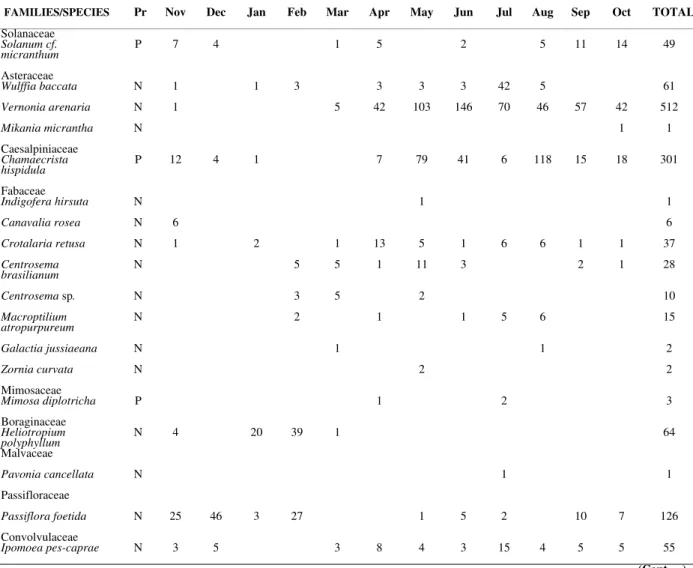
Forty-two species of plants were found flowering in the study area (Tables 1 and 2). A total of 1581 specimens of bees were collected visiting 33 species of plants of 20 families, mainly Fabaceae (8 spp, 24%), Convolvulaceae (4 spp, 12 %), Asteraceae (3 spp, 9%), and Turneraceae (2 ssp, 6%). Each of the remaining plant families were represented by only one species (13 families, 65%) (Table 1).
Among the plant species found flowering, 85.8% were entomophilous (of which 81.0% were melittophilous, pollinated by bees, and 4.8% were generalist insect pollinated) and 7.1% anemophilous (7.1% of the plant species did not have a clearly definable floral syndrome determined). Purple (30.3%), white (27.3%) and yellow (24.2%) were the corolla colours most commonly found among flowers visited by bees.
Flowering Phenology
The number of plant species visited by bees in the rainy season was relatively small (Table 1) but increased during the dry season, from May to October, the principal blooming period (13 to 17 visited species). Most (79%) of the plants had annual or long flowering periods in which 58%
had an extended flowering duration (> 5 mo). Among these, Passiflora foetida, Ipomoea
pes-caprae, I. littoralis, Heliotropium polyphyllum
were the plants most preferred by the bees; 35% had an intermediate flowering (1 – 5 mo) and
Zornia curvata and Mikania micrantha had a brief
flowering duration (< 1 mo). Turnera
melochioides, Crotalaria retusa, Solanum
micranthum, Wulffia baccata, Vernonia arenaria,
Chamaecrista hispidula and Centrosema
brasilianum had a continuous flowering pattern.
Chamaecrista hispidula, a species characteristic of
dunes, occurred with great abundance in all sections of the dune, and presented peak flowering from April to June. Canavalia rosea, had its flowering peak in August and September.
Passiflora foetida (flowering peak in Sep-Jan) and
Solanum cf. micranthum (Jul-Sep) that are also
characteristic dune species, were only observed in sections closest to the primary dune.
The number of flowering specimens per monthly sample of each plant species varied from 1 to 251. Eleven species (26.2%) were represented by small populations, with up to 10 specimens. The species with larger populations were: Chamaecrista
hispidula (251 individuals), Borreria verticcilata
(154), Crotalaria retusa (83), Solanum cf.
micranthum (82), Polygala monticola (81),
Wulffia baccata (78), Ipomoea littoralis (72).
Solanum cf. micranthum, Wulffia baccata,
Turnera melochioides, Chamaecrista hispidula,
Passiflora foetida, Vernonia arenaria, Crotalaria
retusa and Ipomoea pes-caprae flowered and
received visits for approximately 10 months. About 52% of the plant species had a flowering period of less than 6 months, and few bees visited them.
In most of the species, anthesis was between 5:00 a.m. and 6:00 a.m. and the flowers stayed open until 4:30 p.m., but some of the species closed in the morning. Flowers of Ipomoea mauritiana,
Centrosema sp. and Passiflora foetida were
available to the visitors for the shortest periods, anthesis occurring between 5:30 and 6:00 a.m. and by 11:00 a.m. they were completely closed. In
Passiflora foetida, the flowers began to wither at
about 8:30 a.m., but even so they still continued to receive some visits. Flowers of Ipomoea
pes-caprae, I. littoralis, Merremia aegyptia, Turnera
ulmifolia and Centrosema brasilianum closed at
about 12:00 - 1:00 p.m. In Chamaecrista hispidula
and Macroptilium atropurpureum (whose anthesis
melochioides and Crotalaria retusa (anthesis at 7:00 a.m.), flowers closed at 4:00 - 4:30 p.m. Anthesis in Solanum micranthum and Canavalia
rosea occurred at about 5:00 a.m., and flowers
remained open even after 6:00 p.m.
Floral Preferences
Fig. 1 shows the flower preferences analysed by the PREFER program for the bees collected all year round in each plant species. Considering all the bees collected from each plant species without considering the month of collection, it was possible to observe a clear preference for one species of flower: Vernonia arenaria (α = 0.36)
visited mainly Apis mellifera (64%) and Xylocopa
cearensis (27%) for nectar foraging. For pollen
foraging, Chamaecrista hispidula and Solanum
micranthum, both having flowers with poricidal
anthers were the second most preferred, visited mainly by X. cearensis (65%) (Fig. 1A).
In November, the bees showed a clear preference
for Wulffia baccata (α = 0.68) and Solanum
micranthum (α = 0.16) (Fig. 1B).
In December five species of flowers were foraged
and Solanum micranthum (α = 0.51) was the most
preferred (Fig. 1B). In January Cassia hispidula (α
= 0.72) was preferred (Fig. 1B); and in February
Ipomoea mauritiana (α = 0.31), Passiflora foetida
(α = 0.26) and Centrosema sp. (α = 0.15).
In March, April, May, June, July and September the bees showed a clear preference for Vernonia
arenaria, which were the most visited for nectar.
In August, Cassia hispidula (α = 0.45) was the
preferred flower pollen and Vernonia arenaria (α
= 0.22) for nectar (Fig. 1B).
Table 1. - Number of bee visitors netted at flowering plants and principal reward (Pr) collected at S. Marcos beach dunes, S. Luís Island, MA, from November 1993 to October 1994. N = nectar; P = pollen; O = oil; * primary.
FAMILIES/SPECIES Pr Nov Dec Jan Feb Mar Apr May Jun Jul Aug Sep Oct TOTAL
Solanaceae Solanum cf.
micranthum P 7 4 1 5 2 5 11 14 49
Asteraceae
Wulffia baccata N 1 1 3 3 3 3 42 5 61
Vernonia arenaria N 1 5 42 103 146 70 46 57 42 512
Mikania micrantha N 1 1
Caesalpiniaceae Chamaecrista
hispidula P 12 4 1 7 79 41 6 118 15 18 301
Fabaceae
Indigofera hirsuta N 1 1
Canavalia rosea N 6 6
Crotalaria retusa N 1 2 1 13 5 1 6 6 1 1 37
Centrosema
brasilianum N 5 5 1 11 3 2 1 28
Centrosema sp. N 3 5 2 10
Macroptilium
atropurpureum N 2 1 1 5 6 15
Galactia jussiaeana N 1 1 2
Zornia curvata N 2 2
Mimosaceae
Mimosa diplotricha P 1 2 3
Boraginaceae Heliotropium
polyphyllum N 4 20 39 1 64
Malvaceae
Pavonia cancellata N 1 1
Passifloraceae
Passiflora foetida N 25 46 3 27 1 5 2 10 7 126
Convolvulaceae
Ipomoea pes-caprae N 3 5 3 8 4 3 15 4 5 5 55
(Cont. Table 1) FAMILIES/SP
ECIES Pr Nov Dec Jan Feb Mar Apr May Jun Jul Aug Sep Oct TOTAL
Ipomoea
mauritiana N 3 6 9
Ipomoea
littoralis N 2 2 4 9 4 2 1 24
Merremia
aegyptia N 14 2 8 24
Portulacaceae
Talinum sp. P 1 1
Malpighiaceae Tetrapterys sp. *O -
P 3 2 2 7
Bignoniaceae Arrabidaea
brachypoda N 6 2 8
Turneraceae Turnera
melochioides N 12 23 2 2 2 3 7 23 19 6 22 121
Turnera
ulmifolia N 1 2 7 2 1 13
Rubiaceae Borreria
verticilata N 1 36 14 51
Lamiaceae Marsypianthes
hyptoides N 9 1 10
Lecythidaceae Gustavia
augusta P 1 1
Burseraceae Protium
heptaphyllum N 1 1
Polygalaceae Polygala
monticola N 4 14 12 2 1 2 35
Sapindaceae Pseudima
frutescens N 1 1
Commelinaceae Commelina
virginica P 1 1
Total of bee
specimens 73 82 28 89 39 97 222 220 255 236 119 121 1581
Total of plant
species visited 11 5 6 10 11 12 15 14 17 16 11 13 33
Table 2 - Plants visited in beach dunes of S. Marcos, S. Luís, MA, Brazil and number of specimens/bee species collected. (Hab) plant habit, (Tr) tree and shrub, (Hb) herbs, (SS) subshrub, (Cr) creeper, (A) Apis mellifera, (B) Euglossa cordata, (C) Eulaema nigrita, (D) Eufriesea surinamensis, (E) Centris aenea, (F) C. leprieuri, (G) C. flavifrons, (H) Centris sp., (I) C. tarsata, (J) C. fuscata, (K) C.spilopoda, (L) Mesonychium asteria, (M) Ancyloscelis apiformis, (N) Melitoma segmentaria, (O) Diadasina sp., (P) Ptilothrix plumata, (Q) Exomalopsis analis, (R) Ceratina maculifrons, (S) Ceratinula sp.2, (T) Ceratinula sp.n., (U) Ceratinula sp., (V) Xylocopa frontalis, (W) X.cearensis,
(X) X. muscaria, (Y) Pseudaugochloropsis Pandora, (Z) Augochlorella sp., (A1) Acamptopoeum prinii, (B1) Protomelliturga turnerae, (C1) Oxaea festiva, (D1) Megachile (Pseudocentron)sp., (E1) Megachile (Leptorachis) sp.,
(F1) Megachile (Leptorachis) sp.2, (G1) Megachile (Pseudocentron)sp.3, (H1) Megachile (Pseudocentron) sp.2, (I1) Dicranthidium arenarium
Bee rate
Hab Plant rate A B C D E F G H I J K L M N O P Q R S T U V
Solanaceae Tr Solanum cf. micranthum
7 1 3 6
Asteraceae Tr Wulffia baccata 1 1 38 1
SS Vernonia arenaria 327 1 4 15 2 1 1 10 2
Cr Mikania micrantha 1 Caesalpiniaceae SS Chamaecrista
hispidula
25 3 15 12 15 7 2 1 1 2
Fabaceae Hb Indigofera hirsuta
Cr Canavalia rosea 1 5
SS Crotalaria retusa 32
Cr Centrosema brasilianum
6 3 2 1
Cr Centrosema sp. 1 1 Cr Macroptilium
atropurpureum
2 2 1
Cr Galactia jussiaeana Hb Zornia curvata
Mimosaceae SS Mimosa diplotricha 1 2
Boraginaceae Hb Heliotropium polyphyllum
40 2 1 1
Malvaceae Hb Pavonia cancellata 1
Passifloraceae Cr Passiflora foetida 52 1 1
Convolvulaceae Cr Ipomoea pes-caprae 1 11 36 3 1 2
Cr Ipomoea mauritiana 1 1 4 1
Cr Ipomoea littoralis 14 5 2 2
Cr Merremia aegyptia 2 9 11
Portulacaceae Hb Talinum sp. 1
Malpighiaceae Tr Tetrapterys sp. 3 1 2 1 Bignoniaceae Tr Arrabidaea
brachypoda
Turneraceae Hb Turnera melochioides 18 2 1 2 16 1 16 15 3
Hb Turnera ulmifolia 5 1
Rubiaceae Hb Borreria verticilata 12 35
Lamiaceae Hb Marsypianthes hyptoides
2 1
Lecythidaceae Tr Gustavia augusta Burseraceae Tr Protium heptaphyllum Polygalaceae Hb Polygala monticola 1 Sapindaceae Tr Pseudima frutescens
Commelinaceae Hb Commelina virginica 1
Total Bee Sample 456 9 37 5 26 33 18 5 9 3 2 2 37 46 5 2 121 12 17 16 3 46 Total
Hab Plant rate W X Y Z A1 B1 C1 D1 E1 F1 G1 H1 I1 Spp. Sp.
Solanaceae Tr Solanum cf. micranthum
32 49 6
Asteraceae Tr Wulffia baccata 17 2 1 61 7
SS Vernonia arenaria 139 1 1 1 1 4 1 1 512 18
Cr Mikania micrantha 1 1
Caesalpiniaceae SS Chamaecrista hispidula
198 1 19 301 14
Fabaceae Hb Indigofera hirsuta 1 1 1
Cr Canavalia rosea 6 2
(Cont. Table 2)
SS Crotalaria retusa 5 37 2
Cr Centrosema brasilianum
15 1 28 6
Cr Centrosema sp. 7 1 10 4
Cr Macroptilium atropurpureum
10 15 4
Cr Galactia jussiaeana
2 2 1
Hb Zornia curvata 2 2 1
Mimosaceae SS Mimosa diplotricha
3 2
Boraginaceae Hb Heliotropium polyphyllum
20 64 5
Malvaceae Hb Pavonia cancellata 1 1
Passifloraceae Cr Passiflora foetida 61 11 126 5
Convolvulaceae Cr Ipomoea pes-caprae
1 55 7
Cr Ipomoea
mauritiana
1 1 9 6
Cr Ipomoea littoralis 1 24 5
Cr Merremia aegyptia 2 24 4
Portulacaceae Hb Talinum sp. 1 1
Malpighiaceae Tr Tetrapterys sp. 7 4
Bignoniaceae Tr Arrabidaea brachypoda
8 8 1
Turneraceae Hb Turnera melochioides
35 3 6 3 121 13
Hb Turnera ulmifolia 4 3 13 4
Rubiaceae Hb Borreria verticilata 1 1 1 1 51 6
Lamiaceae Hb Marsypianthes hyptoides
6 1 10 4
Lecythidaceae Tr Gustavia augusta 1 1 1
Burseraceae Tr Protium heptaphyllum
1 1 1
Polygalaceae Hb Polygala monticola 31 2 1 35 4
Sapindaceae Tr Pseudima frutescens
1 1 1
Commelinaceae Hb Commelina virginica
1 1
Total Bee Sample 591 1 40 13 1 3 2 4 9 2 1 2 2 1581 36
A. Cumulative data from Nov/1993 to Oct/1994 (n= 1581)
Solanum micranthum Wulffia baccata
Vernonia arenaria Chamaecrista hispidula
Indigofera hirsuta Canavalia rosea
Crotalaria retusa Centrosema brasilianum
Centrosema sp Macroptilum atropurpureum
Zornia curvata Heliotropium polyphyllum
Pavonia cancellata Passiflora foetida
Ipomoea pes-caprae Ipomoea mauritiana
Ipomoea littoralis Merremia aegyptia
Talinum sp Commelina virginica
Tetrapterys sp Turnera melochioides
Turnera ulmifolia Borreria verticcilata
Marsypianthes hyptoides Gustavia augusta
P. monticola P. frutescens
B.
NOV (n=73) DEC (n=82) JAN (n=28) FEB (n=89)
MAR (n=39) APR (n=97) MAY (n=222) JUN (n=220)
JUL (n=255) AUG (n=236) SEP (n=119) OCT (n=121)
Figure 1 -Flower preferences as assessed by bees at S. Marcos beach dunes, S. Luis, MA, from November 1993 to October 1994. (n = number of bees collected), using Manly’s alpha index of preference (Krebs, 1989). A. Cumulative data, B. Preference per month
Bee Diversity on Plants
Among the species of bees collected, 18 were considered predominant, according to the methodology of Kato et al. (1952) (Fig. 2). The frequency distribution of the species in relation to their classes of abundance was a truncate curve (Fig. 3). Variation in plant species visited was observed for these bees (Table 3). Ceratinula sp.
2, Ceratinula sp.nov., Centris flavifrons, C.
tarsata and Melitoma segmentaria were species
that used few floral resources, hence, these were considered as bees with a restricted range of floral
sources. The 16 and 17 individuals, respectively of
Ceratinula sp.nov. and Ceratinula sp.2. used or
Figure 2 - The relative abundance of the predominant bee species visiting flowers in beach dunes of S. Marcos, S. Luís, MA, Brazil from November 1993 to October 1994 as calculated by Kato et al. (1952). Ends of each bar show upper and lower limits of confidence (p =
0.05) and vertical broken line is the upper limit when K = 0 (undiscovered species); the black dots are the cumulative percentage (lower scale) according to each individual
About 83% of the individuals of Centris flavifrons and 77.8% of C. tarsata were captured on flowers
of Chamaecrista hispidula (Caesalpiniaceae) for
pollen foraging. Megachile (Leptorachis) sp.,
Euglossa cordata, Augochlorella sp and Xylocopa
frontalis visited three to five species of plants
showing some preference while nectar foraging:
Vernonia arenaria (Asteraceae), Centrosema
brasilianum (Fabaceae), Turnera melochioides
(Turneraceae) and Crotalaria retusa (Fabaceae) respectively. Eulaema nigrita visited five species of plants most of them for pollen collection. These five bee species could be considered moderate generalists. Xylocopa cearensis, Apis mellifera,
Exomalopsis analis and Pseudaugochloropsis
Pandora, visited 20, 11, 10 and 9 plant species
respectively (Table 2), being considered generalist.
DISCUSSION
The prevalence of melittophilous plants in a coastal ecosystem of dunes was noted by Gottsberger et al. (1988) in Sao Luis and in five apifauna surveys were carried out including the coastal dunes of Brazil (Viana and Alves-dos-Santos 2002). On S. Marcos beach dunes, almost 49% (774) of individuals and 36% (13) of species were large bees (bees of medium-large body length
≥ 1.2 cm) that visited mainly Caesalpiniaceae
(Cassia hispidula), Asteraceae (Vernonia
arenaria), Fabaceae (Crotalaria retusa),
Passifloraceae and Solanaceae. Viana and
Xylocopa cearensis
Apis mellifera
Exomalopsis analis
Xylocopa frontalis
Melitoma segmentaria
Pseudaugochloropsis pandora
Eulaema nigrita
Ancyloscelis apiformis
Centris leprieuri
Centris aenea
Centris flavifrons
Ceratinula sp.2
Ceratinula sp.n.
Augochlorella sp
Ceratina maculifrons
Centris tarsata
Euglossa cordata
Megachile (Leptorachis) sp
0 20 40 60 80 100
0 10 20 30 40%
dos-Santos (2002), analysing four different dune surveys in Brazil, have mentioned the predominance of large solitary bees in this ecosystem, due to their foraging ability despite the adverse dry conditions of the dunes. Costa and Ramalho (2001) suggested that the dominance of bee pollination in those places could be a local
response to bee species resident in adjacent communities in the coastal landscape, since there were few species of bees resident in the dunes.
Figure 3 - Distribution of the frequencies of bee species in classes of abundance (Preston, 1948) in S. Marcos beach dunes, S.Luis, MA. So modal = 7.5; Estimated So = 5.8
Table 3 - Diversity of plants visited by predominant native bees collected in the sand dunes of S. Marcos beach, Maranhão, Brazil from November 1993 to October 1994. n = richness of plant species visited; N = number of bee specimens collected; H = Brillouin diversity index; E2 = Brillouin evenness index.
BEE SPECIES n N H E2
Ceratinula sp.2 2 17 0.17 0.29
Ceratinula sp.n. 2 16 0.17 0.29 Centris (Centris) flavifrons 2 18 0.37 0.62 Centris (Hemisiella) tarsata 2 9 0.40 0.74 Melitoma segmentaria 4 46 0.64 0.51 Megachile (Leptorachis) sp. 3 9 0.79 0.96 Euglossa (Euglossa) cf. cordata 4 9 0.69 0.70 Augochlorella sp. 4 13 0.93 0.86 Eulaema (Apeulaema) nigrita 5 37 0.84 0.59 Xylocopa (Megaxylocopa) frontalis 5 46 0.85 0.59 Ceratina (Crewella) maculifrons 10 12 1.55 1.00 Centris (Centris) aenea 5 26 1.04 0.76 Centris (Centris) leprieuri 6 33 1.08 0.70 Ancyloscelis apiformis 6 37 1.18 0.76 Pseudaugochloropsis pandora 9 40 1.27 0.68 Exomalopsis analis 10 121 1.64 0.76
Apis mellifera 11 456 0.98 0.42
Xylocopa (Neoxylocopa) cearensis 20 587 2.01 0.69
N
. o
f
sp
ec
ie
sp
er
o
ct
av
e
*
*
*
*
*
*
*
*
*
*
1 2 3 4 5 6 7 8 9 10
Individuals per octaves 2
4 6
8 a=0.177/So=7.5
In spite of many existing typical plant species of dunes and sandbanks, the bee visitors were almost all non-coastal in terms of nesting habitats. In São Luís, only Centris leprieuri and
C. aenea nested in beach dunes, but they were
not restricted to this habitat as they were also found in inland, continental areas (nesting in sandbanks – see Gottsberger et al., 1988).
Xylocopa cearensis, the most common visitor to
plants on the dunes of S. Marcos beach was also the main pollinator along beach dunes in Salvador, Bahia (Costa and Ramalho 2001; Viana and Kleinert. 2005).
The pattern of abundance of bee’s species in the dunes of S. Luis was a left truncated curve. The truncation point is called the veil line and the left-hand portion of the curve representing the rare and harder to sample species (Magurran, 2004). Among the species of bees collected at S.Marcos beach dunes, 50% were represented by the three first classes, including less than eight individuals (Table 2).
Comparing the Brillouin diversity index of S. Luis with similar ecosystems in the Northeast of Brazil, S. Luis (2.01) is placed between those ecosystems in Bahia (1.97) and Paraíba (2.38) (Viana and Kleinert, 2005; Madeira-da-Silva and Martins, 2003). The Brillouin evenness index (E2) varied from a minimum of 0.51 in
Bahia, to a maximum of 0.65 in Paraíba. Accordingly to Kevan et al. (1997) although the most acceptable means of measuring ecosystem stress are the diversity indexes, environmental problems cannot be detected by diversity analyses in vacuo. Hence the lognormal model of species diversity and abundance has been used to assess the ecosystem integrity (Minshall et al., 1985; Laroca et al., 1989; Kevan et al., 1997). Thus, according to the above hypothesis, the S. Luís beach dunes ecosystems are under a disequilibrium caused by anthropogenic activity. Pedroso Júnior (2003) has mentioned the critical situation of the ridges of restinga for being located on the coastal plins that coincidentally shelter or are under direct influence of the biggest urban gathering in the country. Accordingly to Viana and Alves-dos-Santos (2002) the dunes were the most fragile environment among all ecosystems on the coast. Our results based on the Brillouin index showed that there was a significant positive correlation
between the abundance of bees of each species and their preference score (r = 0.53). This could suggest that bees abundant if they could use more host plants. This result was in accordance with the theory of the nested structure of flower/flower-visitor interaction webs (Bascompte et al., 2003) in which “the most generalist plant and animal species interacted among them generating a dense core of interactions to which the rest of the community was attached”.
The most frequent habits of plants in the dunes of S. Luis (herbs and creepers) were different from those found by Costa and Ramalho (2001) and Viana (1999, cited by Costa and Ramalho, 2001) in Bahia, where shrubs (37%) were the most common. The same was observed with regard to corolla colours. The pattern presented by Viana (1999, cited by Costa and Ramalho, 2001) (white – 48%, purple – 32% and yellow – 16%) and Costa and Ramalho, 2001 (white – 42%, yellow – 24% and purple – 18%) was different from that found in S. Luis dunes (purple – 30.3%, white – 27.3%, yellow – 16%). These results suggested a spatial heterogeneity and perhaps variation in ecological interactions (flower-visitor) in these ecosystems, as proposed by Costa and Ramalho (2001).
The flowering pattern observed at S. Marcos beach dunes – many species with long and synchronous flowering period (1 –2 flowers per individual) and few species having a long bloom – was typical of ecosystems with adverse climatic conditions. In beach dunes, where strong winds restrict pollinator activity, long blooming periods can represent an adaptive advantage.
It has been observed that convergent selection in the flowering period of sympatric species may be present in some cases (Bawa, 1983). Ipomoea
pes-caprae, I. littoralis and I. mauritiana share the
same pollinators (M. segmentaria, Ancyloscelis
apiformis) and have the same flowering period.
The proximity of individuals with the same flower shape and colour could be a long-distance-attraction-mechanism.
Gottsberger et al. (1988) registered temporal differentiation in anthesis of Passiflora foetida
and Turnera melochioides. With the data obtained
from the S. Marcos beach dunes, it was observed that Ipomoea mauritiana and Centrosema sp. had the same diurnal flowering schedule as P. foetida,
of T. melochioides. Temporal differentiation of the blooming period among species that share the same pollinators seems to be a common pattern in tropical forests or ecosystems in climax (Vogel and Westerkamp, 1991).
Without doubt, the principal floral reward explored by bees in the S. Marcos beach dunes was nectar and for the majority of bee species collected a certain relation was noted between the proboscis length of the bees and many of the flower forms found, as well as an association between the proboscis length and the body aspect that had also been observed in other communities (Inoye, 1978, 1980; Frankie and Haber, 1983, Armbruster and Guinn, 1989).
Ceratinula, Augochlorini and Protomelliturga
turnerae, short proboscis bees, visited mainly
short-tubed and radially symmetrical flowers such as Turneraceae (where 55.6% of short proboscis bees were collected) and Passifloraceae (16.6%). While the large proboscis bees (Centridini, Xylocopini and
Melitoma) were more frequent in tubular corolla
flowers that were not so long and narrow, mainly Asteraceae. Euglossini and X. frontalis (a very large proboscis bee) showed a close relation with papilionate corolla flowers. Among the large bees (Euglossini, Centridini, Ericrocidini, Xylocopini, Megachilini and
Oxaea), there was also a great frequency of
colourful and zygomorphic flowers: mainly species of Fabaceae, Caesalpiniaceae, Lamiaceae, Asteraceae and Passifloraceae. Short bees (Exomalopsis, Ceratinula, Augochlorella
and Dicranthidium) were more frequent (66.3%)
in Turneraceae, Boraginaceae, Rubiaceae with short and pale (white or yellow) flowers, but in many cases, they were only occasional pollinators.
Pollen was the principal or sole reward in six species (Table 1) and two of these were continuous flowering species. Of the four remaining species, two, Mimosa diplotricha and
Commelina virginica, although not categorised
as continuous flowering plants, did produce pollen for about seven months. It was common to collect pollen by touching the surfaces of anthers (Roubik, 1989). This strategy was used mainly by short bees (Ceratinini, Anthidiini, Emphorini) in flowers of Ipomoea, Vernonia,
Mimosa, Passiflora and others. On the other
hand, buzz collecting was dominant in the studied area among species of Euglossini,
Centridini, Xylocopa, Exomalopsis, Augochlorella
and Pseudaugochloropsis.
At S. Marcos beach dunes, bees can be considered one of the principal components in the plant-pollinator communities – the great majority of plants in this ecosystem are melittophilous. Considering plant phenology, the relative constancy in the number of species and individuals flowering in the dry and wet season, offers rewards all the the year round for the visiting bees.
ACKNOWLEDGMENTS
We wish to thank Drs. Jesus Santiago Moure (UFPR), Danúncia Urban (UFPR) and José Manuel Macário Rebêlo (UFMA) for valuable help in bee identification, Luiz Carlos Batista Lobato, Paraense Emílio Goeldi Museum (Belém - PA) for plant identification, Prof. Dr. Fernando A. Silveira (UFMG), for valuable suggestions, and Dr. Chris O’Toole (Hope Entomological Collection, Oxford Natural History Museum) for his critical reading of the manuscript and English revision. We are also grateful to Lucinda A. McDade whose comments were useful for improving the manuscript. This study was supported by the Vale do Rio Doce Company (CVRD) and the first author received a grant from the PICD/Capes/UFMA.
RESUMO
A comunidade de abelhas silvestres de um ecossistema de dunas de praia do nordeste do Brasil foi estudada quanto a fenologia e preferência por recursos florais. As abelhas visitaram trinta e três espécies de 20 familias de plantas. As espécies mais visitadas foram
Vernonia arenaria (Asteraceae), Chamaecrista
hispidula (Caesalpiniaceae), Passiflora foetida
abelhas com uma utilização restrita de recursos polínicos: Melitoma segmentaria, Centris
tarsata, Centris flavifrons, Ceratinula sp.;
moderadamente generalistas: Megachile
(Leptorachis) sp., Euglossa cordata,
Augochlorella sp., Eulaema nigrita e Xylocopa
frontalis; e generalistas: Xylocopa cearensis,
Apis mellifera, Exomalopsis analis e
Pseudaugochloropsis pandora.
REFERENCES
Alves-dos-Santos, I. (1999a), Distribuição vertical de uma comunidade de abelhas (Hymenoptera, Apoidea) do Rio Grande do Sul. Rev bras Ent.,43,
225-228.
Alves-dos-Santos, I. (1999b), Abelhas e Plantas meliferas da Mata Atlantica, Restinga e Dunas do Litoral Norte do Estado do Rio Grande do Sul, Brasil. Rev bras Ent., 43, 191-223.
Armbruster, W.S. and Guinn, D.A. (1989), The solitary bee fauna (Hymenoptera: Apoidea) of Interior and Arctic Alaska: flower associations, habit use, and phenology. J Kansas Entomol. Soc.,
62, 468-483.
Bascompte, J.; Jordano, P.; Melián, C.J. and Olesen, J.M. (2003), The nested assembly of plant-animal mutualistic networks. Proc. Natl. Acad. Sci., 100,
9383-9387.
Bawa, K.S. (1983), Patterns of flowering in tropical plants. In: Jones, E.C., Little, R.J. Handbook of Experimental Pollination Biology. New York: Van
Nostrand Reinhold. pp. 394-410.
Costa, J.A.S. and Ramalho, M. (2001), Ecologia da Polinização em Ambiente de Duna Tropical (APA do Abaete, Salvador, Bahia, Brasil). Sitienbus, 1,
141-153. serie C. Biologicas.
Frankie, G. W. and Haber, W.A. (1983), Why bees move among mass-flowering neotropical tree. In: Jones, E.C., Little, R.J. Handbook of Experimental Pollination Biology. New York: Van Nostrand
Reinhold. pp. 360-372.
Gottsberger, G.; Camargo, J.M.F. and Silberbauer-Gottsberger, I. (1988), A bee-pollinated tropical community: the beach dune vegetation of Ilha de São Luís, Maranhão, Brazil. Bot. Jahrb. Syst., 109,
469-500.
Inouye, D.W. (1978), Resource partitioning in bumblebees: experimental studies of foraging behavior. Ecology, 59, 672-278.
Inouye, D.W. (1980), The effect of proboscis and corolla tube lengths on patterns and rates of flower visitation by bumblebees. Oecologia, 45,197-201.
Kato, M.; Matsuda, T. and Yamasita, Z. (1952), Associative ecology of insects found in the paddy field cultivated by various planting forms. Sci. Rep. Tôhoku Univ. 4yh. Ser. (biology), 19, 291-301.
Kevan, P.G.; Greco, C.F. and Belaoussoff, S. (1997), Log-normality of biodiversity and abundance in diagnosis and measuring of ecosystemic health: pesticide stress on pollinators on blueberry heaths.
J.Appl.Ecology, 34, 1122-1136.
Krebs, C.J. (1989), Ecological methodology. Harper
and Row, New York.
Laroca, S.; Becker, V.O. and Zanella, F.C.V. (1989), Diversidade, abundância relativa e fenologia de Sphingidae (Lepidoptera) na Serra do Mar (Quatro Barras, PR), sul do Brasil. Acta Biol. Paraná., 18,
13-53.
Ludwig, J.A. and Reynolds, J.F. (1988), Statistical ecology: A primer on methods and computing. John
Wiley and Sons Inc., New York.
Madeira-da-Silva, M.C. and Martins, C.F. (2003), Abelhas (Hymenoptera, Apoidea Apiformes) de uma Área de Restinga, Paraíba, Nordeste do Brasil: Abundância, Diversidade e Sazonalidade. Ver. Nord. Biol., 17, 75-90.
Magurran, A.E. (1988), Ecological Diversity and Its Measurement. Princeton University Press, Princeton,
New Jersey.
Magurran, A.E. (2004), Measuring Biological Diversity. Blackwell, Oxford.
Minshall, G.W.; Petersen, R.C. and Nimz, C.F. (1985), Species richness in streams of different size from the same drainage basin. Am. Nat., 125, 16-38.
Newstrom, L.E.; Frankie, G.W. and Baker, H.G. (1994). A new classification for plant phenology based on flowering patterns in lowland tropical rain forest trees at La Selva, Costa Rica. Biotropica, 26,
141-159.
Pedroso Junior, N.N. (2003), Microhabitat Occupation by Birds in a restinga Fragment of Paraná Coast, PR, Brazil. Braz. arch. biol. technol., 46, 83-90.
Pielou, E.C. (1969), An Introduction to mathematical ecology. John Wiley and Sons, New York.
Pielou, E.C. (1975), Ecological diversity. John Wiley
and Sons, New York.
Preston, F.W. (1948), The commonness and rarity of species. Ecology, 29, 254-283
Roubik, D.W. (1989), Ecology and Natural History of Tropical Bees. Cambridge University Press,
Cambridge, England.
Viana, B.F. and Alves-dos-Santos, I. (2002), Bee Diversity of the Coastal Sand Dunes of Brazil. In: Kevan, P.G., Imperatriz-Fonseca, V.L. Pollinating Bees: The Conservation Link Between Agriculture and Nature. Ministry of Environment, Brasilia,
Viana, B.F. and Kleinert, A.M.P. (2005), A Community of Flower-visiting Bees (Hymenoptera: Apoidea) in the Coastal Sand Dunes of Northeastern Brazil. Biota Neotrop. 5,
http://www.biotaneotropica.org.br/v5n2/pt/abstract ?article+BN00305022005 (último acesso em 04/05/2006).
Vogel, S. and Westerkamp, C. (1991), Pollination: An integrating factor of biocenoses. In: Seitz, A., Loeschcke, V. Species Conservation: A Population-Biological Approach. Birkhäuser
Verlag, Basel, pp.159-170.
Zanella, F.C.V.; Schwartz-Filho, D.L. and Laroca, S. (1998). Tropical bee island biogeography: diversity and abundance patterns. Biogeographica, 74,
103-115.