Filipe Serra Atouguia
Bachelor of Science of Chemical and Biochemical Engineering
Physiology of the polyextremophile
Natranaerobaculum magadiense
Dissertation submitted in partial fulfillment of the requirements for the degree of
Master of Science in
Chemical and Biochemical Engineering
Adviser: Alberto Scoma, Associate Professor, Aarhus University
Co-adviser: Maria da Ascensão Carvalho Fernandes Miranda Reis, Full Professor, NOVA University of Lisbon
Examination Committee
Chairperson: Professor Madalena Dionisio Andrade Raporteur: Dr. Cristiana Torres
Physiology of the polyextremophile Natranaerobaculum magadiense
Copyright © Filipe Serra Atouguia, Faculty of Sciences and Technology, NOVA University Lisbon.
The Faculty of Sciences and Technology and the NOVA University Lisbon have the right, perpetual and without geographical boundaries, to file and publish this dissertation through printed copies reproduced on paper or on digital form, or by any other means known or that may be invented, and to disseminate through scientific repositories and admit its copying and distribution for non-commercial, educational or research purposes, as long as credit is given to the author and editor.
"Anything is possible when you have the right people there to support you" - Misty Copeland
MOVE BITCH, GET OUT THE WAY
"It always seems impossible until it’s done." - Nelson Mandela
MOVE BITCH, GET OUT THE WAY
A b s t r a c t
Concrete is a strong, durable and cheap material. Its main problem is cracking, inducing to major problems like sulphate and chloride attacks, carbonation and decalcification. Repairing concrete can be very costly. The solution is the Self Healing Concrete. A sus-tainable, reliable, economical, in long term, and stable concept. Based on an aerobic spore-forming bacteria introduced in concrete and whenever there was a crack and wa-ter came in, the bacwa-teria would start precipitating CaCO3. Concrete can be found also in oil wells. Due to high temperatures and pressures, suffers a lot of stresses and
ten-sions. In Aarhus University, researchers decided to apply the Self Healing Cement in this anaerobic environment. A proper bacteria needed to be found to handle such condi-tions.Natranaerobaculum magadiense (N. magadiense)was the bacteria to be studied. The project is centred on the precipitation of CaCO3induced byN. magadiense. The main goal of this work was to study the physiology ofN. magadienseat different conditions. It was
investigated its behaviour in terms of extreme conditions, since it is a polyextremophile. The project tests involved a reduction of carbonate (HCO3–) from the optimum media, that conflict with microbial CaCO3precipitation. N. magadiense’s behaviour when the pH was changed. A carbon source replacement to measure the CO2/CO32 – production and extreme conditions were applied and the results were evaluated. We proved thatN. magadiensecannot grow without carbonates. It was not found a good replacement carbon source. [HCO3–] cannot be reduced a lot, and [NaCl] cannot be a replacement compound, since [Cl–] inhibited the cells, and it is not recommended to change the pH. The iron reduction process is more noticeable at lower temperatures and the fermentative process is at higher temperatures. In conclusion,N. magadienseis a good candidate to be used in the oil industry but more research is needed to move to its application.
R e s u m o
O betão é um material resistente, duradouro e barato. O principal problema é ocracking, causando grandes problemas como ataques de sulfato e cloreto, carbonatação e descalci-ficação. A sua reparação pode ser muito cara. A solução é a auto-regeneração do betão. Um conceito sustentável, confiável, económico, a longo prazo e estável. Baseado numa bactéria aeróbica formadora de esporos introduzida no betão e sempre que haja um crack e água entra no sistema, as bactérias começam a precipitar o CaCO3. O betão pode tam-bém ser encontrado em poços de petróleo. Devido às altas temperaturas e pressões, este sofre muitas tensões. Investigadores da Universidade de Aarhus decidiram aplicar o con-ceito de auto-regeneração do betão neste ambiente anaeróbico. Precisava-se de encontrar uma bactéria adequada para se adaptar a estas condições. N. magadiensefoi a bactéria selecionada para o estudo. Este projeto é centrado na precipitação de CaCO3 induzida por N. magadiense. Estudou-se a fisiologia de N. magadiense em diferentes condições. Investigou-se seu comportamento em termos de condições extremas, uma vez que é um poliextremófilo. Os testes do projeto envolveram uma redução do carbonato (HCO3–) dos meios ótimos, que entram em conflito com a precipitação microbiana ce CaCO3; o pH foi alterado para saber o comportamento deN. magadiense; uma substituição de fonte de carbono para medir a produção deCO2/CO32−e condições extremas foram aplicadas e os resultados foram avaliados. Provou-se que gls N. magadiense não pode crescer sem carbonatos. Não foi encontrada uma boa fonte de carbono de substituição. [HCO3–] não pode ser muito reduzido, e [NaCl] não pode ser um substituto, pois [Cl–] inibiu as célu-las, e não é recomendado alterar o pH. O processo de redução de ferro é mais percetível a temperaturas mais baixas e o processo fermentativo é a temperaturas mais altas. Em conclusão,N. magadiense é um bom candidato para ser usado na indústria do petróleo, mas mais pesquisas são necessárias para passar à sua aplicação.
C o n t e n t s
List of Figures xv
List of Tables xvii
Acronyms xix
1 Introduction 1
1.1 Concrete, the most used material for constructions . . . 1
1.1.1 Fly ash, blast furnace slag and silica fume, examples to improve concrete . . . 2
1.1.2 The problem happens because of the pore transportation . . . 3
1.1.3 Cement is composed with isolated and interconnected pores . . . 4
1.1.4 Chloride attack . . . 5
1.1.5 Carbonation . . . 6
1.1.6 Decalcification . . . 6
1.1.7 Concrete exposed to sulphate-bearing solutions can show signs of deterioration . . . 7
1.2 Self-Healing Concrete, a concept to prevent concrete’s cracking . . . 9
1.2.1 The potential of calcite precipitation is the most significant factor that influences self-healing of concrete . . . 12
1.3 Self-Healing Cement applied on the Oil Industry . . . 15
1.4 Polyextremophilic selection . . . 18
1.5 N. magadienseis the bacteria to study . . . 19
2 Materials and Methods 23 2.1 The Standard medium and microorganism . . . 23
2.1.1 Inoculum . . . 24
2.1.2 Sampling vials . . . 25
2.2 N. magadiense’s growth . . . 28
2.3 Replacing a complex carbon source with a simple and unique one . . . . 28
2.4 Effect of carbonates onN. magadiense’s growth . . . . 29
2.5 Cl–, SO42 – and PO43 – withN. magadiense . . . 30
2.6.1 Design of Experiments (DOE) . . . 31
2.7 Iron assay . . . 32
2.8 Protein assay . . . 34
3 Results and Discussion 37 3.1 N. magadiense’s growth . . . 37
3.2 The possible candidates to replace a complex carbon source . . . 40
3.3 Carbonates are essential forN. magadiense’s growth . . . 42
3.4 Chloride inhibitsN. magadienseand pH cannot be changed . . . 47
3.5 N. magadiense, a cell that can tolerate extreme conditions . . . 50
3.5.1 DOE applied to the conditions presented in this experiment . . . 51
4 Conclusion 65
L i s t o f F i g u r e s
1.1 Microbial crack healing scenario: the bacteria provokes CaCO3precipitation
while it is immobilized on the concrete adapted from [72] . . . 11
1.2 Microscopic view ofN. magadiense, provided by [87] . . . 20
2.1 Inoculum preparation scheme . . . 24
2.2 Pressure vial . . . 25
2.3 Process of incubation of a pressure vial using reactors . . . 26
2.4 Microscopic view of bacteria in the hemocytometer . . . 27
2.5 Scheme of how does Flow cytometer work, adapted from [88] . . . 27
2.6 Scheme of a microwell plate . . . 33
2.7 The results after an Iron extraction test . . . 33
3.1 Impact of the 1% Inoculum in cell growth . . . 37
3.2 Impact of the 10% Inoculum in cell growth . . . 38
3.3 Approximate behaviour of how the cells grow depending on the inoculum rate 38 3.4 The iron reduction caused in samples with a different simple carbon source . 40 3.5 Carbonate is essential forN. magadiense . . . 45
3.6 Two methods to count the existing cell in the sample . . . 46
3.7 pH changes cell growth and an excess of chloride, inhibits the cells . . . 49
3.8 Schematic view of Overbalanced drilling (OBD), adapted from [84] . . . 50
3.9 Schematic view of Underbalanced drilling (UBD), adapted from [84] . . . 51
3.10 Design’s normality . . . 53
3.11 Design’s Independence . . . 54
3.12 Design’s homogeneity . . . 55
3.13 Box-Cox plot to verify if the model is adapted to the experiment . . . 56
3.14 3D surface plot that relates iron (Fe) reduction, temperature and pressure . . 57
3.15 Contour plot that relates iron (Fe) reduction, temperature and pressure . . . 57
3.16 The number of cells is related with temperature and pressure . . . 58
3.17 Contour plot that relates number of cells, temperature and pressure . . . 59
3.18 Optimization result if it was pretended to maximize Fe reduction . . . 60
3.19 Optimization result if it was pretended to maximize the amount of cell in the system . . . 60
3.21 Conditions to minimize number of cells . . . 61 3.22 Conditions to give more importance to Fe reduction instead of number of cells 62 3.23 Conditions to give more importance to the Number of Cells instead of Fe
reduction . . . 62 3.24 Conditions influenced by the equal importance of Fe reduction and number
of cells on maximizing the results . . . 63 3.25 Conditions influenced by the equal importance of Fe reduction and number
L i s t o f Ta b l e s
1.1 Modified techniques for Primary cementing . . . 15
1.2 Phylogenetic groups of extrema halophiles, adapted from [85] . . . 18
1.3 Types of genus in theNatranaerobiacecaefamily, adapted from [86] . . . 19
1.4 Natranaerobiacecaefamily species specifications, adapted from [86] . . . 20
2.1 Standard medium components . . . 23
2.2 Inoculum’s Preparation . . . 24
2.3 Carbon sources analysed on the first carbon screening . . . 29
2.4 Carbon sources analysed on the second carbon screening . . . 29
2.5 Sample’s specifications . . . 29
2.6 Iron Assay material compounds . . . 32
2.7 Reagent A Compounds, for 1L) . . . 34
2.8 Reagent B Compounds . . . 34
2.9 Reagent C Compounds . . . 34
3.1 Number of cells on each sample . . . 48
3.2 Extreme conditions applied toN. magadiense . . . 50
A c r o n y m s
AFm Aluminate phases.
W /C water cement ratio.
N. magadiense Natranaerobaculum magadiense. C-S-H calcium silicate hydrate.
HPLC High-performance liquid chromatography.
LC Liquid Chromatography.
NB Nutrient Broth.
OBD Overbalanced drilling.
PBS phosphate buffered saline.
PI Propidium iodide.
REV Representative Elementary of Volume.
S9 syto9.
C
h
a
p
t
e
r
1
I n t r o d u c t i o n
1.1 Concrete, the most used material for constructions
Concrete is the most used man-made material, with over 12 billion tonnes manufactured annually, it is known worldwide because of its characteristics being similar to some nat-ural rocks. [1–4] This consideration is based on its durability, strength and low cost. [1, 2]
Concrete’s composition is mainly cement and water. It has been used for many years since it has a high-compressive strength, but, as a disadvantage,it has low tensile forces. This can be compensated by adding reinforcement steel to concrete which will take over this kind of forces. [1]
1.1.1 Fly ash, blast furnace slag and silica fume, examples to improve concrete
Another aspect that has to be mentioned is the fact that, if researchers want to improve concrete, a variety of additives can be added. [1, 5] These additives will work on concrete’s workability, pumpability, setting properties, mechanical performance and durability. [5] They can, as well, enable concrete’s manufacture and construction, producing special products as high fluidity, high strength, underwater and sprayed concrete. [5] These added materials can come from industrial waste or recycled materials and can be poly-mer base, mineral or supplementary cementitious materials. [1, 5] Polypoly-mers can modify the concrete using synthetic rubber latexes and thermoplastic emulsions which are known for being chemically resistant concrete materials [6] but, due to environmental conditions, they cannot be used anymore, making the mineral and supplementary cementitious ma-terials the most common used. [3] The cement production is a high energy consuming process, since raw materials are burnt at 1500°C, and releases to the atmosphere a large amount of CO2[1], 6-8% when producing Portland’s cement. [3] Thus, has a negative im-pact economically- due to high amount of energy needed and spent - and environmentally. [1, 5]
To minimize these factors there are some materials that are utilized to enhance con-crete’s sustainability and improvement of its properties. [1]
Fly ash, silica fume, blast furnace slag are some examples to be studied. [1, 5] Fly ash, a coal-burning power plant waste product, has the ability of replacing 35-75% of cement in the concrete mix, since it is a source of reactive silica. [1] This material can improve strength by decreasing the water cement ratio (W /C) as well as resistance against chemical attacks, reducing the matrix permeability. [1]
Silica fume comes from silicon industry [1] and is a highly favoured material for its superior concrete durability properties. [2, 7–9] Blast furnace slag, from steel industry, and silica can be a good substitute of cement on concrete mix, as both have reactive silica and blast furnace slag has calcium as well. [1] Air-entraining agents, are other common additives used, since they enhance the freeze/thaw resistance, as well as setting or retarding agent and plasticizers, which permit a lowerW /Cand rises concrete strength. [1]
These admixtures, when added to concrete, link with calcium hydroxide loose while the hydration of cement in concrete is occurring, they form another cementitious com-pound, calcium silicate hydrate (C-S-H). [5]
Even if concrete is modified for a greater good, environmentally and economically speaking, it can perform negatively of what it was meant to do. These causes can be from poor design, poor construction, bad material selection, a rigid environment to work with or a combination of all these factors. [3]
1 . 1 . CO N C R E T E , T H E M O S T U S E D M AT E R I A L F O R CO N S T R U C T I O N S
of concrete structures. [1] The main cause of this consequence is the process of cracking. [1] This affects concrete’s permeability and can initiate various mechanisms, like
corro-sion. [1, 2] These cracks will accelerate corrosion allowing the access of corrosion agents to the steel surface. [3]
This is a major problem for civil engineers when they are working on maintaining ageing infrastructures. [2] Corrosion is the reaction of a refined metal with a non-metallic environment inducing the formation of oxides, sulphides, sulphates, chlorides and so on, changing physically and chemically metals properties. [2] Since it is a slow process and easy to detect, this problem only brings economic consequences, where it is spent billions of dollars per year to maintain, repair and replace the damage caused. [2] Freeze/thaw and alkali-silica reactivity are also other problems that can affect concrete and have to be
taken on consideration. [2, 10]
1.1.2 The problem happens because of the pore transportation
Cracking results in various problems in concrete and these problems occur on the pores due to their transportation. [3] There are two types of concrete transport: ionic and moisture. [3]
1.1.2.1 Ionic Transport: an ion diffusion in saturated concrete
Ionic transport refers the diffusion of an ion in saturated concrete is studied by applying
dedicated mathematical models. [3] These models can be simple, where it is tested only the complexity of the ionic transportation, and the multi-ionic, which relates the ionic transport but also another transport mechanism, like water movement when there are humidity gradients. [3] These ions can be transported by two phenomena: an electro-chemical potential gradient and the changes caused by aqueous solution. [3, 11, 12]
Since the ions travel through the pores, their transport modelling should be at pore scale but that does not happen because it is an impossible task. [3] To turn the problem around, it was made a general mathematic model, the homogenization model, where it is averaged the pore sizes. [13–16] This technique counts with equations that are integrated of Representative Elementary of Volume (REV), e.g., a concept where it is measured the smallest volume in a sample that, when measuring the yield, will be insignificant to the whole sample [17], which leads to equation at material scale. [3]
Continuous hydration will affect significantly the concrete’s transport properties when
supplementary cementitious materials are added to the mix, like fly ash and granulated burning slag. [3]
ionic transport, in order to comprehend it, electrochemical potential fields, temperature and water content has to be evaluated. [3]
The electrochemical potential is normally mentioned in ionic transport and is applied using two different methods. [3] The first one is based on the null current density
hy-pothesis, which means that there is no electrochemical potential in the transport. [3] The second one says that electrochemical potential can be counted relating it with the ionic concentration present in the solution. [3]
There is also another parameter that has to be noticed, the temperature field. Different
approaches were proposed to state a prediction about the temperature distribution on porous materials. [3] The most comprehensive involves the resolution of the energy balance on each phase in the porous medium. [3, 18] Turns out that this parameter is hard to evaluate and, for that reason, is often neglected. [3]
1.1.2.2 The moisture transport
The other type of transport is the moisture transport. [3] This one has two approaches when working with it. [3] The first one involves a summary of all phases in the process: aqueous solution, water, vapor and dry air. [3] Here, various mass conservation equations are applied to result on the description of the global moisture fields. [3]
Some tests were made where it was studied the multiphase approach under isothermal conditions. [19] The results confirm that it could reproduce, in a proper way, in isother-mal drying tests. [19] This is useful, but in a marginal way, when analysing concrete’s durability because of the parameters that need to be resolved. [3, 19]
The second method is a simplified version of the first one. [3] It studies the water content in cement-based materials with the assumption that the gas pressure is always the same and corresponds to the atmospheric pressure. [3]
1.1.3 Cement is composed with isolated and interconnected pores
The cement paste structure is composed by pores, that can be isolated and intercon-nected pores. [1, 10] These last pores mentioned have different sizes and are distributed
throughout the cement micro- and macro structure. [10] Three categories describe these interconnected pores, macropores, capillary pores and gel pores. [10]
The gel pores are present in the interlayer spacing within C-S-H and have dimensions from a few fractions to several nm. [10] These pores do not affect neither the concrete’s
1 . 1 . CO N C R E T E , T H E M O S T U S E D M AT E R I A L F O R CO N S T R U C T I O N S
air bubbles, with sizes from 0.05-0.2 mm, that can be present in cement paste as an air-entraining admixture agent, so there is a resistance to freeze/thaw cycles. [10]
This study is more centred on the microstructure of cement paste and, for that reason, is relevant to talk about the isolated and interconnect pores that exist in it. The capillary pores (connected pores) are one of the important parameters to enhance concretes dura-bility. [10] They determine cement’s permeability which permits the entry of chemicals and water on the concrete matrix. [1] This is relevant also on the cracking process, since cracking relate to both types of concrete pores (isolated and interconnected), this will considerably enhance permeability. [1]
Deterioration is a big deal in concrete and starts in concrete’s permeability. Chloride attacks, carbonation, decalcification and sulphate attack are the most usual chemical attacks on concrete. [1, 4]
1.1.4 Chloride attack
Chloride attacks came from many different sources being present into the concrete or may
diffuse within it from the outside. [4] Chloride ions happens to cause destabilization on
the steel reinforcements passive film, accelerating corrosion. [1, 4] These ions are found in the matrix by piercing through the connected pore system. [1] These kinds of attacks start with an ingress and then the corrosion. [4] Chloride ingress is often compared with Fick’s law of diffusion. [3] The first step consists on a suction, with most importance
when the surface is dry. [3] This happens due to capillary action. [3] Salt water is easily absorbed by dry concrete. After this, the diffusion enters because there is some capillary
movement of the salt water through the pores. [3]
On hydrated cement systems, the chloride can have advantages. [4] The cement-chloride interaction and because it links penetrating ions, can influence positively the durability of concrete since it slowly interrupts the ingress of these and other aggressive ions towards the steel. [4]
Some analyses were made on this kind of cement and it was concluded that chloride react with Aluminate phases (AFm) [20–24], proving that is stable over a significant range
of chloride concentrations [22, 25] (up to 3 mol/L). It can also be found but in a chloro-sulphateAFmphase. [26] Some tests have been made, but recently there has been more
interest in the role of Fe and the formation of chloride-bearing minerals. [27] The final conclusion of these tests was that ferrite links with the chloride-bearing minerals. [4] This was recorded in solid phase where cement paste was exposed to a solution of 10% NaCl. [28] At the pore solution/paste interface, chloride can also interact physically with the materials. [4]
1.1.5 Carbonation
The carbonation process consists on the penetration of gaseous carbon dioxide (CO2) in concrete partially saturated, starting a series of reactions with both ions mixed in the pore solution and the hydrated cement paste. [3, 4] The gas will dissolve in water and creates an acid, like it happens to other gases. [3] To summarize it, there is a list of different
steps. The CO2penetrates the material. It will mix itself in the pore solution as HCO3– and CO32 –. The CO32 – molecules then induce a reaction with the dissolved calcium present forming a precipitation of, not only, calcite (CaCO3), but also, other CO2-based solid phases. [4] These reactions will induce a pH drop and, consequently, the dissolution of portlandite. [4] Basically it does not attack the cement paste, per se, it just neutralizes the alkalis in the pore water to form calcite carbonate which lines the pores. [3]
However, carbonation does not have a negative affect when acting by itself. [4] It
can derive to a reduction of the material porosity which favours the development of a protective layer over the concretes surface. [4] Although the pH drop connected to the process will possibly derive to a detrimental effect on reinforced concrete structures
since it destroys the passive layer around the rebars. [3, 4] Other mechanisms induce the formation of calcite by reducing the amount of calcium and hydroxide ions in the pore solution, which, therefore, triggers portlandite dissolution. [4] The formation of calcite instead of portlandite will cause a reduction on the porosity of the material, because calcite has a higher molar volume. [29, 30]
Carbonation damages more quickly when the concrete, that covers the reinforced steel, is fairly low. [3] It can be also caused when the cover is high, but the pore structure is open, meaning that the pores are connected in a way that allows CO2to enter at high rate and this happens when alkaline reserves in the pores are low. [3]
Usually present in old, badly build structures (with special attention to buildings) and reconstituted stone elements containing reinforcements which is often for having a small content of cement and for being widely porous. [3]
An advantage of carbonation is that is easy to notice and measure it, with a simple pH indicator, the usual is a solution of water and alcohol with phenolphthalein. [3]
Many models were made to predict the depth of carbonation. [31–34] Short story of these models is that none counts with the pH drop caused by carbonation because OH– concentrations are ignored, which is prejudicial when evaluating the corrosion risk. [3] The cementitious materials, which is a remarkably alkaline pore solution, is also neglected. [3] Chemically speaking, if there is a significant Na+and K+concentration, this is likely to impact the carbonation process. [3]
As recent studies, carbonation and chloride binding are connected. [35]
1.1.6 Decalcification
1 . 1 . CO N C R E T E , T H E M O S T U S E D M AT E R I A L F O R CO N S T R U C T I O N S
of these hydrates is the consequence of the leaching of ions, the majority are calcium and hydroxide ions, from the pore solution to the external environment. [3] This only affects
structures that have been dealing with pure and acidic waters for long periods of time, like dams, water pipes and radioactive waste disposal facilities. [3] The ionic leaching is prejudicial to concrete since it rises the porosity and permeability as well as loss of mechanical strength. [3]
This process drives to the dissolution of calcium hydroxide and the decalcification of C-S-H. [36–38]
Calcium hydroxide is the most critical phase when exposed to water. [4] Its depletion will increase with the contact period. [36],[39–42]
The amount of leached calcium is directly correlated with theW /C. If there is a high W /C value, it will induce a high porosity, high permeability and high pore volume, as consequences, and a high initial value of portlandite content. [36, 43]
Bulk density and pore structure of hydrated cement paste are changed by decalcifica-tion. [4, 36]
1.1.7 Concrete exposed to sulphate-bearing solutions can show signs of deterioration
There are two ways that cement based materials can be in contact with sulphate: by external sulphate attack, where the sulphate bearing solutions can be natural or polluted ground waters, or by internal sulphate attack, where sulphate can, in fact, exist in the original mix. [44, 45]
Sulphate ions tend to react with ionic species of the pore solution to precipitate gypsum (CaSO4·2 H2O), ettringite ([Ca3Al(OH)6·12 H2O]2·(SO4)3·2 H2O) or thaumasite (Ca3[Si(OH)6·12 H2O]·(CO3)·SO4) [44] or a combination of all these phases. The precip-itation of this compounds can induce to expansion, strength loss, spalling and severe degradation of concrete. [3] A consequence of the formation of gypsum and ettringite could be the expansion and ultimately cracking. Ettringite is often identified as the pre-dominant since it provokes instability on hydrated cement systems, when in contact with sulphate solutions. [45, 46] The formation of gypsum gave the information that causes ex-pansion of C3S hydrated pastes and can contribute, as a possibility, to degrading concrete in rich sulphate environments. [47]
In isolation, this attack does not happen. [3] The reason is that there has to be a cation balance in order to occur reactions with sulphate, since it is not ignored. [3]
There is a lot of reasons that drive to degradation of concrete as sulphate being the reason. [48] An example is theW /Cwhich has a reasonable effect on sulphate ion
specimen expansion suffering a sulphate attack. [3] Nevertheless, their ability to limit
damage is significantly less relevant when there is MgSO2present [51], because magne-sium, when reacted with sulphate, can change the reaction course and end up forming insoluble phases. [3]
Another product that can be originated by a sulphate attack is thaumasite. This formation only happens if SO42 –, C-S-H, CO32 – and water are present. [44, 53, 54] This can come from ettringite by replacing Al3+for Si4+with CO32 – present [53, 55–57] or it could come from the direct interaction with C-S-H, sulphates and carbonates. [55, 56] Supplementary cementing materials can be used to delay the thaumasite formation, but their influence depends on their source. It was discovered that blast furnace slag can improve the behaviour of limestone cements. This does not happen with fly ash because cement will remain vulnerable to thaumasite sulphate attack [58], it just retards the problem. [59]
In conclusion, supplementary cementing materials have a good and effective aspect
on concretes resistance if they act quickly. [59]
Most of these attacks will drive to corrosion of the reinforced steel. [3]
Concrete, as mentioned before, contains pores that have a high concentration of sol-uble calcium, sodium, potassium oxides. [3] These components will create hydroxides, which will create an environment alkaline dense with pH 12-13. [3] These conditions will result in a passive layer formed in the steel surface. [3] This layer, with a probability of being part metal oxide/hydroxide and part mineral from the cement, is a dense, im-penetrable film, which, if it is stable and maintained, will prevent further corrosion by keeping chemicals, like sulphate and chloride, and water far from steel. [3] However, a true passive layer is very concentrated, thin layer of oxide that can lead to corrosion at a very slow pace. [3]
1 . 2 . S E L F - H E A L I N G CO N C R E T E , A CO N C E P T TO P R E V E N T CO N C R E T E ’ S C R AC K I N G
1.2 Self-Healing Concrete, a concept to prevent concrete’s
cracking
The Self-Healing Concrete has been known for a long time. [60] Concrete has been showing that when there are some cracks in old structures, this tend to be lined with white crystalline material, meaning that concrete has the ability of self-seal cracks with chemical products and with the help of rainwater and carbon dioxide. [60] It was studied then, more recently [61, 62], and in water flow research, that cracked concrete under a hydraulic gradient tends to reduce, overtime, the permeability, in a gradual way. [60] This turns the suggestion that concrete could self-seal by itself, slowing the water flow rate. [60] Calcium carbonate, the product of reacting non-hydrated cement with carbon dioxide dissolved in water, is the main cause of self-sealing. [61] To sum it, under certain conditions, this phenomenon is well established. [60] This is important to watertight structures and to increase the duration of infrastructures service life. [60] Recently the term self-healing has been more and more mentioned, a mechanism that can, in a proper way, recover concrete materials creates an astonishing interest beyond the science community. Some demonstrations were made over a resonance frequency of an ultra-high-performance concrete damaged by freeze-thaw actions [60] and the stiffness of pre-cracked specimens
[60] showed that these two problems can be recovered by water immersion. [60] Another research proved that the recovery of flexural strength was verified in pre-cracked concrete beams when exposed to compressive loading at the beginning. [60] It is noticed that self-healing was related to continuous cement hydration within the cracks. [60] As it was previously studied, as a permeability matter, that the width of the concrete cracks, which was discovered that can be critical for self-healing to happen, was artificially restricted using a feedback-controlled equipment and/or by compression to close the preformed attack. [60] These experiments settled that self-healing concept can be used in concrete materials. [60]
Concrete is a unique material for following reason: it has micro-reservoirs of non-hydrated cement particles widely spread and available for self-healing. [60] These par-ticles are known to last a long period of time and, especially in concrete with lowW /C, correspond to a quantity of non-hydrated cement around 25% or higher. [60] This is an-other path called autogenous self-healing which turn to be an economical way comparing with the other ways, to get the self-healing concept, mentioned before. [60] This autoge-nous phenomenon was shown to be effective in transport and mechanical recovery traits.
Although, the reliability of this process is unknown, since it is not regularly studied the quality of this concept, but it should be noticed because mechanical strength recovery is a condition of weak calcite. [60]
As mentioned before concrete is the most used material on the construction sector and it is a strong, durable and cheap. [71] For that reason, there are six important param-eters that need to be considered in order to create an effective autogenous self-healing
functionality. This self-healing needs to be ready to be activated when and where is needed. It needs to last the same time as the service life of a structure which could be decades. It has to be economically manageable for highly cost-sensitive constructions in-dustry, where large volumes of materials are used on a daily basis. Consistency in a wide range of typical concrete structure environments. This process has, also, to be able to repair multiple cracking damages. So, to summarize, pervasiveness, stability, economics, reliability, quality and repeatability are the six traits for a good autogenous self-healing functionality. [1, 60]
There are various types of mechanisms or agents for autonomous self-healing concrete repair. [1] As a viable mechanism, a secondary mineral formation can be involved since it matches with the material matrix, meaning that is does not affect in a negative way but
enhances concrete durability by closing new cracks formed and, consequently, reduce the matrix permeability. [1]
Applying chemical agents such as the inclusion of still nonreacted cement particles in the concrete matrix is a viable way as it is related to some listed self-healing properties. [1] Other agents can also work in an equal way and, at the same time contribute to the self-healing property of concrete, like bacterial agents. [1] The more used ones are chemical agents [72–74], although, recently have been used bacterial agents [72, 75–77]. [71] The concrete matrix can be a very dry and extremely alkaline environment, which may cause, as a first impression, inhospitable for life, comparing with natural systems where occurs bacteria thrive. [1] These bacteria that can be used in the concrete matrix are desiccation-and/or alkali-resistant. The formation of spores is typical in this kind of bacteria and is known to manage high mechanical and chemical induced stresses. [78] Some of these species, since it produces spores, have a low-metabolic activity and extreme long lifetimes, being able to be viable for up to 200 years. [1]
1 . 2 . S E L F - H E A L I N G CO N C R E T E , A CO N C E P T TO P R E V E N T CO N C R E T E ’ S C R AC K I N G
studies have been a point to focus. [1] In these studies bacteria as well as compounds that are required for mineral precipitation had contact in the structure’s surface after crack setting or formation occurred, so it was not present, at the beginning, as a healing agent in the material’s matrix. [1] The bacterial mechanism that induced calcite precipitation was, firstly, based on the enzymatic hydrolysis of urea. [1] This process consisted on the reaction of urea (CO(NH2)2) and water, producing CO2 and ammonia (NH3). A high pK value of theN H3/N H4+system, about 9.2, is caused and the reaction results on an enhance of the pH and, simultaneously, a shift in the carbonate equilibrium with the conversion of CO2in HCO3– and CO32 –. This will provoke calcium carbonate (CaCO3) precipitation when there are enough calcium ions (Ca2+) in the system. [1] The disad-vantage of the urease-based system is the fact that, environmentally speaking, there is an exorbitant production of ammonium to carbonate ions. [1, 71, 76]
For a bacterial self-healing mechanism, both bacteria and the biomineral precursor components, which is environmentally friendly, should be incorporated in the material. [1] The bacteria will be immobilized in the material and it is predicted that the precipita-tion of minerals and crack sealing should start in the moment that there is a crack and, consequently, the entrance of water in the system. [1] Figure 1.1 illustrates the described process.
Figure 1.1: Microbial crack healing scenario: the bacteria provokes CaCO3precipitation while it is immobilized on the concrete adapted from [72]
were cultivated and immobilized to test the potential bacterial mineral production and compatibility with concrete. [1]
Sporosarcina pasteuriiwere the culture selected. It was washed twice in tap water and, before being added to the concrete mix make up water, it was quantified the number of cells on the cell suspension using a microscopic counting. [1]
Yeast extract and peptone were added as carbon sources on the medium for the in-cubation of cement stone pieces with this culture. It was revealed, on the surface of the bacteria-embedded specimen, that a significant formation of calcite-like crystals. [1] This showed that alkali-resistant spore-forming bacteria can form minerals if the appropriate carbon source is accessible, when embedded in concrete’s cement paste. [1]
These types of experiments shown that immobilized bacteria interfere in the precipi-tation of minerals. Additionally, some classes of needed carbon sources and bacteria don’t affect, in a negative way, concrete strength characteristics. Concluding that bacterially
controlled crack-healing in concrete by mineral precipitation is a viable process. [1] But it needs some arrangements in some areas as the effectiveness seal cracking of the
bacte-rial mineral precipitation to make sure if it decreases significantly the cracked concrete’s permeability. Thus, the embedded reinforcements can be protected from corrosion and, consequently enhance the material’s durability. [1]
Moreover, when bacterial species take part of the concrete matrix, a selection is made, so they remain viable to last the predicted lifetime of the construction. [1] If this is possible, then it is compared with abiotic self-healing mechanisms so that all the listed self-healing characteristics for the most ideal agent prove to be bacterial. [1] The bacte-rial mineral production mechanism is metabolic, since bacteria metabolize the available carbon sources, in this case yeast extract and peptone, and under alkaline conditions. Oc-curs the production of carbonate ions which precipitate and react with the calcium ions present in the concrete matrix. [1] Carbonate ions can reach high concentrations where the bacteria are active and calcium carbonate, or calcite, crystals are formed. [1] But, for an autonomous self-healing, all compounds that are required for the healing reaction should be already incorporated in the concrete mix. [1]
1.2.1 The potential of calcite precipitation is the most significant factor that influences self-healing of concrete
1 . 2 . S E L F - H E A L I N G CO N C R E T E , A CO N C E P T TO P R E V E N T CO N C R E T E ’ S C R AC K I N G
carbonate. [61, 71, 79]
Recent studies of bacterial potential for calcium carbonate precipitation on the surface of concrete or limestone had, as a base, enzymatic hydrolysis of urea, as mentioned before. [69–71, 75, 77, 80–82]
In recent years, there has been a development of a two component self-healing sys-tem. [71] The first component corresponds to bacterial spores which after germination, will process organic compounds, the second component, catalysing their metabolic con-version to originate calcium carbonate. [1, 71, 76] These compounds are integrated on concrete, since they are mixed in fresh cement paste. [71] It was proved then that bacteria and calcium lactate, as an organic calcium salt, which behaves as a calcium carbonate precursor, acts positively on concrete’s compressive strength. [71] It was also noticed that the mineral production due to bacterial functionality of incorporated, yet unprotected, two component self-healing agent was restricted to young concrete specimens, i.e. 1-7 years old. [71] Hypothetically, high alkalinity may have been the cause of a major crush-ing and inactivity of the incorporated bacterial spores, makcrush-ing a loss of viability and a reduction of the mineral-forming capacity on older specimens. [71] An alternative to resolve the latter problem, was the immobilization in porous expanded clay particles of the two-component biochemical healing agent principle as a protection on the con-crete. [71] These expanded clay particles work as an internal reservoir and as a part of both structural element of concrete as well as a protective matrix for self-healing agent. [71] This suggests a possibility of viability increase of the biochemical self-healing agent functionality. [71]
This experience, as mentioned before, consisted on a mixture of calcium lactate and bacterial spores that were isolated from an alkaline lake soil, on Wadi An Natrun, Egypt. [71] Two cracked mortar specimens were used, one as a control and other as a bacteria-based. These mortars had a wide number of cracks with different widths and they were
under tap water. [71]
This makes sure that the mortars were kept open to the atmosphere during incubation, allowing free diffusion of oxygen and carbon dioxide over the water-air surface. [71]
These specimens were analysed on a stereomicroscopic as well as photographic imaging for crack healing measurements. [71]
Sampling on this experience based on the removal of the top part a massive columnar precipitate that was formed on the bacteria-based specimen on various crack surface locations. [71]
Aerobically, oxygen is consumed during metabolic bacterial calcium lactate conver-sion. [71] To measure the oxygen consumption, optical oxygen microsensors are used on these two specimens. [71] The Fick’s first law of diffusion (eq. 1.1) is used to calculate
J=−DO2 dC(z)
dz (1.1)
DO2is diffusion coefficient of O2in water, C(z) the O2concentration at depth z. [71] At the end of this experiment applying the two-component biochemical self-healing agent promote and upgrade the capability of concrete self-heal. [71] Also, it was con-cluded that, with the oxygen measurements, bacterial spores embedded in clay particles proved to enhance the bacterial activity and functional for several months after concrete casting, turning this process viable. [71]
The ability of microbes on increasing the crack healing properties of concrete was assumed to be due to a combination of direct and indirect calcium carbonate formation where the direct way is the precipitation of CaCO3is metabolically converted through calcium lactate and the indirect way is a reaction of CO2molecules, metabolically formed before, with Ca(OH)2minerals, that is present in the concrete matrix. [71]
Since the bacteria, that is active on the concrete, consume oxygen, the healing agent will have an important role since it can act as an oxygen diffusion barrier which will
pro-tect, in the end, the steel reinforcements against corrosion. [71] However, the possibility of oxygen being removed from the concrete matrix by bacteria in order to inhibit rein-forcement corrosion as never been studied, although it could, potentially be a beneficial process. [71]
Some advantages of bacteria-based concrete could, presumable, be on maintenance reduction, repair costs and service life extension of concrete constructions, but character-istics as long-term durability and cost efficiency of this recent type of concrete are needed
1 . 3 . S E L F - H E A L I N G C E M E N T A P P L I E D O N T H E O I L I N D U S T RY
1.3 Self-Healing Cement applied on the Oil Industry
This study as mentioned on the previous chapter, showed that there is a possibility to occur a self-healing mechanism on concrete using bacteria as healing agents. This causes a major development on engineering. However, this test was only tested with aerobic bacteria.
Researchers from Aarhus University, AU, decided to study the possibility of having a self-healing property on concrete that is used underground, in oil well perforations.
The cement is used on oil wells to restrict fluid movements between the formations and bonding and supporting the casing. [84] Cementing is slurry mixing process which includes cement and water, being pumped downwards through the casing to points that are critical in the annulus, around the casing or in the open hole below the casing sting. [84]
There are two types of cementing operations: Primary and Remedial. [84] Primary provides a zonal isolation, which is not related, in a direct way, with the production but it is a dependent step for a correct performance, allowing either the production or the simulation operations to be conducted. [84] The process consists on pumping slurry down the casing until it reaches the annulus. [84] However, there are modified techniques that are used for special situations, as it is shown on Table 1.1. [84]
Table 1.1: Modified techniques for Primary cementing Cementing through pipe and casing Normal displacement technique
Stage cementing For wells with critical fracture gradients Inner-string cementing tubing For larger diameter pipes
Outside or annulus cementing tubing For surface pipe and large casing Reverse-circulation cementing For critical formations
Delayed-set cementing For critical formations and placement improvement Multiple-string cementing For small diameter tubing
needs. [84] The next step involves a proper hardware to implement the design made at the beginning, calculate the volume of fluids (slurry) that need to be pumped and blend, mix and pump fluids into the annulus. [84] After this, the treatment is controlled in real time, comparing with the design made and making the necessary changes. Finally, it is appraised the results comparing it with the projected design and applying the necessary changes for future jobs. [84] Well parameters are essential to know the wellbore and its characteristics when designing the cement job. [84] Depth, influencing not only the quantity of wellbore fluids involved, wellbore fluid volume, the friction pressures, hydro-static pressures, temperature and the cement slurry design but also controls the hole and casing sizes. [84] Because of high temperatures, high pressures and corrosive fluids are characteristics of extremely deep wells and it has to have a different type of design. [84]
The amount of cement required for the well is determined by the wellbore geometry. Alongside with the casing dimensions, wellbore geometry ascertains the annular volume and the necessary fluid. [84]
The temperature is divided by three categories: bottom hole circulation temperature (BHCT), bottom hole static temperature (BHST) and temperature differential. [84] BHCT
corresponds to the temperature that cement is exposed while circulating past the bottom of the casing. It conducts the cement setting time (thickening time) and can be measured by temperature probes which flow in the drilling fluid. [84] BHST have in consideration a static condition where there is no fluids flowing the wellbore and not cooling the wellbore. [84] It plays an important role in the strength development of the cured cement. [84] The temperature differential is, essentially, the temperature between the top and bottom of
the cement placement and it becomes significant when cement is placed on deep wells, since there is a considerable temperature difference. [84] As a consequence, it is common
to design two distinct types of cement slurries to better accommodate the temperature difference. [84] To maintain the wellbore integrity, the hydrostatic pressure that is exerted
by, for example, the cement and drilling fluid cannot be higher that the fracture pressure of the weakest formation. [84] The fracture pressure stands for the upper safe pressure limitations of the formations which is before its break down, the pressure needed to extend formation’s fractures. [84] The fluids present in the wellbore, the hydrostatic pressure, along with the friction pressures, created by fluid movement, cannot, as well, surpass the fracture pressure which can conduct to formation break down. [84] This cannot happen because if it does happen, formation is not controlled and, consequently, it results on a lost circulation. [84] Lost circulation, or fluid loss, needs to be controlled for successful primary cementing. [84]
Pressure experienced in the wellbore, as well as BHST, influences the strength devel-opment of the cement. [84]
1 . 3 . S E L F - H E A L I N G C E M E N T A P P L I E D O N T H E O I L I N D U S T RY
fluids, corrosive gases that some formations may also have require some special attention. [84]
1.4 Polyextremophilic selection
There are a variety of bacteria that can grow under extreme conditions, like high sodium salt concentrations ([Na+]), alkaline pH and exalted temperatures, and thus conditions with anaerobic halophilic polyextremophiles. [85]
Sodium carbonates, as well as supplemented NaCl, are the responsible agents for the [Na+]. [85]
Archaea are the most well-known extreme halophiles, but there are also some ex-treme halophilic bacteria. [85] These bacteria were isolated from different extreme
envi-ronments such as solar thalassohaline salterns, which is originated from marine waters, athalassohaline and ancient thalassohaline salt lakes, located in Wadi An Natrum, Egypt and Great salt lake, UT, USA respectively, marine environments and fermented fish sauces. [85]
In terms of aerobic and anaerobic bacterial species, they are an equal distribution on the extreme halophilic class, with four facultative anaerobes as an addition, such as
Halomonas sinaiensisandThiohalorhabdus denitrificans. [85] Bacterial extreme halophiles display various physiological and nutritional properties, belonging to different
phyloge-netic groups. (Table 1.2)
Table 1.2: Phylogenetic groups of extrema halophiles, adapted from [85]
Order Phylum Actinomycetales Actinobacteria Sphingobacteriales Bacteroidetes Bacillales Halanaerobiales Natranaeriobiales Firmicutes Rhizobiales Rhodospirillales Proteobacteria Chromatiales Oceanospirillales Pseudomonadales Proteobacteria
Most extreme halophiles are mesophilic, an organism that grows at moderate tem-perature, or neutrophilic, an organism that thrives at neutral pH, slightly thermophilic extreme halophiles, with abundant alkaphilic extreme halophiles too. [85]
A little percentage of extreme halophiles have the possibility to grow optimally under alkaline conditions as well as at elevated temperatures. [85] But if all these three condi-tions (high pH, high temperature and extreme halophile) are needed for optimal growth, these microorganisms are called polyextremophiles. [85]
1 . 5 . I S T H E BAC T E R I A TO S T U DY
1.5
N. magadiense
is the bacteria to study
Natranaerobiacecaeis a bacterial family affiliated with the classClostridiain phylum
Fir-micutes. [86] Currently there are three types of genus in this family, theNatranaerobium
which as two species included,Natronovirga, with one specie, andNatranaerobaculum, with one as well. (Table 1.2) [86] All the member of this family are fermentative polyex-tremophiles, which, to grow, they need large quantities of salt and a high pH, can tolerate high temperatures, meaning that they are thermotolerant and they are, also, Gram posi-tive species. [86] These types of bacteria where found in the anaerobic sediments of soda lakes with a high saline concentration of the Wadi En Natrun, Egypt and Lake Magadi, Kenya. [86]
Table 1.3: Types of genus in theNatranaerobiacecaefamily, adapted from [86]
Genus Number of
Species Type of Species General Properties
Natranaerobius 2 Natranaerobius
thermophilus
Anaerobic obligate,
Gram positive rods, endospores not noticed. Alkaphilic and thermophilic,
halotolerant chemoorganothrophs. Cell wall have a significant lack
of murien and meso-diaminopimelic acid.
Natronovirga 1 Natronovirga
wadinatrunensis
Anaerobic obligate,
Gram positive rods, endospores not noticed. Alkaphilic and thermophilic,
halotolerant chemoorganothrophs.
Natranaerobaculum 1 Natranaerobaculum
magadiense
Anaerobic obligate,
Gram positive rods, endospore- forming. Alkaphilic and thermophilic,
halotolerant chemoorganothrophs.
Table 1.4:Natranaerobiacecaefamily species specifications, adapted from [86]
Genus Natranaerobius Natronovirga Natranaerobaculum
Species Natranaerobius thermophilus Natranaerobius trueperi Natronovirga wadinatrunensis Natranaerobaculum magadiense Cell size (µm) 0.2-0.4 x 3-5 0.6 x 2-3 0.3-0.4 x 4.5 0.2-0.5 x 3-7
Endospore
formation - - - +
Motility - - +(slow)
pH range for growth and
optimum
8.3-10.6 (9.5) 8.0-10.8 (9.5) 8.5-11.5 (9.9) 7.5-10.7 (9.25-9.5)
Temperature range for growth and optimum (ºC)
35-56 (53-55) 26-55 (52) 26-55 (51) 20-57 (40-50)
Total Na+ range for growth and optimum (M)
3.0-5.0 (3.3-3.9) 3.5-4.5 (3.7) 3.1-5.3 (3.9) 0.5-2.7 (0.9)
Utilization of
carbohydrates + + +
-By the evaluation on Table 1.3, it is shown thatN. magadiense(Figure 1.2) is, in fact, the only bacteria, from this family, that could work on the Self- Healing Cement Project. [87]
Figure 1.2: Microscopic view ofN. magadiense, provided by [87]
To summarize everything,N. magadienseeven though it is a polyextremophile and spore-forming, metabolic proton consumer is a probability, since it uses, as electron donor, peptides from yeast extract. Having an electron donor and a proton consuming metabolism, the pH will rise and, chemically, the following equation will occur
CO2→ CO2−3 (1.2)
And with Ca2+present in the cement could create,
1 . 5 . I S T H E BAC T E R I A TO S T U DY
Which is essential to self-heal a crack, being the main component of concrete. In this study,the main goal of this project was to check if N. magadiensecould induce the precipitation of CaCO3, and soN. magadienseis tested, not only, at different pressures,
C
h
a
p
t
e
r
2
M a t e r i a l s a n d M e t h o d s
Materials and Experimental methods will be referred in this chapter. It is going to be mentioned, in a general way, how the researcher did the experimental medium (standard medium), filled the sample vials, prepared the inoculum, analyzed the amount of proteins present in the medium and determined the amount of cation Iron (II), Fe2+, and total Fe in the vials, at the beginning and end of the experiment.
2.1 The Standard medium and microorganism
• A medium meant for species from the same family asN. magadiense. All the ingre-dients for this medium were provided by Sigma-Aldrich.
Table 2.1: Standard medium components Distilled Water (Milli Q), 1L
Potassium fosfate (KH2PO4), 0.2g Magnesium chloride hexahydrate (MgCl2·H2O), 0.1g Ammonium chloride (NH4Cl), 1.0g Potassium chloride (KCl), 0.2g
Sodium chloride (NaCl), 16.0g Sodium carbonate (Na2CO3), 68.0g Sodium bicarbonate (NaHCO3), 38.0g Yeast Extract, 2.0g
Nutrient Broth (NB), 8.0g Vitamin Solution, 10 mL
Since the beginning of every experiment made is the production of the standard medium, it was added 60% of the MilliQ water required, all the components shown on table 2.7 were added.
The vitamin solution was an exception due to the fact that, at temperatures higher than 60°C, provokes vitamin degradation.
this medium.
The 40% of MilliQ water left is added when all components are dissolved, letting it be agitated for 5 min more, without heating it.
After the medium being mixed and cooled to room temperature, the pH value is measured. The pH value for all experiments need be around 9 to 10, sinceN. magadiense
growth is higher at this range.
The solution is then transferred to a glass bottle, with a rubber lid and metal ring lid attached, and sterilized on the autoclave. This process will force all O2particles to be moved into the gas phase, making the liquid phase anaerobic.
From there, the bottle is quickly sealed to prevent any contact with the surround environment.
Flushing the medium with N2is required in order to have an anaerobic environment. 50 min to one hour is the duration of this step to make sure that the medium is completely anoxic.
Along with the previous step, the temperature will decrease and then it will be pos-sible to add the vitamin solution. This is done with a syringe, 22 µm diameter filter and a 5 µm diameter needle attached to it, to prevent the entrance of more O2in the system apart from the one that already exists in the vitamin solution. Having O2in it will induce to a continuous N2flushing for 10-15 min more.
After this period of N2washing, it is moved to the vial filling process.
2.1.1 Inoculum
• Corresponds toN. magadienseand it was provided by Aarhus University.
Table 2.2: Inoculum’s Preparation Standard medium Inoculum (1 week old)
2 . 1 . T H E S TA N DA R D M E D I U M A N D M I C R O O R GA N I S M
For bacterial fermentative purposes, it was added 10% of inoculum –N. magadiense
growth media – equivalent to the overall flask volume and filled with standard medium. To assess the bacterial growth effect with the presence of Fe, another option was, to the
two components mentioned above, adding a solution of Fe (Fe2O3).
2.1.2 Sampling vials
The vials are sterilized long side with the medium and flushed for about a minimum of 2-4 min.
These tubes can be incubated at atmospheric pressure or to vary this parameter. The capacity will change with the goal of the experiment. Ferric Oxide (Fe2O3) is facultative since in depends on what is going to be analysed, as well as the inoculum’s amount used.
Processing the vials filling, and depending on what is the desired volume, the medium can vary between 82-99% (V/V), Fe2O3from 0 to 28% (V/V) since their concentration can be changed and the inoculum can be the equivalent of 1% as well as 10% (V/V). At the end, it should reach 100%. Some samples were analysed as abiotic controls, which will be explained in more detail on Chapter 3.
Summing everything, the vials are filled with:
Medium (l) +Fe2O3(l) +Inoculum(l) (2.1) Posterior to the vial filling, they are incubated for 1 week and, subsequently, some samples are taken so the researchers can evaluate how didN. magadiensebehaved to the conditions that were given.
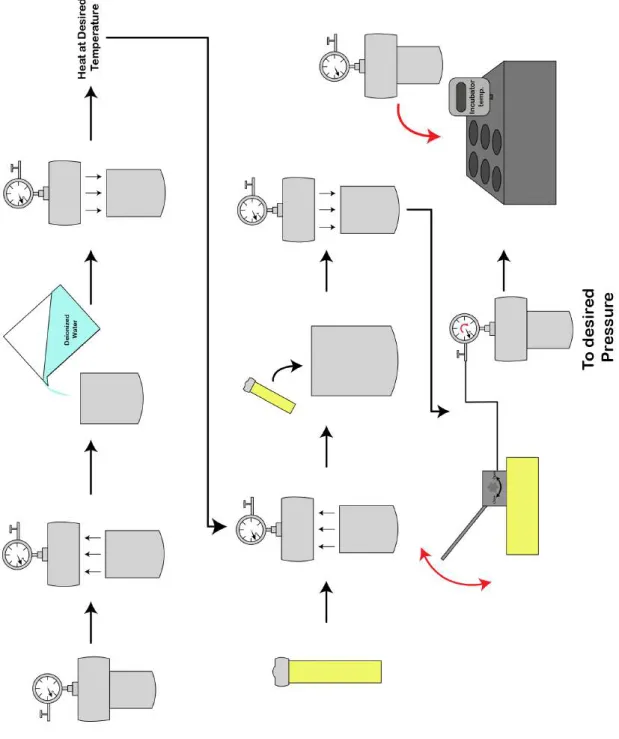
The incubation can be either in an incubator at 1 atm and 50°C or in a reactor that supports pressures to 600 bar. For that, is used the pressure vials (Figure 2.2). The procedure of incubating in these reactors is illustrated in figure 2.3.
2 . 1 . T H E S TA N DA R D M E D I U M A N D M I C R O O R GA N I S M
These tests can be Fe extraction, protein assay, cell counting.
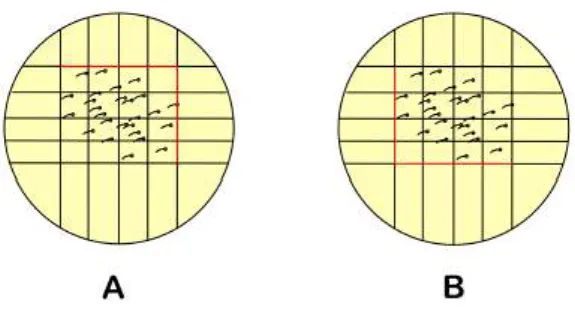
The cell counting can be measured using the microscope or by the Flow Cytometer. Cell counting, by microscope, counts with a chambered microscope slide (hemocytome-ter) and a counter. The cell number that is got over this reading is the average of five of sixteen grids, implemented in the hemocytometer. (Figure 2.4)
Figure 2.4: Microscopic view of bacteria in the hemocytometer
The number of cells that was read, is then calculated through that average times 4 million and the dilution factor, resulting the real cell number.
Average (Cell counted)×4000000× DF=Real N umber of Cells (2.2)
Using this technology, the flow cytometer, a range of measurements are applied on cells, cell organelles, and other objects suspended in a liquid and in a stream at rates equivalent of various thousand per second through a flow chamber. [88] The Figure 2.5 represents how the cell counting is analysed. [88] The process consists is a light beam that reads the number of cells and some other impurities on the sample. [88]
The samples are treated before, to make sure that the reading is effective. Samples
that have Fe particles must be filtered using a 11 µm pore diameter so these particles are retained in it and only the cells pass through. To assure that cells are in suspension, phosphate buffered saline (PBS) is used. This solution is commonly used in biomolecule
research. [89] Consists on a solution of 4% PBS in water, being kept at -20°C. PBS prevents cell activity, immobilizing them.
For fermentation purposes, it was sampled 100 µL from the sampling vials to an Eppendorf with 5 µL of PBS. From there, 10 µL of the first sample were taken to 990 µL of PBS making a 100x dilution. With that, in a microwell plate, 40 µL of the previous sample were taken to be mixed 20 µL, with 179 µL of PBS and 1 µL of syto9 (S9) [90], and 20 µL with 178 µL of PBS, 1 µL of S9 and 1 µL of Propidium iodide (PI) [91]. 10 µL of the samples with Fe were added to a 10 mL of PBS and filtered. From that, 200 µL were taken to a microwell plate, adding S9 as well.
2.2
N. magadiense
’s growth
For this experiment, it was used the standard medium, since the main goal was to check theN. magadiensegrowth.
Since the inoculum did not have iron in the mixture, it was possible to count the cells. Sampling was the only difference between vials.
On a 10 mL volume, which was added to the vial, a percentage of inoculum was added.
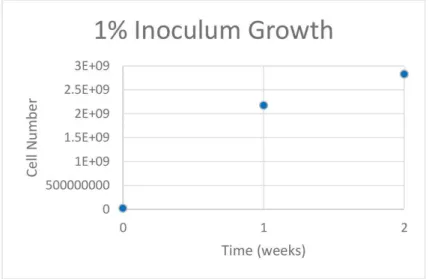
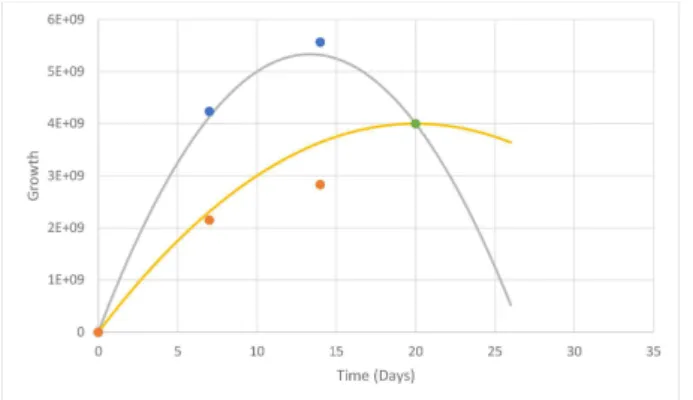
Two tests were made, where one had 1% (0.1 mL) of inoculum and the other 10% (1.0 mL). On both cases, the remaining added volume was standard medium.
The conditions for this experiment were 1 bar, as pressure, 50 ºC, as optimum temper-ature, and pH 10. It was incubated for 2 weeks.
2.3 Replacing a complex carbon source with a simple and
unique one
In this experiment, two carbon screenings were made to see the possibility of a replace-ment between a complex carbon source and a simple and unique one.
Since the objective was to test different carbon sources, the standard medium was
made without the default carbon source (Yeast Extract and NB).
2 . 4 . E F F E C T O F CA R B O N AT E S O N ’ S G R OW T H
Table 2.3: Carbon sources analysed on the first carbon screening
Acetate Pyruvate Citrate Glysine Formate
Cysteine Oxalic Acid Taurine Lysine Butyrate Yeast Extract Creatinine Lactate Glycerol Succinic Acid Propionate Betaine Glutanime Malic Acid Aspartic Acid
The carbon sources were introduced in the sample vial. The sample volume used were 10 mL. This sample had 1% of inoculum (0.1 mL), 0.4 mL of iron, as Ferric Oxide, the carbon source (0.200 g) and the standard medium previously made without the default carbon source.
The second carbon screening had the same procedure, apart of the concentration of carbon source used which, in this case, was 8 g/L. (Table 2.4)
Table 2.4: Carbon sources analysed on the second carbon screening
Acetate Pyruvate Citrate
Cysteine Oxalic Acid Taurine Nutrient Broth Creatinine Lactate
Lactate and Glycerol were only available in liquid phase, so the corresponding volume for 2 g of Lactate and Glycerol was determined. Same applied to the second carbon screening.
2.4 E
ff
ect of carbonates on
N. magadiense
’s growth
On this experiment, it was tested the effect of carbonates inN. magadiensegrowth.
For that, it was reduced the amount of HCO3– present in the medium. Since the objective was to reduce the amount of HCO3–, maintaining the concentration of Na+, seven conditions were studied, where in three of them, it was replaced the anion HCO3– with Cl–. (Table 2.5)
Table 2.5: Sample’s specifications A/D 100% HCO3–
B 10% HCO3– C 1% HCO3–
E 10% HCO3–+ Added NaCl F 1% HCO3–+ Added NaCl G 0% HCO3–+ Added NaCl H 0% HCO3–
In order to do this experiment, seven media were made (100 mL each), taking into consideration the specifications present in table 2.5.
The amount of carbon source, Yeast Extract and NB, used was 1 g/L and 4 g/L, respec-tively.
The conditions for this experiment were 50 ºC, as temperature, pH 10 and, as pressure, 1 bar.
Hence, with a reduction of HCO3–, the pH drops drastically and, in order to maintain the pH at 10, it was used a solution of NaOH. The incubation was for 1 week.
To know the effect of carbonates, iron cannot be added on this test, so it would be
easier the cell counting.
2.5 Cl
–, SO
42 –and PO
43 –with
N. magadiense
The main goal of this experiment was to check the differentN. magadiense growth
be-haviours under different pH values.
It was made the same procedure as in the section 2.4.
Three different media were made, with yeast extract and NB as carbon sources. The
concentrations were the exact same as in section 2.4.
At the end it was tested the number of cells present on each sample using a protein assay instead of cell counting.
2.6 The polyextremophilicity of
N. magadiense
The last test made in this project was the influence of temperature and pressure onN. magadiense.
Since this project was to be applied in oil wells, the pressure values used correspond to the top, middle and bottom. The values used were 1, 150 and 300 bar.
The temperature varied in a interval of -10ºC and +10ºC of 50ºC, the optimum tem-perature for growth. The pH of this experiment was the optimum, 10.
It was used the standard medium and it was sampled to pressure vials, due to a variation of pressures. (Figure 2.2)
These pressure vials have a volume of 4 mL. Then they were introduced on a reactor, as represented on figure 2.3. This experiment had an incubation of 1 week.
2 . 6 . T H E P O LY E X T R E M O P H I L I C I T Y O FN. MAGADIENSE
2.6.1 Design of Experiments (DOE)
DOE is a type of design that compares the behaviour of more than two factors, or param-eters. Hence, it provides enough data to observe changes that might have occurred in one or more characteristics of an experimental unit, the entity that is subjected to certain measurements of one or more characteristics, and to identify the possible causes. The involving factors can be controlled or not, where a controlled factor is a variable that researchers change its values with the intuit of figuring out the effect of one or more
re-sponses. Each factor value is denominated as a level, or treatment, and can be qualitative or quantitative. [92] The effect of a factor is the average change observed on the response
when a factor changes its level. Response stands for the results gotten in an experiment, meaning, it is the characteristic for what researchers are interested in optimizing. [92] Before implement a DOE, it requires a systematic approach so that its application would lead to positive results. This approach, generally, needs to have the following details:
• Constitution of an investigation team;
• A clear definition of the experiment objectives, as a conception of a new product or quality improvement of products that already exist, etc. . .
• Relevant information taken previously like experiments that were made;
• Responses selection, i.e. it is chosen the quality characteristics, as its respective measurement methods;
• Selection of the controllable factors to test as well as its levels and, if it can be executed properly, select the noise factors and respective levels;
• Brief analysis of the possible interactions between factors, knowing that there is at least an interaction between two factors when the effect of one factor in the response
depends on the level of the other factor;
• An identification of which factors will remain constant during the experiment;
• Identifying the experiment restrictions;
• Design the number of experiments that are meant to be made and, based on this decision, the number of factors and levels, plan the experiment using the most appropriate matrix, that is, define the experiment layout;
• Plan how many replicates it is needed to be done;
• Realize all experiments, or trials, randomly.
![Figure 1.1: Microbial crack healing scenario: the bacteria provokes CaCO 3 precipitation while it is immobilized on the concrete adapted from [72]](https://thumb-eu.123doks.com/thumbv2/123dok_br/16496883.733617/31.892.257.622.612.900/figure-microbial-scenario-bacteria-provokes-precipitation-immobilized-concrete.webp)

![Table 1.3: Types of genus in the Natranaerobiacecae family, adapted from [86]](https://thumb-eu.123doks.com/thumbv2/123dok_br/16496883.733617/39.892.129.760.597.879/table-types-genus-natranaerobiacecae-family-adapted.webp)
![Table 1.4: Natranaerobiacecae family species specifications, adapted from [86]](https://thumb-eu.123doks.com/thumbv2/123dok_br/16496883.733617/40.892.129.768.184.560/table-natranaerobiacecae-family-species-specifications-adapted.webp)