A Work Project, presented as part of the requirements for the Award of a Masters Degree in Management from the NOVA – School of Business and Economics.
EVALUATING A CO-CREATION MODEL FOR SOCIAL BUSINESSES: THE CASE OF ‘LINHAS SOBRE RODAS’
BEATRICE ZENONI 839
A Project carried out on the Social Entrepreneurship course, under the supervision of: Professor Miguel Alves Martins
EVALUATING A CO-CREATION MODEL FOR SOCIAL BUSINESSES: THE CASE OF „LINHAS SOBRE RODAS‟
Abstract
The following research is a critical evaluation of „Linhas sobre Rodas‟ co-creation process, since during my internship, from August to November 2012, I had the opportunity of directly and daily collaborate with the entities involved on the operationalization and implementation of this social business. The research analyses the key success factors of the „Linhas sobre Rodas‟ model during its initial stage, focusing on the stakeholders‟ relations and on the strategic alliance between the two co-creators. Through the evaluation of both strengths and weaknesses of this case study, the research provides recommendations and findings for similar cases.
Table of contents
1. „Linhas sobre Rodas‟………...……..4
2. Social business………...………....5 3. Entities involved………...……….6 4. Co-creation model………...8 5. Research question………..9 6. Methodology………11 7. Analysis……….…..12
7.1 Value network creation and stakeholders analysis………12
7.2 SEA and Social Lab strategic alliance………...17
7.2.1 Partner identification……….………..…18
7.2.2 The implementation of the strategic alliance………...19
7.2.3 The future of the alliance………..………..………22
8. Conclusion………...23
8.1 Personal learnings………..23
8.2 Main conclusions……….………..……24
1. „Linhas sobre Rodas‟
„Linhas sobre Rodas‟ – LsR („Threads on Wheels‟) is a social business that provides sewing services with collection and delivery at home/office, in the Lisbon area. The idea of the project was born out of the joint identification of a social problem and a business opportunity:
On the one hand, it has been identified a segment of active professionals that, due to the increasing pressures on family life and free time, are facing difficulties on finding commercial solutions customized to their needs for confection and arrangement of clothes. This target market1usually tends to commute by car, leaving early in the morning and returning at late hours, and does not have many opportunities to access the existent repair shops as the clothing franchising (usually located in shopping malls or in the metro stations), or the small/informal businesses that some seamstresses run from their home. Therefore, the clothes that need to be repaired are accumulated, as there are more urgent needs and priorities in the daily life.
On the other hand, there are in Portugal, especially in some specific areas, many experienced seamstresses that are facing difficult economic situations. Most of them are unemployed or have precarious/informal employments, have difficulties to find costumers and accessing the market. The current economic crisis that forced many shops to close or to become informal has worsened their situation and deteriorated the little purchasing power they had.
Linhas sobre Rodas‟s solution aims to create a connection between supply and demand: the seamstresses are now “on wheels” in the sense that a courier-seamstress moves by
1 The identified LsR target market is constituted by professionally active people, relatively young (25-45
years old), with good income, educated and online savvy, often with children under their care and with little free time for the households tasks, like cleaning, clothing repair, cooking, so they end up hiring someone to take care of it for them.From Linhas sobre Rodas briefing for Eurobest 2012.
motorcycle to the most convenient place for the client, collecting and delivering the service. The seamstresses work from their houses, but now they can reach costumers that before were too “far”. In this way the convenience problem is also solved, since costumers can order online and can choose day/hour and place where is better for them to meet the courier both for the clothes collection and delivery.
The project is at a very early stage of prototyping: it has been set up in the Mouraria hub, and it operates 4 seamstresses and 1 seamstress-courier with 1 motorcycle. The next growth stage should occur only if the prototype proves successful, which means reaching at least 50 clothes repair during a period of 3 months with and average value of 50 euro per repair (collection + delivery + repair itself). In the future LsR is planned to run as a network of hubs, each one employing 10 or more seamstresses and 2 seamstresses-couriers, and an expectation of 150 repairs/month.2
2. Social business
LsR‟ Memorandum of Understanding defines a social business as a “commercial initiative that applies the best management practices for a systematic resolution of social problems, trough the development of projects financially self-sustainable. The social business generates the totality of its revenues in a competitive market, e.g. offering product and/or services based on its merit/utility and not out of charity”.3
According to the literature, a social business is a “new form of business that can be located somewhere between a profit-maximizing and a non-profit organization”4, “an initiative that addressed social needs and/or catalyses social transformation”5: its
2 From Linhas sobre Rodas presentation for Eurobest 2012 and Linhas sobre Rodas financial model. 3
Linhas sobre Rodas Memorandum of Understanding
4 Yunus, Muhammad et al. 2009. Building social business models: a lesson from Grameen experience.
HEC International Business School. Paris. Working Paper – 913. Pg. 311.
5Mair, J. and Marti, I. 2006. “Social entrepreneurship research: a source of explanation, prediction, and delight”, Journal of World Business, Vol. 41 No. 1, Pg. 55.
priority is to solve a social problem6 through innovative and competitive solutions, and therefore create social value (not private value). Unlike most of the third sector entities, however, it does not rely mainly on grants or donations for its survival, but it generates its revenues as traditional businesses and repays its investors of the loans received trough reaching financial sustainability. Revenue generation exists to ensure sustainability and not to maximize investors‟ profit. Thus, a social business “is designed and operated just like a „regular‟ business enterprise, with products, services, customers, markets, expenses and revenues.”7
As a social business, LsR priority is to create jobs for experienced seamstresses in vulnerable situations, which are paid to the highest possible value, retaining just enough margins to cover the costs and to repay the money that was invested in it. LsR has been designed to work as any other business: its services are placed in a competitive market and its customers have chosen them for the value they provide. This gives to the project its “hybrid” social-business status that allows LsR to apply the same know-how of the traditional „for profit‟ management to the resolution of a social problem.8
3. Entities involved
The two entities that are considered “co-creators” of Linhas sobre Rodas are the Social Lab of the EDP Foundation and the Social Entrepreneurs Agency – SEA.
The Social Lab is a “factory of social businesses”, a project born out and supported by the EDP Foundation, whose mission is to “design, test and implement social businesses - that have to be innovative, impactful and replicable - and then pass them on to other
6 See Annex I
7 Yunus, Muhammad et al. 2009. Building social business models: a lesson from Grameen experience.
HEC International Business School. Paris. Working Paper – 913. Pg. 311.
8
organizations with the right skill to operate and manage them.”9
A small team of entrepreneurs, thus, aims to implement social businesses not with the intent of being in the future managed by the EDP Foundation, but by partners carefully chosen for this purpose. In this context, the SEA agency10 is the partner that has been invited to incubate, implement and operationalize the venture. This entity is a cooperative of entrepreneurs founded in 2007. Its mission is to implement social entrepreneurial projects, which can contribute to a social, economic, cultural and environmental sustainability and promote a local and integrated development. Its main activities involve supporting micro-entrepreneurial initiatives, helping job searches and promote social entrepreneurial solutions to local problems.11
While the original idea of LsR came from the Social Lab, both the two entities are co-creators and co-managers of LsR, with different roles and future expectations: as the project will reach its mature phase, the objective is to progressively reduce the Social Lab involvement and allow the SEA to manage it autonomously. For this reason, Linhas sobre Rodas has no legal entity of its own, but it‟s one of the projects run by the SEA agency.
Linhas sobre Rodas, as any other business, requires capital to be implemented. In August 2012 a pitch was made to a group of potential investors demanding the minimum financial investment to cover the estimated costs of the three months pilot (November 2012 to January 2013). 50% of the funding came from the Calouste Gulbenkian Foundation12, a charitable foundation set up in 1956 as a private institution of public
9 From Social Lab‟s presentation for the Nova Summer School of July 2012. 10http://www.seagency.org/
11http://www.seagency.org/frames/Missao.php 12
utility. 30% was invested by the Luso-American Foundation13, a private and financially independent Portuguese institution. Moreover, a private business angel, who prefers to remain anonymous, decided to contribute, with the intent of encouraging private engagement in social businesses and promoting an “investment” perspective and not a “donative” one. The total value invested was equal to 5.000 €, which assured the financial viability of the pilot.
The project could also rely on the support of several partners and volunteers from the public sector, the private and the third one14. LsR value network will be analysed in more details later on.
4. Co-creation model
LsR was implemented in partnership with shared responsibility between two entities: the Social Lab of Edp Foundation and the SEA agency. While the Social Lab was the original author of LsR idea, its intent is to work as a “factory” of social business and thus it was important to search for an entity with the right skills needed to implement and manage this business for its future life cycle. The SEA agency was identified as this entity, being a third sector entity where different expertise is combined. Therefore, Social Lab invited the SEA Agency to become the “host” and “owner” of Linhas sobre Rodas: the two entities have been equally involved in its creation and co-implementation, but the objective is for the Social Lab to progressively reduce its involvement as the project reaches a stable operating stage, and the SEA to become its sole and fully autonomous managing entity.15
A Memorandum of Understanding (MoU) was proposed and approved by the parties involved, e.g. the two co-creators and the investors. This multilateral agreement is a
13http://www.flad.pt/ 14 See Annex II 15
declaration of the engagement based on mutual trust where the different roles, the purpose and the general responsibilities are defined. Linhas sobre Rodas‟ first MoU is valid for the whole pilot stage and states:
- The EDP Foundation, through the project Social Lab, is responsible for the social business strategic co-management, for the supervision of the process and for the evaluation of the social impact. It will support the SEA agency through the entire pilot phase and will gradually reduce its role until a point where the project will be completely autonomous. This point has to be defined by the entities involved in a second phase.
- The SEA agency is responsible for the implementation, operational management and strategic co-management of the social business. Moreover, is responsible for reporting to the parties and monitoring the project.
- Monthly meetings with the social business angels have to be scheduled, in order to report the state of the work, promote the participation of the different parties involved and assuring that the strategic decisions are taken accordingly.
- The resources invested in the prototype are transferred as a subsidy to the SEA agency, and, due to the experimental and short-term nature of this phase, will be entirely used to cover the costs. The reimbursement of the money invested is, thus, conditioned to the existence of a second round investment and the implementation of the complete version of the project.
5. Research question
As presented in the first section, Linhas sobre Rodas represents a case of social business in its very early stage, which has been set up in co-creation between two entities.
The particular partnership structure of LsR leads the research to focus on the dynamics of the collaboration between the two co-creators and how they influenced the project during its initial stage, e.g. during the phases of business planning, design and pilot implementation. The partnership relation between the Social Lab and the SEA agency can be considered as a „strategic alliance‟, defined as a “mutually beneficial and well-defined relationship entered into by two or more organizations to achieve jointly well-defined common goals.”16
According to the literature, the main advantage of collaborative agreements lies in the pooling of resources and knowledge leveraged by the partners17, which may in turn lead to the development of a broader portfolio of resources for firms in the network.18 There are two main risks that can affect the success of a strategic alliance: the relational risk and the performance one. While the first is “concerned with the probability that the partner does not comply with the spirit of cooperation, the second refers to the probability that intended strategic goals of an alliance may not be achieved, even though cooperation between the partners is satisfactory.”19
Moreover, in the social businesses‟ model stakeholders (costumers, target group, social investors, partners, volunteers, etc.) replace shareholders as the focus of value maximization, and the development of a specific value network that facilitate the
16
Mattessich, Paul, W. et al. 2001. Collaboration: What Makes It Work (2nd ed.). St. Paul: Wilder Publishing Center.
17 Gulati, R. 1998. Alliances and networks, Strategic Management Journal, 19(4), 293‐318
18 Yunus, Muhammad et al. 2009. Building social business models: a lesson from Grameen experience.
HEC International Business School. Paris. Working Paper – 913.
19 T.K. Das, et al. 2001. A risk perception model of alliance structuring. Journal of International Management 7 (2001), 1±29
creation of social value from the very early stage is a key factor for social business success.20
The research conducted on this case study aims to evaluate and systematize the key factors and lesson learnt during the initial phases of the project, focusing in particular on the analysis of LsR strategic value network and on the partnership relation between the two co-creators.
Thus, the research question that has been developed is:
What are the key success factors of Linhas sobre Rodas co-creation process during the initial stage?
The research aims to give insights and findings towards the case analysed and stimulate improvements for other similar cases, as well as serve as bases for further researches.
6. Methodology
I started my internship in August 2012, when the Social Lab had just made the first round of investment and the SEA agency had just agreed to co-manage the project. Thus, I had the opportunity during these months to directly observe and participate to the creation of a real collaborative partnership between the two entities, while the project‟s prototype has been implemented.
My analysis is, thus, an exploratory research based on the daily collaboration during the initial stage of the project and critical observation of the relations between the co-creators and the main stakeholders involved, followed by a systematization of the data obtained, and a comparison with the literature review on the main topics, as well as with my previous knowledge from the Social Entrepreneurship course.
20Mair, J. and Marti, I. 2006. “Social entrepreneurship research: a source of explanation, prediction, and
7. Analysis
7.1 Value network creation and stakeholders analysis
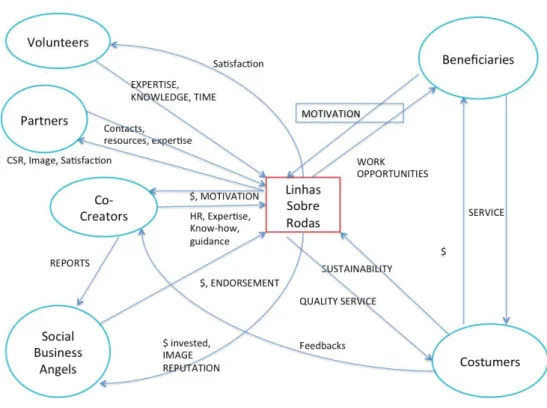
The creation of a strategic value network constitutes a competitive advantage for any social business in order to achieve its social and financial goals, assuring that each activity planned can be provided by a specific link in the network and leveraging expertise and resources by creating collaborations and partnerships. “Each single part in the social value network plays a specific role in the creation of social value for the target group”21
, and the relationships built from the very early stage with each stakeholder are determinant on the success of the process.
Figure I: 'Linhas sobre Rodas' value network
Source: Elaboration of the author
21Mair, Johanna and Schoen, Oliver. 2007. "Successful social entrepreneurial business models in the
context of developing economies: An explorative study", International Journal of Emerging Markets, Vol. 2 Iss: 1, pp.54 - 68
As shown by the value network map of Linhas sobre Rodas, each stakeholder provides a specific value to the project and has specific return expectations. Most of the key players were defined before the implementation of the project, as a prerequisite of the same, while some of them were introduced afterwards, due to the realization that a particular activity was missing.
- Social business angels: The nature of transactions in a social business differs both from the private and the third sector: the investors are not considered shareholders of the company, and do not expect to receive future profits in the form of dividends, but at the same time the capital invested is not a grant or donation since is planned to give it back. The Gulbenkian Foundation and the Luso-American Foundation, as third sector organizations, have a core social strategy that is aligned with LsR social mission. The framework in which the project has been founded (people and entities that were already involved, such as the EDP Foundation) has played a strategic role in facilitating the access of the funding network and in achieving the support of such important and respectable organizations. The non-financial returns that they expect from the project involve mainly their image, as the success of this project will have a direct relation with the reputation of the entities that are behind it. Thus, it‟s their interest to support the project, not just financially, but also sharing knowledge, contacts, giving advises and using their channels to promote it.
At the same time attention has to be given also to the more formal aspects of their support, which means that each document, external communication and promotion event should include the name/brand of the investors‟ entities and should be coherent with their image and policies.
During the monthly meeting between the co-creators and the social business angels importance was given not just to report the state of work and the financial expenses incurred, but also to the participation and the engagement of the investors, due to several reasons: first of all, as already mentioned, there will be another round of investment and the current investors will have the priority of contribution, so make them feel part of the project is strategic to obtain future support. Additionally, partnering with these organizations means also accessing their expertise, network and marketing channels, which are as important as the funds received, and this was particularly clear during the promotion phase. It‟s also a crucial moment for the team to assess what has been already achieved and what still has to be done.
- Partners and Volunteers: Since during the pilot stage the business has to be set up with a minimum amount of resources (financial and human), the role of volunteers and partners that offer pro-bono their skills, expertise and network for this social project is fundamental. Besides the personal contacts and networks of the people involved in the project, the social nature of LsR made the difference in assuring the support of several entities that offered their expertise pro-bono, in order to obtain image returns (in a corporate social responsibility‟s perspective) or just to support a social project considered innovative and worth-while. Regarding the support from the private sector, for example, an important law firm like Viera de Almeida22, that already collaborated with the Social Lab for other projects, offered its consultancy pro-bono in order to set up the legal structure of the project and aloud it to operate according to the law. Also the public sector, through the Municipality of Lisbon and other local entities, was crucial to the development of LsR, trough the concession of the office space and the
support in the identification and interaction with the target beneficiaries. Finally, a group of students from the Nova School of Business and Economics, who founded a consultancy firm, Nova Junior Enterprise, collaborated in designing the business plan of LsR, its processes and management tools.
The role of the volunteers is also strategic, especially for a project that aims to be replicated and scalable in the future. For the volunteers the main value return is satisfaction for supporting a social cause. In order to maintain this motivation through time, it‟s important to find another way to reward them, as through participation or sharing the results achieved. A possible critical factor can result when volunteers (unpaid workers) are directly working with the members of the team (paid workers), due to the different expectations, working times, deadlines and pressures of these different actors.
For example, the responsible of LsR‟s website development was a professional that was working pro-bono for the project during its spare time (nights/week-ends). While it was not fair to put too much pressure or demanding too much to a person that was actually supporting the project as a volunteer, at the same time respecting the deadline for the website‟s launch was fundamental, since the entire communication plan was reliant on it. Thus, the division of responsibilities and timelines has to be clear from the beginning. In my opinion, moreover, a crucial activity in the process cannot be outsourced entirely to volunteer resources, due to the different nature of relationships with the project.
- Beneficiaries: According to the LsR social mission, the seamstresses are the main
beneficiaries, and the success of the project will be determined if they will improve effectively their financial and social condition. One of the main issue regarding social
projects is the difficulty in assessing the „Social Return on Investment' (SROI), e.g. the value created beyond financial terms. In the case of LsR, however, any additional revenue of the project (in terms of works done) represents additional revenue for the beneficiaries of the same, and thus, the social value created is directly related to the financial value achieved. Moreover, besides the changes in the income received by the seamstresses, other non-financial categories are taken into account, e.g. the level of satisfaction towards their professional life, towards their life in general and the “empowerment” created by participating in the project. These categories are clearly more difficult to measure, however, personal interviews, surveys and group meetings have been performed regularly, in order integrate the beneficiaries in the value creation process and make them feel not just receptors but creators of their own destiny.
It‟s important to regularly assess, however, the level of engagement and motivation of each beneficiary, especially because Linhas sobre Rodas is designed to provide a complementary income, meaning that the seamstresses may have another regular job or may be looking for it, and as their financial situation changes, their motivation can also change, affecting their accountability. In order to avoid this issue the communication channel has to remain transparent, since the priority is to improve the beneficiaries‟ life and not just the project success.
In conclusion, during the design stage of this social entrepreneurial project it has been important to carefully plan the resources required and assure the creation of linked entities and people that shared the project‟s social mission and were available and motivated to support it. The funds provided by the social business angels were able to cover the main costs necessary to the project‟s implementation, but the real competitive
advantage was achieved by the creation of a network that could fulfil the missing activities and open new channels and opportunities. At the same time the target group (beneficiaries) was integrated and engaged in the business design from the very early stage, as the seamstresses were considered not just receptors, but co-responsible for the outcome of the social business.
7.2 SEA and Social Lab Strategic Alliance
The partnership relation between the Social Lab and the SEA Agency is a voluntary mutual agreement between two entities in order to share accountability towards a specific project, where the main purpose is to pool resources (both tangible and intangible) and join efforts in order to implement a successful social business. The alliance does not involve other projects that are being implemented by Social Lab or SEA nor the totality of the members of the two organizations, but just a selected team.
Figure II: SEA and Social Lab involvement through LsR phases
Source: Social Lab‟s presentation for the first round investment
The members of the partnership remain equal and autonomous and there’s no legal agreement signed, but a Memorandum of Understanding based on trust and
responsibility of the parties. The duration of this collaboration is not defined, being relative to the project life cycle, but it will have a termination point that will be jointly defined. The figure II shows the planned involvement of each partner during the different phases of the project, in accordance with the co-creation model. The phases considered in this analysis, besides the process of partner identification, are the business sketching and the prototyping.
7.2.1 Partner identification
Choosing the right partner for the project is a key issue, especially because the purpose is to let him the future management and the full ownership of the same. The major issue regarding this choice involves the definition of which skills are required, which ones are already available and which ones are likely to be needed from the partner entity. Moreover, the members of the two organizations have to make a team that strategically works together to achieve the best possible outcome; differences in their cultures, work environments and engagement towards the project can negatively affect this outcome. Given the nature of this social business, the Social Lab was looking for an entity that could “think like a business and act like an NGO”, combining the social purpose of the LsR with entrepreneurial skills and commercial mindset. The SEA agency, which showed motivation and interest for a real engagement in the project, was identified as this entity, which strengths were:
Strong entrepreneurial orientation
Management skills combined with social sector know-how Presence on the territory (Mouraria) and link with local actors Experience with social entrepreneurial initiatives
Strong motivation Social mission shared
Both entities were familiar with the concept of social business and had experience with the implementation of similar projects, so it was quite easy align their goals, vision and strategies. At the same time none of them had professional knowledge of the sewing market or particular experience with the target audience of LsR.
7.2.2 The Implementation of the Strategic Alliance
The intention of collaboration between the two entities was declared before the investment pitch of August 2012, but it became formal with the confirmation of the viability of the pilot. The decision of separating those who manage the project from those who have invested in it (co-creators vs. social investors) was dictated by several reasons:
- The choice of not to ask the EDP foundation to contribute to the investment was to diversify the sources, to widen the network of organizations involved and to promote the culture of “investment” in social businesses. Moreover, as the Social Lab “factory” is financed and supported by the foundation, maintaining the two funding channels separated was considered a way to reduce potential conflicts of interest. - The SEA agency is a small and quite recent organization which does not have its
own capital to invest, but it works implementing projects externally financed;
Thus, LsR pilot was designed to be set up and tested with just the external financial resources obtained, so that the project could be financially autonomous. In practice, however, during the implementation process some secondary but necessary expenses that were not included in the financial model emerged (such as office materials, the mobile phone used by the operational manager or the Windows licences) and it was necessary to either provided itself or find a way to obtain through partnerships or donations.
The Social Lab, as author of the Lsr‟s idea, started as “leader” during the phase of business planning, since it was already working at full speed on the operating model design when the SEA agency joined the venture. Thus, as the meetings between the co-creators began to be scheduled regularly, it was important to make the SEA agency feel equally part of the process, dividing responsibilities and promoting a collaborative environment.
The firsts issues to tackle, in order to make the alliance effective and proceed on the business implementation, was to create a unique team from two different entities, create common spaces and times to work together, divide roles and responsibilities and decide the degree of the collaboration.
Figure III: Linhas sobre Rodas macro workplan
Source: Elaboration of the author based on Linhas sobre Rodas internal documentation
The competencies needed for the “business sketching” phase, which were allocated mainly from the Social Lab as main responsible at this stage, required to design the
entire LsR business model: perform an audit analysis, define the processes, the cost structure, build the stakeholders‟ relations, prepare the tools and the management database needed for the actual business implementation, etc. At the same time, as the management and financial structures of the business were being defined, it became important to set up LsR communication and promotion strategy, as well as its image and social identity, and here is where the SEA agency played a strategic role.
During the whole process, however, it became fundamental to make it clear what was being done and by whom, because if not clearly defined it could have been delayed or neglected, and thus it could have caused some misunderstandings inside the team. A particularly useful tools, in order to have a complete vision of the work, were the “check out” and “check in” e-mails sent every Friday night and Monday morning to all the members of the team, with a list of who has done what, who has to do what and which are the deadlines.
According to the partnership agreement, the project‟s funds cover for LsR‟s operational manager, who has been employed full time as the pilot launch was approaching (November), and a supervisor from the SEA agency who dedicates 20% of her work time to this project. However, during the whole phase of business planning, the human resources‟ involvement required to the SEA agency turned to be more than what expected (as declared by the team members): while a human resource from the Social Lab was full-time allocated to the project, and had consequently a different “speed of work”, the members of the SEA agency had to divide their time and availability with the other activities of the organization.
What happened, moreover, was that there was a fringe category of SEA resources that were paid by the agency but formally they were not allocated to LsR. However their
skills and competencies were needed during the phase of operationalization and implementation (as for example the graphic designer), but their collaboration and time (time that they are subtracting to other SEA‟s project) were not included in the initial agreement. Thus, it became clear that the commitment required was more than what expected, in terms of human resources, quantity of work and deadlines scheduling. This issue however ended up not being a critical factor, but it can create some pressures in the future if not better defined. It also depends on the actors involved, as another entity can have different work flexibility, and can demand a more strict division and allocation of human resources and time.
During the prototyping phase an additional human resource of the SEA agency was employed to manage the operating daily life of this social business and the engagement required to the Social Lab started to decrease progressively.
7.2.3 The alliance‟s future
According to the co-creation model of Linhas sobre Rodas, the partnership between Social Lab and SEA agency will terminate when the project will reach its mature stage, so that the SEA will be able to autonomously manage it. This means that the partnership has a termination point, but at the same time it‟s not a precise date, it can vary according to the parties and to the project‟s outcomes (it‟s forecasted to be in two years, but it‟s just an approximation). This can affect the success of the alliance in two different ways: - First, the SEA agency can demand stronger “power” towards the main decisions or in
the case of collisions inside the team, being the one that will be responsible for the future management of the project. This hasn‟t happened during the implementation phase, because the two organizations were considered equal and they equally participate in the main decisions, but it can be a challenge to face when the Social
Lab will progressively reduce its involvement in the project. There‟s the possibility that the Social Lab will be considered as a strategic consultant. After the pilot phase, another Memorandum of Understanding will be redacted, and it‟s my opinion that at this point the definition of an exit strategy and the future roles of each co-creator will have to be clearly defined.
- The second challenge to face is if the SEA agency will be able to manage alone the social business, since the cooperation between the two entities has caused a dependency relation towards the project. During the phase of business design the outcomes achieved could not have been possible without the participation of all parties involved, and the future exit of one of the two co-creators, even if predicted, can be determinant on the project. At the same time the strategic alliance has been based on the clear communication and transparency between the partners that allowed the share of expertise, contacts and know-how.
8. Conclusion
8.1 Personal learnings
The internship made during the implementation of LsR has been a unique opportunity to transpose from theory to practice the knowledge that I had acquired from previous studies and courses, as well as to challenge myself with new situations and develop new skills. Setting up a social entrepreneurial business in three months requires first of all learning how to carefully plan and define each activity, process and procedure, but it also requires learning how to think outside the box in order to face what was not been planned.
Since the first day it became clear that being confident with the Excel program constitutes a competitive advantage in the everyday life of a social entrepreneur, but at
the same time I had to face less “academic” and really different challenges, from designing a flyer to making personal interviews to the seamstresses.
Thus, the main learning that I bring from this experience is the importance of developing a “problem-solving” approach, being flexible and self-confident in different situations. A social entrepreneur has to be a manager, a financial planner, but also a marketeer, a communicator, a designer, etc.
Related with this issue is the importance of efficiently communicate and develop interpersonal skills, which sometimes has been a tough challenge for me, since Portuguese is not my first language and I realized that I did not had the same confidence of communication in every situation, especially in those situations where the way you say things really makes the difference (during the interviews for example). Another main learning is the importance of networking: many solutions to the everyday challenges during the project‟s implementation came from knowing the right person that could help or give an advise.
8.2 Main conclusions
As enlightened in the analysis, one of the factor considered determinant for the success of the project during its initial stage is sharing the project‟s social mission inside the value network, partner with organizations that consider it as a priority and create a collaborative internal environment. The social nature of the project, combined with the innovation of the idea and the trustfulness of the people and entities behind it, allowed the mobilization of resources and the involvement of volunteers that made the same possible.
Moreover, the strategic alliance between Social Lab and the SEA agency allowed the project to benefit from a broader variety of networks, resources and knowledge that were
strategically combined, and the outcome, even though the project is still in an early phase, is surely positive. Even though none of the partners had previous experience in the sewing market and the business implementation required the acquisition of new knowledge in a short period of time, the problem-solving approach and the cooperation between the co-creators allowed to best respond to every challenge. The key factors that influenced the success of the process, thus, were mostly related to the human resources involved, to their skills and attitudes, than to the type of entities they belong to.
Recommendations for improvements in the co-creation process mainly involve the better definition of the engagement required to the partner organizations, especially during the pre-pilot phase, where the two co-creators have to design the entire business model, processes and procedures in a very short time. Since the chosen partner will have the entire ownership of the social business, its involvement is required in this initial stage where the main decisions towards the business are taken, and its allocation of time and human resources has to be clearly pre-defined.
Neither the relational risk nor the performance one have affected the strategic alliance, since the co-creators have succeeded in creating a collaborative internal environment that allowed the social business to be externally competitive.
ANNEXES
Annex I: Social business vs. Profit maximizing business and not-for-profit organizations
Source: Building social business models: a lesson from Grameen experience. Muhammad Yunus, Bertrand Moingeon, and Laurence Lehmann-Ortega. HEC International Business School. Paris. February
2009. Working Paper – 913. Pg. 23
Annex II: Linhas sobre Rodas‟ main partners
Source: Elaboration of the author based on http://www.linhas.pt/index.php/quem-somos-mm/entidades-mm