INTRODUCTION
Temperature influences metabolism and growth in poikilotherms (Clarke & Johnston 1999) and is con-sidered a key factor shaping the ecophysiology and life history strategy of fish (Pörtner & Peck 2010).
Temperature plays a particularly important role dur-ing the early life of marine fish by influencdur-ing rates of metabolism, growth and mortality of marine fish lar-vae (Houde 1989, Blaxter 1991). The ability of a spe-cies, a population or an individual to persist over a range of temperatures is limited by the thermal adap-© The authors 2016. Open Access under Creative Commons by Attribution Licence. Use, distribution and reproduction are un -restricted. Authors and original publication must be credited. Publisher: Inter-Research · www.int-res.com
*Corresponding author: [email protected]
Effect of temperature on the growth, survival,
development and foraging behaviour of
Sardina pilchardus larvae
S. Garrido
1, 2,*, A. Cristóvão
2, C. Caldeira
2, R. Ben-Hamadou
3, N. Baylina
4,
H. Batista
4, E. Saiz
5, M. A. Peck
6, P. Ré
2, A. M. P. Santos
1, 71Instituto Português do Mar e da Atmosfera, Av. Brasília s/n, 1449-006 Lisboa, Portugal
2Marine and Environmental Sciences Centre, Faculdade de Ciências, Universidade de Lisboa, Campo Grande, 1749-016 Lisboa, Portugal
3Department of Biological and Environmental Sciences, College of Arts and Sciences, Qatar University, PO Box 2713, Doha, Qatar 4Oceanário de Lisboa, Esplanada D Carlos I, 1900-005 Lisbon, Portugal
5Institut de Ciències del Mar – CSIC, Ps. Marítim de la Barceloneta 37-49, 08003 Barcelona, Spain
6Institute for Hydrobiology and Fisheries Science, University of Hamburg, Olbersweg 24, 22767 Hamburg, Germany 7CCMAR, Centro de Ciencias do Mar, Universidade do Algarve, Campus de Gambelas, 8005-139 Faro, Portugal
ABSTRACT: The effect of water temperature on the growth, survival, development and foraging behaviour of European sardine Sardina pilchardus larvae was examined in the laboratory. First, the capability of early sardine larvae to cope with starvation was assessed at temperatures from 10 to 22°C. Second, we examined under ad libitum feeding conditions and across the range of tem-peratures experienced by sardines during spawning along the Atlanto-Iberian coast (13−17°C) the ontogenetic changes in growth, survival and foraging behaviour of sardine larvae. Unfed larvae had similar maximum survival times (11−12 d post hatching, dph) from 13 to 15°C, but the survival time was significantly shorter at the coldest and warmest temperatures tested. The survival of exogenously feeding larvae increased with temperature, but younger endogenously feeding lar-vae had higher survival at colder temperatures. The cumulative mortality after 25 dph, however, was similar at the 3 temperatures. Not only larval growth rate increased with increasing tempera-ture, but ontogenetic development also occurred sooner and at smaller sizes. Notochord flexion, which is a developmental milestone for fish, occurred 10 d earlier at 17 rather than at 13°C. The time spent swimming and the foraging behaviour (orientations to prey, feeding strikes and suc-cessful capture) significantly increased throughout the ontogeny and with temperature. This study highlights how even modest changes in spawning temperature can lead to large changes in the survival and growth of larval sardine. This study also reveals some of the mechanisms whereby inter-annual and seasonal variability in temperature can have significant ecological impacts at the population level.
KEY WORDS: Sardina pilchardus · Growth rate · Pelagic fish · Mortality · Foraging behaviour
O
PEN
PEN
tive capacity of biochemical, cellular and organismal processes which constrains the geographic distribu-tion of stocks and influences inter-annual variability in survival (Jordaan & Kling 2003) and also by the severity of climate impacts (Rijnsdorp et al. 2009). Even within the limits of thermal tolerance, subtle changes in temperature experienced by early larvae cannot only influence survival by altering physiolog-ical rates and behaviour but can also influence the performance of survivors later in life (Johnston et al. 2001, Koumoundouros et al. 2009, Moyano et al. 2016). Discriminating the relative contribution of genetic versus environmental factors to the variation in larval performance is necessary if we hope to provide robust predictions of the effects of climate change on fish stocks (Jordaan & Kling 2003, Dahlke et al. 2016).
The European sardine Sardina pilchardus is dis-tributed along the eastern North Atlantic coast, from Iceland and the North Sea to Senegal and the Medi-terranean Sea (Whitehead et al. 1985). One of the main areas of sardine spawning in the northeast At -lantic is the Iberian Peninsula, where sardine larvae often dominate the ichthyoplankton community (Garrido et al. 2009). Due to persistently low recruit-ment since 2006, the size of the Iberian sardine stock has substantially decreased, reaching historical min-imum values in 2012−2013 (ICES 2014). The de crease in recruitment of European sardines is thought to be directly related to increasing water temperature ob -served in recent years in the Western Iberian Up -welling Ecosystem (ranging from 0.02 to 0.03°C yr−1
since 1985) (Relvas et al. 2009). Field surveys in that region report the highest occurrence of spawning at 14 to 15°C with little or no spawning at water temp -eratures colder than 12°C and warmer than 16°C (Stratoudakis et al. 2007, Peck et al. 2013). The size-at-maturation is generally smaller in sardines from warmer waters and, likely for this reason, length-at-maturation has decreased and the spawning period has increased in western Iberian waters during the last 2 decades (Silva et al. 2006). In order to under-stand the modifications in sardine spawning and development, it is essential to know the underlying physiological and behavioural responses of individ-ual larvae at different temperatures.
Laboratory studies can serve to simplify some of the interactions of inherently complex natural sys-tems by removing factors that confound temperature effects, such as food limitation (Jordaan & Kling 2003). To our best knowledge, there are no previous laboratory studies examining ontogenetic changes and/or the effect of temperature on survival, growth and behaviour of exogenously feeding European
sar-dine, with all previous studies restricted to either embryos or unfed larvae (Blaxter 1969, Miranda et al. 1990, Bernal et al. 2008). The present study investi-gated the effect of temperature on the growth, sur-vival and foraging behaviour of European sardine larvae. First, the capacity of larvae to withstand star-vation as a function of temperature was assessed. Second, the effect of temperature on growth, mortal-ity and foraging behaviour was studied for larvae reared with excess food across at a range of temper-atures encompassing the vast majority (95%) of those associated with sardine spawning in Atlanto-Iberian waters (Coombs et al. 2006). This study examines the effect of temperature on growth, mortality and forag-ing behaviour of European sardine larvae under con-trolled laboratory conditions, and our results are dis-cussed in relation to patterns derived from the field.
MATERIALS AND METHODS Larval rearing and growth experiments Sardine larvae were hatched from eggs spawned by broodstock European sardines Sardina pilchardus maintained in a 15 000 l cylindrical tank at the Oceanário de Lisboa. Fish were originally captured in 2009 and 2010 by purse seine in coastal waters off Peniche (western Portugal). Adult fish started spawn-ing naturally after adjustspawn-ing the temperature (15°C) to natural conditions and increasing the light regime (16 h light:8 h dark) to the maximum number of day-light hours occurring in western Iberia. The eggs were collected daily in the morning from the brood-stock using 500 µm mesh egg collector bags placed in the skimmers of the tank. At that time, most eggs were found halfway through egg development (Stage V, Gamulin & Hure 1955). A total of 2000 viable eggs was placed into 5 l glass beakers containing gently aer-ated water from the broodstock tank. Over the next 1 to 2 h, the temperature was slowly adjusted to 17, 15 or 13°C. Finally, eggs were gently transferred to 30 l cylindrical tanks filled with seawater of salinity 35 at their rearing temperature. Eggs were incubated using a 16 h light:8 h dark light regime and gentle aeration to mix the water and maintain a high oxygen concentration. Surface light levels were kept at 55 to 58 µmol s−1 m−2(Philips Master TL-D Super 80 58W
fluorescent lamp).
Growth experiments consisted of transferring batches of ca. 2000 sardine eggs to the mentioned 30 l tanks and rearing the embryos and larvae either unfed or fed a mixed diet of
dinoflagel-lates Gymnodinium sp., rotifers Brachionus sp. and nauplii, copepodites and adults of the copepod Para
-cartia grani. Details of the feeding conditions, which
translate into saturated feeding and growth rates of sardine larvae, can be found in Silva et al. (2014) and Caldeira et al. (2014). Each morning, after checking the food concentration in the tanks, 20 to 30% of the tank water was renewed by syphoning the bottom of the tank, and new food was added to obtain the pre-established food concentration. Every other day pH, ammonia and oxygen were measured (Hanna Instru-ments 9828) to confirm that high water quality was maintained throughout the experiment. In the starva-tion experiment, 5 different temperatures were tested (10, 13, 15, 17, and 22°C ± 0.4°C). Experiments using fed larvae were conducted at 13, 15 and 17°C, which correspond to the coldest, peak and warmest temper-atures, respectively, measured during peak spawning by sardines in Iberian waters (Coombs et al. 2006).
Throughout the experiment, groups of larvae were randomly sampled from experimental tanks and rap-idly anesthetized with MS-222 to determine their size (total length, TL) under a stereomicroscope (± 0.05 mm accuracy) and posteriorly preserved in formaldehyde. When embryos were found to be in an advanced developmental stage (Stage X; Gamulin & Hure 1955), tanks were inspected frequently to determine the time when 50% of the larvae hatched. Larval size was de termined at the time when ∼50% of the larvae had hatched. Given that at the temperatures tested the hatching period can last up to 10 h (Bernal et al. 2008), larval size-at-hatch would be temperature-dependently overestimated, and for that reason lar-val size at the day of hatching was not formally com-pared between temperatures. Larvae were sampled from each tank each day until death in the case of unfed larvae. In the case of fed larvae, samples were taken until 50 d post-hatching (dph) at 15 and 17°C and at 25 dph at 13°C, where technical problems did not allow measurements beyond that age due to acci-dental loss of larvae. Mean larval TL for fed larvae was determined from measurements made on 20 (at hatching), ≥10 (3 to 15 dph) and 5−10 (≥16 dph) indi-viduals. Measurements of sardine larvae were made at 0, 3, and 5 dph and then every 5 d until the end of the experiment. Every day, the bottom of each tank was syphoned, and dead larvae were counted to determine age-specific survival rates.
Sardine larvae preserved in formaldehyde were digitally photographed under a stereoscope (Leica S8 APO, zoom 8:1 with a Canon EOS SLR550 camera), and the development of important ontogenetic traits of fish larvae, such as fin formation and notochord
flexion, were registered for larvae reared at each of the 3 temperatures.
Foraging behaviour
The behaviour of fed larvae was observed at 3 tem-peratures (13, 15 and 17°C). Every day and for each temperature treatment, randomly selected larvae (≥20 observations) were individually followed and their behaviour registered for a 1 min interval (focal-animal technique, Martin & Bateson 1993). During observations, water mixing was stopped by removing the aeration so that individual larvae could be fol-lowed in the absence of turbulence which may affect larval behaviour. The time spent swimming by the larvae during the 1 min observation period (locomo-tory model action pattern), as an indicator of foraging effort, was logged. The foraging MAPs recorded, adapted from Barlow (1968), included the occurrence of orientations (also termed fixations or s-shape posi-tions when detecting a prey) and the frequency of lunges or attacks on prey; given that not all orienta-tions resulted in successful attacks, the percentage of complete feeding sequences with respect to the total number of orientations was also estimated. At 15 and 17°C, behavioural observations were made until the larvae were 50 and 25 dph at 13°C.
Data analysis
For fed larvae from 3 to 25 dph at each of the 3 temp erature treatments, growth rate was assessed from the exponential fit of TL (in mm) and age data using the equation:
(1) where L0 is length at 3 dph, k is the instantaneous
growth rate and t is age in dph. In the case of larvae reared until 50 dph at 15 and 17°C, data were ad -justed from 3 to 50 dph to a Laird-Gompertz growth curve by an iterative nonlinear regression routine:
(2) where A0is the growth rate at time 0, and α is the rate
of exponential decay.
To compare the relationship between size and age between larvae reared at different temperatures from age 3 to age 25 dph (common range in ages between the 3 temperatures), first generalized linear models (GLMs) with an identity link were used to as
-L kt TL= 0e L A t TL 0e 1 e 0 =
( )
α (− −α)sess if the interactions of age and temperature were significant. When the interaction term was signifi-cant, pairwise comparisons of slopes were conducted using an ANCOVA model. When the differences between the slopes were significant, the regression was repeated excluding the interaction term. When the differences between the slopes were not signifi-cant, a new regression model excluding the inter -action term was fitted, and both regression models (with and without the interaction model) were com-pared using ANOVA, and then the most parsimonious model was selected. Growth rates of 3 to 50 dph larvae reared at 15 and 17°C and fitted to Laird- Gompertz growth curves were compared by using the method to compare non-linear models described in Chen et al. (1992).
Cumulative survival rates of sardine larvae reared with excess food were calculated from Day 0 to 25 dph. Comparison of the survival rates of larvae reared with different temperatures was conducted using the Logrank (Mantel cox) z-test. Cumulative survival rates were considered different when p < 0.05.
GLMs were used to test the significance of the interaction between age and temperature on the time spent swimming, the number of orientations, number of attacks on prey and the percentage of successful attacks on prey for pre-flexion sardine larvae (≤25 dph for larvae reared at 13 and 15°C and ≤20 dph for lar-vae reared at 17°C). When the interaction term was significant, pairwise comparisons of slopes were con-ducted using an ANCOVA model. When the differ-ences between the slopes were significant, the re -gressions were repeated excluding the interaction term. When the differences between the slopes were not significant, a new regression model excluding the interaction term was fitted and both regression models (with and without the interaction model) were compared using ANOVA, and then the most parsi-monious model was selected.
Foraging efficiency (FE) was estimated as
(3) where K is the growth rate of sardine larvae and C is the capture rate (here estimated as the number of attacks on prey) at each of the 3 temperatures. Both K and C were expressed in carbon units (µg C) by using available conversions of larvae length to carbon con-tent and prey mean length of prey (Paracartia grani) to carbon content (Caldeira et al. 2014). Statistical ana lyses were performed using Matlab 8.1 (R2013a) from Mathworks (mortality data) and the open source software R version 2.9.2 of R Development Core Team (growth and behavioural data).
RESULTS
Larval growth under starvation
Sardine larvae hatched sooner at higher tempera-tures, and the time between egg collection to 50% hatch ranged from ca. 72 to 30 h at incubation tem-peratures of 10 and 22°C, respectively. The mean (± SD) TL at the time of 50% hatch was 2.9 ± 0.3, 3.6 ± 0.3, 3.8 ± 0.7, 4.3 ± 0.3 mm and 3.8 ± 0.2 mm at 10, 13, 15, 17 and 22°C, respectively. Time until the yolk-sac absorption and the larvae started exogenous feeding was 2.5 d at 22°C and 4.5 d at 10°C.
The growth of endogenously feeding (yolk sac) lar-vae increased with increasing temperature except at the lowest (10°C) and highest (22°C) temperatures. At 10°C, larval length-at-age remained fairly constant until death and only increased from 0 to 3 dph at 22°C, sharply decreasing afterwards. At the other 3 temper-atures tested, larval size increased until 6− 7 dph and then either abruptly dropped (17°C) or steadily de-clined (13° and 15°C) (Fig. 1). Maximum duration of survival of unfed larvae was 6, 12, 11, 12 and 7 dph at 10, 13, 15, 17 and 22°C, respectively (Fig. 1).
Growth and survival of feeding larvae The batches of sardine larvae used in feeding trials hatched approximately 60, 48 and 30 h after the em -FE=K×100 /C
Fig. 1. Mean size-at-age (total length ± SE, mm) versus age (d posthatching, dph) of unfed European sardine larvae at 5 dif -ferent temperatures. Black lines represent the interval at which the yolk sac was exhausted and eyes were pigmented. Mean size-at-age at age 0 corresponds to the mean size when 50% of the larvae have hatched in the tank, not the precise size-at-hatch
bryos were collected from the adult spawning tank, at 13, 15 and 17°C, respectively. There was a signifi-cant increase in size (TL) with age with increasing temperature (Fig. 2, Tables 1–3). The GLM model showed a significant effect of temperature on growth for larvae growing from 3 to 25 dph at 13, 15 and 17°C (Akaike’s information criterion [AIC] = 2694.8; p < 0.0001). The exponential increase in larval size from 3 to 25 dph (slope) was similar for larvae reared at 17 and 15°C and higher than that of larvae reared at 13°C (Tables 1 & 2). The ANOVA model
compar-Fig. 2. Total length (mm) versus age (d post-hatching, dph) of fed European sardine larvae at 3 different temperatures: (a) 13°C, (b) 15°C, (c) 17°C. Exponential growth curve fitted for the period from 3 to 25 dph for all temperatures (dashed line). Grey area represents the 95% confidence interval of the Laird-Gompertz curve fitted to the period from 3 to 50 dph for larvae
reared at 15 and 17°C
Period Temp. Regression No. of Confidence interval Goodness of fit
(°C) equation ind. (95% confidence bounds) Adjusted R2 One-tailed
Slope Intercept ability (p-value)
3−25 dph 13 257 0.0231−0.0286 4.44−4.77 0.58 < 0.001 15 291 0.0395−0.0437 4.16 ± 4.43 0.84 < 0.001 17 292 0.0412−0.0453 4.28−4.55 0.85 < 0.001 4.12e0.0258age y= 4.12e0.0416age y= 4.32e0.0433age y=
Table 2. Exponential regression of the relationship between larval size (total length, mm) and age (d post hatching, dph) for Sardina pilchardus larvae reared at 13, 15 and 17°C from 3 to 25 dph
Temp. df p-value F ρ R2
(°C) Intercept Slope
13 and 15 1 < 0.001 0.001 941 < 0.001 0.81 13 and 17 1 0.023 < 0.001 1033 < 0.001 0.82 15 and 17 1 0.005 0.714 1710 < 0.001 0.88 Table 1. Results of ANCOVA models analysing the relation-ship between larval size (total length, mm) and age (d post hatching, dph) for Sardina pilchardus larvae reared from
ing the regressions with and without the interaction term of age and temperature for larvae reared at 15 and 17°C from 3 to 25 dph showed that removing the interaction did not significantly affect the fit of the model (F = 0.13; p = 0.71), suggesting that exposure temperature did not significantly alter the growth rate of larvae for this age interval. The regression of larval size depending of larval age and temperature without an interaction term for larvae reared at 15 and 17°C from 3 to 25 dph showed that the intercept was significantly different for larvae reared at the 2 temperatures (F = 24.77; p < 0.0001); therefore, size-at-age was significantly higher for larvae reared at 17°C.
Growth rates of larvae reared from 3 to 50 dph at 15 and 17°C were significantly different (F = 5.76; p > 0.0001), and larval growth rate was higher for larvae reared at the higher temperature (Fig. 2, Table 3). Cumulative survival rates were significantly different between 13 and 15°C (z = 4.75, p < 0.001), be -tween 13 and 17°C (z = 5.26, p < 0.001) and be-tween 15 and 17°C (z = 2.04, p = 0.041 < 0.05) (Fig. 3).
Mor-tality during the endogenous feeding stage increased with increasing temperature, but when exogenous feeding was the only feeding mode used by the larvae (> 5 dph), daily mortality was significantly higher at lower temperatures. From 12 dph (for 15 and 17°C) and 15 dph (for 13°C) onwards, daily mortality was extremely low when compared to the first days after hatch (Fig. 3).
The development was faster at warmer tempera-tures. In general, fin formation occurred earlier and at smaller sizes with increasing temperature (Table 4). At 10 dph, the pectoral and caudal fins were first ob -served at 10 dph for larvae reared at 13 and 15°C and at 5 dph for larvae reared at 17°C. The beginning of notochord flexion was observed at 10, 15 and 20 dph, for larvae reared at 13, 15 and 17°C, respectively, and the complete flexion occurred at 25 and 20 dph for larvae reared at 15 and 17°C, respectively. Not only did notochord flexion occur earlier in time for higher temperatures, it also occurred at smaller sizes. At 13°C, notochord flexion was not complete by the end of the observations (at 25 dph). Development of the caudal fin was complete at 40 dph (16.2 mm TL) and 30 dph (13.7 mm TL) for larvae reared at 15 and 17°C, respectively.
Locomotory behaviour and foraging of well-fed larvae At 13, 15 and 17°C, 1 to 2 dph sardine larvae spent most of their time inactive, at the surface or near the bottom of the tank. Older larvae started swimming horizontally and vertically, spending most of the time in the upper half of the tank until 25 dph and near the bottom half of the tank at ages > 25 dph. Prior to an age of 25 dph, larvae paused fre-quently to search for prey while from approximately 25 dph on wards, larvae Period Temp. (°C) Regression equation No. of ind. Confidence interval (95% confidence bounds) L0 α r 3−50 dph 15 386 3.52−4.02 0.064−0.086 0.035−0.047 17 403 3.30−4.03 0.074−0.101 0.044−0.058 TL = 3.68e 0.074 0.041 1 e 0.041t
( )
(−− ) TL 3.86e 0.081 0.048 1 e 0.048t =( )
(−− )Table 3. Relationship between larval size (total length, mm) and age (d post hatching, dph) for Sardina pilchardus larvae reared at 15 and 17°C from 3 to 50 dph adjusted to a Laird-Gompertz growth curve. t: age in dph; L0: length at 3 dph; α and r:
coefficient of the Laird-Gompertz growth curve (Eq. 2)
Fig. 3. Cumulative survival rate of Sardina pilchardus larvae reared with high concentration diet and under 3 different temperatures using the Kaplan-Meier method. Survival data not shown after 15 d post-hatching (dph) as subsequent changes were negligible (< 3%). Red arrows represent the time period when
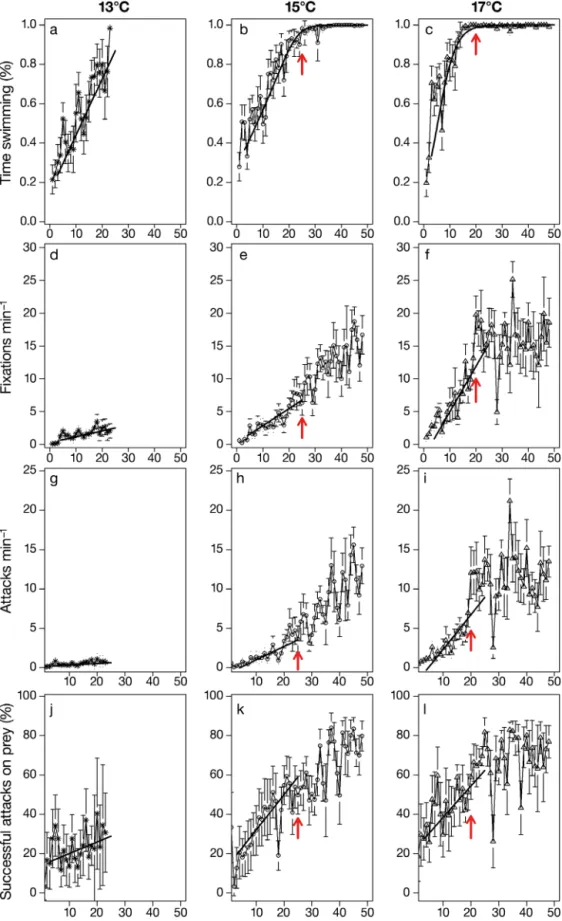
started searching for prey while swimming. Time spent swimming by pre-flexion sardine larvae in -creased significantly with age, and its interaction with temperature was also significant (GLM AIC = 6995; p < 0.0001) (Tables 5 & 6, Fig. 4). The rate of increase in time spent swimming was higher for larvae reared at 17°C when compared to those reared at 13 and 15°C. The ANOVA testing for differences between the regression models with and without the interaction term of temperature and age for larvae reared at 13 and 15°C were not significant (F = 0.846; p = 0.357), suggesting that the rate of increase in swimming with
pre-flexion larvae age was similar for larvae reared at these 2 temperatures. However, the intercept was sig-nificantly different between the two (F = 393; p < 0.0001; R2 = 0.39); therefore, the time spent swimming
at age was higher at 15°C.
At the start of exogenous feeding (3 to 5 dph), for-aging activity was low; the (mean ± SD) frequency of orientation was 0.19 ± 0.54, 0.79 ± 1.36, and 1.75 ± 1.99 prey min−1for larvae reared at 13, 15 and 17°C,
respectively. The frequency of attacks (lunges) for first-feeding larvae was 0.09 ± 0.31, 0.40 ± 0.95 and 0.81 ± 1.24 attacks min−1at 13, 15 and 17°C,
respec-tively (Fig. 4). Foraging activity significantly in -creased with increasing age for pre-flexion larvae, and temperature significantly affected the slope of the increase in the frequency of larval orientations or fixations to prey (AIC = 8573; p < 0.0001), attacks on prey (AIC = 6995; p < 0.0001) and percentage of suc-cessful attacks on prey (AIC = 16776; p < 0.0001). The slope of the relationship between these 3 foraging behaviours with age increased with increasing tem-perature, with 13 < 15 < 17°C, except for the slope of the percentage of successful attacks to prey, which was significantly higher at 15 than at 17ºC (Tables 5 & 6).
After flexion and dorsal fin began to develop (25 dph for 13 and 15°C, 20 dph for 17°C, Table 4), time spent swimming was significantly different ac-cording to the temperatures with which larvae were reared (ANOVA, F = 8.2; p = 0.0005) and was particu-larly high at 17°C and similar between 13 and 15°C (p-values of Tukey-test pairwise comparisons of 0.57, 0.001 and 0.02 for 13−15, 13−17 and 15−17°C, res pec -tively). Orientations towards prey as well as at tacks on prey were also significantly different be tween temperatures during the flexion stage (ANOVA tests:
F = 12.1 and 4.6; p < 0.0001 and 0.012, for com -parisons of orientations and attacks, respectively). Orientations to prey at this stage were lower at 13°C and similar between 15 and 17°C (p-values of Tukey-test pairwise comparisons of 0.001, < 0.0001 and 0.238 for 13−15, 13−17 and 15−17°C, respectively). Attacks on prey were also lower at 13°C and similar between 15 and 17°C (p-values of Tukey-test pairwise compar-isons of 0.002, 0.015 and 0.990 for 13−15, 13−17 and 15−17°C, respectively). The successful attacks on prey were not significantly different between the 3 temperatures (ANOVA; F = 0.99; p = 0.376).
Larvae reached 50% of their maximal value of time spent swimming at an age of 5.3 and 14.7 dph at 17 and 15°C, respectively (Fig. 4, Table 7). At approxi-mately 15 and 20 dph for 17 and 15°C, respectively, sardine larvae spend all the observational time swim-ming, presenting a constant swimming behaviour. Temp. (°C) Age (dph) Mean size ± SD (mm)
Hatching day, no pigmentation
13 0 3.6 ± 0.64 15 0 3.8 ± 0.27 17 0 4.1± 0.34 Pigmentation, yolk sac, mouth open
13 4/5 5.5 ± 0.63 15 3/4 5.4 ± 0.41 17 3 5.0 ± 0.49 Pectoral fins and beginning of caudal fin formation 13 10 5.5 ± 0.60 15 10 5.9 ± 0.60 17 5 5.5 ± 0.41 Beginning of notochord flexion
13 20 8.1±1.32 15 15 7.7 ±1.29 17 10 6.3 ± 0.92 Beginning of dorsal fin development
13 20 8.1±1.32 15 20 10.0 ±1.41 17 15 9.7 ±1.26 Notochord flexion complete
13 − − 15 25 13.1±1.52 17 20 10.8 ±1.25 Dorsal fin complete
13 − − 15 30 13.2 ±1.25 17 25 12.1±1.82 Beginning of anal fin development
13 − − 15 35 14.5 ± 2.29 17 25 12.1±1.82 Caudal fin complete
13 − − 15 40 16.2 ± 2.49 17 30 13.7 ± 2.44 Table 4. Timing of the main morphological events occurring during larval development of sardine Sardina pilchardus at 13, 15 and 17°C. Pigmentation refers to the appearance of many small scattered melanophores in the dorsal region ex-tending from the head to the tail, with one ventral caudal melanophore. Pectoral fins refer to the time when the inser-tion of the pectoral fins become oblique. Caudal fin com-plete refers to the time when the caudal fin has the comcom-plete
Developmental stage Relation Temp. (°C) a (± SE) b (± SE) p R2
Pre-flexion SWI vs. Age 13 0.029 ± 0.002 0.15 ± 0.024 < 0.001 0.30 15 0.027 ± 0.001 0.30 ± 0.020 < 0.001 0.37 17 0.038 ± 0.01 0.31± 0.001 < 0.001 0.47 Orient. vs. Age 13 0.09 ± 0.011 0.28 ± 0.159 < 0.001 0.11 15 0.28 ± 0.017 −0.67 ± 0.277 < 0.001 0.27 17 0.50 ± 0.034 −0.26 ± 0.417 < 0.001 0.32 Attacks vs. Age 13 0.02 ± 0.005 0.12 ± 0.069 < 0.001 0.05 15 0.17 ± 0.013 −0.77 ± 0.207 < 0.001 0.20 17 0.24 ± 0.034 −0.29 ± 0.417 < 0.001 0.27 Success attacks vs. Age 13 0.58 ± 0.235 14.15 ± 3.217 0.01 0.01 15 1.73 ± 0.013 10.15 ± 0.207 < 0.001 0.11 17 1.34 ± 0.283 24.72 ± 3.445 < 0.001 0.05 Post-flexion SWI vs. Age 15 0.002 ± 0.0004 0.88 ± 0.015 < 0.001 0.06 17 −0.0001± 9 × 10⁻⁵ 0.99 ± 0.0032 0.196 0.001
Orient. vs. Age 15 0.35 ± 0.031 −1.20 ±1.194 < 0.001 0.16 17 0.08 ± 0.038 12.66 ±1.319 0.033 0.01 Attacks vs. Age 15 0.36 ± 0.028 −5.07 ±1.051 < 0.001 0.204 17 0.12 ± 0.033 6.63 ±1.154 < 0.001 0.023 Success attacks vs. Age 15 1.30 ± 0.124 14.83 ± 4.682 < 0.001 0.145 17 0.54 ± 0.033 46.61±1.154 < 0.001 0.03 Caudal fin formation SWI vs. Age 15 −0.0001± 0.006 1.00 ± 0.316 0.09 0.01
17 0.0002 ± 0.012 0.98 ± 0.513 0.302 0.0001 Orient. vs. Age 15 0.35 ± 0.145 −1.67 ± 6.637 0.014 0.021 17 0.001± 0.079 16.14 ± 3.160 0.982 −0.002 Attacks vs. Age 15 0.326 ± 0.133 −3.67 ± 6.115 0.015 0.020 17 −0.06 ± 0.069 14.77 ± 2.774 0.352 −0.003 Success attacks vs. Age 15 0.91± 0.447 31.85 ± 21.843 0.056 0.011 17 0.06 ± 0.246 66.71± 9.807 0.782 −0.002 Table 5. Results of the linear regression analyses (y = ax + b) of the effect of age (d post hatching, dph) on the time spent swim-ming (SWI,%), frequency of orientations (Orient.), frequency of attacks and frequency of successful attacks on prey of Sardina pilchardus larvae during 3 developmental stages: pre-flexion (from 3 to 25 dph at 13 and 15°C and from 3 to 20 at 17°C) and post-flexion (25 to 50 dph at 15°C and 20 to 50 dph at 17°C) and after caudal fin formation (40 dph at 15°C and 50 dph at 17°C)
Developmental stage MAPS Temperatures (°C) df p-value F ρ R2 Intercept Slope
Pre-flexion SWI 13 and 15 1 < 0.001 0.358 262 < 0.001 0.39 13 and 17 1 < 0.001 < 0.001 270 < 0.001 0.44 15 and 17 1 < 0.001 < 0.001 270 < 0.001 0.42 Orientations 13 and 15 1 0.004 < 0.001 190 < 0.001 0.31 13 and 17 1 0.193 < 0.001 270 < 0.001 0.44 15 and 17 1 0.390 < 0.001 183 < 0.001 0.33 Attacks 13 and 15 1 < 0.001 < 0.001 140 < 0.001 0.25 13 and 17 1 0.047 < 0.001 229 < 0.001 0.41 15 and 17 1 0.130 0.007 115 < 0.001 0.23 Success 13 and 15 1 0.366 < 0.001 44 < 0.001 0.09 13 and 17 1 0.026 0.042 34 < 0.001 0.09 15 and 17 1 0.262 0.001 36 < 0.001 0.09 Post-flexion SWI 15 and 17 1 < 0.001 < 0.001 26 < 0.001 0.06 Orientations 15 and 17 1 < 0.001 < 0.001 59 < 0.001 0.13 Attacks 15 and 17 1 < 0.001 < 0.001 70 < 0.001 0.15 Success 15 and 17 1 < 0.001 < 0.001 42 < 0.001 0.09 Caudal fin formation SWI 15 and 17 1 0.205 0.310 5 < 0.001 0.02 Orientations 15 and 17 1 0.027 0.047 3 0.017 0.01 Attacks 15 and 17 1 0.010 0.014 3 0.033 0.01 Success 15 and 17 1 0.175 0.136 2 0.058 0.007 Table 6. Results of ANCOVA models analysing the relationship between foraging behaviour (time spent swimming [SWI,%], frequency of orientations, frequency of attacks and frequency of successful attacks on prey) and Age (d post hatching, dph) of Sardina pilchardus larvae during 3 developmental stages: pre-flexion (from 3 to 25 dph at 13 and 15°C and from 3 to 20 dph at 17°C) and post-flexion (25 to 50 dph at 15°C and 20 to 50 dph at 17°C) and after caudal fin formation (40 dph at 15°C and
Fig. 4. Mean ± 0.95 confidence interval bars of the (a,b,c) time spent swimming, (d,e,f) frequency of fixations or orientations, (g,h,i) frequency of lunges during a 60 s period of observation throughout larval ontogeny of Sardina pilchardus and (j,k,l) percentage of successful attacks on prey of larvae reared with high prey concentrations and at 3 different temperatures: 13, 15 and 17°C. Red arrows represent the timing when notochord flexion is complete. Parameters of the linear and logistic
During the post-flexion stage, foraging parameters were higher for larvae reared at 17°C when com-pared to those reared at 15°C (Tables 5 & 6). Time spent swimming did not increase significantly for lar-vae reared at 17°C after flexion, contrary to those reared at 15°C, for which there was a slight but sig-nificant increase (Table 5). Orientations and attacks on prey as well as successful attacks on prey in -creased with age for larvae reared at 15 and 17°C during the post-flexion stage and were significantly higher at 17°C (Tables 5 & 6), and at the temperature when the flexion of the notochord was complete cor-responded to a sharp increase in foraging ability of the larvae reared at 17°C, contrasting to larvae reared at 15°C, for which the increase in foraging was less abrupt.
After the caudal fin formation (30 and 40 dph for larvae reared at 17 and 15°C, respectively), time spent swimming did not increase significantly for lar-vae reared at 15 and 17°C as it was near to maximum. All foraging parameters were significantly higher at 17°C when compared to those of larvae reared at 15°C after caudal fin formation. Moreover, foraging parameters such as orientations and attack on prey significantly increased with age for larvae reared at 15°C, contrary to larvae reared at 17°C, for which these rates did not increase with age after the caudal fin formation (Tables 5 & 6). The percentage of suc-cessful attacks on prey did not increase with age after the caudal fin formation for larvae reared at 15 and 17°C (Fig. 4, Tables 5 & 6).
DISCUSSION
Despite the ecological and commercial importance of sardines and anchovies in the world’s oceans, con-trolled laboratory studies on the growth, feeding and mortality of any life stage of these fishes are rare (Peck et al. 2013). This study is the first to examine
the effect of temperature on the growth, mortality and foraging behaviour of European sardine larvae reared from hatch through first-feeding and well into the exogenous feeding period. Our results highlight the controlling role that temperature plays on larval development, growth and feeding performance.
After fertilizing and incubating eggs at the same temperature, the yolk-sac period of sardine larvae described in Blaxter (1969) and Miranda et al. (1990) was 2 to 5 d between 20 and 10°C, respectively, which agrees with the observations in the present study. Although the rate of embryonic development increased with increasing temperature, the survival of unfed larvae was highest within a more narrow range of temperatures typically occurring during the spawning period of sardine in Iberian Atlantic waters. Time needed from hatch until dead from star-vation was slightly lower in the present study than reported for larvae collected from northwestern Iberia (Miranda et al. 1990) and slightly longer than reported for larvae collected from the English Chan-nel (Blaxter 1969). Part of this variation can be the result of physiological adaptations of marine fish embryos to prevailing local conditions for popula-tions living in different latitudes, as shown by Tar-ifeño et al. (2008) for Peruvian anchovies.
The growth pattern of unfed sardine larvae was similar to that described by Blaxter (1969). Larvae in -creased in length with age until the yolk reserves were exhausted, when substantial decreases in length subsequently occurred. This decrease in mean length was particularly marked at higher temperatures. At 22°C, sardine larvae growth was practically null immediately after the endogenous feeding period, and larvae died sooner than at 13 to 17°C, probably as the result of a sharp increase in metabolic de -mands with the increase in temperature. For the 13− 17°C range, similar to that experienced by sardines spawning off Iberia, there were no relevant differ-ences in the endurance to starvation of the larvae, although the decline in larval mean size for unfed lar-vae was steeper at 17°C. It appears, then, that the point of no return (when larvae will die regardless of whether prey becomes available) is overall quite sim-ilar within this temperature range (Pepin 1991).
Daily mortality was very high for the first weeks of life and then significantly decreased at 12 dph for lar-vae reared at 15 and 17°C and at 15 dph for larlar-vae reared at 13°C. This decrease can be related to the beginning of the flexion of the notochord, when lar-vae became more efficient swimmers and foragers. There were significant differences in the daily mor-tality of fed larvae reared at 13, 15 and 17°C, and the
Parameter 15°C 17°C
Bottom asymptote –1.1 0
Top asymptote 1 1
Inflexion point at (x,y) 14.7, 0.7 5.3, 0.5
Goodness of fit 0.90 0.93
SE 0.47 0.42
50% activity 7.7 5.3
Table 7. Results of the Richard’s logistic regression of the effect of temperature and age (d post hatch, dph) on the percentage of time spent swimming by Sardina pilchardus
patterns observed depended on the life stage. During the endogenous feeding period, daily mortality was higher for larvae reared at higher temperatures, but in exogenously feeding larvae, daily mortality was higher for larvae reared at the lowest temperature. Interestingly, total cumulative mortality was similar between the 3 temperatures at the end of the experi-mental period (25 dph). Similar results were reported for the larvae of Atlantic cod Gadus morhua (von Herbing Hunt et al. 1996), suggesting that, within a range of temperatures near the centre of the toler-ance range, there is little effect of temperature on cumulative mortality. According to the authors, in -trinsic factors may be the predominant agents of mor-tality prior to yolk-absorption, but this shifts to extrin-sic (environmental) factors as the fish begin to feed. Increased mortality during the egg and yolk-sac stage is known to occur at higher temperatures (Houde 1989). Alternatively, increased larval mortality at lower temperatures after the endogenous feeding could be related to the decreased foraging and growth potential at sub-optimally cold temperatures, and consequently, larvae have the smallest size-at-age (Pepin 1991).
Within the range 13−17°C, the growth of well-fed sardine larvae increased with increasing tempera-ture, which is in accordance with previous studies demonstrating that, within the optimal temperature range for a species, growth and development rates increase at warmer temperatures (Pepin 1991). Growth rates of small pelagic fish larvae were described to have a domed-shaped relationship with sea surface temperature (SST) (Takasuka et al. 2007), increasing up until a maximum after which they decrease with increasing temperature. According to the present results, the inflexion point when growth starts to de -crease with increasing temperature for sardine larvae (upper thermal tolerance limit) is >17°C. However, the upper thermal tolerance point for egg develop-ment was not tested. Eggs were spawned and fertil-ized in the adult tank at 15°C and were collected and transferred to different test temperatures halfway through egg development. Since the thermal toler-ance of eggs tends to be lower than that of larvae (Pepin 1991, Jordaan & Kling 2003), the thermal lim-its of sardine egg development from fertilization is likely to have a narrower range than that shown here for the larvae. In a previous study, the broodstock fish used in the present study naturally produced eggs at 18 to 19°C, and those eggs and larvae were reared at this (relatively warm) temperature. Despite using the same feeding protocol, no larvae survived beyond the first week, and many larvae displayed skeletal
deformities, suggesting that these temperatures rep-resent the upper lethal temperature for Iberian sar-dine larvae (S. Garrido unpubl. data). Thermal toler-ance is expected to increase as fish grow up to the juvenile and adult stages. A recent work conducted in the Mediterranean Sea (Schismenou et al. 2016) has found that larvae occurred in areas of SST rang-ing from 13 to 17°C, and a linear and positive rela-tionship of sardine larvae growth rate was found with temperature. In contrast, sardine juveniles devel-oped in a wider range of temperatures (12−27°C) and had a dome-shaped growth response, with an opti-mum at around 24°C.
Temperature-specific growth rates of small pelagic fish larvae can be quite different depending upon the ecosystem/region, year and/or study (Peck et al. 2013). Optimal temperature for sardine spawning off the east Atlantic (Iberian) waters is from approximately 13 to 17°C, with warmer waters being used at lower latitudes (off northwest Africa, 15−20°C) and colder waters being utilized at higher latitudes (British Islands, 10−17°C) (Coombs et al. 2006). It is likely that there are local adaptations of sardine popula-tions to prevalent environmental condipopula-tions and that populations living at higher latitudes are more toler-ant to lower temperatures compared to those living at lower latitudes areas. Sundby (2000) observed that Atlantic cod stocks from the colder areas within the species distribution range tended to have in creased recruitment in warmer than average years, whereas those from warmer areas within the range had increased recruitment in cooler than average years. The authors hypothesize that the causal effect of tem-perature on the growth and recruitment of North Atlantic cod populations can partly be the result of a direct effect by changes in physiological processes of cod and partly an indirect effect through trophic transfer and availability of prey correlated to temper-ature. Nevertheless, the range of temperatures that promotes high rates of larval survival and strong recruitment might be much narrower than could be inferred from the geographic extent of the species (Jordaan & Kling 2003).
Several lines of evidence from the laboratory, such as the midpoint of the zone of thermal toler-ance (Bernal et al. 2008), showed that sardine eggs do not hatch at 10°C, and results mentioned above showed that larvae hatching from eggs reared at >18°C did not survive beyond the first week (S. Garrido unpubl. data). Evidence from the field, such as the median temperature experienced in spawning areas (Coombs et al. 2006) and the tendency for recruitment to be maximized at intermediate
tem-peratures (S. Garrido et al. unpubl.), suggest that the optimal temperature for Atlanto-Iberian sardine during early life would be around 15°C. In our ex -periments, however, early sardine larvae had high growth capacity at temperatures >15°C. This appar-ent mismatch between temperatures of spawning and of maximum larval growth has also been de -scribed for cod (Jordaan & Kling 2003), where peak spawning occurs at 5−7°C, but larvae are able to grow and survive at >15°C. Since standard and active metabolic rates, and consequently prey re -quirements, of ectotherms are positively re la ted to temperature, constrains in the food supply will eventually reduce the temperature at which growth performance is maximized (Brett 1979, Jobling 1997, Sundby 2000, Jordaan & Kling 2003). When facing restricted feeding conditions, larvae will die faster at higher temperatures (Laurel & Blood 2011). Thus, in the wild, fish growth tends to be maximized at temperatures a few degrees lower than those at which food consumption is maximal (e.g. Jobling 1993). Furthermore, other researchers have sug-gested that having maximum field abundance at temperatures slightly colder than optimal tempera-ture for growth is a form of metabolic insurance (Thomas et al. 2012), since thermal windows for performance are shifted to the right, making critical (intolerably warm) temperatures often only a few degrees above optimum growth temperatures (Pört-ner & Peck 2010, Boersma et al. 2016). For these reasons, it is not surprising that European sardine larvae tend to occur most frequently in field samples collected in slightly colder waters (Coombs et al. 2006) than their laboratory maximum (17°C, when larvae grew more than those reared at 15°C and had similar cumulative mortalities, as opposed to those reared at 18°C, as mentioned above). In our experiments, larvae were exposed to optimal feed-ing conditions that may be rarely encountered in the sea. Furthermore, seawater temperature often covaries with food availability (Rankin & Sponaugle 2011); therefore, the indirect effect of temperature on availability of prey may be just as important as the direct physiological effect of temperature on the foraging and growth capacity of fish (Loeng 1989). In regions where temperatures are higher than in the Ibero-Atlantic area, such as the Mediterranean Sea, food availability probably plays a pivotal role in determining larval survival. In the Mediterranean Sea, sardine spawns preferentially at 12−14°C, but spawning also occurs up to 19°C (Palomera et al. 2007). For larvae developing in that area under warmer conditions, growth was described to be
higher when compared to the western Iberia, and larval condition was strongly dependent of high food availability (Catalán et al. 2006).
Elevated temperatures can accelerate the timing of ontogenetic development more than the rate of growth (Fuiman et al. 1998). Not only did larvae grow faster at higher temperatures, but ontogenetic devel-opment also occurred sooner and at smaller sizes. The timing of morphological development of sardine larvae varied inversely with temperature, but as ob -served by Fuiman et al. (1998), not every event was equally accelerated by temperature. In general, fin formation occurred earlier and at smaller sizes with increasing temperature, and this was translated into higher foraging abilities at age for larvae growing in higher temperatures. The time spent swimming and the foraging behaviour of sardine larvae increased with age/size. The increase in the frequency of prey capture with age/size is a consequence of larger lar-vae swimming faster (Silva et al. 2014) and being able to capture prey within a wider size range (Caldeira et al. 2014). By being able to select larger prey, larger larvae maximize the net rate of energy gain, because, all other things being equal, larger prey yield more energy per unit effort. The swim-ming activity and the foraging performance of sar-dine larvae both increased with increasing tempera-ture (from 13 to 17°C), and the effect of temperatempera-ture was more marked on prey pursuit and prey attack frequencies. Larvae spend all their time swimming (at least during daylight hours) when notochord flex-ion begins and dorsal fin starts to form (Fig. 4, Table 4). The ontogenetic increase in the swimming ability of sardine larvae matches the timing of notochord flex-ion (Silva et al. 2014), coinciding with the beginning of the caudal fin formation and development of the swim bladder (Santos et al. 2007). This ontogenetic event also marks the time when foraging abilities (number of orientations and attacks on prey and per-cent success in capturing prey) sharply in creased, which was more abrupt for larvae reared at 17°C than for larvae reared at 15°C. After the caudal fin formation, there was no increase in larval swimming and foraging with age for larvae reared at 17°C, sup-porting the idea that this is an important develop-mental milestone for fish, marking a clear separation of higher abilities (Gibb et al. 2006, Somarakis & Nikolioudakis 2010, Kopf et al. 2014). These morpho-logical changes occurred approximately 10 d earlier at 17°C rather than at 13°C. Earlier improvement of swimming performance for larvae growing at higher temperatures is not only important for the capacity to conduct diel vertical migration influencing advective
transport patterns but also for the ability to success-fully forage and escape predators, coinciding with the timing when fish start the schooling behaviour (Somarakis & Nikolioudakis 2010). At this stage, lar-vae are described to switch from an anguilliform to a subcarangiform swimming style (Batty 1984), and this corresponds to the time when substantial en -durance swimming is developed (Clark et al. 2005). Moreover, temperature can affect the phenotype of the larvae under development, altering the relative timing of development of the different tissues and organs (such as muscles and bones) during very early ontogeny (Johnston et al. 2001, Koumoundouros et al. 2009 and references within). This has been de -monstrated in other clupeids such as Atlantic herring (Moyano et al. 2016) as well as in European sardine, where larvae growing in higher temperatures had a higher recruitment of muscle fibres compared to con-specifics given similar feeding conditions at lower temperatures (Catalán et al. 2004). The temperature experienced during the embryonic and early larval stages, therefore, can have profound consequences for the survival of larvae and later stages (Kou moun -douros et al. 2009).
In contrast to the sardine larvae studied here, Hunter (1972) reported no effect of age on the per-centage of successful attacks (average 52%) in the larvae of northern anchovy Engraulis mordax. Moreover, through an age of 30 dph, those larvae displayed a mean ± SD of 1.75 ± 0.20 feeding strikes min−1at 17−18°C (Hunter 1972), which is similar to
what was observed in the present study at 13°C (1.4 ± 1.8) but markedly lower than feeding strike frequencies observed at temperatures of 15°C (3.7 ± 5.45 min−1) or 17°C (7.1 ± 6.75 min−1), which
sug-gests a higher foraging activity for European sardine larvae.
The substantial enhancement of foraging at warmer temperatures might not necessarily result in en hanced larval growth, since metabolic costs also in crease with increased swimming activity, which could potentially offset any gains due to increased feeding success (Checkley 1984, Kiørboe et al. 1987). It is worth noting, however, that the different compo-nents of each foraging event have different expendi-tures of energy, e.g. swimming speeds during attack result in specific metabolic rates that are twice those in pursuit bursts (Hunt von Herbing et al. 1996). Therefore, increased temperature may have trans-lated into only marginally higher energy expendi-tures and only slight re ductions in growth efficiency, because pursuit success also increased with increas-ing temperature.
The response to temperature of different biological processes is not necessarily similar. The tempera-tures at which ingestion rate, growth rate and con-version efficiency are maximized can be different (Jobling 1993, 1997). Larvae experiencing lower tem-peratures will have longer stage durations which lengthens the period of time when they are most vul-nerable to predators, whereas larvae at warmer tem-peratures will have to ingest more prey per unit growth, and these higher costs decrease the time needed for individuals to reach the point-of-no-return in poor prey fields (Pepin 1991). At the same time, larvae experiencing warmer temperatures may experience higher potential predation mortality through both increased encounter rates with preda-tors and reduced energy available for predator eva-sion (Litvak & Leggett 1992, Lankford et al. 2001, Jor-daan & Kling 2003). A recent modelling study suggested that benefits of faster growth at warmer temperature can be offset by increases in predator feeding rates (Akimova et al. 2016). As a result of these associated trade-offs, the temperature at which maximum daily growth is realized (Otterlei et al. 1999, Steinarsson & Björnsson 1999) may not be the optimal temperature for survival. Additionally, density-dependent effects may impede the benefits of increased growth rates by increasing competition for food in the wild, as described for cod (Holt & Jørgensen 2014).
The survival of sardine larvae and their potential for recruitment will depend on the environmental conditions and how these conditions affect the growth and mortality rates of the eggs and larvae. Tempera-ture has been involved as a major factor in both year-to-year fluctuations and long-term trends in fish pop-ulations (e.g. Loeng 1989). In our experiments with well-fed sardine larvae, growth rate increased with increasing temperature. This higher growth was as -sociated with large increases in foraging activity, therefore implying that sardine larvae will depend on high prey concentrations in order to survive at high temperatures. Sardines have an extensive dis-tribution range from the waters off Ireland and the UK to northwestern Africa, experiencing a relatively broad temperature range. It is likely that the selec-tive pressures acting to limit productivity at the higher latitudinal limit of distribution are more likely related to temperatures falling below tolerance thresholds of the species, whereas food availability probably plays a pivotal role influencing the upper energetically affordable tolerance limit of tempera-tures at the lower latitudinal limit. Therefore, future studies examining the influence of temperature on
the growth and survival of sardine larvae should take into account the combined influence of temperature and food availability, particularly if projections of global warming are associated with changes in plankton productivity.
Acknowledgements. This work was supported by Fundação para a Ciência e Tecnologia (FCT) as part of the project VITAL (Vital rates of pelagic fish larvae PTDC/ MAR/ 111304/ 2009). Project MODELA (PTDC/MAR/098643/2008) partially supported this work. S.G. was partially supported by FCT through 2 post-doctoral fellowships (SFRH/ BPD/ 38332/2007 and SFRH/BPD/ 105419/2014). The microalgae Rhodomonas baltica was provided by the Assemble Program (grant 227799) funded under the European Community − Research Infrastructure Action under the FP7 ‘Capacities’. E.S. was funded by project TOPCOP (CTM2011-23480). Thanks are due to A. Teodósio (CCMAR, Univ. Algarve) and all the team of the Oceanário de Lisboa for their collabora-tion as team of project VITAL. This work contributes to pro-ject UID/Multi/04326/2013 from the Portuguese Foundation for Science and Technology (FCT).
LITERATURE CITED
Akimova A, Hufnagl M, Kreus M, Peck MA (2016) Modeling the effects of temperature on the survival and growth of North Sea cod (Gadus morhua) through the first year of life. Fish Oceanogr 25: 193−209
Barlow GW (1968) Ethological units of behavior. In: Ingle DJ (ed) The central nervous system and fish behavior. Uni-versity of Chicago Press, Chicago, IL, p 217−232 Batty RS (1984) Development of the swimming movements
and musculature of larval herring (Clupea harengus). J Exp Biol 110: 217−229
Bernal M, Ibaibarriaga L, Lago de Lanzós A, Lonergan M and others (2008) Using multinomial models to analyse data from sardine egg incubation experiments; a review of advances in fish egg incubation analysis techniques. ICES J Mar Sci 65:51–59
Blaxter JHS (1969) Experimental rearing of pilchard larvae, Sardina pilchardus. J Mar Biol 49: 557−575
Blaxter JHS (1991) The effect of temperature on larval fishes. Neth J Zool 42: 336−357
Boersma M, Grüner N, Signorelli NT, González PM, Peck MA, Wiltshire K (2016) Projecting effects of climate change on marine systems: Is the mean all that matters? Proc R Soc Lond B 283: 20152274
Brett JR (1979) Environmental factors and growth. In: Hoar WS, Randall DJ, Brett JR (eds) Fish physiology. Academic Press, New York, NY, p 599−675
Caldeira C, Santos AMP, Ré P, Peck MA, Saiz E, Garrido S (2014) Effect of prey concentration on ingestion rates of European sardine Sardina pilchardus larvae in the labo-ratory. Mar Ecol Prog Ser 517: 217−228
Catalán IA, Johnston IA, Olivar MP (2004) Seasonal differ-ences in muscle fibre recruitment of pilchard larvae in the north-western Mediterranean. J Fish Biol 64: 1605−1615 Catalán IA, Olivar MP, Palomera I, Berdalet E (2006) Link between environmental anomalies, growth and condi-tion of pilchard Sardina pilchardus larvae in the north-western Mediterranean. Mar Ecol Prog Ser 307: 219−231
Checkley DM Jr (1984) Relation of growth to ingestion for larvae of Atlantic herring Clupea harengus and other fish. Mar Ecol Prog Ser 18: 215−224
Chen Y, Jackson DA, Harvey HH (1992) A comparison of von Bertalanffy and polynomial functions in modelling fish growth data. Can Fish Aquat Sci 49: 1228−1235 Clark DL, Leis JM, Hay AC, Trnski T (2005) Swimming
ontogeny of larvae of four temperate marine fishes. Mar Ecol Prog Ser 292: 287−300
Clarke A, Johnston NM (1999) Scaling of metabolic rate with body mass and temperature in teleost fish. J Anim Ecol 68: 893−905
Coombs SH, Smyth T, Conway D, Bernal M, Stratoudakis Y, Alvarez P (2006) Spawning season and temperature rela-tionships for sardine (Sardina pilchardus) in the eastern North Atlantic. J Mar Biol Assoc UK 86: 1245−1252 Dahlke FT, Politis SB, Butts IAE, Trippel EA, Peck MA (2016)
Additive genetic variation affects thermal reaction norms for embryo viability in cod, Gadus morhua. J Exp Mar Biol Ecol 474:148–155
Fuiman LA, Poling KR, Higgs DM (1998) Quantifying devel-opmental progress for comparative studies of larval fishes. Copeia 1998(3): 602−611
Gamulin T, Hure T (1955) Contribution à la connaisance de l’écologie de la ponte de la sardine (Sardina pilchardus Walb.) dans l’Adriatique. Acta Adriat 8: 1−22
Garrido S, Santos AMP, Santos A, Ré P (2009) Spatial distri-bution and vertical migrations of fish larvae communities off northwestern Iberia sampled with LHPR and Bongo nets. Estuar Coast Shelf Sci 84: 463−475
Gibb AC, Swanson BO, Wesp H, Landels C, Landels C, Liu C (2006) Development of the escape response in teleost fishes: Do ontogenetic changes enable improved per-formance? Physiol Biochem Zool 79: 7−19
Holt RE, Jørgensen C (2014) Climate warming causes life-history evolution in a model for Atlantic cod (Gadus morhua). Conserv Physiol 2:cou050
Houde ED (1989) Comparative growth, mortality, and ener-getics of marine fish larvae — temperature and implied latitudinal effects. Fish Bull 87: 471−495
Hunt von Herbing I, Boutilier RG, Miyake T, Hall BK (1996) Effects of temperature on morphological landmarks criti-cal to growth and survival in larval Atlantic cod (Gadus morhua). Mar Biol 124: 593−606
Hunter JR (1972) Swimming and feeding behavior of larval anchovy Engraulis mordax. Fish Bull 70: 821−838 ICES (2014) Report of the Working Group on Southern
Horse Mackerel, Anchovy and Sardine (WGHANSA). 20−25 June 2014, Copenhagen, Denmark. ICES CM 2014/ ACOM: 16
Jobling M (1993) Bioenergetics: feed intake and energy par-titioning. In: Rankin CJ, Jensen FB (eds) Fish ecophysiol-ogy. Chapman & Hall, London, p 1−44
Jobling M (1997) Temperature and growth: modulation of growth rate via temperature change. In: Wood CM, McDonald DG (eds) Global warming: implications for freshwater and marine fish. Cambridge University Press, Cambridge, p 223−254
Johnston IA, Vieira VLA, Temple GK (2001) Functional consequences and population differences in the de -velopmental plasticity of muscle to temperature in Atlantic herring Clupea harengus. Mar Ecol Prog Ser 213: 285−300
Jordaan A, Kling LJ (2003) Determining the optimal tem-perature range for Atlantic cod (Gadus morhua)
➤
➤
➤
➤
➤
➤
➤
➤
➤
➤
➤
➤
➤
➤
➤
➤
➤
➤
➤
➤
➤
➤
➤
➤
➤
➤
➤
➤
➤
➤
➤
➤
➤
➤
➤
➤
during early life. In: Browman HI, Skiftesvik AB (eds) The big fish bang. Institute of Marine Research, Bergen, p 45−62
Kiørboe T, Munk P, Richardson K (1987) Respiration and growth of larval herring Clupea harengus: relation be -tween specific dynamic action and growth efficiency. Mar Ecol Prog Ser 40: 1−10
Kopf SM, Humphries P, Watts RJ (2014) Ontogeny of critical and prolonged swimming performance for the larvae of six Australian freshwater fish species. J Fish Biol 84: 1820−1841
Koumoundouros G, Ashton C, Sfakianakis DG, Divanach P, Kentouri M, Anthwal N, Stickland NC (2009) Thermally induced phenotypic plasticity of swimming performance in European sea bass Dicentrarchus labrax juveniles. J Fish Biol 74: 1309−1322
Lankford TE Jr, Billerbeck JM, Conover DO (2001) Evolu-tion of intrinsic growth and energy acquisiEvolu-tion rates. II. Trade-offs with vulnerability to predation in Menidia menidia. Evolution 55: 1873−1881
Laurel BJ, Blood DM (2011) The effects of temperature on hatching and survival of northern rock sole larvae (Lepi-dopsetta polyxystra). Fish Bull 109: 282−291
Litvak MK, Leggett WC (1992) Age and size-selective pre-dation on larval fishes: the bigger-is-better hypothesis revisited. Mar Ecol Prog Ser 81: 13−24
Loeng H (1989) The influence of temperature on some fish population parameters in the Barents Sea. J Northwest Atl Fish Sci 9: 103−113
Martin P, Bateson P (1993) Measuring behavior: an introduc-tory guide. Cambridge University Press, Cambridge Miranda A, Cal RM, Iglesias J (1990) Effect of temperature
on the development of eggs and larvae of sardine Sar-dina pilchardus Walbaum in captivity. J Exp Mar Biol Ecol 140: 69−77
Moyano M, Illing B, Peschutter P, Huebert KB, Peck MA (2016) Thermal impacts on the growth, development and ontogeny of critical swimming speed in Atlantic herring larvae. Comp Biochem Physiol A Mol Integr Physiol 197: 23−34
Otterlei E, Nyhammer G, Folkvord A, Stefansson SO (1999) Temperature- and size-dependent growth of larval and early juvenile Atlantic cod (Gadus morhua): a compara-tive study of Norwegian coastal cod and northeast Artic cod. Can J Fish Aquat Sci 56: 2099−2111
Peck MA, Reglero P, Takahashi M, Catalán IA (2013) Life cycle ecophysiology of small pelagic fish and driven changes in populations. Prog Oceanogr 116: 220−245
Pepin P (1991) Effect of temperature and size on develop-ment, mortality, and survival rates of the pelagic early life history stages of marine fish. Can J Fish Aquat Sci 48: 503−518
Pörtner HO, Peck MA (2010) Climate change effects on fishes and fisheries: towards a cause-and-effect under-standing. J Fish Biol 77: 1745−1779
Rankin TL, Sponaugle S (2011) Temperature influences
selective mortality during the early life stages of a coral reef fish. PLOS ONE 6: e16814
Relvas P, Luis J, Santos AMP (2009) The importance of the mesoscale in the decadal changes observed in the North-ern Canary upwelling system. Geophys Res Lett 36: L22601
Rijnsdorp AD, Peck MA, Engelhard GH, Möllmann C, Pin-negar JK (2009) Resolving the effect of climate change on fish populations. ICES J Mar Sci 66: 1570−1583 Santos AMP, Chícharo A, Dos Santos A, Moita T, Oliveira
PO, Peliz A, Ré P (2007) Physical−biological interactions in the life history of small pelagic fish in the western Iberia upwelling ecosystem. Prog Oceanogr 74: 192−209 Schismenou E, Palmer M, Giannoulaki M, Alvarez I, Tsiaras
K, Triantafyllou G, Somarakis S (2016) Seasonal changes in otolith increment width trajectories and the effect of temperature on the daily growth rate of young sardines. Fish Oceanogr 25: 362−372
Silva A, Santos MB, Caneco B, Pestana G, Porteiro C, Car-rera P, Stratoudakis Y (2006) Temporal and geographic variability of sardine maturity at length in the northeast-ern Atlantic and the westnortheast-ern Mediterranean. ICES J Mar Sci 63: 663−676
Silva L, Faria AM, Teodósio MA, Garrido S (2014) Ontogeny of swimming behaviour in sardine Sardina pilchardus larvae and effect of larval nutritional condition on critical speed. Mar Ecol Prog Ser 504: 287−300
Somarakis S, Nikolioudakis N (2010) What makes a late anchovy larva? The development of the caudal fin seen as a milestone in fish ontogeny. J Plankton Res 32: 317−326 Steinarsson A, Björnsson B (1999) The effects of temperature on growth and mortality of cod larvae. J Fish Biol 55: 100−109
Stratoudakis Y, Coombs S, de Lanzós AL, Halliday N and others (2007) Sardine (Sardina pilchardus) spawning seasonality in European waters of the northeast Atlantic. Mar Biol 152: 201−212
Sundby S (2000) Recruitment of Atlantic cod stocks in rela-tion to temperature and advecrela-tion of copepod popula-tions. Sarsia 85: 277−298
Takasuka A, Oozeki Y, Aoki I (2007) Optimal growth tem-perature hypothesis: Why do anchovy flourish and sar-dine collapse or vice versa under the same ocean regime? Can J Fish Aquat Sci 64: 768−776
Tarifeño E, Carmona M, Llanos-Rivera A, Castro LR (2008) Temperature effects on the anchoveta Engraulis ringens egg development: Do latitudinal differences occur? Env-iron Biol Fishes 81: 387−395
Thomas MK, Kremer CT, Klausmeier CA, Litchman E (2012) A global pattern of thermal adaptation in marine phyto-plankton. Science 338: 1085−1088
Whitehead PJP (1985) Clupeoid fishes of the world. An annotated and illustrated catalogue of the herrings, sar-dines, pilchards, sprats, anchovies and wolfherrings. Part 1 – Chirocentridae, Clupeidae and Pristigasteridae. FAO Fish Synop No. 125, Vol 7. FAO, Rome. ftp://ftp.fao.org/ docrep/fao/009/ac482e/ac482e00.pdf
Editorial responsibility: Stylianos Somarakis, Heraklion, Greece
Submitted: January 5, 2016; Accepted: August 25, 2016 Proofs received from author(s): October 7, 2016