www.ache.org.rs/CICEQ
Chemical Industry & Chemical Engineering Quarterly 16 (2) 183−191 (2010) CI&CEQ
SVETOMIR Ž. MILOJEVIĆ1
SANDRA B. GLIŠIĆ2
DEJAN U. SKALA2
1Faculty of Tehnical Sciences,
Kosovska Mitrovica, Serbia
2Departement of Organic chemical
technology, Faculty of Technology and Metallurgy, University of Belgrade, Belgrade, Serbia
SCIENTIFIC PAPER
UDC 582.477:665.52 DOI 10.2298/CICEQ100317026M
THE BATCH FRACTIONATION OF
Juniperus
communis
L. ESSENTIAL OIL: EXPERIMENTAL
STUDY, MATHEMATICAL SIMULATION AND
PROCESS ECONOMY
The separation in a batch vacuum column of the essential oil of common juniper berries (Juniperus communis L., from the southern part of Serbia) was analyzed. The main goal of the analyzed separation process was to isolate several frac-tions from the essential oil which mainly contained α-pinene, sabinene and myr-cene. These compounds contain about 65 mass% of the essential oil produced by hydrodistillation from the juniper berries originated from the southern part of Serbia. The results of experimental work in a laboratory column with 36 theore-tical stages under vacuum (8.0-3.35 kPa) was simulated using Aspen software, and a proposed mathematical model was used to analyze some other operating conditions for fractionation of juniper berry’s oil (number of plates: 25, 36 and 45 and reflux ratio: 2-10). According to the results of performed simulations, the most acceptable separation procedure which takes into account the prices of raw materials and distillate (α-pinene) as well as consumed energy was proposed.
Key words: vacuum fractionation; Juniper communis L.; α-pinene, As-pen simulation.
The essential oil of juniper berries is one of most valuable bioactive and commercial product. The con-tent of juniper essential oil differs depending on its ori-gin and the amount of some components may signifi-cantly vary [1,2] which highly influence the fractio-nation process as well as the composition of the ob-tained products. In the studies of the essential oil of juniper fruit, it was established that the pharmaco-logical features are derived from its constituents. All terpene hydrocarbons are antiseptic, anti-inflamma-tory, antibacterial, pain-killers, sedatives, stimulators and media for the excommunication of excrete mucus [3-5]. α-Pinene is certainly an acute antiseptic and it was found to act as a rubefaciens [3]. Sabinene has pronounced anti-inflammatory and antibacterial pro-perties [3]. Myrcene acts as a sedative, an anti-in-flammatory agent and as a pain-killer for peripheral organs [3] and stimulates the recovery of the liver [4]. Limonene is known for its strong antiviral properties, helps detoxify the liver, abstracts carcinogenic sub-stances and can retard a tumor development [4].
Correspondening author: S.B. Glišić, Departement of Organic chemical technology, Faculty of Technology and Metallurgy, University of Belgrade, Karnegijeva 4, 11120 Belgrade, Serbia. E-mail: [email protected]
Paper received: 17 March, 2010 Paper revised: 23 April, 2010 Paper accepted: 27 April, 2010
ports regarding the essential oil from juniper berry can be found in the literature. In the previous published study [1,5] it was shown that bioactive components from the juniper essential oil, especially α-pinene and sabinene possess a high inhibitory activity against many micro-organisms with the small minimum inhi-bitory concentration (MIC) values [1,6-8].
in the range of 0.25-0.75 [10]. They found that the best operation conditions for preparing folded oils were obtained at 20 and 10 mbar, the products contained the lowest terpene hydrocarbon fraction and the high-est oxygenated fraction [10]. Nowdays, there is no data about vacuum fractionation of juniper berries’ essential oil reported in literature.
The aim of this study was focused on the se-paration of α-pinene, using the fractional vacuum dis-tillation. Based on experimental investigation, the si-mulation of batch vacuum fractionation using Aspen software was also performed with the aim to confirm the simulation procedure which might be used for fur-ther process optimization.
One problem in realizing the simulation by using the Aspen software is in a fact that although used soft-ware contains an excellent bank of physical and ther-modynamic parameters there is still the lack of some data necessary for calculation (e.g. the vapour pres-sure data for the essential oil’s components). These data were calculated by using the method proposed and recommended in literature. The result of the per-formed simulation and its good agreement with expe-rimental data confirmed the used simulation method, the specified thermodynamic model, and the physical and thermodynamic parameters of the components. According to the results of simulation the optimal ope-rating conditions (number of plates, and constant re-flux) for fractionation of juniper berries’ oil was deter-mined satisfying the goal to produce defined fraction of pure α-pinene followed with most acceptable eco-nomy.
EXPERIMENTAL
Plant materials
Purplish-blue juniper berries were collected at the end of September 2002 from Leposavić, the south side of Kopaonik, Zubin Potok and the Mokra Gora Mountian and voucher specimens (16036 BEOU; Snežana Vukojčić) were deposited at the Herbarium of the Institute of Botany and Botanical Garden Jev-removac, Faculty of Biology, University of Belgrade. The berries were air-dried at room temperature. They were stored in double-layered paper bags at ambient temperature, protected from light and well air-condi-tioned in order to prevent fermentation. Hydrodistil-lation was conducted by a standard procedure (Cle-venger apparatus) with juniper berries which had previously been chopped in a domestic blender. The yield of the obtained essential oil was about 1.15 wt%.
Fractionation
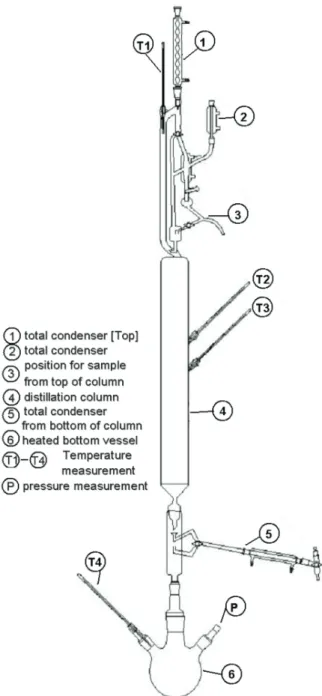
Batch vacuum distillation was performed in a distillation column shown in Figure 1. The column is
29 mm inner diameter and 2 m high and packed with NORMAG type A packaging. The column has 36 theo-retical stages that were determined experimentally by the standard mixture of CCl4-C6H6 using the
proce-dure previously reported [12]. Fractionation of the es-sential oil was conducted at absolute pressures of 8.0 and 3.35 kPa with a reflux ratio of 5. Fractions of ap-proximately 10 cm3 were collected during the
fractio-nal distillation and afractio-nalyzed using GC-FID and GC-MS.
Figure 1. Schematic draw of the column for distillation (rectification column).
GC-FID Analysis
(Varian 3400). A fused silica DB-5 capillary column, 25 m×0.32 mm internal diameter, and 0.25 μm film thicknesses, was used. The purged splitless mode of sampling was implemented. The column temperature was maintained at 50 °C for 2 min and then pro-grammed to increase as follows: at 2 °C/min to 250
°C, and holding at 250 °C for 5 min. The flow rate of the carrier gas (nitrogen) through the column was 2 mL min-1 and the inlet pressure was 68 kPa. The in-jector temperature was 250 °C and the detector tem-perature 300 °C. The quantitative presence of a com-pound in the samples was determined using the me-thod of peak-area normalization, without the applica-tion of response factor correcapplica-tions. Injecapplica-tions were re-peated in triplicate.
GC-MS Analysis
The samples prepared using the same proce-dure as for the GC analysis were subjected to GC-MS analysis on a Varian 3400 split/splitless (1:20) gas chromatograph with a mass spectrometry detector Finningan Ion Trap ITD-705, ionization voltage of 70 eV. A fused silica Supelco column PTE-5, 30 m×0.25 mm internal diameter and 0.25 μm film thickness was used. The column temperature was maintained at 60
°C for 1 min and then programmed to increase as follows: at 4.3 °C/min to 286 °C and holding at 286 °C for 5 min. The linear flow velocity of the carrier gas (hydrogen) through the column was 1 mL min-1. The injector and detector temperature were 250 and 300
°C, respectively. The sample (1 μL) was injected in the split mode (1:60).
The identification of the main compounds pre-sent in the espre-sential was based on the comparison of their retention time and GC elution sequence with li-terature data for juniper berry essential oil [13-15] and also by matching the mass spectra of every GC peak with those of the AMDIS program, ver. 2.1. The com-position of the juniper berry essential oil used for frac-tionation is shown in Table 1.
RESULTS AND DISCUSSION
The experimental vacuum fractionation
The batch vacuum fractionation of juniper ber-ries’ essential oil was performed in a distillation co-lumn which contains 36 theoretical stages. The other operating conditions were: hold-up per stage: 0.001 kg, condenser hold-up: 0.005 kg, condenser pres-sure: 7.3 kPa, column pressure drop: 0.7 kPa, boil-up rate 0.0339 kg/h at total reflux and boil-up rate 0.0249 kg/h at reflux 5. The detailed operating procedure (temperature on the top and bottom, time of fraction accumulation and their masses) and masses of col-lected fractions are given in Table 2.
As it could be seen from Table 1, the juniper berries’ essential oil is rich in α-pinene and with sa-binene and myrcene (about 72 mass% of the oil). Be-cause of that, the fractionation could be easily per-formed with a goal to concentrate the α-pinene even the boiling points of these compounds are very close to each other.
During the fractional distillation at 8.0 kPa, and furthermore at 3.35 kPa, the several fractions were
Table 1. The composition of essential oil of Juniper communis L. used in this study
Rt / min Component Content, mass%
14.7 α-Pinene 40.5
16.6 Sabinene 18.0
17.9 Myrcene 13.5
19.2 p-Cymene 2.3
19.9 Limonene 5.1
21.4 γ-Terpinene 2.2
23.1 Terpinolene 1.2
29.4 1-Terpinen-4-ol 2.5
43.5 α-Cubebene 1.0
45.2 α-Copaene 1.4
47.3 β-Elemene 1.1
49.9 β-Cariofilene 0.6
50.8 α-Hymulene 0.6
51.5 Germacrene-D 0.1
53.6 Bicyclogermacrene 1.3
58.2 γ-Cadinene 0.6
58.9 δ-Cadinene 0.6
collected (14 fractions, Table 3). In the first six frac-tions the α-pinene was separated with the concen-tration of more than 98.3 mass%. The next several fractions (7-10) the concentration of α-pinene signifi-cantly decrease while sabinene appeared up to the concentration of 42.7. Myrcen and limonene was col-lected in the next fractions (sum 10-14, Table 3). Such a distribution of the main constituents of juniper ber-ries’ essential oil in the fractions was expected, due to the similar boiling temperatures of these chemical compounds (α-pinene 155–156 °C sabinene 163–164
°C, myrcene 167–171 °C, limonene 175–177 °C). Ac-cording to the present result it is evident that the se-paration of essential oil by batch vacuum distillation could give the fraction with pure (>99 mass%) α-pine-ne, as well as fraction with a higher content of sabi-nene and myrcene. The fractionation of less volatile compounds is not possible because of high tempera-ture in a still pot and thermal degradation of remaining compounds.
Simulation of Juniper’s essential oil fractionation
The simulation of batch vacuum distillation was performed using ASPEN Plus® v2006 software. The procedure of critical parameters, as well as the va-pour pressure data calculation using the group contri-bution method for some components of essential oil [16,17] was done; they are presented in Table 4 (M, molecular weight; tB, normal boiling point; VB, liquid
volume at tB; TC, critical temperature; pC, critical
pres-sure; vC, liquid molar volume at critical point; ω –
acen-tric factor; ZC – compressibility factor). The different
group contribution parameters, as well as the calcu-lation procedure for all physical and thermodynamic parameters are previously reported [16-18].
The vapour pressure data (pV) were calculated
using the extended Antoine vapour pressure (pV in
N/m2) equation:
lnpV = A + B/(T + C) + D *T + E* lnT + F*TG
where t is temperature in K, and A, B, C, D, E, F and
G are coefficients different for every components. They are used from Aspen data base or calculated using the Riedel method [19] enabling the determi-nation of the vapour pressure for the temperature be-tween 200 and 1000 K (Table 5).
Peng Robinson EOS as a thermodynamic model was used for the determination of the vapour-liquid equilibrium composition. The flowsheet of batch distil-lation (fractionation) column is shown in Figure 2.
The Aspen simulation of juniper berries’ es-sential oil fractional distillation was performed at the same column specification as well as operating con-ditions, as previously described experiment. The used chemical composition for the input were: 41 mass% of α-pinene, 20 mass% of sabinene, 15 mass% of myr-cene, 8 mass% of D-limonene, 5 mass% of γ -terpi-nene, 5 mass% of terpinen-4-ol and 5 mass% of ger-Table 2. The procedure of fraction distillation in a laboratory
Fraction Volume of fraction, cm3 Mass of fraction, g Temperature (top), °C Temperature (bottom), °C Time Start End Start End
Pressure 8 kPa
1 21 17.8 <40.0 49.0 83.0 85.0 7
2 20 17.0 49.0 59.0 85.0 91.0 15.55
3 20 17.3 59.0 59.0 91.0 91.5 28.52
4 20 17.1 64.0 64.0 94.0 94.0 39.72
5 23 19.0 64.0 64.0 95.5 96.0 53.85
6 23 18.7 64.0 64.5 96.0 100.2 68.78
Sum 1-6 124 106.9 <40.0 66.2 83.0 100.2 68.78
7 22 17.5 66.2 66.2 102.0 104.2 82.65
8 19 15.7 66.0 67.0 105.5 107.5 98.25
9 23 19.6 67.0 67.0 108.0 117.0 123.25
Sum 7-9 64 52.8 66.2 66.8 102.0 117.0 123.25
Pressure 3.35kPa
10 9.0 6.6 47.0 47.8 121.0 127.0 136.22
11 10.0 7.3 47.4 48.0 129.0 131.5 152.22
12 10.0 7.1 46.8 47.6 134.5 137.5 171.20
13 10.0 6.8 47.5 47.8 139.0 141.0 206.03
14 10.0 6.9 48.0 50.0 146.0 148.8 235.95
macrene. The simulation was performed in three ope-rating steps (periods) in accordance with the experi-mental data; the first operating step represent the sum of fractions 1-6, the second represent the sum of 7-9 fractions, and the third, the sum of 10-14 frac-tions. Simulated end time of the first operating step (targeting to the <99mass% α-pinene purity in distil-late) was after 74 min when 100.6 °C was reached (Figure 3), what is in good agreement with
experi-mental data (68.3 min and 100.6 °C, Table 3). The yield of this fraction determined by simulation was 115 g what is very close to the experimentally collec-ted mass (Table 3, 106.9 g is sum of 1-6 fractions).
The obtained results indicated that simulation of the distillation process performed by Aspen software, which mainly depends on the proposed thermodyna-mic model and defined so called “pseudo” mixture
Table 3. The chemical composition of the obtained fractions
Fraction Composition in fractions, mass %
α-Pinene Sabinene Myrcene Limonene
1 99.8 - - -
2 99.1 0.4 - -
3 99.3 0.5 - -
4 99.0 0.8 - -
5 98.3 1.5 - -
6 94.4 5.4 - -
Sum 1-6 98.3 1.7 - -
7 86.7 12.8 - -
8 63.1 35.7 - -
9 21.9 74.9 2.4 -
Sum 7-9 55.8 42.7 0.9 -
10 1.3 54.4 31.1 11.4
11 0.9 37.3 43.3 17.1
12 0.7 45.0 26.8 25.8
13 - 25.4 39.9 33.1
14 - 12.0 24.0 52.4
Sum 10-14 0.6 36.1 34.3 29.0
Table 4. The physical and thermodynamic parameters for some components present in essential oil (literature and calculated data)
Parameter α-Pinene Sabinene Myrcene D-limonene γ-Terpinene Terpinen-4-ol Germacrene
M, g/mol 136.24 136.24 136.24 136.24 136.24 136.24 204.36
tB, °C 156.14 164.04 171.15 177.45 183.00 187.00 308.10
vB, m 3
/kmol 0.1826 0.1845 0.1899 0.1906 0.1942 0.1904 0.3298
TC, K 644.00 643.00 649.00 653.00 661.00 667.00 804.50
pC, bar 27.60 27.60 28.00 28.20 28.00 28.20 19.42
vC, m 3
/kmol 0.454 0.494 0.489 0.470 0.489 0.493 0.727
ω 0.221 0.325 0.372 0.381 0.376 0.376 0.437
ZC 0.234 0.255 0.254 0.244 0.249 0.251 0.211
Table 5. The values of constants used for vapour pressure calculation
Constant α-Pinene Sabinene Myrcene D-limonene γ-Terpinene Terpinen-4-ol Germacrene
A 97.75 73.81 67.36 91.50 75.57 64.70 72.60
B -8491.60 -7756.10 -7924.40 -8620.50 -8079.70 -7864.70 -10211.58
C 0.00 0.00 0.00 0.00 0.00 0.00 0.00
D 0.00 0.00 0.00 0.00 0.00 0.00 0.00
E -11.12 -7.34 -6.29 -10.11 -7.56 -5.89 -6.84
F 5.33E-06 8.04E-18 3.68E-18 4.97E-06 8.39E-18 2.72E-18 1.30E-18
containing only 7 compounds which represents the essential oil well fits the experimental data. Further-more, this simulation could be used for the optimi-sation of vacuum distillation of juniper essential oil taking into account different operating condition (num-ber of plate, reflux ratio) and calculating the energy consumption necessary for the realization of a desi-red separation.
Figure 2. The flowsheet of the batch distillation process.
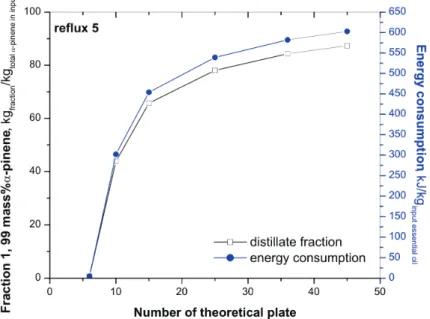
The analysis of the relation between the number of theoretical plates and the yield of fraction 1 con-taining more than 99 mass% of α-pinene is shown in Figure 4 and Table 6. One can conclude that a de-crease in the number of theoretical plates in a column decreases the yield of fraction 1, as well as the ope-ration time and energy consumption (Figure 4). The isolation of fraction with more than 99 mass% of α -pi-nene is not possible in a column containing less than 6 theoretical and using reflux ratio 5.
The results of the simulation analysis for differ-rent reflux ratio and number of theoretical plates and for fixed composition (purity) of fraction 1 are shown in Table 6.
A detailed calculation performed using a diffe-rent number of theoretical plates showed that the same energy is consumed per 1 kg of distillate for the same reflux ratio. For example, for reflux ratio 5 and 25, 36 or 45 number of theoretical plates consumed energy is 53.9 MJ (app. 15 kWh), 58.2 MJ (16.2 kWh) and 60.3 MJ (16.8 kWh) for the distillation performed with batch containing 100 kg of juniper essential oil, respectively. Knowing that the market price of juniper essential oil is between 100 and 150 Euros and that it depends on the quality of oil, while the price of energy is about 0.1 Euro/kWh, it seems that the consumed energy in all investigated cases expressed in Euros could be neglected.
According to the results shown in Table 6 and taking into consideration the yield of α-pinene which might be separated from one batch, it is clear that the optimal reflux ratio for a column with 25, 36 or 45 theo-retical plates should be 5. Namely, the increase of α- -pinene yield is the largest if the reflux ratio increases from 2 to 5; a further increase of the reflux ratio from 5 to 7 and 10 only increases the yield of α-pinene for 10% (N = 25) or less (N = 35 and N = 45).
Process economy
The effect of the separation process depends on the number of plates and reflux ratio and it could be better analyzed if the preliminary or short-cut econo-mic analysis is taken in consideration. The following function based on the mass and energy balance was used for defining the money flow for the separation of one batch:
) kg euro ( ) residue(kg )
kg euro ( ) (kg Distillate )
kJ euro ( ) kJ ( Energy )
kg euro ( ) kg
( C1 C2 C3 C4
EO × + × = × + ×
1
3 n C
C = ×
kg) ( (kg)
Distillate =Y ×EO
where: EO – mass of one batch of the essential oil; C1,
C3 and C4 are the prices of the essential oil, the α
-pi-nene fraction (distillate) and residue (per 1 kg), and
C2 the price of energy.
Also, a few assumptions were taken in eco-nomic analysis: the value of the residue is set to zero;
150 ) kg euro (
1 =
C ;
Figure 4. The impact of the number of the theoretical plate.
Table 6. The impact of reflux and the number of theoretical stages to distillate the amount and energy consumption for 1 kg charge of ju-niper essential oil
Parameter reflux 2 reflux 5 reflux 7 reflux 10
25 Theoretical stages
Time, min 35.7 76.8 83.4 87.3
Distillate yielda, kgdistillate/kginput 0.149 0.320 0.348 0.364
Bottom temperature, °C 87.3 92.7 93.9 94.7
Heat duty in reboiler, W 58.4 116.9 155.7 213.8
Consumed energy, kJ/kgdistillate 839.5 1683.4 2238.9 3076.6
36 Theoretical stages
Time, min 50.8 83.0 87.4 89.8
Distillate, kgdistillate/kginput 0.211 0.346 0.364 0.374
Bottom temperature, °C 89.2 94.3 95.3 95.9
Heat duty in reboiler, W 58.5 116.9 155.6 213.7
Consumed energy, kJ/kgdistillate 845.1 1682.5 2241.7 3078.6
45 Theoretical stages
Time, min 60.2 86.0 89.2 90.8
Distillate, kgdistillate/kginput 0.251 0.358 0.372 0.378
Bottom temperature, °C 90.7 95.4 96.2 96.7
Heat duty in reboiler, W 58.6 116.9 155.6 213.7
Consumed energy, kJ/kgdistillate 843.3 1684.9 2238.6 3080.0
a
5 2 kJ ) 1.94 10
euro
( = × −
C ;
the minimum price of α-pinene (distillate) C3 should
be 366 Euro/kg requiring that the cash flow per one batch is not negative; n=2.93 derived from the as-sumption that 20% income could be realized for theo-retical separation of α-pinene present in juniper es-sential oil.
Solving the equation of the money flow showed that the yield of distillate, Y, should not be lower than 0.341.
The most important conclusion derived from the performed economic analysis showed that the energy consumption has no influence on the process profita-bility (because of low energy price).
The time necessary for one batch treatment is very important and determines, together with non-pro-ductivity time for one batch, how many batches per day might be separated. As it could be seen from the data given in Table 6, the time necessary for sepa-rating one batch is not significantly changed for a column with 25, 36 and 45 theoretical stages for all defined profitable distillate yield (Y ≥ 0.341).
Furthermore, knowing that the smallest invest-ment is for constructing a column with 25 theoretical stages, it seems that the most profitable case will be the separation of juniper essential oil and α-pinene isolation (>99 mass%) in a column with 25 theoretical stages using reflux 7 or more.
CONCLUSION
The fractional separation of juniper essential oil was performed in a vacuum distillation column with 36 stages. Several fractions of distillate were collected and their compositions were analyzed. The obtained results showed that the separation of the essential oil under vacuum could be used for different fractions isolation. The most interesting and important is the first distillate containing α-pinene (> 99 mass%).
The simulation of the batch vacuum distillation process was performed using Aspen software on the basis of a specified thermodynamic model, deter-mined composition of “pseudo” components repre-senting the composition of the essential oil. This mo-del fits the experimental data well (the temperature and composition of collected fractions, their masses and time of distillation). The defined model and simu-lation procedure were used for the process optimisa-tion and determining the best condioptimisa-tion for separating juniper essential oil and α-pinene isolation. Taking into account the prices of essential oil and distillate (α-pinene; >99mass%), the yield of distillate in diffe-rent column with 25, 36 and 45 theoretical stages,
and under different operating condition (reflux ratio), as well as consumed energy necessary for realizing the distillation process, it was shown that column with 25 theoretical stages with reflux 7 or more gave the most profitable separation of α-pinene (>99 mass%) from juniper essential oil.
Acknowledgements
The financial support of the Ministry of Science and Environmental Protection of the Republic of Ser-bia, project ON 142073, is gratefully acknowledged. S. Glišić and D. Skala are grateful to the CHEN De-partment at Texas A&M University at Qatar for using Aspen software during their work in Doha.
REFERENCES
[1] S.B. Glišić, S.Ž. Milojević, S.I. Dimitrijević, A.M. Orlović, D.U. Skala, J. Serb. Chem. Soc., 72 (4) (2007) 311-320 [2] M.Z. Stanković, V.B. Veljković, M. Lazić, Bioactive
pro-ducts of juniper fruit (Juniperus communis L.), Mono-graphy, Faculty of Technology in Leskovac, University of Niš, 1994 (in Serbian)
[3] B.M. Damnjanović, M.Sc. Thesis, Faculty of Technology and Metallurgy, Belgrade, 2000 (in Serbian)
[4] B. Barjaktarević, M. Sovilj, Z. Knez, J. Agric. Food. Chem. 53 (2005) 2630-2636
[5] L. Janku, U. Hava, O. Motl, Experientia 13 (1957) 255-256 [6] M. Mori, J. Cosm. Derm.1 (2002) 183-187
[7] B. Tepe, D. Daferera, A. Sokmen, M. Sokmen, M. Polis-siou, Food Chem. 90 (3) (2005) 333-340
[8] B. Marongiu, S. Porcedda, A. Caredda, B. de Gioannis, L. Vargiu, P. la Colla, Flavour Fragrance J. 18 (5) (2003) 390-397
[9] T. Fang, M. Goto, M. Sasaki, T. Hirose, J. Agric. Food Chem. 52 (2004) 5162-5167
[10] D. Lopes, A. Raga, G.R. Stuart, J.V. de Oliveira, J. Es-sent. Oil Res. 15 (2003) 408-411
[11] G.R. Stuart, D. Lopes, J.V. Oliveira, J. Amer. Oil Chem. Soc. 78 (2001) 1041-1044
[12] S. Glisic, Fractionation of Juniper communis L. essential oil, Diploma work, Faculty of Technology and Metallurgy, Belgrade, Serbia, 2003 (in Serbian)
[13] Yugoslav standard, 1994, Essential oil analysed with gas chromatography on a capilary column, JUS ISO 7609, Službeni list SRJ, No. 27/94
[14] Yugoslav standard, 1996, Essential oil of juniper ( Juni-perus communis Linnaeus), JUS H. H9. 055, Službeni list SRJ, No. 1/96 (in Serbian)
[15] B.M. Damjanović, D.U. Skala, D.M. Petrović-Đakov, J.K. Baras, J. Essent. Oil Res. 15 (2) (2003) 90-92
[16] R. Gani, L. Constantinou, Fluid Phase Equilibria 116 (1996) 75-86
[17] R. Gani, B. Nielsen, A. Fredenslund, AIChE J. 37 (1991) 1318–1332
[18] S.B. Glišić, D.U. Skala, J. Supercrit. Fluids, 2010, in Press, doi:10.1016/j.supflu.2010.03.005
SVETOMIR Ž. MILOJEVIĆ1
SANDRA B. GLIŠIĆ2
DEJAN U. SKALA2
1
Fakultet tehničkih nauka, Kosovska Mitrovica
2
Katedra za organsko hemijsku tehnologiju, Tehnološko metalurški fakultet, Univerzitet u Beogradu, Beograd
NAUČNI RAD
FRAKCIONA DESTILACIJA ETARSKOG ULJA
Juniperus
communis
L.: LABORATORIJSKA ISPITIVANJA,
MATE-MATI
Č
KA SIMULACIJA I EKONOMIKA PROCESA
U ovom radu je ispitivana separacija etarskog ulja iz bobica kleke (Juniperus communis L. sa podneblja južne Srbije) postupkom šaržne vakuum destilacije. Glavni cilj labora-torijskih ispitivanja je usmeren ka izdvajanju pojedinih frakcija iz etarskog ulja kleke koje sadrže u većem procentu α-pinen, sabinen i mircen, a čine 65 mas% etarskog ulja dobi-jenog hidrodestilacijom bobica kleke. Rezultati eksperimentalnih ispitivanja sprovedenih šaržnom destilacijom pod vakuumom (8,0-3,35 kPa) u koloni sa 36 teorijskih podova su bili osnova za definisanje odgovarajućeg matematičkog modela i njegovog rešavanja primenom softverskog paketa Aspen. Dobijeno je dobro slaganje između eksperimen-talnih vrednosti i vrednosti izračunatih na osnovu ovog modela. Potvrđena korektnost modela iskorišćena je za analizu uticaja različitih operativnih parametara (refluksni od-nos od 2 do 10) i konstrukcionih karakteristika kolone (broj podova: 25, 36 i 45) na efekte separacije etarskog ulja kleke. Rezultati su pokazali, na osnovu analize uticaja cene ula-zne sirovine, cene izdvojenih frakcija (α-pinen; smeše α-pinena sabinena, mircena) i ukupno utrošene energije za separaciju, da je u laboratorijskim uslovima izvedeno frak-cionisanje etarskog ulja kleke najprihvatljivije.