Changes in body weight, C-reactive protein, and
total adiponectin in non-obese women after 12
months of a small-volume, home-based exercise
program
Mauro Felippe Felix Mediano,IFabiana Alves Neves,IIAlessandra Cordeiro de Souza Rodrigues Cunha,II Erica Patricia Garcia de Souza,II Anibal Sanchez Moura,IIRosely SichieriI
IState University of Rio de Janeiro (UERJ), Institute of Social Medicine, Department of Epidemiology, Rio de Janeiro/RJ, Brazil.IIState University of Rio de Janeiro (UERJ), Department of Physiological Sciences, Rio de Janeiro/RJ, Brazil.
OBJECTIVE: Our objective was to evaluate the effects of small-volume, home-based exercise combined with slight caloric restriction on the inflammatory markers C-reactive protein and adiponectin.
METHODS:In total, 54 women were randomly assigned to one of two groups for exercise intervention: the control or home-based exercise groups. Weight, waist and hip circumferences, and inflammatory markers were measured at baseline and after 6 and 12 months. Women allocated to the home-based exercise group received a booklet explaining the physical exercises to be practiced at home at least 3 times per week, 40 minutes per session, at low-to-moderate intensity. All participants received dietary counseling aimed at reducing caloric intake by 100-300 calories per day, with a normal distribution of macro-nutrients (26-28% of energy as fat). Clinicaltrials.gov: NCT01206413
RESULTS:The home-based exercise group showed a significantly greater reduction in weight and body mass index at six months, but no difference between groups was observed thereafter. With regard to the inflammatory markers, a greater but non-statistically significant reduction was found for C-reactive protein in the home-based exercise group at six months; however, this difference disappeared after adjusting for weight change. No differences in adiponectin were found at the 6- or 12-month follow-up.
CONCLUSION: Small-volume, home-based exercise did not promote changes in inflammatory markers independent of weight change.
KEYWORDS: Inflammation; Obesity; Overweight; Prevention; Physical Activity; Exercise.
Mediano MF, Neves FA, Cunha AC, Souza EP, Moura AS, Sichieri R. Changes in body weight, C-reactive protein, and total adiponectin in non-obese women after 12 months of a small-volume, home-based exercise program. Clinics. 2013;68(8):1121-1127.
Received for publication onFebruary 7, 2013;First review completed onMarch 14, 2013;Accepted for publication onApril 9, 2013
E-mail: [email protected]
Tel.: 55 21 2442-7661
& INTRODUCTION
Obesity is considered to be a state of chronic, low-grade inflammation in which a greater production of pro-inflammatory cytokines overcomes the production of cytokines with anti-inflammatory properties. This condition seems to be involved in the pathogenesis of insulin resistance and vascular injury among obese individuals, predisposing those who gain weight to a greater risk of developing type 2 diabetes and cardiovascular diseases
(1-3). C-reactive protein (CRP), which is secreted by liver cells, is a well-recognized clinical marker of inflammation that has been implicated in the pathogenesis of many chronic diseases. Large cross-sectional studies have shown that elevated serum levels of CRP are associated with increased body weight (4,5). In contrast, adiponectin is a protein secreted in abundance by adipose tissue in healthy subjects and possesses insulin-sensitizing, anti-inflamma-tory, and anti-atherogenic properties (6). Adiponectin levels are reduced in conditions such as obesity, type 2 diabetes, metabolic syndrome, and ischemic heart disease (7,8).
Lifestyle interventions focusing on the prevention of weight gain, including physical activity, are an important method of curbing the increasing prevalence of obesity and its complications (9,10). Although many studies have demonstrated the beneficial effects of exercise on anthro-pometric and metabolic parameters, the effects of exercise on the state of chronic, low-grade inflammation remain Copyrightß2013CLINICS– This is an Open Access article distributed under
the terms of the Creative Commons Attribution Non-Commercial License (http:// creativecommons.org/licenses/by-nc/3.0/) which permits unrestricted non-commercial use, distribution, and reproduction in any medium, provided the original work is properly cited.
No potential conflict of interest was reported.
controversial (11-14). The results of cross-sectional studies indicate an important association between high levels of physical activity, low levels of CRP, and increased total adiponectin (15,16). A large longitudinal study of 3,042 individuals (1,524 men and 1,518 women), without any evidence of cardiovascular risk, evaluated the relationship between self-reported physical activity status and serum inflammatory markers and showed that participants devoted to high physical activity (.7 kcal/min expended) had a 29% lower concentration of C-reactive protein compared with those who were sedentary, even after adjusting for several confounders, such as gender, age, smoking habits, body mass index, total cholesterol, glucose, and blood pressure (17). Moreover, a cross-sectional study conducted by Tsukinoki et al. (18) investigating the associations between lifestyle factors (including physical activity levels) and plasma adiponectin levels among 202 Japanese male workers showed that even after adjustments for potential confounders, exercising two or more times per week significantly decreased the risk of low adiponectin levels (OR = 0.21; 95% CI = 0.06-0.74).
In contrast, the results from clinical trials that examined the effects of exercise on low-grade inflammation are far from conclusive, with some studies showing the beneficial effects of exercise related to weight loss, others showing beneficial effects independently of weight loss, and still others showing no effect for exercise. It is noteworthy that most of these results were observed in obese individuals with high inflammatory levels at baseline (19-23). The degree of obesity may complicate the evaluation of exercise
per seon inflammatory markers.
An important aspect related to the practice of physical activity is the low adherence to formal programs (24), which limits the efficacy of this intervention and highlights the need to identify strategies to promote an increased adherence to physical exercise. In this context, home-based exercise programs could emerge as an important and feasible strategy to prevent weight gain because it is low cost and less time-consuming . Some authors have shown positive effects of this intervention on different types of outcomes (25,26). Additionally, the prescribed amount of exercise may be of paramount importance to exercise adherence, with more demanding exercise programs asso-ciated with poorer adherence (27).
Therefore, we designed a study based on a small-changes approach (28) in which a small volume and low-to-moderate intensity home-based exercise program improves exercise adherence and subsequently promote greater health benefits. The main results of the present trial related to weight change and lipids have already been published (29). In the present analysis, we randomly selected a subgroup of blood speci-mens from our previous participants to evaluate the effects of small-volume, home-based exercise combined with slight caloric restriction on C-reactive protein and total adiponectin. Our study, conducted in a more homogeneous group of non-obese women, may aid us in evaluating the effect of exercise on inflammation.
& MATERIALS AND METHODS
The study population consisted of a sub-sample of a randomized clinical trial aimed at evaluating the effects of home-based exercise on weight change among non-obese women over a 12-month period. The full description and
results of the effects of exercise intervention on anthropo-metric measures have been published elsewhere (29). Briefly, 203 healthy women aged 25-45 years with a body mass index (BMI) of 23-29.9 kg/m2 and who were not
pregnant or breastfeeding, had at least one child, and did not practice regular physical activity at least 6 months prior the study were randomly assigned to one of two groups for exercise intervention: the control (CG) or home-based (HB) exercise groups. All participants were fully informed about the objectives of the study and signed an informed consent form to participate. The study was approved by the Institutional Review Board of the State University of Rio de Janeiro.
In the present analysis, we included a total of 54 women (CG = 28 and HB = 26) from whom blood samples were collected at baseline and 6 and 12 months of follow-up. The sample size required to detect a difference of 1.2 mg/L for C-reactive protein with a standard deviation of 0.97 mg/L, assuming a power of 90% and a significance level of 5%, was 30 women. Allowing for non-compliance in both groups, the estimated sample size was 50 (25 for each group).
Measurements
Weight, waist and hip circumferences, and inflammatory markers were measured at baseline and after 6 and 12 months of follow-up. Height was measured to the nearest 0.5 cm with a wall-mounted stadiometer, and body weight was measured using the same calibrated digital scale for all participants. Circumferences were determined with the participants standing and were measured at the largest girth of the hip and at the smallest girth of the waist. All measurements were performed in the morning, and blood samples were collected after a 10-hour fast. Aliquots of plasma and serum were isolated from the blood samples and frozen at -70
˚
C within 2 h of being drawn.The CRP concentration was determined using an enzyme immunoassay kit for humans according to the manufacturer’s instructions (Human PCR Enzyme-linked Immunosorbent Assay Kit, USCN Life Science Inc., P.R., China). The kit had an assay sensitivity of 0.059 ng/mL and an intra-assay variation coefficient of 3.75%. Total serum adiponectin was determined using a commercial radioimmunoassay kit (Human Adiponectin RIA KIT I125 coated tube, Millipore Corporation, MA, USA) with an assay sensitivity of 1 ng/mL and an intra-assay variation coefficient of 8.54%.
Intervention
from a chair (30 minutes; balls and ropes were provided to the participants); and 3) a cool-down period during which the same initial stretching exercises were performed (5 minutes). Compliance with the exercise program was assessed once per month during the counseling sessions by having the women mark the days on which they exercised on a specific card printed with the days of the week. At this time, possible doubts related to the exercise program were clarified. The control group received only general information about the benefits of physical activity; no formal exercise prescription was provided to this group. Both groups received dietary counseling aimed at reducing their caloric intake by 100-300 calories per day, with a normal distribution of macro-nutrients (26-28% of energy as fat).
Data analysis
The baseline characteristics of the two groups were compared using Student’s t-test. Baseline correlations between anthropometric measures, CRP, and total adiponec-tin were estimated using the Spearman’s correlation coeffi-cient. Temporal changes in the anthropometric and inflammatory markers between groups were assessed by repeated random regression analysis using the procedure PROC MIXED in SAS (version 9.1, SAS Institute Inc, Cary, NC, USA). The analysis of anthropometric measures included BMI at baseline as a covariate, whereas the baseline measures were included for CRP and total adiponectin. Because of the non-linear weight change observed, the model incorporated a quadratic term (time6time) variable. The term
of interest was time6treatment interaction, which estimates
the rate of change in the outcomes. Statistical significance was set atp,0.05 for all analyses.
& RESULTS
No differences between the control and exercise groups were found in the baseline characteristics except for age,
which showed a small difference (39.4¡4.7 and 36.9¡5.5, respectively;p= 0.08), and CRP, which showed a statistically
significant difference (0.68¡0.32vs.0.99¡0.54, respectively; p= 0.01). As expected, the Spearman’s correlation coefficient
between anthropometric measurements, CRP, and total adiponectin at baseline showed that CRP was significantly associated with body weight (r = 0.30; p= 0.05) and BMI
(r = 0.30; p= 0.04), whereas adiponectin was significantly
inversely associated with the waist-to-hip ratio (r = -0.30;
p= 0.03).
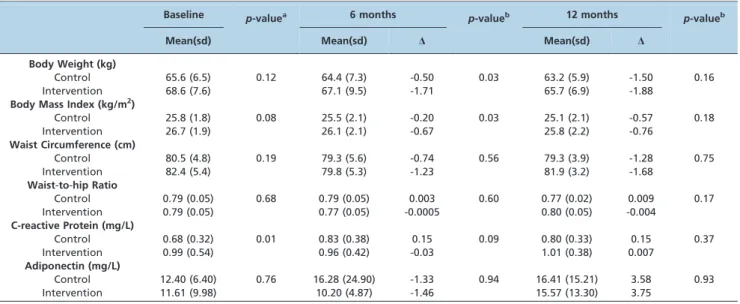
During follow-up, the HB group showed a greater reduction in weight (-1.71vs.-0.50;p= 0.03) and BMI (-0.67 vs. -0.20; p =0.03) at six months. Thereafter, no differences
between the groups were observed in these parameters (Table 1). For the inflammatory markers, a greater but non-statistically significant reduction was found for CRP in the HB group at six months (-0.03 vs. 0.15; p= 0.09), but this
difference disappeared after adjusting for weight change (p= 0.30). Additionally, no differences were found for total
adiponectin during the 12 months of follow-up (Table 1). The main changes in CRP and adiponectin during the 12 months of follow-up are shown in Figure 1. The compliance rates with the exercise protocol during the follow-up period were 79 and 80% for months 6 and 12, respectively.
& DISCUSSION
The present study demonstrated that a small volume of home-based exercise did not promote changes in either CRP or total adiponectin levels and highlights the importance of weight loss for the reduction of CRP, independently of physical activity, even among non-obese women. A greater reduction in CRP was observed among exercisers at 6 months of follow-up; however, this difference was not maintained when weight was regained after 6 months, and the borderline association disappeared when the analysis of CRP change at 6 months was adjusted for weight change.
Table 1 -Crude means (standard deviation) and adjusted changes from baseline (D) for anthropometric measurements and inflammatory markers during the follow-up by intervention group (controls = 28 and home-based exercise = 26).
Baseline p-valuea 6 months p-valueb 12 months p-valueb
Mean(sd) Mean(sd) D Mean(sd) D
Body Weight (kg)
Control 65.6 (6.5) 0.12 64.4 (7.3) -0.50 0.03 63.2 (5.9) -1.50 0.16
Intervention 68.6 (7.6) 67.1 (9.5) -1.71 65.7 (6.9) -1.88
Body Mass Index (kg/m2)
Control 25.8 (1.8) 0.08 25.5 (2.1) -0.20 0.03 25.1 (2.1) -0.57 0.18
Intervention 26.7 (1.9) 26.1 (2.1) -0.67 25.8 (2.2) -0.76
Waist Circumference (cm)
Control 80.5 (4.8) 0.19 79.3 (5.6) -0.74 0.56 79.3 (3.9) -1.28 0.75
Intervention 82.4 (5.4) 79.8 (5.3) -1.23 81.9 (3.2) -1.68
Waist-to-hip Ratio
Control 0.79 (0.05) 0.68 0.79 (0.05) 0.003 0.60 0.77 (0.02) 0.009 0.17
Intervention 0.79 (0.05) 0.77 (0.05) -0.0005 0.80 (0.05) -0.004
C-reactive Protein (mg/L)
Control 0.68 (0.32) 0.01 0.83 (0.38) 0.15 0.09 0.80 (0.33) 0.15 0.37
Intervention 0.99 (0.54) 0.96 (0.42) -0.03 1.01 (0.38) 0.007
Adiponectin (mg/L)
Control 12.40 (6.40) 0.76 16.28 (24.90) -1.33 0.94 16.41 (15.21) 3.58 0.93
Intervention 11.61 (9.98) 10.20 (4.87) -1.46 15.57 (13.30) 3.75
aStudent’s t-test.
bRepeated random regression analysis; the model included time, treatment, and the time
6treatment interaction adjusted for baseline values (PROC
The importance of weight loss in CRP changes has been observed in many studies using different types of interven-tions, including physical activity (31,32). A randomized controlled trial conducted by Campbell et al. (33) evaluated the effects of a year-long moderate-intensity aerobic exercise program (60-75% maximal HR, 40 minutes per session, 3 days per week) on CRP in 115 overweight or obese postmenopausal women. There was a statistically signifi-cant reduction in CRP among exercisers compared with controls (-0.24vs.0.29;p =0.01), with better results obtained
in those women who were obese at baseline and lost a greater amount of weight. In addition, only those exercisers who decreased their body fat by 2% or greater experienced a statistically significant reduction in CRP versus controls,
suggesting that the exercise effect was primarily dependent on fat loss. In another randomized controlled trial, Church et al. (34) observed no effect of exercise training without weight loss on the reduction of CRP when studying individuals with a BMI between 18.5 and 40 kg/m2 and elevated CRP at baseline ($2.0 mg/L). The authors found a correlation between weight loss and reduction in CRP after 4 months of follow-up (r = 0.18; p,0.05). Moreover, Fisher et al. (35) examined the effects of three different intervention groups (diet only, diet plus aerobic training, and diet plus
resistance training) on CRP among premenopausal over-weight women until they reached a BMI,25 kg/m2 and demonstrated a significant reduction in plasma CRP in all three intervention groups at the final follow-up, with no differences in CRP among the groups. This finding suggests that independently of the type of intervention, weight loss had a more profound impact on the reduction of CRP in overweight women than exerciseper se.
Despite the importance of weight change in improve-ments in CRP, some other studies have suggested that exercise could reduce CRP even in the absence of weight loss (36,37). For instance, Donges et al. (38) conducted a clinical trial to investigate the effects of two different exercise interventions (resistance vs. aerobic exercise) on
four groups: (1) sedentary controls, (2) those receiving counseling to perform low-intensity physical activities, (3) those performing prescribed and supervised high-intensity aerobic exercise, and (4) those performing high-intensity aerobic exercise plus resistance training. Although no significant changes in body weight, BMI, fat, or fat-free mass were observed in any of the groups, the levels of CRP decreased in all three exercise groups, with a greater reduction found in those who performed aerobic plus resistance exercise after 12 months of follow-up (54% reduction from baseline). A multiple regression analysis showed that maximum oxygen consumption, exercise volume, and the type of exercise were independent predictors of changes in CRP levels, and the authors suggested that factors related to the exercise prescription, such as type, volume, and intensity of the exercise, could contribute more to improvements in CRP than weight loss. Regarding the effects of exercise on adiponectin, the exercise intervention proposed in the present study did not change the levels of this cytokine during the 12 months of follow-up, although some other studies have demonstrated the positive effects of exercise (40,41). Kriketos et al. (42) demonstrated a substantial increase in adiponectin levels (approximately 260%) after 10 weeks of aerobic exercises performed 4-5 days per week for 40 minutes per session at moderate intensity (55-70% VO2 max) in overweight
individuals. This result was corroborated by the findings of Yoshida et al. (43), revealing that an increase of 51% in adiponectin values was observed after 16 weeks of moderate-intensity exercise (60-80% of age-predicted max-imal heart rate) performed 2-3 times per week for 60 minutes per session in normal-weight dyslipidemic indivi-duals.
A systematic review conducted by Simpson & Singh (21), which included a total of eight randomized clinical trials evaluating the effects of exercise on adiponectin, showed a significant increase in plasma adiponectin ranging from 4.7-34.0% across studies, with an average increase of 16.3%, in response to different exercise modalities ranging from moderate to high intensities. The authors suggested that a minimum exercise volume of 90 minutes per week appeared to be necessary to achieve significant increases in adipo-nectin levels, and a possible dose-response effect of intensity has been observed in some studies (44).
Polak et al. (45) examined the effects of low-intensity aerobic exercise (50% VO2max) performed 5 days per week
for 12 weeks among 25 obese sedentary premenopausal women and found no changes in adiponectin levels even in the presence of significant decreases in body weight and fat mass of 5.9 and 6.5% (p,0.001), respectively. Conversely, a study conducted by Moghadasi et al. (46) demonstrated that a high-intensity endurance exercise program (75-80% VO2
max) performed 4 days a week for 12 weeks increased plasma adiponectin concentrations and gene expression of this cytokine in middle-aged men, reinforcing the impor-tance of exercise intensity in inflammatory marker changes. However, it is important to note that, in the aforementioned study, a decrease in body weight was also found. The authors stated that exercise-induced changes in body weight and fat mass may play a pivotal role in improving plasma adiponectin, as previously shown by Marcell et al. (47), who observed that a greater reduction in body weight and fat mass promoted greater improvements in adiponectin levels.
The lack of a significant effect of exercise on CRP and adiponectin in the present study may indicate that our exercise protocol may have been insufficient in terms of the intensity and volume of training required to promote the physiological adaptations necessary to improve these markers. We could speculate that low-intensity exercises, such as those promoted by our study, need to lead to greater weight loss to reduce CRP and increase adiponectin, whereas higher intensity exercises seem to promote changes in inflammatory markers independently of weight loss. A systematic review conducted by Hamer (48) concluded that both fitness and fatness are associated with systemic inflammatory status and that contributions of both may depend on several factors, such as age, gender, disease, and degree of inflammation at baseline. For example, exercise training is more effective among those individuals with high CRP and low adiponectin values (49,50), a situation that did not occur in our study because none of the participants showed high CRP values (.3.0 mg/L) (51) and only one woman demonstrated low adiponectin levels (,4.0 mg/L) (52) at baseline.
Another important result of the present study corre-sponds to the baseline correlations between anthropometric measures, CRP, and total adiponectin. CRP was correlated with BMI and body weight, whereas adiponectin was associated with waist-to-hip ratio, a surrogate of central adiposity. These data suggest that total body fat is more important for the determination of CRP levels, whereas abdominal fat seems to be of central importance to adiponectin levels, confirming the findings demonstrated previously by other authors (53-55).
The limitations of the present study include the lack of a gold standard measure of physical activity, although a self-reported diary shows good correlation with other methods, such as accelerometers and double-labeled water (56,57). In addition, the inflammatory marker used in the present study (CRP) can be highly variable and can be affected by numerous factors, such as the menstrual cycle, drugs, and alcohol consumption (58-60). Due to our small sample size, it was not possible to perform a sub-group analysis separating overweight from normal-weight women, shifting our findings toward the null hypothesis. Moreover, the subjects in the present study consisted only of females who were not obese, making it difficult to extrapolate the results to males and obese individuals.
In conclusion, a small-volume, home-based exercise program did not promote changes in inflammatory markers after 6 and 12 months of follow-up among non-obese women. The greatest reduction in CRP observed among those women who performed exercise after six months was primarily caused by weight loss. Comparisons of the effects of different exercise modalities, as well as different volumes and intensities of training, on inflammatory markers and the relationship with weight change could be an important topic for future research.
& ACKNOWLEDGMENTS
Research related to this study was funded by grant 500404/2003-8 from the Brazilian National Research Council - CNPq.
& AUTHOR CONTRIBUTIONS
Mediano MF also performed the data collection, interviews, and statistical analysis, as well as wrote the first draft of the manuscript. Neves FA, Souza EP, and Cunha AC performed the biochemical analysis and helped in the statistical analysis. All authors were responsible for the critical review of the article. All authors read and approved the final version of the manuscript.
& REFERENCES
1. Yajnik CS, Joglekar CV, Lubree HG, Rege SS, Naik SS, Bhat DS, et al. Adiposity, inflammation and hyperglycaemia in rural and urban Indian men: Coronary Risk of Insulin Sensitivity in Indian Subjects (CRISIS) Study. Diabetologia. 2008;51(1):39-46.
2. Ouchi N, Parker JL, Lugus JJ, Walsh K. Adipokines in inflammation and metabolic disease. Nat Rev Immunol. 2011;11(2):85-97.
3. Monteiro R, Azevedo I. Chronic inflammation in obesity and the metabolic syndrome. Mediators Inflamm. 2010; 2010.pii:289645. 4. Choi J, Joseph L, Pilote L. Obesity and C-reactive protein in various
populations: a systematic review and meta-analysis. Obes Rev. 2012 14(3):232-44.
5. Taube A, Schlich R, Sell H, Eckardt K, Eckel J. Inflammation and metabolic dysfunction: links to cardiovascular diseases. Am J Physiol Heart Circ Physiol. 2012;302(11):H2148-65.
6. Wozniak SE, Gee LL, Wachtel MS, Frezza EE. Adipose tissue: the new endocrine organ? A review article. Dig Dis Sci. 2009;54(9):1847-56. 7. Chen SJ, Yen CH, Huang YC, Lee BJ, Hsia S, Lin PT. Relationships
between inflammation, adiponectin, and oxidative stress in metabolic syndrome. PloS One. 2012;7(9):e45693.
8. Hara T, Fujiwara H, Nakao H, Mimura T, Yoshikawa T, Fujimoto S. Body composition is related to increase in plasma adiponectin levels rather than training in young obese men. Eur J Appl Physiol. 2005;94(5-6):520-6. 9. Wadden TA, Webb VL, Moran CH, Bailer BA. Lifestyle modification for obesity: new developments in diet, physical activity, and behavior therapy. Circulation. 2012;125(9):1157-70.
10. Donnelly JE, Blair SN, Jakicic JM, Manore MM, Rankin JW, Smith BK. American College of Sports Medicine Position Stand. Appropriate physical activity intervention strategies for weight loss and prevention of weight regain for adults. Med Sci Sports Exerc. 2009;41(2):459-71. 11. Garber CE, Blissmer B, Deschenes MR, Franklin BA, Lamonte MJ, Lee
IM, et al. American College of Sports Medicine position stand. Quantity and quality of exercise for developing and maintaining cardiorespira-tory, musculoskeletal, and neuromotor fitness in apparently healthy adults: guidance for prescribing exercise. Med Sci Sports Exerc. 2011 ;43(7):1334-59.
12. Sallis RE. Exercise is medicine and physicians need to prescribe it! Br J Sports Med. 2009;43(1):3-4.
13. Nicklas BJ, You T, Pahor M. Behavioural treatments for chronic systemic inflammation: effects of dietary weight loss and exercise training. CMAJ. 2005;172(9):1199-209.
14. Ferreira AP, Ferreira CB, Souza VC, Cordova CO, Silva GC, Nobrega Ode T, et al. The influence of intense intermittent versus moderate continuous exercise on postprandial lipemia. Clinics. 2011;66(4):535-41. 15. Hamer M, Steptoe A. Walking, vigorous physical activity, and markers
of hemostasis and inflammation in healthy men and women. Scand J Med Sci Sports. 2008;18(6):736-41.
16. Abramson JL, Vaccarino V. Relationship between physical activity and inflammation among apparently healthy middle-aged and older US adults. Arch Intern Med. 2002;162(11):1286-92.
17. Panagiotakos DB, Pitsavos C, Chrysohoou C, Kavouras S, Stefanadis C. The associations between leisure-time physical activity and inflamma-tory and coagulation markers related to cardiovascular disease: the ATTICA Study. Prev Med. 2005;40(4):432-7.
18. Tsukinoki R, Morimoto K, Nakayama K. Association between lifestyle factors and plasma adiponectin levels in Japanese men. Lipids Health Dis. 2005;4:27.
19. Christiansen T, Paulsen SK, Bruun JM, Pedersen SB, Richelsen B. Exercise training versus diet-induced weight-loss on metabolic risk factors and inflammatory markers in obese subjects: a 12-week randomized intervention study. Am J Physiol Endocrinol Metab. 2010;298(4):E824-31.
20. Huffman KM, Slentz CA, Bales CW, Houmard JA, Kraus WE. Relationships between adipose tissue and cytokine responses to a randomized controlled exercise training intervention. Metabolism. 2008;57(4):577-83.
21. Simpson KA, Singh MA. Effects of exercise on adiponectin: a systematic review. Obesity (Silver Spring). 2008;16(2):241-56.
22. Kelley GA, Kelley KS. Effects of aerobic exercise on C-reactive protein, body composition, and maximum oxygen consumption in adults: a meta-analysis of randomized controlled trials. Metabolism. 2006;55(11):1500-7. 23. Bruunsgaard H. Physical activity and modulation of systemic low-level
inflammation. J Leukoc Biol. 2005;78(4):819-35.
24. Rhodes RE, Warburton DE, Murray H. Characteristics of physical activity guidelines and their effect on adherence: a review of randomized trials. Sports Med. 2009;39(5):355-75.
25. Moholdt T, Bekken Vold M, Grimsmo J, Slordahl SA, Wisloff U. Home-based aerobic interval training improves peak oxygen uptake equal to residential cardiac rehabilitation: a randomized, controlled trial. PloS One. 2012;7(7):e41199.
26. Cheville AL, Kollasch J, Vandenberg J, Shen T, Grothey A, Gamble G, et al. A Home-Based Exercise Program to Improve Function, Fatigue, and Sleep Quality in Patients With Stage IV Lung and Colorectal Cancer: A Randomized Controlled Trial. Journal of pain and symptom manage-ment. 2012;45(5):811-21.
27. Fogelholm M, Kukkonen-Harjula K. Does physical activity prevent weight gain--a systematic review. Obes Rev. 2000;1(2):95-111. 28. Hill JO. Can a small-changes approach help address the obesity
epidemic? A report of the Joint Task Force of the American Society for Nutrition, Institute of Food Technologists, and International Food Information Council. Am J Clin Nutr. 2009;89(2):477-84.
29. Mediano MF, Barbosa JS, Moura AS, Willett WC, Sichieri R. A randomized clinical trial of home-based exercise combined with a slight caloric restriction on obesity prevention among women. Prev Med. 2010;51(3-4):247-52.
30. Persinger R, Foster C, Gibson M, Fater DC, Porcari JP. Consistency of the talk test for exercise prescription. Med Sci Sports Exerc. 2004;36(9):1632-6.
31. Selvin E, Paynter NP, Erlinger TP. The effect of weight loss on C-reactive protein: a systematic review. Arch Intern Med. 2007;167(1):31-9. 32. Esposito K, Pontillo A, Di Palo C, Giugliano G, Masella M, Marfella R,
et al. Effect of weight loss and lifestyle changes on vascular inflammatory markers in obese women: a randomized trial. JAMA. 2003;289(14):1799-804.
33. Campbell PT, Campbell KL, Wener MH, Wood BL, Potter JD, McTiernan A, et al. A yearlong exercise intervention decreases CRP among obese postmenopausal women. Med Sci Sports Exerc. 2009;41(8):1533-9. 34. Church TS, Earnest CP, Thompson AM, Priest EL, Rodarte RQ, Saunders
T, et al. Exercise without weight loss does not reduce C-reactive protein: the INFLAME study. Med Sci Sports Exerc. 2010;42(4):708-16. 35. Fisher G, Hyatt TC, Hunter GR, Oster RA, Desmond RA, Gower BA.
Effect of diet with and without exercise training on markers of inflammation and fat distribution in overweight women. Obesity (Silver Spring). 2011;19(6):1131-6.
36. Jorge ML, de Oliveira VN, Resende NM, Paraiso LF, Calixto A, Diniz AL, et al. The effects of aerobic, resistance, and combined exercise on metabolic control, inflammatory markers, adipocytokines, and muscle insulin signaling in patients with type 2 diabetes mellitus. Metabolism. 2011;60(9):1244-52.
37. Kasapis C, Thompson PD. The effects of physical activity on serum C-reactive protein and inflammatory markers: a systematic review. J Am Coll Cardiol. 2005;45(10):1563-9.
38. Donges CE, Duffield R, Drinkwater EJ. Effects of resistance or aerobic exercise training on interleukin-6, C-reactive protein, and body composi-tion. Med Sci Sports Exerc. 2010;42(2):304-13.
39. Balducci S, Zanuso S, Nicolucci A, Fernando F, Cavallo S, Cardelli P, et al. Anti-inflammatory effect of exercise training in subjects with type 2 diabetes and the metabolic syndrome is dependent on exercise modalities and independent of weight loss. Nutr Metab Cardiovasc Dis. 2010;20(8):608-17.
40. Puglisi MJ, Fernandez ML. Modulation of C-reactive protein, tumor necrosis factor-alpha, and adiponectin by diet, exercise, and weight loss. J Nutr. 2008;138(12):2293-6.
41. Kondo T, Kobayashi I, Murakami M. Effect of exercise on circulating adipokine levels in obese young women. Endocr J. 2006;53(2):189-95. 42. Kriketos AD, Gan SK, Poynten AM, Furler SM, Chisholm DJ, Campbell
LV. Exercise increases adiponectin levels and insulin sensitivity in humans. Diabetes Care. 2004;27(2):629-30.
43. Yoshida H, Ishikawa T, Suto M, Kurosawa H, Hirowatari Y, Ito K, et al. Effects of supervised aerobic exercise training on serum adiponectin and parameters of lipid and glucose metabolism in subjects with moderate dyslipidemia. J Atheroscler Thromb. 2010;17(11):1160-6.
44. Zeng Q, Isobe K, Fu L, Ohkoshi N, Ohmori H, Takekoshi K, et al. Effects of exercise on adiponectin and adiponectin receptor levels in rats. Life Sci. 2007;80(5):454-9.
45. Polak J, Klimcakova E, Moro C, Viguerie N, Berlan M, Hejnova J, et al. Effect of aerobic training on plasma levels and subcutaneous abdominal adipose tissue gene expression of adiponectin, leptin, interleukin 6, and tumor necrosis factor alpha in obese women. Metabolism. 2006;55(10):1375-81.
46. Moghadasi M, Mohebbi H, Rahmani-Nia F, Hassan-Nia S, Noroozi H, Pirooznia N. High-intensity endurance training improves adiponectin mRNA and plasma concentrations. Eur J Appl Physiol. 2011;112(4):1207-14.
47. Marcell TJ, McAuley KA, Traustadottir T, Reaven PD. Exercise training is not associated with improved levels of C-reactive protein or adiponectin. Metabolism. 2005;54(4):533-41.
49. Calder PC, Ahluwalia N, Brouns F, Buetler T, Clement K, Cunningham K, et al. Dietary factors and low-grade inflammation in relation to overweight and obesity. Br J Nutr. 2011;106 Suppl 3:S5-78.
50. Beavers KM, Brinkley TE, Nicklas BJ. Effect of exercise training on chronic inflammation. Clin Chim Acta. 2010;411(11-12):785-93. 51. Pearson TA, Mensah GA, Alexander RW, Anderson JL, Cannon RO, Criqui
M, et al. Markers of inflammation and cardiovascular disease: application to clinical and public health practice: A statement for healthcare professionals from the Centers for Disease Control and Prevention and the American Heart Association. Circulation. 2003;107(3):499-511. 52. Ryo M, Nakamura T, Kihara S, Kumada M, Shibazaki S, Takahashi M,
et al. Adiponectin as a biomarker of the metabolic syndrome. Circ J. 2004;68(11):975-81.
53. Park HS, Park JY, Yu R. Relationship of obesity and visceral adiposity with serum concentrations of CRP, TNF-alpha and IL-6. Diabetes Res Clin Pract. 2005;69(1):29-35.
54. Park KG, Park KS, Kim MJ, Kim HS, Suh YS, Ahn JD, et al. Relationship between serum adiponectin and leptin concentrations and body fat distribution. Diabetes Res Clin Pract. 2004;63(2):135-42.
55. Rexrode KM, Pradhan A, Manson JE, Buring JE, Ridker PM. Relationship of total and abdominal adiposity with CRP and IL-6 in women. Ann Epidemiol. 2003;13(10):674-82.
56. Besson H, Brage S, Jakes RW, Ekelund U, Wareham NJ. Estimating physical activity energy expenditure, sedentary time, and physical activity intensity by self-report in adults. Am J Clin Nutr. 2010;91(1):106-14.
57. Meriwether RA, McMahon PM, Islam N, Steinmann WC. Physical activity assessment: validation of a clinical assessment tool. Am J Prev Med. 2006;31(6):484-91.
58. Sato N, Miyake S, Akatsu J, Kumashiro M. Power spectral analysis of heart rate variability in healthy young women during the normal menstrual cycle. Psychosom Med. 1995;57(4):331-5.
59. Ridker PM, Danielson E, Fonseca FA, Genest J, Gotto AM, Jr., Kastelein JJ, et al. Rosuvastatin to prevent vascular events in men and women with elevated C-reactive protein. N Engl J Med. 2008;359(21):2195-207. 60. Imhof A, Froehlich M, Brenner H, Boeing H, Pepys MB, Koenig W. Effect