Samanta Etges FröhlichI Tatiane da Silva Dal PizzolII Sotero Serrate MengueII
I Programa de Pós-Graduação em
Epidemiologia. Universidade Federal do Rio Grande do Sul (UFRGS). Porto Alegre, RS, Brasil
II Departamento de Medicina Social. UFRGS. Porto Alegre, RS, Brasil
Correspondence: Samanta Etges Fröhlich
R. Visconde do Herval, 556 Apt. 304 Menino Deus
90130-150 Porto Alegre, RS, Brasil E-mail: [email protected] Received: 5/29/2009 Approved: 8/19/2010
Article available from: www.scielo.br/rsp
Instrument to evaluate the
level of knowledge about
prescription in primary care
ABSTRACT
OBJECTIVE: To develop and test an instrument to evaluate patients’ level of knowledge about drug prescription.
METHODS: This study was conducted with users registered with the Family Health Strategy clinics of the city of Santa Cruz do Sul, Southern Brazil, selected by consecutive sampling. Name of the medication, therapeutic indication, drug dosage, times of administration, forms of use, duration of treatment, attitude when doses are missed, possible adverse effects and interactions were included in this study. Each item of the scale was weighted, according to the importance for safe prescribed drug use. The questionnaire was tested by applying an interview to users in 2006 and by analyzing 320 prescriptions. Descriptive statistics, prevalence ratios and chi-square test were calculated for categorical variables and the Tukey test was calculated to compare means.
RESULTS: The level of knowledge about drug therapy was considered good in 11.3% of participants, fair in 42.5%, and insuffi cient in 46.3%. The highest levels of knowledge were observed in times of administration, therapeutic indication and duration of treatment. The lowest levels occurred in drug dosage, adverse effects and attitude when one or more drug doses are missed.
CONCLUSIONS: The proposed instrument enabled the analysis of the magnitude of the gap existing between what the patients must know and what they actually know about their medications. Thus, key aspects of prevention, education and follow-up can be detected to avoid problems associated with unsafe drug use.
DESCRIPTORS: Patients. Health Knowledge, Attitudes, Practice. Drug Prescriptions. Primary Health Care. Questionnaires.
INTRODUCTION
In Brazil, it is diffi cult to obtain drugs, specifi c therapeutic drug classes are under-used and new pharmaceutical products are misused.14 In addition, there are distortions of aspects comprising all drug manufacturing and supply processes and inadequate drug use.13 Fulfi llment of drug prescriptions is an integral part of high-quality clinical care and an object of improvement and evaluation.4 This fulfi llment is related with the patient’s level of information about their therapy.5,15 Their knowledge about the prescription can refl ect the communication between doctor and patient and the cultural and language differences existing between them.
of the therapy.16 Studies show that this information includes: generic or trade name of the medication, therapeutic indication, drug dosage, times of admin-istration, forms of use, duration of treatment, attitude when dosages are missed, possible interactions with foods or other drugs, relevant adverse effects, risks of dependence and adequate storage.1,7,20,21,a
Misunderstanding the prescription may be the result of lack of information,17 failure to interpret and read it, or previous experiences the patient had with the drug.11 Questions about the prescription may cause an individual to feel unmotivated, change it according to their criteria or stop following it. In addition to the correct diagnosis and adequate prescription, the patient must have the necessary information to use the drugs, according to the professional’s intention, that is opera-tionalized by medical prescription.6
It is recommended that the patient should receive information about drug identifi cation (generic or brand name), therapeutic indication, drug administration (dosage, times, forms of use), duration of treatment, relevant adverse effects and precautions, among other things.1,21,a
Aiming to identify the gap that may refl ect the differ-ence between safe drug use and non-adherdiffer-ence to treat-ment, the objective of the present study was to develop and test an instrument to evaluate patients’ level of knowledge about prescription in primary care.
METHODS
A literature review was conducted to develop the instru-ment used to evaluate patients’ level of knowledge about drug prescription.
A questionnaire was designed, aiming at an empirical model founded on a theoretical model, as proposed by Presser et al12 (2004) (Attachment). This instrument was applied by previously qualifi ed Pharmacy students using face-to-face interviews.
Participants in this study were users registered with Family Health Strategy(ESF) clinics of the city of Santa Cruz do Sul, Southern Brazil. In September 2006, the city was served by eight ESF clinics, in different districts, which cared for 8,149 families and 28,863 users (24.1% of the total population).b Health educa-tion was provided in group services, which included hypertensive patients, diabetics, pregnant women, and mothers with low-weight children, in addition to health programs for women, children, adolescents, alcoholics, elderly individuals and family planning.b
a German Foundation for International Development. Report of the 1o International Seminar on Improving Acess to Drug Information in Developing Countries; Berlin, Germany; 1995.
b Prefeitura Municipal de Santa Cruz do Sul. Secretaria Municipal da Saúde. Plano Municipal de Saúde de 2006. Santa Cruz do Sul; 2006[cited 2006 Sep 15]. Available from: http://www.pmscs.rs.gov.br/index.php?acao=areas&areas_id=17
This study included individuals with the following characteristics: to be aged more than 18 years, to accept participating in the research, to be able to communicate adequately, to have used one of the ESF medical services during the data collection period, and to have received a medical prescription that needs to be fulfi lled. Users who met the inclusion criteria and were available after consultation were interviewed, using consecutive sampling.
Responses to questions were transcribed and compared to the medical prescription. Items not expressed in the prescription (therapeutic indication, attitude when dosages are missed, adverse effects and inter-actions) were based on a publication of the United States Pharmacopeia Drug Information(USP DI).19 Participants’ responses were classified into the following categories, according to the level of agree-ment with the prescription and in this publication:19 1) does not know, 2) thinks he/she knows (wrong response), and 3) knows.
The name of the medication was considered correct when pronounced correctly or similarly to the generic or brand name of any product commercialized in Brazil with the active substance in question. The therapeutic indication was regarded as adequate when there was agreement with the therapeutic drug class (differences between technical and popular terminology were not considered). The dosage was considered correct when there was agreement between the patient response and the amount to be administered at each time. In addi-tion to the Internaaddi-tional System Units, responses given in dosage units, such as “one pill”, were classifi ed as correct. Times, forms of use and duration of treatment (agreement between patient response and the acute or chronic nature of the prescribed treatment) were analyzed in the prescription and, when there was no information in such sources, in the pharmacological literature.17 For the items not described in the prescrip-tion, responses were considered correct when there was at least one adverse drug effect and any proper attitude that was reported when dosages were missed or with regard to the interaction between food and/or medications.
The interpretation of the existence of an agreement between patient responses and the information present in the prescription and pharmaceutical literature was conducted independently by two reviewers. In cases of disagreement, a third reviewer was consulted.
use. Indispensable items for the patient to identify and administrate the medication received higher scores. A total of two points were attributed if the user really knew the name of the medication, the dosage, the form of administration and its frequency. Information not directly related to drug administration, which could, however, be important for adherence to treatment, received lower scores. If the user knew the therapeutic indication, the duration of treatment, any adverse effect, any interaction with foods or other medications, and what to do if one or more dosages were missed, one point was attributed. The level of knowledge about drug prescription was obtained by adding up correct responses and considering the weights {mathematical formula: score = (q1 + q3 + q4 + q6 (x2)) + (q2 + q5
+ q7 + q8 + q9)}.
Cut-off points were attributed based on similar studies,7,16,20 and patients were classifi ed into one of the following situations:
• Less than eight points: insuffi cient level (user does not have conditions to use the drug safely);
• From eight to ten points: average level (user has conditions to use the drug safely when there are no incidents);
• 11 points or more: good level (user has conditions to use the drug safely, under any circumstances).
The good level, corresponding to at least 11 points, implied that at least three essential questions and all secondary questions were responded correctly, or that all essential questions and at least three secondary questions were correct. The remaining levels were created on the same basis. The insuffi cient level corre-sponded to less than half of the essential and secondary questions.
The complexity of the prescription was evaluated by a method developed and validated by George et al3 (2004), based on the pharmaceutical form, frequency of dosage and additional information in the drug prescription.
The relationship between level of knowledge and the complexity of the prescription resulted from the dichotomization of the level of knowledge into low (less than eight points) and high (between eight and 13 points). The complexity of the prescription was also dichotomized into low (up to seven points in the scale by George et al3) and high (more than seven points). The prevalence of high level of knowledge for prescrip-tions of high and low complexity was calculated and the prevalence ratio between them was obtained.
An analysis of the association between level of knowl-edge about prescription and level of education was made, using Pearson chi-square test. The “level of
knowledge” and “level of education” variables were dichotomized into: low (less than eight points) and high (from eight to 13 points) and low (incomplete primary education) and high (complete primary education or higher), respectively.
Tukey test was used to compare the mean levels of knowledge for the main prescribed drug classes.
Descriptive and explanatory statistical analyses were performed in the SPSS 13.0. Frequencies, means, standard-deviations, prevalences, prevalence ratios and chi-square were estimated for categorical variables and the Tukey test was used to compare different means.
The present study was approved by the Santa Cruz do Sul Department of Health (official letter 530/ SMS/2005/PF) and the Research Ethics Committee of the Universidade Federal do Rio Grande do Sul (process 2005450). All users had to read and sign an Informed Consent Form to participate in this study.
RESULTS
Of all 383 users approached, 47 refused to participate in the study (12%). In addition, of all 336 who responded the questionnaire, 320 (95%) showed the medical prescription.
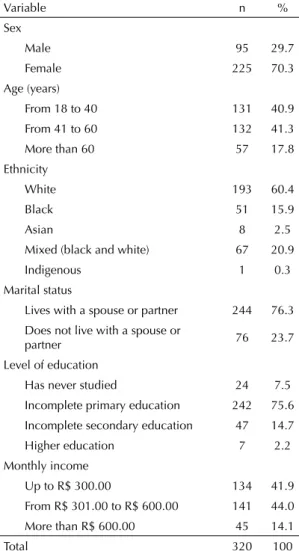
This population is young and with a high prevalence of women, who were white and lived with a partner. The socioeconomic level of the sample was low, represented by low level of education and income (Table1).
More than half (59.7%) of participants affi rmed having previously used the drug. Times of administration, therapeutic indication and duration of treatment were considered to lack little information (Table 2). Almost half of the population had questions about the name of the medication and how to use it. The dosage to be used, possible adverse effects, interactions and attitude when missing one or more dosages were the most defi cient pieces of information. Of all the 16.2% patients who positively responded to the questions about adverse effects of the prescribed drug, 65.4% had the effects in question.
Table 2. Results of level of knowledge about drugs prescribed to the users studied. Santa Cruz do Sul, Southern Brazil, 2006. (n = 320)
Questions about the prescribed drug Correct responses Incorrect responses Did not know
n % n % n %
Name 182 56.9 19 5.9 119 37.2
Therapeutic indication 249 77.8 59 18.4 12 3.8
Dosage 37 11.6 50 15.6 233 72.8
Time of administration 258 80.6 29 9.1 33 10.3
Duration of treatment 242 75.6 45 14.1 33 10.3
Form of use 189 59.1 51 15.9 80 25.0
Attitude when one or more dosages are missed 66 20.6 75 23.5 179 55.9 Interactions with other drugs and/or foods 88 27.5 44 13.7 188 58.8
Adverse effects 52 16.2 30 9.4 238 74.4
Among all users, 72.0% responded that they did not need more information to undergo the treatment. Of the 28.0% who reported that they needed more infor-mation, 94.7% wanted to know about the interactions;
92.6%, adverse effects; 90.4%, duration of treatment; and 87.2%, how to take the medication.
The chi-square test indicated an association between level of knowledge about the prescription and level of education (X2 = 0.79, p = 0.04), where a low level of education was associated with low knowledge about prescription.
Among the more complex prescriptions (more than seven points), 49.6% of users had a high level of knowledge. Among less complex prescriptions (up to seven points), 64.2% had a high level of knowledge. The prevalence ration between these values was 0.77 (CI 95%: 0.61;0.97): users with more complex prescrip-tions have a probability of high level of knowledge which is 23% lower than those with less complex prescriptions.
Mean level of knowledge of users, according to thera-peutic drug class, is shown in Table 3. The comparison between mean levels of knowledge and the main thera-peutic drug classes was performed using the Tukey test (Table 4). The results show a statistically signifi cant difference between the level of knowledge about contin-uous use drugs and that about occasional use drugs.
DISCUSSION
An instrument to evaluate ESF users’ level of knowl-edge about drug prescription was proposed. A scale, weighted per item, was constructed according to the importance for safe drug use.
The high prevalence of interviewed women may have resulted from the fact that they are more attentive to signs and symptoms of a disease and that they have more initiative to seek medical services. Men may use ESF services less frequently than women because they are more included in the economically active population, once the majority of the female population Table 1. Sociodemographic characteristics of the users studied.
Santa Cruz do Sul, Southern Brazil, 2006. (n = 320)
Variable n %
Sex
Male 95 29.7
Female 225 70.3
Age (years)
From 18 to 40 131 40.9 From 41 to 60 132 41.3
More than 60 57 17.8
Ethnicity
White 193 60.4
Black 51 15.9
Asian 8 2.5
Mixed (black and white) 67 20.9
Indigenous 1 0.3
Marital status
Lives with a spouse or partner 244 76.3 Does not live with a spouse or
partner 76 23.7
Level of education
Has never studied 24 7.5 Incomplete primary education 242 75.6
Incomplete secondary education 47 14.7 Higher education 7 2.2 Monthly income
Up to R$ 300.00 134 41.9 From R$ 301.00 to R$ 600.00 141 44.0
More than R$ 600.00 45 14.1
interviewed were housewives. The socioeconomic level of the population studied was low, characterized by low level of education and income.
According to the parameters studied, practically half of the sample studied does not have conditions to undergo drug therapy safely, and only one out of every ten interviewees had conditions to do so. These results are alarming, once more than half of individuals had previ-ously used the prescribed medication and patients who did so showed a slightly higher level of knowledge.
Times of administration, therapeutic indication and duration of treatment were considered to lack little information. More than half of the population had ques-tions about the name of the medication and the way to use it. Few users knew the prescribed dosage or possible adverse effects, the interactions and what to do if one or more dosages are missed. All this information must be included in the routine of doctors and pharmacists for safe drug use.
The attribution of a low level of knowledge about the dosage could have occurred due to the strictness of data analysis. However, the patient must be certain about the dosage to be taken, in view of the different existing types of dosages. This result may also be associated with the diffi culty in memorizing information, because interpretation errors are more likely to occur when the understanding of instructions to use drugs involves the combination of qualitative and quantitative types of information.11
The majority of users, who knew about the existence of adverse effects caused by a certain drug, had already had these effects. Memory lapses regarding prescrip-tion and the pressure suffered by doctors to care for a higher number of patients in a short period of time could have contributed to the poor results in the level of information about prescription.
In a similar study conducted by Silva et al16 (2000), 31% of participants did not respond the name of the prescribed drug correctly; 19%, the therapeutic indica-tion; 19%, the dosage; and 31%, the frequency of the prescribed administration. With regard to the dura-tion of treatment, 69% of patients knew for how long
they should use the medication; 31% knew about the precautions during treatment; and 20% knew about the existence of adverse effects. In a study conducted with patients aged more than 16 years, users of 15 Unifi ed Health System health centers of the Federal District, Central-Western Brazil, in 2001, less than one out of every fi ve patients understood which drug was prescribed and how it was used.9
Many users reported they knew the responses to the items, but these were not correct in some cases, espe-cially with regard to the attitude taken when one or more drug dosages were missed. This suggests that patients frequently behave in an inadequate way, which could result in high or low daily dosages, adverse effects – often not identifi ed by patients – or, yet, a lack of drug effect on the morbidity in question. Other items show error indices, showing that the interviewees believed they knew the responses or responded without thinking, to hide their lack of knowledge.
Although the level of knowledge was unsatisfactory, only one out of every four patients admitted the need Table 3. Mean levels of knowledge about treatment, in terms of drug classes prescribed to the users studied. Santa Cruz do Sul, Southern Brazil, 2006. (n = 320)
Drug classes Mean level of knowledge SD Minimum Maximum
Cardiovascular drugs 8.52 1.67 0 13
Central nervous system drugs 7.68 1.64 0 13
Digestive system and metabolism-related drugs 6.90 1.22 0 13
Musculoskeletal system drugs 7.52 1.75 0 13
Anti-infection drugs 5.94 1.32 0 12
Blood-related drugs 7.92 1.85 5 12
Respiratory system drugs 5.00 1.22 2 8
Table 4. Comparison of mean levels of knowledge among the main drug classes, prescribed to the users studied. Santa Cruz do Sul, Southern Brazil, 2006.
Drug classesa Drug classesb
Differences between means(a-b)
p*
1 2 0.84 0.22
3 1.00 0.06
4 2.58 <0.0001 5 3.52 <0.0001
2 3 0.16 0.78
4 1.74 <0.0001 5 2.68 <0.0001
3 4 1.58 <0.0001
5 2.52 <0.0001
4 5 0.94 0.09
1 = Cardiovascular drugs, 2 = Central nervous system drugs, 3 = Musculoskeletal system drugs, 4 = Anti-infection drugs, 5 = Respiratory system drugs.
for more information to undergo their treatment. In the study conducted by Jenkins et al8 (2003), 5% of interviewees expected more information about drug treatment, especially about the way to take the medica-tion, time of use and drug interactions, also reported in the present study. Bonner & Carr2 (2002) observed that 18% of patients requested information about medica-tions from pharmacists – especially about symptoms, changes in drug therapies and correct drug use.
Users who have at least complete primary education show a higher level of knowledge than those with a lower level of education. The higher the level of education, the easier for a user to understand oral and written instructions about aspects related with the medication.6,10,15,18,20 In addition, the great difference between the level of education of the patient and that of the doctor could inhibit the former from asking the doctor about their treatment.6,15,18,20
In more complex prescriptions, there was a higher amount of information to be assimilated, thus hindering the memorization of instructions.
When knowledge about medications was evaluated, according to therapeutic drug classes, it was observed that the level of knowledge about continuous use drugs, such as cardiovascular drugs, is signifi cantly higher. On the other hand, knowledge about occasional use drugs, such as anti-infection drugs and those for the respira-tory system, is signifi cantly lower. The highest level of knowledge was either due to use of the medication in question for a long period of time or greater user care for drug use. Participation of this population in discussion groups offered by ESF clinics could benefi t health education.
The instrument proposed showed a prevalence of approximately 50% of users with an insuffi cient level of knowledge. This high frequency may not be useful to decide which patients should be selected to increase quality of treatment. An alternative classifi cation would be the creation of a critical level of information, corre-sponding to a set of points where all essential pieces of information were wrong or a cut-off point in the lower quartile of distribution of level of knowledge. In the
fi rst case, individuals who achieved a number of points equal to or lower than fi ve were considered to have a critical level of knowledge about prescription, including 20.0% of the studied sample, while this score was six points or less, in the second case.
This study has certain limitations. The selection of the fi rst prescribed drug exclusively may not refl ect the patient’s level of knowledge about the set of prescribed drugs. The fi rst drug tends to express the main treatment involved with the reason for the medical consultation, while the remaining ones could be secondary (even if having an equal therapeutic importance). It is believed that people tend to remember the fi rst prescribed drug better or that the doctor focuses more on this, overesti-mating the scale score. In certain situations, where the patient only uses one drug and visually identifi es it, the name of the medication is not as important a piece of information, when compared to the patient who uses two or more drugs – thus, there is the impossibility of reach of the score used.
Despite the limitations discussed, the instrument used enables one to detect the magnitude of the existing gap between what the patient must know about their medications and what they in fact know. Prevention, education and follow-up must be prioritized in the case of individuals who require more attention to the phar-macological aspects of their treatment. In the analyzed sample, the knowledge of users with regards to drug treatment of their diseases, as proposed by the ESF, is not refl ected in their knowledge about the drugs they use. Collaboration, communication and professionals with an educational approach are required to change this situation, so that a collective construct is formed to incorporate the attention and desire to share. Monitoring of the prescription and the education required by users prevent problems related to medications, in addition to emphasizing therapeutic and economic results for these users and society.
1. American College of Physicians. Drug informations for patients. Ann Intern Med. 1986;104(1):121.
2. Bonner CJ, Carr B. Medication compliance problems in general practice: detection and intervention by pharmacists and doctors. Aust J Rural Health. 2002;10(1):33-8. DOI:10.1046/j.1440-1584.2002.00406.x
3. George J, Phun YT, Bailey MJ, Kong DC, Stewart K. Development and validation of the medication regimen complexity index. Ann Pharmacother. 2004;38(9):1369-76. DOI:10.1345/aph.1D479
4. Gómez-Castro MJ, Arcos P, Rubiera G, Rigueira AI. Comparison of two models of prescription quality indicators in primary care. Gac Sanit. 2003;17(5):375-83. DOI:10.1590/S0213-91112003000500006
5. Higashi T, Shekelle PG, Solomon DH, Knight EL, Roth C, Chang JT, et al. The quality of pharmacologic care for vulnerable older patients. Ann Intern Med. 2004;140(9):714-20.
6. Hogerzeil HV, Barnes KI, Henning RH, Kocabasoglu YE, Möller H, Smith AJ, et al. Guia do instrutor em práticas de boa prescrição médica. Genebra: Organização Mundial da Saúde; 2001.
7. Jeldres CD, Herrera AB. Atención primária de salud: perfi l de uso de los medicamentos em adultos mayores. Acta Farm Bonaer. 1995;14(2):99-106.
8. Jenkins L, Britten N, Stevenson F, Barber N, Bradley C. Developing and using quantitative instruments for measuring doctor-patient communication about drugs. Patient Educ Couns. 2003;50(3):273-8.
9. Naves JO, Silver LD. Evaluation of pharmaceutical assistance in public primary care in Brasilia, Brazil. Rev Saude Publica. 2005;39(2):223-30. DOI:10.1590/ S0034-89102005000200013
10. Olivares J, Espinoza Y. Determinación del nivel de información sobre el uso de antiinfl amatórios no esteroideos em pacientes ambulatórios de un hospital general. Medicamentos Salud Popular. 1996;33:19-28.
11. Patel VL, Branch T, Arocha JF. Errors in interpreting quantities as procedures: the case of pharmaceutical labels. Int J Med Inform. 2002;65(3):193-211. DOI:10.1016/S1386-5056(02)00045-X
12. Presser S, Rothgeb JM, Couper MP, Lessler JT, Martin E, Martin J, et al. Methods for testing and evaluating survey questionnaires. New Jersey: John Wiley & Sons; 2004.
13. Ribeiro AQ, Araújo CMC, Acurcio FA, Magalhães SMS, Chaimowicz F. Qualidade do uso de medicamentos por idosos: uma revisão dos métodos de avaliação disponíveis. Cienc Saude Coletiva. 2005;10(4):1037-45. DOI:10.1590/S1413-81232005000400026
14. Rozenfeld S. Prevalência, fatores associados e mau uso de medicamentos entre os idosos: uma revisão. Cad Saude Publica. 2003;19(3):717-24. DOI:10.1590/ S0102-311X2003000300004
15. Shikiar R, Rentz AM. Satisfaction with medication: an overview of conceptual, methodologic, and regulatory issues. Value Health. 2004;7(2):204-15. DOI:10.1111/ j.1524-4733.2004.72252.x
16. Silva T, Schenkel EP, Mengue SS. Nível de informação a respeito de medicamentos prescritos a pacientes ambulatoriais de hospital universitário. Cad Saude Publica. 2000;16(2):449-55. DOI:10.1590/S0102-311X2000000200015
17. Teixeira JJ, Lefevre F. Drug prescription from the perspective of elderly patients. Rev Saude Publica. 2001;35(2):207-13.
18. Tempier R. Long-term psychiatric patients’ knowledge about their medication. Psychiatr Serv. 1996;47(12):1385-87.
19. United States Pharmacopeial Convention. USP dispensing information. 17.ed. Rockville; 1997.
20. Vargas M, Domecq C, Maureira C. Análisis del grado de cumplimiento y de conocimiento Del tratamiento entre los pacientes ingresados em um Servicio de Medicina. Rev OFIL. 1991;1(1):2-10.
21. World Health Organization. Rational drug use: consumer education and information. Geneva; 1996. Trends in consumer education and advocacy; p.5-16.
REFERENCES
Attachment. Instrument to evaluate patients’ level of knowledge about drug prescription.
The following questions refer to medications that you will take or are already taking. Do not worry about answering them correctly, because all answers are welcome.
If there is more than one prescribed medication, the fi rst one in the medical prescription received will be considered for the following questions to be answered.
1 – What is the name of the prescribed medication? 1 – Does not know
2 – _______________________(response)
2 – What did the doctor prescribe this medication for? 1 – Does not know
2 – _______________________(response) 3 – What is the dosage of medication that you should take? 1 – Does not know
2 – _______________________(response) 4 – What are the times that you should take the medication? 1 – Does not know
2 – _______________________(response) 5 – For how long should you take the prescribed medication? 1 – Does not know
2 – _______________________(response) 3 – Undefi ned
6 – How should you use the prescribed medication? 1 – Does not know
2 – ____________________(response) 7 – What should you do if you miss one or more dosages? 1 – Does not know
2 – _______________________(response) 8 – Is there another medication, food or beverage that you should
avoid while using this medication?
1 - If yes, which?_____________(response) 2 – No
3 - Does not know
9 – Can this medication cause side effects? 1 – If yes, which? ______________(response), go to question 10
2 – No, go to question 11
3 – Does not know, go to question 11 10 – Have you ever felt any of these side effects? 1 – Yes
2 – No
11 – Do you need more information to take your medication? 1 – Yes, go to question 12 2 – No
12 – What information do you need:
12.1 – How to take the medication. 1 – Yes 2 – No 12.2 – For how long you need to take the medication. 1 – Yes 2 – No 12.3 – If the medication could cause any side effects. 1 – Yes 2 – No 12.4 – Se há algum outro medicamento que não posso tomar enquanto estiver tomando este.