WASTE MANAGEMENT OF HEALTHCARE SERVICES FROM THE
PERSPECTIVE OF NURSING PROFESSIONALS
1Deonízio Gercy Bento2,Roberta Costa3, Juliana Homem da Luz4, Patricia Klock5
1 Paper taken from the thesis – Strategies of the pediatric nursing team for the appropriate disposal of health service waste in the hospital context, presented to the Graduate Program in Nursing Care Management at Universidade Federal de Santa Catarina (UFSC). 2Professional Master’s Degree in Nursing, Programa de Mestrado Proissional em Gestão do Cuidado em Enfermagem at UFSC.
Nurse, Hospital Infantil Joana de Gusmão. Florianópolis, Santa Catarina, Brazil. E-mail: [email protected]
3 Ph.D. in Nursing. Professor, Nursing Department, Graduate Nursing Program and Programa de Mestrado Proissional Gestão do Cuidado em Enfermagem, UFSC. Florianópolis, Santa Catarina, Brazil. E-mail: [email protected]
4 Ph.D. in Nursing. Florianópolis, Santa Catarina, Brazil. E-mail: [email protected]
5 Ph.D. in Nursing. Nurse, Hospital Universitário Polydoro Ernani de São Thiago, UFSC. Florianópolis, Santa Catarina, Brazil. E-mail:
ABSTRACT
Objective: to identify the knowledge of nursing professionals at pediatric inpatient units about waste management of health services. Method: this descriptive, exploratory research was developed at two inpatient units of a children’s hospital in Southern Brazil. Data
collection was carried out between July and August 2014 through questionnaires to 30 nursing team professionals. The data were analyzed in a quantitative and qualitative perspective.
Results: the results show that few professionals at the investigated institution know the Health Service Waste Management Program. The
majority performs care related to the waste, but does not participate in training on the subject.
Conclusion: the training of nursing professionals is critical for the effectiveness of the waste management program at the health institution,
favoring proper disposal, facilitating the collection and contributing to environmental preservation.
DESCRIPTORS: Waste management. Medical waste. Professional training. Nursing, team. Nursing.
O GERENCIAMENTO DE RESÍDUOS DE SERVIÇO DE SAÚDE SOB A ÓTICA
DOS PROFISSIONAIS DE ENFERMAGEM
RESUMO
Objetivo: identiicar o conhecimento dos proissionais de enfermagem de unidades de internação pediátrica sobre o gerenciamento de
resíduos do serviço de saúde.
Método: pesquisa exploratória, descritiva, desenvolvida em duas unidades de internação de um hospital infantil do Sul do Brasil. A coleta
de dados foi realizada entre julho e agosto de 2014, através de questionários aplicados junto a 30 proissionais da equipe de enfermagem. Os dados foram analisados em uma perspectiva quanti-qualitativa.
Resultados: os resultados apontam que poucos proissionais da instituição investigada conhecem o Programa de Gerenciamento de
Resíduos de Serviço de Saúde. A maioria realiza cuidados em relação aos resíduos, mas não participam de capacitações sobre o tema.
Conclusão: a capacitação dos proissionais de enfermagem é fundamental para a efetivação do programa de gerenciamento dos resíduos
da instituição de saúde, favorecendo o descarte adequado, facilitando a coleta e contribuindo para preservação do meio ambiente.
DESCRITORES: Gerenciamento de resíduos. Resíduos de serviços de saúde. Capacitação proissional. Equipe de enfermagem. Enfermagem.
LA ADMINISTRACIÓN DE RESIDUOS DE SERVICIO DE SALUD BAJO LA
ÓPTICA DE LOS PROFESIONALES DE ENFERMERÍA
RESUMEN
Objetivo: identiicar el conocimiento de los profesionales de enfermería de unidades de internamiento pediátrica sobre la administración
de residuos de servicios de salud.
Método: investigación exploratoria, descriptiva, desarrollada en dos unidades de internamiento de un hospital infantil del Sur de Brasil. La recolección de datos fue realizada entre julio y agosto de 2014, a través de cuestionarios aplicados junto a 30 profesionales del equipo de enfermería. Los datos fueron analizados bajo una perspectiva cuanti-cualitativa.
Resultados: los resultados apuntan que pocos profesionales de la institución investigada conocen el Programa de Administración de
Residuos de Servicios de Salud. La mayoría realiza cuidados en relación a los residuos, más no participan de capacitaciones sobre el tema.
Conclusión: la capacitación de los profesionales de enfermería es fundamental para la efectivación del programa de administración de los residuos de la institución de salud, favoreciendo el descarte adecuado, facilitando la recolección y contribuyendo para la preservación del medio ambiente.
DESCRIPTORES: Gerenciamiento de residuos. Residuos de servicios de salud. Capacitación profesional. Equipo de Enfermería. Enfermería.
INTRODUCTION
Health Service Waste (HSW) is any waste resulting from patient care at home and at public and private institutions. In Brazil, each day, 149,000
tons of domestic and commercial waste are pro
-duced, one to three percent of which is HSW. Of this total, only between 10 and 25% needs special
treatment.1 A large amount of waste produced and handled in health care is considered high-risk and, when managed inappropriately, it can affect
people’s health and cause environmental damage.2 In a way, due to the characteristic of its activity, the hospital should be considered as an environment
that makes the transmission and dissemination of
illnesses possible, entailing potential risks for the
different communities that make up the natural
habitat on our planet.3
HSW management in hospitals, whether public or private, represents a great challenge. The Brazilian National Health Surveillance Agency (ANVISA) regulates and guides the elaboration of a Health Service Waste Management Program (HSWMP), through Collegiate Board Directive 306/04, in which each institution that produces HSW should elaborate a plan for the management,
segregation, conditioning, collection, storage, trans
-portation and inal disposal of the waste produced.4 A structured and active program avoids illnesses, promotes the diagnosis of problems and permits early intervention.5
Lack of knowledge and the non-implemen-tation of the HSWMP at institutions entails further
risk, for the professionals working at the health services as well as for the waste collectors.6 Invest
-ments in HSWMP should consider the importance of raising the health teams and society’s awareness on the responsibility of each stakeholder’s role in care for HSW.7 The nursing profession is clearly
present in the health team and stays with the patient throughout the hospitalization. Therefore, nursing professionals can lead the solution of this problem. At the inpatient units, nursing activities are highly
relevant, as the nursing professionals are in charge of the organization, maintenance and coordination
of activities for its total functioning, playing a
fun-damental role in articulating the different health professionals’ work.8
The nursing professionals’ proximity to the pa-tient during care delivery exposes them to different risks, including biological risks. Contact with blood, body luids, instruments like catheters, syringes,
needles, among others, can cause contamination,
whether in care delivery and/or in the inappropriate
disposal of the materials used in care.6
There is a gap in the knowledge production on HSW. Also, little discussion on this theme has
taken place in the academic context and in health
professionals’ daily practice.9-11 Studies highlight
the need to equip these health professionals for the appropriate management of HSW.2,9-12
In that sense, this research was developed to
identify the knowledge of nursing professionals at pediatric inpatient services about health service
METHOD
An exploratory and descriptive research with qualitative and quantitative analysis was developed
at two inpatient services of a pediatric hospital that
is a referral institution for care delivery to children and adolescents in the South of Brazil. At this in-stitution, the Hospital Infection Commission is in charge of the HSWMP. One of the authors of this research is a member, responsible for the activities
related to waste management, which was the main
motivator to choose the place of study.
The research participants were 30 nursing professionals. The inclusion criterion was: working
at the units where the research was undertaken,
excluding professionals on holiday or leave of ab-sence. No time limit was established for the length of experience at the hospital, as the objective was
to investigate the knowledge in general, gained in professional education as well as in professional
practice. It should be highlighted that, out of the 44 nursing team professionals, only three did not accept to participate in the research. The remaining two were on medical leave or holiday.
The data were collected between July and August 2014, during the afternoon and night. The
professionals were not contacted during the morn -ing shift as all of them work on a 12h regimen and the morning period is the most demanding for the nursing professionals in terms of routine care
actions. Thus, the intent was to avoid interfer-ence in the dynamics of each service. One of the
researchers invited the participants to participate in the research at their workplace and during
their work shift. Initially, the objective and form of participation were explained and any doubts were clariied. All professionals who accepted to
participate signed the Informed Consent Form
and were informed that they could drop out of the research at any time.
The data were collected by applying a ques-tionnaire with questions about the characteristics of the nursing professionals, what they consider as HSW and HSWMP, about training on the theme and about the care taken in the management and
disposal of HSW. In addition, the participants were asked to identify the symbols referring to the differ-ent types of HSW. While completing the question-naire, one of the researchers stayed at the unit to give advice and solve doubts.
The data were analyzed from two perspec-tives: one quantitative, in which the information was categorized according to the variables, calculating absolute and relative frequencies. For the qualitative data, all answers to the questionnaires were fully
read. Next, a second reading was undertaken to mark
important aspects found in the answers. After the
ex-ploration phase of the material, the results produced were summarized to present the most important points that expressed the participants’ discourse.
Against the background of the literature, the results were subject to critical and relexive analysis.
Approval for the research project was ob-tained from the Research Ethics Committee at the research institution, registered under CAAE 31045914.4.0000.5361 and Opinion 682.580 on June 5th 2014. The research complied with the requisites of National Health Council Resolution 466/12 on ethics in research involving human beings. To guarantee the participants’ anonymity, they were identiied by means of the professional category*, Auxiliary Nurse (AN), Nursing Technician (NT) and Nurse (N), followed by Arabic numerals.
RESULTS
Among the 30 nursing professionals who par-ticipated in the study, 27 were women (90%) and three men (10%). As regards the professional cat-egory: seven were nurses (23.3%), 21 nursing tech-nicians (70%) and two auxiliary nurses (6.7%). The professionals’ age range varied from 20 to 60 years.
Concerning the length of experience at the hospital,
three professionals worked for at least one year (10%), 16 between one and nine years (53.3%), and 11 for more than ten years at the hospital (36.7%).
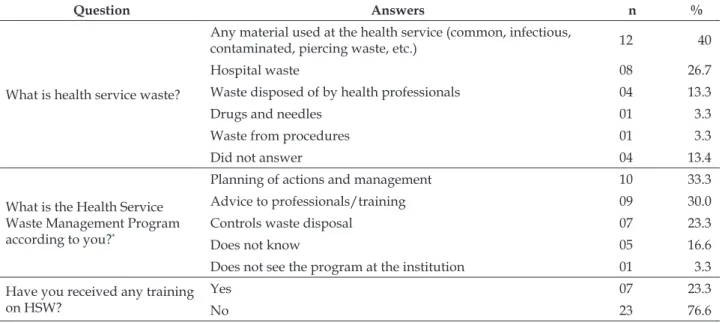
With regard to the questions about HSW, the participants’ answers indicate: lack of training on the theme and lack of knowledge on HSW and HSWMP (Table 1).
Table 1 – Nursing team professionals’ knowledge on health service waste. Florianópolis, SC, Brazil, 2014
Question Answers n %
What is health service waste?
Any material used at the health service (common, infectious,
contaminated, piercing waste, etc.) 12 40
Hospital waste 08 26.7
Waste disposed of by health professionals 04 13.3
Drugs and needles 01 3.3
Waste from procedures 01 3.3
Did not answer 04 13.4
What is the Health Service Waste Management Program according to you?*
Planning of actions and management 10 33.3
Advice to professionals/training 09 30.0
Controls waste disposal 07 23.3
Does not know 05 16.6
Does not see the program at the institution 01 3.3
Have you received any training
on HSW? Yes
07 23.3
No 23 76.6
* The participants’ answers it into more than one option, according to the clustering the authors elaborated.
Concerning the concept of HSW, the records
revealed that, although four professionals did not
answer this question, many are able to appropriately describe the concept.
It is any material used and disposed of at hospital and health services (NT8).
Is the material used in procedures involving the patients (NT12).
Is any and all waste produced in the health envi-ronment and that needs to be disposed of in accordance with standards (N2).
Collection of hospital waste, infectious, piercing and cutting material (AN2).
When asked about the NSWMP, disagreements
came up, as some professionals know the program
and/or its functions, while others present many doubts. It advises on the steps for the waste to be taken in the right direction and in the correct manner. Conduct-ing this program well leads to less spendConduct-ing in economic terms and to the correct disposal of the waste (NT1).
Program that manages the waste the hospital pro-duces and where this waste goes (NT13).
Program that guides and trains us on the correct way to dispose of infectious and common waste (N4).
I’m not sure (AN1). All waste (AN2). I don’t know (NT17).
As regards the care the professionals take dur-ing the management and disposal of the HSW, the following actions were appointed:
[...] put the contaminated waste [dirty with blood, used syringes, used gauze] into the white garbage. And paper, wrappings, paper towels, plastic bags, into the black garbage (NT20).
I try to dispose of the material in the suitable place for better use when that is the case and the appropriate disposal. Use Individual Protection Equipment correctly and dispose of it when necessary (NT3).
I try to separate the white and the black garbage at the indicated place (AN2).
Dispose of common waste in the black garbage and infected waste in the white one (NT5).
I always try to protect myself and use the correct garbage containers (N2).
As for the training on HSW, it is observed that, independently of the instruction level, more than 75% of the nursing professionals did not participate in any orientation activity on the theme.
Yes, at another company where I used to work, the theme was about better recycling, environment aware-ness (NT6).
I did not receive any training on waste, only advice from colleagues (NT4).
No. The minimum I received was incipient (N1). No. Sometimes [...] comes to inform us about the bags that are used (AN2).
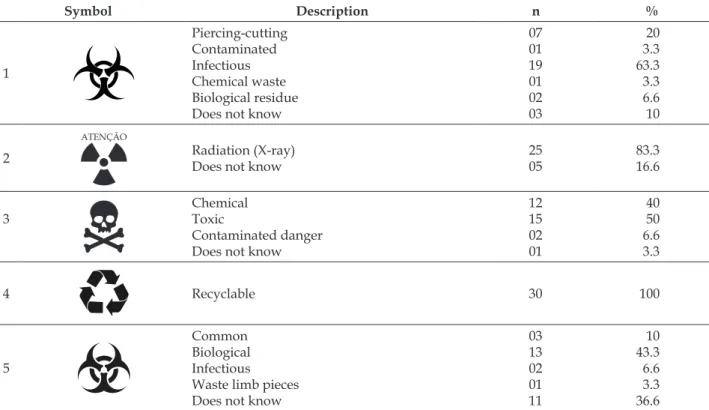
Table 2 – Knowledge of nursing team professionals about the symbols of health service waste. Florianópolis, SC, Brazil, 2014
Symbol Description n %
1
Piercing-cutting Contaminated Infectious Chemical waste Biological residue Does not know
07 01 19 01 02 03
20 3.3 63.3 3.3 6.6 10
2
ATENÇÃO
Radiation (X-ray) Does not know
25
05 83.316.6
3
Chemical Toxic
Contaminated danger Does not know
12 15 02 01
40 50 6.6 3.3
4 Recyclable 30 100
5
Common Biological Infectious Waste limb pieces Does not know
03 13 02 01 11
10 43.3
6.6 3.3 36.6
Legend: 1= piercing-cutting waste; 2= radioactive material; 3= chemical substance; 4= recyclable waste or for reuse; 5= infectious substance.
DISCUSSION
The HSWMP needs to train and recycle the health professionals, particularly the nursing profes-sionals, as they deliver integral care to the patients and handle materials contaminated with biological agents. RDC 306/04 established that continuing education should be offered to advise, motivate,
raise the stakeholders’ awareness and inform them
about the health service waste.1,4
The research participants are mostly female young adults, nursing technicians, with one to nine years of professional experience, who did not receive training on HSW at the institution where they work and where the research was undertaken. If they are knowledgeable and receive constant recycling on the HSWMP, the professionals can act in all phases of HSW processing, promoting care
at the workplace and in the environment.13 “The elaboration, implementation and development of the HSWMP should involve all hospital sectors, observing the characteristics of each environment and, based on this context, determine the actions
related to the program.”3:92
It is important to highlight that, when they are asked about the HSW concept, most of the nursing team constructed a concept. Only one of the nurses
who participated did not answer this question. As regards the symbols used to identify the disposal sites of the HSW, opinions greatly differed. The
sites the nursing team recognized least were related
to piercing-cutting waste and biological material. That does not mean inappropriate disposal though, but calls attention to the lack of knowledge on the symbols recommended in the HSWMP.14
The concern with this result is related to the
internal phase developed at the hospitals, which
according to the HSWMP corresponds to the man-agement, segregation and disposal of the HSW. Are these activities performed appropriately? Can it be
inferred that there is a great risk of occupational accidents and of an increased volume of materials
mistakenly disposed of in the containers of
piercing-cutting material.15 The elaboration of a training and
recycling plan on HSWMP and HSW is extremely necessary and urgent.11
The lack of knowledge on the appropriate management of HSW calls attention to the
biohaz-ard of occupational accidents and the contamination
by infectious agents, such as HIV, Hepatitis B and Hepatitis C, present in the luids and body luids like blood.16 “Occupational accidents involving
reality in health institutions. The gaps in the
comple-tion of important informacomple-tion reveal the need to
train the responsible professionals for the registra-tion and make it dificult to elaborate preventive
strategies.”17:145 On the opposite, despite the lack of
knowledge on some aspects of the HSW problem at health institutions, the nursing professionals try to structure a concept of HSWMP in their own manner. Managing the HSW for disposal is a vital phase in the HSWMP, as it determines the
appro-priate placement of the waste in the collection con
-tainer. The inappropriate segregation entails losses
for the workplace in terms of the risk of occupational accidents for workers and waste collectors, as well as for the environment, as it increases the need to
build landills and exploit raw materials.18
The health services are responsible for estab-lishing HSW production and management control programs, making the standards accessible
con-cerning the production, segregation, conditioning, collection, storage, transportation, treatment and
inal disposal, and also guaranteeing continuing in-service education about the theme, thus guar-anteeing the safety and minimizing the dangers of
exposure to human health.12,14
CONCLUSION
The study permitted the identification of
nursing professionals’ knowledge at the pediatric
hospitalization services about HSW management. The results outline the health institutions’ challenge
in terms of continuing education, addressing the
HSWMP, occupational safety and the environment. As the leader of the nursing team, the nurse plays an important role in guiding and overseeing
the steps related to the appropriate management
of HSW at the health services until their inal dis-posal. Spaces for relection in daily care can produce changes in the professional reality. This research
calls attention to the need to implement educational strategies with a view to minimizing health and
environmental problems due to the HSW.
Although the participants demonstrated some knowledge on the concepts and recognize the symbols used to represent the HSW, the simple act of waste
dis-posal in the collection container involves professional
qualiication, logistics and continuing education, steps that were not visualized in this study.
Further studies are suggested, involving the other professional categories who work at the health services, as all multiprofessional team profession
-als need training to put the HSWMP in practice,
contributing to appropriate waste disposal in each container, facilitating the collection and contributing
to the environmental preservation.
REFERENCES
1. Ministério da Saúde (BR). Agência Nacional de
Vigilância Sanitária. Manual de gerenciamento de resíduos de serviços de saúde. Brasília (DF): Ministério da Saúde, 2006.
2. Muller AM, Silveira DD, Nara EOB, Kipper LM,
Moraes JAR. Um olhar exploratório sobre os resíduos de serviços de saúde para os cursos da área da saúde numa universidade comunitária do Sul do Brasil. Rev Eletr Gestão, Educ Tecnologia Ambiental [Internet]. 2013 [cited 2015 Oct 20]; 17(17):3327-35.
3. Erdtmann BK. Gerenciamento dos resíduos de serviço
de saúde: biossegurança e o controle das infecções hospitalares. Texto Contexto Enferm [Internet]. 2004 [cited 2015 Oct 20]; 13(spe): 86-93. Available from: www.scielo.br/pdf/tce/v13nspe/v13nspea10.pdf
4. Ministério da Saúde (BR). Agência Nacional de
Vigilância Sanitária. RDC nº 306, de 7 de dezembro de 2004. Dispõe sobre o regulamento técnico para
o gerenciamento de resíduos de serviços de saúde [Internet]. 2004 [cited 2015 Oct 20]. Available from: http://bvsms.saude.gov.br/bvs/saudelegis/ anvisa/2004/res0306_07_12_2004.html
5. Santos MA, Souza AO. Conhecimento de enfermeiros da Estratégia Saúde da Família sobre resíduos dos serviços de saúde. Rev Bras Enferm [Internet]. 2012 [cited 2015 Oct 20]; 65(4):645-52. Available from: http://www.scielo.br/scielo.php?script=sci_ arttext&pid=S0034-71672012000400014
6. Soares LG, Labronici LM, Maftum MA, Sarquis LMM, Kirchhof AL. Risco biológico em trabalhadores de enfermagem: promovendo a relexão e a prevenção. Cogitare Enferm [Internet]. 2011[cited 2015 Oct 20]; 16(2):261-7. Available from: revistas.ufpr.br/cogitare/ article/viewFile/21815/14225
7. Côrrea LB, Lunardi VL, Santos SSC. Construção do saber sobre os resíduos de serviços de saúde na formação em saúde. Rev Gaúcha Enferm [Internet]. 2008 [cited 2015 Oct 20]; 29(4):557-64. Available from: http://seer. ufrgs.br/index.php/RevistaGauchadeEnfermagem/ article/view/7626/4681
8. Lorenzetti J, Gelbcke FL, Vandresen L. Management technology for hospital inpatient care units. Texto Contexto Enferm [Internet]. 2016 [cited 2016 Agu 18]; 25(2):e1770015. Available from: http://dx.doi. org/10.1590/0104-07072016001770015
cuidadofundamental/article/view/1697
10. Moreschi C, Rempel C, Backes DS, Carreno I, Siqueira DF, Marina B. The importance of waste from healthcare
services for teachers, students and graduates of the
healthcare sector. Rev Gaúcha Enferm [Internet]. 2014 jun [cited 2016 Jun 24]; 35(2):20-6. Available from: http://www.scielo.br/scielo.php?pid=S1983-14472014000200020&script=sci_arttext&tlng=in
11. Pereira MS, Alves SB, Silva e Souza AC, Tipple
AFV, Rezende FR, Rodrigues EG. Waste management in non-hospital emergency units. Rev Latino-am Enfermagem [Internet]. 2013 [cited 2015 Mar 17]; 21(esp):259-66. Available from: http://www.scielo.br/scielo.php?script=sci_ arttext&pid=S0104-11692013000700032
12. Doi KM, Moura GMSS. Resíduos sólidos de serviços
de saúde: uma fotograia do comprometimento da equipe de enfermagem. Rev Gaúcha Enferm [Internet]. 2011 jun. [cited 2015 Oct 20]; 32(2):338-44. Available from: http://www.scielo.br/scielo.php?script=sci_ arttext&pid=S1983-14472011000200018
13. Silva ITS, Bonfada D. Resíduos sólidos de serviços
de saúde e meio ambiente: percepção da equipe de enfermagem. Rev Rene [Internet]. 2012 [cited 2015 Oct 20]; 13(3):650-7. Available from: www.revistarene.ufc. br/revista/index.php/revista/article/viewFile/732/pdf
14. Alencar TOS, Machado CSR, Costa SCC, Alencar
BR. Descarte de medicamentos: uma análise da prática no Programa Saúde da Família. Ciênc
Saúde Coletiva [Internet]. 2014 jul [cited 2015 Oct 20]; 19(7):2157-66. Available from: http:// w w w . s c i e l o . b r / s c i e l o . p h p ? s c r i p t = s c i _ arttext&pid=S1413-81232014000702157
15. Sales CCL, Spolti GP, Lopes MSB, Lopes DF.
Gerenciamento dos resíduos sólidos dos serviços de saúde: aspectos do manejo interno no município de Marituba, Pará, Brasil. Ciênc Saúde Coletiva [Internet]. 2009 Dez [cited 2015 Oct 20]; 14(6):2231-8. Available from: http://dx.doi.org/10.1590/S1413-81232009000600032
16. Jansen AC, Marziale MHP, Santos CB dos, Dantas RAS, Ko Nai-Ying. Assessment of adherence to post-exposure conducts among health workers:
translation and cultural adaptation of an instrument.
Texto Contexto Enferm [Internet]. 2015 [cited 2016 Aug 18]; 24(3):670-9. Available from: http://dx.doi. org/10.1590/0104-07072015011010014.
17. Valim MD, Marziale MHP. Avaliação da exposição ocupacional a material biológico em serviços de saúde. Texto Contexto Enferm [Internet]. 2011 [cited 2015 May 14]; 20(spe):138-46. Available from: http:// dx.doi.org/10.1590/S0104-07072011000500018 18. Alves SB, Souza ACS, Tipple AFV, Rezende KCD,
Rezende FFR, Rodrigues EG. Manejo de resíduos gerados na assistência domiciliar pela Estratégia de Saúde da Família. Rev Bras Enferm [Internet]. 2012 [cited 2015 Oct 20]; 65(1):128-34. Available from: http://dx.doi.org/10.1590/S0034-71672012000100019
Correspondence: Roberta Costa Universidade Federal de Santa Catarina Departamento de Enfermagem
88040-970 – Trindade, Florianópolis, SC, Brasil E-mail: [email protected]