Virtual educational proposal in
cardiopulmonary resuscitation
for the neonate care
*PROPOSTA EDUCACIONAL VIRTUAL SOBRE ATENDIMENTO DA RESSUSCITAÇÃO CARDIOPULMONAR NO RECÉM-NASCIDO
PROPUESTA EDUCATIVA VIRTUAL PARA LA ATENCIÓN DE LA REANIMACIÓN CARDIOPULMONAR EN EL RECIÉN NACIDO
* Excerpted from the monograph “Desenvolvimento de uma Proposta educacional virtual sobre atendimento da ressuscitação cardiopulmonar no recém-nascido”. School of Nursing, University of São Paulo, 2007. 1 Nurse graduate by School of Nursing, University of São Paulo. São Paulo, SP, Brazil.
[email protected] 2 Nurse. Associate Professor of the Department of Professional Guidance at School of Nursing, University of São Paulo. São
Paulo, SP, Brazil. hhcperes@usp 3 Nurse. Master in Nursing by School of Nursing, University of São Paulo. São Paulo, SP, Brazil. [email protected] 4 Professor of the Department of Professional Guidance at School of Nursing, University of São Paulo. São Paulo, SP, Brazil. [email protected] 5 Nurse. Graduate
O
RIGINAL
A
R
TICLE
RESUMOO objetivo deste estudo foi desenvolver uma proposta educacional virtual, utilizando re-cursos multimídia, visando inovar, dinami-zar e diversificar espaços de comunicação e interação, favorecendo o processo de ensi-no aprendizagem autôensi-nomo e reflexivo do enfermeiro. Este trabalho constitui-se de uma pesquisa aplicada, seguindo as fases cíclicas e interativas de concepção e plane-jamento, desenvolvimento e implementa-ção. A proposta educacional foi desenvolvi-da na plataforma TelEduc, utilizando ferra-mentas de organização, de conteúdo, de co-municação, do aluno e do administrador. Os módulos de ensino referiram-se as seguin-tes temáticas: Módulo 1 – Fundamentos de anatomia e fisiologia cardíacas do recém-nascido; Módulo 2 – Fatores de risco para ocorrência da parada cardiorrespiratória no recém-nascido; Módulo 3 – Planejamento da
assistência de enfermagem; Módulo 4 –
Medicações empregadas na parada cardior-respiratória no recém-nascido; e Módulo 5
– Atendimento da parada cardiorrespirató-ria no recém-nascido. Este projeto pode con-tribuir com a inovação do ensino em enfer-magem a partir de uma proposta educacio-nal virtual sobre um tema de relevância que é o atendimento da ressuscitação cardiopul-monar do recém-nascido.
DESCRITORES
Informática em enfermagem. Educação em enfermagem. Tecnologia educacional.
Gilciane Ribeiro Gonçalves1, Heloisa Helena Ciqueto Peres2, Rita de Cássia Rodrigues3, Daisy Maria
Rizatto Tronchin4, Irene Mari Pereira5
ABSTRACT
The purpose of this study was to develop an educational proposal using virtual mul-timedia resources, to innovate, stimulate and diversify areas of communication and interaction, facilitating nurses’ autonomous and reflexive process of teaching and learn-ing. This is an applied research, following the cyclical and interactive phases of de-signing, planning, developing and imple-menting. The educational proposal was developed on the TelEduc platform, using specific tools for content organization and communication between students and ad-ministrator. The teaching modules were on the following themes: Module 1 – Funda-mentals of the heart anatomy and physiol-ogy in newborns; Module 2 – Risk factors for the occurrence of cardiorespiratory ar-rest in newborns; Module 3 – Planning nursing care; Module 4 – Medications used in cardiopulmonary arrests in newborns; and Module 5 – Cardiorespiratory arrest care in newborns. This study may contrib-ute to innovating teaching in nursing from a virtual educational proposal on the im-portant issue of newborn cardiopulmonary resuscitation care. KEY WORDS Nursing informatics. Education, nursing. Educational technology. RESUMEN
El objetivo de este estudio fue desarrollar una propuesta educativa virtual haciendo uso de recursos multimedia, pretendiendo innovar, dinamizar y diversificar espacios de comuni-cación e interacción, facilitando el proceso de enseñanza y aprendizaje autónomo y reflexi-vo del enfermero. Este trabajo se constituye de una investigación aplicada, siguiendo las fases cíclicas e interactivas de concepción y planeamiento, desarrollo e implementación. La propuesta educativa fue desarrollada so-bre la plataforma TelEduc, utilizando herra-mientas de organización, de contenido, de co-municación, del alumno y del administrador. Los módulos de enseñanza se refirieron a las siguientes temáticas: Módulo 1 – Fundamen-tos de anatomía y fisiología cardiaca del re-cién nacido; Módulo 2 – Factores de riesgo para la ocurrencia de paro cardiorrespiratorio en el recién nacido; Módulo 3 – Planeamiento de los cuidados de enfermería; Módulo 4 – Medicamentos utilizados en el paro car-diorrespiratorio del recién nacido, y Módulo 5 – Atención del paro cardiorrespiratorio en el recién nacido. Este estudio puede contri-buir a la innovación en la enseñanza de la enfermería a partir de una propuesta educa-tiva virtual referida a un tema de alta rele-vancia como lo es la atención de la resu-citación cardiopulmonar del recién nacido.
DESCRIPTORES
Informática aplicada a la enfermería. Educación en enfermería.
INTRODUCTION
In a country with vast educational needs, as the case of Brazil, and considering the dispersion of people in several geographical locations, it is mandatory to supply the edu-cational needs in a society that has a growing demand for knowledge.
In the information society, characterized by the exponen-tial growth of knowledge, the education model should pro-pose dynamic teaching that looks at students as active sub-jects capable of determining their self-learning, in addition to favoring experimentation, critical thinking and raising hy-potheses, using interactive and participative strategies(1-2).
In this view, educational strategies must be adopted and should allow for having interactive learning and offer the necessary conditions for developing skills for research, deve3lopment, technical-scientific dissemination and knowledge development.
Information and Communication Technologies (ICT) are strategies that permit innovations in the educational pro-cess and to articulate theory, practice and research. These technologies can be used from initial student
education to their entrance to the work mar-ket, to continuous professional advancement, thus determining a new educational practice and qualitative differences in these pro-cesses(3).
In regards to the social impact, including ICT in the teaching process can provide greater access to information and interaction between distant groups, besides demanding better professional preparation to manage these tools(4).
Furthermore, based on the integration of multiple in-formation and communication technologies, virtual learn-ing environments consist of computer systems available on the internet which have the purpose of offering support to educational activities that use several media, languages and resources making it possible to organize information, es-tablish interactions between people and knowledge objects, create and socialize productions, with a view to achieve specific educational objectives(5).
Therefore, the particular feature of a virtual learning environment is to integrate several ICT and make it pos-sible to manage all the resources used in teaching, and thus there is a need for a team with the following members:
•
Administrator – manages the server and has access to all the resources of the environment;•
Course administrator – responsible for creating the course, has access to the main area and all course databases;•
Instructor – has access to the main area and courses;students from the course list or perform other administra-tive tasks and the instructor-editor does not perform any administrative tasks regarding the course (which would be the teacher);
•
Student – final user of the course(6).•
The several technologies added to virtual learning en-vironments that aim at improving the interaction between teachers, students and student group may be character-ized as the following:•
E-mail: software used to send and receive messages and attachments, and requires an electronic address;•
Chats: an application for real time communication (on-line), which can be used for having specific discussions with the participation of a mediator (teacher or tutor);•
Forums or discussion lists (list servers): applications that allow for communicating, registering and posting mes-sages. In the discussion list the messages are socialized as in e-mails;•
Hypermedia information (www): documents ranging among texts, multimedia (images, sounds and videos), which have the characteristic of having links that make it possible to skip to another sec-tion of the same document, or to another document; and•
Hypertext: a network of links that inte-grate non-linearly throughout a text. In teaching, it can raise curiosity and deepen topics(6).It should be stressed that a virtual learn-ing environment consists of information ecol-ogy(7), i.e., a complex system of people, practices, values and technologies, which emerges from the interdependent human activity among participants of this conjecture. As participants interrelate, they change the way they think at the same time they change their environment. Information ecology does not focus on technology, rather it focuses on the relationships that involve people and tools in the activ-ity, characterized by a complex dynamics, by the diversity of spaces and opportunities of development, evolution and experiences.
According to some authors(8-9), technology-assisted teaching permits student education out of the conventional classroom environment with flexibility regarding the space requirements and class hours, as well as the time and pace of learning. It is observed that the individual development of students is important, and they should be considered as active subjects of their education, of knowledge develop-ment and overcoming physical and temporal distances in learning.
Although using technology does not solve problems regarding outdated education projects that are not in line
...technology-assisted teaching permits student education out
can trigger a process of thinking and restructuring of insti-tutions and faculty regarding their educational practices, thus generating changes in the strategies and teaching tools(10).
Therefore, when using technology-assisted teaching, a common mistake made in conventional teaching should be avoided, i.e., using ICT should be supported on a teaching concept that permits significant learning, supporting think-ing that is critical, dialogical, contextual, complex, inten-tional, collaborative, constructive and active(9,11).
These new technologies, applied to learning allow for greater flexibility, creativity, dynamicity, interaction and communication in the teaching-learning process, encour-aging students toward active participation in a constructivist perspective(10).
The participation in virtual learning environments means entering a virtual world in which communication occurs mainly through reading and interpreting text and hypertext materials, consisting of reading other people’s written thoughts, or expressing your own thought through writ-ing. It also means to face diversity and particularities, ex-change ideas and experiences, perform simulations, test hypotheses, solve problems and create new situations, be-coming engaged in the collective construction of an infor-mation ecology, in which values, motivations, habits and practices are shared(5).
In this context, it is important to perform studies that involve the applicability of informatics in nursing education, helping to develop educational strategies that facilitate learn-ing in a collaborative and constructivist perspective.
In nursing, authors(12) show that the use of computer resources as an effective tool in the teaching-learning pro-cess and the implementation of that instrument in the edu-cational environment has been positive despite the resis-tance from students and teachers. These resisresis-tances are mostly related with the lack of basic knowledge in informatics, as well as the constant technological changes, which is a fact that can become a trouble to those who are against computer technology.
Therefore, Nursing must seek technological preparation to use informatics, with an objective to explore its poten-tials and recognize its possibilities as a working instrument applied in teaching, in knowledge acquisition, in care ser-vices, in research and in nursing management(10).
Considering the referred information, we sought to de-velop proposal for education in cardiopulmonary resusci-tation in newborns applied in a virtual teaching environ-ment, with scientific grounding, and that will be made avail-able by a public teaching institution.
This theme was chosen considering the scarcity of educa-tional material on the topic and the need for preparing nurses to work in an emergency situation involving life risks, which requires safety, abilities and skills regarding the procedure.
The care to newborns, especially in a situation or car-diopulmonary arrest has many particularities, which differ-entiate it from care to adults, requiring safe and efficient practice in a moment when there is a life at risk.
Therefore, flexible training and technical-scientific preparation for nurses, using multimedia resources, inter-action and simulation exercises, may help to effectively re-duce neonatal morbidity and mortality and improve the quality of health care delivered in emergency situations involving newborns.
Virtual learning environments could provide access to information that would add value to the daily practice of nurses, in addition to promoting professional updates.
Due to the existence of several possibilities and poten-tialities of different technology resources it is important to plan and analyze new forms of teaching and learning by establishing educational goals as well as skills and abilities in the cognitive, psychomotor and attitudinal aspects, ad-justing the use of computers to the objectives proposed(10).
OBJECTIVE
To develop a proposal for interactive virtual education in cardiopulmonary resuscitation in newborns.
METHOD
This study is an applied research, which resulted in a technological production, characterized by the develop-ment of a product, and referred to the creation of an edu-cational proposal applied to a virtual learning environment.
Applied research is currently related with the develop-ment of new products or processes oriented to the needs of the market or to the solution of problems of immediate interest for the society(13).
The methodology for developing the educational pro-posal followed the cyclical and interactive stages of con-ceiving and planning, developing and implementing, as pro-posed by several researchers(4,14-16).
To facilitate communication among the members of the research group and speed up the process of developing the project, an e-group was created on the Yahoo – Brasil® browser, called PCR_Projeto_EEUSP,which was used to store all the meeting calendars, register all the meeting minutes, and to file the educational materials that were developed.
1. Conceiving and planning:
This stage consisted of the basis of the project for de-veloping the virtual learning environment. In addition, the profile of the target audience was characterized, the theme to be addressed was chosen and the available resources were defined.
In the period from October 2005 to August 2007, sev-eral meetings were held with the research group with a view to perform the bibliographic survey, create and evalu-ate the content, select resources and electronic addresses regarding the chosen theme and choose the environment to be used.
Also in this stage, the storyboard of the educational proposal was constructed. According to a previous study (17), the storyboard is considered a draft of how the
imple-mentation will be organized, thus allowing for detailing the sequence of contents, the structure of navigation and the interface.
The chosen target-audience consisted of nursing un-dergraduates, as per established during the study groups.
The theme was chosen considering the scarcity of edu-cational material on the topic and the need for professional preparation regarding cardiopulmonary resuscitation in newborns.
Regarding the selection of content, the educational ma-terial adopted was developed by the graduate student from the research group, who authorized making it available as hypertext. The hypertext content was evaluated by the re-spective group members who were experts in the area.
The teaching-support platform chosen for developing the virtual environment was the TelEduc teaching manage-ment system, an environmanage-ment for the creation, participa-tion and administraparticipa-tion of on-the-web distance learning courses that has been under development since 1997, by the partnership between the Center for Education Informatics (Núcleo de Informática aplicada à Educação -NIED) and the Computer Institute (Instituto de Computação - IC), both from Unicamp(18).
TelEduc is a distance learning support system that has communication tools that were designed to facilitate the development of activities based on knowledge development such as collaborative activities, with support from differ-ent materials, including texts, software and Internet refer-ences. The interactions that occur in the TelEduc environ-ment are registered with the purpose of allowing for
for-mative evaluation by continuously following these regis-ters, and by having students think critically about their learning process (18).
In addition, a bibliographic survey was performed on Bireme and Medline (Pubmed Interface) databases to se-lect the studies that addressed the themes of the course modules, which were made available on the TelEduc tools. The interesting linkswere also selected and posted in the virtual environment so students could explore.
2. Development:
This stage involved the process of producing and digi-talizing the media used in the virtual learning environment, according to the selection made in the stage of conceiving and planning, which was developed by the undergraduate.
The resources of the TelEduc platform include tools that permit to present information, post contents and allow for course participants to communicate among themselves. The tools are located on the left side of the screen.
The tools can be used as presented below(19):
Organization tools:
•
Structure of the environment: offers information about the tools and the environment;•
Course dynamics: presents information about meth-odological strategies and course organization;•
Calendar: it is the entrance page to the course, pre-senting the daily, weekly or monthly program;•
Evaluations: lists the ongoing evaluations and the grades of the course participants.Content tools:
•
Activities: presents the course activities;•
Support material: provides articles related with the course theme and some suggestions of journals, newspa-pers and addresses on the web;•
Reading: presents useful information related with the course theme, offering support for the proposed activities.Communication tools:
•
Mural: an area where participants can post informa-tion that they consider relevant, referring to the course context;•
Discussion Forums: provides access to a page contain-ing the topics becontain-ing discussed durcontain-ing that particular mo-ment in the course;•
Chat: permits participants to have real time conversation;Student tools:
•
Groups: permits to create groups to facilitate task distribution;•
Profile: stores the participants’ individual profiles;•
Daily Journal: a place for students to write notes that may be read and commented by educators;•
Portfolio: stores texts and files to be used or devel-oped during the course, as well as internet addresses;In addition to the tools listed above, TelEduc has ad-ministration tools that are exclusive to educators, who can follow user attendance and see the interaction between course participants in the Discussion Forums and Chat tools.
The goal proposed by TelEduc is that concepts, in any area of knowledge, should be learnt by solving problems, with the aid of different educational materials. TelEduc also offers a great possibility of intense communication between the participants of the course and a broad view of the work developed. The system stores all information generated during a course, which can be recovered at any time(18).
Using these tools, the content was distributed into modules, which permit using several media and different resources offered by the platform.
The software used to plan, type, and prepare the course content was Word for Windows XP®.
3. Implementation:
This final stage involved performing initial navigation tests and content evaluation regarding the use and presen-tation of the environment.
Therefore, in this stage pre-tests were performed to verify if media were working properly in the environment and to review the texts. All necessary corrections regard-ing the content and the texts were performed.
RESULT
The proposal on virtual educational in cardiopulmo-nary resuscitation in newborns was developed according to the described plan, with a view to prepare nursing un-dergraduates.
The TelEduc platform was used for developing the virtual environment, which can be accessed at: http://arenito.cirp. usp.br/~teleduc//cursos/aplic/index.php?cod_curso=373, using a login and password which the tutor provides to stu-dents when they register for the course (and can later be changed).
Hence, students access the home page where the envi-ronment was developed, containing the weekly program.
By clicking on the Course Dynamics tool, students ac-cess the course objectives, the list of learning resources that will be used, the course program, and information about the evaluation, certification, and tutors.
The class modules refer to the following themes: Mod-ule 1 – Fundamentals of heart anatomy and physiology in newborns; Module 2 – Risk factors for the occurrence of cardiopulmonary arrest in newborns; Module 3 – Planning nursing care; Module 4 – Medications used in cardiopul-monary arrest in newborns; and Module 5 – Cardiopulmo-nary arrest care in newborns, as shown in Figure 1.
The Support Material and the Readings work as a basis for discussions or group projects, helping students to deepen their knowledge: and include articles regarding the
addressed theme, as well as several electronic addresses, as shown in Figure 2:
Figure 2 - Screen showing the related articles and links as Support Materials for Module 1, item “Cardiopulmonary Anatomy, Physiology and Embryology in Newborns” - São Paulo - 2007
Among the main TelEduc tools, the Mural and Discussion Forums were included, as shown in Figure 3:
Each activity can be accessed by tutors, offering an over-view of any activity that was not completed or not corrected.
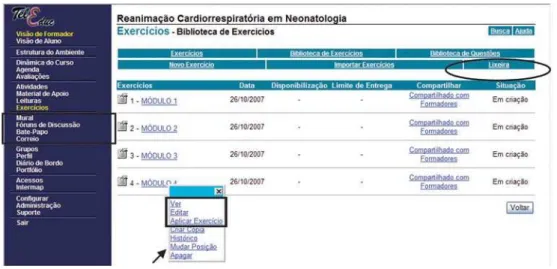
In addition, the proposed activities are divided into class mod-ules, which contain questions regarding each one (Figure 4):
Figure 4 - Screen with Proposed Activities divided by Modules, in the “Activity Library” - São Paulo - 2007
To see a question, tutors simply click on the dialogue box on the side, and choose see. A popup window will open with the instruction, the score, the type of question (open, multiple choice, link columns, or true or false; re-spectively referred to as the following abbreviations in Por-tuguese: DIS - dissertativa, ME - múltipla escolha, AC –
Associar colunas,VF – Verdadeiro e Falso) and their respec-tive answer choices.
Furthermore regarding the questions, in addition to tu-tors attributing scores and classifications according to the type, they may also be classified according to the level of difficulty; as easy (F, as in fácil), medium (M) or difficult (D).
Figure 5 - Screen showing Question 2 of Module 4 - São Paulo - 2007
FINAL CONSIDERATIONS
Taking into consideration that the objective of the present study was to Develop a Proposal for Virtual Educa-tion in Cardiopulmonary Resuscit aEduca-tion in Newborns, it is concluded that the points that determined the success of the project and the satisfaction in completing it was the group work, the quality of the educational material, the chosen learning-support platform and methodology.
In the current context of education, there is a demand for opinion-former professionals. Hence, there is a need for new teaching-learning practices using educational resources and technologies, encouraging and favoring the advancement and preparation of nurses and allowing for self-learning.
From this perspective it becomes evident that there is a need to understand and incorporate the virtual
environ-ment as an efficient educational device, and to use that knowledge as a strategy to add new experiences and val-ues to nursing practice.
Finally, we believe this study may contribute with the innovation of nursing education, by means of a proposal for virtual education on a relevant theme, i.e., cardiopul-monary resuscitation in newborns.
REFERENCES
1. Abreu AF, Gonçalves CM, Pagnozzi L. Tecnologia da informa-ção e educainforma-ção corporativa: contribuições e desafios da mo-dalidade de ensino-aprendizagem à distância no desenvolvi-mento de pessoas. Rev PEC (Curitiba). 2003;3(1):55-8.
2. Chaves E. Tecnologias na educação: conceitos básicos [texto na Internet]. [citado 2007 out. 21]. Disponível em: http://edu tec.net/Tecnologia%20e%20Educacao/edconc.htm
3. Barreto RG. Tecnologias na formação de professores: o discur-so do MEC. Educ Pesq. 2003; 29(2):271-86.
4. Caetano KC. Desenvolvimento e avaliação de um ambiente de aprendizagem virtual em administração em enfermagem [dis-sertação]. São Paulo: Escola de Enfermagem, Universidade de São Paulo; 2006.
5. Almeida MEB. Educação à distância na Internet: abordagens e contribuições dos ambientes digitais de aprendizagem.Educ Pesq [periódico na Internet]. 2003 [citado 2006 dez. 20];29(2):[cerca de 14 p.]. Disponível em: http://www.scielo.br/pdf/ep/v29n2/ a10v29n2.pdf
6. Informática na Assistência e no Ensino de Enfermagem e Teleenfermagem: avanços tecnológicos na prática profissional. In: Sistema de Educação Continuada à Distância. Programa de Atualização em Enfermagem Saúde do Adulto. Porto Alegre: Artmed; 2006.
7. Nardi BA, O’Day VL. Information ecologies [text on the Internet]. 2nd ed. Cambridge: MIT Press; 1999. [cited 2006 Ago 15].
Available from: http://www.firstmonday.org/issues/issue4_5/ nardi_chapter4.html
8. Gutierrez F, Prieto D. A mediação pedagógica: educação à dis-tância alternativa. São Paulo: Papirus; 1994.
9. Bastos MAR, Guimarães EMP. Educação à distância na área da enfermagem: relato de uma experiência. Rev Lat Am Enferm [periódico na Internet]. 2003 [citado 2006 ago. 15];11(5):[cer-ca de 7 p.]. Disponível em: http://www.scielo.br/pdf/rlae/ v11n5/v11n5a18.pdf
10. Peres HHC. O ser docente frente ao mundo da informática: um olhar na fenomenologia social [tese]. São Paulo: Escola de Enfermagem, Universidade de São Paulo; 2001.
11. Universidade Federal do Rio de Janeiro. Casa da Ciência. Edu-cação à distância [texto na Internet]. Rio de Janeiro; 1999. [citado 2006 ago. 15]. Disponível em: http://www.cciencia. ufrj.br/educnet/EDUCOMUN.HTM
12. Zem-Mascarenhas SH, Cassiani SHB. Desenvolvimento e ava-liação de um software educacional para o ensino de enfer-magem pediátrica. Rev Lat Am Enferm [periódico na Internet]. 2001 [citado 2006 ago. 15];9(6). Disponível em: http:// www.scielo.br/pdf/rlae/v9n6/7820.pdf
13. Appolinário F. Metodologia da ciência: filosofia e prática da pesquisa. São Paulo: Pioneira; 2006.
14. Diogo RCG. Desenvolvendo um website educacional sobre intervenção de enfermagem: aspiração de secreção traqueo-brônquica [tese]. São Paulo: Departamento de Enfermagem, Universidade Federal de São Paulo; 2001.
15. Sasso GTMD. A concepção do enfermeiro na produção tec-nológica informatizada para ensino/aprendizagem em reani-mação cardiorrespiratória [tese]. Florianópolis: Universidade Federal de Santa Catarina; 2001.
16. Nogueira VO, Marin HF, Cunha ICKO. Informações on-line sobre transporte intra-hospitalar de pacientes críticos adul-tos. Acta Paul Enferm. 2005;18(4):390-6.
17. Falkembach GAM. Concepção e desenvolvimento de materi-al educativo digitmateri-al. Renote Rev Novas Tecnol Educ [periódi-co na Internet]. 2005 [citado 2007 ago. 15];3(1). Disponível em: http://www.cinted.ufrgs.br/renote/maio2005/artigos/ a23_materialeducativo.pdf
18. Rocha HV. O ambiente TelEduc para Educação à Distância baseada na Web: princípios, funcionalidades e perspectivas de desenvolvimento. In: Moraes MC, organizador. Educação à distância: fundamentos e práticas. Campinas: Unicamp/ Nied; 2002. p.197-212.