*Correspondence: T. U. de Andrade. Departamento de Farmácia, Centro Universitário de Vila Velha. R. Comissário José Dantas de Melo, 21 – 29102-170 - Vila Velha - ES, Brazil. E-mail: [email protected]
A
vol. 45, n. 2, abr./jun., 2009
Evaluation of the satisfaction level of patients attended by
a Pharmaceutical Care Program in a Private Communitarian
Pharmacy in Vitória (ES, Brazil)
Tadeu Uggere de Andrade
1,2*, Daiani Mucelin Burini
3, Michelli de Oliveira Mello
3, Natyara dos
Santos Bersácula
3, Renata Aubin Dias Saliba
1,4, Francielli Teixeira Bravim
1, Nazaré Souza Bissoli
1,41Departament of Physiological Science, Health Science Center, Federal University of Espírito Santo, 2Pharmacy Department,
University Center of Vila Velha, 3Pharmacy Course, University Center of Vila Velha, 4Ethosfarma Teaching Institute
The present study was designed to evaluate the satisfaction of users of a Pharmaceutical Care (PC) service in a private communitarian pharmacy in Vitória (ES, Brazil). In this transversal observational study, patient interviews were performed by an experimenter that had no relationship with the establishments evaluated. Data were collected using a structured questionnaire. The questionnaire used a ive point Likert scale, in which smaller numbers represented lower levels of satisfaction. For comparison, user satisfaction was also evaluated for two pharmaceutical establishments that do not have standardized PC services. In these cases, age-matched patients were selected randomly. A higher level of satisfaction was reported by users of the PC service, with values between three and ive. The higher averages for the establishment with PC service were the result of greater perceived pharmacist interest in the patient’s health. As the same results were not obtained by the services without PC, it was concluded that this practice is very important to the satisfaction level of users of pharmacy services.
Uniterms: Pharmaceutical care/user´s evaluation. Pharmacy services. Communitarian pharmacy/ evaluation.
O presente estudo teve por objetivo avaliar a satisfação de usuários de um serviço de atenção farmacêutica, implantado em uma farmácia comunitária privada no município de Vitória - ES. Trata-se de um estudo observacional de corte transversal, cuja coleta dos dados se deu por meio da aplicação de um questionário de satisfação. O instrumento foi aplicado por indivíduo treinado e sem vínculo com os estabelecimentos avaliados. Foi utilizada uma escala de intensidade de cinco pontos do tipo Likert, cujo menor número representa a opção “ruim” e o maior à opção “excelente”. Também foi avaliado, para efeito de comparação, o nível de satisfação de usuários de dois outros estabelecimentos farmacêuticos que não possuíam esta prática implantada. Neste caso, os pacientes foram selecionados de forma aleatória, porém pareados pela idade. Foi obtido um alto nível de satisfação dos usuários do serviço de atenção farmacêutica. Os valores obtidos estavam entre 3 e 5, numa escala que varia de 1 a 5 pontos, sendo que as médias mais altas se referiam ao interesse do farmacêutico pela saúde do paciente. Como nos demais estabelecimentos o nível de satisfação foi inferior, foi possível concluir que o serviço de atenção farmacêutica foi o responsável pelo excelente resultado obtido.
Unitermos: Atenção farmacêutica/avaliação de usuários. Serviços de farmácia. Farmácia comunitária/ avaliação.
INTRODUCTION
The concept of Pharmaceutical Care (PC) was irstly deined as the responsible provision of pharmacologic tre
-atment, with the purpose of obtaining concrete results im-proving the patients quality of life. (Hepler, Strand, 1999)
Care deining the same as the direct interaction between
the pharmacist and the user, aiming rational
pharmacothe-rapy, the obtainment of deinite and measurable results,
and designed toimprove the quality of life. It includes attitudes, ethical values, behavior, abilities, commitment and co-responsibilities in the prevention of diseases, pro-motion and recovery of health, in an integrated manner to the health team (OPAS, 2002).
On account of the growing importance of PC in the society, it becomes necessary to evaluate the satisfaction level of patients who use that service. The satisfaction
relects the reality of care, as well as the preferences and
expectations of the patient. Therefore, it becomes impor-tant to evaluate the satisfaction level of patients in face of the services offered by healthcare professionals, once it can be used as an indicator of quality of these services (Larson, Roves, Mackeigan, 2002; Kucukarslan & Schom-mer, 2002; Halal et al., 1994).
The observed satisfaction level becomes a useful instrument; since by it, it might be possible to take neces-sary corrective measures, aiming constant improvement of the patient’s care (Oliveira, Guirardello, 2006). There are some essential factors that might interfere with the qua-lity of attending and the relationship between the patient and the healthcare professional. Among those factors, it could be mentioned the ability, the knowledge, the clear-ness in the transmission of information related to use of medications, and the constant assistance to each patient
individually, creating greater conidence in the healthcare
professional, consequently the patient will followbetter the treatment (Greeneich, Long, Miller, 1992).
It is useless to evaluate the satisfaction of the patient considering only the PC service. Data related to the phar-macy structure, employees’ assistance, organization and resources are used as parameters which interfere with the service results (Scheider, Ninckman, 1994).
Therefore, the present study was designed to evalua-te the satisfaction level of patients of a pharmaceutical care service in a private communitarian pharmacy in Vitória-ES, besides comparing the satisfaction level with users of pharmaceutical services without this institutionalized practice and, in this way, qualify the healthcare services offered.
METHODOLOGY
It was evaluated the satisfaction level of users of a private communitarian pharmacy within the PC program implanted (service A) and, for comparison purposes, it was also evaluated the satisfaction of users from other two pharmaceutical establishments, private (service B) and
public (service C), both having not this kind of service. This is a transversal observational study, using quanti-qualitative approach, whose data were collected by means of a structured questionnaire.
Evaluation of the satisfaction level of users of communitarian pharmacy with a PC Program implanted
Description of the service (Service A)
This is a private communitarian pharmacy, located in Santo Antônio district, Vitória – ES; where assistance services are provided with commercialization of medi-cations and other products, besides pharmaceutical care.
In 2000, it was implanted the Pharmaceutical Care Program (PCP) in that pharmacy with costless services for patients from SUS (“Uniied Health System”), in as -sociation with the Public Health Center (PHC)located in the same district. In this Program, from February 2007 to May 2008, 56 previously selected patients followed the
PCP. At irst, it was carried out a survey of data about these
patients, such as: social-economic aspect, medical record of present and past health conditions, life style, diet and family medical record. Also, it was made an evaluation of
the prescription and medicative application, identiication
of drug-related problems (DRP), interventions for solution of those ones and assistance about the correct use of the medications (Saliba et al., 2007).
Besides pharmacists, the Program had the participa-tion of a multiprofessional team from the PHC, consisting of: physicians, nurses, physical educators, social assistants and health agents (Saliba et al., 2007).
The patients were observed for 13 months, nine individual meetings were held at the pharmacy and four collective meetings at the PHC.
During the individual meetings the patients were
submitted to: blood pressure measurement, veriication of
weight, height, abdominal circumference, capillary glyce-mia. In addition, informative material was distributed, evaluations of the pharmacotherapy and therapeutic
pur-pose were achieved, identiication and resolution of DRP, pharmaceutical interventions and the medical request for diagnosis of other diseases, as well as reevaluation of the treatment. Furthermore, at the collective meetings, bioche-mical exams were made: total cholesterol, HDL, VLDL, LDL, uric acid, urea, creatinine, glucose and glycosylated hemoglobin (Saliba et al., 2007).
The exams, materials, equipments and the medications Simvastatin and Amlodipinewere financed by private companies (Saliba et al., 2007).
Profile of the users
The PCP had participation of 50 patients with age average of 62 ± 2 years, 82% of the participants were fema-le and 18% were mafema-le; 20% illiterate, 32% low education level and 48% medium education (Saliba et al, 2007).
Evaluation of the satisfaction of users of establishments that do not have PCP implanted
Communitarian Pharmacy (Service B)
This is a private communitarian pharmacy, also lo-cated in Santo Antônio district, Vitória – ES, close to the PHCof this area. At that pharmacy, commercialization of medications and other products were made. Such service was developed by a responsible pharmacist and other em-ployees. The pharmaceutical professional, as declared,is present at the establishment full time to help and answer the clients’ questions, if necessary and solicited. However, PC services are not offered.
Public Pharmacy located at the PHC (Service C)
It’s about the PHU pharmacy of the district. The service A collaborates with one of the family health program teams at this PHU to make available the PCP, however with no participation of that health center phar-macy, in other words, service C. This PHU is equidistant at the others pharmacies which provide the services A and B. At the PHU pharmacy, it is done the dispensation of medications, by means of prescription to the registe-red people. During the dispensation, the pharmacist, if necessary, transmits some important information about the medications. At that establishment, however, there’s no standardized PC service. The PHU provides multi-professionalassistance,by means of several existing health programs.
At the pharmacies which provides the services B and C were interviewed respectively 20 and 21 people, in a random manner and age-matched (in other words, individuals of the same age group, independently of other characteristics).
Satisfaction Evaluation Instrument
In order to check the users satisfaction, it was per-formed a structured interview using as instrument the “Satisfaction Questionnaire with the Pharmacy Services”,
irst elaborated and implanted by Kucukarslan & Schom -mer (2002) and adopted, translated and validated to the
Portuguese language by a research group of the Federal University of Paraná (Correr et al., 2009).
The questionnaire evaluated the services provided by the pharmacist as well as the general services of the
pharmacy. The used scale consists of a ive point Likert
scale, in which smaller number represents the option “bad” and the largest one the option “excellent”. The in-terviewed, then, chooses an answer that better represents his opinion. The same procedure was performed at the services B and C.
The interviews were performed in April 2008 by an experimenter that had no relationship with the PCP, neither with other pharmaceutical establishments.
Statistical Analysis
Collected data were compiled on a spreadsheet, which was elaborated with Microsoft Excel, Ofice 2007
version. Database was analyzed with utilization of the statistical program Statistical Package Social Science 11.5 (SPSS 11.5). It was performed the simple relative frequen-cies on the qualitative variables within each group, also compared among the groups (crossed relative
frequen-cies). Chi-square test was applied at a signiicance level of
5%. For the quantitative variables it was developed a one way variation analysis (ANOVA). Fisher was the post-hoc
test used, with the purpose of multiple comparisons with fully random lineation.These data were expressed as the mean ± standard error of the mean (S.E.M.)
Ethical Aspects
The present study was developed according to research regulations involving human beings and it had its previous approval by the Institutional Review Board/ Independent Ethics Committee of Salesian Faculty, in
Vitória (protocol nº 02/2006).
RESULTS AND DISCUSSION
From the 56 patients selected to participate in the
PCP service A, 50 inalized the project, corresponding to
at service A (55.9%) in comparison to the others (Service B = 23.7%; Service C = 18.9%; p<0.01 in relation to the service A). These numbers indicate that the practice of PC was the factor which raised the satisfaction rate of the users at the pharmacy with the program implanted. All the users of service A reported satisfaction level above the average, in other words, between 3 and 5, in a scale varying from
one to ive points.
.
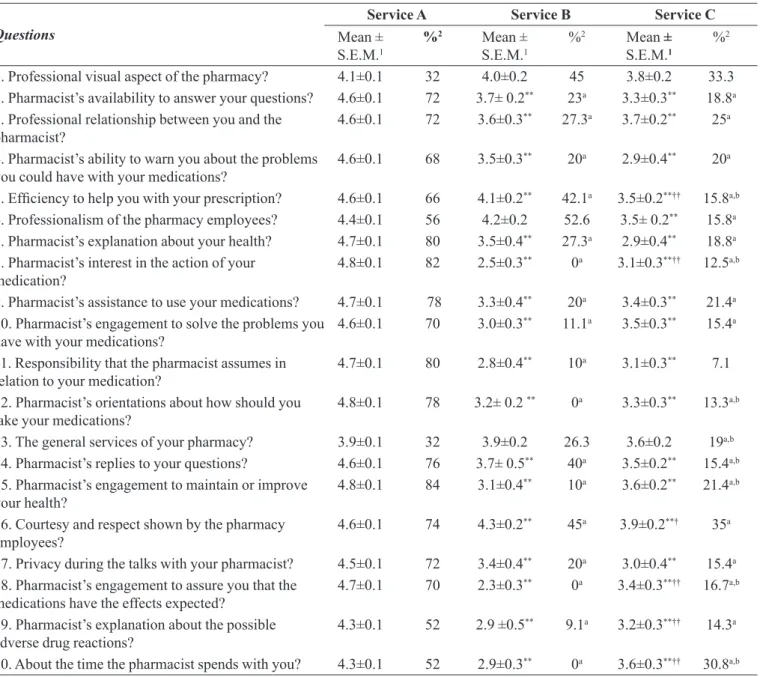
Analyzing each item of the questionnaire (Table I), the highest average value obtained at service A corres-ponds to the following questions: “pharmacist’s interest in your health” (4.8 ± 0.6), which obtained 82% of replies ‘excellent’, and “pharmacist’s engagement to maintain or improve your health” (4.8 ± 0.7), which obtained 84% of replies ‘excellent’. This result shows that the practice of the pharmaceutical professional, at this service, is focused on the patient,so this one starts to develop a better contact with the pharmacist, who, by means of his intervention, succeeds in making the patients realize the interest this one
has to improve his health. So, it was conirmed that the
relationship pharmacist-patient interferes positively with the satisfaction level.
For comparison, at the establishments having no PC services, the averages obtained from the question referring to the pharmacist’s interest in the health were very lower than those at service A (2.45 ± 0.28 at service B and 3.06 ± 0.32 at service C; p<0.01 compared to service A). It
indicates that a differentiated pharmaceutical service is a
relevant factor which inluences the satisfaction level of
users of a public or private establishment.
At the services B and C the highest average value obtained was from the question referring to the establish-ments, reaching 4.0 ± 0.23 (45% of ‘excellent’ replies) and 3.81 ± 0.20 (33,3% of ‘excellent’ replies), respectively.
The lowest average values obtained, at service A (3.94 ± 0.12), corresponds to the pharmacy in general, which involves the establishment employees. It might have occurred because the patients do not use frequently the services provided by the employees, since most of the used medications are gotten at PHU, with no charges.
It is worthy to mention that medications Simvastatin
and Amlodipine,not available at the PHU,were donated to PCP participants by a pharmaceutical private company; some exams were also made periodically and free of char-ge. It can’t be denied the fact of that practice might have
inluenced positively the results of satisfaction obtained at
service A. However, if the medications free of charge and the realization of exams were the main determinant aspects of users satisfaction with health services, the evaluation result performed with the individuals attended by service C (Pharmacy of the Health Center, where medications are also costless) should have been compatible with service A.
The Table II indicates the distribution of frequencies and percentages, according to the social-economic and cultural characteristics of the users. The users of service B had education level higher than that of other users. Some authors observed association between the scholarity rate and the level of satisfaction with the services provided, showing that the individuals with less education tend to devalue themselves and be more condescending towards the health services provided for them(Rodriguez, Lopez, 2002; Camprubí, 1998). So, the highest scholarity rate of
service B users could have inluenced negatively on satis -faction, as well as the highest satisfaction level of service
A users might have been inluenced by the lower scholarity
rate of the participants. When the users are matched by the same scholarity rate (it was chosen the highest education
level at the three services, high school), it was veriied the
maintenance of the superior evaluation tendency of service A, once 100% of the users with higher education attributed
value ≥4, against 25 % of service B and 66,6% of service C.
In relation to the familiar income, it was noticed that service C users had monthly income inferior than the others; 52.4 % received from 1 to 2 minimum wages, while at the other services, the users received from 3 to 5. It was proved already the tendency of users from low social levels to evaluate positively the provided services (Ware, 1978; Mosteller, 1988). However, in this study it was not
observed the positive inluence on satisfaction from users
having small income, due to the fact that satisfaction result of service C represented a lower level than service A.
The number of interviewed women was higher than men at the three services, while the difference was lower
at service B. However, the variant sex did not inluence
the results at service A, once satisfaction levels of men and women were equivalent (85.4% of women and 88.9% of men attributed values between 4 and 5). Another
obser-vation that conirms the nonexistent gender inluence on
obtained results was the evidence that, despite service B has a higher number of men, they evaluated the service as being more satisfactory than service C (40% of the men at service C and 66% of the men at service B attributed values between 3 and 5), but the general average of satisfaction between these two services was the same.
The variant age cannot be considerate to justify the result differences obtained at services A, B and C, as the age averages were equivalent (62 ± 2, 61 ± 3 e 66 ± 3 years, respectively).
TABLE I – Instrument items of evaluation and replies from the patients
Questions
Service A Service B Service C
Mean ± S.E.M.1
%2 Mean ±
S.E.M.1
%2 Mean ±
S.E.M.1
%2
1. Professional visual aspect of the pharmacy? 4.1±0.1 32 4.0±0.2 45 3.8±0.2 33.3 2. Pharmacist’s availability to answer your questions? 4.6±0.1 72 3.7± 0.2** 23a 3.3±0.3** 18.8a
3. Professional relationship between you and the pharmacist?
4.6±0.1 72 3.6±0.3** 27.3a 3.7±0.2** 25a
4. Pharmacist’s ability to warn you about the problems you could have with your medications?
4.6±0.1 68 3.5±0.3** 20a 2.9±0.4** 20a
5. Eficiency to help you with your prescription? 4.6±0.1 66 4.1±0.2** 42.1a 3.5±0.2**†† 15.8a,b
6. Professionalism of the pharmacy employees? 4.4±0.1 56 4.2±0.2 52.6 3.5± 0.2** 15.8a
7. Pharmacist’s explanation about your health? 4.7±0.1 80 3.5±0.4** 27.3a 2.9±0.4** 18.8a
8. Pharmacist’s interest in the action of your medication?
4.8±0.1 82 2.5±0.3** 0a 3.1±0.3**†† 12.5a,b
9. Pharmacist’s assistance to use your medications? 4.7±0.1 78 3.3±0.4** 20a 3.4±0.3** 21.4a
10. Pharmacist’s engagement to solve the problems you have with your medications?
4.6±0.1 70 3.0±0.3** 11.1a 3.5±0.3** 15.4a
11. Responsibility that the pharmacist assumes in relation to your medication?
4.7±0.1 80 2.8±0.4** 10a 3.1±0.3** 7.1
12. Pharmacist’s orientations about how should you take your medications?
4.8±0.1 78 3.2± 0.2 ** 0a 3.3±0.3** 13.3a,b
13. The general services of your pharmacy? 3.9±0.1 32 3.9±0.2 26.3 3.6±0.2 19a,b
14. Pharmacist’s replies to your questions? 4.6±0.1 76 3.7± 0.5** 40a 3.5±0.2** 15.4a,b
15. Pharmacist’s engagement to maintain or improve your health?
4.8±0.1 84 3.1±0.4** 10a 3.6±0.2** 21.4a,b
16. Courtesy and respect shown by the pharmacy employees?
4.6±0.1 74 4.3±0.2** 45a 3.9±0.2**† 35a
17. Privacy during the talks with your pharmacist? 4.5±0.1 72 3.4±0.4** 20a 3.0±0.4** 15.4a
18. Pharmacist’s engagement to assure you that the medications have the effects expected?
4.7±0.1 70 2.3±0.3** 0a 3.4±0.3**†† 16.7a,b
19. Pharmacist’s explanation about the possible adverse drug reactions?
4.3±0.1 52 2.9 ±0.5** 9.1a 3.2±0.3**†† 14.3a
20. About the time the pharmacist spends with you? 4.3±0.1 52 2.9±0.3** 0a 3.6±0.3**†† 30.8a,b 1 The numbers represent the mean ± the standard error of the mean (S.E.M.). **p<0.01 in relation to service A.††p<0,01 and †p<0,05 in
relation to service B. Replies excellent(5) and bad (1). 2Porcentage of replies excellent (5). ap<0.05 in relation to service A.bp<0,05
The studies on customers’ opinion are really relevant to improve the execution of activities at an establishment. Concerning to a pharmaceutical establishment, an effort is made to improve the quality of dispensation, the resolution of the complaints and the capacity to satisfy the patients’ needs (Pires et al., 2006). The user dissatisfaction can be understood by his reaction against the context, the process and the overall result of his experience respecting to a given service (Donabedian, 1980).
Perceptible, the importance of checking and eva-luating the user’s satisfaction, of this and other health
services, as well as knowing the factors that inluence sa -tisfaction. Also, the aspects that can be improved in order to assure high quality services, consequently promoting
beneits to the users.
Therefore, to correct the deiciencies of each service
is not only a matter of prestige of such service. Actually, such measures might result in a worthy impact over es-sentially “technical” aspects, over morbidity and, possibly, over users mortality (Kloetzel et al., 1998).
CONCLUSION
With the questionnaire was possible to measure users satisfaction level of the pharmacy with PCP. There was a high level of satisfaction at service A, mainly concer-ning to pharmacist’s interest in health and his engagement to improve or maintain the users’ health.
The presence of the PC service seems to be the main factor determining the satisfaction level of users of phar-maceutical services, once the same result was not obtained by the services without PC.
ACKNOWLEDGMENTS
The present study was financed by University Center of Vila Velha – UVV and Ethosfama Institute of Professional Education. We thank to the pharmaceutical establishments which provided the accomplishment of this research in their facilities, to Tommasi Laboratory by its support and realization of the laboratory exams, to
TABLE II – Distribution of absolute (n) and relative (%) frequencies, according to the socio-economic and cultural characteristics of the users
Characteristics Service A Service B Service C
n % n % n %
Sex
Female 41 82 11 55* 16 76.2†
Male 5 18 9 45* 5 23.8†
Age (years)
< 50 6 12 3 15 2 9.5
50-60 19 38 9 45 1 4.8**††
61-70 14 28 4 20 12 57.1**††
71-80 11 22 4 20 6 28.6
Monthly Income (minimum wage-MW)
< 1 MW 1 2 1 5 6 28.6**††
1-2 MW 21 42 4 20** 11 52.4††
3-5 MW 24 48 8 40 2 9.5**††
6-10 MW 3 6 6 30** 2 9.5††
> 10 MW 1 2 1 5 0 0*†
Scholarity
Illiterate 10 20 0 0** 3 14.3††
Complete Elementary School 8 16 1 5** 9 42.9**††
Incomplete Elementary School 9 18 0 0** 5 23.8
Complete High School 4 8 12 60** 3 14.3**††
Incomplete High School 19 38 5 25 0 0**††
College 0 0 2 10* 1 4.8*
Alquimia Pharmacy by donation of medications, to Abbott MedisenseLaboratory by donation of strips, lancets and capillary glycemia dosage equipments; necessary to the PCP at service A.
REFERENCES
CAMPRUBÍ, J. La satisfacción del cliente: singularidades de los servicios sanitarios. In:DEL LLANO, J.; ORTÚN, V.; MARTÍN, J.M., MILLÁN, J.; GENÉ J. (Eds.).Gestión sanitaria: innovaciones y desafíos. Barcelona: Masson; 1998. p. 333-348.
CORRER, C.J.; PONTAROLO, R.; MELCHIORS, A.C.; PAULA e SOUZA, R.A.; ROSSIGNOLI, P.; FERNÁNDEZ-LLIMÓS, F. Satisfação dos usuários com serviços da farmácia: tradução e validação do “pharmacy services questionnaire” para o Brasil. Cad. Saúde Pub., v.25, n.1, p.87-96, 2009.
DONABEDIAN, A. Exploration in quality assessment and monitoring. Ann Arbor: University of Michigan, 1980. v.1, 163 p.
GREENEICH, D. S.; LONG, C. O.; MILLER, B. K. Patient satisfaction update: research applied to practice. Apple Nurs. Res., v.5, n.1, p.43-48, 1992.
HALAL, I. S.; SPARRENBERGER, F.; BERTONI, A. M.; CIACOMET, C.; SEIBEL, C. E.; LAHUDE, F. M.; MAGALHÃES, G. A.; BARRETO, L.; LIRA R. C. A. Avaliação da qualidade de assistência primária à saúde em localidade urbana da região sul do Brasil. Rev. Saúde Pública, v.28, n.2, p.131-136, 1994.
H E P L E R , C . D ; S T R A N D , L . M . O p o r t u n i d a d e s y responsabilidades en la Atención Farmacéutica. Pharm. Care, v.47, p.35-47, 1999.
KLOETZEL, K.; BERTONI, A. M.; IRAZOQUI, M. C.; CAMPOS, V. P. G.; SANTOS, R. N. Controle de Qualidade em atenção primária à saúde. I – A satisfação do usuário.
Cad. Saúde Pub., v.14, n.3, p.623-628, 1998.
K U C U K A R S L A N , S . ; S C H O M M E R , J . C . P a t i e n t s ’ expectations and their satisfaction with pharmacy services.
J. Am. Pharm. Assoc., v.42, n.3, p.489-895, 2002.
LARSON, L. N.; ROVES, J.; N. MACKEIGAN, L. D. Patient satisfaction with pharmaceutical care: update of a validated instrument. J. Am. Pharm. Assoc., v.42, n.1, p.44-50, 2002.
MOSTELLER, F. The Quality of Medical Care: Information for Consumers. In: U.S. congress office of technology assessment, 1988, Washington: U.S. Government Printing
Ofice, 1988. 318 p.
OLIVEIRA, A. M. L.; GUIRARDELLO, L. B. Satisfação do paciente com os cuidados de enfermagem: comparação entre dois hospitais. Rev. Esc. Enferm. USP, v.40, n.1, p.71-77, 2006.
ORGANIZAÇÃO PAN-AMERICANA DE SAÚDE. Brasília.
Consenso brasileiro de atenção farmacêutica: proposta. Brasília, 2002. 24 p.
PIRES, C. F.; COSTA, M. M.; ANGONESI, D.; BORGES, F. P. Demanda Del servicio de atención farmacéutica en una farmacia comunitaria privada. Pharm. Pract., v.4, n.1, p.34-37, 2006.
RODRÍGUEZ W. M.; LÓPEZ, C. C. Satisfacción de usuarios de consulta externa de especialidad en Instituto Nacional de Pediatria. Acta Pedriatr. Méx., v.23, p.7-12, 2002.
SALIBA, R. A. D.; BRAVIM, F. T.; FILHO J. J. R.; BISSOLI N. S. Pharmaceutical care to elderly patients with metabolic syndrome attended on private pharmacy in partnership with sanitary unit/SUS. In: INTERNATIONAL CONGRESS OF PHARMACEUTICAL SCIENCES, 6., Ribeirão Preto, 2007. Resumos. Ribeirão Preto: Faculdade de Ciências Farmacêuticas de Ribeirão Preto-USP, 2007. p.52.
SCHNEIDER, J. K.; NICKMAN, N. A. Assessment of pharmaceutical care needs in an ambulatory setting. Hosp. Pharm., v.29, n.3, p.238-242, 1994.
WARE, J. E. Jr. Effects of acquiescent response set on patient satisfaction ratings. Med. Care, v.16, n.4, p.36-327, 1978.
Received for publication on 01st august 2008