A neural network - based algorithm for predicting stone -
free status after ESWL therapy
_______________________________________________
Ilker Seckiner
1, Serap Seckiner
2, Haluk Sen
1, Omer Bayrak
1, Kazım Dogan
1, Sakip Erturhan
11 Department of Urology, Gaziantep University, Gaziantep, Turkey; 2 Department of Endustrial Engineering, Gaziantep University, Gaziantep, Turkey
ABSTRACT
ARTICLE
INFO
______________________________________________________________ ______________________
Objective: The prototype artificial neural network (ANN) model was developed using data from patients with renal stone, in order to predict stone-free status and to help in planning treatment with Extracorporeal Shock Wave Lithotripsy (ESWL) for kidney stones.
Materials and Methods: Data were collected from the 203 patients including gender, single or multiple nature of the stone, location of the stone, infundibulopelvic angle primary or secondary nature of the stone, status of hydronephrosis, stone size after ESWL, age, size, skin to stone distance, stone density and creatinine, for eleven vari-ables. Regression analysis and the ANN method were applied to predict treatment suc-cess using the same series of data.
Results: Subsequently, patients were divided into three groups by neural network soft-ware, in order to implement the ANN: training group (n=139), validation group (n=32), and the test group (n=32). ANN analysis demonstrated that the prediction accuracy of the stone-free rate was 99.25% in the training group, 85.48% in the validation group, and 88.70% in the test group.
Conclusions: Successful results were obtained to predict the stone-free rate, with the help of the ANN model designed by using a series of data collected from real patients in whom ESWL was implemented to help in planning treatment for kidney stones.
Keywords:
Calculi; Lithotripsy; therapy [Subheading]
Int Braz J Urol. 2017; 43: 1110-4
_____________________
Submitted for publication: December 07, 2016
_____________________
Accepted after revision: April 09, 2017
_____________________
Published as Ahead of Print: June 28, 2017
INTRODUCTION
Kidney and ureteral stones are the third most commonly encountered pathologies in uro-logical practice after urinary infections and dis-eases of the prostate. The incidence of stones has been reported as 5-10% and they are observed three-fold more frequently in men than in women. The risk is high between the ages of 30 and 50 years, and patients with stones have been report-ed to experience stone development more than once throughout their lifetime. Most of the stones formed are eliminated through urination. The time
period for the elimination process depends on the location and size of the stone. Spontaneous pas-sage of ureteral stones smaller than 5mm is at a rate of about 80% (1). Extracorporeal Shock Wave Lithotripsy (SWL), ureterorenoscopy (URS), ret-rograde intrarenal surgery (RIRC), percutaneous nephrolithotomy (PNL), and open surgery are used to treat active stones.
time, increases the length of hospitalization, and has a high-cost rate, thus favoring SWL (2, 3). The principle of SWL, where shock waves are directed over the stones, was first initiated in Russia in the 1950s; studies on the modality started in 1974, and it was first experimented on humans in 1980. SWL has become the first option in the manage-ment of urinary stones particularly those smaller than 2cm, since there is no need for surgery and anesthesia (3). The success rate in stones smaller than 2cm is 70-80%. Many factors have been re-ported to affect success including anatomic fac-tors and age of the patient; type, opacity, and size of the stone; its location in the collecting system; and the anatomy of the kidney collecting system. In this study, we developed an algorithm which predicts the stone-free status of the patients in or-der to select the better treatment method and to notify patients.
The aim of this study was to develop a prototype artificial neural network (ANN) model from data obtained from real patients.
MATERIALS AND METHODS
Patients who presented for SWL treatment at the Urology Department, between January 2013 and December 2015, were included in the study. Data were collected from 203 patients including gender, single or multiple nature of the stone, lo-cation of the stone, infundibulopelvic angle (IPA), history of SWL treatment, status of hydronephrosis, stone size after SWL, age, number of SWL session, size, skin to stone distance, stone density and creat-inine, for a total of eleven variables. The first seven of these variables were categorical; the remaining six were numerical variables. Accordingly, sizes of the stones after SWL were determined as an output, and the size of the kidney stone was used to dem-onstrate the success rate of treatment.
Alyuda NeuroIntelligence Software ran-domized the training set, test set and validation set in the order of 100 (69.44%), 22 (15.28%) and 22 (15.28%) respectively.
Artificial Neural Network
The Alyuda NeuroIntelligence 2.2 (Alyuda Research, Inc., Los Altos, California, USA) software
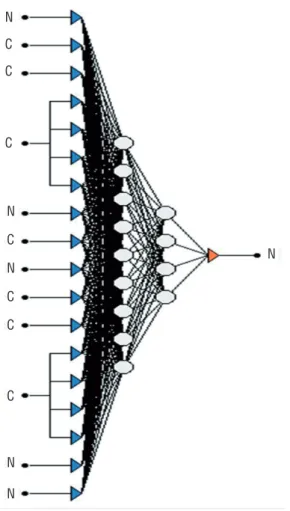
was used to create an artificial neural network (ANN). While creating the ANN, data were analyzed with regards to training, validity, and test. Data were analyzed according to numerical and categor-ical data, and also about what percentage of data was training, validity or test related. The second stage involved the transformation of all data to the numerical form for processing. In the third stage, the ANN structure was formed (Figure-1). A total of 16 neurone input values were introduced into the network structure; eight each for two intermedi-ate neurone layers and one neurone was formed to express output. In this study, it was demonstrated that formation of two intermediate neurone layers was important to better understand the training set. The number of neurones was determined with trials. There are no particular rules in the litera-ture expressing how to determine it. In the ANN model, all input and output values are determined according to logistic activation functions - values are transformed between the 0 and 1 interval. Af-ter deAf-termining the network structure, the training function is selected at the next training stage. This function would not normally prolong the duration of the procedure and the derivative should be an easily accessible function. Considering the features of our data, the Conjugate Gradient Descent func-tion appeared to be the ideal training algorithm among the software programs used. Furthermore, this algorithm provided the best training means from the previous data. The classification Accuracy Ratio was considered a criterion for suspending the algorithm. This ratio was accepted as 95% for our training set. In order to prevent the duration of the training from being hindered by local minimal values, we designated the learning coefficient as 0.1 and the speed emission coefficient as 1.75. The program was designed to suspend the algorithm when the training data attained the required learn-ing level. Weight values between the neuronal con-nections were constantly updated throughout the training period. An accurate prediction was said to be in place for a new case when these weights at-tained the most accurate value.
Regression Analysis
analysis. The SPSS for Windows 22.0 (SPSS Inc, Chicago, IL) program was hence used. Significant values were calculated from coefficients obtained from the regression analysis. A value of 95% was considered significance level.
RESULTS
A total of 203 patients were included in our study (Table-1). The patients were aged be-tween 1 to 77 years (mean: 33.87±17.90 years). Of these patients, 121 (59.6%) were male and 82 (40.4%) were female. A hundred and thirty-eight patients (68%) were shown to have a single kid-ney stone, while 65 (32%) patients had multiple kidney stones. Localization of the stones in the patients was as follows: in 15 (7.4%) patients at the upper pole, in 132 (65%) patients at the middle
calyx group and pelvis, in 28 (13.8%) at the lower pole, and in 28 (13.8%) patients in multiple loca-tions. SWL was performed on 11 (5.4%) patients in one session, 25 (12.3) patients in two sessions, 24 (11.8%) patients in three sessions, 45 (22.2%) patients in four sessions, 20 (9.9%) patients in five sessions, 76 (37.4%) patients in six sessions, and on two (1.0%) patients in seven sessions. The IPA was found to be <45º in 13 (6.4%) patients, and >45º in 190 (93%) patients. The sizes of the kidney stones varied from 10-489mm². They were between
Figure 1 - The architecture of the current algorithm.
N
C
C
C
N
C
N
C
C
C
N
N
N
Table 1 - Patient Characteristics.
Mean age, (range) 33.87±17.90 (1-77)
Gender, n (%)
Male 121 (59.6%)
Female 82 (40.4)
Stone no, n (%)
Single 138 (68%)
Multiple 65 (32%)
Stone localization
1 Upper pole 15 (7.4%)
2 Middle calyx group and pelvis 132 (65%)
3 Lower pole 28 (13.8%)
4 Multiple locations 28 (13.8%)
Number of SWL Sessions
1 11 (5.4%)
2 25 (12.3%)
3 24 (11.8%)
4 45 (22.2%)
5 and above 98 (48%)
Infundibulopelvic angle
<45 degree 13 (6.4%)
>45 degree 190 (93.6%)
Mean Serum creatinine (range, mg/dL) 0.10-1.70
Pre-treatment stone size (range, mm²) 10-489
0-100mm² following SWL. Two hundred (98.5%) patients were receiving SWL for the first time, whereas three (1.5%) patients were receiving it for the second time. Hydronephrosis was identified in 120 (59.1%) patients; Grade 1 hydronephrosis in 39 (19.2%) patients, Grade 2 hydronephrosis in 22 (10.8%) patients, and Grade 3 hydronephrosis in 18 (8.9%) patients. There is no information about the presence of hydronephrosis in the remaining patients (2%). The creatinine levels of the patients ranged between 0.1-1.7mg/dL.
Significant correlations were found be-tween stone size, number of SWL session, stone location, infundibulo-pelvic angle, skin to stone distance and stone-free rate in the regression analysis (Table-2).
Patients were randomly divided into three groups in order to implement the ANN: the train-ing group (n=139), the validation group (n=32), and the test group (n=32).
The ANN analysis demonstrated the pre-diction accuracy of the stone-free rate as 99.25% in the training group, 85.48% in the validation group, and as 88.70% in the test group.
DISCUSSION
Decision support systems (DSS), such as the ANN, can be used in the medical field, as com-puter generated algorithms, which help health care officials in clinical decision making. The basis of algorithms written in various forms is to mimic the learning style of the brain. These algorithms assist medical officials in decision making using specific clinical information of patients. As it is with other algorithms, real patient data should be registered in the computer. Data organization with the group of information at hand is useful, and with the help of various functions the computer is taught how to use data to make certain analysis. With the help of functions used on ANN, the com-puter is programed to predict certain parameters in a clever form, using training sets within the time frame. At the end of the training, the performance of the trained computer, which uses these real data is evaluated. The extent to which the computer has learned is evaluated, with regards to validity and test data. If the computer is concluded to have
learned enough to predict users, the program is deemed useful.
The ANN may be very beneficial in im-proving the quality of health services, help in the early diagnosis of diseases, prevent medical faults, and help health officials provide appropri-ate treatment to patients and to reduce costs. The decision making process is terminated by the se-lection of one of the alternative results from cog-nitive processes. The cogcog-nitive process is said to increase and the possibility of making mistakes also increases with an increase in the number of alternatives. At the end of the decision, an ac-tion or an idea is formed. An investigative sub-ject is produced in different forms to demonstrate how individuals make decisions. The interaction of psychological factors and cognitive activities with the environment should be analyzed during the decision making process. A person’s mind is expected to provide certain suggestions through logical filtering, and then make the right decision by itself. Despite much research, it is not yet well understood how the human brain functions in decision making. Solid and reliable information is needed by the brain to carry out the decision making function. All alternatives should be con-sidered together in order to make the right deci-sion. Since knowledge is a value against time, it
Table 2 - Coefficients obtained from regression analysis.
Standardized Coefficients
Significance
Age -0.044 0.663
Sex -0.107 0.291
Single/Multiple 0.268 0.007
Location 0.221 0.027
Number of sessions 0.245 0.014
IP angle 0.207 0.039
Stone size 0.394 0.001
Primary/Secondary -0.149 0.140
Hydronephrosis -0.019 0.848
Creatinine 0.088 0.382
Stone Density 0.056 0.578
is necessary to provide the decision maker with the data in the shortest possible time, in order to make effective and fast decisions. As a result, many administrative and specialist organiza-tion currently require the ANN for effective and speedy decision-making.
Recently, the ANN has gained effective us-age in urological practice. Most of these studies have been on diseases of the prostate, particularly on carcinoma, with acceptably successful results (4).
SWL, which has long been used in the management of urinary system stones, is especial-ly effective in the treatment of small sized stones. However, SWL may produce poor results in a cer-tain group of patients. From the patient’s perspec-tive, this accounts to time wasted, loss of kidney function, additional costs, and stress. As a result, it is important to know beforehand if certain treat-ment procedures would be successful in certain diseases. Clinicians actually use certain param-eters to predict the success of treatment through discussion with their patients, and depending on their clinical experience. Studies that have been conducted to predict the success of SWL have identified certain effective parameters. However, the desired results have not been attained from these studies conducted using classical statistical methods. For example, Gomha et al. (5) used a lo-gistic regression model to investigate stone-free status and demonstrated some significance only in the location of stones and the presence of a stent.
In the pilot study conducted by Hamid et al. (6) on 82 patients to predict the optimal frag-mentation of stone on SWL, it was demonstrated that the prediction complete fragmentation was possible in a rate of approximately 75%, but re-ported that more advances studies are required for better results.
The current study predicted the rate of stone elimination by developing an algorithm aimed at directing the course of effective treat-ment, making sure that the patient received the right treatment method and providing the patient with the required information. Unlike in previ-ous studies, our study included a larger sample
size and used ANN to attain a higher stone-free rate, proving that it was possible to predict with high accuracy (99%). By so doing, data collected before treatment and registered into the system were used with an already prepared algorithm to predict the success rate of treatment. As a result, treatment modalities that were predicted as un-successful were discontinued in order to save cost and time, and to examine other possible treatment measures.
CONFLICT OF INTEREST
None declared.
REFERENCES
1. Campbell-Walsh Urology Tenth Edition 2014;1257-1353. 2. Eisenger F, Chaussy C, Wanner K. Extrakorporale anwendung
von hochenergetischen stosswellen. Ein neurer aspekt in der harnsteinleidens. Akt Urol. 1977; 8: 3-15.
3. Chaussy C, Brendel W, Schmiedt E. Extracorporeally induced destruction of kidney stones by shock waves. Lancet. 1980;2:1265-8.
4. Naguib RN, Robinson MC, Neal DE, Hamdy FC. Neural network analysis of combined conventional and experimental prognostic markers in prostate cancer: a pilot study. Br J Cancer. 1998;78:246-50.
5. Gomha MA, Sheir KZ, Showky S, Abdel-Khalek M, Mokhtar AA, Madbouly K. Can we improve the prediction of stone-free status after extracorporeal shock wave lithotripsy for ureteral stones? A neural network or a statistical model? J Urol. 2004;172:175-9.
6. Hamid A, Dwivedi US, Singh TN, Gopi Kishore M, Mahmood M, Singh H, et al. Artificial neural networks in predicting optimum renal stone fragmentation by extracorporeal shock wave lithotripsy: a preliminary study. BJU Int. 2003;91:821-4.