or orgaNizatioNal Form
?
Jorge Renato Verschoore* Alsones Balestrin** Alexandre Perucia***
Abstract
I
n the ield of organizations, one relevant question is whether or not to considernetworks as organizational forms. On the one hand, Williamson (1985) says that networks are hybrid arrangements. On the other, authors like Powell (1990) argue that networks constitute themselves as organizational forms. Given this dilemma, the present article proposes the analysis of organizational characteristics of small-irm networks (SFN). To reach such objective, twelve SFNs in distinct stages of development were analyzed. The results show that SFNs constitute themselves as singular organization forms which boundaries and identities are delineated by strategy, structure, coordination, processes and relationships.
Keywords: Small irms. Cooperation networks. Organizational form.
Resumo
N
o campo organizacional, o questionamento se as redes coniguram ounão uma forma organizacional estimula os debates sobre o tema. Por um lado, Williamson (1985) sustenta que redes são arranjos híbridos. Outros autores, como Powell (1990), argumentam que redes constituem uma forma organizacional. Diante dessa problemática, o presente artigo se propõe a analisar as características organizacionais das Redes de Pequenas e Médias Empresas (RPME). Para alcançar esse objetivo, foram analisadas 12 RPME em diferentes es-tágios de desenvolvimento. Os resultados evidenciam que as RPME constituem uma forma organizacional singular onde estratégia, estrutura, coordenação, processos e relacionamentos possuem fronteiras e identidades delineadas.
Palavras-chave: Pequenas empresas. Redes de cooperação. Forma
organi-zacional.
* Doutor em Administração, professor e pesquisador do Programa de Pós-graduação em Administração da Universidade do Vale do Rio dos Sinos. E-mail: [email protected]
** Doutor em Administração, professor e pesquisador do Programa de Pós-graduação em Administração da Universidade do Vale do Rio dos Sinos. E-mail: [email protected]
Introduction
I
nterest in organizational forms is all but a recent phenomenon. For more than 50years, authors have studied the emergence and establishment of new organiza-tional forms from different theoretical perspectives. (HANNAN; FREEMAN, 1986; PUGH, 1997) Such contributions helped understand the diversity of organizations making the competitive landscape thus encouraging further theoretical-empirical investigations. Although there is not a common deinition for organizational form, a distinction about the different forms can be made, once the characteristics that iden-tify an organization as a distinct entity and as part of a group of organizations are deined. (ROMANELLI, 1991)
Over the past decades, researchers have started to analyze interirm networks (IN) as a new organizational form (GRANDORI; SODA, 1995), motivated by the debate on markets, hierarchies and hybrid forms, further analyzed by Williamson (1985). Some authors like Jarillo (1988) and Provan, and Fish and Sydow (2007) started to
address networks as an organizational form. The INs, according to these authors,
cannot be considered hybrid arrangements situated between markets and hierarchies since: a) they have a unique organizational rationale (POWELL, 1990); b) they are not
understood from the perspective of market transactions (GRANOVETTER, 1985); and
c) follow rules which differ from those of command and control, present in hierarchies. (PERROW, 1992) Notwithstanding, some authors argue that INs deliver advantages when compared with other organizational forms (CASTELLS, 1999; THOMPSON, 2003;
TODEVA, 2006; KLEINDORFER; WIND, 2009), especially when considering the
emer-gence of a world based on a network society. (RAAB; KENIS, 2009)
Such discussion encouraged the understanding of INs as a new organizational form that cannot be seen as loose ties mediating hybrid arrangements. Instead, they are organizations with a distinct lavor. (PODOLNY; PAGE, 1998) The INs, when seen as a dynamic organization (AHUJA; SODA; ZAHEER, 2012) is an entity comprising a set of organizations with multilateral relationships, which cooperate with one another in order to achieve common goals. This network is deined by some authors as whole networks, because such an entity is created and managed to achieve the goals dei-ned by its members. (KILDUFF; TSAI, 2003; PROVAN et al., 2007; MARIANO, et al., 2012; ROTH et al., 2012)
In face of this problematic, the present study does not aim to end discussion on whether or not networks constitute an organizational form. The focus here is to point out the characteristics of a speciic type of IN, known as small-irm networks (SFN) and understand the possibility of classifying it as an organizational form. In such SFNs, relationships are cooperative, power is de-centralized, and shared among SFN’s stakeholders. And associated irms are in general part of one link of the production chain. Nevertheless, as understood by Perrow (1992) SFNs are generally immersed in an institutional environment, which includes local incentives, from government and commercial associations, such as economic information, training and support servi-ces. So this research will shed light on relevant questions for understanding the SFN phenomenon, such as: could SFNs be considered an organizational form? If this is the case, new approaches, built on the foundations of organizational theory, may be incorporated into the study of the SFN phenomenon and, therefore, other questions may become pertinent: what are the characteristics that make networks an organiza-tional form? What are the elements that distinguish networks as hybrid organizaorganiza-tional arrangements from networks as organizational forms?
irms, 45,000 jobs and more than R$ 5 billion (US$ 2.5 billion) in annual revenues. (HUNDERTMARKER, 2010)
In order to present the theory and empirical evidence found, this article is organized into ive sections, besides this Introduction. The irst two sections show the theoretical aspects that deine networks as organizational forms, as well as the characteristics that allow the identiication and classiication of networks as singular organizations. In the third section, the study focuses on the research methodology. The analysis of major indings will be presented in the fourth section, and in the last section the study will discuss implications of the results, as well as the inal conside-rations for this work.
Interfirm network as an organizational form
Identifying and classifying organizations have long been a recurring topic of study. Theoretical discussions and empirical research have fostered the debate on the origins of organization forms (HANNAN; FREEMAN, 1977, 1986) and, despite such debate, only in the past decades have scholars started to understand how organizations emerge and establish themselves. (ROMANELLI, 1991) There is no common deinition for organizational form but, in general, it can be understood as “[...] those characteristics of an organization that identify it as a distinct entity and, at the same time, classify it as a member of a group of similar organizations.” (RO-MANELLI, 1991, p. 81) In this sense, the environment is traditionally seen as the major inluence on the emergence as well as the extinction of organizational forms, since it causes managers to deal with their organization’s boundaries in a lexible way. (VOLBERDA, 1996)
In the eighties, INs became a major topic of investigation, especially due to the emerging and wide set of competitive dynamics businesses had to start to deal with. (MILES; SNOW, 1986) Since then, the purpose of networks has become a provider of a pool of resources for its members through a dynamic structure, sustained by uniform and de-centralized mechanisms. This helps networks adapt themselves to the competitive environment, which is normally characterized by constant changes, increasing consumer expectations and increasing eficiency of industry practices. (JOHNSON-CRAMER; PARISE, S.; CROSS, 2007) The INs have the ability to achieve common goals of a group of organizations by joining their members’ resources and fostering collective action. Thus, such networks can be deined as a set of repetitive transactions supported by relational and structural conigurations that are characterized by dynamic boundaries. (TODEVA, 2006) One example of such dynamism is the changing number of associated irms in an IN, which can feature a higher or a lower number of members at a given moment. Considering this, the deinition of organization boundaries becomes a key topic when debating Ins. (VAN NUENEN, 2007)
The scientiic literature identiies two major concepts of organization boundaries in the context of INs. The irst considers networks as intermediate or hybrid arrange-ments in which some characteristics of market and hierarchies are present. Authors who defend this perspective argue that networks do not constitute themselves as a particular form of organization, but a hybrid combination of structural elements of market and hierarchy. Thus, networks are considered an in-between organizational form, in a spectrum ranging from market and its loose coordination, to hierarchy and its tight control. (CASSON; COX, 1997; HENNART, 1993; WILLIAMSON, 1985) From a second perspective, networks are not situated in this middle range but are conside-red to be a new organizational form, featuring unique and distinctive characteristics when compared to the market and hierarchy relations. (BIRKINSHAW, 2000; POWELL, 1990; THORELLI, 1986)
because of these two aspects, they are denominated whole networks (PROVAN et al., 2007). In a related deinition proposed by Podolny and Page:
We deine a network form of organization as any collection of actors (N > 2) that pur-sue repeated, enduring exchange relations with one another and, at the same time, lack a legitimate organizational authority to arbitrate and resolve disputes that may arise during the exchange. (PODOLNY; PAGE, 1998, p. 59)
Therefore, networks feature mutual agreements, complementary resources, power and reputation disputes, as well as trustworthy relationships. They combine common sense and conlict, collaboration and competition. (NOOTEBOOM, 2004) In this respect, the collective actions of a group of organizations create organizational boundaries properly delineated by a common identity. For example, “Industry associa-tions sometimes produce a sense of collective identity and a sense of distinctiveness.” (HANNAN; FREEMAN, 1986, p. 62)
The constant and recurring interactions, involving the dilemmas of collective action and coordination of member’s individual interests as the network matures, give form to an organization with its own identity. (RAAB; KENIS, 2009) The formation of a common identity in the network follows a process that is similar to those found in the emergent social systems. In this perspective, distinct organizational forms are a consequence of cumulative interactions between entrepreneurs and organizations seeking to establish new social systems. (ROMANELLI, 1991) Therefore, the idea of INs as a new organization is supported by a collective organizational identity which is shared among its members, and that emerges from enduring relationships focused on the generation of competitive advantages when compared to other organizations outside the network. Such collective identity, thus, is also established as an institutional asset within the network’s organizational boundaries, characterizing who is inside and who is outside. This reinforces the character of the entity that is represented by the network, outlining its singularity as an organizational form.
INs, when seen as organizations, combine speciic network characteristics as well as characteristics that are common to organizations. For example, INs feature actors, relationships and interdependencies, as well as, strategy, structure, coordination and processes. The network’s identity and its organizational boundaries are established by the initiatives of the network and its participants, through the symbols, institutions and actions that bring them together and through the results that keep them close and united. The next section details these major characteristics, identifying INs as a distinct entity and as a part of a speciic group of organizations.
Characteristics of networks as an organizational form
As shown, INs can be understood not only as loose relationships, but also as a new form of organization that emerges as a consequence of the evolving and compe-titive nature of markets. (MILES; SNOW, 1986) Some studies have been advancing the scientiic knowledge about INs as an organizational form. Based on organizational theory, such studies have contributed to the understanding of different characteristics that allow INs to be distinguished from other forms of organizations. (HIBBERT; HU-XHAM; SMITH-RING, 2008; KALE; SINGH; BELL, 2009; KILDUFF; TSAI, 2003; PROVAN et al., 2007; THOMPSON, 2003; TODEVA, 2006; RAAB; KENIS, 2009)
this helps in delimiting the INs’ boundaries, resulting in the formation of a common identity, since network strategy favors more collective action among member irms towards the INs competitive goals when compared to other organizations. (PARK, 1996; PROVAN; FISH; SYDOW, 2007)
The second characteristic that distinguishes INs as an organizational form is structure. Networks feature dedicated structures comprising management capabilities intended to stand and overcome the dificulties that are inherent to the activities of cooperation among irms. (KALE; SINGH; BELL, 2009) However, differently from other organizations, network structures become established far more because of the dynamic relations among its member irms than because of stable hierarchies with permanent rules. This means that INs are structured mainly by the inluences originated from member roles and routines that drive the behavior of each actor. (BECHKY, 2006) Despite not requiring a formal structure that deines its boundaries, the INs count on deliberated, besides emergent, actions that fortify a common identity. Examples are the selection of participants, rules for delegating roles, and creation of communication channels. (TODEVA, 2006)
The third aspect that allows INs to be characterized as an organizational form is coordination. Nooteboom (2004), for example, afirms that coordination is needed for the consolidation of an IN and its effectiveness for reaching organizational goals. That happens because the INs’ coordination guides and controls the roles of actors and their collective practices. However, differently from individual organizations that often adopt hierarchical mechanisms, INs’ coordination of member irms is sustained basically by social mechanisms such as reciprocity, socialization and reputation. (JO-NES; HESTERLY; BORGATTI, 1997) Therefore, the collective identity built by the IN works as guidance and control for common activities within the network, conducting member irms towards the achievement of its organizational goals. In other words, “the coordination of activities occurs through the identity which reveals a common purpose, collective result or interest, which everybody will work for.” (THOMPSON, 2003, p. 31)
The fourth characteristic that distinguishes INs as organizational forms is processes. Every organization counts on process design to get a clear notion of the steps to be followed and of actions it should take to achieve its goals. In a peculiar way, INs’ processes follow a more collective emphasis. The purpose of the collective processes is to make sure member irms follow the steps required for the success of cooperation, as well as for successful partner selection and eficient negotiation of collective actions. (KALE; SINGH; BELL, 2009) The studies that further analyze processes in the context of INs adopt, in most cases, a dynamic rationale of phases and stages, or even of life cycles, of cooperation. (HIBBERT; HUXHAM; SMITH-RING, 2008; RING; VAN DE VEN, 1994) These dynamics foster actions and cyclical reactions among member irms when conducting collective processes (LUI; LU, 2002; LUI; NGO, 2005) which can reinforce a common identity and, above all, contribute with the delimitation of organization boundaries, since such interactions will deine those who are inside and those who are outside the network. (PROVAN; FISH; SYDOW, 2007; RAAB; KENIS, 2009)
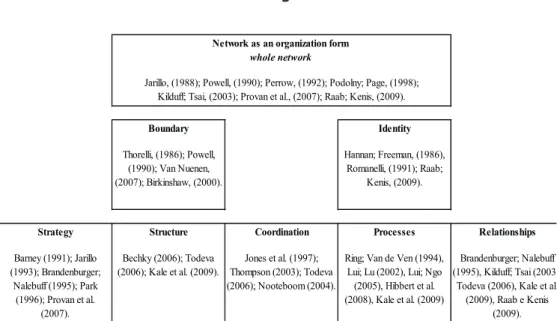
Figure 1 - Conceptual scheme for the analysis of a network as an organizational form
Network as an organization form whole network
Boundary Identity
Thorelli, (1986); Powell, (1990); Van Nuenen, (2007); Birkinshaw, (2000).
Hannan; Freeman, (1986), Romanelli, (1991); Raab;
Kenis, (2009).
Strategy Structure Coordination Processes Relationships
Barney (1991); Jarillo (1993); Brandenburger;
Nalebuff (1995); Park (1996); Provan et al.
(2007).
Bechky (2006); Todeva (2006); Kale et al. (2009).
Jones et al. (1997); Thompson (2003); Todeva (2006); Nooteboom (2004).
Ring; Van de Ven (1994), Lui; Lu (2002), Lui; Ngo (2005), Hibbert et al. (2008), Kale et al. (2009)
Brandenburger; Nalebuff (1995), Kilduff; Tsai (2003) Todeva (2006), Kale et al. (2009), Raab e Kenis
(2009). Jarillo, (1988); Powell, (1990); Perrow, (1992); Podolny; Page, (1998);
Kilduff; Tsai, (2003); Provan et al., (2007); Raab; Kenis, (2009).
Source: elaborated by the authors.
The discussion herein supported the establishment of ive characteristics (strategy, structure, coordination, processes and relationships). These will guide the analysis of networks as organizational forms, considering the dimensions of bounda-ries and identities. In this sense, the synthesis presented in Figure 1 has the purpose of guiding the methodological procedures of the research, which is the subject of the following section.
Methodology
This study follows a qualitative and exploratory approach with the unity of analy-sis being the IN, with two speciic dimensions of an organizational form: boundaries and identities. Speciically in this article such dimensions will be further analyzed through ive characteristics: strategy, structure, coordination, processes, and rela-tionships. The empirical ield of study is represented by the SFNs from Southern Bra-zil, which beneit from a local public policy that supports the formation, development and consolidation of networks. This policy is called “Programa Redes de Cooperação – PRCRS” (Cooperation Networks Program) and, during the past decade, supported the establishment of more than 200 networks (HUNDERTMARKER, 2010) turning the region into a reference on cooperation networks.
From this rich empirical pool of INs, twelve SFNs were selected. The choice of the twelve INs resulted from the discussions and deinitions outlined with
coordina-tors of the Network Cooperation Program from a meeting on September 2nd, 2009.
The selection of SFNs took into account two criteria: i) its business sector and ii) its stage of development, which considers time of existence of the network, as well as its number of members. Such criteria were deined in order to collect a wider range of information and views about the SFNs. In conformity with these criteria, the selected networks cover the sectors of commerce (retail), industry, and services. They also represent networks in initial stage (formation), medium stage (maturing and growing up) and inal stage (consolidated).
evidence that was framed against the proposed theoretical scheme. For each SFN, interviews were conducted with ive of its representatives (SFN’s director and manager, SFN’s secretary or treasurer of the network, and two SFN’s irm representatives with no speciic roles related to network management).
The proile of each SFN is presented in Box 1. For reasons of conidentiality, the twelve SFNs analyzed will be referred hereon by acronyms (SFN A, SFN B, SFN C, SFN D, SFN E, SFN F, SFN G, SFN H, SFN I, SFN J, SFN K, and SFN L).
Box 1– Proile of selected SFNs
Net
-work Sector
No. of member irms
Years of exis-tence
< 20
20 a 40
> 40
< 4
4 a 6
> 6
SFN A Industry
SFN B
Commer-ce (retail)
SFN C Industry
SFN D Industry
SFN E
Commer-ce (retail)
SFN F
Commer-ce (retail)
SFN G
Commer-ce (retail)
SFN H Service
SFN I Service
SFN J
Commer-ce (retail)
SFN K
Commer-ce (retail)
SFN L Service
Source: elaborated by the authors and based on interviews and documents from the SFN.
The data were treated through interview transcripts and content analysis. With these techniques, interpretations aligned with the proposed theory were found and organized, according to the unity of analysis as suggested by Hair and others (2005).
Results and discussion
rela-tionships present in the SFNs that characterize these as organizational forms. Such observations foster the discussion to be presented in the next sub-sections.
Strategy
Regarding strategy, SFNs relect an organization deliberately formed to achieve speciic goals. According to a irm representative of SFN C
[…] Our objective was to bring several Rice Mills together [...] there is the Rice
Asso-ciation which plays an inluent role in the sector […] we feel that some decisions are not ideal and it is dificult for us to reach them as one small irm. So we create this
SFN to build the power needed to be there and have a seat which is occupied by our network representative. (SFN C, 2009)
The evidence illustrates a “cooperate to compete” strategy (BRANDENBUR-GER; NALEBUFF, 1995) which is needed given the political power that characterize the decisions in this sector. This reveals clearly deined boundaries for this SFN and characterizes its group of small Rice Mills as an organization in order to face its com-petitors. (ROMANELLI, 1991)
The collective action, which is present in the elaboration strategy, is also ob-served in the SFN E and K. Regarding the case of SFN E, one of its members
outli-nes “[...] we hold member meetings each two months. During these meetings, we
deine the most strategic points of the network”. (SFN E, 2009) In similar view, the collective practice of strategic planning is observed in the case of SFN K. The strategy development of this network is based on the participation of several member irms,
as the representative of one of them states “[...]each team (marketing, innovation,
expansion, etc.), which is formed by representatives of member irms, has its action plan and objectives deined; the team facilitator is responsible for controlling and
supervising the process.” (SFN K, 2009) Such examples demonstrate strategy as a
result of a predominantly collective process, being conceived by the group of mem-ber irms. (JARILLO, 1993) This is a relevant aspect that reveals the network’s own organizational identities and boundaries.
In parallel one can observe the cases of SFN A and J which also provide evidence of organizations formed with the purpose of reaching beneits for their members, such as higher bargain power and access to key suppliers. As the irm representative of SFN
A states “[...] Our network seeks better deals, that is, we buy as a group of irms to
reduce cost and to become individually more competitive.” (SFN A, 2009) That is an
example of a deliberate strategy of collective action towards a higher bargain power when dealing with suppliers, seeking reduction of costs when acquiring products and
services. Also, the irm representative of SNF J outlines: “[...] We try to negotiate
discounts with the big brands. One of our goals was already accomplished with Adidas. Now we are dealing hard to achieve it with Nike.”(SFN J, 2009)In both cases, the IN’s
act strategically on behalf of the member irms, seeking to secure better deals when buying from suppliers and to secure access to larger and well known suppliers. Here the INs are characterized as an organization formed by organizations, created and managed in order to achieve members’ common goals that would be hardly achieved by each member irm individually. (KILDUFF; TSAI, 2003; PROVAN et al., 2007)
The deinition of common objectives by means of a collective strategy is not a simple task. The examples of SFN L and SFN B demonstrate this. According to one representative of SFN L:
[...] one of our four important strategic goals was to reach a national presence [...] it
the other member irms so we can together decide and, if needed, divide costs if we
reach an agreement. (SFN L, 2009)
In a similar way, the associate of SFN B outlines “[...] First we conduct a
stu-dy, we check if a given region could receive a new store so we can keep a balanced
level of competition in the region and do not harm the member irm that is already
established in that place.” (SFN B, 2009) In both situations, one can observe that the
strategy is collectively created and involves cooperation, as well as competition and conlict among the participants. This conforms to the theory concepts of Park (1996) and Provan, Fish e Sydow (2007) which delineate identities and boundaries in the organization.
Structure
In order to match the interest of its members, SFNs also devise structures to support collective actions. In the case of SFN L, this structure is represented by the
network’s sales ofice, as mentioned by its member representative: “[...] It is important
to have a sales ofice [...] and beneit as a network from a dedicated sales team”. (SFN
L, 2009). The evidence of SFN D’s ofice is an example that clearly shows a group of organizations operating as a single organization, in form of a network. (PODOLNY; PAGE, 1998) In the example of the SFN H, instead, it is possible to illustrate the distinctive organizational characteristics through the structure, which identify and standardize
the operations of its members, as cited by one of the SFN’s representatives: “[...] We
deined a network that makes strong investment in its image in order to minimize the
lack of credibility consumers have on individual unbranded gas stations.” (SFN H, 2009)
Such evidence demonstrates a SFN with a sense of collective identity and a sense of distinctiveness of member irms and their network in relation to other organizations that do not belong to it. (HANNAN; FREEMAN, 1986)
Another example of structure is the IT system managed by SFN B. By using an IT system the network concentrate demand projections from all member irms facili-tating better deals with large suppliers. This provides member irms with advantages of cost reduction when purchasing quality products that will be later resold to
consu-mers with better margins. As one representative of SFN B cites: “[...] this technology
is password protected. You need an access-key that is only available to the member
irms of the network. Product purchase is conducted entirely online. There are no telephone-base sales or external sales. It is only through the internet and it is a very
effective system.” (SFN B, 2009)Technology becomes an important element of the network structure; given the network system is an effective way to make feasible large transactions. Besides, it allows the associate to have access to high quality products with no need of directly negotiating with a supplier. Information structure is essential for the member irms, thus technology ends up becoming a mechanism which supports network governance. This can be veriied by one representative of SFN B:
[...] our network management prepared a inal proposal, approved in a network me
-eting. Today if one associate delays the payment of the network’s monthly fee, she/ he will lose the status of member irm in the system. She or he can see all offerings
but cannot access the deal and cannot make any transaction. (SFN B, 2009)
Such an example elucidates the network structure as a characteristic that seeks to overcome the dificulties that are inherent to cooperation. (KALE; SINGH; BELL, 2009) This characterizes the network as one organization in relation to its suppliers, delineating its organizational boundaries and deining the member irms that can effectively operate their businesses using the network structure and those that cannot.
D illustrate theses points. In the case of SFN F, one of its associates cites: “[...] we have a sales pavilion built by our members in a location near one big retailer of the
sector […] this is where the majority of the member irms get together [...] to sell our
products.” (SFN F, 2009) Operating practically like a big company, the SFN D deines communication procedures among member irms that share information and business opportunities through an appropriated structure. In the operation of SFN D, the ne-twork keeps structures of shared information, containing their members’ processes, equipment and capabilities, as one representative of SFN D outlines:
[...] we have a list of machines each associate owns... as we know our members, we
can igure out the characteristics of each member’s technologies and what each irm
is capable of doing. When we face an order, we can quickly map out which member has an appropriate machine for each step of the production process. (SFN D, 2009)
It is possible to observe that the evidence supports the theoretical concept where structure delineates the collective identity in a network by means of deliberate or emergent actions that fortify the common sense of group and belonging, through the creation of communication channels. (TODEVA, 2006)
Coordination
Another element that characterizes a network as an organizational form is the coordination of its members. Coordination can be evidenced in SFN K’s planning which is the result of a collective action, as one representative of SFN K states:
[...] each team is responsible for one major department of the network management, such as marketing, innovation and expansion. Each team has its own action plan with
detailed objectives; the team facilitator is responsible for controlling and supervising
the activities. (SFN K, 2009)
Such collective coordination allows for a systematic monitoring of activities
con-ducted in the network, as cited by a member representative of SFN K: “[...] we have
one meeting every month to discuss with the network management planning status, task delays, and check achieved goals.” (SFN K, 2009) As demonstrated, consensus
and conlict, collaboration and cooperation, become present within organizational boundaries (NOOTEBOOM, 2004), and distributing coordination in different activities is possible only with a collective identity in the network which reveals a sense of a “whole network”. (KILDUFF; TSAI, 2003)
The coordination among network members can be originated from shared in-terests and the existence of a common purpose. That is what is observed in some cooperation networks, as one representative of SFN C outlines:
[...] our irst objective was to unify several Rice Mills [...] they represents those 20
small and medium Mills that have the same interest as the large ones [...] when we
have a goal, like our Parboiled Rice Mill, we deine, for example, who is responsible for machines, who will take care of formalization of this new organization etc. (SFN C, 2009)
In the same manner, the representative of the SFN I points out: “[...] we joined
forces because we seek to exchange information [...] we make purchases together, high volume ones, coordinating transactions between suppliers and network members that wish to buy.” (SFN I, 2009) The evidence strengthens the theoretical background
Processes
The INs keep processes that relect the sense of identity of its member irms and as well as its organization boundaries. One of the key motivators of cooperation in SFN A is to achieve a quality standard for the launching of the network’s wine seal,
as one representative of its member irms outlines: “[...] with this seal we will have a
quality standard [...] we expect the network’s wine will have standards of cleanliness,
hygiene and quality in wine production processes. We are developing a good practice manual.” (SFN A, 2009) The evidence illustrates how processes support the building
of an identity, in this case, in a form of a quality standard that will contribute for the success of cooperation among the network’s member irms. (HANNAN; FREEMAN, 1986)
Another evidence of processes supporting network identity comes from the previously presented evidence of technology from SFN B. This technology systema-tizes the access of member irms to products that the network negotiates with large suppliers and is an essential requirement member irms must deal with when making
any purchase in the network. One representative of SFN B comments: “[...] we have
an online system where we handle our product purchases and payment requests to the network.” (SFN B, 2010) All transactions from members are organized so the
network can establish one, bigger, transaction with suppliers as cited by the network
representative: “[...] all purchases are formatted online in our system [...] and we
es-tablish direct connection with our supplier.” (SFN B, 2009) The SFN B, thus, aggregates
through its process of online purchases, all demands of its members, facilitating the creation of big purchases that will be negotiated with key suppliers. This process infers the existence of a collective identity for the network members. (ROMANELLI, 1991)
How processes can reveal the deinition of boundaries in a network organization can be observed in the examples of networks like SFN K and SFN G. As outlined by a irm representative of SFN K:
[...] we have a procedures manual which was developed by the expansion team […]
there are basic criteria that deine which irm can join the network. For example, three
or more years of existence, minimum revenues, outlet with a minimum distance of
ive kilometers in relation to a network outlet [...] so we have one store for at least 30.000 people in the region. (SFN K, 2009)
The case of SFN G reinforces this theoretical principle, as one representative of the network outlines:
[...] the network card system from SFN G represented a big advance [...] we have
all member irms ready to accept purchases from consumers with this card […] so
consumers are able to buy in each drugstore as if she or he were buying from a one
network organization [...] everybody will join. (SFN G, 2009)
In both examples, processes are capable of inluencing the boundaries of the network, as observed in the cases of SFN K and SFN G. In the case of SFN K, the expansion process, with their geographic and technical criteria, and in the case of SFN G, with its card system that integrates the low of transactions of all member sales in the network. Such empirical evidence is aligned with the idea that processes contribute with the delimitation of organizational boundaries, separating those that are in and those that are out of the network domain. (PROVAN; FISH; SYDOW, 2007;
RAAB;KENIS, 2009)
Relationships
participate in different markets, each with a different seasonality. The period of high demand in the agricultural sector, for example, tends to be different from that of the nautical sector. SFN D’s member irms use their relationships in the network to
promote interdependent developments, as an SFN D representative illustrates: “[...]
when one irm has excessive demand, it shares that demand with a irm facing low demand at that period and vice-versa. Both irms become more balanced.” (SNF D, 2009) The evidence demonstrates the collective identity in a group of organizations (HANNAN; FREEMAN 1986) which encourages sharing information and developing
business within the network.
In a similar way the collective sense is manifested in SFN F, as one of its
repre-sentatives describes: “[...] we promote the integration among network members with
informal gatherings like a lunch time during our network meetings.” (SFN F, 2009) The
associate of SFN E also outlines: “[...] every weekend we promote soccer matches and
parties with network members.” (SFN E, 2009) The relationships, as demonstrated by the evidence, favor the building of a collective identity, showing similarities among the network members and the deinition of a group in the form of a network, aware of the collective objectives the network seeks as one organization. (KILDUFF; TSAI,
2003; RAAB;KENIS, 2009)
As relationships reinforce the collective identity, they also establish the irms that are part or not of the network organization which deines its boundaries. Observations from members’ representatives offer support to this afirmation. The representative of SFN A, for example, outlines the importance of fostering relationships within the
network when deciding for the acceptance of a new member: “[...] when the future
member is invited to participate in a meeting, the relationship is reinforced with him, the objectives, the importance of information sharing [...] we make use of a little bit of sensibility to get the new member as involved in our network as possible.” (SFN
A, 2009) Such evidence reveals to the new member the conditions to be admitted in the network. The representative of SFN D, in the following evidence, outlines how this relects a higher degree of relationship among network members:
[...] I was not able to manufacture a speciic piece before. Now if I can’t, some member of my network can […] I can manufacture part of the piece and other network member inishes the service, and I can still sell this piece as if it were entirely produced by
me. (SFN D, 2009)
The evidence demonstrates that the network’s member irms need to develop individual and collective competences that enable them to cooperate internally and compete externally (BRANDENBURGER; NALEBUFF, 1995; KALE; SINGH; BELL, 2009) delineating the network as an organization in the face of its competitors. With the purpose of facilitating the understanding of the results found in this study, the evi-dence of identities and boundaries is synthesized in Box 2, considering each of the ive characteristics that were analyzed.
Box 2 – Synthesis of the results
Characteristics Evidence of identity and boundaries
Strategy Identity
“[…] Our objective was […] the Rice Association […] we feel it is difi
-cult for us to reach them as one small irm. So we created this SFN to
build the power needed to be there.” (SFN C, 2009)
Boundaries
“[...] Our network seeks better deals, that is, we buy as a group of
Structure Identity
“[...] We deined a network that makes strong investments in its im
-age in order to minimize the lack of credibility consumers have on
individual unbranded gas stations.” (SFN H, 2009).
Boundaries
“[...] If one associate delays the payment of the network’s monthly fee, she/he will lose the status of member irm in the system. She or he
can see all offerings but cannot access the deal and cannot make any transaction.” (SFN B, 2009)
Coordination Identity
“[...] we have different teams for marketing, innovation and
expan-sion. Each team has its own action plan with detailed objectives;
the team facilitator is responsible for controlling and supervising the activities.” (SFN K, 2009)
Boundaries
“[...] our irst objective was to unify several Rice Mills [...] 20 small and
medium Mills that have the same interest as the large ones [...] when
we have a goal [...] we deine, for example, who is responsible for machines, who will take care of formalization of this new organization,
etc.” (SFN C, 2009)
Processes Identity
“[...] with this seal we will have a quality standard [...] we expect the
network’s wine will have standards of cleanliness, hygiene and quality.” (SFN A, 2009)
Boundaries
“[...] the network card from SFN G represented a big advance [...] so consumers are able to buy in each drugstore as if she or he were
buy-ing from a one network organization.” (SFN G, 2009)
Relationships Identity
“[...] when one irm has excessive demand, it shares that demand with a irm facing low demand at that period and vice-versa. Both irms be -come more balanced.” (SFN D)
Boundaries
“[...] it is an opportunity to access new markets and development of
new products. For example, I was not able to manufacture a speciic piece before. Now if I can’t, some member of my network can.” (SFN D, 2009)
Final remarks
This study sought to understand, in theoretical and empirical terms, how ne-tworks can represent an organizational form, taking into consideration the empirical evidence of SFNs from Southern Brazil. In theoretical terms the study demonstrated that the organizational form, when manifested in a network, is substantiated through two dimensions: boundaries and identities. Also these dimensions can be empirically observed through ive major characteristics which are present in the context of co-operation networks: strategy, structure, coordination, processes and relationships.
Thus, in general terms, the evidence set forth by SFNs provides examples of the concepts presented in theory, illustrating this speciic kind of network as a new organizational form that operates in its business environment. The examples that were analyzed illustrate the network as an organizational form with its boundaries and identities well delineated, which is a consequence of the development of collective strategy, and conciliation of conlicts and interests from the network’s member irms. (BRANDENBURGER; NALEBUFF, 1995; JARILLO, 1993; PARK, 1996; PROVAN; FISH; SYDOW, 2007) The study also demonstrated that structure is a factor that deines identities and boundaries in the network by means of resources that support the management of dificulties that are inherent to the activities of cooperation and in formatting a common identity. (KALE; SINGH; BELL, 2009) In the evidence of coor-dination, the study observed that the networks promote mechanisms of coordination as a consequence of shared interest and the existence of a common purpose among its members. These indings are aligned with the background theory presented in this study. (THOMPSON, 2003)
Regarding processes, boundaries and identities are delineated with speciic programs of expansion and certiication that deine member irms that are inside the network and those that are outside of the network. (KALE; SINGH; BELL, 2009; PROVAN; FISH; SYDOW, 2007; RAAB; KENIS, 2009) Finally, the aspects of rela-tionships in the network promote a collective sense of those members that belong to the network, thus creating a collective perception of identity and competition in the business environment. Such indings are also in line with the theory presented in this study (BRANDENBURGER; NALEBUFF, 1995; KALE; SINGH; BELL, 2009) Such evidence demonstrates that SFNs feature well delineated identities and boundaries that set them as unique entities and also make them part of a group of similar orga-nizations. (ROMANELLI, 1991) The understanding of these ive elements (strategy, structure, coordination, processes, and relationships) in the empirical context of SFNs in Southern Brazil provides ground for further development of the body of knowledge on this particular form of organization.
It is worth noting the limitations of this research. The evidence focuses on SFNs from Southern Brazil. Therefore, it is not possible to imply that the indings of this study are applicable to the understanding of INs in general. Other forms of arrange-ments among irms, such as the keiretsu and chaebol, supply networks organized by automotive organizations, and even franchising and brand license arrangements, may or may not share the characteristics found in the empirical evidence of this study. Due to the particular market dynamics of the region, indings may be biased by a predo-minance of network strategies, structures, coordination, processes, and relationships that particularly adhere to the organizations competing in such environments. Also, the indings presented here are representative of little more than ive percent of the SFNs available in the empirical ield. Given this, the present study encourages new research endeavors seeking a larger set of such organizations to ind more generali-zable observations.
among big companies. Thus, new possibilities are open for studies seeking to explore networks as a new organizational form, and relevant topics such as the internal aspects and the evolving dynamics of those organizations could be addressed.
References
AHUJA, G.; SODA, G.; ZAHEER, A. The Genesis and dynamics of organizational
Networks. Organization Science, v. 23, n. 2, p. 434-448, 2012.
BARNEY, J. B. Firm resources and sustained competitive Advantage. Journal of
Management, v. 1, n. 17, p. 99-120, 1991.
BECHKY B. A. Gaffers, gofers, and grips: role-based coordination in temporary
organizations. Organization Science,v. 17, n. 1, p. 3-21, 2006.
BIRKINSHAW, J. Network Relationship Inside and Outside the Firm, and
Development of Capabilities. In: BIRKINSHAW, J.; HAGSTRÖM, P. The lexible irm:
capability management in network organizations. Oxford: Oxford University Press, 2000.
BRANDENBURGER, A. M.; NALEBUFF, B. J. The right game: use game theory to
shape strategy. Harvard Business Review, july-august, p. 57-71, 1995.
CASSON, M.; COX, H. An Economic Model of Inter-Firm Networks. In: EBERS, M.
The formation of inter-organizational networks. Oxford: Oxford University Press, 1997.
CASTELLS, M. A sociedade em rede. São Paulo: Paz e Terra, 1999.
GRANDORI, A; SODA, G. Inter-im networks: antecedents, mechanisms and forms.
Organization Studies, v. 16, n. 2, p. 183-214, 1995.
GRANOVETTER, M. Coase revisited: business groups in the modern economy.
Industrial and Corporate Change, v. 4, p. 93-131, 1985.
HAIR, J. F. et al. Fundamentos de métodos de pesquisa em administração. Porto
Alegre: Bookman, 2005.
HANNAN, M. T; FREEMAN, J. The population ecology of organizations. American
Journal of Sociology, v. 82, n. 5, march, p. 929-964, 1977.
HANNAN, M. T; FREEMAN, J. Where do organizational forms come from?
Sociological Forum, v. 1, n. 1, winter, p. 50-72, 1986.
HENNART, J. F. Explaining the Swollen Middle: why most transactions are a mix of
market and hierarchy. Organization Science,v. 4, p. 483-497, 1993.
HIBBERT, P. HUXHAM, C.; SMITH-RING, P. Managing Collaborative
Inter-organizational Relations. In: CROPPER, S. et al. The Oxford Handbook of
inter-organizational relations. Oxford: Oxford University Press, 2008.
HUNDERTMARKER, C. A. O Programa Redes de Cooperação do Rio Grande do Sul: dez anos de práticas colaborativas de gestão. In: ANTUNES, J.; BALESTRIN,
A.; VERSCHOORE, J. Práticas de gestão de redes de cooperação.São Leopoldo:
UNISINOS, 2010.
JARILLO, C. Strategic networks. Oxford: Butterworth-Heinemann, 1993.
JOHNSON-CRAMER, M. E.; PARISE, S.; CROSS, R. L. Managing change through
networks and Values. California Management Review, v. 47, n. 3, spring, p. 85-109,
JONES, C.; HESTERLY, W. S.; BORGATTI, S. P. A general theory of network
governance: exchange conditions and social mechanisms. Academy of Management
Review,v. 22, n. 4, p. 911-945, 1997.
KALE, P.; SINGH, H.; BELL, J. Relating well: building capabilities for sustaining
alliance networks. In: KLEINDORFER, P. R.; WIND, Y.; GUNTHER, R. E. The network
challenge: strategy, proit, and risk in an interlinked world. New Jersey: Pearson,
2009.
KILDUFF, M.; TSAI, W. Social networks and organizations. Thousand Oaks, CA:
Sage, 2003.
KLEINDORFER, P. R.; WIND. Y. The Network imperative: community or contagion.
In: KLEINDORFER, P. R.; WIND, Y.; GUNTHER, R. E. The network challenge:
strategy, proit, and risk in an interlinked world. New Jersey: Pearson, 2009. LUI S. S.; LU, Y. Managing the inter-pirm cooperation process: exploratory
case studies of hong kong architects and contractors. Asia Paciic Journal of
Management, v. 19, n. 4, p. 502-523, 2002.
LUI, S. S.; NGO, H. An Action pattern model of inter-irm cooperation. Journal of
Management Studies, v. 42, n. 6, p. 1123-1153, 2005.
MARIANO, E. B.; GUERRINI, F. M.; REBELATTO, D. A. N. Análise da relação entre
estrutura e desempenho de redes interorganizacionais colaborativas. Gestão &
Produção, v. 19, n. 3, p. 471-479, 2012.
MILES, R. E.; SNOW, C. C. Organizations: new concepts for new forms. California
Management Review, v. 28, n. 3, spring, p. 62-73, 1986.
NOOTEBOMM, B. Inter-irm collaboration, learning and networks: an integrated
approach. London: Routledge, 2004.
PARK, S. H. Managing an interorganizacional network: a framework of the
institutional mechanism for network control. Organization Studies, v. 17, n. 5,
p. 795-824, 1996.
PERROW, C. Small-irms networks. In: NOHRIA, N.; ECCLES, R. G. Networks and
organizations: structure, form, and action. Cambridge: Harvard University Press, 1992.
PODOLNY, J. M.; PAGE, K. L. Network forms of organization. Annual Review of
Sociology, v. 24, p. 57-76, 1998.
PORTER, M. Estratégia competitiva. Rio de Janeiro: Campus, 1986.
POWELL, W. W. Neither Market, Nor Hierarchy: network forms of organization.
Research in Organizational Behaviour, v. 12, p. 295-336, 1990.
PROVAN, K. G.; FISH, A.; SYDOW, J. Interorganizational networks at the
network level: a review of the empirical literature on whole networks. Journal of
Management, v. 33, p. 479-516, 2007.
PUGH, D. S. Organization theory: selected readings. London: Penguin Books, 1997.
RAAB,J.;KENIS, P. Heading toward a society of networks: empirical developments
and theoretical challenges.Journal of Management Inquiry,v. 18, p. 198-210,
2009.
RING, P. S; VAN DE VEN, A. Developmental processes of cooperative
interorganizational relationships. Academy of Management Review,v. 19, n. 1,
p. 90-118, 1994.
RIO GRANDE DO SUL. Secretaria do Desenvolvimento e dos Assuntos
ROMANELLI, E. The evolution of new organizational forms. Annual Review of Sociology, v. 17, p. 79-103, 1991.
ROTH, A. L. et al. Diferenças e inter-relações dos conceitos de governança e gestão
de redes horizontais de empresas: contribuições para o campo de estudos. Revista
de Administração (FEA-USP), v. 47, n. 1, p. 112-123, 2012.
THOMPSON, G. F. Between hierarchies and markets: the logics and limits of
network forms of organization. Oxford: Oxford University Press, 2003.
THORELLI, H. B. Networks: between Mmarkets and hierarchies. Strategic
Management Jornal, v. 7, p. 37-51, 1986.
TODEVA, E. Business networks: strategy and structure. London: Routledge, 2006.
VAN NUENEN, M. Beyond boundaries: a cognitive perspective on boundary setting.
In: GÖSSLING, T.; OERLEMANS, L.; JANSEN, R. Inside networks: a process view on
multi-organisational partnerships, alliances and networks. Cheltenham, UK: Edward Elgar Publishing, 2007.
VERSCHOORE, J. R.; BALESTRIN, A. Outcomes in small-irm networks: a
quantitative study in the southern brazilian context. In: JOHANSON, M.; LUNDBERG H. Network Strategies for Regional Growth. Houndmills: Basingstoke, UK: Palgrave
Macmillan, 2011.
VOLBERDA, H. W. Toward the lexible form: how to remain vital in hypercompetitive
environments. Organization Science, v. 7, n. 4, p. 359-374, 1996.
WEGNER, D.; PADULA, A. D. Quando a cooperação falha: um estudo de caso
sobre o fracasso de uma rede interorganizacional. RAM. Revista de Administração
Mackenzie, v. 13, n. 1, p. 145-171, 2012.
WILLIAMSON, O. The economic institutions of capitalism. New York: The Free Press,
1985.