Impact of the Psychological Testing Assessment System (SATEPSI)
for Scientiic Publications in Psychological Assessment
Marcela Mansur-Alves – Universidade Federal de Minas Gerais, Belo Horizonte, Brasil Renata Saldanha Silva – Faculdade de Ciências Médicas de Minas Gerais, Belo Horizonte, Brasil Sthefanie Carvalho de Ávila Fernandes – Universidade Federal de Minas Gerais, Belo Horizonte, Brasil
Abstract
The strengthening of psychological assessment in Brazil in the twenty-irst century can be understood as a result of the foun
-dation of Psychological Test Evaluation System (SATEPSI, its Portuguese acronym) by Resolution 02/2003 of the Federal Council of Psychology. In this sense, the present study aimed to describe the impact of SATEPSI for research in the area. A survey of Brazilian researchers’ publications was conducted in two periods in SciELO and BVS-Psi databases - 1993-2002 and 2003-2014 - using the terms “psychological evaluation”, “psychological tests” and “construction / adaptation of psychological instruments”. Overall, the results point to the positive impact of SATEPSI for the area of psychological assessment. It was observed an increasing in quantity and quality of publications, as well as a greater variety of psychological tests used in different contexts. It can be concluded that the pursued goals of the Resolution 02/2003 were mostly achieved.
Keywords: psychological assessment, psychological tests, scientiic publications
Impacto da Criação do Sistema de Avaliação dos Testes Psicológicos (SATEPSI)
para as Publicações Cientíicas em Avaliação Psicológica
Resumo
O início do século XXI marcou o fortalecimento da Avaliação Psicológica no Brasil como resultado de ações que culminaram na implantação do Sistema de Avaliação de Testes Psicológicos (SATEPSI) por meio da Resolução nº 02/2003 do Conselho Federal de Psicologia. Nesse sentido, o presente trabalho objetivou descrever o impacto da criação do SATEPSI para a pesquisa na área. Para isso, foi realizado um levantamento das publicações de pesquisadores brasileiros em dois períodos – 1993 a 2002 e 2003 a 2014, nas bases de dados SciELO e BVS-Psi – utilizando os termos “avaliação psicológica”, “testes psicológicos” e “construção/adaptação de instrumentos psicológicos”. De forma geral, os resultados encontrados apontam para o impacto positivo do SATEPSI para a área de avaliação psicológica, observada no aumento da quantidade e qualidade das publicações, bem como em uma maior variedade de contextos e testes psicológicos utilizados nas pesquisas. Conclui-se que as metas alme
-jadas com a publicação da Resolução foram, em sua maioria, alcançadas. Palavras-chave: avaliação psicológica, testes psicológicos, publicações cientíicas
Impacto de la Creación del Sistema de Evaluación de Tests Psicológicos (SATEPSI) en las Publicaciones Cientíicas en Evaluación Psicológica
Resumem
El comienzo del siglo XXI marcó el fortalecimiento de la Evaluación Psicológica en Brasil, como resultado de acciones que cul
-minaron en la implantación del Sistema de Evaluación de Tests Psicológicos (SATEPSI) a través de la Resolución Nro.02/2003 del Consejo Federal de Psicología. En este sentido, el presente estudio tuvo como objetivo describir el impacto del SATEPSI en la investigación en el área. Fue realizado un levantamiento de las publicaciones de investigadores brasileños en dos períodos, 1993 a 2002 y 2003 a 2014, en las bases de datos SciELO y BVS-Psi, utilizando los términos “evaluación psicológica”, “tests psi
-cológicos” y “construcción / adaptación de instrumentos psi-cológicos”. En general, los resultados señalan el impacto positivo del SATEPSI en el área de la evaluación psicológica, observado en el aumento de la cantidad y la calidad de publicaciones, así como también en la mayor variedad de contextos y tests psicológicos utilizados en las investigaciones. Las metas deseadas con la publicación de la Resolución fueron en su mayoría alcanzadas.
Palabras clave: evaluación psicológica, tests psicológicos, publicaciones cientíicas
Psychological Assessment (PA) appears as an important work ield for psychologists, which not only relates to the creation of evaluating instruments and techniques but, above all, the development of Psychol -ogy itself as a science, allowing psychological theories to be objectiicated and operationalized (Anastasi & Urbina, 2000; Cross & Alchiei, 2003; Primi, 2010). It is a process aimed at understanding the psychological
functioning of individuals with or without the use of psychological tests, in order to build a knowledge that can serve as basis for making decisions that beneit the individual and, if necessary, direct the beginning of treatment (Noronha & Alchieri, 2004; Urbina, 2007).
country, having gone through several phases during its history (Pasquali, 2001; 2003). For example, in the ini -tial period (before 1930), the psychological tests were mostly used by other professionals such as doctors and teachers. With the increasing development of psychol -ogy in the country in the following decades, there was a growing interest in psychological testing and research to build instruments grew rapidly (Pasquali, 2003). Although there were investments for test building, there was a lack in concern in checking scientiically whether such instruments complied with the parameters neces -sary for use in the national context. Many psychological instruments were therefore used for over thirty years in an abusive manner, without studies to prove their technical and scientiic quality.
As a result, between the decades of 1970 and 1990 harsh criticism rose regarding the professional activities in PA, particularly the use of psychological tests, which resulted in decreased use and growth of publications in the area (Augras, 1990; Collares, 1994; Mindrisz, 1994; Patto, 1997; Wanderey, 1985). Wanderley (1985), for example, questioned the use of psychological tests in professional selection process, pointing unsatisfactory validity indexes for most of them. He argued that there was often no relationship between the characteristics measured by tests and those necessary for proper work performance. He also mentions the standards placed at the time by the US government to control the use of psychological tests in selection processes in the coun -try, such as requirement to provide predictive validity of tests for the work context and present studies that pointed the relationship between the characteristic eval -uated and the one necessary for work performance. The author regarded such standards as a strategy that should be adopted in Brazil to control the indiscriminate use of psychological tests in the organizational context. In this sense, Augras (1990), criticizes the use of tests cre -ated and standardized for different cultures, without due care for adaptation. The author cites anthropo -logical studies conducted with minority cultural groups, in which psychological tests were used and showed inconsistent results, thus enabling the conirmation of dominant Western culture superiority ideals.
The construction and use of psychological instruments of dubious scientiic quality, the lack of specialized professionals and the shortage of gradua -tion courses qualiied to teach PA contributed to the declining interest of professionals for the area, as well as to the harsh criticism carried out by psychologists and other mental health professionals and the general
discrediting of the area by the population (Pasquali, 2001; 2003). However, such criticisms served as a warn -ing to the need for consideration on the train-ing and professional practice in the ield, working ultimately as a push toward change in this reality.
From the 1990s onwards, researchers and profes -sionals engaged in a concerted effort for change that, according to Noronha and Reppold (2010), could be initially perceived in many held events and meetings. Other achievements emerged, such as the creation of the Brazilian Institute of Psychological Assessment (IBAP) in 1997, and the Psychological Assessment journal in 2002. The goal was to solve issues perceived in the area by proposing quality improvement on university teaching of professionals in the PA area, the produc -tion of research for the development and valida-tion of psychological instruments in the country, among others.
Nevertheless, the turning point in this context of changes was the implementation, by the Conselho Federal de Psicologia (CFP, Brazilian Federal Council of Psychology), of the Consultative Committee on Psychological Evaluation and the Psychological Tests Evaluation System (SATEPSI), started in 2001 and consolidated through Resolution No. 02/2003 (later amended by Resolution no. 05/2012). The SATEPSI can be understood as a national certiication system of the scientiic and technical quality of psychological tests commercialized in the country (Anache & Cor -rêa, 2010; Primi & Nunes, 2010). This certiication is given on the basis of minimum technical requirements (validity studies, accuracy, standardization and relevant theoretical basis), which were deined based on inter -national rules (e.g., American Psychological Association, National Council on Measurement in Education) for the con -struction of psychological tests (Noronha & Reppold, 2010). The SATEPSI, as regulates the CFP Resolu -tion No. 002/2003 through their counsel members, therefore has a duty to ensure the ethical and detailed evaluation of psychological instruments developed or adapted in Brazil relative to its graphic, theoretical, psychometric and ecological quality (Anache & Cor -rêa, 2010; Noronha & Reppold, 2010; Primi & Nunes, 2010).
after more than 10 years of its implementation, there seems to be some consensus today about the impor -tance of SATEPSI for the technical, scientiic and ethical development of the area in the country, as well as to raise awareness of psychologists themselves on their professional performance (Primi & Nunes, 2010). Some authors have raised data that would support the claims of SATEPSI’s importance to the growth of the area, although none of them has, in fact, compared the periods before and after its creation (Anache & Corrêa, 2010; Barroso, 2010; Joly, Silva, Nunes, & Souza, 2007). Joly, Silva, Nunes and Souza (2007) note, for example, an increase, since 2003, in the number of panels and researchers participating in national congresses of psy-chological assessment, though there yet seems to be a higher concentration of works coming from the South -east region. Similarly, Barroso (2010) also points to an increase in the publication of theoretical papers and research reports in journals of psychological assess -ment, with higher concentration in the Southeast and South regions.
In this sense, and considering the lack of pub -lished works about the SATEPSI in the country, the aim of this paper is to describe the impact of the cre -ation of SATEPSI for the development of research in the psychological assessment area by comparing the scientiic publications in the area in Brazil during two periods, covering the years 1993 to 2002 (before the Resolution No. 02/2003) and 2003 to 2014 (after the Resolution No. 02/2003). This study therefore aims to test the hypothesis that some of the main goals of the Consultative Committee and the SATEPSI were reached after more than ten years of its implementa -tion. These goals would be, according to Primi and Nunes (2010), an increase in the number of searches performed in different contexts of psychological assessment, diversiication of the studied psychologi -cal tests and a raise in quality of the articles produced and published in the area.
Method
Analysis of the scientiic production evolution in the area was chosen as the data collection methodology, since it enables the mapping of the main topics dis -cussed in the knowledge area in question as well as the theoretical development gaps in it (Witter, 1999; 2005).
Virtual Health Library – Psychology (BVS-Psi) and the SciELO (Scientiic Electronic Library Online) were consulted, as they are the main electronic
databases of Brazil and Latin America. Search key -words used were “psychological evaluation” [avaliação psicológica], “psychological tests” [testes psicológicos] and “construction of psychological instruments” [con -strução de instrumentos psicológicos]. Once the survey was inished, abstracts were read and analyzed accord -ing to the determined inclusion/exclusion criteria. The remaining papers after this initial analysis were read and analyzed in full.
The search was limited to review articles or research reports (empirical)1 indexed and available in
full text, written in Portuguese, English or Spanish, but published by researchers from Brazilian universi -ties. The survey covered the period from 1993 to 2002 (before the creation of SATEPSI) and 2003 to 2014 (after the creation of SATEPSI). Studies that, despite using psychological tests among the instruments for data collection did not have as their main purpose to promote thought on the psychological assessment prac -tice or to investigate the psychometric characteristics or procedures involved in cross-cultural adaptation of psychological tests themselves were excluded. In order to describe the resulting changes from the creation of SATEPSI in psychological assessment research, the two periods were compared (before and after the system’s creation) according to the following indicators: a) num -ber of publications; b) contexts/contemplated subareas; c) number and variability of psychological tests used/ investigated; and d) quality of publications. The division of articles by context took as reference the subields of Psychology set by the Federal Council of Psychol -ogy2. In the analysis of papers found by context it was taken into account the objectives of each study, which should clearly present the context studied. Some studies set out to analyze more than one context, or could not be classiied among the deined categories. All of these were classiied as “Miscellaneous”. The analysis of the publications’ quality was performed using the Qualis system of Brazilian journals evaluation, maintained by Brazilian Higher Education Personnel Improve -ment Coordination (Coordenação de Aperfeiçoa-mento de Pessoal de Ensino Superior, CAPES). This system lists and classiies the media used for the dissemina -tion of intellectual produc-tion of graduate programs in the strict sense (masters and doctorate), regarding the
1 As such were considered empirical articles/research reports those involving ield research with individuals, groups, institutions or document analysis research.
circulation scope (local, national or international) and quality (A, B, C), based on assessment area3.
Results and Discussion
Having the search keywords deined, there were found 193 articles from 1993 to 2002 and 245 articles from 2003 to 2014. The initial reading of abstracts led to the exclusion of 99 articles published between 1993 and 2002 and 64 articles published between 2003 and 2014, due to most of them not discussing or producing data on the psychological assessment area or psychological tests themselves. Sixty-six articles appeared repeatedly when the keywords “psychological evaluation” and “psychological tests” were used, and were thus considered only once for analysis.
This resulted, therefore, in a total of 62 articles published between 1993 and 2002 and 179 articles pub -lished between 2003 and 2014, totaling 241 items in both periods considered for the analysis, which were investigated in greater detail.
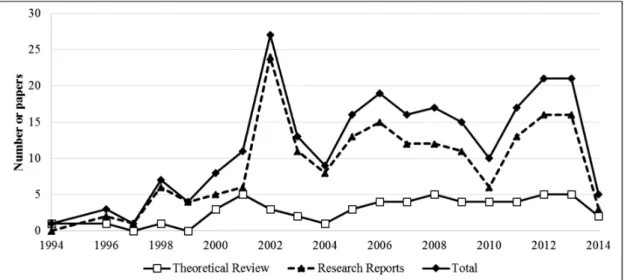
Of the 241 articles found, seven were written in English, two of them in period I (1993-2002), and ive in period II (2003-2014). Of the 62 articles published in period I, 48 refer to research reports (77.42% of total). Among the studies published in period II were 136 (75.97% of total) research reports. Studies of literature review were more frequent from the year 2001 onward. This increase in theoretical review articles from 2001 overlaps the implementation of SATEPSI and the foundation for the work of the Consultative Commis -sion. One might think that the need for relection on professional practice and on research conducted so far has motivated experts in psychological assessment to produce literature review articles aimed at resuming old issues and bringing new and essential aspects to strengthen psychological assessment in Brazil.
A comparison between numbers of publications on testing and psychological assessment throughout the study period, as shown in Figure 1, points to a steady growth over the years, which indicates a possible increase in interest from researchers for the quality and adequacy of instruments and theories in psychological assessment. A similar result was also found by Anache and Corrêa (2010), who studied the progression in
3 Consultation of the Qualis rating for each journal can be per -formed using the address http://qualis.capes.gov.br/webqualis/ principal.seam. For this study it was considered the current clas
-siications of journals and not the classiication at the time of the articles’ publication.
number of theses/dissertations published in the Psy -chological Assessment ield between the years of 1990 and 2010. The authors show that in 1993 there were only 21 theses/dissertations, while in 2010 there were 494, an increase of 473 works in 17 years. Moreover, 2002 was the year with the highest number of publica -tions among all surveyed. This may be a result of the creation of SATEPSI in the year 2001, which starts to question the quality of psychological tests in Brazil, and may have raised demand for this type of study. This inding can be supported by the fact that almost all arti -cles published in 2002 refer to research reports rather than theoretical studies, demonstrating the importance of such system, as pointed Primi and Nunes (2010), in increasing the interest of researchers to verify the validity and/or accuracy of psychological assessment instruments that were then used in Brazil.
As regards to the regions of origin of the publica -tions, as shown in Figure 2, in period I there is a smaller amount of publications coming from all regions of the country, with the Southeast comprising 71% of pub -lications (n = 45). In period II, the Southeast Region maintains its prevalence of published articles (66%) and the state of São Paulo accounts for over a half of articles published in the period (56.74%). This inding is similar to that found by Joly et al. (2007) and Bar -roso (2010), who point to the Southeast and São Paulo, in particular, as center of scientiic production (be it in publications or in presenting papers at national con -ferences) in the Psychological Assessment area during the 1977-2008 period. It is interesting to note, however, that in period II you can see a signiicant growth of publications of scientiic articles coming from other regions of the country, especially the South, authoring 13 publications in period I and 45 articles in period II. Publications of researchers from the Northern, North -east and Midwest regions start to become part of the national scientiic research scenario.
researchers from historically marginalized regions in the production of national scientiic knowledge.
It was also raised as a hypothesis that, with the advent of SATEPSI, a greater diversity of publications on psychological assessment in different applica -tion contexts would be found, when compared to the period prior to this Resolution. This because, especially with regard to the construction and adaptation of psy -chological tests, the resolution emphasizes the need to clearly present the instrument’s purpose and to lift empirical evidence of validity and accuracy to the main contexts for which it was developed CFP (2003, 2013).
Figure 3 shows the division of articles by context. It is noted that most of the research is associated with the clinical context/mental health and school, both in Period I and Period II, as already pointed out by Joly et al. (2007). In period I there was a higher pro -portion of publications in the school context, which may represent a relection of the historical inluence of this context over psychological assessment practices (Noronha & Reppold, 2010; Pasquali, 2001; 2003). In Period II, it is perceived a proportional increase in num -ber of publications in the clinical setting and mental health, pointing to a change in the interests of research -ers, who are giving more attention to the assessment of mental disorders and their impact on quality of life. It is important to note, also, the signiicant increase in publications in Organizational and Work Psychology and in Vocational Guidance, as well as the emergence of studies in the context of transit and forensics. These data support the hypothesis of a current trend to ward
diversiication of the study contexts of psychological assessment, although some still require more research (CFP, 2013; Ferreira & Santos, 2010).
Finally, it was worked with the hypothesis that in the second period reported (2003-2014) there would be found a greater amount of psychological tests being studied and used by researchers throughout the national territory. The starting assumption was that SATEPSI would act as an incentive to investigate and use psychological tests, as well as recognition of the effort made by researchers to develop studies up to date with new psychological tests and those already existing in Brazil. A total of 44 different instruments were mentioned in period I (1993-2002) and 108 cited in period II (2003-2014). Table 1 provides an overview in absolute numbers of the most commonly used tests, with an absolute frequency equal or higher than 04 in at least one of the periods. The other tests mentioned in a frequency of 03 or less are not included in Table 1 due to space limitations.
Figure 2.Distribution of papers by region and time of publication (Period I from 1993 to 2002; Period II from 2003 to 2014).
Figure 3. Percentage of articles published in periods I (1993-2002) and II (2003-2014) by context in psychological assessment.
al. (2002). It is essential to emphasize that there was an increase in the amount of tests used in research when comparing the two periods here presented (Table 1). This result points to an interest of Brazilian research -ers to study other constructs and different instruments
would reduce the effects of practice in cases of mul -tiple applications.
As regarding to the quality of publications, it is observed that, in both periods, most of the publi -cations (66% and 84%, respectively) were made in magazines currently considered of high quality (Qualis A1 and A2). The percentage of publications in Qualis B and C journals was still signiicant in period I (around 34%), while these were the minority in period II (about 16%). Attention should be paid to the fact that, until 1997, there was no evaluation system for publications in Brazil whatsoever. It was only in 1998 that Qualis was implemented by CAPES (Frigeri, 2012; Frigeri & Monteiro, 2010), which may have led researchers to look for higher quality journals to publish their studies. Either way, this result seems to indicate a tendency for researchers to publish their work, whether of theoreti -cal or empiri-cal nature, in more highly rated journals.
As an additional way to assess the quality of pub -lished articles in both periods, an analysis was made of the average impact factor (IF) of each. This analysis was used since the current Qualis is not a good indica -tor of the quality of articles published in a journal ive or ten years ago, as a journal previously rated A2 can be currently A1. To calculate the IF, the numbers of constant citations in Google scholar was divided by the number of years since publication of each article. Thus, for instance, an article written in 2001 that had had 20
quotes has an IF of 1.54, when dividing 20 citations by 13 years since publication (2014-2001). Studies pub -lished in 2014 were excluded, as they had not yet been cited. The IF average for period I was 2.65 (SD = 5.92) and for period II was 2.22 (SD-2.27). Mean compari -son test (Mann-Whitney test for independent samples) performed using the SPSS statistical software, version 22, showed no signiicant differences between the two periods regarding IF (p = 0.688). One must consider, however, that the articles published in recent years may not have showed their real impact on national publi -cations, as the interval between their publication and consequential citations was lower than in period II.
Conclusion
Metascience as practice to investigate the scien -tiic production in a given area of knowledge has been seen as crucial methodological strategy to provide easy access to researchers to the large volume of informa -tion available in their area (Joly et al., 2007). Studies of scientiic production allow not only to identify the subjects that have been receiving greater prominence in academia, but to also identify gaps in scientiic knowl -edge production (Witter, 2005). Thus, this study aimed primarily to describe the impact of SATEPSI and its consequences for research in Psychological Assess -ment, through a review of the scientiic literature that Table 1
Description of the Most Used Tests, by Period
Psychological Test Period I Period II Total
Reasoning Battery Tests (Bateria de Provas de Raciocínio 5 – BPR-5) 2 7 9
Human Figure Drawing Test (DFH) 5 4 9
The Pister’s Color Pyramid Test 0 7 7
Rorschach 3 4 7
MSCEIT 0 6 6
WISC 5 1 6
16PF 0 5 5
Professional Counseling Scale (Escala de Aconselhamento Proissional –
EAP) 0 5 5
Test Z – Zulliger 0 5 5
Bender Gestalt Test 1 4 5
Self-directed Search (SDS) 0 4 4
* Note. With the exception of the 16 PF test, all other tests from period I with zero references in articles did not exist at the time,
compared two periods – before and after the creation of SATEPSI.
Overall, the results revealed a positive impact of the Consultative Committee and SATEPSI creation for the production of knowledge in the psychologi -cal assessment area. There was an increasing amount of publications as well as in their quality. There also seems to have been a change in the concentration of these publications among Brazilian regions. Production remains largely concentrated in the Southeast, followed by the South, in both periods considered. A result which is line with the observations made by Souza Filho, Belo, and Gouveia (2016) and Barroso (2010). The increased participation of other Brazilian regions in the psychological assessment production, especially in the Northeast after the year 2003, is, however, note -worthy. It has been found, moreover, a diversiication of research contexts in psychological assessment after 2003 and a greater variety of instruments reported in them.
Together, these results conirm that, as pointed out by Primi and Nunes (2010), the creation of the Consultative Committee and SATEPSI was indeed a turning point for the Brazilian psychological assess -ment. At least with regard to the production of knowledge in the area, there is evidence that the creation of SATEPSI seems to have enabled the development of national psychological assessment, which then sought to meet international standards of rigor in the construction, evaluation, marketing and use of psychological tests. The growing involvement of researchers from different Brazilian states and uni -versities, as previously reported by Hutz & Bandeira (2003), signals for the establishment of policies more committed to ethics and scientiic rigor.
Despite the creation of the Consultative Com -mittee and SATEPSI having contributed greatly to a change in the theoretical and practical concepts of work in psychological assessment, these measures have evidently not solved all the issues and laws existing in the area. The Consultative Committee, along with Bra -zilian professionals and researchers, needs to promote a broad debate that focus on the matters of profes -sional education, the establishment of more rigorous criteria for evaluating the quality of psychological tests, the improvement of discussions on human rights in the practice and research of psychological assessment and ethical aspects concerning the use of psychologi -cal instruments. It is also expected that this study raises other considerations that assist in the continuation
of psychological assessment growth in Brazil, for through the joint efforts of researchers and profes -sionals the psychological assessment ield may respond more effectively to its continuously faced challenges. Although this study presents as limitations the research in only two virtual databases, iltering only the articles from indexed periods and with full text available online, it is considered that its proposed objective has been reached. Future studies on the impact of SATEPSI over the growth of national scientiic research in psy -chological assessment should consider other important sources of information on domestic production such as theses/dissertations banks, annals of the coun -try’s major psychological assessment events, ongoing research projects in the area, lattes curriculum of researchers and working groups enrolled in the meet -ings of the National Association of Research and Postgraduate Studies in Psychology (ANPEPP). More -over, it would be important to consult the researchers and professionals of the area about their perceptions about the impacts and future directions of the Consul -tative Committee and SATEPSI.
References
Anache, A., & Corrêa, F. (2010). As políticas do conselho federal de psicologia para a avaliação psi -cológica. In Conselho Federal de Psicologia (Ed.), Avaliação psicológica: Diretrizes na regulamentação da
proissão, 19-30. Retrieved from http://site.cfp.org. br/wp-content/uploads/2012/07/Diretrizes.pdf Anastasi, A., & Urbina, S. (2000). Fundamentos da testagem
psicológica. Fundamentos da testagem psicológica. Porto Alegre: Artmed.
Augras, M. (1990). Testes psicológicos e antropologia. Arquivos Brasileiros de Psicologia, 42, 78-87. Retrieved from http://bibliotecadigital.fgv.br/ojs/index. php/abp/article/view/21770/20523
Barroso, S. M. (2010). Avaliação psicológica: Análise das publicações disponíveis na SciELO e BVS-Psi. Fractal: Revista de Psicologia, 22(1), 141-154. Retrie -ved from http://www.uff.br/periodicoshumanas/ index.php/Fractal/article/viewArticle/174 Collares, C. A. L. (1994). O cotidiano escolar
http://www.bibliotecadigital.unicamp.br/ document/?code=000110119&opt=4
Conselho Federal de Psicologia (2003). Resolução nº. 02/2003. Conselho Federal de Psicologia. Bra -sília, DF. Retrieved from http://site.cfp.org.br/ legislacao/resolucoes-do-cfp
Conselho Federal de Psicologia (2013). Relatório do ano temático da avaliação psicológica 2011/2012. Conselho Federal de Psicologia. Brasília, DF. Re -trieved from http://site.cfp.org.br/wp-content/ uploads/2012/12/264tico-de-Avaliacao- Psicolo -gica_versao-inal.pdf
Cruz, R. M., & Alchieri, J. C. (2003). Avaliação psicológica: Conceito, métodos e instrumentos. São Paulo, SP: Casa do Psicólogo.
Ferreira, M. C., & dos Santos, A. A. A. (2010). A ava -liação psicológica no contexto organizacional e do trabalho. In Conselho Federal de Psicologia (Ed.). Avaliação psicológica: Diretrizes na regulamentação da
proissão. Retrieved from http://site.cfp.org.br/wp --content/uploads/2012/07/Diretrizes.pdf
Frigeri, M. (2012). Entendendo o qualis: Um estudo sobre
a avaliação dos periódicos brasileiros cientíicos brasileiros
(Dissertação de mestrado). Universidade Estadual de Campinas. Instituto de Geociências. Retrieved from http://www.bibliotecadigital.unicamp.br/ document/?code=000875213
Frigeri, M., & Monteiro, M. S. A. (2010). Implanta -ção do SEER na Revista Brasileira de Inova-ção: Melhora da qualidade no processo editorial? Tra -balho apresentado no I Encontro Nacional de Usuários do Sistema Eletrônico de Editoração de Revistas. Brasília, DF. Retrieved from http://eu -seer.ibict.br/index.php/iieuseer/euseer1/paper/ view/59
Hutz, C. S., & Bandeira, D. R. (2003). Avaliação psi -cológica no Brasil: Situação atual e desaios para o futuro. In O. H. Yamamoto & V. V. Gouveia (Eds.), Construindo a psicologia brasileira: Desaios da
ciência e prática psicológica (pp. 621-277). São Paulo, SP: Casa do Psicólogo.
Joly, M. C. R. A., Silva, M. C. R. D., Nunes, M. F. O., & Souza, M. S. D. (2007). Análise da pro -dução cientíica em painéis dos congressos brasileiros de avaliação psicológica. Avaliação Psi-cológica, 6(2), 239-252. Retrieved from http:// pepsic.bvsalud.org/scielo.php?script=sci_
arttext&pid=S1677-04712007000200013&lng=pt &tlng=pt.
Mindrisz, R. K. (1994). A tirania do QI: O quociente de
inteligência na caracterização do indivíduo deiciente mental.
(Dissertação não de mestrado). PUC, São Paulo, SP.
Noronha, A. P. P., & Alchieri, J. C. (2004). Conhecimento em avaliação psicológica. Estudos de Psicologia, 21(1), 43-52. doi: 10.1590/S0103-166X2004000100004 Noronha, A. P. P., Beraldo, F. N. D. M., & Olivei
-ra, K. L. D. (2003). Instrumentos psicológicos mais conhecidos e utilizados por estudantes e proissionais de Psicologia. Psicologia Escolar e Educacional, 7(1), 47-56. Retrieved from http:// pepsic.bvsalud.org/scielo.php?script=sci_ arttext&pid=S1413-85572003000100005&lng=pt &tlng=pt
Noronha, A. P. P., Oliveira, A. F. D., Cobêro, C., Paula, L. M. D., Cantalice, L. M., Guerra, P. B. D. C., ... & Felizatti, R. (2002). Instrumentos psicológicos mais conhecidos por estudantes do sul de Minas Gerais. Avaliação Psicológica, 1(2), 151-158. Retrieved from http://pepsic.bvsalud.org/scielo.php?script=sci_ arttext&pid=S1677-04712002000200008&lng=pt &tlng=es
Noronha, A. P., & Reppold, C. T. (2010). Considerações sobre a avaliação psicológica no Brasil.
Psicolo-gia Ciência e Proissão, 30, 192-201. doi: 10.1590/ S1414-98932010000500009
Pasquali, L. (2001). Técnicas de exame psicológico – TEP: Manual. São Paulo, SP: Casa do Psicólogo.
Pasquali, L. (2003). Psicometria: Teoria dos testes na psicologia e na educação. Petrópolis, RJ: Vozes.
Patto, M. H. S. (1997). Para uma crítica da razão psi -cométrica. Psicologia USP, 8(1), 47-62. Retrieved from http://www.scielo.br/scielo.php?script=sci_ arttext&pid=S0103-65641997000100004&lng=e n&tlng=pt. 10.1590/S0103-65641997000100004. Primi, R. (2010). Avaliação psicológica no Brasil: Fun
-damentos, situação atual e direções para o futuro. Psicologia: Teoria e Pesquisa, 26(25anos), 25-36. Re -trieved from http://www.scielo.br/pdf/ptp/ v26nspe/a03v26ns.pdf
Diretrizes na regulamentação da proissão, 129-148. Re -trieved from http://site.cfp.org.br/wp-content/ uploads/2012/07/Diretrizes.pdf
Urbina, S. (2007). Fundamentos da testagem moderna. Porto Alegre: Artmed.
Wanderley, W. M. (1985). Os testes psicológicos em seleção de pessoal: Análise crítica dos conceitos e procedimentos utilizados. Arquivos Brasileiros de Psicologia, 37(2), 16-31. Retrieved from http://bi -bliotecadigital.fgv.br/ojs/index.php/abp/article/ view/19187
Witter, G. P. (1999). Leitura: Textos e pesquisas. Campinas: Alínea.
Witter, G. P. (2005). Metaciência e psicologia. Campinas: Alínea.
Souza Filho, M. L. S., Belo, R., & Gouveia, V. V. (2006). Testes psicológicos: Análise da produção cien -tíica brasileira no período 2000-2004. Psicologia
Ciência e Proissão, 26(3), 478-489. doi: 10.1590/ S1414-98932006000300011
Recebido em: 23/03/2015 Primeira reformulação em: 14/04/2015 Aprovado em: 19/05/2015
Sobre as autoras:
Marcela Mansur-Alves é doutora em Neurociências, professora adjunta do Departamento de Psicologia e do Pro -grama de Pós-Graduação em Psicologia da Universidade Federal de Minas Gerais, onde leciona e orienta trabalhos sobre Psicologia das Diferenças Individuais, Avaliação Psicológica, Construção de Testes Psicológicos e Programas de Intervenção Cognitiva; é iliada ao Instituto Brasileiro de Avaliação Psicológica e membro do Laboratório de Avaliação das Diferenças Individuais (UFMG).
E-mail: [email protected]
Renata Saldanha Silva é graduada e mestre em Psicologia pela Universidade Federal de Minas Gerais, professora do curso de Psicologia da Faculdade Ciências Médicas de Minas Gerais, coordenadora do curso de pós-graduação lato-sensu em Neuropsicologia do Centro Universitário UMA, terapeuta cognitiva associada à Federação Brasileira de Terapias Cognitivas e membro colaborador do Laboratório de Avaliação das Diferenças Individuais (UFMG). E-mail: [email protected]
Sthefanie Carvalho de Ávila Fernandes é graduanda pela UFMG, com formação prevista para 2016/1, possui experiências acadêmicas na área de Avaliação Psicológica, tendo participado de dois projetos de pesquisa no LADI, já atuou ainda como monitora nas disciplinas de TEP I e II, possui experiência em Orientação Proissional, atuando como estagiária no Colégio Magnum e, atualmente, estagia na empresa RH Jr, na área de Recursos Humanos. E-mail: [email protected]
Contato com as autoras:
UFMG
Departamento de Psicologia – Faculdade de Filosoia e Ciências Humanas Av. Antônio Carlos, 6627 – Pampulha, Belo Horizonte/MG