Progress in High-Energy Electron
and X-Irradiation of Insulating Dielectrics
A. R.Frederickson
California Institute of Technology Jet Propulsiom Laboratory
Mail Stop 303-217 4800 Oak Grove Drive Pasadena, CA 91109, USA
Received 30 March, 1998
The eects of high-energy irradiation on the charging of insulators is reviewed primarily with a viewpoint similar to the seminal work of Professor Bernhard Gross. Recent results relating to insulation breakdown and to insulators in space radiation are more easily explained because of Gross' fundamental studies. A number of important issues remain unsolved, yet the rst steps to solutions have been provided by Gross.
I Introduction
The works of Bernhard Gross, and our shared commu-nications, have had a strong impact upon my work. His example has been a beacon of light as the years have passed and as we have explored some of the marvels of the natural world. The interest that he generates has expanded amongst his co-workers and a small commu-nity of scholars. When I meet someone who has worked with Professor Gross, the reaction is always the same - an immediate smile. If I have made progress, it has been due in part to the sharing of ideas with Bernhard Gross. His broad-ranging ideas in radiation charging were reviewed [1], and he even compiled literature ref-erences to help us [2]. The results that are reviewed here build upon [1] and other works of Gross, and have had useful application in spacecraft radiation problems. In 1970, while measuring secondary electron emis-sion and backscattering with high energy electrons in-cident on metal surfaces, I noted that some insulating materials and lms were charging up to high negative potentials. Even dirty oxide surfaces of aluminum were charging to tens of millivolts (negative or positive de-pending on the dirt). The insulators were hidden from line of sight bombardment by electrons from the source and from the irradiated surface. But electrons never-theless multiply scatter to eventually nd their way into any insulators that were used to electrically isolate
ele-ments in the vacuum chamber. Once charged, the insu-lators remained charged until light was shone on them, or until the vacuum was eliminated by ingress of air. The electric elds produced by the trapped charges in the insulator altered the motion of low-energy electrons in the vacuum.
A search in the library quickly found the 1957 pa-per by Gross on the charging of borosilicate glass [3]. There he correctly laid out the basic ideas that are used to this day. Two-MeV electrons penetrate up to 0.4 cm into the glass. The distribution of penetrating electron-stopping depths combined with the divergence of ther-malized carrier conduction currents were correctly iden-tied as the sources of space charge and high electric elds in the insulator. The books by Bube and by Rose provided further insight to the electronic conduction process which Gross expanded upon [4] while analyzing the exact quantity and spatial distribution of charges stopped in the insulator.
compelled to make some of these fascinating Lichten-berg gures.
X-rays and Gamma rays are absorbed in material mostly by transferring energy and momentum to the electrons. A high-energy electron current is thereby produced that may also generate Lichtenberg discharge gures. Gross generalized this phenomena to develop the dielectric Compton Diode which generates a current proportional to the photon ux.[6,7] Vacuum diodes were in use [8], but currents of low-energy electrons in the vacuum complicated the results. The dielectric had the advantage of suppressing currents of low-energy electrons while the high-energy electrons would traverse one electron range in the dielectric.
II Improvements on the box
model
The ideas in the early work of Gross were general. But the rst experiments were necessarily related to theo-retical models that were analyticallytractable. The box model was a simplication that proved to be very prof-itable, especially with monoenergetic electron beams which partially penetrated the insulator [9,10]. In the box model it is assumed either that all electrons pen-etrate to the same stopping depth, or that an average stopping depth is sucient to model the problem. In the depth penetrated by electrons, conduction is dom-inated by radiation-induced mobile electron-hole pairs. In the depth beyond electron penetration, conduction is dominated by normal dark conductivity and by charge injected from the irradiated region. The box model and related experiments showed that the dominant pro-cesses involved the stopping of the primary electrons, the generation of static electric eld by the stopped electrons, the generation of electron-hole pairs in the conduction-valence bands, and the development of con-duction currents proportional to the product of local electric eld and electron-hole concentrations.
Once the box model had proven the basic concepts, it became possible to provide computer simulation for the more general problem. Gross proposed a semi-analytic model which required computer solution of in-tegrals [11]. Independently, and nearly simultaneously, several groups produced straightforward computer sim-ulations of the one- dimensional problem [12-16]. This simulation technique, developed by many, will hence-forward be called NUMIT (for numerical iteration). In the NUMIT simulation one can calculate the full
time-and space-complexity of stopped charge, eld, time-and con-duction currents. The simulation allows one to rapidly change many parameters for comparison with experi-mental results. For example, one may include the de-pendence of conductivity on electric eld, or on accu-mulated radiation dose, both of which had been men-tioned by Gross in his early work. In general, NUMIT allows for easy inclusion of the dependence of any pa-rameter, such as conduction current, on any of the other parameters, such as electric eld and irradiation dose. NUMIT allows for time and spatial dependent injection, diusion, eects of trapping, spatially and time varying trap concentrations, and can include the eects of steep doping proles to simulate semiconductor junction be-havior.
The problem can be described mathematically in a simple fashion. Since mathematical detail is not neces-sary in this review, the one-dimensional model is sim-plest to envision. Radiation generates a current which subsequently stops in, and charges, a dielectric. Electric elds develop conduction currents, and the conduction charges are provided by any source including photo-generation of electron-hole pairs, thermal photo-generation, eld-induced tunneling from traps, electrode injection, etc. The separation between high- energy particles and conduction processes in the thick materials considered here can be arbitrary. Usually particles above 100 eV are considered primary particles, and all below 100 eV are tracked as either stopped or as conduction particles. The complex reasons for this are left unsaid. The gen-eral equations are thus: The charged particle current is the sum of three independent terms,
J p=
J fas+
J
conduction+ J
diusion
: (1)
The dierential equation for space charge density is
@(x;t) @t
=, @J
p( x;t) @x
: (2)
The electric eld is found from solution of
@E(x;t) @x
=(x;t): (3)
subject to the boundary conditions and added to any externally applied electric eld:
Z b a
E(x;t)dx=V app(
t) ; (4)
J total(
t) =J p(
x;t) +
dE(x;t) dt
where a and b are the positions of the electrode-insulator interfaces, andV
appis the applied voltage. As in Gross' box model, this system is quasistatic and ne-glects the (small) eects of magnetic eld.
III Progress at high electron
energies above 10 keV
1. Analytic and Monte Carlo Determination of
Electron Stopping Depth Distribution.
Stopping of electrons is often the primary process for charging insulators or insulated material. Calcula-tion of the distribuCalcula-tion of stopping depths of electrons is essential for modeling the charging process. Gross pro-vided an early measurement of depth distribution for dielectrics [17], and such problems were also addressed by radiation transport work in the nuclear industry [18]. Gross et al provided further measurements for direct application in the electret eld with electrons from 10 to 50 keV [19].
Tabata, Andreo and Ito [20] have used the widely available Monte Carlo codes [21] from the nuclear radi-ation eld to tabulate stopping depth for normal in-cidence electrons at many energies from 100 keV to 100 MeV in nearly any material. A number of experi-ments have conrmed the Monte Carlo electron trans-port codes for specic cases. An analytic function is available [22] which ts the tabulation [21] within a few percent for both current transmission and stopping depth distribution at all energies from 100 keV to 100 MeV. The analytic function interpolates between the electron energies and material atomic numbers tabu-lated by Tabata and Ito, and thereby covers a broad range of energies and atomic numbers.
2. Eect of Space-Charge Fields on the
Trans-port of Fast Electrons.
In material, the slowing of fast electrons acts as if there were an electric eld continuously decelerating the electron. In solids, the slowing is produced by an eective decelerating eld of approximately 2 MV/cm for electrons of energies from 300 keV to 3 MeV. Yet it is possible to sustain space charge elds of 2 MV/cm for minutes to hours without breakdown of the solid dielectric. It becomes obvious that the largest space-charge eld will at least slightly alter the motion of the high-energy electrons while inside the dielectric. This
had been cleverly analyzed for specic cases [23,24], but full inclusion of the details of the three-dimensional mo-tion of the electrons for any material and geometry was beyond analytic solution. Inclusion of the eects of elec-tric eld in Monte Carlo transport simulation provides the general solution of the problem.
Modeling of irradiations with electrons below 50 keV can usually ignore this eect. At 10 keV, the electron stopping eld is at least 20 MV/cm in typical solids, well above the sustainable static electric eld. Nevertheless, the calculational method was developed and tried at 20 keV where the electron motion could be described classically [25]. The calculations found no eect, less than 1% change in depth of penetration in a thick slab. For the purpose of mathematical model-ing, the density of the dielectric can be made arbitrar-ily small so that the stopping power vanishes while the space-charge eld remains large. But experimental ver-ication below 50 keV awaits the development of low-density solid insulators (which seems impossible). With such insulators, one might measure the space charge and internal electric eld distributions by any of the methods reviewed by R. Gerhard-Multhaupt [26].
Hikita and Zahn provided the impetus to extend the calculation of fast electron trajectories with electric elds to relativistic electron velocities. They measured the time and depth dependent evolution of space-charge electric elds in thick polycarbonate with partially pen-etrating 2-MeV electrons [27]. In these measurements, the zero-eld plane was found to move towards the irra-diated surface as time progressed. However, if the elec-tric eld does not act on the fast electron trajectories, then the zero-eld plane should move away from the ir-radiated surface [28]. By combining the eld-dependent trajectories of the fast electrons with the NUMIT sim-ulation, and by including high-eld conduction eects, the experiments of Hikita and Zahn were correctly mod-eled [28]. Gross outlined the utility of the concept of the zero-eld plane [29] which assists one to interpret experimental results.
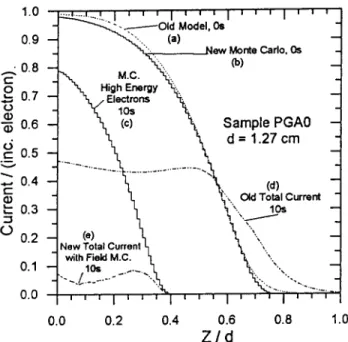
80s hinted that such work was progressing, but disclo-sure was limited leaving the exact results unclear.] Fig-ure 1, taken from [28], indicates how the experiments of Hikita and Zahn allowed the model to be developed to include correct charge penetration, dose penetration, and conduction physics. Experimental measurement of electric eld in high-energy irradiations is a key ingre-dient to further progress.
Figure 1. Comparison of Field Dependent Monte Carlo (M.C.) Simulation with Earlier (Old) Field- Independent Simulation. The high-energy electron current penetration after ten seconds of irradiation: without eld dependence is given by (a) or (b), and with eld dependence is given by (c). The total current at ten seconds including conduction processes is given by: (d) with eld-independent fast elec-tron transport, and (e) eld-dependent fast elecelec-tron trans-port. At ten seconds the electric eld strength was of order MV/cm, and other details are in [28].
3. Secondary-Electron Yield from Dielectrics as
a Function of Electric Field.
Simulation, such as NUMIT, can be used to model many details within an experiment, including secondary electron emission. Consider a dielectric slab with thin metal foils painted on both sides of the dielectric. As-sume that NUMIT correctly determines the currents of high-energy electrons, radiation-induced conduction currents, space-charge distribution and electric elds in the insulator under bombardment by high-energy elec-trons [27,28]. One can perform the experiment and the simulation by choosing the incident electron energy such that a small fraction of the electrons pass com-pletely through the insulator. The current of through-penetrating electrons, as well as their dose in the
fol-lowing material, can be measured as a function of time while electric elds build up in the insulator. Usually, the fraction penetrating and their dose will decrease as time progresses and the dielectric accumulates space charge [27,28]. NUMIT seems to correctly simulate all of the details in this irradiation, including eld depen-dent conductivity in the insulator near the electrodes.
Consider the arrangement of Fig. 2 where the rst irradiated metal foil is separated from the insulator by a vacuum space of any chosen distance, say 1 cm. In the planar one- dimensional geometry, the act of sepa-rating the foil causes the following changes (all of which are included in a NUMIT simulation):
1) Secondary electrons, which are conduction band electrons escaping the insulator, will accelerate away from the negatively charged insulator and enter the rst metal foil. 2) The high-energy irradiation elec-trons will be slowed by the electric eld that is gener-ated in vacuum between the foil and the insulator, and therefore fewer electrons will completely penetrate the insulator. Both the eld in the vacuum and the eld in the insulator will reduce the dose rate behind the insulator. Choosing a thick vacuum causes the eld in vacuum to reduce the penetrating dose more than the eld in the insulator reduces the dose. 3) The current monitored between the electrodes is proportional to the distance traveled by each charge carrier [30]. Conduc-tion electrons in the insulator move only short distances before being trapped, perhaps one micrometer or less. But conduction electrons in the vacuum move entirely across the vacuum, 1 cm, and thereby contribute large current between the electrodes.
Figure 2. Experimental Arrangement for Measurement of Field-dependent Secondary Electron Emission by Irradiated Insulator (polymethylmethacrylate).
thick vacuum and its eects will be clearly seen in the experiment and in the simulation.
The experiment to measure secondary electron emission proceeds as follows. First, an experiment is performed with the rst electrode painted on the insu-lator, and the parameters of the simulation are found to correctly predict the time dependent foil currents and penetrating dose. This establishes the correct insulator-dependent parameters for calculating the radiation-induced currents, conduction and electric eld in the insulator. Second, the rst foil is displaced from the insulator in vacuum, and the same electron irradiation is performed on a virgin sample. The eect of the vac-uum eld must be included for simulating the trajec-tories of the irradiation electrons. As the simulation proceeds through time, the secondary electron current across the vacuum is adjusted so that both the calcu-lated electrode current and the calcucalcu-lated penetrating dose rate are in agreement with the measured time-dependent current and dose rate. Within the simula-tion is the time and posisimula-tion dependent electric eld, including the eld at the vacuum surface of the insula-tor. Thus, at each time, one has determined the surface electric eld and the secondary electron current, and thus the dependence of secondary yield on electric eld at the sample surface.
Figure 3. Simulation of the Eects of Secondary-Electron Yield, SeY, on Field Build-up and Dose Penetration.
The results for polymethylmethacrylate using 1-MeV electron tests are commented [31] where the sec-ondary yield increased roughly a factor of ten for elec-tric elds of roughly 30 kV/cm. Fig. 3 indicates how the simulation models the experiment. With zero eld, the secondary yield is roughly 2%, and the simulation successfully reproducess the experimental data for 500 seconds using secondary yields of 2% to 10%. After
500 seconds, the simulation must use a secondary elec-tron yield of 25% to reproduce the experimental result. After 1500 seconds the secondary yield must again be increased so that the simulation reproduces the exper-iment.
4. RelationshipBetweenPulsingandthe Space-chargeElectricFields.
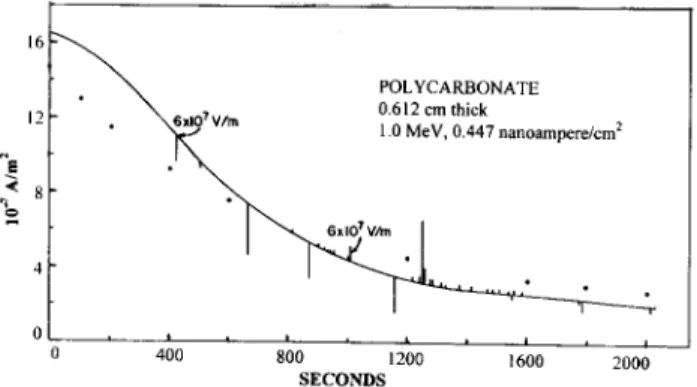
One can monitor currents between the electrodes for the occurrence of pulsed discharges. The NUMIT simu-lation of the conditions of the irradiation will determine the electric eld at the time of the pulsed discharges. This has been reviewed [32], and two examples are indi-cated in Figs. 4 and 5 with electrodes attached to both surfaces of the planar insulators under partially pen-etrating electron beams. In clear sheet stock without obvious aws the pulses are infrequent. In berglass-lled material the narrow glass bers apparently induce frequent pulses. In all materials tested, the pulsing did not occur until the eld strength was above 100 kV/cm.
Figure 4. Simulation and Experiment in Clear Polycarbon-ate. Simulation provides the series of dots. Experiment pro-vides the continuous chart recorder trace of the current to ground from the rear electrode. Vertical spikes are caused by small partial discharges in the insulator. The electric eld reaches pulsing magnitude at the front electrode at 400 seconds, and at the rear electrode at about 900 seconds.
are largely reduced by a single pulsed discharge process [35] is the origin of the pulse scaling laws [33].
Figure 5. Simulation and Experiment in Fiber-lled Mate-rial. The simulation (dots) follows the experiment, but the pulsing frequently drives the chart recorder o scale. The second trace is the same experiment at later times, and in-dicates that pulsing is less frequent despite the fact that elds have increased. Pulsing continued several days after the electron beam stopped. The rst pulse occured when the electric eld was 110
7V/m.
5. Eect of Fast Electrons on Spacecraft Insu-lation
The ux of space radiation is dominatedby fast elec-trons. Typically, one to two mm of aluminum shielding is provided to protect the electronics by reducing the in-tensity of the radiation. This has the eect of stopping electrons below perhaps 700 keV, but allows the less populous electrons above 1 MeV to penetrate into the electronic circuits. The total dose to electronic devices is reduced to an acceptable level, but the insulating materials eventually develop high space-charge electric elds as stopped electrons accumulate.
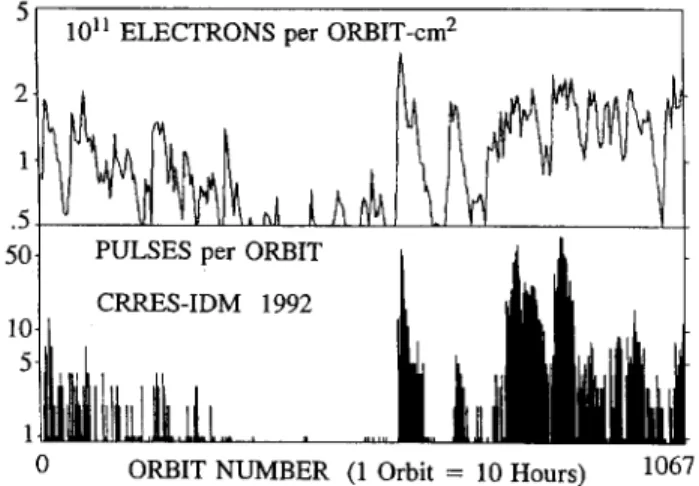
Analogous to the Lichtenberg discharges investi-gated in glass and plexiglass [1,2], the spacecraft in-sulators produce discharge pulses that can interfere with electronics by producing 100-volt pulses on circuit-board traces [36]. Pulsing of insulators has been cor-related with operational problems on spacecraft [37]. Figure 6, taken from [38], indicates the rate at which several insulating materials pulsed during 14 months in Earth orbit. The pulse rate is proportional to a power of the high-energy electron ux [39]. Insula-tors with berglass ller pulsed [38] most frequently, probably due to the electric eld enhancement at the ends of the berglass. TFE based insulators pulsed most frequently during the rst months in orbit be-cause accumulated radiation on TFE increases the dark
conductivity thereby reducing the electric eld in later months [40]. FR4 berglass-lled circuit-board pulsed most frequently after several months, probably because outgassing for several months reduced the dark conduc-tivity. Pure sapphire never pulsed, perhaps because it has a large carrier schubweg, or high radiation-induced conductivity. Clear FEP Teon pulsed occasionally.
Figure 6. Pulse Rate Summed Over All Insulators Moni-tored in Space for 14 Months Compared to Fast Electron Flux.
It is tempting to predict that a pulse will occur when the voltage, or the electric eld, achieves a particular level during the space radiation. But this simple model, although appealing, does not work. Instead, as the elec-tric eld grows, some pulsing occurs while the elecelec-tric eld continues to grow. Eventually the electric eld will reach a maximum, and the rate of pulsing is likely to decline while the maximum eld is maintained [32]. In some samples, the pulse rate declines to nearly zero. I remember discussing this with B. Gross 15 years ago when he related it to the phenomena of self healing in high voltage capacitors. The space test results [38] are very similar to the ground test results [32], and are probably related to Gross idea about self healing.
causing the problems. Yet proof of pulsing is almost al-ways lacking. On one spacecraft a signicant percent-age of approximately 400 problems in several instru-ments occurred simultaneously (time resolution in the spacecraft data stream was 32 seconds) with a large ESD pulse observed by a pulse detector inside a dif-ferent instrument [37]. Thus, it was proven that ESD pulses were the cause of numerous problems on this spacecraft. Usually, lacking actual pulse measurement, one only infers (not proves) that ESD pulses caused problems if the problems occurred when the exposure to high-energy electrons is elevated.
6. Charging of Spacecraft Relative to Plasma
Potential
At the surface of the spacecraft, the space radiations can charge the entire spacecraft relative to the ambient plasma potential. Spacecraft surface potentials vary from a few volts positive to 20 kV negative [41,42]. The surface potential is measured using electron and proton spectrometers which detect the acceleration of the nor-mally cold ( 1 eV) plasma particles. Secondary electron emission [43] and photoemission from surfaces of the spacecraft usually prevent high negative charging. Oc-casionally, spacecraft experience a high ux of electrons above 10 keV which overwhelms the secondary electron and photoelectron currents and negatively charges the spacecraft [41]. Dierent potentials between isolated portions of the spacecraft can exceed 2 kV [44] and pro-duce electrostatic discharge pulses that interfere with spacecraft circuits [45]. A spacecraft design standard has been in use for a decade to help designers prevent problems from the charging of outer spacecraft surfaces [46].
7. Discharge Pulse Scaling Laws, and Pulse
Shapes.
An extensive early set of experimental data were summarized as pulse scaling laws [33]. This work was mostly performed with electron beams at ten or twenty keV, although some work with higher energy electrons from a radioactive source found similar results. Sub-sequently, others found similar results when their tests were also performed in small conductive vacuum cham-bers. Still others found dierent pulse shapes when testing in much larger chambers, or with dierently structured samples. Much of the pulsing data has been
recently reviewed, and it is proposed that nearly all pulse shapes can be related to a single process [35,34]. A pulse begins with a small discharge internal to the insulator similar to the Lichtenberg tree phenom-ena. For low-energy electron beams, it may be a sur-face Lichtenberg tree. Or, it could begin as the ex-plosion of a dielectric needle at its surface stressed by high electric eld. Each of these phenomena issues a burst of partially ionized gaseous matter into the vac-uum which evolves into a gaseous discharge. The gas discharge evolves and compensates the voltages on the surfaces exposed to the vacuum-gas discharge medium. The current which ows in the gas discharge produces the measured signals that form the scaling laws and the pulse shapes reported in the literature.
The gas discharge expands in the vacuum at thermal gas velocities to electrically short-circuit electrodes that are biased by power supplies, solar cell arrays, or bat-teries. More than 100 amperes can be conducted with only 100 volts applied from batteries [34]. The amount of gas evolved, the rate at which it expands into vac-uum, and the current waveforms have been investigated [34]. Since the gas can short electrodes diering by only 100 volts, it will certainly short together spacecraft sur-faces that have voltages diering by a kV or more, and gaps of 20 cm have been spanned [Fig. 7 in 35]. It appears that the pulse shape is partly controlled by the evolution of charge currents in the gaseous discharge.
8. Application to Vacuum Electron Tube Glass
Envelope Breakdown
Vacuum electron tubes were usually contained in a glass envelope, and discharges of the glass were not reported. Yet high-energy electron beams on glass quickly produce discharge pulses [3]. Why was this not seen in vacuum electron tubes?
Almost always, electron tubes were operated with the cathode near ground potential. The glass envelope remained near ground potential and did not exhibit ef-fects of static charge (unlike television picture tubes and computer monitors which are obviously charged and at-tract dust, etc.). The anode of the tube was at high positive voltage. Thus, electrons would bombard the glass envelope only at thermal energies, not at high en-ergies. It was unlikely for the glass to charge more than a few volts.
outside of the glass envelope. Electrons from the cath-ode might bombard the glass and ultimately apply the full cathode potential across the glass. Vacuum tube glass envelope breakdown has been reported [47].
9. Failure of Insulation with High-Energy
Radi-ation at Moderate Flux.
Irradiation produces enhanced conductivity [1,4] and Lichtenberg discharge trees [3,5] in the insulators. In most insulators the conductivity current is small, usually no larger than the current carried by the radi-ation itself. However, the conductivity current in pho-toconductors is large and this eect is used to detect radiation. Usually, the Lichtenberg discharge trees do not penetrate the insulator. The discharge tree weakens the insulation only to the extent that a thin hole drilled in the insulation weakens it. The tree forms instantly in one burst and does not seem to produce the tracking phenomena that repeated discharges are known to pro-duce in high voltage power supplies. Can the radiation cause insulation failure?
Complicated arrangements of material can bring to-gether various eects with disastrous results. Obviously a photoconductor, made suciently conductive, will overheat upon application of sucient external bias. Recent experience in space and in ground tests indi-cates that the radiation-induced eects can cause in-sulation failure that was not predicted. Although not a photoconductor, kapton slowly pyrolizes under radi-ation, including uv, to become more conductive, espe-cially at elevated temperature in sunlight in space. A radiation-induced discharge by fully insulating material can initiate a current ow in nearby electrodes under battery bias [34] to induce a continuous glow discharge. The glow discharge can initiate local heating of kap-ton which pyrolizes to become permanently conductive. Even if the glow discharge is stopped, the conductive kapton will overheat under resumed bias to eventually form a carbon electrical short [49]. Spacecraft solar ar-rays with kapton operating above 50 volts have failed. Rearrangement of materials and electrodes can prevent such problems [50].
Immediate failure of the insulation upon formation of the radiation-induced discharge tree has been re-ported [51]. With certain arrangements of irradiation and applied bias, the radiation-induced discharge tree can be made to propagate entirely through the insu-lator to form a conducting channel of gaseous plasma
between biased electrodes. The short circuit will re-main as long as the power supply provides enough en-ergy to continue evolution of gas from the electrodes and nearby insulation.
Cosmic rays impinging thin insulation in modern microcircuits have been implicated in insulation fail-ures. Microcircuits are typically operated at ten volts and less. The cosmic ray induces a high level of con-ducting electron-hole pairs in a submicron tube sur-rounding its track. Whether this tube can devolve into a breakdown, or simply appears as a transient space-time spike of conductivity is a subject of controversy. The studies reviewed in this paper are at low levels of ionization, with high voltage, and cannot contribute to resolution of this problem.
10. Another Compton Diode and Radiation
De-tector.
High-energy X-rays and gamma rays passing through material develop a forward moving ux of fast electrons. The divergence of this current deposits charge in the material. The total charge deposited is therefore proportional to the attenuation of the photon current [6,7]. The basic Compton Diode as discussed by Gross, therefore, produces a current which cannot exceed the initial photo-Compton electron current pro-duced by the photons upon passage through one elec-tron range in the material.
an electrode consisting of Pb-Be will emit electrons to surrounding material.
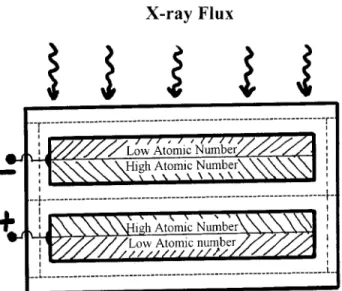
Figure 7. Arrangement of Conductors for an Ecient Compton Diode Cell. The dashed lines (|) indicate in-sulator foils to block low energy electron currents.
One can alternately stack many planar Be-Pb elec-trodes with many planar Pb-Be elecelec-trodes to form a battery by passing gamma rays through the stack. The Be-Pb electrodes can be connected together to form the negative current source, and the Pb-Be can be con-nected together to form the positive current source. The total current generated can exceed that generated by the elementary Compton Diode, provided a reason-able choice of Be and Pb thicknesses are chosen [48]. Series wiring of these cells can achieve high voltage, provided that secondary electron current between cells does not counter the development of high voltage. One can prevent secondary electron currents by interject-ing thin insulator materials between the electrodes. It is certainly unusual to improve a battery by surround-ing its electrodes with insulation! The thin insulators pass the high-energy electron currents which provide the electromotive force for the cell, and prevent the low-energy electron currents which tend to deplete the cell power.
It is instructional to think of the cell in this fash-ion. The full Compton current is developed in only one electron range of material. But very little of the gamma rays are attenuated in one range of material. If the electron current generated in the rst electron range is abstracted for use, then nearly the same amount of current can be generated and abstracted from the sec-ond electron range of material, and the third, etc. The proper arrangement of high- and low- atomic number
material best approaches this ideal cell arrangement. Although patented [48], I do not know if this device is being used anywhere.
IV Future work enabled by past
successes
1. Analysis for Non-Normal Incidence.
Analytic functions t to fast electron current pene-tration for non-normalincidence now seem possible. Al-though the functions for normal incidence appear com-plicated, they are actually based on simple concepts [22]. For non-normal incidence, one needs to modify the normal incidence concepts with the following ideas. A small fraction of o-normal electrons will be scat-tered by the rst several atomic layers near the surface to be essentially normal incidence. Thus, the deepest possible penetration will be the same as for normal in-cidence. The fraction backscattered out of the surface and the fraction stopped at shallow depth will increase monotonically with angle of incidence. The fraction stopped at deep depth, and the average depth of pen-etration will decrease monotonically with angle of in-cidence. The actual quantitative dependencies should be determined by applying the Tiger codes [21] to non-normal incidence perhaps in ten-degree intervals, with smaller intervals from 70 to 90 degrees.
Secondary electron yields are proportional to dose rate in the rst 50 angstroms for metals, 1 micrometer or more in insulators. Conduction and electron-hole pair production are proportional to dose rate at every point in the insulator. Thus, the on-going models by Tabata and co-workers for dose rate as a function of depth for non-normal incidence should be adapted to our insulators.
2. Total Insulation Failure Under High-Energy
Radiation.
Ground tests for ESD pulsing caused by 10 to 50 kV electron irradiations have been interpreted to indicate that a discharge-related stream of current has passed completely through the insulator [52]. This interpre-tation resulted from observation of pulses of negative charge owing to ground from the rear electrode, si-multaneous with decay of the negative voltage on the oating front surface of the insulator. It was sometimes stated that electrons punched through the sample from near the front surface.
In performing similar experiments, Levy was able to prevent this polarity of pulse by completely cover-ing the rear electrode with insulator [34]. I interpret this to mean that negative pulses propagate to the rear electrode during the gaseous discharge process by go-ing around the edge of the insulator sample. The front surface may not discharge by punch-through of the in-sulator. By blocking the gas from accessing the rear electrode, one blocks the discharge from proceeding to ground via the rear electrode. When so blocked, the discharge of the front surface must proceed by nega-tive charges owing away from the oating surface, and away from the rear electrode, and towards the elec-tron gun, resulting in positive (image) charge owing from the rear electrode to ground. Our experiments [34] proved that, in our tests, punch-through did not occur.
The general question remains: under what condi-tions can electron irradiation cause breakdown of in-sulators between electrodes, including punch-through breakdown.
3. Field-Dependent Conduction and Emission.
Conduction and secondary emission are strongly de-pendent on electric eld. This creates a problem in analysis at the surface of insulators. The conduction current that escapes the surface to become secondary electrons generates signicant positive charging within a depth of one schubweg below the surface. This re-quires the NUMIT to model conduction with a ne depth resolution near the surface. For thin insulators, less than 100 micrometers, electron emission and eld-dependent mobilitybecome very importantparameters. These facts are already well known in radiation eects in silicon dioxide passivation in microelectronics, but NUMIT simulation has not been performed in these applications.
4. Nature of the Discharge Pulses.
Are the ESD pulses in irradiated insulators simi-lar to the pulses in DC-biased capacitor dielectrics? Certainly, the electric eld plays a dominant role as causitive agent in irradiated insulators. But if we had applied the same electric eld using batteries, would the statistics of pulsing have remained the same? Or does radiation modulate the processes of pulse forma-tion so that the same E-eld in irradiated insulators makes more frequent pulses, or a dierent ratio of num-ber of large pulses to numnum-ber of small pulses? Until these questions are answered, one cannot use high volt-age alone to test for pulsing in irradiated dielectrics, one must use radiation in reasonable simulation of the in-service radiation.
For example, it is suspected that the berglass lled materials pulsed frequently because the elds at the tips of the bers became enhanced and initiated frequent pulses [53]. Radiation alters the conductivity of ma-terials. If the ber material becomes more conductive while the base material remains constant, the pulse rate will be increased. But if the ber material remains con-stant and the base material conductivity increases, then eld enhancement and pulse rate will both decrease.
5. Discharge-Pulse Scaling Laws.
The discharge-pulse scaling laws were empirically determined using electron beams of 10 kV to 20 kV where irradiated surfaces charge to roughly 10 kV. A single pulse discharges a signicant portion of the sur-face voltage over most or all of the sursur-face area. But in-side a metal box under electron radiations above 100 kV at space intensities, the discharge pulses did not con-tinue scaling to higher amplitude. Instead, the pulse amplitudes on 50 ohm transmission lines did not ex-ceed 100 volts, and the total charge did not alter the surface voltage more than a few hundred volts [55]. At high intensity 1 MeV irradiation, however, the pulses did attain signicantly higher amplitude than with the 20 kV irradiations [31].
6. ContactEects.
High-energy irradiations are often concerned with thick samples and high space-charge voltage. The is-sues of blocking contacts are diminished because ex-treme electric elds can be generated to force conduc-tion across the contact, because radiaconduc-tion-generated carriers cross the contact before being thermalized, and because the voltage generated at the blocking contact is small relative to the voltage generated across the thick insulator. Yet the issues remain important, and the work begun by Gross and others for thick insulators [1,4,9,11,43,54] should be continued.
7. Radiation-InducedPoint-DefectIntro duction Rate inInsulators.
Defects are introduced into the silicon lattice by electrons above 300 keV. The rate of atomic displace-ment rises rapidly as electron energy is increased. At these energies, collision can impart enough energy to cause a silicon atom to move at least one atomic spac-ing to occupy an interstitial position. The energy of displacement is related to the binding energy between neighboring atoms. By comparing experiments using electrons below 100 keV with experiments using elec-trons above 1 MeV, it might be possible to measure the eects of displaced atoms on the conduction processes in highly insulating dielectrics.
The fast electron has the advantage of generating electron hole pairs in the conduction/valence bands in known quantity for fast electron energies above 100 eV. The electron-hole excitation process is optical and diers only in rate, not in kind, as the primary elec-tron bombardment energy varies. Defects introduced by electron irradiation above 1 MeV may act as conduc-tion electron or hole traps to reduce the conductivity of the insulator so that it better stores charge. Irradia-tions below 0.1 MeV will not directly introduce defects as readily. Comparison between the two irradiations might indicate an eective rate of trap introduction by MeV electron bombardment. It is conceivable that in-sulators in extended use in space will be so altered in their charge storage properties, or practical insulators can be modied to useful advantage. Space measure-ments have indicated aging of charge storage properties, but the cause is uncertain [38].
8. ConductionPro cesses.
Gross and co-workers have provided many exam-ples of the eects of various conduction processes on the charging of insulators. As new samples are tested, these and other eects are sure to be important, and for real applications one must carefully consider the pro-cesses of conduction. The papers by Gross on radiation-related conductivity provide useful guidelines for inter-pretation of future insulator irradiation experiments. This review emphasized the high-energy aspects, not mechanisms of conductivity. But full understanding of real data requires information on the conductivity processes. In various situations I have had to apply conduction models involving: percolation, electrode in-jection, hole transport, H, OH and O radicals, polariza-tion, multiple trapping levels, diusion, etc. However, the level of conductivity in these experiments usually is exceedingly low, high eld eects often are impor-tant, and the mechanisms invoked to explain the results are easily disputed because the experimental data are sparse while conduction phenomena are certainly nu-merous. Conduction phenomena are best studied in a large array of literature beyond that reviewed here.
V Summary
with a burst of gas which modies or controls the sur-face discharge process. Perhaps the gas results from the Lichtenberg gure noted by Gross. The conditions for violation of the integrity of glass envelopes by electron bombardment of high voltage electron tubes have been investigated. Improved Compton Diodes have resulted from detailed studies of the currents in irradiated com-plex material structures.
The works of Gross have helped to point us to-wards the future. The analysis of normal-incidence one-dimensional problems has been successful and en-courages one to condently attempt three dimensional problems. The conditions that allow radiation to cause full insulator breakdown are being enumerated with in-creasing clarity. The nature of spontaneous discharge pulses is being determined. Knowledge of radiation ef-fects in semiconductors is beginning to assist in the understanding of insulator eects. The detailed de-lineation of fast electron transport and stopping now allows one to experimentally address the issue of con-duction currents with more clarity.
References
1. B. Gross, Topics in Applied Physics33:Electrets, 217 (1979).
2. B. Gross,ChargeStorage inDielectrics,a Biblio-graphical Review on the Electret and Related Ef-fects, Elsevier, Amsterdam, 1964.
3. B. Gross, Physical Review107(2), 368 (1957). 4. B. Gross, Solid State Communications15, 1655
(1974).
5. B. Gross, J. Polymer Science27, 135 (1958). 6. B. Gross, Z. Physik155, 479 (1959).
7. B. Gross, IEEE Trans. Nuclear Science 25(4), 1048 (1978).
8. B. Hess, Z. Angew. Physik11, 449 (1959). 9. L. Nunes de Oliveira and B. Gross, J. Appl. Phys.
46(7), 3132 (1975).
10. B. Gross, G. M. Sessler and J. E. West, J. Appl. Phys. 45, 2840 (1974).
11. B. Gross and G. F. Leal Ferreira, J. Appl. Phys. 50(3), 1506 (1979).
12. A. R. Frederickson, Radiation-induced Electri-cal Current and Voltage in Dielectric Structures, AFCRL-TR-74-0582 (1974).
13. A. R. Frederickson, IEEE Trans. Nuc. Sci. 22, 2556 (1975).
14. S. Matsuoka, H. Sunaga, R. Tanaka, H. Hagiwara and K. Araki, IEEE Trans. Nuc. Sci. 23, 1447-52 (1976).
15. J. Pigneret and H. Strobeck, IEEE Trans. Nuc. Sci. 23, 1886 (1976).
16. D. A. Berkeley, J. Appl. Phys. 50, 3447 (1979). 17. B. Gross, A. Bradley and A. P. Pinkerton, J. Appl.
Phys. 31(6), 1035 (1960).
18. M. J. Berger, Radiation Research 12 (4), 422 (1960). J. Appl. Phys. 28(12), 1502 (1957). 19. B. Gross, R. Gerhard-Multhaupt, K. Labonte and
A. Berraissoul, Colloid & Polymer Science 262, 93-98 (1984).
20. T. Tabata, P. Andreo and R. Ito, Nuclear Instru-ments and Methods B94, 103 (1994).
21. J. A. Halbleib, R. P. Kensek, G. Valdez, S. M. Seltzer and M. J. Berger, IEEE Trans. Nuc. Sci. 39,1025 (1992).
22. A. R. Frederickson, J. T. Bell and E. A. Beidl, IEEE Trans. Nuc. Sci. 42, 1910 (1995).
23. B. Gross and S. V. Nablo, J. Appl. Phys. 38(5), 2272 (1967).
24. B. Gross, J. Dow and S. V. Nablo, J. Appl. Phys. 44(6), 2459 (1973).
25. A. R. Frederickson and S. Woolf, IEEE Trans. Nuc. Sci. 29(6), 2004 (1982).
26. R. Gerhard-Multhaupt, Phys. Rev. B27, 2494 (1983).
27. M. Hikita, M. Zahn, K. A. Wright, C. M. Cooke and J. Brennan, IEEE Trans. Electrical Insulation 23, 861 (1988).
28. A. R. Frederickson, S. Woolf and J. C. Garth, IEEE Trans. Nuc. Sci. 40(6), 1393 (1993). 29. B. Gross and M. M. Perlman, J. Appl. Phys. 43,
853-7 (1972).
30. W. Shockley, J. Appl. Phys. 9, 635 (1938). This is derived for slowly varying currents where Maxwell's rst equation,divD=Q, alone suces. 31. A. R. Frederickson, Proceedings, 17 th Interna-tional Symposium on Discharges and Electrical Insulation in Vacuum, Berkeley, CA, 517-22, July, 1996. Sponsored by IEEE and APS.
32. A. R. Frederickson, IEEE Trans. Elec. Insul. 18, 337 (1983).
33. K. G. Balmain and G. R. Dubois, IEEE Trans. Nuc. Sci. 26, 5146 (1979).
34. A. R. Frederickson, L. Levy and C. L. Enloe, IEEE Trans Elec. Insul. 27 (6), 1166 (1992).
35. A. R. Frederickson, IEEE Trans. Nuc. Sci. 43 (2), 426 (1996).
36. E. P. Wenaas, M. J. Treadaway, T. M. Flanagan, C. E. Mallon and R. Denson, IEEE Trans. Nuc. Sci. 26, 5152 (1979).
37. M. D. Violet and A. R. Frederickson, IEEE Trans. Nuc. Sci. 40, 1512 (1993).
Mullen, IEEE Trans. Nuc. Sci. 39, 1773 (1992). 39. A. R. Frederickson, IEEE Trans. Nuc. Sci. 43,
2778 (1996).
40. A. R. Frederickson, Proceedings of 1981 Con-ference on Electrical Insulation and Dielectric Phenomena, 45-51, (1981) IEEE Publication 81-CH1668-3.
41. H. B. Garrett, Rev. Geophysics Space Physics19, 577 (1981).
42. E. C. Whipple, Reports on Progress in Physics44, 1197 (1981).
43. B. Gross, H. von Seggern and A. Berraissoul, Proc. Fifth Intern. Symp. Electrets, Heidelberg, 608 (1985).
44. E. G. Mullen, A. R. Frederickson, G. P. Murphy, K. P. Ray and E. G. Holeman, IEEE Trans. Nuc. Sci. 44(6), 2188 (1997).
45. G. Wrenn, J. Spacecraft Rockets 32 (3), 514 (1995).
46. C. K. Purvis, H. B. Garrett, A. C. Whittlesey and N. J. Stevens,Design guidelines for Assessing and Controlling Spacecraft Charging Eects, NASA Technical Paper 2361 (1984).
47. V. D. Bochkov, Proceedings 17 th International Symposium on Discharges and Electrical Insu-lation in Vacuum, Berkeley, CA, 517-22 (July, 1996). Sponsored by IEEE and APS. Also, \In-vestigation of Dielectric Strength of Vacuum Elec-tronic Devices Operating Above 50 kV..." PhD Dissertation, Ryazan Radioengineering Institute, Ryazan, Russia (1982).
48. A. R. Frederickson and A. D. Morris,U. S. Letters Patent 3,780,304 \Charge Accumulation Gamma Radiation Detector" (18 December 1973).
49. Private Correspondence, Dale Ferguson and David Snyder, NASA Lewis Research Center, Cleveland, Ohio, USA, September, 1997.
50. A. R. Frederickson, IEEE Trans. Nuc. Sci. 36 (6), 2405 (1989).
51. A. R. Frederickson, P. B. McGrath and P. Leung, Proceedings, 1989 Conference on Electrical Insu-lation and Dielectric Phenomena, 210-17, IEEE #89CH2773-0 (1989).
52. B. Gross and P. Gunther, IEEE Trans. Nuc. Sci. 40, 83 (1993).
53. A. R. Frederickson, Proceedings Symposium on Spacecraft Materials in Space Environment, 221-31, ONERA-CERT, Toulouse, France
(Septem-ber, 1988).
54. L. Nunes de Oliveira and G. F. Leal Ferriera, Phys. Rev. B11 (6), 2311 (1975).
55. A. R. Frederickson, IEEE Trans. Nuc. Sci. 40, 1547 (1994).
The following papers by Gross and co-workers are helpful, especially for conductivity.
B. Gross and R. Hessel, IEEE Trans. Elec. Insul. 26(1), 18 (1991).
B. Gross, R. Gerhard-Multhaupt, A. Berraissoul and G. M. Sessler, J. Appl. Phys. 62(4), 1429 (1987).
R. G. Filho, B. Gross and R. M. Faria, IEEE Trans. on Electrical Insulation EI- 21(3), 431 (1986).
B. Gross, H. Von Seggern, R. Gerhard-Multhaupt, J. Phys. D Appl. Phys. 18, 2497 (1985).
B. Gross, H. Von Seggern, and J. E. West, J. App. Phys. 58(8), 2333 (1984).
R. M. Faria, B. Gross, and R. G. Filho, IEEE Conf. On Electrical Insulation and Dielectric Phe-nomena, Clayton, DE, October 21-24, 1984. B. Gross, H. von Seggern and D. A. Berkley, Phys. Stat. Sol. (A)79, 607 1983.
B. Gross, J. A. Giacomettiand G. F. Leal Ferreira, IEEE Trans. on Nuclear Science28, (1981). B. Gross, IEEE Conf. On Electrical Insulation and Dielectric Phenomena, Pocono Manor, Penn-sylvania, Oct.-Nov. 1978.
B. Gross, J. Electrostatics 1, 125 (1975).
B. Gross and L. Nunes de Oliveira, J. Appl. Phys. 45(10), 4724 (1974).
B. Gross, G. M. Sessler and J. E. West, Appl. Phys. Lett. 24(8), 351 (1974).
B. Gross, G. M. Sessler and J. E. West, Appl. Phys. Lett. 22(7), 315 (1973).
B. Gross, Zeit. Angew. Phys. 30(5), 323 (1971). B. Gross, J. Appl. Phys. 36(5), 1635 (1965). P V. Murphy and B. Gross, J. Appl. Phys. 35(1), 171 (1964).
P V. Murphy, S. Costa Ribeiro, F. Milanez and R. J. De Moraes, J. Chem. Phys. 38(10), 2400 (1963).
B. Gross and R. J. De Moraes, J. of Chem. Phys. 37(4), 710 (1962).