650 Brazilian Journal of Physics, vol. 34, no. 2B, June, 2004
Luminescence from Miniband States in Heavily Doped Superlattices
R.F. Oliveira, A.B. Henriques
∗, T.E. Lamas
∗, A.A. Quivy
∗, M.P. Pires
†,
P.L. Souza
†, B. Yavich
†, and E. Abramof
∗∗∗
Instituto de F´ısica da Universidade de S˜ao Paulo, Caixa Postal 66318, 05315-970, S˜ao Paulo, Brazil †
Centro de Estudos em Telecomunicac¸˜oes, Pontif´ıcia Universidade Cat´olica,
Rua Marquˆes de S˜ao Vicente, 225, 22453-900, Rio de Janeiro, Brazil ∗∗
Instituto Nacional de Pesquisas Espaciais, LAS, Caixa Postal 515, 12141-970, S ˜ao Jos´e dos Campos, SP, Brazil
Received on 31 March, 2003
We have studied doped superlattices of GaAs/AlGaAs composition. When the doping atoms are introduced into the barriers surrounding the superlattice, as well as to the inner ones, but with half of the concentration, the pho-toluminescence due to interband transitions from extended superlattice states is detected. This is demonstrated by a study of the sample’s photoluminescence in a magnetic field, whose intensity oscillates in concomitance with the SdH spectrum of electrons confined in the miniband.
1
Introduction
The determination of the characteristic parameters of low di-mensional semiconductor systems requires an experimental technique sensitive enough to detect the singularities in the electronic density of states [1-4]. In superlattices, optical detection of the van Hove singularities associated with elec-tronic minibands has been accomplished by measuring the absorption spectrum due to intraband transitions, in the far infrared wavelength range [5]. Interband optical methods, however, could not be used successfully, due to the forma-tion of excitons at the edges of the van-Hove singularities [1]. In heavily doped superlattices, exciton formation is sup-pressed, due to Coulomb screening and phase-space filling, and it should be possible to detect miniband singularities by using interband photoluminescence (PL) spectroscopy, which is the subject of the present investigation. One draw-back, however, is that often the PL of doped superlattices is completely dominated by transitions between localized Tamm states, precluding the detection of interband transi-tions associated with extended miniband states [6]. When the doping atoms are located in the inner barrier layers of the superlattice, the spatial separation between the electronic charge and the ionized donors gives rise to a strong bend-ing of the band-edges at the boundaries of the superlattice, which causes a shift of the outer wells from resonance with the inner ones, and Tamm states are formed (for a survey on Tamm states in superlattices see Ref.[7]).
By solving the Schroedinger and Poisson equations, we found that the band-bending that causes the formation of Tamm states can be avoided if, in addition to the inner bar-riers, doping atoms are also added to the outer layers of the superlattice, with an areal concentration about half the value used for the inner ones. Superlattices with such a doping profile are investigated in the present report.
2
Experimental
The AlGaAs/GaAs superlattices were grown by molecular beam epitaxy (MBE) and consisted of 20 GaAs quantum wells of 50 ˚A width, separated by 19 Al0.21Ga0.79As
in-ner barriers of thickness 50 ˚A. The thickness of the layers in the structures were determined by X-ray reflectivity mea-surements. The density of Si in each AlGaAs inner layer was1.9×1012
cm−2
in both samples (one of the samples was also doped in the outer AlGaAs layers, with half of the concentration contained in the inner AlGaAs layers). The Shubnikov-de Haas (SdH) measurements of in-plane con-ductivity were made on approximately square samples, with contacts in the corners, using currents of∼200-400µA. PL measurements were done in the Faraday geometry, using op-tical fibers andin situminiature focusing optics. All mea-surements were done at 2K.
3
Results and Discussion
Figure 1 shows the Fourier transform of the SdH oscillations for the samples studied. For sample 2434 (doped only inter-nally) we observe a peak at 14T (due to electrons in a Tamm state) and two peaks at 35T and 44T (due to electrons in ex-tended miniband states). For sample 2268 (doped both inter-nally and exterinter-nally) the Tamm peak was absent, and peaks were detected at 25T and 34T, due to electrons in extended miniband states. The arrows indicate the association of the peaks with either Tamm states (T) or miniband states (M0
andM1), based on the peak’s displacements as a function of
forma-R.F. Oliveiraet al. 651
tion of Landau levels. For the samples with both internal and external doping the Landau level structure developed was weaker than in the sample containing dopants in the internal barriers only. This observation fits well into the assump-tion that the in the latter type of sample, PL is dominated by electron-hole recombination in Tamm states, whereas in the former type samples, the PL is due to the recombination of electron-hole pairs in extended miniband states. This is because the quantum lifetime of electrons occupying mini-band states is about 50% shorter than of electrons in Tamm states, and therefore will be described by a weaker Landau level structure (the quantum lifetime at the Fermi energy for Tamm and extended superlattice states was estimated from the SdH spectrum; SdH oscillations associated with Tamm and superlattice states as in Fig. 1 were isolated from the rest of the SdH spectrum, using a Fourier bandpass filter, and the quantum lifetime was determined from the magnetic field dependence of the amplitude of the SdH oscillations).
Figure 1. Fourier transform of the oscillations of SdH spectra of samples 2434 and 2268.
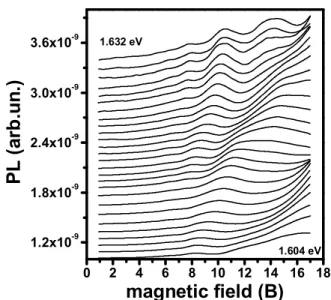
To establish the nature of the Landau level structure on more solid evidence we measured the PL intensity at fixed photon energies as a function of the magnetic field. Fig-ure 2 shows the output of such an experiment for sample 2268. In order to demonstrate that the origin of the magneto-oscillatory PL (MOPL) shown in Fig. 2 is the optical re-combination of photoexcited holes and electrons belonging to extended miniband states, the MOPL was Fourier trans-formed, and the resulting spectrum was compared to the Fourier transform of the SdH oscillations. For all photon en-ergies, the MOPL showed a doublet structure in the Fourier transform.
Figure 3 shows the Fourier transform of the MOPL de-tected at a photon energy ofhν = 1.632eV, and the Fourier transform of the SdH oscillations. The two spectra are re-markably similar. In order to understand the relation be-tween the two spectra, we assume a parabolic in-plane
dis-Figure 2. Magneto-oscillatory PL intensity for sample 2268 at fixed photon energies.
Figure 3. (a) MOPL athν = 1.632eV and SdH spectrum for
sample 2268; (b) Fourier transform of the MOPL and of the SdH spectrum.
persion. Taking into account the crystal momentum conser-vation [9], the energy of the photons emitted when electrons transit between conduction band and valence band Landau levels will be given by
hν=E0+
µ
N+1 2
¶~
eB µ
or (1)
hν=E0+ ∆c+ ∆v+
µ
N+1 2
¶~
eB µ ,
for transitions at the Van Hove singularitiesM0 and M1,
respectively, where N = 0,1, . . . and E0 is the
zero-field bandgap,∆c and∆v are the conduction and valence
miniband energy widths, andµis the reduced mass of the electron-hole pair.
652 Brazilian Journal of Physics, vol. 34, no. 2B, June, 2004
one of the energies given by (1). For photon detection at the Fermi level, i.e. hν = EF = E0 +φc, where EF
is the Fermi level andφc is the energy difference between
the Fermi level and the bottom of the conduction miniband, the magnetic fields,BN, at which the maxima occur will be
given by
1
BN =
¡
N+1 2
¢~
e µφc
, or 1 BN
=
¡
N+1 2
¢~
e µ(φc−∆c−∆v)
, (2) therefore the Fourier transform of the MOPL will be char-acterized by a doublet at the frequencies
fMOPL(M0) = µφc
~e , fMOPL(M1) =
µ(φc−∆c−∆v)
~e .
On the other hand, according to Onsager’s quasiclassi-cal quantization formula, the Fourier frequencies in the SdH oscillations will be given byfSdH = ~
2πeAe, whereAeare
the extremal sections of the mini-Fermi surface, hence for parabolic in-plane dispersion we obtain
fSdH(M0) = m∗φc
~e , fSdH(M1) =
m∗(φc−∆c) ~e .
Since ∆v ≪ ∆c, and µ ∼< m∗, we expect that when
hν ∼EF thenfMOPL <∼ fSdH. Figure 3 (b) shows that this
is exactly what happens, the Fourier transform of the MOPL athν = 1.632 eV is remarkably similar to the SdH one. This clearly demonstrates that the PL detected arises from interband transitions involving electrons occupying states in a superlattice miniband.
In conclusion, superlattice structures of GaAs/AlGaAs composition were produced, and their low temperature PL was studied in high magnetic fields. A broad luminescence band was observed. Under an applied magnetic field the in-tensity of the luminescence oscillates in concomitance with
the SdH oscillations due to carriers confined in an electronic miniband. Thus, the PL seen can be associated with inter-band transitions between miniinter-band states.
This work was supported by FAPESP (Grants No. 99/10359-7 and No. 01/00150-5) and CNPq (Grant No. 306335/88-3 ). The authors thank Professor Nei F. Oliveira Jr. for allowing us the use of the 17T magnet.
References
[1] H.T. Grahn, Semiconductor Superlattices - Growth and Eletronic Properties, World Scientific USA, 1995.
[2] Y. Fu, M. Willander, Z.F. Li, and W. Lu, J. Appl. Phys.89, 5112 (2001).
[3] A. Parasini, L. Tarricone, V. Bellani, G.B. Parravicini, E. Diez, F. Dom´ıngues-Adame, and R. Hey, Phys. Rev. B63, 165321 (2001).
[4] H. Willenberg, O. Wolst, R. Elpelt, W. Geiβelbrecht, S. Malzer, and G.H. Dohler, Phys. Rev. B65, 35328 (2002). [5] M. Helm, W. Hilber, T. Fromherz, F.M. Peeters, K. Alavi, and
R.N. Pathak, Phys. Rev. B48, 1601 (1993).
[6] A.B. Henriques, R.F. Oliveira, P.L. Souza, and B. Yavich, Physica B298, 320 (2001); A.B. Henriques, Appl. Phys. Lett.
78, 691 (2001).
[7] M. Steslicka, R. Kucharczyk, A. Akjouj, B. Djafari-Rouhani, L. Dobrzynski, and S.G.Davison, Surf. Sci. Rep. 47, 93 (2002).
[8] A. B. Henriques, L.K. Hanamoto, P.L. Souza, and B. Yavich, Phys. Rev. B61, 13369 (2000).