1Universidade Federal de Minas Gerais, Programa de Pós-Graduação em Geologia – CPMTC-IGC-UFMG, Campus Pampulha, Belo Horizonte (MG), Brazil.
E-mails: [email protected], [email protected], [email protected], [email protected]
2Centro Federal de Educação Tecnológica de Minas Gerais – CEFET, Araxá (MG), Brazil. E-mails: [email protected], [email protected],
3Complexo Cultural e Cientíico de Peirópolis, Universidade Federal do Triângulo Mineiro – UFTM, Uberaba (MG), Brazil. E-mail: [email protected]
*Corresponding author.
Manuscript ID: 20170032. Received in: 01/12/2017. Approved in: 04/26/2017.
RESUMO: A Formação Uberaba, de idade campaniana e ocorrência restrita à região da cidade homônima, é composta de arenitos líticos e conglomerados de cor esverdeada, com possível contribuição vulcano-clástica. Nessa unidade ocorrem minerais pesados como ilmenita, grana-da, perovskita e magnetita, além de clinopiroxênio, plagioclásio, quartzo, calcita e apatita. A Formação Uberaba é marcada geoquimicamente por altos teores em Ba, Ta, La, Nb e h, com padrões de elementos terras raras normalizados ao condrito fortemente fracionados (LaN/YbN = ca. 128) e planos (sem anomalia de Eu). Análises de química mineral das granadas detríticas da Formação Uberaba indicam predominância de chorlomita com ainidade com granadas crustais (G3). A proveniência sedimentar da Formação Uberaba corresponde a uma mistura de materiais de distri-tos alcalinos do Alto Paranaíba e derivados da erosão da Formação Serra Geral e dos grupos Canastra e Araxá. Os conglomerados produtores de diamante que ocorrem proximamente, em Romaria, foram considerados por alguns autores como correlatos à Formação Uberaba, porém a com-posição das granadas retiradas desses conglomerados é bastante diferente, plotando no campo de granadas mantélicas (G9/G10). Descarta-se, dessa forma, correlação entre essas duas unidades, e a Formação Uberaba, por-tanto, não é uma fonte provável dos diamantes aluvionares encontrados no rio homônimo.
PALAVRAS-CHAVE: Formação Uberaba; Magmatismo Alcalino; Triângulo Mineiro; Proveniência; Cretáceo Superior.
ABSTRACT: he campanian Uberaba Formation, which crops out around the homonymous town, is composed of greenish lithic sands-tones and conglomerates with possible volcanoclastic contribution. In this unit, heavy minerals such as ilmenite, garnet, perovskite and magnetite, besides clinopyroxene, plagioclase, quartz, calcite and apatite, are found. he Uberaba Formation geochemistry is marked by high grades of Ba, Ta, La, Nb and h, with lat (no Eu anomaly) and highly fractionated (LaN/YbN = ca. 128) chondrite-normalized
rare earth elements. Mineral chemistry analyses of detrital garnets from the Uberaba Formation indicate the predominance of chor-lomite with an ainity to crustal garnets (G3). he sedimentary provenance of the Uberaba Formation corresponds to a mixing of materials from the alkaline districts of the Alto Paranaíba and from the erosion of the Serra Geral Formation and the Canastra and Araxá groups. Diamond-producing conglomerates which crop out nearby, in Romaria, were considered by some authors as correlated to the Uberaba Formation. However, the composition of garnets recovered from those conglomerates is diferent, plotting in the ield of mantle garnets (G9/G10). We consider, then, that those units are not corre-lated, and that the Uberaba Formation is not a possible source for the alluvial diamonds found in the homonymous river.
KEYWORDS: Uberaba Formation; Alkaline magmatism; Triângulo Mineiro; Provenance; Upper Cretaceous.
Geochemistry and sedimentary
provenance of the Upper Cretaceous
Uberaba Formation (Southeastern
Triângulo Mineiro, MG, Brazil)
Geoquímica e proveniência sedimentar da
Formação Uberaba (sudeste do Triângulo Mineiro, MG)
Dennis Arthuso Quintão1*, Fabrício de Andrade Caxito1, Joachim Karfunkel1,
Florence Rodrigues Vieira2, Hildor José Seer2, Lúcia Castanheira de Moraes2,
Luiz Carlos Borges Ribeiro3, Antônio Carlos Pedrosa-Soares1
INTRODUCTION
he discovery of alluvial diamonds in the Triângulo Mineiro (TM) and Alto Paranaíba (AP) regions, southeast Brazil, most speciically between the cities of Coromandel and Uberaba, has called the attention of researchers on the source area and sedimentary control of these deposits. he fact that some occurrences are located in alluvial deposits of the Uberaba River (Fig. 1), which occurs in the southern por-tion of the TM above a speciic unit denominated Uberaba Formation, has brought some attention to this unit, as in the works of Hasui (1968), Barbosa et al. (1970), Barcelos (1984), Ferreira Jr. (1996), Ferreira Jr. and Gomes (1999), and Gravina et al. (2002).
The Uberaba Formation, with a mean thickness of 70 m and composed of sandstones and conglomerates, was deposited at ca. 80 Ma ago based on fossiliferous content (Huene 1939). It is stratigraphically the base of the Bauru
Group, and its sandstones show a considerable amount of detrital perovskite. Some authors interpret a volcaniclastic origin for at least part of the unit, with further sedimen-tary reworking (Hasui 1968, Barcelos 1984, Fulfaro & Barcelos 1991, Goldberg 1995). Despite its importance for both the reconstruction of Cretaceous paleoenvironments and potential source for diamond-producing, the Uberaba Formation is one of the least studied units in the context of the Bauru Group.
his paper presents novel data on the Uberaba Formation, emphasizing its geological cartography, petrography, min-eral chemistry and geochemical aspects. he main objec-tive is to characterize its provenance and source areas. Besides, in the present paper, we analyze for the irst time the potential of the unit as a source for the placer-type alluvial diamond deposits of the area, with respect to the great quantity of alluvial diamonds already recovered in the TM and AP (Campos 1891, Hussak 1891, Hussak
48º20'00"W 48º10'0"W 48º0'0"W 47º50'0"W 47º40'0"W
19º40'0"S
19º50'0"S
20º0'0"S
20º10'0"S
D
A B C
0 10 20 40 km
48º0'0"W 42º0'0"W
15º0'0"S
20º0'0"S
120 80 40 855 m 555 m
AB Transect
Cintilometric Transect
Geologic Transect
230 155 80 805 m 765 m
CD Transect
Cintilometric Transect
Geologic Transect Horizontal Exaggeration: 3X
Vertical Exaggeration: 15X
Legend Quaternary
Alluvial Deposit Terciary
Laterite Cover Bauru Group
Marília Formation Vale do Rio do Peixe Formation Uberaba Formation São Bento Group
Serra Geral Formation Botucatu Formation
Cartography Conventions Cities
Whole Rock Samples Uberaba River Cintilometric transects (values in count per second – cps)
Source: 1:100,000 Geological map of the Veríssimo-Miguelópolis and
Uberaba sheets (in press)
Datum WGS84
1906, Karfunkel et al. 2014). In this respect, it is interest-ing that some authors correlate the Uberaba Formation to diamond-producing conglomerates, which crop out 95 km to the northeast, in the Romaria region (Ferreira Jr. 1996, Coelho 2010). he study of heavy minerals recovered from the Uberaba Formation, and their mineral chemistry will help in the deinition of the provenance and potential for mineralization of this unit.
GEOLOGICAL CONTEXT
Bauru Group and Uberaba Formation
he Bauru Group presents approximately 370,000 km2
or ca. 20% of the Paraná Basin (Barcelos 1984, Fernandes & Coimbra 2000), occurring in the states of Minas Gerais, Goiás, Mato Grosso do Sul, Paraná and São Paulo. his group is limited to the north by the Alto Paranaíba Arch, and cor-responds to semi-arid system tract deposits, formed by allu-vial fans, ephemeral luallu-vial systems and an endoreic palus-trine zone (Milani et al. 2007).
Soares et al. (1980), based on paleontological and strati-graphic studies, suggest that the Bauru Group was depos-ited in the Aptian-Maastrichtian interval, as also proposed by Bertini (1993). he Uberaba Formation is considered as deposited in the Campanian (83.6 to 72.1 Ma), based on lithostratigraphic relationships with the Vale do Rio do Peixe and Marília formations, in addition to paleontological data (Huene 1939, Santucci & Bertini 2001) and paleomagnetic studies of Tamrat et al. (2002).
he Uberaba Formation belongs to the lower portion of the Bauru Group, in an erosive contact upon the Serra Geral Formation (Fig. 1). his contact is marked by the pres-ence of a polymictic conglomerate with basalt, sandstone and claystone clasts (Hussak 1906). he upper contact with the Marília Formation is considered by some authors as also abrupt, marked by a silexite level and a conglomerate rich in quartz clasts (Seer & Moraes, in press), cimented by cal-cite (Barbosa 1934, Hasui 1968).
Hasui (1968), Barcelos (1984), Goldberg (1995), Ferreira Jr. (1996) and Batezelli (2003) interpret the Uberaba Formation as constituted predominantly by sedimentary rocks with volcaniclastic contribution, mostly coarse sandstones with a local greenish matrix of volcanic origin due presence of Ce oxides, arkoses and lithic sandstones, locally siltstones and mudstones (Fig. 2A), conglomerates and conglomeratic sandstones. Carbonate cementation might occur, as well as carbonate nodules. Macrofossils are common (Santucci & Bertini 2001), as well as bioturbation (Fig. 2B), cross bedding (Fig. 2C), plane-parallel bedding and some syn-depositional
deformational structures such as lame structures and con-volute fold structures.
Ferreira Jr. (1996) and Ferreira Jr. and Gomes (1999) describe the presence of clay minerals such as detrital illite and authigenic esmectite in the intergranular spaces and suggest their formation from volcanic ashes. On the other hand, Goldberg (1995) proposes a process of mechanic iniltration of ine-grained sediments transported in high stand periods and deposited by decantation over the sand deposits (sieve efect).
Silva et al. (1994) suggest that detrital components of the sandstones were sourced of basalts from the Serra Geral Formation, quartzites and schists from the Canastra, Ibiá and Araxá groups, and alkaline rocks from the Alto Paranaíba region.
he depositional setting of the Uberaba Formation is a matter of high debate, and some work hypothesis have been proposed, e.g., luvial with little transport (Hasui 1968), lu-vio-deltaic (Suguio 1980), meandering (Barcelos 1989) and braided (Ferreira Jr. & Guerra 1993, 1995, Batezelli 2003). However, a detailed sedimentological approach is necessary for this issue to be fully understood.
Besides the Uberaba Formation, the Vale do Rio do Peixe and Marília formations compose the Bauru Group in the studied area. he Vale do Rio do Peixe Formation is com-posed by ine to medium-grained reddish sandstones, with cross-bedded foresets of up to 3 m (Fernandes & Coimbra 2000). he Marília Formation, according to Almeida & Barbosa (1953) corresponds to conglomerates and coarse sandstones with calcite cementation, divided by Barcelos (1984) in three members: Ponte Alta (conglomerate sand-stones and conglomerates, calcretes and silcretes), Serra da Galga (polimictic conglomerates with calcrete clasts) and Echaporã (ine to medium-grained sandstones). Other authors as Fernandes and Ribeiro (2015) and Batezelli and Ladeira (2016) consider only two members in this area (Serra da Galga and Ponte Alta).
he stratigraphic subdivision adopted in this paper is according Barcelos (1984) and Batezelli (2003) following the nomenclature of Vale do Rio do Peixe Formation from Fernandes and Coimbra 2000 (Fig. 3).
Diamonds in the Uberaba region
he diamond occurrences of the TM and AP regions are known for more than 250 years and correspond mostly to placer type deposits in the drainage gravels. here are some occurrences in rocks like Romaria’s conglomerate and the Capacete Formation of the Mata da Corda Group (Fernandes
have not yet been found in the Uberaba Formation rocks, only within alluvium sediments such as along the Uberaba River. One of the authors (L.C.B.R.) saw a 9 carat diamond at the end of the 70’s north of the Uberaba city recovered from gravels of the Uberaba River. According to informa-tion from garimpeiros (diggers) a 42 ct diamond has also been recovered from an alluvial deposit. To one of the co-authors (J.K.), several diggers reported the largest recovered stone in the headwaters of the Uberaba River gravel in the 60’s ties that weigh 42 ct, and a second one of 34 ct. Karfunkel et al. (2014, 2015) discuss and put forwards some hypotheses to explain the origin of these gems, from local sources, or trans-ported from long distances by extrusive rocks.
A
C
B
Figure 2. Field aspects of rocks from the Uberaba Formation: (A) red ine sandstone bed (below) in contact with green lithic green sandstone (above); (B) bone fossils (probably titanosaur ribs) found in excavation in the Uberaba town; (C) cross stratiications in likely channel deposits. Hammer is 42 cm long.
MATERIALS AND METHODS
Fieldwork for data and sample collection was conducted within the context of the Triângulo Mineiro CODEMIG/ UFMG 2015–2017 mapping project, speciically within the context of Veríssimo/Miguelópolis and Uberaba 1:100.000 sheets. All of the authors were involved in the ieldwork stage. During the ieldwork, stratigraphic sec-tions were made by L.M., H.S., D.Q. and F.C., with the collection of samples for petrographic, heavy minerals and chemical analyses.
Cartography of the Uberaba Formation was greatly aided by the utilization of aerogeophysical maps, mainly gamma spectrometric maps (U, h and ternary K-h-U maps in Fig. 4), from the program Levantamento Aerogeofísico do Estado de Minas Gerais 2010/2011 of CODEMIG, in a 1:500.000 scale. Also, scintillometric transects were produced by D.Q. and J.K. (Fig. 1). hose transects were made near the geological contacts between the various units in order to identify possible radiometric variations which could aid in the individualization of the units. A SC-132 hand scin-tillometer of Mount Sopris Instrument Co. was used for this purpose.
Separation of heavy minerals from selected samples was conducted at the Laboratório de Tratamento de Minérios, CEFET-MG – Campus Araxá. Samples were dried at 300ºC for two hours, then crushed in a jaw crusher, sorted, and then sieved utilizing 70# (210 μm) and 120# (125 μm) sieves. Samples were panned, and then magnetite was removed using a hand magnet. Finally, acid attack with 10% HCl has been carried out for 24 hours in Erlenmeyers. Heavy minerals were then separated by H.S., L.M. and F.V. using a binocular lens.
Twenty-four samples were selected for petrographic analysis, from which ive samples were selected for min-eral chemistry analysis (samples V634, V620A and B, V631 and 7C). After covering of the polished thin sec-tions with a ine carbon powder, they were subjected to quantitative and semi-quantitative analysis in a JEOL JXA-8900RL (WDS) microprobe at the Centro de Microscopia, Universidade Federal de Minas Gerais, using an acceleration tension of 15 kV and a beam current of 20 nA. Twelve oxides were determined for each analyzed point, and the grades were obtained using Ian Steele and Astimex collection standards.
After crushed and pulverized, 17 samples were sent for whole rock chemistry analysis at GEOSOL Laboratories, Brazil, and two other samples were sent to ACME Analytical Laboratories Ltda., Canada (sample location in Fig. 1). Major element grades were analyzed by ICP-MS (ACME) or ICP-OES (GEOSOL), and trace element grades were analyzed by ICP-MS in both laboratories after fusion with lithium metaborate/tetraborate and digestion with diluted nitric acid. Analytical errors are within 5% for oxides and 10–15% for trace elements. Base and precious metal grades were determined by digestion in Aqua Regia fol-lowed by ICP-MS analysis. he Loss On Ignition (LOI) was determined by the weighing diference after ignition at 1,000ºC.
RESULTS
Application of geophysics in the
cartography of the Uberaba Formation
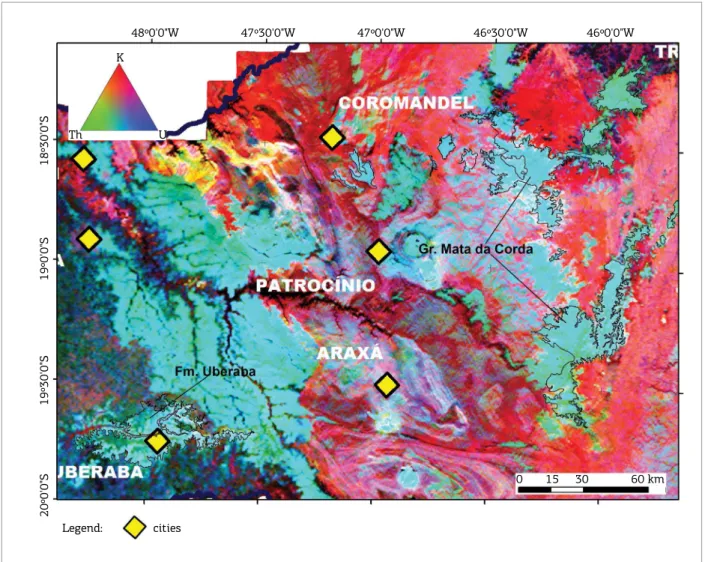
In the ternary K-h-U gamma spectrometric map of the region an E-W trending area in the central portion exhibits high h and U contents (Fig. 4A), correspond-ing to the outcrop area of the Uberaba Formation (whiter colors in Fig. 4A). In the h channel map, the Uberaba Formation is characterized by values above 23,844 ppm (purple and pink shades in Fig. 4B), mainly due to the high perovskite content of the unit. In the U channel map, values above 1,430 ppm (red and pink shades in Fig. 4C) characterize the unit.
Another resource utilized in the mapping of the Uberaba Formation is scintillometric transects (Fig. 5). During the realization of those transects, the Uberaba Formation has shown high radiometric activity, with 250–350 cps (counts per second), while basalts of the Serra Geral Formation show average values around 50 cps and rocks of the Marília Formation around 110 cps. hus, geophysical data improved considerably the cartography and recognition of the Uberaba Formation outcrop area. For geological mapping in lat lying
Sedimentary Cover Bauru Gr. Serra Geral Fm. SW Quaternary Upper Cretaceous L owe r Cretaceous Echaporã Mb.
Vale do Rio do Peixe Fm.
Marília Fm.
Tu Serra da Galga Mb.
Uberaba Fm.
Serra Geral Fm. Q P onte Alta Mb. NE Legend:
A
B
C
Gamma spectrometry Ternary Th-U-K
K
Th U
48º30'0"W 48º20'0"W 48º10'0"W 48º0'0"W 47º50'0"W 47º40'0"W 47º30'0"W
48º30'0"W 48º20'0"W 48º10'0"W 48º0'0"W 47º50'0"W 47º40'0"W 47º30'0"W ppm
ppm
48º30'0"W 48º20'0"W 48º10'0"W 48º0'0"W 47º50'0"W 47º40'0"W 47º30'0"W SIRGAS 2000
SIRGAS 2000
SIRGAS 2000 0 5 10 20 km
0 5 10 20 km
0 5 10 20 km
20º0'0"S 19º50'0"S 19º40'0"S 19º30'0"S
20º0'0"S 19º50'0"S 19º40'0"S 19º30'0"S
20º0'0"S 19º50'0"S 19º40'0"S 19º30'0"S
Gamma spectrometry Th Channel
Gamma spectrometry U Channel
rock sequences with diferent backgrounds in vast regions covered by plantations like sugar cane and soya, this auxil-iary method has been of great help.
In a ternary gamma spectrometric map of the east-ern TM and AP (Fig. 5), the signature of the Uberaba Formation is comparable to that of the Mata da Corda Group (Guimarães 1964, Bryon 1999, Sgarbi et al. 2003). Both units show high h and U grades as shown by the bluish colors in the map.
Sedimentological aspects
hree schematic stratigraphic columns were measured for a preliminary study of the Uberaba Formation sedimen-tary features. For each column, a group of sedimensedimen-tary facies was described as follows.
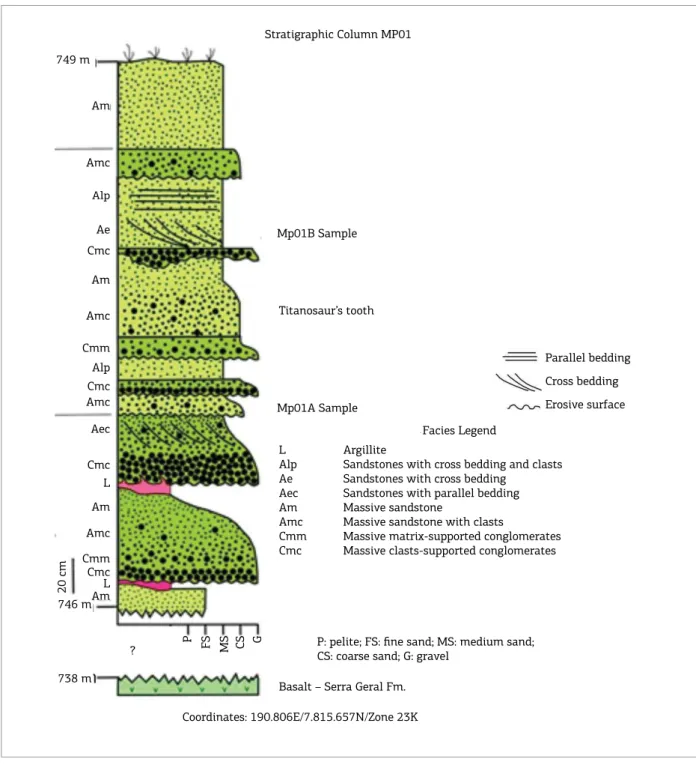
In the MP01 column (Fig. 6), located in Randolfo Borges Junior Avenue corner with José Marçal Costa Street (190806 E/ 7815657 N; WGS84 23K), predominantly coarse facies
can be recognized, marked by the occurrence of clast- and matrix-supported massive conglomerate, massive sand-stone with clasts and medium-grained sandsand-stone followed by a claystone bed. In the middle portion of the column, the sedimentary package is characterized by the presence of erosive surfaces. Above these, clast-rich sandstone and massive conglomerate have been observed, followed by a massive clast-rich sandstone that grades upwards to medi-um-grained sandstone. he top of the column is marked by conglomerate sandstone and medium-grained sandstone.
he MP02 column (Fig. 7), located in Randolfo Borges Junior Avenue closer to Florestan Fernandes Avenue (189948 E/ 7.816.650 N; WGS84 23 K), is characterized from base to top by normal graded facies with conglomerates grading to sandstones. Atop basalts of the Serra Geral Formation, massive matrix-supported conglomerates and sandstones with cross bedding are identiied. Above an erosive surface, matrix-supported conglomerate occurs, followed by sandstone
20º0'0"S 19º30'0"S 19º0'0"S 18º30'0"S
Legend: cities
48º0'0"W 47º30'0"W 47º0'0"W 46º30'0"W 46º0'0"W
0 15 30 60 km
Th U
K
with cross bedding and claystone beds. Above a second ero-sive surface, another layer of clast-supported conglomerate is followed by massive and cross-bedded sandstone. In the top of the sequence, also delimited by a basal erosive sur-face, matrix-supported conglomerate, massive and clast-rich sandstone occurs.
he base of column FU464 (Fig. 8), located in Leopoldino de Oliveira Avenue corner with José Pimentel Camargo Street (194297 E/ 7813016 N; WGS84 23 K), is marked by a claystone bed followed by a conglomerate sandstone
Coordinates: 190.806E/7.815.657N/Zone 23K Stratigraphic Column MP01
749 m
Am
Amc
Alp
Ae Cmc
Am
Amc
Cmm Alp Cmc Amc
Aec
Cmc L
Am
Amc
Cmm Cmc L Am
P
FS MS CS G
?
20 cm
746 m
738 m
Mp01B Sample
Titanosaur’s tooth
Parallel bedding
Cross bedding
Erosive surface Mp01A Sample
L Alp Ae Aec Am Amc Cmm Cmc
Facies Legend Argillite
Sandstones with cross bedding and clasts Sandstones with cross bedding
Sandstones with parallel bedding Massive sandstone
Massive sandstone with clasts
Massive matrix-supported conglomerates Massive clasts-supported conglomerates
P: pelite; FS: fine sand; MS: medium sand;
CS: coarse sand; G: gravel
Basalt – Serra Geral Fm.
Figure 6. Stratigraphic column MP01.
above an erosive surface, showing decreasing-upwards grain size and grading to medium-grained cross-bedded sandstone. he upper portion of the column is marked by another matrix-supported conglomerate covering an erosive surface.
Petrography
Parallel bedding Cross bedding Erosive surface Stratigraphic Column MP02
742 m
741 m
740 m
739 m
738 m Am
Cmc L
L Aec
Amc
Am
Cem
Ae
Alp
Ae
Cmm
20 cm
P FS MS CS G
Mp02 Sample
746,8 m
746 m
745 m
744 m
743 m Am
Am Amc
Cmm
Ae
Alp
P FS MS CS G
Facies Legend Argillite
Sandstones with cross bedding and clasts Sandstones with cross bedding
Sandstones with parallel bedding Massive sandstone
Massive sandstone with clasts
Massive matrix-supported conglomerates Massive clasts-supported conglomerates Massive matrix-supported conglomerates with cross bedding
P: pelite; FS: fine sand; MS: medium sand;
CS: coarse sand; G: gravel L
Alp Ae Aec Am Amc Cmm Cmc Cem Wheathered
basalt
Massive basalt (non-Wheathered)
Coordinates: 189.948E/7.816.650N/Zone 23K
Stratigraphic Column FU464
Cmm
775 m
Am
774 m
Ae FU464 Sample
Cmc
Amc
20 cm
773 m
L
Cross bedding
Erosive surface
Facies Legend Argillite
Sandstones with cross bedding and clasts Sandstones with cross bedding
Sandstones with parallel bedding Massive sandstone
Massive sandstone with clasts
Massive matrix-supported conglomerates Massive clasts-supported conglomerates L
Alp Ae Aec Am Amc Cmm Cmc
P: pelite; FS: fine sand; MS: medium sand;
CS: coarse sand; G: gravel
Coordinates: 194.297E/7.813.016N/Zona 23K
P FS MS CS G
Figure 8. Stratigraphic column FU464.
or arkoses. Accessory minerals are olivine, pyroxene, titanite, apatite, phlogopite, garnet, perovskite and opaque minerals, generally up to 5%, but locally, in concentrated laminae, reaching up to 36% of the total rock.
the detrital grains show chemical alterations in the borders and corrosion gulfs (Fig. 9A and B) in varying sizes, from 0.1 mm to 0.5 mm.
Lithic fragments are generally constituted of basalt, quartz-ite, schist, phyllite and well-sorted sandstone (Fig. 9C–E).
Feldspars are usually altered through sericitization and caulin-ization processes. Plagioclases are more common, but alka-li-feldspars also occur. It is common to identify perovskite and garnet in the heavy mineral levels (Fig. 9F). In some sam-ples, an amorphous, very ine greenish mass of clay minerals
Prv
Me
0,2 mm Prv
Me
Ms Cpx
Ms Cpx
0,2 mm Qz Corrosion gulf Qz Corrosion gulf
0,2 mm
Cpx Cpx
0,2 mm
Cb Qz
Cb Qz
0,2 mm Qz
Corrosion gulf
Qz
Corrosion gulf
0,2 mm
A
C
E
B
D
F
is observed, illing the intergranular voids. his groundmass can reach up to ca. 25% of the total rock volume.
Heavy minerals
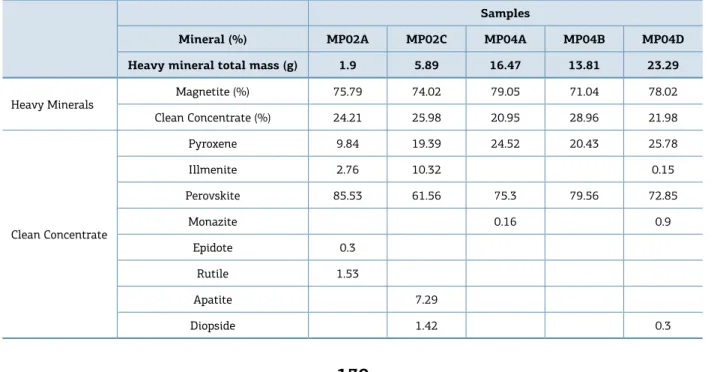
Two samples from MP02 site and three samples from MP04 were selected for separation of the heavy miner-als. From those samples, magnetite, pyroxene, ilmen-ite, perovskilmen-ite, monazilmen-ite, epidote, rutile, apatilmen-ite, and diopside were separated (Tab. 1). It is noteworthy that for most samples the magnetite concentration is much higher than the other minerals (ca. 75%). The main other heavy mineral is perovskite (ca. 70% of the clean concentrates), followed by pyroxene with ca. 20% and ilmenite around 7%. Other minerals such as monazite, epidote, rutile and apatite show minor contributions or are lacking in some samples.
Mineral Chemistry
hrough quantitative and semi-quantitative (EDS) micro-probe analysis a great variety of detrital minerals from the Uberaba Formation were characterized, such as ilmenite, perovskite, phlogopite, andradite, pumpellyite, augite and richterite, sanidine and diopside (Tab. 2). Semi-quantitative EDS analyses (Tab. 3) aided in the characterization of other minerals such as titanite, celadonite, zircon, apatite, ana-tase, rutile, phlogopite, allanite, illite, muscovite, glauco-nite and dolomite.
Analyses of perovskite (Tab. 2) were always performed in the nucleus of the grains, due to its small size. he analyzed perovskites are close to the ideal formule (inal member CaTiO3 with ca. 29.48% Ca and 35.22% Ti).
Low grades of Na, between 0.04 and 0.62%, suggest low concentration of components such as loparite (NaCeTi2O6) and/or lueshite (Na2Nb2O6). Considerable amounts of Fe, between 0.64 and 1.41%, might be related to solid solution of latrappite (CaNb0.5Fe0.5O3). h can reach up to 0.36% (Tab. 2), which relects the characteristic gamma spectro-metric responses of the Uberaba Formation (Fig. 4B). U, on the other hand, might be more correlated to celadon-ite in the rock matrix.
Detrital garnets of the Uberaba Formation are typically enriched in Ca (22.41 to 24.36%), Fe (19.58 to 20.34%) and Ti (2.12 to 3.54%), and show low Al (0.22 to 0.40%), Cr (0.04 to 0.22%) and Mn (0.02 to 0.08%), mostly clas-siied as andradite. Ti and Fe enrichment of those garnets allows to further classify then as the andradite subtypes, mostly schorlomite and melanite (Deer et al. 1992).
he most common detrital mica of the Uberaba Formation is phlogopite. Chemistry analyses close between 77.23 e 91.25% because of the water preset in their mineral struc-ture, which is not considered during the analyses. he phlo-gopites show Mg amounts between 11.74 and 16.84%, Fe between 4.32 and 6.64%, Al between 3.97 and 6.678%, and, lastly, Ti between 1.14 and 1.92% (Tab. 2). he majority of the phlogopites analyses belong to a solid solution series between tetra-ferriphlogopite and phlogopite.
Whole rock geochemistry
Nineteen samples were analyzed for whole rock geochem-istry, and results are shown in Tables 4 and 5. he spatial distribution of those samples within the Uberaba Formation is shown in Fig. 1.
Table 1. Heavy mineral concentrated from Uberaba Formation.
Samples
Mineral (%) MP02A MP02C MP04A MP04B MP04D
Heavy mineral total mass (g) 1.9 5.89 16.47 13.81 23.29
Heavy Minerals
Magnetite (%) 75.79 74.02 79.05 71.04 78.02
Clean Concentrate (%) 24.21 25.98 20.95 28.96 21.98
Clean Concentrate
Pyroxene 9.84 19.39 24.52 20.43 25.78
Illmenite 2.76 10.32 0.15
Perovskite 85.53 61.56 75.3 79.56 72.85
Monazite 0.16 0.9
Epidote 0.3
Rutile 1.53
Apatite 7.29
Table 2. Mineral Chemistry from electron microprobe (%wt).
Na Ti Th Si Cr U Mg Fe Ca Al Mn K Total
(%) Minerals
0.02 3.37 0 14.99 0.06 0.12 0.46 20.06 24.36 0.22 0.22 0.02 63.88 Andradite
0.01 3.54 0 14.94 0.08 0 0.55 19.58 24.23 0.4 0.18 0.01 63.53 Andradite
0.07 2.38 0 15.72 0.05 0 0.42 20.11 22.41 0.27 0.11 0.01 61.54 Andradite
0.02 2.12 0 16.73 0.02 0.06 0.35 20.34 23.08 0.27 0.04 0 63.01 Andradite
0.75 0.67 0 25.36 0 0.03 9.68 3.55 16.95 0.07 0.06 0.01 57.13 Augite
0.05 1.69 0 15.89 0.07 0.73 11.74 5.78 0.51 3.97 0.3 3.22 43.94 Phlogopite
0.08 1.19 0.09 16.99 0 0.61 15.72 4.53 0.65 6.16 0.26 3.1 49.38 Phlogopite
0.04 1.92 0 16.16 0 0 15.24 6.64 1.21 5.22 0.11 4.46 51 Phlogopite
0.05 1.14 0 17.73 0.02 0.49 16.84 4.33 0.54 6.68 0.29 2.89 51 Phlogopite
0.23 0.32 0 24.51 0 0.08 10.86 2.57 17.82 0.08 0.08 0 56.55 Diopside
0.07 0.07 0.01 23.67 0 0 0.36 0.61 0.11 10.63 0 5.97 41.51 Illite
0.06 30.04 0 0 0.25 0 5.3 30.3 0.06 0 0.7 0.01 66.71 Ilmenite
0.02 33.55 0.01 0.03 0.1 0.05 7.01 17.94 0.65 0 2.99 0.05 62.4 Ilmenite
0.1 0 0 25.98 0 0 0.14 0.41 0.09 10.17 0 8.3 45.19 Muscovite
1 32.86 0.36 0 0 0 0 0.97 23.1 0.02 0 0.01 58.32 Perovskite
0.63 33.92 0.15 0.02 0 0.04 0 0.72 24.71 0.03 0.02 0.02 60.25 Perovskite
0.6 33.77 0.21 0.02 0 0.01 0.01 0.72 25.46 0.01 0 0.01 60.83 Perovskite
0.21 34.72 0.16 0.01 0 0 0 0.76 28.06 0.06 0 0.02 63.99 Perovskite
0.04 34.13 0.03 0.03 0 0.04 0.02 1.33 28.87 0.09 0.06 0.01 64.65 Perovskite
0.05 33.8 0.04 0.04 0 0 0.02 1.23 29 0.07 0 0.02 64.26 Perovskite
0.06 33.08 0.01 0.06 0.01 0.01 0.03 1.41 28.57 0.12 0.01 0.02 63.39 Perovskite
0.26 34.29 0.15 0.03 0.07 0 0 0.72 28.51 0.02 0 0.02 64.07 Perovskite
0.1 33.98 0.02 0.06 0.02 0 0.03 1.03 28.68 0.06 0.06 0.04 64.08 Perovskite
0.23 35.7 0 0.01 0 0.06 0 0.78 28.47 0.02 0.03 0.01 65.31 Perovskite
0.56 34.06 0.06 0.01 0 0 0 0.74 25.93 0.03 0.03 0.02 61.44 Perovskite
0.55 34.65 0.13 0.02 0.02 0 0.02 0.64 26.27 0.01 0.01 0.01 62.33 Perovskite
0.01 0.19 0 17.68 0.02 0 0.01 6.47 17.06 14.97 0.13 0.01 56.55 Pumpellyite
0 0.08 0 46.27 0 0 0 0 0.01 0.01 0.04 0 46.41 Quartz
6.62 0.54 0.01 26.44 0.03 0 2.57 18.93 5.78 0.09 0.28 0.01 61.29 Amphibole
5.46 0.37 0.02 24.2 0 0.03 2.61 16.96 6.77 0.06 0.45 0.02 56.94 Amphibole
0.34 0 0.04 28.29 0.05 0 0 0.02 0.01 10.08 0 11.96 50.78 Sanidine
0.11 25.37 0.03 6.08 0.16 0.08 0.07 13.74 7.66 0.03 0.67 0.04 54.03 Titanite
0.1 23.23 0 14.74 0 0.02 0 1.31 20.03 0.08 0.05 0.01 59.56 Titanite
Samples show overall low SiO2 (25.15 to 53.88%) and Al2O3 content (2.70 to 6.71%), and relatively high contents of CaO (2.34 to 29.18%), K2O (2.85 to 6.97%), Fe2O3
Table 3. Mineral Chemistry from energy dispersive X-ray detector (EDS) analyzes (%wt).
Na Ti Si Cr Mg Fe Ca Al Mn K P Ba C Zr S Ce Mineral
0 0 15.75 0 0 8.02 6.24 0 0 0 4.15 0 0 0 0 17.62 Allanite
0 3.45 22.74 0 6.63 3.25 0 5.54 0 7.39 0 0 0 0 0 0 Alumino Celadonite
0 59.9 0 0 0 0 0 0 0 0 0 0 0 0 0 0 Anatase or Rutile
0 0 0 0 0 0 39.27 0 0 0 16.58 0 0 0 0 0 Apatite
0 0 0 0 0 0 0 0 0 0 0 46.14 0 0 23.35 0 Barite
0 0 21.59 0 10.3 0 0 7.18 0 7.09 0 0 0 0 0 0 Biotite
0 0 27.65 0 5.55 5.11 0 2.78 0 7.65 0 0 0 0 0 0 Celadonite
0 0 22.93 0 7.31 9.42 0 3.85 0 6.04 0 0 0 0 0 0 Celadonite
0 0 0 0 20.44 0 32.32 0 0 0 0 0 1.54 0 0 0 Dolomite
0 0 21.44 0 16.61 0 0 7.02 0 0 0 0 0 0 0 0 Phlogopite
0 0 23.07 0 7.27 9.36 0 3.82 0 6 0 0 0 0 0 0 Glauconite
0 0 21.02 0 2.35 0 0 17.05 0 5.53 0 0 0 0 0 0 Illite
0 0 21.31 0 3.06 0 0 16.58 0 7.27 0 0 0 0 0 0 Illite
0 0 21.2 0 0 0 0 15.76 0 9.42 0 0 0 0 0 0 Muscovite
0 0 28.4 0 0 0 0 10.01 0 10.1 0 0 0 0 0 0 Sanidine
0 12.98 19.55 0 0 0 21.84 0 0 0 0 0 0 0 0 0 Titanite
0 0 21.37 0 0 0 0 0 0 0 0 0 0 34.82 0 0 Zircon
3.59 and 11.38%) and Na2O (0.08 to 0.28%), MnO (0.14 to 0.36%) and Cr2O3 (0.05 to 0.77%) are low.
Chondrite-normalized rare earth element (REE) pat-terns of the samples are characterized by a strong fraction-ing of the light rare earths (LREE) relative to the heavy rare earths (HREE), with LaN/YbN around 128 and LaN/ LuN around 154. No relevant Eu anomalies are found, and the mean value of Eu/Eu* is 0.89. hus, the chondrite-nor-malized patterns are lat with a steep incline towards HREE (LREE — enriched).
Chondrite-normalized (hompson 1982) incompatible element plots for the Uberaba Formation (Fig. 10A) show a distinctive enrichment in Ta-Nb (positive Ta-Nb anomaly) and also h enrichment (due to the presence of perovskite). P and Sr show, on the other hand, negative anomalies. North American Shale Composite (NASC)-normalized patterns (Taylor & McLennan 1995) present the same anomalies ver-iied on the chondrite-normalized plots (Fig. 10B and 10C).
In the plots of Figs. 11 and 12, besides the samples of the Uberaba Formation, the ields which correspond to the plotting area of the alkaline complexes of the AP (Tapira, Araxá, Catalão I, Serra Negra and Salitre) are also plot-ted for comparison. In general, samples from the Uberaba Formation plot within the patterns of the AP complexes in Fig. 11, and there is a high overlap between the com-plexes, generally showing highly fractionated LREE and a positive Nb-Ta anomaly. he patterns which are closer to the Uberaba Formation are those of Tapira and Catalão. Fig. 12A shows a bi-variant plot of SiO2 × MgO. hose two variables are not correlated, and MgO is constant with higher SiO2. In this diagram, some samples plot within the Serra Negra / Salitre and Tapira / Araxá ields, but away from Catalão I.
Table 4. Whole rock analysis – Major elements (%wt).
Samples Coordinate (X) Coordinate (Y) Zone Al2O3 CaO Cr
2
O3
Fe
2
O3 K2
O
MgO MnO Na
2
O
P2 O5
SiO
2
Ti
O2
7C 191484 7815082 23K 4.86 10.95 0.13 15.85 5.89 9.7 0.19 0.12 1.49 42.35 8.48
FU442 194843 7819800 23K 4.85 11.12 0.26 12.09 5.71 8.99 0.15 0.18 0.69 48.92 7.05
FU460 191898 7814786 23K 6.11 27.04 0.12 8.69 6.15 4.99 0.16 0.18 0.71 41.79 4.07
FU464 194297 7813016 23K 5.58 9.45 0.25 13.34 6.06 7.48 0.17 0.28 0.89 49.14 7.36
HD04 196919 7813106 23K 5.68 9.37 0.21 13.55 6.53 8.14 0.19 0.24 0.84 48.39 6.86
HD05 192647 7813608 23K 4.66 10.49 0.17 15.79 6.02 10.25 0.19 0.17 0.92 43 8.35
MP01A 190806 7815657 23K 4.55 8.84 0.11 13.46 5.42 9.89 0.15 0.11 0.63 49.65 7.2
MP01B 190806 7815657 23K 2.84 12.44 0.11 15.65 4.59 9.59 9.59 0.1 0.85 31.56 12.69
MP02 189948 7816650 23K 4.78 25.7 0.05 7.99 4.71 7.5 0.15 0.16 0.76 44.38 3.82
MP04 187457 7815942 23K 4.57 12.03 0.1 10.65 4.43 11.39 0.14 0.08 0.58 42.8 13.23
V620A 811753 7807036 22K 3.53 4.94 0.77 25.19 4.1 8.25 0.23 0.13 0.72 35.74 16.41
V620B 811753 7807036 22K 5.88 21.52 0.2 12.02 6.29 8.69 0.18 <0.1 0.85 38.83 5.54
V631 187431 7813503 23K 4.63 15.1 0.22 15.79 4.89 10.16 0.19 0.15 0.94 38.78 9.15
V632 187401 7815231 23K 4.05 22.43 0.12 13.81 4.35 6.92 0.19 0.15 0.96 40.03 6.99
V633A 187490 7816065 23K 2.7 29.18 0.15 17.36 2.86 8.77 0.24 0.2 1.11 25.15 12.29
V633B 187490 7816065 23K 6.64 12.17 0.07 12.85 6.39 10.56 0.15 <0.1 1.32 45.16 4.69
V634 186272 7820493 23K 4.85 10.02 0.13 14.72 5.05 8.79 0.17 0.15 0.92 46.72 8.5
V648 810121 7814540 22K 6.71 2.34 0.18 14.85 6.97 5.6 0.16 0.18 0.89 53.88 8.23
V658 805109 7815396 22K 5.95 4.3 0.6 30.29 2.87 3.59 0.36 <0.1 0.59 27.21 24.23 and high Al2O3 as compared with the alkaline complexes,
although the Serra Negra/Salitre complexes plot closer to the samples.
Figure 12C correlates the quantities of TiO2 with SiO2. This diagram shows elevated values for the Uberaba Formation, plotting closer to the Serra Negra/Salitre complexes, compared to the other alkaline complexes. The elevated SiO2 and TiO2 contents can again be cor-related with detrital input from sandstones, quartzites and schists of the basement (SiO2) and alkaline com-plexes (TiO2).
Unlike major element-based diagrams, a trace-element diagram using the h/Yb vs. Ta/Yb ratios (Wilson 1989) show a high geochemical ainity of the Uberaba Formation to the AP alkaline complexes, with an enriched-mantle like composition (Fig. 12D).
DISCUSSION
Table 5. Whole rock analysis – rare earth element and trace elements (ppm).
Samples 7C FU442 FU460 FU464 MP01A MP02 V633A V633B V620A V620B V631 V632 V634 V648 V658 HD04 HD05 MP01B MP04
Ba 1933 1805 1248 1164 1814 772 769 871 875 1032 1854 745 857 924 925 1426 1131 1575 901
Ce 723.1 983.1 550.9 996.7 775.7 824.4 1683 595.6 1871 1044 936.4 971.7 891.5 1234 3045 949.2 850 1485.1 1207.9
Co 50.7 43.1 30.2 40.9 53.2 31 45.8 39.1 76.9 37.2 47.8 43.2 64.7 81.5 98 44 51 55.2 32.8
Cs 1.24 0.94 1.17 1.14 1.06 0.81 0.63 1.59 0.69 1.45 1.26 0.81 0.99 1.45 0.52 1.33 0.84 0.6 0.5
Cu 76 40 37 49 60 42 64 71 74 53 62 54 65 77 108 57 63 48.8 37.3
Dy 9.55 14.13 8.54 13.61 8.49 22.03 35.4 12.63 20.37 15.64 12.79 21.44 10.45 15.95 74.99 10.81 12.29 14.81 13.26
Er 3.35 4.12 3 4.08 2.42 5.84 9.46 4.17 5.42 4.76 3.84 5.91 3.19 5.54 26.48 3.4 4.27 3.68 3.16
Eu 8.36 12.12 6.75 12.11 8.83 14.93 25.16 8.58 19.95 11.51 11.36 14.52 9.96 13.77 62.44 9.92 10.25 17.18 15.57
Ga 13.6 10.8 11.1 12.8 12.1 9.6 12 15.3 15.9 12.4 12.1 10.8 12.6 16.3 20.9 12.8 12.4 9.4 7.8
Gd 22.74 33.55 18.85 32.85 23.48 42.63 71.79 25.74 53.82 32.96 31.39 41.37 26.73 40.05 176.41 26.77 28.55 38.52 34.23
Hf 13.13 11.34 9.05 13.18 9.4 7.07 10.25 12.37 13.54 10.73 12.19 9.42 10.9 13.3 15.77 10.88 11.26 11.5 10.6
Ho 1.4 1.92 1.21 1.81 1.08 2.88 4.72 1.81 2.57 2.16 1.71 2.83 1.38 2.38 11.12 1.44 1.79 1.64 1.56
La 414.3 423.7 259.9 483.1 388.1 210.3 679.5 255.4 839.6 348.7 466.3 349 464.5 578 2517 430.3 429.7 695.4 561.5
Lu 0.3 0.3 0.26 0.31 0.18 0.28 0.39 0.32 0.31 0.33 0.26 0.29 0.24 0.4 1.99 0.28 0.27 0.28 0.25
Mo <2 <2 <2 <2 <2 <2 <2 <2 <2 <2 <2 <2 <2 <2 <2 <2 <2 <0.1 0.1
Nb 304.96 286.66 150.37 364.61 244.89 118.53 421.2 155.8 638.44 177.11 311.34 210.58 291.43 346.08 >1000 330.09 266.48 450.2 478.8
Nd 293.5 372 215.2 400.8 307.9 297.2 652.7 227.2 704.1 303.6 369.3 344 351.3 460.5 2421 344.2 332.3 550.5 481.5
Ni 233 170 155 175 267 132 205 204 339 742 658 550 217 787 437 179 327 189 142.3
Pr 83.33 99.68 59.16 108.66 84.24 67.4 166.97 59.13 193.96 76.98 101.48 85.49 97.02 124.38 649.27 95.31 91.36 158.58 134.12
Rb 100.7 83.7 82.7 89.4 83.8 61 50 110.6 66.9 93.5 84.7 65.4 79.4 114.1 44.8 103.3 88.4 77.6 52.7
Sm 38 53.2 29.9 54.3 40.1 55.4 101.3 35.2 92.2 47.3 50.5 56.8 45.7 61 280.9 45.9 45.3 71.18 62.37
Sn 3.6 2.9 1.6 3.3 2.4 0.8 2.9 2.1 5.7 1.9 3.1 2.5 2.7 3.1 8.3 3 2.9 4 3
Sr 978 1148 830 976 1034 1634 2166 952 587 1425 1146 1360 1002 481 611 1125 1094 1312.1 905.6
Ta 19.68 19.3 8.96 20.66 18.57 6.97 27.81 7.99 48.27 11.71 20.75 14.04 20.7 22.39 74.54 18.31 18.45 35.7 44.1
Tb 2.33 3.52 2 3.37 2.26 4.88 8.02 2.77 5.38 3.59 3.14 4.76 2.66 3.93 18.04 2.69 2.95 3.57 3.41
Th 46.9 53 28.3 63.6 45.8 25 79 23.5 118.9 39 51.3 36.6 50.8 62.9 216.4 62.6 47.9 82.8 95
Tl <0.5 <0.5 <0.5 <0.5 <0.5 <0.5 <0.5 <0.5 <0.5 <0.5 <0.5 <0.5 <0.5 <0.5 <0.5 <0.5 <0.5 <0.1 <0.1
Tm 0.38 0.41 0.33 0.42 0.24 0.54 0.83 0.45 0.51 0.47 0.4 0.51 0.33 0.57 2.77 0.37 0.42 0.38 0.4
U 2.76 4.22 2.72 5.21 2.56 1.89 4.09 2.65 9.82 2.45 3.33 2.87 3.67 4.01 15.64 4.88 2.49 3.5 6.5
V 143 164 79 173 122 121 314 92 337 89 169 219 156 259 604 137 156 234 312
W 13.6 88.2 57.8 47.3 88.8 85.8 16.8 9.7 23.5 6.4 21.7 51.1 79.7 172.9 56.9 48.9 28.7 9 4.4
Y 32.21 40.5 30.02 38.54 22.85 57.1 91.48 45.23 55.5 50.45 37.32 58.63 30.51 94.94 376.19 32.6 57.04 39 35.5
Yb 2.4 2.3 2 2.4 1.4 2.6 3.9 2.6 2.8 2.7 2.2 2.7 1.9 3 15.5 2.2 2.2 2.23 2.43
Zn 96 68 59 95 77 40 80 76 142 67 87 70 76 143 160 87 93 73 58
Zr 504 401 314 506 367 241 356 485 515 405 442 333 405 550 573 474 445 469.7 429.9
kimberlitic and kamafugitic intrusions and clastic sedi-mentary rocks. Some minerals which are abundant in the Uberaba Formation are also common in the volcanic rocks of the Mata da Corda Group, such as olivine, clinopyroxene,
(1917, in Freyberg 1934) linked to kimberlite-picritic eruptive events and chrono-correlated with the Uberaba Formation. On the other hand, Batezelli and Ladeira (2016) suggest that the Capacete Formation is chrono-correlated with the Marília Formation. he 206Pb/238U perovskite ages
of kamafugites from the Mata da Corda Group generally cluster in the 80–81 and 75–76 Ma age interval (Sgarbi
et al. 2003). hus, the Mata da Corda Group could be a correlative to the Uberaba Formation. his hypothesis needs to be checked by further geochronological studies. We also discuss the probable chrono-correlation of the Uberaba Formation with the diamond-bearing conglomerates of the Romaria region, which outcrops 95 km to the north-east of Uberaba, in isolated channels carved in the basement. he conglomerates of the Romaria region are very important diamond producers, having yielded thousands of carats, includ-ing large stones. he company GAR Mineração, Comércio, Importação e Exportação LTDA. explores diamonds in the so-called Tauá conglomerate of Romaria since 2014. Some authors have proposed that this conglomerate is chrono-cor-related to the Uberaba Formation, but this hypothesis remains to be proved (Ferreira Jr. 1996, Gravina et al. 2002).
According to Bizzi et al. (1991, 1993), alkaline rocks of distinct ages occur in the AP, based on Rb-Sr phlogopite ages: Santonian (117–119 Ma) and Aptian (87–86 Ma). According to Huene (1939), the Uberaba Formation was deposited during the Campanian, ca. 80 Ma ago. hus, this unit is contemporaneous or slightly younger than the alka-line-carbonatitic intrusion of the AP.
he anomalous concentration of clinopyroxene, pla-gioclase and Ti-bearing minerals in the Uberaba Formation lithic sandstones seems to be related to the erosion of the Serra Geral Formation, while schist and quartzite frag-ments are mostly related to the erosion of the Canastra and Araxá groups. Indeed an important component of erosion from the nearby basement, without considerable transport and sorting, is suggested by the subangulous clasts with medium sphericity.
he mineral chemistry of the Uberaba Formation detri-tal garnets and phlogopites are shown in Figs. 14 and 15, and compared with similar minerals in the alkaline com-plexes (Barbosa 2009, Brod et al. 2013) of the AP, along with mineral chemistry of samples from the Romaria region (Coelho 2010).
Chemical analyses of the detrital garnets of the Uberaba Formation indicate the presence of Ti-rich andradite, which is a common mineral in alkaline rocks (Keep & Russell 1992). his garnet variety is present in the Tapira (Brod 1999, Eberhardt 2014) and Salitre (Barbosa 2009) complexes. Fig. 14A shows a plot of Mg/(Mg+Fe) × Ca/(Ca+Mg) in gar-nets (Schulze 2003), and the corresponding ields of crustal
versus mantellic garnets. Most of the garnets from Romaria show a mantle ailiation, while the Uberaba Formation and alkaline complexes garnets are mainly crustal. Fig. 14B shows a Mg/(Mg+Fe) × Cr2O3 plot (Schulze 2003), in which most garnets of the Romaria conglomerate shows a peridotitic
Cs RbBaTh U K NbTa La Ce Sr Nd P Hf ZrSmTi Tb Y TmYb
Sample/Chondrites
100,000
10,000
1,000
100
10
1
0.1
0.01
A
B
C
100,000
10,000
1,000
100
10
1
0.1
0.01
100,000
10,000
1,000
100
10
1
0.1
0.01
Sample/REE chondrite
Sample/NASC
Ba Rb Th K Nb Ta La Ce Sr Nd P Sm Zr Hf Ti Tb Y TmYb
La Ce Pr Nd PmSm Eu Gd Tb Dy Ho Er Tm Yb Lu
Figure 10. Whole rock geochemistry plots for samples of the Uberaba Formation: (A) trace elements, chondrite-normalized ater Thompson (1982); (B) REE, chondrite-normalized ater Boynton (1984); (C) REE, NASC-normalized ater Taylor and McLennan (1995).
A
C
B
D
Sample/Chondrites
Sample/REE chondrite
Sample/Chondrites
Sample/REE chondrite
100,000
10,000
1,000
100
10
1
0.1
0.01
100,000
10,000
1,000
100
10
1
0.1
0.01
Ba Rb Th K Nb Ta La Ce Sr Nd P Sm Zr Hf Ti Tb Y TmYb La Ce Pr Nd Pm Sm Eu Gd Tb Dy Ho Er Tm Yb Lu
100,000
10,000
1,000
100
10
1
0.1
0.01
100,000
10,000
1,000
100
10
1
0.1
0.01
Ba Rb Th K Nb Ta La Ce Sr Nd P Sm Zr Hf Ti Tb Y TmYb La Ce Pr Nd Pm Sm Eu Gd Tb Dy Ho Er Tm Yb Lu
Complexes: Complexes:
Complexes: Complexes:
Serra Negra Salitre Catalão I Serra Negra Salitre Catalão I
Araxá Tapira Araxá Tapira
composition, while those from the Uberaba Formation and alkaline complexes are more like eclogitic garnets.
Studies of garnet chemistry by Dawson and Stephens (1975), Grütter (1998) and Grütter et al. (2004) led to a clas-siication based on the CaO and Cr2O3 contents in 13 groups (G0 to G12) (Fig. 14C). G0 corresponds to garnets of dubi-ous origin. G1 and G2 are brown megacrystals; G3, G4, G5, G6 and G8 are garnets from eclogite xenoliths; G7, G9, G11 and G12 are from lherzolite xenoliths; G10 are garnets from harzburgite and possibly diamond-bearing rocks. In the dia-gram of Fig. 14C (Grütter et al. 2004), garnets from Romaria are mostly within the G9 (some within the G10) group, i.e., lherzolite-derived. Garnets from the Uberaba Formation and from the alkaline complexes, on the other hand, show sig-niicative quantities of Fe, Ca and Mn (ca. 1%), and low Cr, localized in the G3 ield, from eclogitic xenoliths.
Plotting the mica analysis in a Mg × Fe × Ca dia-gram (Fig. 15a) makes possible the classiication of the
phlogopites. he small diferences with respect to the phlo-gopite-annite series are due to the high Ti concentrations (mean 1.48%). A similar situation is observed for the phlo-gopites of the Tapira (Brod et al. 2001) and Serra Negra (Grasso 2010) complexes (Fig. 15A). In a Fe × Mg plot (Fig. 15B) the samples plot within the alkaline complexes trend. A subordinate substitution of Mg to Fe can be iden-tiied in this plot. According to Cordeiro et al. (2010), this substitution occurs in the Catalão I Complex and indi-cates distinct zoning patterns in the micas of the difer-ent rocks of the complex. he compositional variation of the Al2O3 and TiO2 grades in micas, plotted in Fig. 15C, relects the high grades of TiO2 and low Al2O3, a signa-ture that is similar to the one of the alkaline complexes. Finally, a Ti × [Fe/(Fe+Mg)] diagram (Fig. 15D) shows the high Ti grades in analyzed phlogopites. his is accom-panied by a raise in Fe/(Fe+Mg), a pattern which is very similar to that of phlogopites of the AP alkaline complexes.
Figure 11. Compared whole rock geochemistry of the Uberaba Formation (line graphics) and AP alkaline complexes: (A) trace elements and (B) REE, chondrite-normalized ater Thompson (1982) for the following alkaline complexes: Serra Negra (Grasso 2010), Salitre (Barbosa 2009) and Catalão I (Cordeiro et al. 2010); (C) trace elements and (D) REE, chondrite-normalized ater Boynton (1984) for the following alkaline complexes: Araxá (Traversa et al. 2000) and Tapira (Brod et al. 2013).
Whole rock chemistry analyses of the Uberaba Formation sandstones also suggest a high inluence of the alkaline com-plexes as source areas. his is mainly expressed in the high overall REE concentrations, heavily fractionated LREE, lat REE chondrite-normalized patterns (no Eu anomaly), Ta-Nb positive anomalies, and high Ti and h concentra-tions from perovskite, a rare mineral in detrital rocks, but common in alkaline complexes.
The complexes of Serra Negra, Catalão I, Salitre, Araxá and Tapira share all of those characteristics, with high REE concentrations, fractionated LREE, Nb-Ta positive
anomalies, etc. (Fig. 11). The smaller complexes, such as Catalão I, Araxá and Tapira, show little variation of the element concentrations resulting in limited fields in the plots (Fig. 11). The larger complexes, such as Serra Negra and Salitre, on the other hand, show a greater variabil-ity, leading to broader plotting fields (Fig. 11A and B). hus, between the studied complexes, the ones that most closely resemble the geochemical patterns of the Uberaba Formation are those of Catalão I and Tapira (Fig. 11C and D). he main diference is the negative Sr anomaly of the Uberaba Formation, which might be related to the leaching of this element
A B
C D
50
40
30
20
10
0
50
40
30
20
10
0
30
25
20
15
10
5
0
SiO
2
Ti
O2
MgO
CaO
Al2O3
0 10 20 30 40 0 5 10 15
0 10 20 30 40 50
100
10
1
0.1
0.01
0.01 0.01 1 10 Ta/Yb
Th/Yb
Oceanic island arcs
Activ
e continental margins
Depleted mantleMORB
Enriched mantleIntra-plate basalts
High Paranaíba Alkaline Complexes
Legend
Serra Negra and Salitre Complexes Uberaba Formation
Tapira and Araxá Complexes Catalão I Complex
0º0'0"S 15º0'0"S 30º0'0"S 60º0'0"W 45º0'0"W
50º0'0"W 45º0'0"W 40º0'0"W
20º0'0"S 15º0'0"S
19º30'0"S 19º0'0"S 18º30'0"S 18º0'0"S 17º30'0"S
48º0'0"W 47º30'0"W 47º0'0"W 46º30'0"W 46º0'0"W 45º30'0"W Datum: WGS84 0 15 30 60 km
Legend
Mata da Corda Group Uberaba Formation Alkaline Complexes Kimberlites Areado Group Paraná Basin Bambuí Group Brasília Belt
Geologic Conventions
Normal Fault Thrust Fault Structural Lineament
Cartography Conventions
Cities Drainage
Figure 13. Geologic map of the AP (Alto Paranaíba). Adapted from Oliveira et al. (2004), with the locations of the alkaline complexes and the distribution of the Uberaba Formation.
Legend:
Uberaba Formation
Salitre Complex
Tapira Complex
Romaria’s conglomerate
A
C
B
1.0
0.8
0.6
0.4
0.2
0.0 0.2 0.4 0.6
Ca/(Ca+Mg)
Mg/(Mg+Fe)
0.0 0.2 0.4 0.6
Mg/(Mg+Fe)
Crust Mantle
6
4
2
0
Cr
2
O3
Eclogitic Trend
Peridotitic Trend
6
4
2
0
Cr
2
O3
0 5 10 15 20 25 30 35
CaO G10
H G9
L G12
W
G0 G4 G5 G1
G3 E
Figure 14. Mineral chemistry binary diagrams of garnets from Uberaba Formation comparing with garnets from alkaline complexes and from Romaria’s diamantiferous conglomerate (Tauá): (A) [Mg/(Mg+Fe)] × [Ca/(Ca+Mg)] diagram ater Schulze (2003) separating mantle-ailiation and crust-ailiation garnets; (B) Mg/(Mg+Fe) × Cr2O3
diagram ater Schulze (2003) classifying garnet’s evolutionary trends and (C) CaO × Cr2O3 diagram ater Grütter
during the carbonatic/dolomitic cementation. On the other hand, enrichment in Ti and h is related to detrital perovskite.
According to Mitchell (1986), garnets are important indicators in the identiication of kimberlites and their magma sources. he results obtained for detrital garnets of the Uberaba Formation conirm the presence of andradite garnet, of the schorlomite variety, which is rich in Ti, thus not indicating a kimberlitic source, as suggested by the plot-ting of the garnets in the eclogitic xenolith ield in Fig. 14B. he contrary is observed in Romaria pyrope garnets, which
indicate a kimberlitic source. Compared to the diamond-bear-ing conglomerates of Romaria, the Uberaba Formation prov-enance and sourcing is quite distinct (Fig. 14C).
CONCLUSIONS
According to the stratigraphic, petrographic, mineral chemistry and whole-rock geochemical data gathered for the Uberaba Formation, three main source areas can be
Tapira Complex Serra Negra Complex
A
C
B
D
Al
Eastonite
Phlogopite
Mg tetra-ferriphlogopite Biotite
Siderophyllite
Annite
Fe
Fe
15
10
5
0
Mg
6 8 10 12 14 16
Al
2
O3
5.00
1.00
0.50
0.10
0.05
0.01
-1 0 1 2 3 4
TiO2
2.0
1.5
1.0
0.5
0.0
0.5
-1.0
Ti
0.0 0.2 0.4 0.6 Fe/(Fe+Mg)
Legend for figure (a):
Uberaba Formation Salitre Complex Catalão I Complex
Tapira Complex Serra Negra Complex
Legend for figures (b), (c) and (d):
Salitre Complex Catalão I Complex Uberaba Formation
recognized for the provenance of the lithic sandstones and conglomerates of this unit, which probably represents a braided luvial system:
1. Precambrian rocks of the Araxá and Canastra groups;
2. basalts of the Serra Geral Formation;
3. alkaline rocks of the Catalão I, Catalão II, Serra Negra, Salitre, Tapira, and Araxá cretaceous intrusions and others similar rocks.
All of those units are exposed in the AP Arch, a base-ment high to the east of the Uberaba Formation outcrop area, which has been active during the Cretaceous.
he chemical composition of the Uberaba Formation rocks, which is very similar to that of the alkaline complexes (highly fractionated REE with LaN/YbN = ca. 128; positive Nb-Ta and Ba anomalies), and abundant detrital perovskite, suggests that the third source area was somewhat prepon-derant over the other two ones. he unit might also involve some syn-sedimentary volcanic or volcanoclastic activity as suggested by a greenish very ine matrix in some samples and fragments of quartz with corroded gulfs.
he chemical analysis of perovskite, garnet and phlo-gopite conirms that those minerals show similar compo-sition as those ones found in the alkaline complexes of the AP. Garnets of the Uberaba Formation are mainly schor-lomite, a Ti-rich variety of andradite, and plot in the ield of eclogitic xenoliths (crustal garnets) in discriminatory
diagrams. hus, the unit is not prone to bear detrital dia-mond grains, as garnets are not indicative of a kimberlitic (mantellic) ailiation.
A chronocorrelation of the Uberaba Formation and the Mata da Corda Group, of around 80–75 Ma (Sgarbi et al. 2003) can be considered for investigation. he diamond-bear-ing Romaria conglomerate, however, shows a very distinct provenance pattern, bearing pyrope garnets which fall within the kimberlitic ield in discriminatory diagrams. hus, the Uberaba Formation is probably not correlated to the Romaria conglomerate. he geochemical and mineral chemistry features suggest that the Uberaba Formation was not a likely source for alluvial diamonds of the southeastern TM region. hus, the quest for the source of those diamonds remains open.
ACKNOWLEDGMENTS
Companhia do Desenvolvimento do Estado de Minas Gerais (CODEMIG) and Centro de Pesquisas Manoel Teixeira da Costa (CPMTC-IGC-UFMG), for inancial and logistic support through the Triângulo Mineiro map-ping project 2015/2017. Complexo Cultural e Cientíico de Peirópolis/Universidade Federal do Triângulo Mineiro, in Uberaba (MG), team for the lodging. he manuscript was greatly improved after comments and suggestions by G. Basilici and F. Vesely.
Almeida F.F.M. & Barbosa O. 1953. Geologia das quadrículas de Piracicaba e Rio Claro. Boletim da Divisão de Geologia e Mineralogia,
143:1-96.
Barbosa O. 1934. Resumo de geologia do Estado de Minas Gerais. Departamento de Serviço Geográico e Geológico. In: Boletim 3, 40p. Minas Gerais.
Barbosa O., Braun O.P.C., Dyer R.C., Cunha C.A.B.R. 1970. Geologia da região do Triângulo Mineiro. In: Boletim 136, Rio de Janeiro. DNPM/
DFPM. 140p.
Barbosa E.S R. 2009. Mineralogia e petrograia do complexo carbonatítico foscorítico de Salitre, MG. Tese – Instituto de Geociências, Universidade de Brasília, Brasília. 432p.
Barcelos J.H. 1984. Reconstrução Paleogeográica da Sedimentação
do Grupo Bauru Baseada na sua Redeinição Estratigráica Parcial em Território Paulista e no Estudo Preliminar Fora do Estado de São Paulo. Tese – Instituto de Geociências e Ciências Exatas, Universidade
Estadual Paulista “Júlio de Mesquita Filho”, Rio Claro. 190p. Barcelos J.H. 1989. Inluência do Soerguimento do Alto Paranaíba na Sedimentação Pós-Basáltica na Área do Triângulo Mineiro (MG), Borda NNE da Bacia do Paraná. Geociências,8:38-54.
Batezelli A. 2003. Análise da sedimentação cretácea no Triângulo Mineiro e sua correlação com áreas adjacentes. Tese – Universidade
Estadual Paulista “Júlio de Mesquita Filho”, Rio Claro. 195p.
REFERENCES
Batezelli A. & Ladeira F.S.B. 2016. Stratigraphic framework and
evolution of the Cretaceous continental. Journal of South American Earth Sciences,65:1-24.
Bertini R.J. 1993. Paleobiologia do Grupo Bauru, Cretáceo Superior continental da Bacia do Paraná, com ênfase em sua fauna de amniotas. Tese – Instituto de Geociências, Universidade Federal do
Rio de Janeiro, Rio de Janeiro. 493p.
Bizzi L.A., Smith C.B., Meyer H.O.H., Armstrong R., De Wit M.J. 1991. Mesozoic kimberlites and related rocks in southwestern São Francisco Craton, Brazil: a case for local mantle reservoirs and
their interaction. 8th International Kimberlite Conference.Extended
Astracts. Victoria, Canada. p.17-19.
Bizzi L.A., De Wit M.J., Smith C.B., Armstrong R.A. 1993. Características isotópicas e origem dos kimberlitos e vulcânicas
alcalinas relacionadas em Minas Gerais. In: Simpósio Brasileiro sobre a Geologia do Diamante, Brasil. Geol. Diamante. 1. In: Anais...
Cuiabá, UFMT Publ. Esp. 2/93, p. 141-151.
Boynton W.V. 1984. Cosmochemistry of the rare earth elements:
meteoritic studies. In: Henderson, P. (ed.). Rare Earth Elements
Geochemistry. Amsterdam: Elsevier, p. 63-114.
Brod, J.A. 1999. Petrology and Geochemistry of the Tapira Alkaline
Brod J.A., Gaspar D.P., Araújo D.P., Gibson S.A., Thompson R.N., Junqueira-Brod T.C. 2001. Phlogopite and tetra-ferriphlogopite from Brazilian carbonatite complexes: petrogenetic constraints and
implications for mineral-chemistry systematics. Journal of Asian Earth Sciences,19:265-296.
Brod J.A., Junqueira-Brod T.C., Gaspar J.C., Petrinovic I.A., Valente S.C., Corval A. 2013. Decoupling of Paired Elements, Crossover REE Patterns, and Mirrored Spider Diagrams: Fingerprinting Liquid Immiscibility in The Tapira Alkaline Carbonatite Complex, SE Brazil.
Journal of South American Earth Sciences,41:41-56.
Bryon J.M. 1999. Physical Volcanology and Lithogeochemistry of
Mata da Corda Formation, Minas Gerais, Brazil. Tese – Carleton
University, Ontario. 297p.
Campos L.F. 1891. Jazidas Diamantíferas de Água Suja (Bagagem) Estado de Minas Gerais. Rio de Janeiro: Typ. Ed. Fluminense.
Coelho F.M. 2010. Aspectos geológicos e mineralógicos da Mina de
diamantes de Romaria, Minas Gerais. MS Dissertation, Universidade de São Paulo, São Paulo. 106p.
Cordeiro P.F.O., Brod J.A., Dantas E.L., Barbosa E.S.R. 2010. Mineral Chemistry, Isotope Geochemistry and Petrogenesis of Niobium-Rich Rocks From The Catalão I Carbonatite-Phoscorite Complex, Central
Brazil. Lithos,118:223-237.
Costa M.T. 1963. Estrutura geológica dos cerrados. Departamento de
Pesquisas e experiências Agropecuárias, Ministério da Agricultura,
Bolívia, 15.
Dawson J.B. & Stephens W.E. 1975. Statistical classiication of garnets from kimberlites and associated xenoliths. Journal of Geology,83:589-607.
Deer W.A., Howie R.A., Zussman J. 1992. An Introduction to the Rock Forming Minerals.2nd ed. London: Longman. 696p.
Eberhardt D.B. 2014. Elementos-Traços em Minerais do Complexo Alcalino Carbonatítico de Tapira – MG. MS Dissertation –
Universidade de Brasília, Brasília. 148p.
Fernandes L.A. & Coimbra A.M. 2000. Revisão Estratigráica da Parte Oriental da Bacia Bauru (Neocretáceo). Revista Brasileira de Geociências, 30(4):717-728.
Fernandes A.F., Karfunkel J., Hoover D.B., Sgarbi G.N.C., Walde D., Gomes J., Kambrock K. 2014. The Basal Conglomerate of the Capacete Formation (Mata Da Corda Group) and its Relation to Diamond Distributions in Coromandel, Minas Gerais State, Brazil.
Brazilian Journal of Geology,44:91-103.
Fernandes L.A., Ribeiro C.M.M. 2015. Evolution and
palaeoenvironment of the Bauru Basin (Upper Cretaceous, Brazil).
Journal of South American Earth Sciences,61:71-90.
Ferreira V.G., Quintão D.A., Caxito F.A., Bittencourt J., Ribeiro L. C.
B. (in press). Mapa Geológico da Folha Veríssimo-Miguelópolis,
escala 1:100.000. Belo Horizonte, Projeto de Mapeamento Geológico
CODEMIG/UFMG2015-17.
Ferreira Jr. P.D. 1996. Modelo Deposicional e Evolução Diagenética da Formação Uberaba, Cretáceo Superior da Bacia do Paraná, na Região do Triângulo Mineiro. MS Dissertation – Universidade Federal de Ouro Preto, Ouro Preto. 175p.
Ferreira Jr. P.A. & Gomes N.S. 1999. Petrograia e Diagênese da Formação Uberaba, Cretáceo Superior da Bacia do Paraná no Triângulo Mineiro. Revista Brasileira de Geociências, 29(2):163-172.
Ferreira Jr. P.D. & Guerra W.J. 1993. Estudo preliminar sobre o ambiente deposicional da Formação Uberaba. In: 7.º Simpósio de
Geologia de Minas Gerais. Belo Horizonte. In: Anais... Belo Horizonte,
SBG/MG, p. 17-21.
Ferreira Jr. P.D. & Guerra W.J. 1995. Análise de elementos arquiteturais na caracterização do sistema luvial da Formação Uberaba, Cretáceo Superior da Bacia do Paraná no Triângulo Mineiro. In: 8.º Simpósio de
Geologia de Minas Gerais, Diamantina, 1995. In: Anais... Diamantina,
SBG/MG, p. 104-106.
Foley S.F., Venturelli G., Green D.H., Toscani L. 1987. The ultrapotassic rocks – characteristics, classiication, and constraints
for petrogenetic models. Earth-Science Reviews,24:81-134.
Freyberg B.Von. 1934. Die Bodenschätze des Staates Minas Gerais (Brasilien). E. Schweizerbart’sche Verlagsbuchhandlung. Erwin Nägeli. 453p.
Fulfaro V.J. & Barcelos J.H. 1991. Grupo Bauru no Triângulo Mineiro: Uma Nova Visão Litoestratigráica. In: 2.º Simpósio de Geologia do Sudeste, São Paulo. Atas... São Paulo, SBG/SP-RJ, p.59-66.
Goldberg K. 1995. Reconstituição Paleoambiental do Cretáceo Continental Brasileiro na região do Triângulo Mineiro. MS Dissertation – Universidade do Vale do Rio dos Sinos, São
Leopoldo. 181p.
Grasso C.B. 2010. Petrologia do complexo alcalino-carbonatítico
de Serra Negra, MG. MS Dissertation – Instituto de Geociências,
Universidade de Brasília, Brasília. 164 p.
Gravina E.G., Kaino C.V., Brod J.A., Boaventura G.R., Santos R.V.,
Guimarães E.M., Jost H. 2002. Proveniência de arenitos das formações
Uberaba e Marília (Grupo Bauru) e do Garimpo Bandeira: Implicações para a controvérsia sobre a fonte do diamante do Triângulo Mineiro.
Revista Brasileira de Geociências,32(4):545-558.
Grütter H.S. 1998. Chrome-calcium, magnesium-number and yttrium characteristics of garnets in depleted lherzolitic, harzburgitic and duniticc mantles. Extended Abstracts. In: 7th International Kimberlite Conference, Cape Town, South Africa, p. 277-279. Grütter H.S., Gurney J.J., Menzies A.H., Winter F. 2004. An updated classiication scheme for mantle-derived garnet, for use by diamond
explorers. Lithos,77:841-857.
Guimarães D. 1964. Geologia do Brasil. Memoria N.º 1. DNPM, 674p.
Rio de Janeiro.
Hasui Y. 1968. A Formação Uberaba. In: 22.º Congresso Brasileiro de
Geologia, Belo Horizonte. Anais... Belo Horizonte, SBG, p. 167-179.
Huene F.Von. 1939. Carta de F.von Huene ao Dr. Euzébio de Oliveira.
Mineração e Metalurgia, Rio de Janeiro, 4(22):190.
Hussak E. 1891. Notícia dos Minerais das Areias Diamantíferas da Bagagem de Água Suja. Rio de Janeiro: Typ. Da Cia Ed. Fluminense.
p. 21-25.
Hussak E. 1906. Rocha Tufácea de Uberaba, Rico em Perowiskita.
Zeitschrit für Prakitische Geologie, Jg., 16:322-324.
Karfunkel J., Hoover D., Fernandes A.F., Sgarbi G.N.C., Krambrock K., Oliveira, G.D. 2014. Diamonds from the Coromandel Area, West Minas Gerais State, Brazil: an update and new data on surface
sources and origin. Brazilian Journal of Geology, 44(2):325-338.
Karfunkel J., Hoover D.B., Fernandes A.F., Norberto G.C.S., Kambrock K., Walde D., Michelfelder G. 2015. Surface source of Coromandel diamonds (Minas Gerais State, Brazil) and their possible origin from the Serra Negra/Salitre Supervolcano. Neues Jahrbuch für Geologie und Paläontologie,277(2):237-250.
Keep M. & Russell J.K. 1992. Mesozoic alkaline rocks of the Averill
plutonic complex. Canadian Journal of Earth Sciences,29:2508-2520.
Milani E.J., Melo J.H.G., Souza P.A., Fernandes L.A., França A.B. 2007.
Bacia do Paraná. Boletim de Geociências da Petrobras,15(2):265-287.
Mitchell R.H. 1986. Kimberlites. Mineralogy, Geochemistry, and
Oliveira I.W.B., Sachs L.L.B., Silva V.A., Batista I.H. 2004. Folha
SE.23-Belo Horizonte. In: Schobbenhaus C., Gonçalves J.H., Santos J.O.S., Abram M.B., Leão Neto R., Matos G.M.M., Vidotti R.M., Ramos M.A.B.,
Jesus J.D.A. (Editors). Carta geológica do Brasil ao millionésimo:
Sistema de Informações Geográicas – SIG e 46 folhas na escala 1: 1.000.000. Brasília: CPRM. 41 CD-ROM Pack.
Rimann E. 1917. A Kimberlita no Brasil. Anais da Escola de Minas de Ouro Preto, 15:27-32.
Sad G.J.H. 1970. Complexos silicocarbonatíticos da região do Alto Paranaíba, Brasil Meridional. In: 24.º Congresso Brasileiro de Geologia,
Brasília. Resumo das conferências e comunicações, SBG, p. 16-19.
Santucci R.M. & Bertini R.J. 2001. Distribuição Paleogeográica e Biocronológica dos Titanossauros (Saurish, Sauropoda) do Grupo Bauru, Cretáceo Superior do Sudeste Brasileiro. Revista Brasileira de Geociências,31(3):307-315.
Schulze D.J. 2003. A Classiication Scheme for Mantle-Derived Garnets in Kimberlite: A Tool for Investigating The Matle and
Exploring for Diamonds. Lithos,71:195-213.
Seer H. & Moraes L.C. (in press). Mapa Geológico da Folha Uberaba, escala 1:100.000. Belo Horizonte, Projeto de Mapeamento Geológico
CODEMIG/UFMG2015-17.
Sgarbi P.B.A., Heaman L.M., Gaspar J.C. 2003. U-Pb Perovskite Ages for Brazilian Kamafugitic Rocks: Further Support for a Temporal Link to a Mantle Plume Hotspot Track. Journal of South American Earth Sciences,16:715-724.
Silva R.B. de, Etchebehere M.L. de C., Saad A. R. 1994. Groundwater
Calcretes: Uma Interpretação Alternativa para os Calcários da
Formação Marília no Triângulo Mineiro. In: 3.º Simpósio Sobre o Cretáceo do Brasil, Rio Claro, São Paulo. Boletim... Brasil, p. 85-90.
Soares P.C., Landim P.M.B., Fulfaro V.J., Sobreiro Neto A.F. 1980. Ensaio de caracterização estratigráica do Cretáceo no Estado de São
Paulo: Grupo Bauru. Revista Brasileira de Geociências, São Paulo,
10(3):177-185.
Suguio K. 1980. Fatores Paleoambientais e Paleoclimáticos, e Subdivisão Estratigráica do Grupo Bauru. In: Mesa-Redonda A Formação Bauru no Estado de São Paulo e Regiões Adjacentes, São Paulo. Coletânea de trabalhos e debates. São Paulo: SBG, p. 15-30 (Publicação Especial, 7).
Tamrat E., Ernesto M., Fulfaro V.J., Saad A.R., Batezelli A., Oliveira A.F. 2002. Magnetoestratigraia das formações Uberaba e Marília (Grupo Bauru) no Triângulo Mineiro (MG). In: 6.º Simpósio sobre o cretáceo do Brasil e 2.º Simpósio sobre el creácico de América del Sur, São
Pedro. Boletim... São Pedro, p. 323-327.
Taylor S.R. & McLennan S.M. 1995. The geochemical evolution of
the continental crust. Reviews of Geophysics,33:241-265.
Thompson R.N. 1982. Magmatism of the British Tertiary Volcanic Province. Department of Geology, Imperial College of Science and
Technology, London.
Traversa G., Gomes C.B., Brotzu P., Buraglini N., Morbidelli L., Principato S.R., Ruberti E. 2000. Petrography and Mineral Chemistry of Carbonatites and Mica-Rich Rocks From The Araxá Complex (Alto Paranaíba Province, Brazil). Anais da Academia Brasileira de Ciências,73(1):71-98.
Wilson M. 1989. Igneous Petrogenesis – A Global Tectonic Approach. London: Harper Collins. 466p.