Introduction
The public interest of sports at non-profi t sports organizations
that are supported by the government
CDD. 20.ed. 796.05 796.06
http://dx.doi.org/10.1590/1807-55092016000300689
Jorge Pereira SOARES* Hélio Lourenço ANTUNES* Albino BÁRBARA* Carolina ESCÓRCIO* Paula SALDANHA*
* U n i v e r s i d a d e d a Madeira, Funchal, Portugal.
Sport is recognized as a tool for acquiring and improving physical and technical skills, contributing to the development of education, socializing and contentment. When properly used, sport is a training school for educational and social values that shape human behavior1. Sport is also a cultural
factor2, an interactive and unique space that
provides wide social activity3-4.
Th e public interest refers to the common good that an activity can provide the social environment, although doubts can be raised regarding the limits of its action. At one extreme, an activity must benefi t all members of society to be truly in the public interest. On the other hand, any other activity can
part of the population and does not harm anyone. Generally, the public interest is associated with the role of the state or the role of organizations that develop activities aimed at benefi ting society.
According to the Business dictionary5, public
interest is defi ned as: “Welfare of the general public (in contrast to the selfi sh interest of a person, group, or fi rm) in which the whole society has a stake and which warrants recognition, promotion, and protection by the government and its agencies.” An organization develops a public service when it contributes to the social good of people by making it accessible and possible to be generalized to the largest part of the population as possible. Sport
Abstract
This paper analyses the concept of public interest in sport and the criteria that must be taken into consideration in terms of Government support to clubs and sports associations. The data was collected through semi structured interviews that were applied to nine sports directors with board responsibilities: seven of them from sport clubs and sport associations, and two of them from public administration. The directors pointed out that sport is considered to be of public interest when: it is developed in the concept of “sport for all”, provides health benefi ts and serves as a means of education and social development. Regarding advantages used with public utility status, tax benefi ts and partnerships with the sports system organizations were the most mentioned aspects. Given a better use of fi nancial resources provided by public administration to clubs and associations, sport directors believe that the Government should have a strategy focused on setting priorities and ranking fi nancing criteria for sport. If the government had that strategy, the development of sports results would be much better. The participants also suggest that the Government should conduct an assessment of the social role of sport clubs and associations, according to the public and social interest of sport. In conclusion, sport and physical activity should be considered as public interest activities, provided that: are able to ensure positive effects on health plans and wellness, provide a qualitative and sustainable sport development, improve economic and social development of a population.
private sector as it should not represent a cost to the user6. However, private organizations and non-profi t can and should promote activities socially useful to common good7. Th e physical, sporting and
recreational activity should be accessible to people so that they can develop their physical abilities, improve their well-being and increase their satisfaction. For example, a promenade or a sea promenade can be seen as a public good accessible to all persons without the need to give anything back for using it. For these reasons, when sport and physical activity add positive eff ects on social, cultural and economic contexts, they deserve recognition and support by the State. More, the State can even pull indirect benefi ts (through reducing the budget for health and primary care) when society is less sedentary, more active in sports and aware of the positive eff ects of the healthy lifestyle and of a physical activity habit that promotes the welfare of people8-9.
Th e importance given to sport relies heavily on education and sports culture shown by the people10-11, but it also relies on the way sport is
organized and how it is oriented toward the pursuit of certain training and educational goals. For example, in the pedagogical context, it is not the sport itself which determines the positive or negative nature of their practice, but the nature of the experiences it aff ords12. Sport will naturally cause a
positive impact on society if it is organized according to principles, socially accepted sporting and human values, following goals that are oriented towards active, conscious and autonomous citizenship, and towards improving the quality of life.
Th e fair play, social values related to cooperation, solidarity, respect, resilience and competitiveness, related to dedication and equal opportunities for participants of all gender in the phenomenon of sport, are real opportunities and challenges for a more just and humanized society13. According to the sports
code of ethics of the Europe Council14 sport is
a social and cultural activity that enriches society and friendship between nations, provided that it is practiced legally. Sport is also regarded as an activity which, if exercised in a fair way, allows the individuals to know themselves better, to express themselves, be accomplished and fully develop themselves, acquire an art and demonstrate their capabilities (p.3).
Social policies that place the sport as a social development factor seek to spread awareness of their relevance and try to generalize it to the whole community. However, the central public
administration, responsible for the development of these policies does not have, in isolation, the ability to respond to all the sports areas. Th e Constitution of the Portuguese Republic15, while acclaiming sport
as a right of all citizens, recognizes that the state needs the collaboration of various public and private nonprofi t organizations to “promote, encourage, guide, and support the practice and dissemination of physical culture and sport, as well as preventing violence in sport “(Article 79, n.2).
Th e main organizations collaborating for the fulfi llment of sport as a citizens’ right are schools, clubs and voluntary associations which, since they are close to the people, try to encourage the right to sport as cultural and formative environment16, as an
education and local development tool17-18 and also
as factor of a sane body culture development and individual and social well-being19. Th e associative
sports movement in Portugal, at a federated sector level, resembles a pyramid where we can find three major levels of association. At the base of the pyramid are the sports clubs whose mission is to promote the practice of competitive and recreational sports at the local level. Th e grouping of clubs in a given region which practice a particular sport constitutes a sports association mode, which, within the sports system, represents an intermediate structure that is situated between the affi liated clubs and their national federation. In turn, the national federation supports the specifi c sport at the country level, organizes national competitive frameworks and acts as regulator. All these organizations play diff erent roles but are coordinated amongst them in order to create synergies that promote more and better sports competition. Thus, the State may implement protocols, partnerships, program contracts and agreements with local authorities and the voluntary sports movement in order to facilitate the spreading of sport in their area and promote sport and physical activity as a factor for improving people’s quality of life. According to the Basic Law of Physical Activity and Sport (LBAFD)3 and the Decree-Law n. 273/200920, the
TABLE 1 - Dimensions and criteria that defi ne the public interest of sport.
Dimensions Criteria
Country representation20 Athletes have the right and duty to participate in international sports competitions as the country’s offi cial representation, and for that they should be properly supported and recognized by the State.
Construction, support and usage of sports facilities20
Using and making sports spaces and equipments available to the population or to the organization of socially relevant sporting events, in order to make sport accessible, inclusive and widespread.
Sport, physical activity and individual and social welfare9
Physical and sporting activities should serve as a means of promoting the population’s quality of life, health and well being, matching the level of people’s motivations and needs.
Intentionality, intensity and regularity of physical activity9
Physical activity must be intentional (directed at a specifi c target group and pursue achievable sports goals) be regular (2-5 x per week) and have the intensity appropriate to the practitioners’ level of physical ability.
Social and cultural values13 Sport can be a population’s culture development factor through social values: social responsibility, cooperation, solidarity, determination, warmth, friendship, tradition, cultural identity, respect, fairness and transparency.
Sport and local identity24 Sport and sporting events represent a place and a people’s integration and diff erentiation factor.
Organization of major sporting events21, 23
Sporting events such as tournaments, championships, and European or world level sports competitions are relevant factors of development with positive impacts on sports, economic and tourism plans.
Gender equal opportunity14, 25 Sport is a social activity that can minimize the eff ects of social gender inequality and contribute to the women emancipation in sports phenomenon.
Safety at sports events3, 26 Th e State and the professional and amateur sports organizations should be responsible for the safety of spectators during sports competitions.
Violence prevention and education for sportsmanship13-14
Sport is a tool to prevent violence, to encourage fair play and to safeguarding sporting truth. “Fair play - the winning way”14 (p.6).
Education of children and young people through sport12 or education through sport and sports club27
In the way sport is used and organized, it should serve as a factor of education and integral development of the young people. It is the sports club responsibility to take upon itself a major role in promoting a suitable environment for the young people education through the sport’s social qualities such as the development of autonomy, respect and solidarity among young people.
Adapted sports and social inclusion28
Sport should serve as a factor of social inclusion and adaptation to the skills of those with special needs.
Besides these two types of fi nancing, the State may bear part of the costs relating to: the training of the various sports agents; the support programs to “sport for all”; sports activities that are of high performance and country representing; the promotion of traditional games; support the events organization and sports competition events of national or regional interest, in order to promote the development of the economy and local sport 20; and even the movement of people to regional, national and international events.
If we analyze the eff ects of public investment or fi nancing to sport, there is scientifi c evidence supporting a positive return for the economy and the state (taxes), provided that the in the process of developing a sports product there is a market to buy this same product21 or provide local indirect benefi ts by way of economic development.
For example, between 1987 and 2002, the US government supported the professional teams in building their sporting facilities in order to enhance economic development and promote the sport entertainment. Th e positive impact on the local economy development seems to have justifi ed the support of the State in this type of sports development factor. Th e same applies to state support to national and international sports federations to organize global and international championships, as there are results that highlight the importance of direct revenues (ticket sales) with positive impact on the local economy development and also in tourism development22.
Th e State may grant to sports associations the “declaration of public utility”29, in recognition of
their social importance, and consequently as a way to encourage social and tax benefi ts. Associations or foundations pursuing a general interest and cooperating with the government are considered legal persons of public utility. The declaration of public utility is usually the Government’s responsibility, it can only be granted after fi ve years of eff ective and relevant operation, unless there are exceptional circumstances justifying the reduction. The acquisition of this title is an asset to the associations, since they can benefi t from a number of tax exemptions anticipated in the law. On the other hand, it allows greater power to raise private social partners considering the contribution and support of the activities promoted by these organizations,
Method
either through the rules of patronage normative regulations, or by way of social recognition.
For a legal person to be declared of public utility its activities should be framed within the principles laid down in the law and it must have an aim that is of public interest30. Th e granting of this status meets certain
requirements, such as interventional development in the community in areas of social and cultural emphasis cannot be directed to for profi t activities.
Th is study aims to analyze the concept of public interest and the criteria that must be taken into account in the relations between public administration and clubs, and sports associations. Th e article also explores the relevance of the use of sport public utility status and its advantages. Finally, some measures to value the sport as public interest service that are within the reach of clubs and associations will be presented.
Th e study was based on a qualitative approach to the concept and criteria of sport in the public interest. Semiestructured31 interviews were conducted to nine
directors, two of them with responsibilities in the sports public administration and seven of them with directive responsibilities in clubs and sports associations. Th ese are non-profi t sports organizations that are benefi ting from the regional government support and that develop their activity in the Madeira Island, Portugal. Of the seven organizations that have participants in this study, four held public utility status.
We relied on interviews for data collection because it is one of the widely used research instruments when you want to understand and deeply study a phenomenon32. Consulting and analyzing the
literature allowed for setting the fi rst version of the interview script which was then submitted to two university professors with a vast experience in sport management area. Th eir considerations and suggestions led to some adjustments in terms of content and organization of the issues. Subsequently, a pilot study was conducted, where we interviewed two individuals with similar roles to those of the participants in order to determine to what degree the questions were understood and the duration of the interviews.
Th e fi nal version of the interview script addressed: the identifi cation of the organization social mission; the sports public interest concept and defi nition criteria, and the role available to sports organizations to value the sport as an activity of public interest.
The research considered ethical procedures complied with the guidelines and rules enshrined in the Brazilian and Portuguese law. In this measure, there was an initial contact to prepare the interview with the directors and associations. Th is has taken place in two ways: telephone contact and in person, in order to make the director participation easier. Later it was requested a statement of consent, which contained all the information about the study conditions and it also ensured the data would be confi dential and used for scientifi c purposes only. Finally a place and time for the interviews was set up, and they were held during the month of November 2012. Th e anonymity of each of the directors and organizations to which they belonged was safeguarded and the interviews were conducted at comfortable spaces without distracting factors.
Once transcribed, the interviews were submitted to content analysis with a corroborative purpose33.
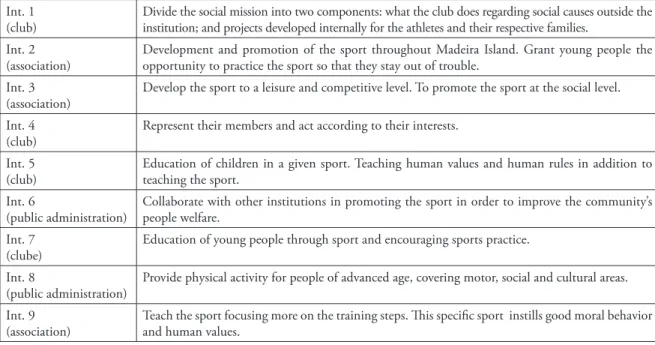
TABLE 2 - Mission and social relevance.
Results
Mission and social relevance
Regarding the mission and social relevance we diff erentiate the results according to the type of organization. Th us, sport associations represent the mission in the frame of developing and promoting
the respective sport in the territory under their control (i.e.: as TABLE 2, Int. 2, 3 and 9), clubs have mostly an youth training and educational mission (TABLE 2, Int. 1, 5 and 7) and, fi nally, public organizations advocate the concept of promoting physical activity and sport (TABLE 2, Int. 6 and 8).
Int. 1 (club)
Divide the social mission into two components: what the club does regarding social causes outside the institution; and projects developed internally for the athletes and their respective families.
Int. 2 (association)
Development and promotion of the sport throughout Madeira Island. Grant young people the opportunity to practice the sport so that they stay out of trouble.
Int. 3 (association)
Develop the sport to a leisure and competitive level. To promote the sport at the social level.
Int. 4 (club)
Represent their members and act according to their interests.
Int. 5 (club)
Education of children in a given sport. Teaching human values and human rules in addition to teaching the sport.
Int. 6
(public administration)
Collaborate with other institutions in promoting the sport in order to improve the community’s people welfare.
Int. 7 (clube)
Education of young people through sport and encouraging sports practice.
Int. 8
(public administration)
Provide physical activity for people of advanced age, covering motor, social and cultural areas.
Int. 9 (association)
Teach the sport focusing more on the training steps. Th is specifi c sport instills good moral behavior and human values.
Sport as a public interest good
When asked what is in the public interest, most of the directors said that sport is of public interest when it is “for all”, contrary to what happens in elite sport (i.e.: as TABLE 3 Int. 7)
When asked about the criteria that defi ne a public interest activity, there is constancy among
Criteria for defi ning a sporting activity as a public interest good
Criteria for a public interest sports activity. TABLE 4
-TABLE 3 - Concept of sports public interest.
Int. 1 (club)
Th e sport is in the public interest because it educates young people, keeping them out of trouble. Th e public interest in sport is related to each institution; however, organizations must have a social mission more relevant than their sports mission.
Int. 2 (association)
Sport in general is very rich because it allows people to enter society helping them at various levels. Population must defi ne what they want, not the state. If there is a group of people willing to practice certain activity then there is already public interest.
Int. 3 (association)
Sport is a public good when it is for everyone. It is a key mean for the development of a person's personality.
Int. 4 (club)
Sport is of public interest, it is an activity for all people and all ages.
Int. 5 (club)
Public interest is to keep the youth out of the streets in order to practice sports. It is promoting the sports movement among children and training them to the level of knowing how to win and lose, because if we invest in young people, we are developing the men of tomorrow. Th ere is no public interest in a group of friends using a sports facility for leisure.
Int. 6
(public administration)
Activities of general interest. I would like to do more for recreational sport, which has not been done due to fi nancial shortage. What has been done is supporting other organizations that are based in the community.
Int. 7 (club)
Th e practice of sport is good for health since is well oriented. Th e high- level competition should not be in the public interest because, despite the economic impact, is harmful to health.
Train children and young people in the sport because it improves physical and social aspects, teamwork and discipline.
Int. 8
(public administration)
Th e sport that is well guided by human kinetics professionals is of public interest, is good for the health and for the social wellbeing. In the future the State will take advantage of it because it will spend less on the health care users.
Int. 9 (association)
Professional sport is not of public interest. Th e sport that benefi ts the population in the health and welfare aspects is of public interest.
To transmit values through the sport but also support charities.
most directors. Th ere are two standard replies. In the fi rst one, the criterion is when the sport is “for all” (TABLE 4, Int. 2, 3, 5 and 6.); the second refers to the benefi ts that sport brings to the health and well-being of people (TABLE 4 Int. 3, 7 and 9).
Int. 1 (club)
Put a social mission above a sports mission. Institutions should train people for the future and not athletes obsessed with ephemeral goals.
Int. 2 (association)
When there is a group of people interested in a particular practice, it turns out to be of public interest. When sport is for everyone.
Int. 3 (association)
Sport is good for health, and is in the public interest when the sport is available for everyone.
Int. 4 (club)
Mobilize people towards the sport practice, leading them into the habit of participating in social and sports activities.
Int. 5 (club)
Th e criterion should be related to when there are people willing to perform a particular practice. If a practice is restricted to a group of people, this practice ceases to have public interest.
Int. 6
(public administration)
Mobilize people for sport practice.
Int. 7 (club)
Th e criteria should encourage and motivate the sports practice because physical activity is benefi cial to health.
Int. 8
(public administration)
It is important that the sports practice is well guided by competent professionals who have knowledge of the training principles and of exercise prescription. Pedagogical issues come after that.
Int. 9 (association)
What drives organizations to acquire public utility status?
In this study, four of the volunteer sector organizations hold the public utility status. We sought to fi nd out the reasons which led organizations to apply for such status. A standard answer is clear: three out of four interviewees justify the application with the resulting tax benefi ts. Th e other interviewee refers to the development of the organization’s social work in terms of human development and its social relevance (TABLES 3 and 4).
The responses regarding reasons for the use of public utility status corroborate the previous
responses, that is: various tax benefi ts and also that it is easier to create partnerships with other organizations, since there is a greater social recognition and state acknowledgement.
We sought to fi nd out what sports directors expect from the state so that sports as public interest continue and so does the consequent state support. Most directors agree that the state should defi ne what the sport that should be supported is, and in which path we want sport to be (TABLE 5). Another opinion stresses the need for the state to be more discerning and demanding in the support it directs to the clubs and associations (i.e.: as TABLE 5, Int. 3 and 5).
Int. 1 (club)
Support programs should value the work done at the social level. If the main criterion is winning titles, then clubs are not developing people.
Int. 2 (association)
It would be important that the state defi nes which sports must be supported. In terms of international results, it would be important to have fewer athletes and sports supported, so that those that are supported would be well supported.
Int. 3 (association)
In the past, the money given to clubs and associations was not controlled. Now we should be more discerning and demanding with the support.
Th e issue of Sports Development Plans is an asset because it is more discerning.
Int. 4 (club)
It would be important to fulfi ll what is on paper (that the government would fulfi ll the support to sport as it is already regulated and under contract. Th en it would also be essential that the State defi ne what to do with sport, there is a lot in writing, but little of that is executable.
Int. 5 (club)
One should not give money to clubs because they are dependent on subsides. Funding should be directed to facilities, forcing clubs to be aware of other forms of fi nancing. Th e support should be more distinct. Int. 6
(public administration)
Th e State should off er support on the level of infrastructure construction. If you off er good conditions there will be greater involvement of people.
Int. 7 (club)
Th e Sports Institute (regional public entity which regulated and granted the fi nancial support to sport) was an asset for the region, because it regulated, though I did not agree with all its decisions. Th e state should say where it wants to go with sport. Th ere should also be greater control, because previously things were regulated but not controlled. Th e state should also look at the general population, because sport is good for health, and the more people practice, the healthier the population is.
Int. 8
(public administration)
A few years ago the activities were free in order to raise awareness of the physical activity benefi ts, but in the current context (public administration’s strong fi nancial constraints) sport must be paid.
Int. 9 (association)
Th e professional athlete receives the most support and that is not right. Th e amateur is the one providing a public service to the population, if they received more support, more activities could be provided.
What the State should do in order to continue public interest in sports. TABLE 5
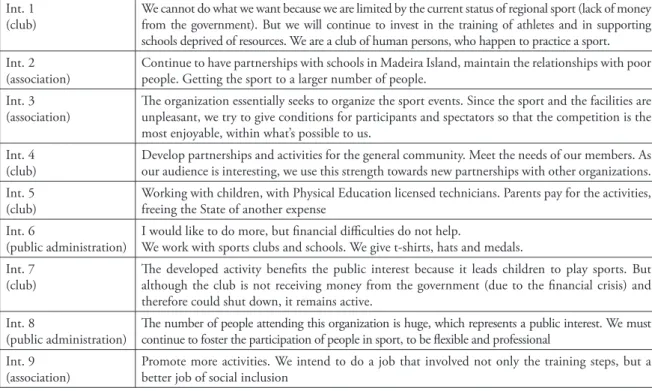
-The last question focused on what each organization intends to do to ensure that their activities are of public interest. Th is was an equally open question, and the results were as follows: there isn’t a converging standard between the directors’ responses within the diff erent organizations. Some directors say that in order to positively use the
TABLE 6 - What organizations can do for sports public good.
Int. 1 (club)
We cannot do what we want because we are limited by the current status of regional sport (lack of money from the government). But we will continue to invest in the training of athletes and in supporting schools deprived of resources. We are a club of human persons, who happen to practice a sport.
Int. 2 (association)
Continue to have partnerships with schools in Madeira Island, maintain the relationships with poor people. Getting the sport to a larger number of people.
Int. 3 (association)
Th e organization essentially seeks to organize the sport events. Since the sport and the facilities are unpleasant, we try to give conditions for participants and spectators so that the competition is the most enjoyable, within what’s possible to us.
Int. 4 (club)
Develop partnerships and activities for the general community. Meet the needs of our members. As our audience is interesting, we use this strength towards new partnerships with other organizations.
Int. 5 (club)
Working with children, with Physical Education licensed technicians. Parents pay for the activities, freeing the State of another expense
Int. 6
(public administration)
I would like to do more, but fi nancial diffi culties do not help.
We work with sports clubs and schools. We give t-shirts, hats and medals. Int. 7
(club)
Th e developed activity benefi ts the public interest because it leads children to play sports. But although the club is not receiving money from the government (due to the fi nancial crisis) and therefore could shut down, it remains active.
Int. 8
(public administration)
Th e number of people attending this organization is huge, which represents a public interest. We must continue to foster the participation of people in sport, to be fl exible and professional
Int. 9 (association)
Promote more activities. We intend to do a job that involved not only the training steps, but a better job of social inclusion
Discussion
Th e fi rst question asked to the sports directors was related to their organizations’ mission and social relevance. Th e club’s social mission is consistent among interviewees; it is essentially about the young people training and education, both regarding the sport that is being taught, and regarding social and human aspects; associations have the mission to promote the sport in the area and to organize events and competitions. Th e public sector organizations have the main role of promoting physical activity and sport, especially within the young and elderly. All respondents focused on the social objective, stressing that their mission is aimed at meeting the needs and interests of their target groups and that such action will infl uence the population quality of life.
Th e second question was designed to assess the opinion of sports directors on what is the public interest of sports. For most interviewees, there is public interest status when the sport is directed to all people, that is, when it is oriented towards the inclusive and widespread participation of the population. Other interviewees claim that the public interest is in the health benefi ts that sport practice provides. For many directors, high-level competition should not be considered of public interest.
and their training - coaches, referees, offi cials and programs to fi ght doping. For example, in the issue of equal opportunities between men and women, although there has been an interesting evolution in women’s participation in the sports phenomenon25, the variation of female participation rate in the federated sports sector between 2003 and 2010 was of only 2%, going from 70,051 practitioners, which corresponds to 23% of the total, to 133,471 practitioners, which corresponds to 25%. Sport is still a social activity that needs to enhance the women participation and promote equal gender opportunity. Despite this social discrimination, most likely due to the women’s multidimensional role in the family and society areas, the associative sports movement plays an irreplaceable role in the overall social context promoting an “essential contribution directed to the general interest”36 through its diff erent structures (popular sports clubs, associations and other sports groups). Furthermore, sport is an excellent education tool1, 18 because when properly guided and organized, it can provide a higher level of autonomy and social responsibility in young people. It can also provide confi dence levels and considerable organization.
When analyzing support programs to sport at a national level, we fail to identify national impact programs that encourage widespread inclusiveness and social integration through sport. Although it is known that there are social phenomena involving violence that are dragged to the sports events.
The results show that some directors argue that high-level competitive sports should not be considered in the public interest, even if they generate revenue and sports entertainment. Indeed, it is known and it is proven that major sports events move people, companies and positive impacts on various levels37-39. Th ese events are attractive to the people who follow the competitions through the media, also considering the hundreds, or even thousands of people that transport themselves to the places where these events take place, making them and an asset for the promotion of one or more locations and, consequently, of a country40.
Th ere are many examples of what is mentioned in the previous paragraph. Here we revive the 2004 European Football Championship fi nal match, held in Lisbon among Portugal and Greece national teams. A fi nal match that was followed by fi ve million Portuguese people, more than three million Greek citizens and a worldwide audience of between 130 and 150 million people. Each game in this
around the world. Th ese mega-events are attractive on a global scale, which makes the sport an attractive product. However, one must consider the economic and social return on public resources invested in supporting these events organization23, 37. On one hand, it can be profi table for the international organization that has the authority over the event (for example, the UEFA - Union of European Football Associations - reaches signifi cant profi ts with the European champions league organization). On the other hand, one must consider a number of factors that should be taken into account in public support. Th e direct and indirect impact is crucial for a one-time event like the World Cup 2014 (Brazil), but also the sustainability of sports facilities put together to these events and their use by the local teams41. More than organizing the event, the central issue is put into perspective the positive eff ects that the sports facilities and their accessibility can provide to local partners, to the population involvement and to economy development7.
We also add the organization of a sports event in a unique environment as a factor of a local identity integration and diff erentiation24 and that can serve as a source of interest in an experiential tourism destination associated to sports42.
Although the high-level competition may involve health risks to its practitioners, it is an excellent way to recruit young practitioners, who want to follow their idols’ footsteps. In this context, we consider that high-level competition sport, when properly calculated and contextualized to the local level according to a sportsmanship and fair play environment13, it can highly be of public interest. In this sense, and in a perspective of sports development, it is necessary to involve high performance athletes with international prestige as well as their coaches in promoting sports activities among young people and in the improvement of sports talents. Th is connection is critical to a sustainable and coherent sports development43.
When the interviewees are asked about the public interest of their activities, we observe differences between public sector organizations (for example: local authority) and volunteering organizations (for example: sport clubs and sport associations). Th e volunteering sector organizations focus on their activities interest to training young people in sports, social and human levels. As for the public organizations, most of them support sports through helping other organizations.
activities’ interest is based on young people’s social and human development through sport. In fact, sport can be a tool for social and human development, recognized and valued by international sports organizations44. However we allow for a critical
refl ection: that ideal is not always in place. Th e competition should be a pleasant space for socializing where the athletes would show their sports skills, but that is not always the case. Th ere are numerous studies that show coaches and directors mostly concerned about winning at all costs, putting results above of educational and training values12, 27. But if the club’s mission is to contribute to the young people training and improving the people’s quality of life and to contribute to sport development as a culture and welfare factor, then government support for sport in Madeira Island should be more directed to the youngest training sector and to making sports accessible for all, and less directed for the competitive sport and professional sport. Th e results illustrate a contradiction between what the directors argue is the mission and the sport public interest, and what happens in the public policies to support the sports, since the latter is much more oriented to the national level sports competition and to achieving results in national and international levels45.
Th e literature mentions that the requirements to consider a sports activity of public interest are related to the type of activity that an organization develops in the social environment in which it operates. In other words, if it acts in areas of social importance such as culture and education, sports can be recognized and valued as being of public interest6, 46. Th e interviewed directors claim that the criterion defi ning the public interest depends on the existence of added benefi ts the population’s health.
Regarding the public sector, directors say they could do more, but are limited by the current economic situation. If it is a fact that Portugal and Madeira Island are not at their best at the economic level, it is also true that public organizations (community councils, city councils and organizations linked to them) develop activities mainly aimed at younger and older people. In this context, low cost activities with a symbolic price can be held. If sport and physical activity is accessible to all people, the population health indicators will be better and the State will benefi t in the medium to long term. Th erefore, we will be able to reduce the health expenditures and, as the Int. 7 says, we must “prepare for an easier old age because we know that at some point we begin to lose qualities, but
we can lessen the decrease in capability that comes with advancing in age.”
Out of the seven voluntary organizations, four hold the public utility status, and their interviewed directors recognized that this status can bring tax advantages. Th e directors of the three other organizations that do not hold this status report that they could have benefi ts for tax purposes. Nevertheless, Int. 5 points out that the benefi ts tend to decrease more and more.
According to the Int. 1, his organization requested the status for the human and social work developed internally. Holding the status “is simply a reinforcement of our image as a training school, and it is a quality certifi cate that we have (...) we are a training school of excellence and here athletes will receive a comprehensive education that includes sports, human and social aspects. “
Having the present work’s goal in mind, one of the questions asked to the interviewees related to what they consider to be the sports support criteria and the future of sport development, taking into account the current fi nancial context. For most directors it is important to be more discerning and demanding when granting support to the associative sports movement. For others, the state should redefi ne the sport strategy. Th e Int. 2, for example, considers it “important that the state, once and for all, defi ne what sports are supported (...) against our goals in the European, international and Olympic levels; there should be a defi nition of priorities ... we support this or that sport.” Th e Int. 7 also said that: “Th e state must represent: we want to reach a certain goal, achieve a certain global participation in this or that sport ...” If on one hand the directors consider that the State should be more discerning and judicious in allocating fi nancial support through its sports policies, in line with the sports and the performance level achieved; on the other hand, they argue that sport is in the public interest when it is accessible to everyone. Now, how can you reconcile a sports policy directed to the elite and professional sport (national and / or international) and even to professional with a sports policy of widespread sport inclusiveness? Th is is a crucial issue, but it is beyond the scope of this study; it is not possible to foresee a plausible explanation.
Pires47 mentions, any road will do when one does
not know where they are going.
Regardless of how well State support is organized, club directors do not admit their strategic responsibilities to generate other revenues as alternatives to public subsidies. Volunteer organizations should have a strategy for fi nancial balance48 to allow them to cover
the main charges and be able to develop their activities on behalf of its members and the general population. The results obtained indicate strong financial dependence on the regional public administration, which corroborates other studies that reinforce the regional government power in developing sports policies to support national sports competition and to the recognition of Madeira Island as an autonomous developing region49-50.
Th e Int. 6 argues that the state should support the associative movement through infrastructure creation: one of the most important measures to promote access to sport. In our perspective, it is essential to carry out an economic feasibility study that precedes the construction of any sporting infrastructure. Th is means a study to outline its purpose, as well as its target audience and its respective profi tability. Th e problem is often not the initial cost, but it is the maintenance and the opportunities that can be generated from the sports services development and other associated activities36. Th e development
of sports should involve a qualitative dimension to people’s participation in public policies51 and to the
use that people make of sport and physical activity within the sports facilities, as if it was tool for personal development, subjectivity, socialization , promotion of the welfare and autonomy.
After knowing their opinions on the way forward by the State, we sought to know what organizations can and should do for the sport development as a public service. Th e vast majority of interviewees did not provide solutions toward the future, or changes in their projects, showing themselves as resigned to
the work done so far. Some allude to the fact that the current regional sport context (the lack of fi nancing and lack of fulfi llment of regulated public support) limit the organizations’ sports activities. Interviewee 1 states: “We are limited because regional sport is how it is (...); goodwill, commitment and dedication can only take us so far; from there on we need minimum conditions that are currently not met in regional sport.” Int. 8 also says: “What you saw is what is in my power; it is to streamline, to be on the ground, always available, and to be fl exible and very professional.” Although resigned, the directors confi rm that in order to put the sports public interest to good use, they will continue to invest in the young people social training, in getting the practice to more people. On their side, the public sector organizations interviewees say they will continue to build partnerships with other organizations so as to promote the sport.
Overall, we conclude that the results we obtained were very fragile, resulting from lack of knowledge about the various criteria and dimensions that can be exploited for developing sport of true public interest. Additionally, there is certain conformism and dependence on the government role of funding and supporting sport as if it was a mandatory and irrefutable duty. Perhaps the issue of which type of sport and which benefi ts are the most important for the return on the investment or on the fi nancial support from the public resource should still be reviewed.
All sports activities that represent a social and public good for a group or a society can and should be supported and taken over by the state as a social cost with positive return; in other words, they must be understood as public investment in medium to long term. However, objective criteria for sport as public interest must be established, and means for evaluating the results of this “investment” must be set. Hence the state should assume a role that is of support, sponsor and, above all, regulate.
Resumo
O interesse público do desporto das organizações desportivas sem fi ns lucrativos que são apoiadas pela administração pública
References
1. Siedentop D. Introduction to sport education. In: Siedentop D, organizer. Sport education: quality physical rducation through positive sport experiences. Champaign: Human Kinetics; 1994. p.3-16.
2. Gaya A. As Ciências do desporto nos países de língua portuguesa. Porto: Faculdade de Ciências do Desporto e de Educação Física da Universidade do Porto; 1994.
3. Portugal. Lei n.5, de 16 de janeiro de 2007. Lei de Bases da Atividade Física e do Desporto. Diário da República, Lisboa (16 jan. 2007); Sér. 1:11.
4. Sage GH. Sport and the social sciences. Ann Am Acad Pol Soc Sci. 1979;445:1-14.
5. Business Dictionary. Defi nition of public interest. {cited 2013 Sept 13]. Available from: http://www.businessdictionary. com/defi nition/public-interest.html.
6. Hoye R, Nicholson M, Smith A, Stewart B, Westerbeek H. Sport management: principles and applications. London: Elsevier; 2006.
7. Barroso L. Prefácio à obra “Interesses públicos versus interesses privados: desconstruindo o princípio de supremacia do interesse público”. Rio de Janeiro: Lúmen Júris; 2005.
8. C3 Collaborating for Health. Th e benefi ts of physical activity for health and well-being: review. London: C3 Collabo-rating for Health; 2011. [cited 2014 Jan 24]. Available from: http://www.c3health.org/wp-content/uploads/2009/09/ C3-review-of-physical-activity-and-health-v-1-20110603.pdf.
9. World Health Organization. Global strategy on diet, physical activity and health. Geneve: WHO. [cited 2014 May 23]. Available from: http://www.who.int/dietphysicalactivity/goals/en/.
10. Araújo J. Refl exões sobre o desporto português: comunicações apresentadas na conferência: sistema desportivo português que modelo? Lisboa: Confederação do Desporto de Portugal; 2001. p.37-48.
11. Gomes R. O corpo e a política da vida. Coimbra: Centro de Estudos Biocinéticos; 2009. 12. Coelho O. Pedagogia do desporto. 2a ed. Lisboa: Livros Horizonte; 2004.
13. Simon R. Fair play, values and society. Boulder; Westview; 1991.
14. Council of Europe. Committee of Ministers. Code of Sports Ethics. Strasbourg: Council of Europe; 2001. Recommendation n. R (92), 14 REV. [cited 2014 May 23]. Available from: https://www.coe.int/t/dg4/epas/resources/texts/Rec(92)14rev_en.pdf. 15. Portugal. Constituição da República. VII Revisão Constitucional. Lisboa: Assembleia da Republica; 2005. [cited
2014 Jun 20]. Available from: http://www.parlamento.pt/Legislacao/Paginas/ConstituicaoRepublicaPortuguesa.aspx. 16. Robinson L, Palmer D. Managing voluntary sport organizations. London: Routledge; 2011.
17. Drucker P. Managing the nonprofi t organization: practices and principles. New York: Harper Collins; 1990. 18. Lideman S, Conway S. Sport through education: a country strategy. In: Collins M, Editor. Examining sports
develo-pment. London: Routledge; 2010.
19. Fraga A. Ordem sedentário e políticas de vida ativa. In: Gomes R, editor. O corpo e a política da vida. Coimbra: Centro de Estudos Biocinéticos; 2009.
o desporto é de interesse público quando: a) é desenvolvido na perspectiva da generalização da prática da atividade física e desportiva; b) proporciona benefícios para a saúde; c) serve como ferramenta de educação e de desenvolvimento social. No que respeita às vantagens utilizadas com o estatuto de utilidade pública, os benefícios fi scais e as parcerias com organizações do sistema desportivo, foram as mais apontadas. Os entrevistados consideram que o Governo deveria ter uma estratégia focada na defi nição de prioridades e de seriação de critérios de fi nanciamento, no sentido de um melhor aproveitamento do papel dos clubes e da obtenção de resultados desportivos. Sugerem ainda um maior cuidado e rigor, por parte da administração pública regional, na avaliação do papel social e desportivo dos clubes e associações, tendo em conta o desenvolvimento do interesse público e social do desporto. Como conclusão o desporto e a atividade física devem ser considerados como atividades de interesse público desde que assegurem efeitos positivos nos planos da saúde e do bem-estar da população, proporcionem o desenvolvimento qualitativo e sustentado da prática desportiva e potenciem o desenvolvimento econômico-social.
20. Portugal. Decreto-Lei n.273, de 1 de outubro de 2009. Defi ne o regime jurídico dos contratos: programa de desen-volvimento desportivo. Diário da República, Lisboa (1 out. 2009); Sér:1:191.
21. Instituto do Desporto de Portugal. Portarias que regulamentam os apoios à organização de grandes eventos reali-zados em Portugal. Lisboa: IDP; 2015 [cited 2015 May 17]. Available from: http://www.idesporto.pt/legislacao. aspx?id=9&idMenu=10.
22. Baade RA. Evaluating subsidies for professional sports in the United States and Europe: a public-sector primer. Oxford Rev Econ Policy. 2003;19:585-97.
23. Gratton C, Shibli S, Coleman R. Th e economic impact of major sports events: a review of ten events in the UK. Sociol Rev. 2006;54:41-58.
24. Hofman A. Local identity and sport: historical study of integration and diff erentiation. Sportwissenschaft. 2002;32:472-5. 25. Associação Portuguesa a Mulher e o Desporto. Igualdade de género no desporto: educação e políticas públicas. Quei-jas: APMD; 2009. [cited 2014 Jan 23]. Available from: http://www.mulheresdesporto.org.pt/web/images/stories/pdf/ publicacoes/APMD_2008_Igualdade_de_Genero_no_Desporto.pdf.
26. Portugal. Decreto-Lei n.35/2004, de 21 de fevereiro. Regula o exercício da atividade de segurança privada. [cited 2014 Jan 26]. Available from: http://www.idesporto.pt/fi cheiros/fi le/DL_35_2004.pdf.
27. Gonçalves C. Educação pelo desporto e associativismo desportivo, uma ligação necessária. Porto: Edições Afronta-mento; 2013.
28. Kelly L. Social inclusion through sports-based interventions? Crit Soc Policy. 2011;31:126-50.
29. Portugal. Decreto-Lei n.460/77, de 7 de novembro. O decreto aprova estatuto das coletividades de utilidade pública, introduzindo mecanismos de simplifi cação administrativa na concessão da declaração de utilidade pública. Diário da República, Lisboa (13 dez. 2007); Sér:1:240 [cited 2014 Jan 20]. Available from: http://www.idesporto.pt/fi cheiros/ fi le/DL_391_2007.pdf.
30. Homem F. O direito ao desporto: lazer ou rendimento? Rev Desporto. 2003;4:24-7. 31. Quivy R. Manual de investigação em ciências sociais. Lisboa: Gradiva; 2005.
32. Ruquoy D. Situação de entrevista e estratégia do entrevistado. In: Albarello L, Digneff e F, Hiernaux J P, Maroy C, Ruquoy D, Saint-Georges P. Práticas e métodos de investigação em ciências sociais. 2a ed. Lisboa: Gradiva; 2005. 33. Bardin, L. Análise de conteúdo. Coimbra: Edições 70; 2008.
34. Silva D, Borges C, Amaral S, Gestão das políticas públicas do Ministério do Esporte do Brasil. Rev Bras Educ Fís Esporte. 2015;29:47-64.
35. Instituto do Desporto de Portugal. Estatísticas do desporto. Lisboa: IDP; 2015 [cited 2015 Jan 8]. Available from: http://www.idesporto.pt/conteudo.aspx?id=101&idMenu=5.
36. Carvalho M. Associativismo, inovação social, eesenvolvimento. Lisboa: Confederação do Desporto de Portugal; 2002. 37. Chappelet J-L. Mega sporting event legacies: a multifaceted concept. Papeles Europa. 2012:76-86.
38. Department of Culture, Media and Sport. Before, during and after: making the most of the London 2012 Games. London: DCMS; 2008.
39. Misener L, Mason DS. Urban regimes and the sporting events agenda: a cross-national comparison of civic development strategies. J Sport Manag. 2008;22:603-27.
40. Masterman G. Strategic sports event management: Olympic edition. 2nd ed. Oxford: Butterworth-Heinemann; 2009. 41. Ernst Young. Fundação Getúlio Vargas. Brasil sustentável: impactos sócioeconômicos da Copa do Mundo 2014. Rio
de Janeiro: FGV; 2010.
42. Francis S, Murphy P. Sport tourism destinations: the active sport tourist perspective. In: Higham J, editor. Sport tourism destinations: issues, opportunities and analysis. Amsterdam: Elsevier Butterworth Heinemann; 2005. Vol. 14. 43. Enoch N. Towards a contemporary national structure for youth sport in England. In: Collins M, editor. Examining
sports development. London: Routledge; 2010. p.41-71.
44. International Olympic Committee. Sport, a tool for development. Lausanne: IOC; 2009. [cited 2014 Sept 25]. Available from: http://www.olympic.org/news/sport-a-tool-for-development/209689.
45. Portugal. Região Autónoma da Madeira. Portaria n.1/2013. Defi ne os valores a atribuir a cada área de apoio ao des-porto, na época 2012/2013. Jornal Ofi cial (11 jan. 2013); Sér.1:4.
46. Brookes S, Wiggan J. Refl ecting the public value of sport. Public Manag Rev. 2009;11:401-20. 47. Pires G. Agôn: gestão do desporto - o jogo de Zeus. Porto: Porto Editora; 2007.
ADDRESS Jorge Pereira Soares Universidade da Madeira Praça do Município 9000-082 - Funchal - PORTUGAL
e-mail: [email protected]
Submitted: 02/24/2014 1a. Review: 05/25/2015 2a. Review: 08/25/2015 3a. Review: 10/08/2015 Accepted: 10/15/2015
49. Barros CP, Barros CD. Th e role of human and social capital in the earnings of sports administrators: a case study of Madeira Island. Eur Sport Manag Quart. 2005;5:47-62.
50. Soares J, Correia A, Rosado A. Political factors in the decision-making process in voluntary sports associations. Eur Sport Manag Quart. 2010;10:5-29.