Printed in Brazil - ©2004 Sociedade Brasileira de Química 0103 - 5053 $6.00+0.00
A
r
t
ic
le
* e-mail: [email protected]
Principal Component Analysis of Molecular Geometries of
Cis
- and
Trans
-C
2
H
2X
2with X = F or Cl
João Bosco P. da Silva* and Mozart N. Ramos
Departamento de Química Fundamental, Universidade Federal de Pernambuco, Cidade Universitária, 50740-250 Recife - PE, Brazil
Gráficos de escores de PC1 e PC2 mostram como as geometrias calculadas dependem de características da função de onda molecular dos cis- e trans- difluoro e dicloroetilenos. PC1 e PC2
separam os resultados obtidos com e sem funções de polarização e com e sem a inclusão de correlação eletrônica. A qualidade das geometrias experimentais é analisada projetando-as nos gráficos dos escores. Usando este procedimento, a geometria de Takeo obtida a partir de transições de microondas não se compara com nenhuma dos cálculos ab initio para o cis-C2H2Cl2, ao passo que
a geometria de Schäfer obtida por espectroscopia de difração de elétrons está em boa concordância com aquelas de cálculos MP2/cc-pVDZ, MP2/cc-aug-pvDZ and CCD/cc-pVDZ.
PC1 and PC2 score graphs show how calculated molecular geometries depend on characteristics of the molecular wave-functions of cis- and trans- difluoro- and dichloroethylene. PC1 and PC2 separate the results obtained with or without polarization functions and with or without the inclusion of electronic correlation. The quality of the experimental geometries are analyzed projecting them on the PC score graphs. Using this procedure, Takeo’s geometry obtained from microwave transitions does not compares with any of the ab initio calculations for cis-C2H2Cl2, whereas Schäfer’s geometry
obtaines from gas electron diffraction spectroscopy is in good agreement with the MP2/cc-pVDZ, MP2/cc-aug-pVDZ and CCD/cc-pVDZ calculations.
Keywords: difluoroethylenes, dichloroethylenes, ab initio geometry, experimental geometry,
PCA
Introduction
In the last twenty years, we have devoted considerable attention1-10 to cis- and trans-dihaloethylenes in order to gain a better understanding of their electronic and vibrational properties. The cis- and trans-dihaloethylenes
(C2H2X2) are interesting isomeric species since they contain the same kind and number of chemical bonds. The major difference between them is due to the relative configurations of these bonds within the molecule. In particular, trans-dihaloethylenes are intriguing molecules
from a spectroscopic point of view because, in spite of their high molecular symmetry, the orientations of their in-plane dipole derivatives are not restricted to the principal symmetry axes. We have shown that these directions are, in general, similar to those expected on the basis of simple chemical valence concepts.1-3 These studies have also shown, that atomic polar tensors of cis- and trans
-C2H2X2 (X = F or Cl) are very similar since those of the
cis-compounds are capable of reproducing the experimental vibrational intensities of the trans-isomers within the
propagated experimental error.4-6 Furthermore, the electronic structures of cis- and trans-C2H2Cl2 are more
similar than those of cis- and trans-C2H2F2 in terms of the
intensity parameters of equilibrium charges and charge fluxes.7,8
In contrast to chemical intuition, both theoretical and experimental studies11-14 have revealed that the cis isomer is more stable than its corresponding trans form, as a
44 Silva and Ramos J. Braz. Chem. Soc. Recently, the molecular geometries of the trans-C2H2X2
(X = F or Cl) species have been obtained from the microwave transitions observed in high-resolution infrared spectroscopy (IR)23,24 and are somewhat different from those obtained using GED.22 For example, the values of the C-Cl, C=C and C-H bond lengths for trans-C2H2Cl2
obtained from GED22 are 1.725(2) Å, 1.332(8) Å and 1.092(26) Å respectively whereas their corresponding values using IR24 are 1.740(3) Å, 1.305(5) Å and 1.078(4) Å. In order to better understand both the theoretical and experimental changes which occur in the molecular geometries of the cis- and trans-C2H2X2 species, we have
performed a multivariate exploratory analysis using Principal Components Analysis (PCA).25,26 This technique has been successful in analyzing the effects of wave-function modifications on calculated C-H and C-X (X = F or Cl) vibrational frequencies and infrared intensities of the dihaloethylenes.9,10 For example, all the calculated C-H stretching frequencies can be adequately described by a single principal component whereas bidimensional principal component graphs are sufficiently accurate for a direct comparison of the results of trial wave-functions with the observed results of the vibrational bending frequencies.
Calculations
A set of ab initio molecular orbital calculations was
performed with the Gaussian 9227 and Dalton28 programs. The Hartree-Fock (HF)29 and Möller-Plesset of second order (MP2)30 calculations were carried out using a 24 factorial design, where two levels of four factors were investigated: (i) the use of basis sets 6-31G or 6-311G; (ii) the presence
or absence of diffuse functions; (iii) the presence or absence
of polarization functions; (iv) the use, or not, of perturbative
Möller-Plesset corrections of second order (MP2) to HF calculations.16 The MP2 calculations were performed using the frozen-core electron correlation approach. The others were performed using coupled-cluster calculations with double excitations (CCD) and single and double excitations (CCSD) augmented by a perturbational correction for connected triple excitations [CCSD(T)].31 In order to evaluate the importance of electron correlation for inner-shells, in particular for the dichloroethylene systems, the CCSD(T) calculations were also performed including additional electron correlation for Cl 2s2p core electrons. These calculations result in a data matrix X
n,p
composed of 5 variables, which correspond to three bond lengths (C-H, C=C and C-X) and two bond angles (CCH and CCX), and “n” objects, which correspond to the different ab initio calculations for each C2H2X2 species.
This matrix X can be taken as a set of “n” calculations represented as a graphic in a 5-dimensional space.
Principal component analysis (PCA) represents a rotation of the original axis system searching a new direction concentrating at maximum the original information and for which one hope to find some kind of patterns present in the original data set. From a practical point of view, this is obtained through the diagonalization of the covariance matrix XtX (where Xt is the transposed of
the data matrix X). The eigenvector elements called loadings represent the director cosines, i.e., the contribution
of the original axes for the composition of the new axes called principal components. The eigenvalues represent the amount of variance described by the corresponding eigenvectors. The first eigenvector is the first principal component (PC1) and corresponds to the axis for which the objects have the maximum variance. Therefore, PC1 corresponds to the axes for which the objects are at its maximum spread. The second principal component, (PC2), is orthogonal to PC1, and represents the second axis of larger residual variance, i.e., it is the axis of maximum
amount of variance not explained by PC1. A projection of the data on these two axes yields a graphical representation of the maximum statistical information that can be compressed into two dimensions, and may help to detect patterns hidden in the original multidimensional data.
In this work the principal component analyses using autoscaled (i.e., each element on a column was subtracted
by the average and scaled to unit variance on the column) data were carried out using the chemometrics package Ein*Sight 3.032 on a personal microcomputer of the Laboratory of Theoretical and Computational Chemistry of the Departamento de Química Fundamental at the Universidade Federal de Pernambuco (UFPE, Brazil). The M.O. calculations were performed on workstations of UFPE and San Diego Supercomputer Center (SDSC) of the University of California, San Diego (UCSD).
Results and Discussions
In Tables 1 to 4 the optimized geometries for cis and trans-C2H2X2 (X = F and Cl) are shown together with the
experimental values.
cis-C2H2F2
The score graph in Figure 1 for the cis-C2H2F2 species
Table 4. Optimized geometry of trans-C2H2Cl2. Bond length in Ang-strom and bond angles in degrees
Calculations C-Cl C=C C-H CCH CCCl
HF/6-31G 1.795 1.307 1.066 125.5 121.1
HF/6-311G 1.795 1.304 1.064 126.0 121.2
HF/6-31++G 1.796 1.308 1.067 125.6 121.2 HF/6-311++G 1.794 1.305 1.064 125.9 121.2 HF/6-31G** 1.729 1.311 1.071 123.8 121.7 HF/6-311G** 1.733 1.308 1.071 124.2 121.6 HF/6-31++G** 1.730 1.312 1.071 123.8 121.7 HF/6-311++G** 1.732 1.309 1.071 124.0 121.6
MP2/6-31G 1.824 1.339 1.083 125.6 121.0
MP2/6-311G 1.822 1.333 1.080 126.0 121.1 MP2/6-31++G 1.825 1.340 1.084 125.6 121.0 MP2/6-311++G 1.821 1.334 1.080 125.9 121.0 MP2/6-31G** 1.723 1.335 1.079 123.3 121.7 MP2/6-311G** 1.723 1.336 1.083 123.4 121.5 MP2/6-31++G** 1.724 1.337 1.080 123.3 121.6 MP2/6-311++G** 1.723 1.336 1.083 123.4 121.4 HF/cc-pVDZ 1.735 1.314 1.079 123.9 121.5 HF/cc-aug-pVDZ 1.737 1.314 1.077 124.3 121.3 MP2/cc-pVDZ 1.732 1.345 1.093 123.2 121.2 MP2/cc-aug-pVDZ 1.739 1.346 1.091 123.9 120.9
CCD/6-31G 1.828 1.337 1.086 125.6 121.0
CCD/6-31G** 1.730 1.331 1.079 123.4 121.7 CCD/cc-pVDZ 1.739 1.340 1.093 123.4 121.4 CCSD(T)/cc-pVTZ 1.733 1.333 1.080 123.6 121.2 CCSD(T)/cc-pVTZ_viba 1.738 1.339 1.084 123.7 121.0
CCSD(T)/cc-pVTZ_2s2pb 1.727 1.334 1.080 123.4 121.3 CCSD(T)/cc-pVTZ_2s2p_vibc 1.732 1.339 1.084 123.6 121.0
(ED)Schäferd 1.725 1.332 1.092 124.0 120.8
(IR)Craige 1.740 1.305 1.078 125.3 119.9
aCorrected due to average vibration, see text; badditional electron correlation for Cl 2s2p core electron; cadditional electron correlation for Cl 2s2p core electron and average vibration corrections; dRef. 22, eRef. 24.
Table 3. Optimized geometry of cis-C2H2Cl2. Bond length in Ang-strom and bond angles in degrees
Calculations C-Cl C=C C-H CCH CCCl
HF/6-31G 1.783 1.309 1.067 121.7 125.5
HF/6-311G 1.783 1.306 1.065 122.0 125.6
HF/6-31++G 1.784 1.310 1.068 121.7 125.4 HF/6-311++G 1.783 1.307 1.066 121.8 125.6 HF/6-31G** 1.721 1.312 1.072 120.1 125.7 HF/6-311G** 1.724 1.311 1.041 120.5 125.6 HF/6-31++G** 1.721 1.314 1.072 120.2 125.7 HF/6-311++G** 1.723 1.312 1.072 120.3 125.6
MP2/6-31G 1.812 1.340 1.085 121.8 125.2
MP2/6-311G 1.810 1.334 1.081 122.0 125.5 MP2/6-31++G 1.813 1.341 1.085 121.9 125.1 MP2/6-311++G 1.810 1.335 1.082 122.1 125.3 MP2/6-31G** 1.716 1.337 1.079 120.0 125.2 MP2/6-311G** 1.715 1.338 1.083 120.1 125.0 MP2/6-31++G** 1.717 1.339 1.080 120.0 125.0 MP2/6-311++G** 1.715 1.339 1.083 120.1 124.8 HF/cc-pVDZ 1.726 1.316 1.079 120.4 125.4 HF/cc-aug-pVDZ 1.727 1.317 1.077 120.5 125.4 MP2/cc-pVDZ 1.724 1.347 1.093 119.9 124.8 MP2/cc-aug-pVDZ 1.729 1.348 1.092 120.5 124.3
CCD/6-31G 1.816 1.338 1.087 122.0 125.2
CCD/6-31G** 1.723 1.332 1.079 120.2 125.3 CCD/cc-pVDZ 1.731 1.342 1.094 120.1 125.0 CCSD(T)/cc-pVTZ 1.724 1.335 1.080 120.4 124.7 CCSD(T)/cc-pVTZ_viba 1.730 1.339 1.083 120.5 124.5
CCSD(T)/cc-pVTZ_2s2pb 1.718 1.336 1.080 120.3 124.7 CCSD(T)/cc-pVTZ_2s2p_vibc 1.724 1.340 1.083 120.4 124.5
(ED)Schäferd 1.717 1.337 1.096 120.3 124.0
(MW)Takeoe 1.717 1.319 1.100 123.2 124.2
aCorrected due to average vibration, see text; badditional electron
correlation for Cl 2s2p core electron; cadditional electron
correla-tion for Cl 2s2p core electron and average vibracorrela-tion correccorrela-tions; dRef. 22; eRef. 21.
Table 2. Optimized geometry of trans-C2H2F2. Bond length in Ang-strom and bond angles in degrees
Calculations C-F C=C C-H CCH CCF
HF/6-31G 1.371 1.307 1.065 126.7 119.2
HF/6-311G 1.370 1.303 1.064 126.8 119.3
HF/6-31++G 1.378 1.308 1.066 127.4 118.9 HF/6-311++G 1.372 1.303 1.064 127.1 119.1 HF/6-31G** 1.329 1.306 1.071 125.2 120.2 HF/6-311G** 1.324 1.305 1.071 124.9 120.3 HF/6-31++G** 1.331 1.308 1.071 125.6 120.0 HF/6-311++G** 1.324 1.306 1.071 125.2 120.2
MP2/6-31G 1.410 1.339 1.082 127.0 118.8
MP2/6-311G 1.411 1.331 1.078 127.1 118.9 MP2/6-31++G 1.425 1.339 1.082 128.4 118.1 MP2/6-311++G 1.417 1.332 1.079 128.0 118.2 MP2/6-31G** 1.353 1.330 1.078 125.1 119.8 MP2/6-311G** 1.342 1.331 1.082 124.6 120.2 MP2/6-31++G** 1.361 1.331 1.078 126.1 119.4 MP2/6-311++G** 1.346 1.331 1.082 125.3 119.8 HF/cc-pVDZ 1.327 1.309 1.079 124.8 120.4 HF/cc-aug-pVDZ 1.332 1.311 1.077 125.4 120.2 MP2/cc-pVDZ 1.347 1.339 1.092 124.2 120.5 MP2/cc-aug-pVDZ 1.363 1.340 1.090 125.8 119.5
CCD/6-31G 1.407 1.338 1.085 127.1 118.7
CCD/6-31G** 1.352 1.327 1.078 125.4 119.7 CCD/cc-pVDZ 1.345 1.336 1.093 124.4 120.4 CCSD(T)/cc-pVTZ 1.342 1.330 1.080 124.9 120.1 CCSD(T)/cc-pVTZ_viba 1.346 1.336 1.085 125.1 119.8
(IR)Craigb 1.352 1.316 1.080 126.3 119.2
(ED)van Schaickc 1.338 1.320 1.088 125 119.8
(ED)Carlosd 1.334 1.329 1.080 129.3 119.3
aCorrected due to average vibration, see text; bRef. 23; cRef 19; dRef. 20.
Table 1. Optimized geometry of cis-C2H2F2. Bond length in Ang-strom and bond angles in degrees
Calculations C-F C=C C-H CCH CCF
HF/6-31G 1.366 1.308 1.065 124.2 122.1
HF/6-311G 1.364 1.303 1.064 124.3 122.2
HF/6-31++G 1.370 1.310 1.066 124.6 121.9 HF/6-311++G 1.364 1.305 1.064 124.3 122.0 HF/6-31G** 1.324 1.307 1.071 122.9 122.5 HF/6-311G** 1.319 1.306 1.071 122.6 122.8 HF/6-31++G** 1.325 1.303 1.070 123.0 122.5 HF/6-311++G** 1.318 1.307 1.071 122.6 122.8
MP2/6-31G 1.405 1.339 1.083 124.2 122.1
MP2/6-311G 1.404 1.332 1.079 124.3 122.1 MP2/6-31++G 1.416 1.340 1.083 124.9 121.8 MP2/6-311++G 1.408 1.333 1.080 124.7 121.8 MP2/6-31G** 1.349 1.330 1.078 122.9 122.1 MP2/6-311G** 1.338 1.331 1.082 122.2 122.7 MP2/6-31++G** 1.354 1.332 1.078 123.2 122.1 MP2/6-311++G** 1.339 1.332 1.083 122.5 122.5 HF/cc-pVDZ 1.323 1.310 1.078 122.3 123.0 HF/cc-aug-pVDZ 1.326 1.312 1.076 122.7 122.7 MP2/cc-pVDZ 1.343 1.339 1.091 121.7 123.1 MP2/cc-aug-pVDZ 1.356 1.341 1.089 122.9 122.2
CCD/6-31G 1.401 1.339 1.086 124.4 121.8
CCD/6-31G** 1.347 1.327 1.078 123.2 122.0 CCD/cc-pVDZ 1.341 1.336 1.092 122.1 122.9 CCSD(T)/cc-pVTZ 1.337 1.330 1.080 122.3 122.6 CCSD(T)/cc-pVTZ_viba 1.342 1.336 1.083 122.4 122.4
(MW)Laurieb 1.335 1.324 1.089 124.0 122.1
(MW)Harmonyc 1.337 1.325 1.088 123.9 122.1
(ED)van Schaickd 1.332 1.311 1.100 127 122.5
(ED)Carlose 1.335 1.331 1.084 121.6 123.7
aCorrected due to average vibration, see text; bRef. 17; cRef. 18;
46 Silva and Ramos J. Braz. Chem. Soc.
The first principal component, PC1, describes 54.7% of the variance. It is dominated by the C-F (+0.57) bond length and the CCH (+0.56) and CCF (-0.57) bond angles (see equation of PC1 in Figure 1). In this Figure, we can observe that PC1 separates the calculations containing polarization functions (at left), which have near zero or negative scores, and the calculations without polarization functions (at right, positive scores). This arrangement means that the ab initio calculations with polarization
functions have the smallest numerical values for the C-F bond length and the CCH bond angle, which have positive coefficients in the PC1 equation, and the highest numerical value for the CCF angle (negative coefficients in PC1). For example, the C-F, CCH and CCF values for the MP2/6-311G calculation are 1.404Å, 124.3o and 122.1o respectively, whereas their corresponding values are 1.338 Å, 122.2o and 122.7o for the MP2/6-311G** calculation. On the other hand, PC2 describes 40.8% of the total data variance. It is dominated by the C-H (+0.69) and C=C (+0.66) bond lengths. This second principal component separates the calculations including electron correlation (MP2, CCD and CCSD(T)), which have positive scores, from those at the HF level (negative scores). In this case,
ab initio calculations without electronic correlations
produce the smallest numerical values for the C-H and C=C bond lengths. For example, these values are 1.071Å (C-H) and 1.307Å (C=C) for the HF/6-311++G** calculation, whereas their corresponding values are 1.082Å and 1.332Å for the MP2/6-311++G** calculation, respectively. These values for the more sophisticated
CCSD(T)/cc-pVTZ vib average (i.e., for geometrical
corrections due to average vibrations) calculation are 1.083Å (C-H) and 1.336Å (C=C), respectively, thus very similar to the MP2/6-311++G** calculation.
In Figure 1, the experimental geometries were inserted substituting autoscaled experimental values in equations of PC1 and PC2. This procedure will also be adopted for the other dihaloethylenes. In Table 1 we can note that the microwave (MW) geometries from Laurie and Pence17 and from Harmony et al.18 are very similar and appear superimposed in Figure 1. They are very close to those using the MP2/6-31++G**, MP2/6-31G** and CCD/6-31G** calculations. van Schaick’s geometry19 using gas electron diffraction spectroscopy (GED) is situated at the right and near to MP2/6-31++G** calculation. On the other hand, the geometry of Carlos et al.,20 also using GED, is very far from this group and practically isolated. It appears at the left and near the top as consequence of both a large CCF bond angle (123.7o) and small CCH bond angle (121.6o), corresponding to a negative score of PC1, and also a large C=C bond length (1.331Å) with a positive score in PC2.
trans-C2H2F2
The score graph in Figure 2 for the trans-C2H2F2 species
reveals that the original 5-dimensional space in Table 2 can be adequately represented by two principal components, which describe 98.1% of the total data variance.
-3 -2 -1 0 1 2 3
-3 -2 -1 0 1 2 3
CCD/cc-pVDZ MP2/cc-pVDZ
(ED)Carlos
CCSD(T)/cc-pVTZ_vib
CCSD(T)/cc-pVTZ MP2/6-311++G**
MP2/6-311G**
MP2/cc-aug-pVDZ
MP2/6-31G**
CCD/6-31G** MP2/6-31++G** (MW)Harmony
(MW)Laurie
(ED)van Schaick MP2/6-311++G
MP2/6-311G MP2/6-31++G MP2/6-31GCCD/6-31G
6-31++G** 6-31G** 6-311G**
6-311++G** cc-aug-pVDZ cc-pVDZ
6-31++G 6-31G
6-311++G 6-311G
P
C
2
(4
0.
8
%
of
va
ria
nc
e
)
PC1 (54.7 % of variance)
PC1 = 0.573 RC-F + 0.175 RC=C – 0.037 RC-H + 0.561 ACCH – 0.569 ACCF PC2 = 0.147 RC-F + 0.662 RC=C + 0.691 RC-H - 0.240 ACCH + 0.070 ACCF Figure 1. Score plot for the optimized geometry of cis-C2H2F2. The experimental points were projected into the score plot.
-3 -2 -1 0 1 2 3 4
-3 -2 -1 0 1 2 3
CCSD(T)/cc-pVTZ_vib
CCSD(T)/cc-pVTZ
(ED)Carlos
(IR)Craig
(ED)van Schaick
MP2/6-311G**
MP2/6-31++G** CCD/6-31G** MP2/6-31G** MP2/6-311++G**
cc-aug-pVDZ cc-pVDZ
6-31++G** 6-311++G** 6-31G** 6-311G**
6-311G 6-31G
6-311++G 6-31++G
MP2/6-311G
MP2/6-311++G MP2/6-31++G MP2/6-31G
CCD/6-31G MP2/cc-aug-pVDZ
CCD/cc-pVDZ MP2/cc-pVDZ
P
C
2
(3
9.
2%
o
fv
ar
ia
nc
e)
PC1 (58.9% of variance)
The first principal component, PC1, describes 58.9% of the variance, while PC2 contains 39.2% of the remaining variance. Analogously to what was found for cis-C2H2F2,
PC1 is dominated by the C-F bond length (+0.57) and the CCH (+0.55) and CCF (-0.58) bond angles, whereas PC2 is dominated by the C-H (+0.71) and C=C (+0.66) bond lengths. It is also interesting to note that the coefficients of the PC1 and PC2 equations in trans-C2H2F2 are also
very similar to those found in cis-C2H2F2. As consequence,
here also PC1 separates the calculations with polarization functions with respect to those without them, which have positive scores and are at the right in Figure 2. PC2 separates the calculations with electronic correlation (MP2, CCD and CCSD(T)) from those at HF level.
Since trans-C2H2F2 is non-polar, the geometries are not
directly accessed from the MW spectrum. Here three experimental geometries are available: those obtained by van Schaick et al.19 and Carlos et al.20 using the GED technique and that from Craig et al.23 using infrared spectroscopy. The GED geometry from van Schaick et al.
is close those obtained using the CCSD(T)/cc-pVTZ, MP2/ 6-311G**, MP2/6-31G** and MP2/6-311++G** calculations. Craig’s geometry is reasonably close to those using the CCD/6-31G** and MP2/6-31++G** calculations. Again Carlos’ geometry is far from those obtained using more elaborate calculations. This is mainly due to the large CCH bond angle of 129.3o. The CCH values obtained from Craig et al. and from van Schaick et al. are 126.3o and 125o, respectively.
cis-C2H2Cl2
The score graph in Figure 3 for the cis-C2H2Cl2 species
shows that the 5-dimensional original space in Table 3 can be adequately represented by two principal components.
The first principal component, PC1, describes 58.7% of the total data variance, while PC2 contains 34.3% of the variance. Therefore, PC1 and PC2 describe 93.0% of the total variance. Their coefficients are different from those found for cis- and trans-C2H2F2. PC1 is dominated
by the C=C (-0.51) and C-H (-0.50) bond lengths and the CCCl (+0.51) bond angle. It is important to point out that the C-Cl (+0.31) bond length and the CCH (+0.37) bond angle are small but can not be ignored. In contrast to cis
-and trans-C2H2F2, here PC1 separates the calculations with
or without electronic correlation; the HF calculations have positive scores and are located at the right of PC1. PC2 is mainly dominated by the C-Cl (+0.65) bond length and the CCH (+0.58) bond angle.
Four groups can be roughly identified in Figure 3. On
opposite sides of the PC1 axis, (I) HF calculations without polarization functions at right and (II) calculations including electronic correlation without polarization functions appearing near the top, (III) HF calculations including polarization functions, located at the bottom part of the plot and (IV) calculations with electronic correlation including polarization functions possessing negative scores in PC1 and PC2.
Two experimental geometries were inserted in Figure 3. The geometry of Takeo et al.21 using microwave (MW)
transitions and Schäfer et al.22 ones using gas electron diffraction (GED) spectroscopy. The first is isolated from all the theoretical calculations. This is mainly due to the large CCH angle (123.2o) and the low value of the C=C bond length (1.319Å). Schäfer’s geometry is close the MP2/ cc-pVDZ, MP2/cc-aug-pVDZ and CCD/cc-pVDZ calculations. This suggests the necessity of using correlated basis sets in electronic correlation calculations to adequately reproduce the experimental geometry. Here the MP2/6-nG** and CCD/6-nG** (n = 31 or 311) calculations are not close to the experimental ones, in contrast to what was observed for cis- and trans-C2H2F2.
trans-C2H2Cl2
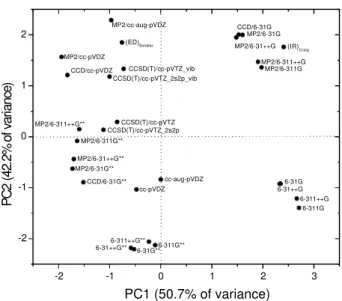
Figure 4 shows the score graph for the trans-C2H2Cl2
species. The first two principal components explain 92.9% of the total data variance of the calculated angles and bond lengths. PC1 describes 50.7% of this variance and PC2 contains 42.2% of the variance.
-3 -2 -1 0 1 2 3
-2 -1 0 1 2 3
CCSD(T)/cc-pVTZ_2s2p_vib
CCSD(T)/cc-pVTZ_2s2p CCSD(T)/cc-pVTZ_vib
CCSD(T)/cc-pVTZ
MP2/6-31G**
CCD/6-31G** MP2/6-31++G**
MP2/6-311G** MP2/6-311++G** MP2/cc-pVDZ
CCD/cc-pVDZ (ED)Schäfer
MP2/cc-aug-pvDZ
CCD/6-31G MP2/6-31++G MP2/6-31G
MP2/6-311++G MP2/6-311G (MW)Takeo
ccpvDZ cc-aug-pVDZ
6-31G** 6-31++G**6-311++G**
6-311G**
6-311++G 6-311G 6-31++G
6-31G
P
C
2
(3
4.
3%
of
va
ria
nc
e)
PC1 (58.7 of variance)
48 Silva and Ramos J. Braz. Chem. Soc.
PC1 is dominated by the C-Cl (+0.56) bond length, and the CCH (+0.62) and CCCl (-0.31) bond angles. Essentially, PC1 separates the calculations with or without polarization functions. This means that the ab initio
calculations with polarization functions have the smallest numerical values for the C-Cl bond length and the CCH bond angle, which have positive coefficients, and the highest ones for the CCCl angle which has a negative coefficient in the equation for PC1. For example, the C-Cl, CCH and CCCl parameters for the MP2/6-311G calculation are 1.822Å, 126.0o and 121.1o respectively, whereas the corresponding values are 1.723 Å, 123.4o and 121.5o for the MP2/6-311G** calculation. PC2 is dominated by the C=C (+0.58), C-H (+0.55) bond lengths and the CCCl (-0.53) bond angle and separetes the calculations with and without electron correlation. For example, in PC2, HF calculations with or without polarization functions have negative scores.
Two experimental geometries were inserted in Figure 4. The geometry of Craig et al.24 obtained from infrared (IR) spectroscopy and Schäfer et al.’s geometry22 obtained from gas electron diffraction (GED) spectroscopy. Analogous to what was found for cis-C2H2Cl2, the latter is
relatively close to the MP2/cc-aug-pVDZ, CCSD(T)/cc-pVTZ-vib, CCSD(T)/cc-pVTZ-2s2p-vib, MP2/cc-pVDZ and CCD/ccpVDZ, i.e., to the more sophisticated
calculations. Craig’s geometry in turn, is close the MP2 calculations with basis sets without polarization functions. In particular, these experimental geometries mainly differ on the values of the bond lengths.
Conclusions
The results of the principal component analysis (PCA) reported here reveal in a convincing way how calculated molecular geometries depend on the characteristics of the molecular wave-functions of cis- and trans- difluoro- and
dichloroethylene. This can be better visualized through bidimensional graphs. In other words, these graphs indicate that the 5-dimensional original space (three bond lengths and two angle bonds) is adequately represented by only two principal components (PC1 and PC2) in describing the total data variance. The coefficients of the PC1 and PC2 equations are very similar for cis- and trans-C2H2F2 and trans-C2H2Cl2, in contrast to what occurs in cis-C2H2Cl2.
Our results reveal that the presence or not of polarization functions and the inclusion or not of electronic correlation in the ab initio calculations are the two main
effects explaining the total data variance for the geometry. The inclusion of polarization functions in the basis set decreases both the C-X (X = F or Cl) bond length and the CCH bond angle, whereas the inclusion of electronic correlation (MP2, CCD or CCSD(T)) increases both the C=C and C-H bond lengths. The simultaneous inclusion of these effects is essential to obtain calculated geometries in good agreement with the experimental ones. The use of 6-31G or 6-311G basis sets with or without difuse functions seem to have smaller effects. From the bidimensional PCA graphs, it was possible to analyze how (di)similar are these experimental geometries (obtained from different techniques) compared to the calculated ones. For example, the microwave geometries compare very well with the CCD/6-31G**, MP2/6-31G** and MP2/6-31++G** calculations, whereas the experimental values obtained from gas electron diffraction (GED) are not close to these calculations when considering the bidimensional graph of cis-C2H2F2. On the other hand, the GED geometries from
van Schaick et al.19 for trans-C
2H2F2 are in good agreement with theoretical calculations when polarization functions and electronic correlations are simultaneously used, in contrast to the GED geometry from Carlos et al..20 For the dichloroethylene species the GED geometries from Schafer
et al.22 seem to be the best since they appear close to the
higher level calculations.
Acknowledgements
The authors thank FACEPE, CNPq and FINEP for partial financial support. The CCSD(T) calculations were kindly performed by Peter Taylor and Dan Jonsson (SDSC/UCSD). The present form of this text was benefited from referees’ comments, which are gratefully acknowledged.
-2 -1 0 1 2 3
-2 -1 0 1 2
CCSD(T)/cc-pVTZ_2s2p_vib
CCSD(T)/cc-pVTZ_2s2p CCSD(T)/cc-pVTZ_vib
CCSD(T)/cc-pVTZ MP2/cc-aug-pVDZ
(ED)Schäfer
MP2/cc-pVDZ
CCD/cc-pVDZ
MP2/6-311++G**
MP2/6-311G**
MP2/6-31++G** MP2/6-31G**
CCD/6-31G** cc-aug-pVDZ
cc-pVDZ
6-311++G** 6-311G** 6-31++G** 6-31G**
(IR)Craig
MP2/6-311G MP2/6-311++G MP2/6-31G
MP2/6-31++G CCD/6-31G
6-31G 6-31++G
6-311++G 6-311G
P
C
2
(4
2.
2
%
o
fv
a
ria
n
ce
)
PC1 (50.7% of variance)
References
1. Suto, E.; Ramos, M. N.; Bruns, R. E.; J. Phys. Chem.1993, 97,
6161.
2. da Silva, J. B. P.; Ramos, M. N.; Suto, E.; Bruns, R. E.; J. Phys.
Chem.1997, 101, 6293.
3. Ramos, M. N.; Neto, B. B.; Bruns, R. E.; J. Phys. Chem.1985,
89, 4979.
4. Kagel, R. O.; Powell, D. L.; Overend, J.; Ramos, M. N.; Bassi, A. B. M. S.; Bruns, R. E.; J. Chem. Phys.1983, 78, 7029.
5. Hopper, M. J.; Overend, J.; Ramos, M. N.; Bassi, A. B. M. S.; Bruns, R. E.; J. Chem. Phys.1983, 79, 17.
6. Kagel, R.O.; Powell, D. L.; Overend, J.; Hopper, M. J.; Ramos, M. N.; Bassi, A. B. M. S.; Bruns, R. E.; J. Phys. Chem.1984,
88, 521.
7. da Silva, J. B. P.; Ramos, M. N.; J. Mol. Struct. (TheoChem)
2001, 539, 83.
8. Ramos, M. N.; Fausto, R., Teixeira-Dias, J. J. C.; Castiglioni, C.; Gussoni, M.; Zerbi, G.; J. Mol. Struct.1991, 248, 281.
9. da Silva, J. B. P.; Ramos, M. N.; Bruns, R. E.; Spectrochim. Acta A, 1997, 53, 733.
10. Ramos, M. N.; da Silva, J. B. P.; Bruns, R. E.; Spectrochim.
Acta A1997, 53, 1563.
11. Graig, N. C.; Entemann, E. A.; J. Am. Chem. Soc.1961, 83,
3047.
12. Craig, N. C.; Overrend, J.; J. Chem. Phys.1967, 51, 1127. 13. Ambartzmuian, R. V.; Chekalin, N. V.; Doljikov, V. S.; Letokhov,
V. S.; Lokman, V. N.; Opt. Commun.1976, 18, 400;
14. Craig, N. C.; Piper, L. G.; Wheeler, V. L.; J. Phys. Chem.1971,
75, 1453.
15. Yamamoto, T.; Tomoda, S.; Chem. Lett.1997, 10, 1069.
16. da Silva, J. B. P.; J. Braz. Chem. Soc.2000, 11, 219. 17. Laurie, V. W.; Pence, D. T.; J. Chem. Phys.1963, 38, 2693.
18. Harmony, M. D.; Laurie, V. W.; Kuczkowski, R. L.; Schwendeman, R. H.; Ramsay, D. A.; Lovas, F. J.; Lafferty, W. J.; Maki, A. G.; J. Phys. Chem. Ref. Data1979, 8, 619. 19. van Schaick, E. J. M.; Mijlhoff, F. C.; Renes, G.; Geise, H. J.;
J. Mol. Struct.1974, 21, 17.
20. Carlos, J. L.; Karl, R. R.; Bauer, S. H.; J. Chem. Soc., Faraday
Trans.21974, 2, 177.
21. Takeo, H.; Sugie, M.; Matsumura, C.; J. Mol. Struct.1988,
190, 205.
22. Schäfer, L.; Ewbank, J. D.; Siam, K.; Paul, D. W.; Monts, D. L.; J. Mol. Struct.1986, 145, 135.
23. Craig, N. C.; Abiog, O. P.; Hu, B.; Stone, S. C.; Lafferty, W. J.; Xu, L.; J. Phys. Chem.1996, 100, 5310.
24. Craig, N. C.; Appleman, R. A.; Barnes, H. E.; Morales, E.; Smith, J. A.; Klee, S.; Lock, M.; Mellau, G. C.; J. Phys. Chem.
1998, 102, 6745.
25. Mardia, K. V.; Kent, J. T.; Bibby, J. M.; Multivariate Analysis,
Academic Press: London, 1979, chapter 8.
26. Suto, E.; Ferreira; M. M. C.; Bruns, R. E.; J. Comput. Chem.
1991, 12, 885.
27. Frisch, M. J.; Binkley, J. S.; Schlegel, H. B.; Raghavachari, K.; Melius, C. F.; Martin, R. L.; Stewart, J. J. P.; Bobrowicz, F. W.; Rohlfing, C. M.; Kahn, L. R.; Defrees, D. J.; Seeger, R.; Whiteside, R. A.; Fox, D. J.; Fleuder, E. M.; Pople, J. A.;
Gaussian 92, Revision C; Gaussian, Inc.: Pittsburg PA, 1992.
28. Helgaker, T.; Aa. Jensen, H. J.; Jørgensen, P.; Olsen, J.; Ruud, K.; Ågren, H.; Auer, A. A.; Bak, K. L.; Bakken, V.; Christiansen, O.; Coriani, S.; Dahle, P.; Dalskov, E. K.; Enevoldsen, T.; Fernandez, B.; Hättig, C.; Hald, K.; Halkier, A.; Heiberg, H.; Hettema, H.; Jonsson, D.; Kirpekar, S.; Kobayashi, R.; Koch, H.; Mikkelsen, K. V.; Norman, P.; Packer, M. J.; Pedersen, T. B.; Ruden, T. A.; Sanchez, A.; Saue, T.; Sauer, S. P. A.; Schimmelpfennig, B.; Sylvester-Hvid, K. O.; Taylor, P. R.; Vahtras, O.; Dalton, a Molecular Electronic Structure
Pro-gram, Release 1.2; 2001.
29. Dunning Jr., T. H., Hay, P. J.; Schaefer III, H. F. eds.;
Elec-tronic Structure Theory, Plenun Press: New York, 1977, p.12.
30. Moller, C.; Plesset, M.S.; Phys. Rev.1934, 46, 618.
31. Raghavachari, K.; Trucks, G. W.; Pople, J. A.; Head-Gordon,
M.; Chem. Phys. Lett.1989, 157, 479.
32.Ein*Sight 3.0; Infometrix, 2200 Sixth Avenue, Suite 833,
Seattle: WA 98121, 1991.
Received: October 21, 2002