
Ar
ti
cle
*e-mail: [email protected]
Synthesis, Structural and Spectral Studies of Five- and Six-Coordinate Adducts of
Organotin(IV) Halides Containing Dibenzylsulfoxide (dbso) as Ligand.
The Crystal Structures of
fac
-[MeSnCl
3(dbso)
2] and
trans
-[Ph
2SnCl
2(dbso)
2]
Gerimário F. de Sousa,*,a José R. Sabino,b Ivo Vencato,b Carlos A. L. Filgueirasc and José D. Ardissond
aInstituto de Química, Universidade de Brasília, 70919-970 Brasília-DF, Brazil
bInstituto de Física, Universidade Federal do Goiás, Campus Samambaia, 74001-970 Goiânia-GO, Brazil
cInstituto de Química, Universidade Federal do Rio de Janeiro, 21495-970 Rio de Janeiro-RJ, Brazil
dLaboratório de Física Aplicada, Centro de Desenvolvimento de Tecnologia Nuclear,
30123-970 Belo Horizonte-MG, Brazil
A reação do ligante ambidentado dibenzilsulfóxido (dbso) com Me2SnCl2 na proporção molar 1:1 leva à formação do produto pentacoordenado [Me2SnCl2(dbso)], enquanto Ph2SnCl2 leva à formação do complexo hexacoordenado trans-[Ph2SnCl2(dbso)2], utilizando as mesmas condições
de reação. Por outro lado, a reação com nBu
2SnCl2 forma o produto bimetálico [{nBu2SnCl2(dbso)}2],
o qual provavelmente possui núcleos de estanho(IV) octaédricos e cloretos em ponte. Os complexos [MeSnCl3(dbso)2] e [Ph3SnCl(dbso)] também foram preparados. Todos os produtos foram estudados por análise elementar e por espectroscopias no IV, RMN (1H, 13C, 119Sn) e Mössbauer. As espécies
hexacoordenadas fac-[MeSnCl3(dbso)2] e trans-[Ph2SnCl2(dbso)2] foram também estudadas por
difratometria de raios X; as determinações estruturais revelaram que estes compostos cristalizam-se nos sistemas cristalinos ortorrômbico, Pbcn, e monoclínico, P21/c, respectivamente. As moléculas
possuem átomos de estanho(IV) numa geometria octaédrica distorcida, com os dois ligantes dbso em posições cis e trans, respectivamente.
The reaction of the ambidentate ligand dibenzylsulfoxide (dbso) with Me2SnCl2 in 1:1 molar ratio leads to the formation of the ive-coordinate adduct [Me2SnCl2(dbso)], whereas the same reaction conditions with Ph2SnCl2 provide the six-coordinate adduct trans-[Ph2SnCl2(dbso)2].
On the other hand, the reaction with nBu
2SnCl2 forms the dimeric adduct [{nBu2SnCl2(dbso)}2],
which probably possesses octahedral tin(IV) nuclei and bridging chlorides. The adducts [MeSnCl3(dbso)2] and [Ph3SnCl(dbso)] were also prepared and included in the study. All complexes were studied by microanalysis and IR, NMR (1H, 13C and 119Sn) and Mössbauer spectroscopies
to investigate their structural properties. The six-coordinate species fac-[MeSnCl3(dbso)2] and trans-[Ph2SnCl2(dbso)2] were also studied by single crystal X-ray diffractometry. These compounds
crystallize in the orthorhombic, Pbcn, and monoclinic space group P21/c, respectively, as discrete neutral molecules with the tin(IV) atom in a distorted octahedral geometry and the two dbso ligands in cis and trans positions, respectively.
Keywords: sulfoxide complexes, organotin(IV) complexes, crystal structure analyses
Introduction
Organotin(IV) compounds have demonstrated to exhibit wide biological activity.1,2 Insofar as many sulfoxides are
also noteworthy for the same reasons,3 a combination
of the two chemistries is an interesting line to pursue. Diorganotin(IV) dihalides, and more particularly Me2SnCl2,
form well-known 1:2 adducts with Lewis bases.4 However,
both Me2SnCl2 and Ph2SnCl2 form 1:1 adducts5-7 with
monodentate ligands, but reports on the isolation of both 1:1 and 1:2 adducts are scarce.8 The formation of 1:1 systems
is curious and, surprisingly, neither the stoichiometry of the reactants nor the reaction conditions appear to exert much inluence.4 The 1:1 adduct, [Me
2SnCl2(dbso)], whose
X-ray structure is already known,5 has been described as an
compound without any intermolecular contact. The structure of dbso is shown below.
We report herein the preparation and spectroscopic investigation of ive- and six-coordinate adducts involving R4–mSnClm (R = Me, nBu, Ph; and m = 1, 2, 3) and
dibenzylsulfoxide (dbso). The X-ray diffraction study of the adducts trans-dichloro-trans-bis (dibenzylsulfoxide)-trans-diphenyltin(IV), trans-[Ph2SnCl2(dbso)2], and fac-trichloro-cis-bis(dibenzylsulfoxide)methyltin-(IV), fac-[MeSnCl3(dbso)2], is also presented.
Experimental
Material and procedures
All starting compounds and reagents were of highest grade and were used without puriication. IR spectra were recorded from KBr pellets on a Bomem MB100 FT-IR spectrometer in the 4000-400 cm–1 region. (1H, 13C, 119Sn) NMR spectra
were run on a Varian Mercury Plus 300 MHz spectro-photometer, using CDCl3 as solvent. Chemical shifts (ppm) are relative to TMS and Me4Sn. 119Sn Mössbauer spectra
were collected at 77 K in the transmission geometry, on a conventional constant-acceleration spectrometer with a CaSnO3 source kept at room temperature. All isomer shift values reported in this work are given with respect to this source. All Mössbauer spectra were computer-itted assuming Lorentzian line shapes and the resulting isomer shifts and quadrupole splittings are accurate to ca. ± 0.05 mm s–1. The velocity calibration of the instrument
was done at room temperature with 57Fe enriched foil. The
microanalyses were performed using a FISSONS CHNS, model EA 108 microanalizer.
Single-crystals of trans-[Ph2SnCl2(dbso)2] and fac -[MeSnCl3(dbso)2], suitable for X-ray studies, were obtained at room temperature as colourless solids by slow evaporation from EtOH/CHCl3 (3:1, v/v) and Me2CO solutions, respectively. The data collection of trans -[Ph2SnCl2(dbso)2] was performed using an Enraf-Nonius Kappa CCD diffractometer9 (Mo-K
α radiation) with cold N2 gas cooling of the sample crystal. Diffraction data for fac-[MeSnCl3(dbso)2] were collected using an Enraf-Nonius CAD-4 diffractometer10 (Cu-K
α radiation) at room
temperature, and data reduction was performed using the XCAD-4 program.11
Synthesis
Ph3SnCl (0.5 g, 1.3 mmol) and dbso (0.3 g, 1.3 mmol) were dissolved in EtOH (30 mL). The solution was stirred at 70 °C for 2 h. The hot colorless solution was then left to stand at room temperature to evaporate the solvent and colorless crystals of [Ph3SnCl(dbso)] were separated. All the other diorgorganotin(IV) adducts were obtained by slow evaporation of a CHCl3 solution containing the appropriate diorganotin(IV) dihalide and dbso in 1:1 molar ratio; the products were then recrystallized from a suitable solvent. Attempts to prepare [Me2SnCl2(dbso)2] (1:2) and [Ph2SnCl2(dbso)] (1:1) were unsuccessful.
dbso: 1H-NMR (300 MHz, CDCl3): d 7.43–7.26 (m, 10H, –Ph); 3.92 (dd, J 12 and 15 Hz, 4H, –CH2–Ph). 13C-NMR (300 MHz, CDCl
3): d 57.1 (C–Ph), 130.0 (o-C),
128.8 (p-C), 128.8 (m-C), 128.2 (q-C).
[Me2SnCl2(dbso)]: 1H NMR (300 MHz, CDCl3):
d 7.43–7.26 (m, 10H, –Ph); 3.97 (dd, J 13 and 14 Hz, 4H, –CH2–Ph); 1.06 (s, 6H, Sn–CH3, 2J(119Sn–1H) = 75.3
Hz). 13C NMR (300 MHz, CDCl
3): d 130.3 (o-C), 129.0
(p-C), 128.8 (m-C), 128.7 (q-C); 55.8 (C–Ph), 9.9 (Sn–C, 1J(119Sn–13C) = 568 Hz). Anal. calcd. for C
16H20Cl2OSSn:
C, 42.71; H, 4.48; S, 7.12%. Found: C, 41.24; H, 4.64; S, 7.18%. Yield 90%; m.p. 117–118 °C.
[Ph2SnCl2(dbso)2]: 1H NMR (300 MHz, CDCl3):
d 7.76–7.23 (m, 30H, –Ph); 3.89 (dd, J 15 and 18 Hz, 4H, –CH2–Ph). 13C NMR (300 MHz, CDCl
3): d 130.3 (o
-C), 129.2 (p-C), 129.0 (m-C), 128.6 (q-C); 55.9 (C–Ph). Anal. calcd. for C40H38Cl2O2S2Sn: C, 59.72; H, 4.76; S, 7.97%. Found: C, 59.61; H, 4.81; S, 8.09%. Yield 60%; m.p. 127–128 °C.
[nBu
2SnCl2(dbso)]:
1H NMR (300 MHz, CDCl 3):
d 7.43–7.26 (m, 10H, –Ph); 3.93 (dd, J12 and 15 Hz, 4H, –CH2–Ph); 1.77 (m, 4H, –CH2–Ph); 1.77 (m, 4H,–CH2– Sn); 1.39 (m, 8H,); 0.94 (t, 6H, Sn–C–C–CH3). 13C NMR
(300 MHz, CDCl3): d 130.2 (o-C), 129.1 (p-C), 129.0 (m-C), 128.7 (q-C); 55.1 (C–Ph), Sn–C(28.9)–C(27.0)– C(26.2)–C(13.5).Anal. calcd. for C22H32Cl2OSSn: C, 49.47; H, 6.04; S, 6.00%. Found: C, 48.21; H, 6.09; S, 6.21%. Yield 80%; m.p. 110–112 °C.
[MeSnCl3(dbso)2]: 1H NMR (300 MHz, CDCl3):
d 7.40–7.25 (m, 10H, –Ph); 4.02 (s, 4H, –CH2–Ph); 1.24 (s, 3H, Sn–CH3, 2J(119Sn–1H) = 123 Hz). 13C NMR (300
[Ph3SnCl(dbso)]:1H NMR (300 MHz, CDCl3): d 7.80 – 7.20 (m, 25H, –Ph); 3.80 (dd, J 15 and 21 Hz, 4H, –CH2– Ph).13C NMR (300 MHz, CDCl
3): d 130.1 (o-C), 129.7
(p-C), 128.9 (m-C), 128.4 (q-C); 56.6 (C–Ph). Anal. calcd. for C32H29ClOSSn: C, 62.42; H, 7.75; S, 5.21%. Found: C, 61.04; H, 7.81; S, 5.19%. Yield 50%; m.p. 101–103 °C.
Crystal structure determination
The initial structure solutions were obtained by the heavy-atom method using the SHELXS-97 program.12 The
other non-H atoms positions were obtained by difference Fourier maps. Hydrogen atoms were placed in geometric positions with C–H distances in the range of 0.93–0.99 Å and reined with a riding model with their Uiso proportional to Ueq of their parent atoms. Non-H atoms were reined with anisotropic displacement parameters. For the adduct trans-[Ph2SnCl2(dbso)2], no correction for absorption was applied, and in fac-[MeSnCl3(dbso)2]the rings were reined as idealized rigid groups with C–C bond distances of 1.39 Å. All reinements were performed with full-matrix least-squares on F2,using the SHELXL-97 program.13 The
data of fac-[MeSnCl3(dbso)2] were corrected for absorption using the numerical method (Gaussian), with minimum and maximum transmission coeficients of 0.103 and 0.230, respectively. The crystal data and details of data processing are given in Table 1.
Results and discussion
The structure of trans-[Ph2SnCl2(dbso)2]
The molecular structure with the labelling scheme is shown in Figure 2 and the selected bond distances and angles are listed in Table 2. The arrangement about tin(IV) in trans-[Ph2SnCl2(dbso)2] is best described as a distorted octahedron geometry, in which the dbso molecules are well adapted for trans coordination. The coordination sphere is completed by two trans-phenyl and two trans-chloride groups and a slight distortion of the octahedron is observed. Thus, the angle C31i–Sn1–C31 is 177.3(3)°, and the other
two trans bond angles O1i–Sn1–O1 and Cl1–Sn1–Cl2 are
174.0(2) and 180°, respectively. The last angle indicates that the adduct possesses crystallographic two-fold axial symmetry with tin(IV) and both Cl atoms lying on the crystallographic two-fold axis. It is interesting to compare our results with literature data for the ive-coordinate adduct [Me2SnCl2(dbso)].5 In trans-[Ph
2SnCl2(dbso)2], the bond
distance Sn1–O1 of 2.258(4) Å is signiicantly shorter than the equivalent bond distance value of 2.319(10) Å observed in [Me2SnCl2(dbso)], indicating a stronger interaction in
Ph2Sn2+/dbso than in Me
2Sn2+/dbso. On the other hand,
the Sn1–C31, 2.147(6); Sn1–Cl1, 2.578(2); and Sn1–Cl2, 2.509(2) Å bond lengths are considerably longer than the Sn1–C1, 2.128(15); Sn1–C2, 2.109(16); Sn1–Cl1, 2.392(6); and Sn1–Cl2, 2.464(6) Å bond lengths found in [Me2SnCl2(dbso)], as expected. The arrangement of the dbso ligands differs from that observed by Nardelli and collaborators14 in cis-dichloro-cis-bis (dimethylsulfoxide)-trans-diphenyltin(IV), cis-[Ph2SnCl2(dmso)2], which has the chlorine atoms and the oxygen atoms cis, and the carbon atoms trans.
A sulfoxide coordinated to a metal via the oxygen atom can be represented formally by an R2Sd+–Od– dipolar form,
and coordination to an organotin(IV) species would be expected to lengthen the S–O bond. This lengthening is observed in most organotin(IV)–sulfoxide complexes.5,15
This is corroborated by IR spectroscopy, which shows a lowering of ν(S–O) from 1033 to 969-988 cm–1 for all
complexes under study here.
The structure of fac-[MeSnCl3(dbso)2]
The molecular structure with the labelling scheme is shown in Figure 1 and the selected bond distances and angles are listed in Table 2. The arrangement about tin(IV) in fac-[MeSnCl3(dbso)2], located in a general position of the space group P21/c, is a distorted octahedral geometry in which the three chlorides are arranged in a facial fashion and the dbso ligands are bonded by O atoms cis to one another. The trans position to the methyl group is occupied by a chlorine atom and not by the sulfoxide ligand, as observed in mer -[EtSnI3(dpso)2]16 (dpso = diphenylsulfoxide). However, the
adducts mer-[MeSnCl3(ImSOMe)], ImSOMe = 1-methyl-2-(methylsulinylimidazole), and mer-[MeSnCl3(PySOnPr)],
PySOnPr = 2-(n-propylsulinyl)pyridine, possess three
chlorides arranged in a meridional position and the methyl group is trans to the N atom.17
In Table 2, the Sn1–Cl1, Sn1–Cl2 and Sn1–Cl3 distances are given as 2.429(2), 2.399(2) and 2.422(2) Å, respectively. Therefore, the average of the Sn1–Cl1 and Sn1–Cl3 bond lengths (Cl trans to the dbso ligand) is 2.426(2) Å, and 2.426 – 2.399 = 0.027 Å. The O–Sn–O bonds [2.203(5) and 2.241(7) Å] form an angle of 92.6(3)° at the metal and the S–O bonds lengths [1.523(8) and 1.522(5) Å] are otherwise not much different from those bonds observed in other mono-organotin(IV) adducts containing sulfoxide as ligand.16,17 The [Sn–C 2.142(8) Å] bond distance is
longer than those found in mer-[MeSnCl3(ImSOMe)] [2.122(4) Å] and in mer-[MeSnCl3(PySOnPr)] [2.110(7) Å],
Infrared spectroscopy
Table 3 lists the most important IR data, allowing several conclusions. The dbso ligand always binds to the tin(IV) moiety through the oxygen atom, as shown by the shift of ν(S–O) to lower values as compared to the free base. The ν(Sn–O) bands appear at 483 cm–1 for fac-[MeSnCl
3(dbso)2],
at 460 cm–1 for trans-[Ph
2SnCl2(dbso)2] and at 455 cm–1 for
[Ph3SnCl(dbso)], in accordance with reported work related to ambidentate sulfoxides bonded to tin(IV).18 However, the
ν(Sn–O) absorptions in ive-coordinate diorganotin(IV)–
sulfoxide adducts have been reported in the 415-440 cm–1
range.19 The ν(C=C), d(C–H) and d(C=C) stretching
vibrations do not show any appreciable alteration, indicating that the benzyl groups are far from the coordination center.
(1H, 13C, 119Sn) NMR spectroscopy
The assignment of the 1H and 13C chemical shifts
is presented in the experimental section, and coupling Table 1. Crystal data and structure reinement
Compound trans-[Ph2SnCl2(dbso)2] fac-[MeSnCl3(dbso)2]
Empirical formula C40H38Cl2O2S2Sn C29H31Cl3O2S2Sn
Formula weight 804.45 700.98
Temperature (K) 100(2) 297(2)
Wavelength (Å) 0.71073 1.54180
Crystal system Orthorhombic Monoclinic
Space group Pbcn P21/c
Crystal color/habit Colourless/prism Colourless/prism
a (Å) 14.347(1) 9.182(4)
b (Å) 10.259(1) 19.281(4)
c (Å) 23.661(1) 18.057(5)
β (deg.) 104.44(2)
Volume (Å3) 3482.6(4) 3095.7(17)
Z 4 4
Calculated density (g cm–3)
1.534 1.503
Absorption coeficient (mm–1)
1.043 1.041
Crystal size (mm) 0.15 x 0.10 x 0.06 0.40 x 0.20 x 0.20 Theta range for data
collection (°)
2.23 to 27.85 3.41 to 68.04
Index ranges –18 ≤ h≤ 18 –13 ≤k≤ 0 0 ≤l≤ 30
–11 ≤h≤ 9 –23 ≤k≤ 4 0 ≤l≤ 21 Relections collected 7475 6420
Independent relections
3953
[R(int) = 0.0462]
5551
[R(int) = 0.0826]
Data/restraints/ parameters
3953/0/215 5551/0/294
Goodness-of-it on F21.132 1.045
Final R indices [I > 2σ(I)]
R1 = 0.0530,
wR2 = 0.1659
R1 = 0.0650,
wR2 = 0.1751
R indices (all data) R1 = 0.0901, wR2 = 0.1906
R1 = 0.1029, wR2 = 0.1996 Extinction coeficient 0.0018(4) 0.0008(1)
Largest diff. peak and hole (e Å–3)
1.463 and –1.636 1.044 and –1.402
Figure 1. View of fac-[MeSnCl3(dbso)2] with the displacement parameters drawn at the 30% probability level.
Figure 2. View of trans-[Ph2SnCl2(dbso)2], with ellipsoids drawn at the
constants, 1J(119Sn–13C) and 2J(119Sn–1H), and chemical
shifts, d(119Sn), of our adducts, as well as of other
compounds from the literature, are shown in Table 4. The NMR coupling constants 1J(119Sn–13C) and 2J(119Sn–1H)
for compound 5, which was crystallographically
characterized5 as being a ive-coordinate tin(IV) adduct,
were observed at 568 and 72 Hz, respectively. However, the adduct 6, which has higher coupling constants values of
888 and 92 Hz, is formed by six-coordinate tin(IV) atoms. In view of this, the coupling constants values for adducts
1-3 indicate that, in CDCl3 solution, they are no longer
octahedral as in the solid state, but undergo a structural
change, showing ive-coordinate behavior. In addition to that, the coupling constants for adduct 7 are considerably
larger than those for adducts 1-5, indicating that higher 1J(119Sn–13C) and 2J(119Sn–1H)values tend to correlate with
higher coordination numbers (see Table 4). This can be attributed, at least partially, to a tendency to maximize the s-character in the C–Sn–C bonds in six-coordinate derivatives.20 Applying the equation 1J(119Sn–13C) =
11.4 θ – 875, and our observed coupling constant of 568 Hz to adduct 5, whose X-ray structure is known, we
ind the value of 127° for the (C–Sn–C) angle θ of adduct
5, only 9° lower than the angle of 136.4(9)° reported by
Ng and Rheingold4 (Table 4). The NMR data for the 1:1
adduct [Me2SnCl2(Hmimt)] [Hmimt = 1-methyl-2(3H)-imidazolinethione], whose X-ray structure shows it to be a trigonal bipyramid,21 present some similarity with the
data for adduct 5. The reported values of 1J(119Sn–13C), 2J(119Sn–1H), d(119Sn) and θ(C–Sn–C) for this compound
are 491, 71 Hz, +19 ppm and 133°, respectively. The coupling constant 2J(119Sn–1H) value of 123 Hz
found for fac-adduct 18 is only 8 Hz higher than that found
for fac-adduct 16 and it is almost equal to that of 124 Hz
found for mer-adduct 17. This observation indicates that
this behavior may be due more to an electronic rather than to a structural effect, wherein the oxygen atom in BtSOMe exhibits a higher electronic donor effect than the oxygen in dbso. Thus the tin(IV) atom would be more shielded in 18
than in 16. This behaviour is also observed in 119Sn-NMR
spectroscopy.
119Sn chemical shifts were found to lie between
ca. –90 and –330 ppm in ive-coordinate dimethyltin(IV) chelates.22 However, the values for adducts 1-5 (Table 4) are
completely out of this range, indicating that the presence of chlorine atoms in the coordination sphere of the tin(IV) nucleus shifts the signal towards much more deshielded values. In diphenyltin(IV) derivatives, (adducts 8-10 and 12), the chemical shift values were found as usual, i. e., at lower frequencies than in dimethyltin(IV) adducts, in spite Table 2. Selected bond lengths [Å] and angles [°]
trans-[Ph2SnCl2(dbso)2] fac-[MeSnCl3(dbso)2]
Sn1–C31 2.147(6) Sn1–C1 2.142(8)
Sn1–O1 2.258(4) Sn1–O1 2.203(5)
Sn1–Cl2 2.509(2) Sn1–O2 2.241(7)
Sn1–Cl1 2.578(2) Sn1–Cl1 2.429(2)
Sn1–O1 2.258(4) Sn1–Cl2 2.399(2)
S1–O1 1.524(4) Sn1–Cl3 2.422(2)
S1–C1 1.815(5) S1–O1 1.529(5)
S1–C2 1.829(5) S2–O2 1.523(8)
C31–Sn1–C31i 177.3(3) C1–Sn1–Cl3 96.4(3)
C31–Sn1–O1i 91.5(2) O1–Sn1–Cl3 175.8(2)
C31–Sn1–O1 88.3(2) O2–Sn1–Cl3 83.7(2)
O1i–Sn1–O1 174.0(2) Cl2–Sn1–Cl3 92.43(8)
C31–Sn1–Cl2 91.4(1) C1–Sn1–Cl1 99.0(3) O1–Sn1–Cl2 93.0(1) O1–Sn1–Cl1 88.3(2)
C31–Sn1–Cl1 88.6(1) O2–Sn1–Cl1 168.0(2) O1–Sn1–Cl1 87.0(1) C1–Sn1–O1 85.6(3)
O1–S1–C1 103.0(2) Cl2–Sn1–Cl1 88.07(8) O1–S1–C2 105.7(2) C1–Sn1–O2 93.0(3) C1–S1–C2 101.5(3) Cl3–Sn1–Cl1 95.00(9)
Symmetry code: (i) –x + 1, y, –z + ½.
Table 3. Selected infrared absorptions (cm–1)
Compound C.N. ν(C=C) ν(S=O) ∆ν(S=O) ν(Sn–O) d(C–H) d(C=C)
dbso - 1493vs, 1455vs 1033vs - - 776vs 700vs
[Me2SnCl2·dbso] a 5 1496vs, 1458vs 988vs 45 - 775sh 697vs
[Ph2SnCl2·(dbso)2] b 6 1494s, 1455s 984vs 49 460s 776vs 700vs
[nBu
2SnCl2·dbso]2 6 1494vs, 1455vs 973vs 60 - 776vs 701vs
[MeSnCl3·(dbso)2] a 6 1496vs, 1455vs 950vs 83 483s 767vs 697vs
[Ph3SnCl2·dbso] c 5 1492s, 1452s 969vs 64 455s 775vs 698vs
Abbreviations and attributions: C.N. = coordination number; aν
of the greater electron donation properties of the methyl groups compared to phenyl.23 This observed dependence
of the chemical shift of the tin(IV) atom on the nature of the diorganotin(IV) derivative can be related to the relative polarity of the Sn–C bonds. The polarity of these bonds depends on the amount of residual positive charge located on tin, as well as on the s-character of tin(IV) in these bonds.24 Accordingly, more residual positive charge is
localized on the central tin(IV) atom in Ph2Sn2+ compared
to Me2Sn2+. Therefore, more shielding is expected on
the tin(IV) atom in the ive-coordinate diphenyltin(IV) derivative. The 119Sn chemical shift value of –167 ppm,
observed for adduct 14, is inside the range of –125 to
–515 ppm observed for six-coordinate diorganotin(IV) chelates.22
Mössbauer spectroscopy
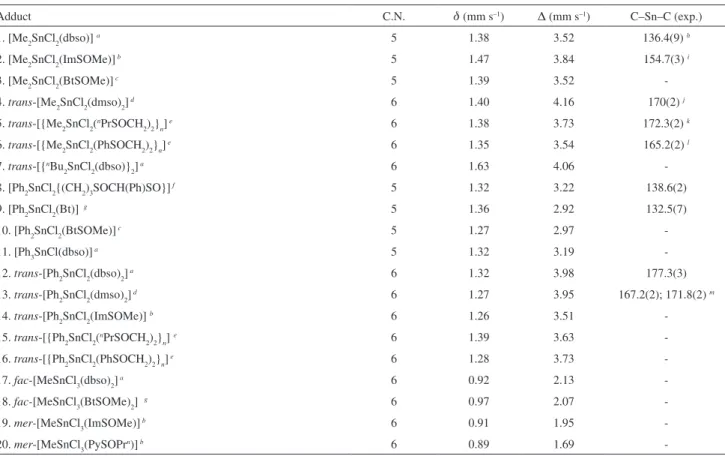
119Sn Mössbauer spectral parameters of the dbso
derivatives are reported in Table 5, which includes parameters from the literature for comparison. The spectra of the adducts 2, 7, 13 and 19 are shown in Figure 3.
The isomer shift (d) is very sensitive to the first coordination sphere and depends on the nature and number
of organic groups bonded to the tin(IV) atom.28,29 This
parameter is correlated to the change of s-electron density on the metal by means of the +I inductive effect imposed by the ligands. A result of this is the inverse dependence of d with electronegativity.30 Thus d increases on replacing
the phenyl by the alkyl groups in the coordination sphere of tin(IV). This increase in d can be seen (Table 5) starting with the adducts 17-20 derived from MeSnCl3 (0.89–0.97
mm s–1), including the adducts 12-16 derived from Ph 2SnCl2
(1.26-1.39 mm s–1), and inishing with the adducts 1-6
derived from Me2SnCl2 (1.35-1.47 mm s–1). The adduct 7
derived fromnBu
2SnCl2 (1.63 mm s–1) conirms that isomer
shifts increase in the sequence Ph2Sn2+ < Me
2Sn2+ < nBu2Sn2+
(see Table 5).
The quadrupole splitting (∆) values summarized in Table 5 show that this parameter can potentially throw light upon the question of which is the correct coordination number of the tin(IV) atom in adducts formed from diorganotin(IV) dichloride and monodentate ligands. The ∆ value of adduct 1 (3.52 mm s–1) is typical
of dimethyltin(IV) adducts with a distorted trigonal bypyramidal geometry around the tin(IV) atom, as supported by the crystal structure determination: an authentic ive-coordinate trigonal bipyramidal compound5
Table 4. (1H, 13C)-NMR coupling constants (J, Hz) and 119Sn-NMR chemical shifts (d, ppm)
Adduct C.N. 2J(119Sn–1H) 1J(119Sn–13C) d(119Sn)
1. [Me2SnCl2(nPrSOCH
2)2] a 5, 6 h 78 595 +9
2. [{nBu
2SnCl2(dbso)}2]b 5, 6 h - - +42
3. [{Me2SnCl2(PhSOCH2)2}n]a 5, 6 h 71 - +59
4. [Me2SnCl2(BtSOMe)] c 5 72 538 +99
5. [Me2SnCl2(dbso)] b 5 72 568 +100
6. trans-[Me2SnCl2(ImSOMe)] d 6 92 888 -8
7. trans-[Me2SnCl2(dmso)2] e 6 86 1060
-8. [Ph2SnCl2(ImSOMe)] d 5 - - -36
9. [Ph2SnCl2{(CH2)3SOCH(Ph)SO}] f 5 - - -62
10. [Ph2SnCl2(BtSOMe)] c 5 - - -63
11. [Ph3SnCl(dbso)] b 5 - - -67
12. [Ph2SnCl2(PySOnPr)] g 5 - - -108
13. trans-[{Ph2SnCl2(PhSOCH2)2}n]a 6 - - -129
14. trans-[Ph2SnCl2(dbso)2] b 6 - - -167
15. [{Ph2SnCl2(nPrSOCH 2)2}n]
a 6 - - -168
16. fac-[MeSnCl3(BtSOMe)2] c 6 115 538 -214
17. mer-[MeSnCl3(PySOnPr)] g 6 124 - -350
18. fac-[MeSnCl3(dbso)2] b 6 123 - -368
without any short intermolecular contact. The parameters d = 1.45; ∆ = 3.13 mm s–1 and the angle θ (C–Sn–C) = 133°
have been reported for the related adduct with analogous coordination geometry, namely [Me2SnBr2(Hmimt)].21
The larger ∆ value of adduct 2 (3.84 mm s-1), compared to 1 (3.52 mm s–1), is due to the considerable intermolecular
contact [S=O···Sn 2.75(1) Å], which makes this distance much shorter than the sum of the van der Waals31 radii of
the two atoms, rSn = 2.2, ro = 1.5 Å. Thus, the C–Sn–C angle is opened up to 154.7(3)°, to complete the distorted trans-C–Sn–C skeleton.16 The differences observed in ∆ values ranging from 3.54-4.16 mm s–1 for adducts 4-7,
compared to adducts 1 and 3, are considerable (Table 5).
Therefore, this means that these compounds (4-7) possess
the same geometry around the tin(IV) atom, which corresponds to six-coordinated structures, as supported by X-ray diffraction for 4,19 5,32 and 6.33 In view of
this, the Mössbauer spectra of the adducts 8-11 show a
doublet with values of ∆ ranging from 2.92-3.22 mm s–1,
indicating five-coordinated tin(IV) compounds, whereas the spectra of 12-16 show values ranging from
3.51–3.98 mm s–1, which are typical of six-coordinated
tin(IV) derivatives.
The geometry about tin(IV) in adducts 17 (∆ = 2.13 mm s–1)
and 18 (∆ = 2.07 mm s–1) is that of a distorted octahedron
environment, with the SnCl3+ skeleton arranged in facial
mode (Figure 1). On the other hand, in the octahedral adducts
19 (∆ = 1.95 mm s–1) and 20 (∆ = 1.69 mm s–1), the SnCl3+
skeleton is organized in a meridional position with the methyl group trans to the nitrogen atom in both compounds.17 In view of this, we believe that the magnitude of ∆ can be used to distinguish between fac- and mer-arrangements as more crystallographic data become available.
From the ∆ value and the point-charge approach, the equation ∆ = –4 [R] (1 – 0.75 sin2 θ)1/2 gives an estimate
of θ, where (θ, deg) is the C–Sn–C bond angle34 and [R] is
the partial quadrupole splitting (pqs) of the group, arising either from the alkyl or the aryl groups. For ive- and six-coordinated tin(IV), the working values used for [Me] and [Ph] were –1.13 and –0.95 mm s–1, respectively.34,35
The calculated bond angle values of 134o for 1 and
180° for 12 reveal trigonal bipyramidal (TBP) and
Table 5. Mössbauer data and C–Sn–C angles (°)
Adduct C.N. d (mm s–1) D (mm s–1) C–Sn–C (exp.)
1. [Me2SnCl2(dbso)] a 5 1.38 3.52 136.4(9) h
2. [Me2SnCl2(ImSOMe)] b 5 1.47 3.84 154.7(3) i
3. [Me2SnCl2(BtSOMe)] c 5 1.39 3.52
-4. trans-[Me2SnCl2(dmso)2] d 6 1.40 4.16 170(2) j
5. trans-[{Me2SnCl2(nPrSOCH 2)2}n]
e 6 1.38 3.73 172.3(2) k
6. trans-[{Me2SnCl2(PhSOCH2)2}n]e 6 1.35 3.54 165.2(2) l
7. trans-[{nBu
2SnCl2(dbso)}2]
a 6 1.63 4.06
-8. [Ph2SnCl2{(CH2)3SOCH(Ph)SO}] f 5 1.32 3.22 138.6(2)
9. [Ph2SnCl2(Bt)] g 5 1.36 2.92 132.5(7)
10. [Ph2SnCl2(BtSOMe)] c 5 1.27 2.97
-11. [Ph3SnCl(dbso)] a 5 1.32 3.19
-12. trans-[Ph2SnCl2(dbso)2] a 6 1.32 3.98 177.3(3)
13. trans-[Ph2SnCl2(dmso)2] d 6 1.27 3.95 167.2(2); 171.8(2) m
14. trans-[Ph2SnCl2(ImSOMe)] b 6 1.26 3.51
-15. trans-[{Ph2SnCl2(nPrSOCH 2)2}n]
e 6 1.39 3.63
-16. trans-[{Ph2SnCl2(PhSOCH2)2}n] e 6 1.28 3.73
-17. fac-[MeSnCl3(dbso)2] a 6 0.92 2.13 -
18. fac-[MeSnCl3(BtSOMe)2] g 6 0.97 2.07 -
19. mer-[MeSnCl3(ImSOMe)] b 6 0.91 1.95 -
20. mer-[MeSnCl3(PySOPrn)] b 6 0.89 1.69
-Abbreviations and attributions: C.N. = coordination number; BtSOMe = 2-(methylsulinyl)-benzothiazole; ImSOMe = 1-methyl-2-(methylsulinyl) imidazole; (CH2)3SOCH(Ph)SO = 2-phenyl-1,3-dithiane-trans-1-trans-3-dioxide; PySOnPr = 2-(n-propylsulinyl)pyridine; dmso = dimethylsulfoxide; a
this work; b reference 26; c reference 19; d reference 36; f reference 6; g reference 37; h reference 5; i reference 16; j reference 38; k reference 32; l reference
Figure 3.119Sn Mössbauer effect spectra obtained at 77 K for complexes [Me
2SnCl2(dbso)] (2)-(a); [{ nBu
2SnCl2(dbso)}2](7)-(b); trans-[Ph2SnCl2(dbso)2]
(13)-(c); and fac-[MeSnCl3(dbso)2] (19)-(d).
octahedral (Oh) arrangements around the tin(IV) atoms, respectively.
Supplementary Information
Crystallographic data for the structural analysis of the complexes have been deposited at the Cambridge Crystallographic Data Center, with the deposition numbers CCDC 619271 for trans-[Ph2SnCl2(dbso)2] and CCDC 619272 for fac-[MeSnCl3(dbso)2]. Copies of the data can be obtained free of charge on application
to CCDC, 12 Union Road, Cambridge CB21EZ, United Kingdom; Fax: +44 1223 336033, or e-mail: [email protected].
Acknowledgements
References
1. Pellerito, L.; Naggy, L.; Chem. Rev. (Washington, DC, U.S.)
2002, 224, 111.
2. Gielen, M.; Appl. Organomet. Chem. 2002, 16, 481.
3. Gorshkova, J. E.; Gordeliy, V. I.; Crystallogr. Rep. 2007, 52,
535.
4. Ng, S. W.; Barnes, C. L.; van der Helm, D.; Zuckerman, J. J.;
Organometallics1983, 2, 600.
5. Ng, S. W.; Rheingold, A. L.; J. Organomet. Chem. 1989, 378,
339.
6. De Sousa, G. F.; Filgueiras, C. A. L.; Nixon, J. F.; Hitchcock, P. B.; J. Braz. Chem. Soc. 1997, 8, 649.
7. Abras, A.; Filgueiras, C. A. L.; Baba, J. M. K.; J. Inorg. Nucl. Chem. 1981, 43, 2249.
8. Liengme, B. V., Randall, R. S.; Sams, J. R.; Can. J. Chem. 1972,
50, 3212.
9. Enraf-Nonius, COLLECT; Enraf-Nonius BV: Delft, The
Netherlands, 1997-2000.
10. Enraf-Nonius, CAD4/PC; Version 1.2. Enraf-Nonius: Delft, The
Netherlands, 1993.
11. Harms, K.; Wocadlo, S. XCAD-4; Program for Processing CAD-4 Diffractometer Data, University of Marburg, Germany, 1995.
12. Sheldrick, G .M.; SHELXS97. Program for Crystal Structure Solution, University of Göttingen, Germany, 1997.
13. Sheldrick, G. M.; SHELXL97. Program for Crystal Structure Reinement, University of Göttingen, Germany, 1997.
14. Coghi, L.; Nardelli, M.; Pelizzi, C.; Pelizzi, G.; Gazz. Chim.
Ital. 1975, 105, 1187.
15. Karol, T. J.; Hutchinson, J. P.; Hyde, J. R.; Kuivila, H. G.; Zubieta, J. A.; Organometalics 1983, 2, 106.
16. Jatsenko, A. V.; Medvedev, S. V.; Paseshnitchenko, K. A.; Aslanov, L. A.; J. Organomet. Chem. 1985, 284, 181.
17. De Sousa, G. F.; Filgueiras, C. A. L.; Darensbourg, M. Y.; Reibenspies, J. H.; Inorg. Chem. 1992, 31, 3044.
18. Filgueiras, C. A. L.; Celso, C.; Marques, E. V.; Johnson, B. F. G.; Inorg. Chim. Acta1982, 59, 71.
19. De Sousa, G. F.; Abras, A.; Filgueiras, C. A. L. Proceedings of the International Conference on the Applications of the
Mössbauer Effect, ICAME-95, Ortalli, I., Ed., SIF, Bologna, vol. 50, 1996, p. 79.
20. Mcgrady, M. M.; Tobias, R. S.; Inorg. Chem. 1964, 3, 1157. 21. Martínez, E. G.; Gonzáles, A. S.; Casas, J. S.; Sordo, J.; Valle,
G.; Russo, U.; J. Organomet. Chem. 1993, 453, 47. 22. Otera, J.; J. Organomet. Chem. 1981, 221, 57.
23. Smith, P. J.; Tupciauskas, A. P.; Ann. Rep. NMR Spectrosc. 1978, 8, 291.
24. Iskander, M. F.; Labib, L.; Nour, M. M. Z.; El-Din, N.; Tawik, M.; Polyhedron1989, 8, 2755.
25. De Sousa, G. F.; Filgueiras, C. A. L.; Abras, A.; Carvalho, C. C.; Francisco, R. H. P.; Gambardella, M. T. do P.; Anais Assoc. Bras. Quim. 1995, 44, 42.
26. De Sousa. G. F. Synthesis, Characterization and Reactivity of Organocomplexes of Tin and Platinum: Spectroscopy and X-ray
Diffraction, Doctoral Thesis, Universidade Federal de Minas
Gerais, Belo Horizonte, Brazil, 1992.
27. Lockart T. P.; Manders W. F.; J. Am. Chem. Soc. 1987, 109,
7015.
28. Carcelli, M.; Fochi, A.; Pellagatti, P.; Pelizzi, G.; Russo, U.;
J. Organomet. Chem. 2001, 628, 161.
29. De Sousa, G. F.; Delon, V. M.; Gambardella, M. T. do P.; Francisco, R. H. P.; Ardisson, J. D.; Niquet, E.; Inorg. Chem. 2006, 45, 4518.
30. Kovala-Demertzi, D.; Kourkounelis, N.; Koutsodimou, A.; Moukarika, A.; Horn, E.; Tiekink, E. R. T.; J. Organomet. Chem.
2001, 620, 194.
31. Huheey, J. E. Inorganic Chemistry-Principles of Structure and Reactivity, 3rd ed., Harper & Row, New York, 1983.
32. Carvalho, C. C.; Francisco, R. H. P.; Gambardella, M. T. do P.; De Sousa, G. F.; Filgueiras, C. A. L.; Acta Crystallogr., Sect. C: Cryst. Struct. Commun. 1996, 1627.
33. Carvalho, C. C.; Francisco, R. H. P.; Gambardella, M. T. do P.; De Sousa, G. F.; Filgueiras, C. A. L.; Acta Crystallogr., Sect. C: Cryst. Struct. Commun. 1996, 1629.
34. Bancroft, G. M.; Sham, T. K.; Inorg. Chem. 1975, 14, 2281.
35. Jankovics, H.; Pettinari, C.; Marchetti, F.; Kamu, E.; Nagy, L.; Troyanov, S.; Pellerito, L.; J. Inorg. Biochem. 2003, 97, 370.
36. Crowe, A. J.; Smith, P. J.; J. Organomet. Chem. 1982, 224, 223.
37. Harrison, P. G.; Molloy, K. C.; J. Organomet. Chem. 1978, 152, 63.
38. Isaacs, N. W.; Kennard, C. H. L.; J. Chem. Soc. 1970, A, 1257.
Received: February 26, 2009
![Figure 1. View of fac-[MeSnCl 3 (dbso) 2 ] with the displacement parameters drawn at the 30% probability level.](https://thumb-eu.123doks.com/thumbv2/123dok_br/18993010.461317/4.892.461.785.470.846/figure-view-mesncl-displacement-parameters-drawn-probability-level.webp)
![Table 2. Selected bond lengths [Å] and angles [°]](https://thumb-eu.123doks.com/thumbv2/123dok_br/18993010.461317/5.892.93.438.399.831/table-selected-bond-lengths-å-angles.webp)
![Figure 3. 119 Sn Mössbauer effect spectra obtained at 77 K for complexes [Me 2 SnCl 2 (dbso)] (2)-(a); [{ n Bu 2 SnCl 2 (dbso)} 2 ] (7)-(b); trans-[Ph 2 SnCl 2 (dbso) 2 ] (13)-(c); and fac-[MeSnCl 3 (dbso) 2 ] (19)-(d)](https://thumb-eu.123doks.com/thumbv2/123dok_br/18993010.461317/8.892.166.702.116.804/figure-mössbauer-effect-spectra-obtained-complexes-sncl-mesncl.webp)
