Microstructural Characterization of As-Cast V-Si Alloys and Reevaluation of the Invariant
Reactions Involving the Liquid Phase of the V-Si System
Belmira Benedita de Lima-Kühna,b, Antonio Augusto Araujo Pinto da Silvaa,c*, Paulo Atsushi
Suzukia, Gilberto Carvalho Coelhoa,d, Carlos Angelo Nunesa
Received: January 02, 2016; Revised: June 27, 2016; Accepted: August 10, 2016
Alloys containing Me-Si-B (Me - Refractory Metal) are of great interest for high temperature structural applications and accurate knowledge of its low order systems (binaries and ternaries) is important to predict the phase relations in the multicomponent alloys. Recent reevaluations of binaries containing Me-Si found out that the accuracy of the description of this type of systems could be improved. Knowing this, a reevaluation of the invariant reactions in the V-Si system via microstructural characterization of as-cast alloys is presented. Alloys of key compositions were prepared by arc melting pure V (min. 99.75%) and Si (min. 99.998%) and characterized via scanning electron microscopy (SEM) using back-scattered electron (BSE) mode, energy-dispersive X-ray spectroscopy (EDS) and
X-ray difraction (XRD). The results of this study conirmed the solid phases, the nature of the invariant
reactions and determined new compositions for the liquid participating in certain invariant reactions.
Keywords: V-Si system, phase diagrams, silicides, solidiication.
* e-mail: [email protected]
1. Introduction
Accurate description of binaries and ternaries phase diagrams is of fundamental importance for the development of thermodynamic databases to predict phase relations and
to deine processing conditions for multicomponent alloys.
Reviews of the V-Si system were published by Smith1,2 and Schlesinger3, consolidating the information available in the literature up to 1981, 1985 and 1990, respectively. All reviews are in good agreement, the following solid phases are considered stable: (V), V3Si, V5Si3, V6Si5, VSi2 and (Si).
The (V) phase dissolves important amount of Si while the solubility of V in (Si) is negligible. The phase V3Si has an important range of solubility whereas the V5Si3, V6Si5 and VSi2 phases are stoichiometric. Smith1 initially considered the V3Si phase with peritectic formation but the investigation of Jorda and Muller4 indicated it as congruent and also
established its range of solubility. This new information was
taken into account in the latter reviews2,3. The compounds V5Si3, VSi2 are also formed via congruent transformations while V6Si5 is a product of a peritectic reaction (L + V5Si3
↔ V6Si5), decomposing eutectoidically at lower temperature (V6Si5 ↔ V5Si3 + VSi2). Four eutectics reactions are found
in this system: (1) L ↔ (V)+ V3Si; (2) L ↔ V3Si + V5Si3;
(3) L ↔ V6Si5 + VSi2; (4) L ↔ VSi2 + (Si). Table 1 shows the crystallographic data for the stable solid phases of this system. Zhang et al.5 assessed the V-Si system taking into account the available data for phase equilibria and
thermodynamic properties and also performed diferential thermal analysis (DTA) experiments. Their optimization
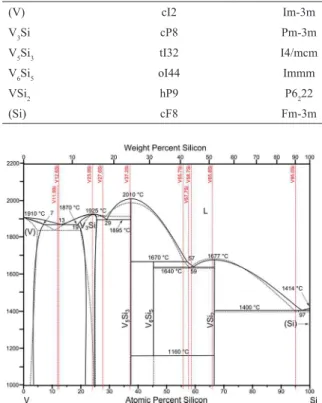
is in good agreement with the phase diagram proposed by Smith2. Figure 1 shows the superposition of the V-Si phase diagram proposed by Smith2 and that calculated by Zhang et al.5 where the vertical lines indicate the nominal compositions of the alloys prepared in this work.
Recent investigations carried out in our group6-10 have contributed to better description of phase diagrams of several Me-Si (Me-metal) binaries, revealing the need to
reevaluate the phase relations in these systems. Thus, in this
work the invariant reactions involving the liquid phase of the V-Si system have been reevaluated via microstructural characterization of as-cast alloys.
2. Experimental Procedure
V-Si alloys with masses between 2 and 8 g were prepared by arc melting V (min. 99.8 wt.%) and Si (min. 99.998 wt.%) under argon (min. 99.995%) in a water-cooled copper
hearth using non-consumable tungsten electrode and Ti
a Escola de Engenharia de Lorena - EEL, Universidade de São Paulo - USP, Estrada Municipal do
Campinho, s/n, 12600-000, Lorena, SP, Brazil
b Universidade Federal Rural do Rio de Janeiro - UFRRJ. Rodovia BR 465, Km 7, 23851-970,
Seropédica, RJ, Brazil
c Instituto de Engenharia Mecânica - IEM, Universidade Federal de Itajubá - UNIFEI, Avenida BPS,
1303, 37500-903, Itajubá, MG, Brazil
d Núcleo de Pesquisa - Centro Universitário de Volta Redonda - UniFoa, Avenida Paulo Erlei
Table 1: Crystallographyc data11 of the stable solid phases in the V-Si system.
Phase Pearson symbol Space Group Strukturbericht designation Prototype
(V) cI2 Im-3m A2 W
V3Si cP8 Pm-3m A15 Cr3Si
V5Si3 tI32 I4/mcm D8m W5Si3
V6Si5 oI44 Immm … V6Si5
VSi2 hP9 P6222 C40 CrSi2
(Si) cF8 Fm-3m A4 C (Diamond)
Figure 1: V-Si Phase Diagram proposed by Smith2 (solid lines)
and Zhang et al.5 (dashed lines). Vertical lines indicate the assumed
compositions of the alloys prepared in this work.
getter. Five melting steps were carried out for each alloy to produce chemically homogeneous samples. After melting the alloys were weighted to evaluate possible mass losses during arc melting.
The alloys were characterized through scanning electron
microscopy (SEM) in the back-scattered electron mode (BSE), Energy-Dispersive X-ray Spectroscopy (EDS) and
X-ray difraction (XRD).
For the SEM/EDS analyses the alloys were hot mounted
in resin, ground with SiC abrasive paper (#120 → #4000) and polished with colloidal silica suspension (OP-S). The images were obtained in a 1450VP (LEO) and TM3000 (Hitachi) SEM instruments. The EDS analyses were carried out using a Swift ED3000, Oxford Instruments.
For the XRD experiments, the as-cast alloys were
mechanically ground and sieved to below 80 Mesh (177 µm).
The measurements were carried out at room temperature using Ni-iltered Cu-Kα radiation in an Empyrean (Panalytical) difractometer. The measurement conditions were 20°<2θ<90°, 0.02° step. The phases were identiied based on Villars and
Calvert crystallographic data11 and the Powder Cell software12.
The liquid compositions of the invariant reactions were
estimated based on the microstructure of the alloys: either according to the transitions of primary precipitation between two consecutive samples or when the microstructure of the
sample was 100% eutectic. In the irst case the estimated
composition for the liquid is the average between the calculated compositions attributing the mass loss to Si in the two consecutive samples. In the second case it is the average between the nominal composition and the calculated one attributing mass loss to Si.
3. Results and Discussion
The results will be presented according to the Si contents of the alloys, from the lowest to the highest. Table 2 shows
the chemical compositions of the alloys prepared in this work, i.e. their nominal composition and their composition range based on the mass losses occurred during the arc melting (attributing all the mass losses to either V or Si). In the
following text as well as in Figure 1, the alloys are referred
to their calculated compositions attributing all the mass losses
to Si vaporization (column 4 of Table 2). Table 3 indicates
the phases present in each alloys, as determined via XRD.
The XRD results of V11.9Si and V12.6Si alloys have
indicated the presence of (V) and V3Si in their microstructure. Figure 2 (a, b) shows SEM/BSE micrograph of these alloys where an eutectic formed by (V) and V3Si is observed in both of them. However, the V11.9Si alloy presents primary precipitation of (V) while V12.6Si alloy shows primary precipitation of V3Si. The presence of (V) primary precipitates in V11.9Si alloy and of V3Si in V12.6Si alloy indicates that the liquid eutectic composition is in the 11.9 - 12.6 at.% Si (i.e. 12.3 ± 0.3 at.% Si) interval, which is between 10.8 assessed by Zhang et al.5 and 13 at.% proposed by Smith2.
The XRD results of V23.9Si alloy have shown only
V3Si phase in the microstructure of this alloy, conirmed
by single-phase observation in the SEM/BSE analysis. This result conirms the congruent formation of V3Si phase, in agreement with the proposal of Smith2 and Zhang et al.5.
The XRD results of the V27.6Si alloy have indicated
Table 2: Compositions of the alloys produced in this work.
Alloy Composition (a) Nominal composition (at. % Si) (b) Mass loss during arc-melting(%) Composition Range (at. % Si)
(c) (d)
V11.9Si 11.96 0.02 11.93 11.97
V12.6Si 13.00 0.28 12.57 13.03
V23.9Si 24.00 0.09 23.89 24.02
V27.6Si 28.02 0.36 27.61 28.11
V37.2Si 37.50 0.33 37.19 37.60
V55.7Si 56.01 0.54 55.68 56.24
V57.7Si 58.01 0.60 57.67 58.27
V58.7Si 58.97 0.42 58.74 59.15
V65.8Si 66.70 1.96 65.85 67.63
V95.0Si 94.98 2.55 94.84 96.39
(a) Adopted composition; (b) composition based on the weighted masses of V and Si, before arc melting; (c) calculated composition attributing mass losses to Si; (d) calculated composition attributing mass losses to V.
Table 3: XRD identiication of the phases present in the alloys produced in this work.
Alloy Phase 1 Phase 2 Phase 3
V11.9Si (V) V3Si
V12.6Si (V) V3Si
V23.9Si V3Si
V27.6Si V3Si V5Si3
V37.2Si V5Si3
V55.7Si V5Si3 V6Si5 VSi2
V57.7Si V6Si5 VSi2
V58.7Si V6Si5 VSi2
V65.8Si VSi2
V95.0Si VSi2 (Si)
Figure 2: SEM/BSE micrograph of: (a) V11.9Si; (b) V12.6Si as-cast alloys.
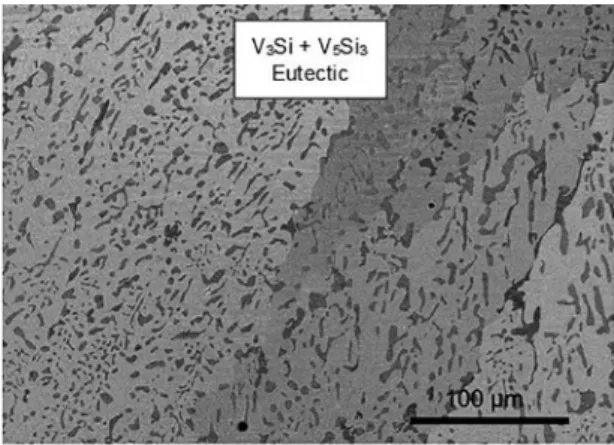
Figure 3: SEM/BSE micrograph of the V27.6Si as-cast alloy.
The XRD results of V37.2Si alloy have indicated only
V5Si3 phase in its microstructure, supported by the SEM/BSE
analysis. This result conirms the congruent formation of the
V5Si3 phases, in agreement with Smith2 and Zhang et al.5. Figure 4 shows SEM/BSE micrographs of the V55.7Si (a, b), V57.7Si (c) and V58.7Si (d) alloys. XRD results have indicated the presence of V6Si5 and VSi2 in all these alloys as well as V5Si3 in the V55.7Si alloy. SEM/BSE micrographs from all these alloys presented a eutectic formed by V6Si5 and VSi2 in the last regions to solidify. Alloy V55.7Si micrograph shows small fractions of V5Si3 primary precipitation and pro-eutectic V6Si5. The microstructure of V57.7Si alloy presents near fully V6Si5 + VSi2 eutectic microstructure and few V6Si5 primary precipitates. The micrograph of V58.7Si alloy shows primary precipitation of VSi2. The presence of V5Si3 primary precipitates in the V55.7Si alloy and V6Si5 primary precipitates in the V57.7Si alloy suggests that the composition of the liquid in the peritectic reaction involving V6Si5 is between 55.7 and 57.7 at.% Si (i.e. 56.7 ± 1.0 at.% Si) in accordance (considering the estimated error) with the 57 at.% proposed by Smith2 and 56.2 at.% proposed by Zhang et al.5. The presence of V
Figure 4: SEM/BSE micrographs of the: (a,b) V55.7Si, (c) V57.7Si and (d) V58.7Si as-cast alloys.
alloy and VSi2 primary precipitates in V58.7Si alloy indicates that the composition of the liquid in the V6Si5 + VSi2 eutectic is between 57.7 and 58.7 at.% Si (i.e. 58.2 ± 0.5 at.% Si). Our proposed composition for the eutectic liquid is between 57.6 (assessed by Zhang et al.5) and 59 at.% (proposed by Smith2).
The XRD results of V65.8Si alloy have indicated only
the VSi2 phase. The SEM/BSE micrographs of this alloy have shown a major VSi2 microstructure, conirming the congruent formation of VSi2 as proposed by Smith2 and Zhang et al.5.
The XRD results of the V95.0Si alloy have indicated the
presence of VSi2 and (Si) in its microstructure. Figure 5 shows a SEM/BSE micrograph of this alloy with a fully eutectic microstructure formed by VSi2 and (Si). The presence of a 100% eutectic microstructure indicates that the composition of the liquid in the VSi2 + (Si) eutectic is between 94.8 and 95.0 at.% Si (i.e. 94.9 ± 0.1 at.% Si). Our proposal for the liquid composition is richer in V than the 97 at.% proposed by Smith2 but in agreement with the assessment of Zhang et al.5.
Figure 5: SEM/BSE micrograph of the V95.0Si as-cast alloy.
Table 4: Liquid compositions at invariant reactions in the V-Si system.
Invariant reaction Liquid Composition, at.% Si Liquid Composition, at.% Si Liquid Composition, at.% Si
Zhang et al.5 Smith2 This work
L ↔ (V) + V3Si 10.8 13 12.3 ± 0.3
L ↔ V3Si 25 ~24 (a) Not evaluated
L ↔ V3Si + V5Si3 27.8 ~29 27.8 ± 0.2
L ↔ V5Si3 37.5 37.5 Not evaluated
L + V5Si3 ↔ V6Si5 56.2 57 56.7 ± 1.0
L ↔ V6Si5 + VSi2 57.6 ~59 58.2 ± 0.5
L ↔ VSi2 66.7 66.7 Not evaluated
L ↔ VSi2 + (Si) 94.7 97 94.9 ± 0.1
(a) Approximate value obtained by reading the phase diagram
The microstructural analysis of these alloys, therefore, conirms all the solid phases and invariant reactions in the V-Si phase diagram. The proposal for the liquid phase compositions in the invariant reactions is summarized in Table 4.
4. Conclusions
The results of microstructural characterization (SEM/BSE
study conirmed the solid phases, the nature of the invariant
reactions and determined new compositions for the liquid participating in certain invariant reactions of this system.
The compositions of the liquid phase that participates in the
invariant reactions are suggested as: (1) In the (V)+ V3Si eutectic the liquid composition is 12.3 at.% Si; (2) In the V3Si + V5Si3 eutectic the liquid composition is 27.8 at.% Si; (3) In the V5Si3 + L peritectic the liquid composition is 56.7 at.% Si; (4) In the V3Si + V5Si3 eutectic the liquid composition is
58.2 at.% Si; and inally in (5) In the VSi2 + (Si) eutectic the liquid composition is 94.9 at.% Si.
5. Acknowledgements
Belmira Benedita de Lima-Kühn acknowledges CAPES
for the inancial support. The authors also acknowledge Wah
Chang (Albany, OR, USA) for providing the vanadium used in this work.
6. References
1. Smith JF. The Si-V (Silicon-Vanadium) System. Bulletin of Alloy Phase Diagrams. 1981;2(21):42-48.
2. Smith JF. The Si−V (Silicon-Vanadium) system: Addendum. Bulletin of Alloy Phase Diagrams. 1985;6(3):266-271.
3. Schlesinger ME. Thermodynamics of solid transition-metal
silicides. Chemical Reviews. 1990;90(4):607-628.
4. Jorda JL, Muller J. The V3Si phase: Type of formation and
homogeneity range. Journal of the Less Common Metals. 1982;84:39-48.
5. Zhang C, Du Y, Xiong W, Xu H, Nash P, Ouyang Y, et al.
Thermodynamic modeling of the V-Si system supported by key experiments. Calphad. 2008;32(2):320-325.
6. da Silva AAAP, Ramos ECT, Faria MIST, Coelho GC, Nunes CA. The Ta-Si System: Reevaluation of the Liquid Compositions
in the Invariant Reactions and Determination of the Invariant
Reaction Involving Both βTa5Si3 and αTa5Si3 Phases. Journal
of Phase Equilibria and Difusion. 2015;36(3):209-217.
7. Gigolotti JCJ, Nunes CA, Suzuki PA, Coelho GC. Evaluation of Phase Equilibria Involving the Liquid Phase in the Hf-Si System. Journal of Phase Equilibria and Difusion. 2014;35(5):622-630.
8. Chad VM, Faria MIST, Coelho GC, Nunes CA, Suzuki PA.
Microstructural characterization of as-cast Cr-Si alloys. Materials Characterization. 2008;59(1):74-78.
9. Baldan R, Faria MIST, Nunes CA, Coelho GC, Chad VM, De Avillez RR. Microstructural Evidence of βCo2Si-phase Stability
in the Co-Si System. Journal of Phase Equilibria and Difusion. 2008;29(6):477-481.
10. Nunes CA, Coelho GC, Ramos AS. On the invariant reactions in the Mo-rich portion of the Mo-Si system. Journal of Phase Equilibria. 2001;22(5):556-559.
11. Villars P, Calvert LD. Pearson’s handbook of crystallographic data for intermetallic phases. 2nd ed. Materials Park: ASM International; 1991.
12. Kraus W, Nolze G. PowderCell for Windows (version 2.3).
Berlin: Federal Institute for Materials Research and Testing;