Resumo
Esse artigo apresenta as observações geológicas, petrográicas e geomorfológicas do neck subvulcânico de rocha alcalina máica do Pico do Cabugi, RN. Esse maciço tem 370 m de altura relativa e cerca de 0.4 km3 de volume total. É constituído,
princi-palmente, pelo Ortognaisse Caicó. O neck está exposto no topo do maciço formando uma saliência cônica de 160 m de altura relativa e 500 m de diâmetro. O volume
da rocha alcalina máica é 0,056 km3, ocupando 14% do maciço. A forma geral do
maciço é fortemente convexa com o MCI (Índice de Macro Concavidade) de -2.3. O neck é constituído por álcali microgabro rico em olivina no centro e por álcali dolerito na zona de contato. Observam-se disjunções colunares bem desenvolvidas com diâ-metro típico de 60 cm. As disjunções colunares são de alto ângulo no centro do neck e sub-horizontais na zona de contato. Na Planície Sertaneja, não foram observados aloramentos de vala de rochas alcalinas máicas, outros depósitos eruptivos ou debrís de rochas vulcânicas. Essas observações permitem concluir que o edifício vulcânico e os depósitos eruptivos do inal do Oligoceno foram removidos completamente pelo so-erguimento posterior e consequente denudação regional e que a superfície atual é, sig-niicativamente, mais baixa do que aquela da época da erupção. Os aloramentos do Pico do Cabugi exibem a estrutura geológica subterrânea do vulcão do Oligoceno. A morfologia original do vulcão não é mais preservada e a saliência morfológica atual é atribuída à erosão diferencial do neck subvulcânico. Conforme a deinição vulcanoló-gica, a morfologia atual do Pico do Cabugi não é classiicada como um vulcão extinto.
Palavras-chave: Pico do Cabugi, Rio Grande do Norte, olivina microgabro, neck subvulcânico, magmatismo alcalino de Macau, erosão diferencial.
Abstract
This article reports geologic, petrographic, and geomorphological observations of the maic alkaline subvolcanic neck of the Cabugi Peak, located in the State of Rio Grande do Norte, Brazil. The massif is 370 m high and has 0.4 km3 of total volume. It is constituted mainly by Caicó orthogneiss. The neck is exposed on the top of the massif forming a conical morphologic protrusion with relative height of 160 m and diameter of 500 m. The volume of the maic alkaline rock is 0.056 km3 occupying 14% of the whole massif. The general form of the massif is strongly convex with the MCI (Macro Concavity Index) of -2.3. The neck is constituted by olivine-rich alkaline micro-gabbro in the centre and alkaline dolerite at the contact zone. There are well-developed cooling columnar joints with typical diameter of 60 cm. They
Subvolcanic neck of Cabugi
Peak, State of Rio Grande
do Norte, Brazil, and origin
of its landform
Neck subvulcânico de Pico do Cabugi, RN,
e origem do seu relevo
Akihisa Motoki
Departamento de Mineralogia e Petrologia Ígnea, Universidade do Estado do Rio de Janeiro [email protected]
Thomas Ferreira da Costa Campos Departamento de Geologia,
Universidade Federal do Rio Grande do Norte [email protected]
Vanildo Pereira da Fonseca Departamento de Geologia,
Universidade Federal do Rio Grande do Norte [email protected]
Kenji Freire Motoki Departamento de Geologia, Universidade Federal Fluminense [email protected]
are steep at the centre of the neck and sub-horizontal at the contact zone. On the foothill surface, called Sertaneja surface, no outcrops of maic alkaline lava, other eruptive deposits, or volcanic rock debris have been observed. These observations allow a conclusion that the volcanic ediice and eruptive deposits of the late Oligocene were completely removed by later uplift and consequent regional denudation and that the present-day surface is signiicantly lower than that of the eruption time. The outcrops of the Cabugi Peak exhibit the underground geologic structure of the late Oligocene volcano. The original volcano form is not preserved anymore and the present morphologic elevation is attributed to differential erosion of the subvolcanic neck. According to the volcanological deinition, the present-day morphology of the Cabugi Peak is not classiied as an extinct volcano.
Keywords: Cabugi Peak, Rio Grande do Norte, olivine micro-gabbro, subvolcanic neck, Macau alkaline magmatism, differential erosion.
1. Introduction
The Cabugi Peak (Pico do Cabugi) is located in the central region of the State of Rio Grande do Norte, Brazil, at the coordinates of N05°42.3’, W36º19.3’, about 7 km to the west of Lages city and 120 km to the west of Natal city (Figure 1). This massif has 370 m of relative height and its top exposes a neck of maic alkaline rocks (Sial, 1978; Silveira et al., 2002). It is a member of the Cenozoic Macau maic alkaline magma province (Mizusaki, 1989; Souza et al., 2007), which is attributed to a hot-spot track (Sial, 1978). These mafic rocks were studied either in terms of geochemistry or geochronology (e.g. Sial, 1976; 1978; Silveira et al., 2002), having a K-Ar age of 19.7 Ma, whole-rock Ar-Ar age of 23.7 ± 1.2 Ma (Archanjo & Brito Neves, 2001),
and high accuracy whole-rock Ar-Ar age of 24.6 ± 0.8 Ma (Souza et al., 2003). Recent Ar-Ar datings show late Oligocene ages, 24.6 ± 0.8, 24.8 ± 0.3, 25.5 ± 0.4Ma, and 25.5 ± 0.6 (Silveira, 2006). The rocks of the Cabugi Peak have normative nepheline, SiO2 varying from 39% to 45%, and are characterised by enrichment of Ti, K, Sr, and Ba (Souza et al., 2003). The Sr isotope ratio varies from 0.7039 to 0.7044 (Sial et al., 1981), which indicates their origin from enriched mantle.
The peculiar landform of the Cabugi Peak (Figure 2) seems to be of an extinct volcano. This idea was transmitted mainly by non-academic sources. However, no revised scientiic article with volcanologi-cal discussions has been published, and therefore, its geologic mode of occurrence
is still unclear. There are two possible hypotheses: 1) The present morphologi-cal elevation is attributed directly to the volcanic ediice; 2) The original volcanic ediice was completely removed by later regional uplift and consequent deep denu-dation and the present-day morphology is originated from differential erosion of subvolcanic neck, that is, underground geologic structure beneath the late Oli-gocene volcano.
This article presents geologic, litho-logic, and geomorphological observations of the Cabugi Peak, State of Rio Grande do Norte, Brazil, and petrographic de-scription of its constituent maic alkaline rocks. Based on the data, the authors discuss its geologic emplacement mode and the origin of the present landform.
Figure 1
Locality map of the Cabugi Peak, State of Rio Grande do Norte, Brazil, based on Shuttle Radar Topographic Map (SRTM) processed by GeoMapApp™.
Figure 2
General view of the Cabugi Peak from the BR-304 national freeway. The relative height is about 370 m. RN
Natal Brazil
100 km
State of Rio Grande do Norte
Macau
Lages
2000 km
Açu
Angicos
Lajes
Santana do Matos
Lagoa Nova Cabugi Peak
37°00' 36°40' 36°20' 36°00'
Longitude (W)
L
a
tit
u
d
e
(
S
)
6°00'
6°10' 5°50' 5°40'
N
2. Ge
omorphological analyses
For the geomorphological analy-ses, the authors have adopted digital elevation model of ASTER sensor component of the TERRA satellite,
called GDEM (Global Digital
Eleva-tion Map), with horizontal resolu-tion of 30 m. In order to express the morphology in a better manner, the drainages narrower than 60 m wide are virtually filled using summit level technique (Motoki et al., 2008a; 2009a; Fortes et al., 2010). The above-mentioned operations have been
performed by the original software system BAZ (Basic Applications of Ze-nith geomorphological tools) ver. 1.0, build 72 (Motoki & Motoki, 2011).
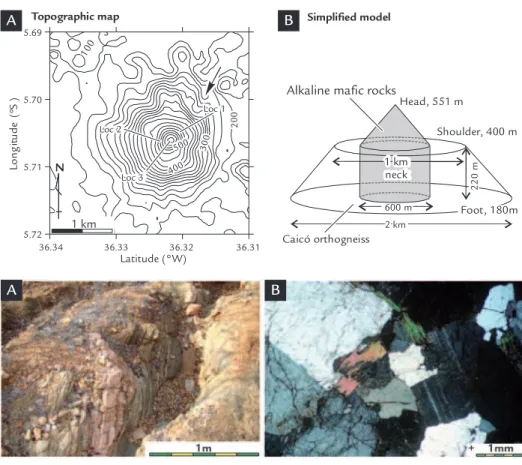
The ASTER GDEM shows that the Cabugi Peak is a small mountain, about 370 m high, standing up on the regional peneplane-like surface with altitude of 180 m, called locally Sertaneja surface (Planície Sertaneja). The highest point is 551 m above sea level (Figure 3). The Sertaneja surface exposes Archaean to Palaeoproterozo-Archaean to Palaeoproterozo-
Palaeoproterozo-ic high-grade migmatitPalaeoproterozo-ic orthogneiss of the basement, called Caicó Com-plex (Souza et al., 1996; Jardim de Sá et al., 1995).
The Cabugi Peak has a circular truncated cone-like general form, so-called “Shoulder” (Figure 4). The di-ameter of the base circle is 2.0 km and that of the top circle is 1.0 km. The Shoulder is constituted by migmatitic orthogneiss of the Caicó Complex. On the top of the Shoulder with altitude of 400 m, a conical morphologic
pro-Figure 3 Landform of the Cabugi Peak and adjacent
area based on the ASTER GDEM: A) Topographic map. B) Simpliied morphologic model. The drainages narrower than 60 m are illed virtually by the summit level technique.
Figure 4 Orthogneiss of the Caicó Metamorphic
Complex, the basement of the Cabugi Peak maic alkaline subvolcanic neck: A) Field occurrence. B) Photomicrography.
trusion occurs, called “Head”. The Head is 500 m in diameter and 160 m in relative height, and is made up of maic alkaline rocks.
According to the pixel counting met hod (Motok i et a l., 20 07a), using the original software Wilbur (Motoki et al., 2006), the volume of the Shoulder above the Sertaneja
surface is about 0.40 km3 and that
of t he He ad is 0.012 k m3. T he
d ist r ibut ion a re a for t he m a f ic alkaline rocks is 0.20 km2. The mafic
alkaline neck has approximately cylindrical form and it is intrusive into the basement gneiss. The neck
volume is 0.056 km3, corresponding
to only 14% of the whole massif (Figure 3B). In case the neck is of
slightly funnel-shaped form, the volume would be smaller. The small distribution area of mafic alkaline rocks is comparable with the other intrusive rock bodies of the Macau magmatic province.
The geomorphological analyses show that the erosion effects of the drainages are small, either on the Shoulder or on the Head. On the Shoulder, the largest drainage is 30 m deep (Figure 3, arrow). On the Head, no drainage is recognised.
The Macro Concavity Index (MCI; Motoki & Motoki, 2011) for the Cabugi Peak is strongly negative, being -2.3, indicating that the massif is remarkably convex in three-dimen-sional form (Figure 5A).
According to the Figure 5B, the active and young volcanoes have slightly positive MCI because of the original stratovolcano landform. When they are eroded, the mountain slope will be more concave and the MCI will be higher.
On the other hand, felsic alkaline rocks are mechanically very firm (Petrakis et al., 2009) and form convex-form massifs with remarkably negative MCI. The MCI value of the Cabugi Peak, -2.3, is minor than that of the alkaline massifs, suggesting that the massif is of high erosive resistance. This strongly negative MCI is favourable to differential erosion hypothesis, but unsuitable to an eroded extinct volcano.
1 km
400 100
300
2
0
0
36.34 36.33 36.32 36.31
Latitude (°W)
Lo
n
g
it
u
d
e
(
°S
)
5.69
5.70
5.71
5.72
500
Topographic map
Shoulder, 400 m Head, 551 m
Simplified model
Caicó orthogneiss Alkaline mafic rocks
N
Loc 1
Loc 2
Loc 3
2 km
2
2
0
m
neck 1 km
600 m Foot, 180m
A B
3.
F
ield observations
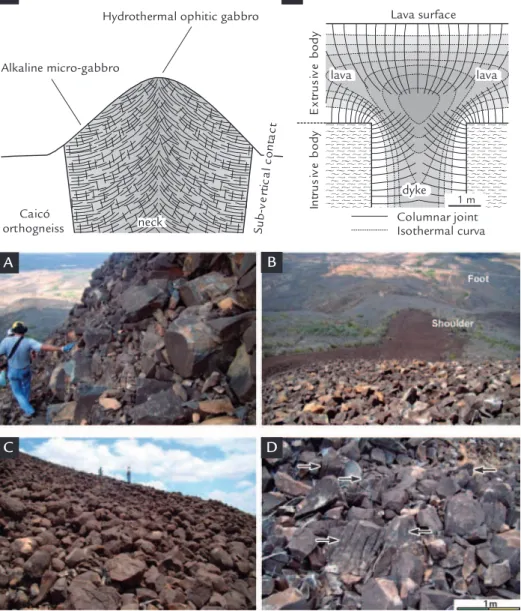
The Head is constituted by maic alkaline rocks and covered by its blocks with representative size of 60 cm. The slope of the Head is of high angle, about 30º, corresponding to the maximum stability angle for dry solid objects. At some localities, there are outcrops, which are characterised by hexagonal columnar joints, because of removal of the blocks by surface collapse. The largest outcrop, about 60 m long and 30 m wide, is located at the northwest slope (Loc. 1, Figure 3A). The columnar joints of the central part of the neck are of high-angle (Figure 6A, arrow H), and these of the border zone are of low-angle (Figure 6A, arrow L). The columnar joints close to the contact are sub-horizontal (Loc. 2, Figure 3; 6B).
Lava lows and shallow subsurface intrusive bodies, such as sill, generally have sub-vertical columnar joints, for example: Columbia River Basalt (e.g. Spry, 1962; Long & Wood, 1986); Devil’s Tower,
Wyoming (Robinson, 1956); Sheepeater
Cliff, Yellowstone National Park (Harris & Kiver, 1985); Palisades Sill, New Jersey (Spry, 1962); Shiprock, New Mexico, USA (Delaney & Pollard, 1981); Cerro
Re-dondo, Santa Cruz, Argentina (Schilling et al., 2005). Vertical columnar joints of lava lows indicate that the magma cooled by surface thermal irradiation.
On the other hand, early Cretaceous tholeiitic dykes of the State of Rio de Janeiro, Brazil, related to the magmatism of the Paraná basaltic province, have well-developed horizontal columnar joints (Motoki et al., 2009b). They were em-placed at a depth of about 5 km (Motoki & Sichel, 2008; Motoki et al., 2008b) and cooled by thermal conduction to the dyke wall. Similar Cretaceous tholeiite dykes are exposed on the Sertaneja sur-face (Angelim et al., 2006), also showing horizontal columnar joints.
The Devil’s Tower is an intrusive body of cylindrical form with highly de-with highly de-veloped vertical columnar joints. On the other hand, the Cabugi Peak has oblique to sub-horizontal columnar joints (Figure 6; 8A). The angle of the columnar joints indicates thermal flow direction dur-ing the magma cooldur-ing (Jiang & Chen, 2004; Figure 7B). The columnar joint direction indicates that the cooling effect of the Earth’s surface is strong for Devil’s
Tower but that for the Cabugi Peak is less expressive. In this sense, the Cabugi Peak subvolcanic neck could have been emplaced at a site deeper than the Devil’s Tower, but not as deep as tholeiite dykes with horizontal columnar joints.
The block layer on the Head is 5 to 10 m thick and it is composed of angular maic alkaline rocks. They are originated from the columnar joints and have hex-agonal column form (Figure 8A). Many blocks have fresh fragmentation surfaces. The Shoulder top generally exposes or-thogneiss of the Caicó Complex, but is covered by maic alkaline blocks at few localities (Figure 8B). The blocks on the Shoulder tend to be slightly rounded (Fig-ure 8C), showing node rounding. How- How-ever, hexagonal edges are often preserved. These observations indicate that the block tumbling is still very active and the Head is in on-going surface collapse process. The neck was exposed at the surface in a recent geologic time.
On the other hand, no outcrops of maic alkaline lava, pyroclastic eruptive deposits or volcanic rock debris have been observed. The foothill of the Sertaneja Figure 5
The MCI diagram for the Cabugi Peak according to the method of Motoki & Motoki (2011): A) Projection of summit level vs. the difference between summit level and base level of grid interval of 480 m; B) MCI for the Cabugi Peak compared with young volcanoes and nepheline syenite intrusive massifs. OSR - Osorno Volcano, Chile; PYN - Payún Liso Volcano, Argentina; DMN - Cerro de Diamante Volcano, Argentina; NVD - Nevado Volcano, Argentina; MDN - Mendanha nepheline syenite massif, Brazil; MSJ - Morro de São João nepheline syenite massif, Brazil.
Figure 6
Columnar joints of the maic alkaline rock at the Head of the Cabugi Peak, State of Rio Grande do Norte, Brazil: A) Transition from high-angle joint at the central part of the neck (arrow H) to low angle ones at the border (arrow L). B) Horizontal columnar joints close to the contact.
-0.0023x +2.0334x-261.59 R =0.899
2
2
0
Summit level hight (m)
0 100 200
MCI = -2.3
R e lie f a m o u n t (m )
200 400 600
S e rt a n e ja s u rf a c e 2 0 100 200 300 400
OS R
PYN
DMN N
VD
M D
N
0 500 1000 1500
Relative summit level height (m) MSJ
Cabugi, MCI = -2.3
nepheline syenit massif young volcano
Cabugi Peak Comparison
Nephelie syenite massif
MSJ: Morro de São João, MCI = -1.2 MDN: Mendanha, MCI = -0.7
Young volcanoes:
PYN: Payun Liso, MCI = 0.04 OSR: Osorno, MCI = 0.02 NVD: Nevado, MCI = 0.03 DMN: Diamante, MCI = -0.03 Macro Concavity Index (MCI) = a x 1000 (y = ax + bx + c)
Relief amount (Kifukuryo) = summit level (seppomen) - base level (sekkokumen)
A B
Figure 7 Direction change of columnar joints: A) The Cabugi Peak neck, State of Rio Grande do Norte, Brazil, schematic illustration of the authors. B) Lütao dyke-lava system, Pengfu Islands, Taiwan (Jiang & Chen, 2004). Note the similarity between the columnar joint of the Cabugi Peak and dyke part of the Lütao intrusive body.
Figure 8 Maic alkaline rock blocks
covering the Head: A) High-angle slope of the Head covered by hexagonal and fragmented angular blocks. B) View from the top of the Head showing the surface of the Shoulder covered partially by the blocks. C) Slightly rounded blocks on the Shoulder. D) Linear and polygonal cooling cracks (black arrows).
surface exposes the Caicó Complex or-thogneiss and tholeiitic dykes intruded in a deep site. If the Cabugi Peak were an extinct volcano, the above-mentioned volcanic materials must be abundantly present on the Sertaneja surface, especially at the localities close to the Cabugi Peak.
The contact plane between the neck and its country body is a most important subject to be observed, but during the ieldwork no adequate outcrop has been found. Sub-horizontal columnar joints at the contact zone suggest that the contact is sub-vertical. All of the columnar joints
are tilted largely or slightly to the centre of the neck. This observation suggests that the contact plane is of slightly funnel-shaped three-dimensional form, that is, the neck could be open upward. If so, the abundance of the maic alkaline blocks on the Head is easily explained.
Macroscopically, the maic alkaline rocks are relatively coarse-grained, with grain-size of about 1 mm, and contain olivine-rich mantle xenoliths less than 2 cm in size (Figure 9A). There are blocks with linear cracks and curved polygonal crack like turtle’s carapace (Figure 8D,
arrows). Some of them are apparently similar to bread-crust bomb (Figure 9B). These fractures occur only on lateral surfaces of the columnar joints and origi-nated from surface volume contraction by rapid cooling along columnar joint planes (Figure 10).
Bread-crust bombs are character-ised by: 1) Volume expansion; 2) Porous texture by vesicular formation; 3) Elliptic form (e.g. MacDonald, 1972); 4) Vitric; 5) Andesite do dacite composition. The blocs of the Cabugi Peak are featured by: 1) Volume contraction; 2) Massive texture
Figure 9 Peculiar fabrics of the maic alkaline rock blocks: A) Olivine-rich xenoliths (red arrows). B) Polygonal cooling crack on the lateral surfaces of a hexagonal columnar joint.
neck Caicó
orthogneiss
Hydrothermal ophitic gabbro
Alkaline micro-gabbro
Su b-v ert ica l co nta
ct
Lava surface
1 m
Columnar joint Isothermal curva
lava lava
dyke
E
x
tr
u
s
iv
e
b
od
y
In
tr
u
s
iv
e
b
o
d
y
A Cabugi Peak neck B Lütao dyke-lava system, Taiwan
A B
C D
without vesicles (Figure 9A); 3) Hexagonal column form; 4) Holocrystalline; 5) Maic
to ultramafic composition. Therefore, the above-mentioned maic rock blocks
(Figure 9B) are not considered to be bread-crust bombs.
Figure 10
Schematic illustration for the polygonal cooling crack of columnar joint of the Head of the Cabugi Peak.
4.
Pe
trographic observations
The maic alkaline rocks of the Head are made up of olivine, clinopyroxene, plagioclase, opaque minerals, and apatite (Figure 11). According to Sial et al. (1981), the SiO2 contents are 39~45wt%, which correspond to picritic alkaline gabbro of ultrabasic category. In spite of ultrabasic composition, there rocks are not ultramaic. Olivine occurs either as phenocrysts of 1.0 mm in diameter, or in the ground-mass. Some large olivine crystals show resorption texture (Figure 11D). The clinopyroxene is titanoaugite and 0.2 mm to 0.4 mm in size (Figure 11B). Plagioclase takes place as large tabular crystals (Figure 11A) and microliths (Figure 11B, C).
There is a notable textural contrast between the central part of the neck and
the contact zone. The sample of the centre is relatively coarse-grained (Figure 11A). The plagioclase crystals are 1.5 mm x 0.4 mm in size, and the rock is classiied to be olivine-rich micro-gabbro. Alteration of large plagioclase crystals and partial decomposition of the maic minerals into opaque ones are notable. These features suggest metasomatic or hydrothermal alteration, which is commonly observed in the central part of alkaline rock dykes (Motoki et al., 2008b).
The sample of the contact zone is holocrystalline and relatively ine-grained (Figure 11B). According to the crystallinity and grain size, it is classiied to be olivine-rich dolerite. In contrast to the central part of the neck, the rock is fresh without signs
of alteration. The texture is sometimes not typically porphyritic. It is characterised by intermediate-sized olivine and clinopyrox-ene crystals. The plagioclase microliths are 0.08 mm x 0.4 mm (Figure 11C).
Some of the olivine crystals show sign of remelting (Figure 11D) but most of them are idiomorphic without remelting. This observation suggests two different origins. Considering the existence of olivine-rich mantle xenoliths (Figure 9A), the re-melted olivine could be originated from the xenolith. On the other hand, the idiomorphic ones are phenocrysts.
These observations conirm basi-cally the previous description (e.g. Sial et al., 1981; Ferreira & Sial, 1999), but no volcanic glass is recognised.
Figure 11
Photomicrography of the Cabugi Peak maic alkaline rocks: A) Central part of the neck. B) Contact zone of the neck.
C) Tabular plagioclase of the sample B. D) Olivine with resorption texture. Ol – olivine; Pl – plagioclase.
5. Extinct volcano or shallow intrusive body?
The idea of the Cabugi Peak as an extinct volcano was proposed by Moraes
(1924). He considered that the present morphology is originated directly from
the volcanic ediice without notable ero-sive effects (Figure 12A). That is, the late
Rapid cooling
V
o
lu
m
e
c
o
n
tra
c
ti
o
n
Cooling fracture Columnar joint
A B
Oligocene volcanic landform is almost perfectly preserved up to the present. Most of the non-academic sources (e.g. Rocha & Nascimento, 2007; Barros, 2009; Jornal do Turismo, 2011) adopted this opinion and call it as “the only one Brazilian extinct volcano with preserved original form”.
Souza et al. (2002), Paiva et al. (2004), and Nascimento et al. (2006) accepted the volcano model, but with some modiications. There was a volcanic ediice larger than present morphology of the Cabugi Peak and its lateral slope
was deeply eroded remaining the central conduit illed by magma, that is, neck (Figure 12B). The original volcanic land-form is no more preserved. These authors used the term “neck” as the conduit illed by consolidated magma at the centre of the volcanic ediice, that is, cylindrical magma feeder above the surface level of the eruption time. However, the geologic term “neck” corresponds to the cylindrical magma feeder either above or under the original surface (MacDonald, 1972). In order to distinguish the both types, the authors adopt the expression “neck in the
volcanic ediice” for the former (Figure 12B) and “subvolcanic neck” for the latter (Figure 12C).
The models A and B of Figure 12 consider that the Cabugi Peak is an ex-trusive volcanic rock body. In addition, the surface of the Oligocene was the same of the present, without regional denuda-tion. Therefore, the present position of the Cabugi Peak is above the surface of the eruption time. Rolff (1965) and Sial (1978) described it as a neck or plug. But no clear model for the geologic emplace-ment was expressed.
Figure 12 Comparative illustration of the models for geologic emplacement mode of the Cabugi Peak maic alkaline rock body: A) Preserved extinct volcano (Moraes, 1924). B) Eroded volcanic ediice (e.g. Souza et al., 2002; Paiva et al., 2004; Nascimento et al., 2006). C) Subvolcanic neck, proposal of the present paper.
The present study has clariied that the Cabugi Peak neck is characterised by: 1) Cylindrical or slightly funnel-shaped three-dimensional rock body form; 2) High-angle columnar joints at the centre of the neck and sub-horizontal ones, at the contact zone; 3) Centre of the neck constituted by olivine-rich micro-gabbro and the border, by olivine-rich dolerite; 4) Distribution of the maic alkaline rock in very restrict, in an area of 0.20 km2; 5)
Absence of maic alkaline lava, eruptive deposits, and volcanic rock debris on the Foot plane of the Sertaneja surface; 6) The three-dimensional form of the massif is strongly convex, with strongly negative MCI of -2.3.
The models of volcano and eroded volcano (Figure 12A, B) have incompat-ibilities with the present observations. The magma of the Cabugi Peak is of ultrabasic composition and has low viscosity and high luidity. If the Cabugi Peak were an extinct volcano, the eruptive materials, such as lava low and pyroclastic depos-its, should be present extendedly on the Sertaneja surface. In addition, the blocks originated from the eroded part of the vol-canic ediice should be present abundantly. However, in fact, no such materials have been observed. The strictly limited distri-bution area is unfavourable to an extinct volcano hypothesis.
If the Head were the central conduit
in the volcano, that is, the neck in the vol-canic ediice, the Shoulder must be a part of the volcanic ediice (Figure 12B). How-ever, the Shoulder is made up of the Caicó orthogneiss. If the maic alkaline rocks were constituent of an extrusive body, the rocks should be vitric or very ine-grained and porous, and the columnar joints should be vertical. However, the rocks are holocrystalline massive micro-gabbro or dolerite and the joints are sub-horizontal at the contact zone.
If the Cabugi Peak were eroded volcanic ediice and not a morphological elevation originated from differential ero-sion of a subvolcanic intrusive body, the general massive form should be concave
A
B
C
Oligocene surface original vonlcano (extrusive body)
present surface
early Oligocene surface = present surface Volcano
Without erosion, without denudation
Eroded volcano
With erosion, without denudation
Subvolcanic neck
Deep denudation
d
e
n
u
d
a
ti
o
n
Shoulder Head
present landform Oligocene landform
= present landform
volcano
subvolcanic neck (intrusive body)
Foot
erosion erosion
and the MCI should be positive. However, its three-dimensional form is convex, with a strongly negative MCI, of -2.3. These facts indicate that the Cabugi Peak neck is not an extrusive body at the surface, but an intrusive one emplaced at an un-derground site.
Ferreira & Sial (1999) interpreted the blocks with polygonal cooling frac-tures on the lateral surfaces of the colum-nar joint (Figure 8D, 10B) as bread-crust bombs. Such bombs are formed by volume expansion by vesiculation of vitric essen-tial fragments, that is, the magma drops ejected from the crater in consolidation process. However, the blocks in ques-tion are holocrystalline and massive, and not, vitric and porous. Bread-crust bomb occurs in the eruption of high viscosity magmas, such as andesitic, dacitic, and trachytic ones, represented by Vulcanian eruption (MacDonald, 1972). However, the blocks of the Cabugi peak are consti-tuted by holocrystalline olivine-rich alka-line micro-gabbro or dolerite of ultrabasic composition, and therefore, such magma cannot generate bread-crust bomb.
Considering the previous discus-sions, the authors propose a subvolcanic
neck model for the Cabugi Peak. The Earth’s surface of eruption time of the late Oligocene was not the same height of the present regional level of the Ser-taneja surface, but it was much higher. The volcanic ediice was emplaced on this previous surface. However, later regional uplift and consequent deep denudation removed completely the volcanic ediice and eruptive deposits. At the present, only the underground conduit is left as a subvolcanic neck (Figure 12C).
The Sertaneja surface has wide and shallow morphologic depressions originated from lateral river erosion. The surface is close to be an elevated peneplane but it is not completely in ero-sive equilibrium. In this sense, the regional denudation is still active in spite that it is not so strong.
The model of the Figure 12C is similar to that of the alkaline intrusive complexes with pyroclastic bodies of the State of Rio de Janeiro, such as Mendanha (Motoki et al., 2007b), Itaúna (Motoki et al., 2008c), Tanguá, Rio Bonito, Soarinho (Motoki et al., 2010), Morro dos Gatos (Motoki et al., 2011), and Cabo Frio Island (Sichel et al., 2008). The original surface
has been removed by later uplift and con-sequent regional denudation. The magma chambers and subvolcanic conduits 3 km below the prior surface are exposed at the present-day surface (e.g. Motoki & Sichel, 2006; Motoki et al., 2008d).
The geologic expressions “volca-no” and “volcanic ediice” are deined as a morphologic elevation formed directly by eruptions and consequent accumula-tion of eruptive materials on the Earth’s surface (e.g. MacDonald, 1972; Bates & Jacson, 1987). The positive relieves originated from differential erosion of intrusive bodies, such as dyke and sub-volcanic neck, are not classiied to be extinct volcanoes.
For example, the Chachahuén Vol-cano and the Plateado VolVol-cano, Mendoza Province, Argentina are deeply eroded stratovolcanoes (Bermudez et al., 1993). In spite of the strong erosion effects, the denudation is null. The surface of the erup-tion time is the same of the present. The present-day topographic elevations are directly delivered from volcanic ediices and not because of differential erosion. Therefore, they are classiied to be eroded extinct volcanoes.
6.
In
terpretation of eruption mode
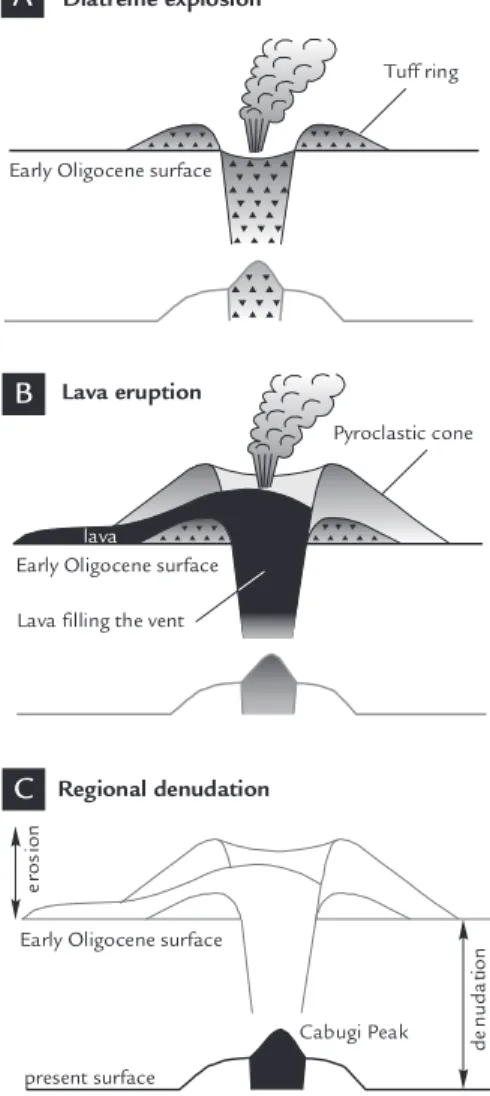
Low viscosity magmas, such as of al-kaline olivine gabbro, rise up in the upper crust by means of dyke intrusion. When the magmas arrive at the surface, a issure eruption takes place. In this case, large cylindrical conduits, such as the Cabugi subvolcanic neck, are unnecessary.
Cylindrical or slightly funnel-shaped subvolcanic conduits are formed by explo-sive eruptions. Some maic to ultramaic alkaline magmas have high luid contents
and it causes explosive eruption forming tuff volcano and upward opened funnel-shaped conduits called diatreme(Figure 13A). When a large amount of magma is provided just after the explosive eruption, the diatreme vent space is illed by magma (Figure 13B).
After the eruption, deep regional denudation occurred. The volcanic ediice, eruptive deposits, and the surface of eruption time have been removed, re-maining only the subvolcanic neck. The
present erosion base level is situated at the Sertaneja surface and it is much lower than the old surface. The outcrops of the Cabugi Peak correspond to the subvolca-nic structure of the eruption time and the subvolcanic neck is an intrusive body. The morphological relief of the Head is formed by differential erosion of the subvolcanic neck (Figure 13C). This is a possible inter-pretation without contradiction with the ield evidences.
7. Conclusion
The Cabugi Peak was reported as the only one Brazilian extinct volcano with preserved original form. However, the present study leads to a different conclu-sion. Field observations, geomorphologi-Field observations, geomorphologi-cal analyses, petrographic descriptions, and volcanological consideration of the Pico do Cabugi indicate the following conclusions:
1. The Cabugi Peak is 370 m high, has a volume of 0.4 m3, and is made
up mainly of basement orthogneiss of the Caicó Complex. The neck is exposed on its top forming a coni-cal morphologic protrusion of 160
m of relative height and 500 m of diameter. The volume of the maic alkaline rock is 0.056 km3 occupy-
occupy-ing 14% of the whole massif. The massif has remarkably convex gen-eral form and the MIC is -2.3. This strongly negative MCI is favourable to differential erosion hypothesis, but unfavourable to eroded extinct volcano one.
2. The neck is characterised by well-developed columnar joints with typical diameter of 60 cm. They are steep at the centre of the neck and sub-horizontal at the contact zone.
The sub-horizontal columnar joints suggest that this neck is not an ex-trusive body, but a shallow inex-trusive one. The fragments originated from the columnar joints cover the surface of the neck. The fractures similar to those of bread-crust bomb are formed by rapid cooling on the hexagonal planes of columnar joints.
8.
Ackn
owledgement
The vehicle and fuel for the ield-work are provided by the Universidade Federal do Rio Grande do Norte. The
instruments of the informatics are sup-ported by the FAPERJ, Carlos Chagas Filho Foundation, of the Rio de Janeiro
State Government. The ASTER GDEM data are offered by ERSDAC, Japan. The authors are grateful to these institutions.
9. References
ANGELIM, L.A.A., NESI, J.R., TORRES, H.H.F., MEDEIROS, V.C., SANTOS, C.A., VEIGA JUNIOR, J.P., MENDES, V.A., OLIVEIRA, P.G., SAMPAIO,
M.A., ARAÚJO, R.B. Geologia e recursos minerais do Estado do Rio Grande
do Norte. Texto explicativo dos mapas geológico e de recursos minerais do Estado do Rio Grande do Norte, Escala 1:500.000. CPRM (Brazilian Geological Survey), 2006. 119p.
ARCHANJO, C.J., BRITO NEVES, B.B. Idades 40Ar/39Ar do magmatismo básico
Meso-Cenozóico da Província Borborema Oriental, Nordeste do Brasil. Boletim
Figure 13 Schematic illustration of the model for the
formation process of the Cabugi Peak: A) Explosive eruption and formation of tuff-ring and diatreme. B) Diatreme vent illed by magma. C) Regional denudation exposing
the subvolcanic structure. A
B
C
Lava eruption
lava
Pyroclastic cone
Lava filling the vent
Regional denudation
lava
Diatreme explosion
Tuff ring
d
e
n
u
d
a
ti
o
n
e
ro
s
io
n
present surface
Cabugi Peak Early Oligocene surface
Early Oligocene surface
Early Oligocene surface
4. No outcrop of lava low of the maic alkaline rocks, eruptive deposits, or volcanic debris is observed on the Foot plane of the Sertaneja surface. The maic alkaline rock occurs only on the Head in an area of 0.2 km2.
This limited distribution is favour-able to subvolcanic neck model. The volcanic ediice and eruptive deposits of the late Oligocene were completely removed by later denudation caused by regional uplift and the original
landform of volcanic ediice is not preserved any more.
5. The present-day exposure of the Cabugi Peak corresponds to a subvol-canic neck, being a shallow intrusive body, and not a neck in the volcanic ediice. The topographic high is at-tributed to differential erosion. Ac-cording to the geologic deinition, the Cabugi Peak is not classiied to be an extinct volcano because of the total elimination of the original volcanic
ediice and eruptive deposits. 6. Geologic setting of the Cabugi Peak
de Resumos do 19º Simpósio de Geologia do Nordeste. Natal, Sociedade Brasileira de Geologia, p. 260-261, 2001.
BARROSRROS, C. Trilha ecológica do Pico do Cabugi. Geotrilhas, 2009. http:// www.geotrilhas.blogspot.com/2009/09/trilha-ecologica-do-pico-do-cabugi.html, Acess: May 14, 2011.
BATES, R., JACSON, J.A. Glossary of Geology, 3rd edition. McGraw-Hill Book Company, 1987. 788 p.
BERMUDEZ, A., DELPINO, D., FREY, F., SALL, A. Los basaltos extraandinos.
In: CONGRESO GEOLÓGICO ARGENTINO, 12. Relatorio de la. Asociación
Geológico Argentino, v. 1, p. 161-172, 1993.
DELANEY, P.T., POLLARD, D.D. Deformation of host rocks and low of magma during growth of Minette dikes and breccia-bearing intrusions near Ship Rock, New Mexico,
Bulletin of the United State Geological Survey, Professional Paper, n. 1202, 1981.
FERREIRA, V.P., SIAL, A.N. Pico do Cabugi, RN. Registro do mais jovem
magmatismo continental do Brasil. SIGEP-Sítios Geológicos e Paleobiológicos, v. 39, p. 393-398, 1999.
FORTES, E., OLIVEIRA, S.B., VOLKMAER, S. Aplicações da técnica de seppômen na análise paleoclimática e morfoestrutural: o caso da bacia hidrográica do Rio São Pedro - Faxinal, PR. In: SEMINÁRIO LATINO AMERICANO DE GEOGRAFIA FÍSICA, 6 e SEMINÁRIO IBERO AMERICANO DE GEOGRAFIA FÍSICA, 2.
Anais... Portugal: Universidade de Coimbra, 2010. 12p. CD.
HARRIS, D.V., KIVER, E.P. The geologic story of the national parks and monuments. John Wiley & Sons, Inc. 1985. 464p.
JARDIM DE SÁ, E.F.J., FUCK, R.A., MACEDO, M.H.F., PEUCAT, J.J., KAWASHITA, K., SOUZA, Z.S., BERTRANDT, J.M. Pre-Brasiliano orogenic evolution in the Seridó Belt, NE Brazil: Conlicting geochronological and structural data. Revista Brasileira de Geociencias, v. 25, n.4, p. 307-314, 1995.
JIANG, W.S., CHEN, J.C. The topographic landscape of volcanic necks of the Coastal Range and Lutao, eastern Taiwan. Taiwan Academy of Science, Taipei, v. 17, p. 82-92, 2004.
JORNAL DO TURISMO. Peito da Moça. Destino do Sol, Jornal do Turismo,
Brasil. http://www.destinodosol.com.br/html/destinos/sertao_e_agreste/sertao_e_ agreste_12.html. Acess: May, 11, 2011.
LONG, P.E., WOOD, B. Structures, textures, and cooling histories of Columbia River basalt lows. Geological Society of America Bulletim, v. 97, n. 9. p. 1144-1155, 1986.
MACDONALD, G.A. Volcanoes. Prentice-Hall, Englewood Cliffs, 1972. 510 p.
MIZUSAKI A.M.P. A Formação Macau na porção submersa da bacia Potiguar.
Boletim de Geociências da Petrobras, v.3, p. 191-200, 1989.
MORAES, L.J. Serras e Montanhas do Nordeste. Ministério de Viação e Obras Públicas, Publicação 58, Série I.D., 123p, 1924.
MOTOKI, A., MOTOKI, K.F. Origem dos relevos do maciço Mendanha, RJ, movimento de falhas ou erosão diferencial?: análises geomorfológicas por seppômen e sekkokumen com base do ASTER GDEM. In: SIMPÓSIO NACIONAL DE
ESTUDOS TECTÔNICOS, 13. Anais... Campinas, SBG, CD, 378-381, 2011.
MOTOKI, A., SICHEL, S.E. Avaliação de aspectos texturais e estruturais de corpos vulcânicos e subvulcânicos e sua relação com o ambiente de cristalização, com base em exemplos do Brasil, Argentina e Chile. REM-Revista Escola de Minas, Ouro Preto, v. 59, n. 1, p. 13-23, 2006.
MOTOKI, A., SICHEL, S.E. Hydraulic fracturing as a possible mechanism of dyke-sill transitions and horizontal discordant intrusions in trachytic tabular bodies of Arraial do Cabo, State of Rio de Janeiro, Brazil. Geofísica Internacional, Mexico City, v. 47, v. 1, p. 13-25, 2008.
MOTOKI, A., ZUCCO, L.L., SICHEL, S.E., AIRES, J.R., PETRAKIS, G.H. Development of the tecnique for digital colour speciication and the new nomenclatures of ornamental rock based on the measured colours. Geociências, Rio Claro, v. 25, n. 4, p. 403-415, 2006.
MOTOKI, A., SOARES, R., NETTO, A.M., SICHEL, S.E., AIRES, J.R., LOBATO, M. Genetic reconsideration of the Nova Iguaçu Volcano model, State of Rio de Janeiro, Brazil: eruptive origin or subvolcanic intrusion? REM-Revista Escola de Minas, Ouro Preto, v. 60, n. 4, p. 583-592. 2007b.
MOTOKI, A., PETRAKIS, G.H., SICHEL, S.E., CARDOSO, C.E., MELO, R.C., SOARES, R.S., MOTOKI, K.F. Landform origin of the Mendanha Massif, State of Rio de Janeiro, Brazil, based on the geomorphological analyses by summit level map technique. Geociências, Rio Claro, v. 27, n. 1, p. 99-115, 2008a.
MOTOKI, A., SICHEL, S.E., SAVI, D.C., AIRES, J.R. Intrusion mechanism of tabular intrusive bodies of subhorizontal discordant emplacement of the Cabo Frio Island and the neighbour areas, State of Rio de Janeiro, Brazil. Geociências, Rio Claro, v. 27, n. 2, p. 207-218, 2008b.
MOTOKI, A., SICHEL, S.E., SOARES, R.S., NEVES, J.L.P., AIRES, J.R. Geological, lithological, and petrographical characteristics of the Itaúna Alkaline Intrusive Complex, São Gonçalo, State of Rio de Janeiro, Brazil, with special attention of its emplace mode.Geociências, Rio Claro, v. 27, n. 1, p. 33-44, 2008c.
MOTOKI, A., SICHEL, S.E., SOARES, R.S., AIRES, J.R., SAVI, D.C., PETRAKIS, G.H., MOTOKI, K.F. Vent-illing pyroclastic rocks of the Mendanha, the Itaúna, and the Cabo Frio Island, State of Rio de Janeiro, Brazil, and their formation process based of the conduit implosion model. Geociências, Rio Claro. v. 27, n. 3, p. 451-467, 2008d.
MOTOKI, A., SICHEL, S.E., CAMPOS, T.F.C., SRIVASTAVA, N.K., SOARES, R.S. Present-day uplift rate of the Saint Peter and Saint Paul Islets, Equatorial Atlantic Ocean. REM-Revista Escola de Minas, Ouro Preto, v. 62, n. 3, p. 331-342, 2009a. MOTOKI, A., SICHEL, S.E., PETRAKIS, G.H. Genesis of the tabular xenoliths
along contact plane of the maic dykes of Cabo Frio area, State of Rio de Janeiro, Brazil: Thermal delamination or hydraulic shear fracturing? Geociências, Rio Claro, v. 28, n. 1, p. 15-26, 2009b.
MOTOKI, A., SICHEL, S.E., VARGAS, T., AIRES, J.R., IWANUCH, W., MELLO, S.L.M., MOTOKI, K.F.; SILVA, S., BALMANT, A., GONÇALVES, J. Geochemical evolution of the felsic alkaline rocks of Tanguá, Rio Bonito, and Itaúna intrusive bodies, State of Rio de Janeiro, Brazil. Geociências, Rio Claro, v. 29, n. 3, p. 291-310, 2010.
MOTOKI, A., GERALDES, M.C., IWANUCH, W., VARGAS, T., MOTOKI, K.F., BALMANT, A., RAMOS, M.N. Pyroclastic dyke and welded crystal tuff of the Morro dos Gatos alkaline intrusive complex, State of Rio de Janeiro, Brazil. REM-Revista Escola de Minas, Ouro Preto, v.65, n.1, p. 35-45, jan-mar, 2012.
NASCIMENTO, M.A.L., SOUZA, Z.S., PAIVA, H.S., SILVEIRA, F.V., VASCONCELOS, P.M.P. O Pico do Cabugi: raiz de um vulcão extinto no sertão do Rio Grande do Norte. In: CONGRESSO BRASILEIRO DE GEOLOGIA, 43.
Anais... Aracaju. Sociedade Brasileira de Geologia, v. 1. p. 262-262, 2006.
PAIVA, H.S., SOUZA, Z.S., SILVEIRA, F.V. Caracterização geológica do edifício vulcânico Cabugi - RN. In: CONGRESSO BRASILEIRO DE GEOLOGIA, 42.
Anais... Araxá. Sociedade Brasileira de Geologia. CD-ROM, 1p., 2004.
PETRAKIS, G.H., MOTOKI, A., SICHEL, S.E., ZUCCO, L.L., AIRES, J.R., MELLO S.L.M. Ore geology of special quality gravel and artiicial sand: exem-ples of alkaline syenite of Nova Iguaçu, State of Rio de Janeiro, and rhyolite of Nova Prata, State of Rio Grande do Sul, Brazil. Geociências, Rio Claro, v. 29, n. 1, p. 21-32, 2010.
ROBINSON, C.S. Geology of Devils Tower, Wyoming. Bulletin of the United States
Geological Survey. p 1021, 1956.
ROCHA, J.C.A.D., NASCIMENTO, M.A.L. Pico do Cabugi como produto ecoturístico e geoturístico no Rio Grande do Norte. Golbal Geoturismo, v. 3, n.2, 2007. 22p.
ROLFF, P.A.A. O pico vulcânico do Cabugi, Rio Grande do Norte. Departamento
Nacional de Produção Mineral, Divisão de Geologia e Mineração, Notas Preliminares e Estudos, v. 126, p. 1-26, 1965.
SIAL, A.N. The Rio Grande do Norte alkali-olivine basalt association, northeast Brazil. Revista Brasileira de Geociências, São Paulo, v. 6, p. 1-14, 1976.
SIAL, A.N. Major and trace chemistry of the Tertiary basaltic suite of Rio Grande do Norte and Paraíba, northeast Brazil. Jornal de Mineralogia, v. 7, p. 119-128, 1978. SIAL, A.N., LONG, L.E., PESSÔA, D.A.R., KAWASHITA, K. Potassium-argon
ages and strontium isotope geochemistry of Mesozoic and Tertiary basaltic rocks,
northeastern Brazil. In: ACADEMIA BRASILEIRA DE CIÊNCIAS, Anais...
v. 53, n. 1, p. 115-122, 1981.
SICHEL, S.E., MOTOKI, A., SAVI, D.C., SOARES, R.S. 2008. Subvolcanic vent-illing welded tuff breccia of the Cabo Frio Island, State of Rio de Janeiro, Brazil.
REM-Revista Escola de Minas, Ouro Preto, v. 61, n. 4, p. 423-432, 2008.
SILVEIRA, F.V. Magmatismo cenozóico da porção central do Rio Grande do Norte,
NE do Brasil. Natal: Universidade Federal do Rio Grande do Norte, 2006. 195p. (Tese de Doutorado - Unpublished)
SILVEIRA, F.V., SOUZA, Z.S., PAIVA, H.S. Ocorrência de corpos peridotíticos e rochas vulcânicas associadas na região de Lajes - Pedro Avelino / RN, extremo nordeste da Província Borborema. In: CONGRESSO BRASILEIRO DE GEOLOGIA, 41.
Anais... João Pessoa: Sociedade Brasileira de Geologia, p. 425, 2002.
SOUZA, Z.S., JARDIM, E.F., MARTIN, H. Metagranitóides do Complexo Caicó, NE do Brasil: aspectos geoquímicos de um megmatismo cálcico-alcalino na transição Arqueano - Paleoproterozóico. Boletim do Instituto de Geociências da Universidade de São Paulo, v. 18, p. 55-57, 1996. (Publicação Especial).
SOUZA, Z.S., PAIVA, H.S., SILVEIRA, F.V. O edifício vulcânico Cabugi, Terciário do Rio Grande do Norte. In: SIMPÓSIO SOBRE VULCANISMO E AMBIENTES
ASSOCIADOS, 2. Boletim de Resumos... Belém, 2002. p. 105.
SOUZA, Z.S., VASCONCELOS, P.M.P., NASCIMENTO, M.A.L.,, SILVEIRA, F.V., PAIVA, H.S., DIAS, L.G.S., THIED, D., CARMO, I.O. 40Ar/39Ar geochronology
of Mesozoic and Cenozoic magmatism in NE Brazil. Short Papers of the IV South American Symposium on Isotope Geology, Salvador, v. 2. p. 691-694, 2003. SOUZA, Z.S., VASCONCELOS, P.M.P., SILVEIRA, F.V. Vulcanismo no NE do
Brasil: reavaliação da Formação Macau. In: SIMPÓSIO DE GEOLOGIA DO NORDESTE, 22. Atas... Natal: Sociedade Brasileira de Geologia, v. 20, p. 189, 2007.
SPRY, R.A. The origin of columnar jointing, particularly in basalt lows. Australian Journal of Earth Sciences, v. 8, n. 2, p. 191-216, 1962.