M
ASTER IN
M
ARKETING
M
ASTER
’
S
F
INAL
W
ORK
D
ISSERTATION
T
HE INFLUENCE OF MOBILE AD FRAUD ON INTERCOMPANY
RELATIONSHIPS
–
T
HE CASE OF
H
ANG
M
Y
A
DS
I
NÊS
M
INEIRO
P
AIS
M
ASTER IN
M
ARKETING
M
ASTER
’
S
F
INAL
W
ORK
D
ISSERTATION
T
HE INFLUENCE OF MOBILE AD FRAUD ON INTERCOMPANY
RELATIONSHIPS
–
T
HE CASE OF
H
ANG
M
Y
A
DS
I
NÊS
M
INEIRO
P
AIS
S
UPERVISION:
M
ARIAC
RISTINAS
ALESB
APTISTAJ
OSÉM
ANUELN
OVAISS
ANTOSi
ACKNOWLEDGEMENTS
Several months have passed since I first started working on this dissertation. It has been an intense year that although extremely challenging and demanding – sometimes incredibly difficult – at the personal, academic and professional levels, did not fail to leave me with feelings of immense pleasure and accomplishment.
I would like to leave a thanking note to everyone who, in a way or another, contributed to the success of this work, either by providing me with help, guidance and knowledge, or by simply supporting me throughout the process:
First, I thank my supervisors, Professor Cristina Baptista and Professor José Novais Santos, for all the support and guidance they gave me from day one, for constantly being so enthusiastic and optimistic towards my progress and for always adding the right dose of humor to our emails and meetings. I would also like to mention Professor João Mota who along with my supervisors contributed to growing my interest in studying business settings and business-to-business marketing.
Second, I thank Hang My Ads for introducing me to the complex world of ad fraud, for being part of this study and for helping me gather the data that gave shape to this research. A special thank note goes to Sara Lameira, Rodrigo Jogo, Catarina Graça and Rita Magalhães for sharing valuable insights with me and for fearlessly accepting to be interviewed. But I would also like to thank the rest of my co-workers and friends for believing I would nail this from day one – I hope they were right!
Another mention must be made to the three partner companies who accepted to share their experiences with fraud with me – although I can’t name them, their inputs were extremely important to the success of my dissertation.
A very special gratitude goes to my family for everything they mean for me, for putting up with all my different moods, for motivating me when I most need and for pretending to understand what I am writing about. I am grateful to my mother and sister, Ana and Madalena, and to my grandparents, Hermínia and Vítor.
Last but not least, I thank my friends, for understanding my absence, for cheering me up and for reminding me that everything was under control. A special thank note goes to Filipe and Andrea, two of my biggest fans, for believing in my potential and for making me push my limits and ambitions further!
ii
ABSTRACT
Since its emergence, the mobile advertising industry has been struggling with fraud issues that cause great financial losses and damage how companies relate to one another. The present study takes advantage of the privileged position of the researcher to explore the effects of fraud issues taking place in the mobile advertising industry on intercompany relationships; particularly, it looks at the mobile app advertising ecosystem, the focal context of Hang My Ads and the adaptation processes undertaken by advertisers and publishers to tackle the effects of fraud.
A qualitative case study methodology was used to address the research problem. In addition to the collection of secondary data, semi-structured face-to-face or internet-mediated interviews were made.
The mobile app advertising ecosystem is found to be organized in advertisers, intermediates, publishers and technology companies, and characterized by marking challenges such as fraud, lack of transparency and lack of regulation. Advertisers and publishers seem to adapt in similar ways to one another, but differences are found at the processes of service planning and scheduling, production, and “other” – where advertisers adapt more and seem to invest more resources; and at the level of organization structure – where adaptations appear to be related with company size. Furthermore, the case confirms the occurrence of adaptations taking place in the dyad and propagating to the broader network. In addition to financial losses and poor ROI, the reallocation of budgets according to a publisher’s competence to handle fraud is confirmed; moreover, it is found that damages at the levels of user experience, industry’s reputation and companies’ efficiency are caused by fraud. A visual scheme of the ecosystem’s mapping and a modified framework of analysis are proposed.
iii
RESUMO
Desde o seu início, a indústria da publicidade mobile tem vindo a enfrentar problemas de fraude associados a grandes perdas financeiras e danos na forma como as empresas se relacionam. O presente estudo tira partido do acesso privilegiado da investigadora para explorar os efeitos dos problemas de fraude nas relações entre empresas da indústria; em particular, o estudo aborda o ecosistema da publicidade das aplicações mobile, o contexto focal da Hang My Ads e os processos de adaptação levados a cabo por advertisers e publishers para lidar com os efeitos da fraude.
O problema de investigação foi abordado através de uma metodologia qualitativa de caso de estudo. Além da recolha de dados secundários, foram conduzidas entrevistas semi-estruturadas presenciais ou mediadas por internet.
O ecosistema da publicidade de aplicações mobile revela organizar-se em advertisers, intermediários, publishers e empresas de tecnologia, e é marcado por desafios como a fraude, a falta de transparência e a falta de regulamentação. Advertisers e publishers parecem adaptar-se de formas adaptar-semelhantes, embora diferenças adaptar-sejam detetadas nos processos de planeamento e agendamento do serviço, produção, e “outro” – onde advertisers adaptam mais e investem mais recursos; mas também ao nível de estrutura organizacional – onde as adaptações parecem estar relacionadas com a dimensão da empresa. Além disto, a investigação confirma a ocorrência de adaptações ao nível da díade, que se propagam para a rede de empresas mais alargada. Além de perdas financeiras e baixo ROI, a realocação de orçamentos de acordo com a competência do
publisher para lidar com fraude é confirmada; o estudo revela ainda como efeitos da fraude
danos aos níveis da experiência do utilizador, da reputação da indústria e da eficiência das empresas. Um esquema visual do mapeamento do ecosistema e um modelo de análise modificado são propostos.
PALAVRAS-CHAVE: relacionamentos empresariais; processos de adaptação; publicidade
iv TABLE OF CONTENTS ACKNOWLEDGEMENTS ... i ABSTRACT ... ii RESUMO ... iii TABLE OF CONTENTS ... iv
TABLES AND FIGURES ... v
GLOSSARY ... vi
1. INTRODUCTION ... 1
2. LITERATURE REVIEW ... 3
2.1. Business relationships and networks ... 3
2.1.1. Development of business relationships ... 3
2.1.2. Interdependence and networks ... 5
2.2. Adaptation processes ... 6
2.2.1. Definition of dyadic adaptations ... 7
2.2.2. Classification and measurement of dyadic adaptations ... 8
2.3. Mobile advertising and fraud ... 9
2.3.1. Mobile advertising ... 9
2.3.2. Fraud in the online advertising industry ... 11
3. FRAME OF REFERENCE ... 14
4. METHODOLOGY ... 15
4.1. Methodological approach ... 15
4.2. Sampling and data collection techniques ... 16
4.3. Data quality and analysis ... 18
5. CASE STUDY –THE CASE OF HANG MY ADS ... 18
5.1. Mapping of the network of the MAAE ... 18
5.2. Fraud issues within the MAAE ... 20
5.3. Adaptation processes ... 22
5.3.1. Adaptation processes by publishers ... 22
5.3.2. Adaptation processes by advertisers ... 25
5.4. Effects of fraud in the MAAE ... 28
6. ANALYSIS AND DISCUSSION ... 30
7. CONCLUSION ... 37
REFERENCES ... 41
APPENDICES ... 45
Appendix I ... 45
v
TABLES AND FIGURES
Table 1: Interview map... 47
Table 2: Fraud forms. ... 48
Figure 1: Conceptual framework. ... 14
Figure 2: Modified framework of analysis. ... 36
vi
GLOSSARY
AFSP – Anti-Fraud Software Partner APC – Advertiser Partner Company CPA – Cost-per-action
CPE – Cost-per-engagement CPI – Cost-per-install
DSP – Demand-side Platform
eCPM – Effective Cost per Mille/ Effective Cost per Thousand Impressions HMA – Hang My Ads
HMA’s COO – Hang My Ads’ Chief Operating Officer HMA’s CTO – Hang My Ads’ Chief Technology Officer HMA’s AM – Hang My Ads’ Advertiser Manager HMA’s PM – Hang My Ads’ Publisher Manager IMP – International Marketing and Purchasing Group IO – Insertion Order
MAAE – Mobile App Advertising Ecosystem MMP – Mobile Measurement Partner
PPC – Publisher Partner Company ROI – Return on Investment RTB – Real Time Bidding
SDK – Software Development Kit SSP – Supply-side Platform VPN – Virtual Private Network
1
1. INTRODUCTION
Research devoted to business relationships has been extensive over the last decades, exploring not only topics concerned with the nature, importance and age of intercompany relationships; but also the factors affecting the development and decay of those relationships; and their effects on the parties involved and the broader horizon of interconnected companies (Håkansson & Snehota, 1995).
Business relationships are based on repeated interactions between companies (e.g. Ford, Gadde, Håkansson and Snehota, 2003; Håkansson and Snehota, 1995; Holmlund, 2004). Such interactions produce mutual orientation and commitment (Håkansson & Snehota, 1995) and provide the knitting of episodes that affect and are affected by the overall relationship, simultaneously revealing conflict and cooperation (Turnbull, Ford, & Cunningham, 1996). The establishment, development and maintenance of relationships with other companies become a complex and central marketing task (Ford, 1980) that is affected by a variety of factors such as past episodes, the present situation, future expectations and the wider network of relationships (Håkansson & Ford, 2002). Moreover, the complex dynamic of a business network reveals that companies cannot remain independent isolated entities, but are, instead, connected with several other companies within a network, be it directly or indirectly (Håkansson & Snehota, 1995; Håkansson & Ford, 2002). Hence, coping with change within the relationship and network emerges as another critical task (Håkansson & Snehota, 1995), since as well as being the means to address problems, interaction and change may be sources of problem generation and conflict between companies (Ford et al., 2008).
Interaction can be understood through the three sub-processes of exchange, adaptation and coordination (Möller & Wilson, 1988), assuming the form of a continuous problem-solving process between companies. Adaptations are held as a necessary condition for the existence of partnerships (Brennan & Turnbull, 1997b) and can emerge incrementally over time (Brennan & Turnbull, 1997), as they stem from the need to coordinate the activities of the individuals and companies, by modifying and adapting products, routines and rules of conduct (Håkansson & Snehota, 1995). In this sense, interfirm adaptations function as elements of social exchange, involving trust-building and power relations (Hallén, Johanson, & Seyed-Mohamed, 1991; Brennan, Turnbull, & Wilson, 2003).
The advertising industry has had swift growth since the emergence and rapid development of the internet. On a global scale, the advertising spending is expected to have escalated beyond
2
$628 billion by the end of 2018 (eMarketer, 2018), driven by increased investments in digital and mobile ads. Together, digital and mobile are expected to hold 43.5% of the total advertising investments by the end of 2018 and near 50% by 2020 (eMarketer, 2018). Having achieved unprecedented growth, mobile advertising accounted for 56.7% of digital ad revenues in 2017 (PwC, May 2018), and is forecasted to keep increasing its share to 62% in 2018 (Magna Global, September 2018). Meanwhile, desktop-based ad revenues will keep declining by 3.9% this year. (Magna Global, September 2018).
As mobile advertising escalates, marketers are faced with great challenges. Besides from the many advantages brought by the internet, illegal and unethical behaviors – such as online frauds, thefts, violation of digital property rights and privacy issues – started to arise and create major challenges to the advertising industry (Kim, Jeong, Kim, & So, 2011). The threat of fraud to the advertising ecosystem is a growing concern to both academics and practitioners (Crussell, Stevens, & Chen, 2014; Zhu, Tao, Wu, Cao, Kalish & Kayne, 2017), for it results in reduced return on investment (ROI) for advertisers and an increased portion of wasted advertising budgets (Daswani, Mysen, Rao, Weis, Gharachorloo, Ghosemajumder and The Google Ad Traffic Quality Team, 2008). Yet, very little research has been published on the topic.
The present study aims to deepen the theoretical and empirical knowledge on the influence of mobile ad fraud in intercompany relations. The research takes as theoretical delimitation the study of business relationships with a specific focus on their inherent adaptation processes since these consist of the core processes through which not only companies respond to environmental and market forces, but also establish long-term relationships with other companies. On the other hand, taking advantage of the privileged access to data by the researcher, the study assumes as practical limitations: the focus on the mobile app advertising ecosystem – a subsector of the broader mobile advertising industry, which for the scope of this study is considered as the ecosystem of companies related to either demand or supply of in-app and/ or app advertising; the issue of mobile ad fraud; and the focal network of Hang My Ads (HMA) – a mobile advertising company focused on app promotion.
The overall purpose of the research is to understand how fraud in the mobile advertising industry affects intercompany relationships, from which the following research problem emerges: how do fraud issues in the mobile advertising industry affect the relationships between advertisers and publishers? Four research questions are selected: RQ1) Who are the different players within the mobile app advertising ecosystem and how can the relationships between them be mapped? RQ2) How do fraud issues affect the adaptation processes undertaken by
3
publishers (suppliers)? RQ3) How do fraud issues affect the adaptation processes undertaken by advertisers (clients)? RQ4) What are the main effects of fraud within the mobile app advertising ecosystem?
The relevance of combining the study of business relationships and adaptation processes with the mobile app advertising ecosystem (MAAE) and the phenomenon of mobile ad fraud relates to the lack of academic and sometimes managerial knowledge on the topic: whilst many researchers have dedicated studies to the comprehension of fraudulent activities within online advertising, very little has been written about those involved or the impact their activities have on advertiser-publisher relationships. As Grewal, Bart, Spann and Zubcsek (2016) note, marketing research must continue to push the boundaries of mobile advertising research, by collaborating closely with practitioners for a greater access to relevant data. By taking advantage of the professional position of the researcher, the opportunity to fill the theoretical and empirical gap presented and simultaneously provides a positive and original contribution to the academic community becomes exciting and, hopefully, more feasible.
The study presented is outlined as follows: we first review prior research on the topics of business relationships and networks, adaptation processes, and mobile advertising and fraud; the next section presents the conceptual framework that guides the research; considerations of method are next described; further ahead, the case study and its analysis are presented; finally, the closing chapter highlights the major conclusions, implications for management and recommendations for future research arising from the research.
2. LITERATURE REVIEW
In the course of this literature review, a brief outline of prior research is carried out with regards to the major topics and concepts underlying the research. The approach to business relationships and networks includes a discussion on how business relationships develop and how interdependence between them forms business networks; research on dyadic adaptation processes, its classification and its measurement models is further presented. Lastly, literature on mobile advertising and fraud in the online advertising industry is discussed.
2.1. Business relationships and networks 2.1.1. Development of business relationships
Some of the pioneer contributions to the research on business relationships have had their origin within the International Marketing and Purchasing (IMP) Group, but a number of other
4
contributors have also helped to shape the theoretical and empirical knowledge on business-to-business marketing and the nature of buyer-seller relationships within business-to-business markets (Turnbull et al., 1996). Yet, as Fonfara, Ratajczak-Mrozek and Leszczyński (2016) note, the IMP Group’s research stood out because of its search for explaining empirically observed phenomena, while challenging old economic thinking’s concepts and ideas and suggesting alternative frameworks.
Although the extant literature on the subject reveals slight differences between definitions of business relationships, a common assumption that these are based on repeated interactions between the counterparts involved is evident (Holmlund, 2004). Håkansson and Snehota (1995) adopt a relationship view of business markets, focusing on intercompany relationships over time, instead of singular transactions and exchange episodes, as this seems to offer a more pragmatic description of the problems faced by companies. The authors take on the definition of relationship as a “mutually oriented interaction between two reciprocally committed parties” (Håkansson & Snehota, 1995, p. 25) and apply it to the intercompany context in industrial markets to further define it as “a result of an interaction process where connections have been developed between two parties that produce a mutual orientation and commitment” (Håkansson & Snehota, 1995, p. 26). Similarly, Ford et al. (2003, p. 38) define a business relationship as the “pattern of interactions and the mutual conditioning of behaviors over time, between a company and a customer, a supplier or another organization”. For Turnbull et al. (1996, p. 45) the relationship works as a “receptacle for the combined experience of the participants”, consisting of learned rules and norms of behavior and providing the atmosphere of episodes that affect and are affected by the overall relationship, simultaneously revealing conflict and cooperation.
The concept of time emerges as a defining feature of business relationships and the chain of interactions and episodes that shape them (Ford, 1980; Ford et al., 2003; Håkansson & Snehota, 1995; Holmlund, 2004). By focusing on episodes taking place between companies over time, the authors adopt a relationship view as opposed to single exchange episodes (Ford et al., 2003) and capture the past and future of interdependencies (Håkansson & Snehota, 1995), behaviors, experiences, expectations and commitments within the relationship (Ford et al., 2003). Seen as sequences of acts and counteracts, business relationships become simultaneously mutually demanding and mutually rewarding (Håkansson & Snehota, 1995).
The complex structure and dynamics of business markets imply that companies foster the establishment, development, and maintenance of relationships with other companies as a central
5
marketing task (Ford, 1980). Håkansson and Ford (2002), when studying actor’s reactions, identify five factors that impact on relationship development: 1) previous acts taking place within the relationship; 2) previous learnings from other relationships; 3) the current state of the relationship and connected relationships; 4) expectations of the parties regarding the future of the relationship; and 5) what is happening in the wider network of relationships.
2.1.2. Interdependence and networks
Exploiting the full potential of a supplier-customer relationship requires a close integration of both companies’ operations and, therefore, extensive interpersonal interaction, coordination of activities and adaptation of resources become necessary (Gadde & Snehota, 2000).
One of the core assumptions of the IMP Group’s research is the interdependency between business relationships, meaning that exchange in one relationship necessarily conditions exchange in others and therefore one company cannot be fully autonomous (Ford et al., 2003; Gadde & Snehota, 2000; Håkansson & Snehota, 1995). Each relationship entails interdependencies between the parties involved, and at the same time reveals interdependencies with several other relationships, forming a network (Gadde & Snehota, 2000). The adoption of a network approach implies that business relationships are seen as forming part of a wider structure, instead of being isolated entities (Ford et al., 2003; Håkansson & Snehota, 1995; Möller & Halinen, 1999). Such vision offers a richer picture of the constraints and opportunities a company faces when dealing with its suppliers and clients (Håkansson & Snehota, 1995) and emphasizes all the related interactions that take place in the network between a multitude of connected parties (Backhaus & Büschken, 1997).
The concept of business network takes shape as an organization without a clear center or clear boundaries that implies a chain effect resulting from connectedness, meaning that whatever happens in one business relationship propagates and affects the whole network. Consequently, any relationship between two companies cannot depend solely on the parties involved: a change in one relationship affects the state of some other relationship(s), be it positively or negatively; and any attempt of developing new relationships depends on the broader network structure (Håkansson & Snehota, 1995; Håkansson & Ford, 2002; Möller & Halinen, 1999). In this sense, business networks can be regarded as patterns of complex interactions within and between companies, taking place over time and incurring in both benefits and costs for the parties involved (Ford et al., 2003; Håkansson & Ford, 2002). Such
6
interactions, along with adaptations and investments over time, dictate how dense the network is and how it is economically, technically and socially structured (Håkansson & Ford, 2002).
2.2. Adaptation processes
The IMP’s interaction approach has largely contributed to the research on business relationships (Backhaus & Büschken, 1997; Biggemann & Buttle, 2007; Håkansson, 1982; Håkansson & Ford, 2002; Holmlund, 2004; Medlin, 2004; Möller & Wilson, 1988; Turnbull et al., 1996), by placing the analytical concept of interaction at the heart of the relationship and network (Medlin, 2004).
Interfirm interaction can be understood through the three sub-processes of exchange, adaptation, and coordination. Together, interaction processes shape the way relationships develop, are maintained and are terminated (Möller & Wilson, 1988). Interaction is a process in which ideas, solutions, technologies, problems, and interdependencies are dealt with and transferred across a network of companies, each taking advantage of the benefits, continuous change and cooperation involved, therefore working as both a dynamic and a stabilizing force (Ford et al., 2008). Additionally, interaction may take place as a routine, without conscious effort or planning, or may, in contrast, require extensive planning, development, negotiation, bargaining or conflict; the typical scenario is that interaction assumes the role of a more or less continuous problem-solving process between the parties and each dyadic interaction is affected to a greater or lesser extent by those with which it is connected (Ford et al., 2008).
Within interaction processes, adaptation processes have deserved greatest prominence in research (e.g. Brennan & Turnbull, 1997, 1997b, 1999; Brennan et al., 2003; Fonfara et al., 2016; Ford, 1980; Hallén et al., 1991; Schmidt, Tyler, & Brennan, 2007), since “adaptation, by one or both partners, is a necessary condition for the existence of a “relationship” or “partnership”” and “the ability of the firm to respond to environmental or market forces is a critical factor for survival and success” (Brennan & Turnbull, 1997b, p. 128).
Adaptation processes represent “the extent to which the buyer and seller make substantial investments in the relationship” (Metcalf, Frear & Krishnan, 1992, p. 29, as cited in Baptista, 2013) and stem from the need to coordinate the activities of individuals and companies, by modifying and adapting products, routines and rules of conduct, so to reflect a mutual commitment that both constrains and empowers companies (Håkansson & Snehota, 1995).
Ford et al. (2003) argue that adaptations are the means by which a company shows it can be trusted to respond to a counterpart’s requirements and that the willingness to adapt reveals
7
the company’s commitment to the development of the relationship. Interfirm adaptations are hypothesized by Hallén et al. (1991) as elements of a social exchange process, involving trust-building and power relations. The same component of trust-trust-building in mutual adaptations is emphasized by Brennan et al. (2003), who, supporting the findings of Hallén et al. (1991), distinguish between reciprocal and unilateral adaptations: while the former corresponds to a means of trust building, the latter emerges in research as a response to power imbalances (Brennan et al., 2003; Hallén et al., 1991). Adaptations often lead to the emergence of relationship-specific assets and thus have to be managed and controlled, in order to avoid uncontrolled investments (Ford, 1980).
Schmidt et al. (2007) findings reveal that there is no difference between supplier and customer companies in terms of motivations to adapt, although suppliers refer to a wider variety of reasons to adapt. The authors justify the finding with the fact that – as other researchers have argued – suppliers adapt more than customers (Baptista, 2013; Brennan et al., 2003; Schmidt et al., 2007). The authors also find that suppliers are much more likely to adapt in large scale and that large-scale adaptations are a rarity in customer companies (Schmidt et al., 2007). Finally, their study suggests that while product or production process adaptations are more commonly motivated by direct operational needs, human resources and organization structure adaptations are usually driven by the need of building trust and commitment (Schmidt et al., 2007).
2.2.1. Definition of dyadic adaptations
Early research points out to the importance of adaptations, by highlighting examples and offering analogies (e.g. Håkansson, 1982; Hallén et al., 1991), without, however, providing a succinct definition of the concept. Brennan, Turnbull and Wilson (2003, p. 1939) call this lack of consensus problematic and suggest a definition wide enough to comprise changes by both parties and a broad range of activities: “dyadic adaptations are defined as behavioral or organizational modifications at the individual, group or corporate level, carried out by one organization, which are designed to meet the specific needs of one other organization”. The term dyadic adaptation places the focus at the level of the supplier-customer relationship, as opposed to some approaches to strategic marketing that emphasize the macro-environment (“environmental adaptation”) and the market level (“market adaptation”). Dyadic adaptations can be unilateral (when a firm implements a non-reciprocal specific modification for an exchange partner) or mutual (when reciprocal adaptation takes place to facilitate the exchange process) (Brennan et al., 2003).
8
Dyadic relationships are influenced by relationships with other companies (Anderson et al., 1994) and thus adaptations and changes cannot be attributed solely to the dyad: because companies are socially constructed through the interaction of people within the company and with other companies, network effects can potentially be observed within dyadic interaction, since its actors construct meaning with reference to contexts beyond the dyad (Biggemann & Buttle, 2007). Halinen et al. (1999) come to similar findings by stressing the possibility of connected and disconnected changes within a business relationship dyad. The authors suggest that part of the change always remains within a dyad (confined change), whereas some part of it may also have effects in the extended network of relationships (connected change). Hence, the dyad not only “generates change by itself, but also functions as a recipient and a transmitter of change with respect to other relationships in the network” (Halinen et al., 1999, p. 784).
2.2.2. Classification and measurement of dyadic adaptations
Several classification and measurement schemes for dyadic adaptations have been proposed by researchers in prior literature and are reviewed by Brennan et al. (2003). Håkansson (1982) establishes a classification scheme that entails both suppliers and customers divided by: product specification, product design, manufacturing processes, planning, delivery procedures, stockholding, administrative procedures, and financial procedures. Turnbull and Valla (1986) and Hallén et al. (1991) distinguish between customer and supplier adaptations, comprising: product, manufacturing process, payment terms, production, planning, delivery, and stocks. Other studies view adaptations unilaterally (e.g . Holmlund and Kock, 1995, as cited in Brennan et al., 2003; Cannon, Achrol and Gundlach, 2000, as cited in Brennan et al., 2003). Brennan et al. (2003) further builds on Håkansson (1982) and suggests the addition of two other categories to his classification, namely, information provision and organization structure. The authors defend that such addition improves the classification of adaptation outcomes and state that no evidence emerged from prior literature to support the differentiation between customer adaptations and supplier adaptations, and, for that reason, “a single classification system could be equally well applied to adaptations implemented by supplier and customer organizations” (Brennan et al., 2003, p. 1640). Adaptations are therefore classified in terms of: production planning and scheduling, stockholding and delivery, product, information exchange, production process, financial or contractual terms and conditions, organization structure, and other adaptations (Brennan et al., 2003, p. 1641). Schmidt et al. (2007) claim to have found a more diverse scheme and state that besides from adaptations of products, production processes and logistics explored by the previous research, organizational and behavioral adaptations must
9
be taken into consideration as well (e.g. financial and contractual terms/conditions, organization structure, and personnel).
As Brennan et al. (2003) note, the tendency for evaluation of dyadic adaptations lays at the self, i.e. individuals tend to emphasize adaptations made by their company instead of adaptations made by their counterparts. Because the measurement of adaptation is affected by individual perceptions, straightforward unilateral measurement instruments are problematic and, ideally, data should be gathered from both ends of the dyad and from more than one respondent in each organization, so to obtain deeper consistency (Brennan et al., 2003). A similar finding can be drawn from the study by Corsaro and Snehota (2012, p. 279) who state that “behaviors in interaction cannot be effectively explained by what the individual party knows and intends to do; rather, (…) we need to look closely at joint behaviors and how they mutually condition the parties to the relationship”.
2.3. Mobile advertising and fraud 2.3.1. Mobile advertising
The concept of mobile advertising hasn’t yet been attributed a common definition. The American Marketing Association (2018) does not provide any definition for mobile advertising nor for mobile marketing. The Mobile Marketing Association (2009) defines mobile marketing as the “set of practices that enables organizations to communicate and engage with their audience in an interactive and relevant manner through and with any mobile device or network” and mobile advertising as “a form of advertising that is communicated to the consumer/ target via a handset (…), most commonly seen as Mobile Web Banner (top of page), Mobile Web Poster (bottom of page banner), and full screen interstitial.” (Mobile Marketing Association, 2018). Leppäniemi, Karjaluoto and Salo (2004, p. 93) suggest that mobile advertising can be defined as “any paid message communicated by mobile media with the intent to influence the attitudes, intentions and behavior of those addressed by the commercial messages” through mobile devices.
The personal nature of mobile devices along with the ability to track context-dependent information (such as time and location) provides advertising with new opportunities (Barnes, 2002). Some research has focused on developing mobile advertising specific frameworks and on exploring the industry’s potential and implications (Barnes, 2002; Bulander, Decker, Schiefer, & Kölmel, 2005; Fanjiang & Wang, 2017; Grewal et al., 2016; Hu, Shin, & Tang, 2010; Leppäniemi et al., 2004; Park, Shenoy, & Salvendy, 2008).
10
Barnes (2002) reviews the emerging technologies, applications and research issues inherent to wireless advertising, highlighting the personal, interactive and ubiquitous nature of devices as well as their measurability and traceability potentials. The author further highlights the opportunity of deepening customer relationships by providing services in a productive and context-relevant manner, stating that the convergence between marketing, CRM and mobile commerce represents a mighty platform for advertisers. Leppäniemi et al. (2004), on their model of mobile advertising value chain, identify five critical factors for the value chain creation: content, cross-media marketing, campaign management, customer database, and carrier cooperation; and identify as the key players in value chain: the advertisers, the advertising companies, the media owners, the traditional advertising agencies, the network operators/carriers, the technology providers, and the customers.
Park et al. (2008) propose a framework for advertising through mobile phones, according to three groups of factors: advertisement design, audience, and environment. Similarly, Grewal et al. (2016) develop a mobile advertising effectiveness framework and organize it under seven components: role of context, consumer-related contextual variables, role of advertising goals, relevant outcome metrics, role of advertising elements, market factors, and firm-level macro factors. The authors consider the nature of the industry, market differences, the variety of devices and carriers, partnerships, government and industry regulations, and privacy concerns as crucial forces that may restrain or enable the effectiveness of mobile advertising. Moreover, they note the fragmentation on exchange systems and pricing schemes practiced.
Bulander et al. (2005), in turn, list the main features and challenges of the mobile business (e.g. high penetration rate of mobile terminals, multimedia capabilities, interactivity, spam, limited user interface, privacy concerns) and stress a core conflict related to the fact that personalized advertising requires sensitive information from the user, which brings to light tremendous privacy concerns. They further propose a system for mobile advertising that considers and balances both ends of the paradigm. The framework proposed by Fanjiang and Wang (2017) also aims to solve the problems inherent to mobile ads, suggesting that by using context rules, users may be able to filter advertising they’re not interested in, therefore reducing spam and increasing the effectiveness of the advertising effort.
Despite the increasing popularity of mobile in-app advertising, very few studies have explored the subject. The existent research mainly focuses on security and privacy concerns and issues (e.g. Kim et al., 2011), but some other topics related to in-app advertising have started to arouse curiosity among academics.
11
Mobile apps can be monetized either through in-app purchases or through in-app advertising (Lee & Shin, 2017). Advertisement is a primary business model encouraging app developers to distribute their apps for free (Crussel et al., 2014; Cho, Cho, Song, Choi, & Kim, 2016), in which ad libraries embedded in the app fetch ad content to display to the user using the app’s interface (Crussel et al., 2014). However, as Chen, Ji and Copeland (2016) point out, a number of criticisms underlie in-app advertising practices: users must passively receive ads while using apps; users get nothing from viewing and clicking ads; ad networks may collect user’s private information without user’s consent; and irrelevant ads may cause negative impressions and harm the advertised brands.
Chen et al. (2016) present the “In-App AdPay” framework that aims to combine the advantages of in-app advertising and in-app billing together so that ad networks can request users’ permissions and serve more tailored ads; in return, advertisers must pay targeted users’ virtual transactions (e.g. coins or points). In this sense, the authors place the users in the monetization loop in order to balance both user’s privacy and experience while securing the conditions for the existing monetization strategies. Lee and Shin (2017), for example, contribute to the body of literature about the effectiveness of mobile advertising by approaching the effects of in-app rewarding on subsequent in-app purchases (applied to the mobile gaming context) and discover that in-app rewarding plays a boosting role on subsequent in-app purchases.
2.3.2. Fraud in the online advertising industry
Kim et al.(2011)study the emergence of a negative stream of practices associated with the new internet technologies to which they call “the dark side of the internet” (e.g. spam, malware, hacking, phishing, attacks, invasion of privacy, frauds, violation of digital property rights, etc.) and to which they provide taxonomies of the causes, costs and possible responses. The authors believe that the nature of the internet works as a major facilitator of the dark side behaviors, not only due to the easiness of anonymity, but also due to the availability of highly valuable but free resources and services, and identify the reasons behind such behaviors, such as psychological factors and the desire for financial gains – this last one serving as a major reason for online and ad frauds (Mungamuru & Weis, 2008; Kim et al., 2011)
The threat of fraud to the advertising business model and ecosystem is a growing concern to both academics and practitioners (Crussel et al., 2014; Zhu et al., 2017), since it results in reduced ROI for advertisers and an increased portion of wasted advertising budgets (Daswani et al., 2008). Existent studies range from the implications of ad fraud, to the technical challenge
12
of its detection, and the presentation of solutions for its prevention. However, research is mostly focused on the context of desktop advertising and on the so-called click fraud. Consequently, mobile advertising fraud has been largely unstudied so far (Crussel et al., 2014; Zhu et al., 2017) and many studies fail to approach other types of ad fraud.
Overall, three major revenue models are commonly used in online ad systems: cost per mile (CPM), when the advertiser is charged per thousand impressions delivered; cost per click (CPC), when the advertiser is charged per click; and cost per action (CPA), when the advertiser is charged per completion of a predetermined action (e.g. an app install, a purchase, a subscription) (Daswani et al., 2008; Zhu et al., 2017). Performance-based advertising is a particularly significant and attractive method because it allows to track the effectiveness of campaigns, as the user actually performs an action beyond clicking the ad (Daswani et al., 2008; Cho et al., 2016). Despite this, Shankar and Hollinger (2007) point out to the fact that CPA-based advertising itself cannot measure ROI of future purchases CPA-based simply on a single ad exposure and claim that companies cannot make the mistake of basing their metrics on transactions instead of customers.
Put in the simplest form, ad fraud can be differentiated into human and robotic attacks (Daswani et al., 2008). The taxonomy suggested by Zhu et al. (2017) classifies ad fraud into three major types: ad placements, whose main goal is to manipulate the publisher media space or content so to increase the number of impressions or clicks; ad traffic, whose intent is to generate fake traffic and inflate the number of impressions or clicks generated from individual sites or placements; and ad user actions, whose strategy is to target user’s actions and generate revenue. In their taxonomy, impression and click fraud are categorized under the umbrella of traffic fraud, while conversion and re-targeting fraud are put under the specter of action fraud.
Different approaches may be used in each fraud behavior. Fake clicks may be generated either by click farms (when cheap human labor is hired to manually click on ads) or by click bots (when automated computer systems generate click events that resemble genuine human users) (Daswani et al., 2008; Kim et al., 2011; Zhu et al., 2017). Similarly, conversion fraud may come from lead farms (when people from under-developed countries are hired to produce fake conversions) or by lead bots (when a computer agent automatically fills out lead forms, for example, with randomly generated or partially correct data) (Zhu et al., 2017). On the other hand, re-targeting fraud is usually achieved exclusively with the use of computer-generated agents that mimic human’s intentions and behaviors, deceiving advertisers into the belief that traffic is coming from valuable potential customers (Zhu et al., 2017).
13
Specific research on fraud and mobile apps is still very limited. Crussel et al. (2014) identify two fraudulent behaviors in in-app advertising: requesting ads while the app is on the background; and clicking on ads without user interaction. The authors build on the two behaviors described and develop “MadFraud”, an analysis tool that allows running several Android apps simultaneously in emulators, triggering and exposing ad fraud. They find that 30% of apps with ads make ad requests while running on the background of a user’s device; in addition, they identify twenty-seven apps from their dataset that generate clicks without user interaction. Cho et al. (2016) extend the previous work by implementing independent bot programs that automatically generate fraudulent click events. The authors target eight advertising networks and find out that artificially generated click events are successfully approved by six of them, which means they were not able to detect such anomalous click attempts. They further propose an advertising system that mitigates click generation software, an approach they call “honey advertisement” (Cho et al., 2016).
Another stream of research has been looking into the impact of fraud in the advertising ecosystem. Mungamuru and Weis (2008) propose an economic model of the online advertising market focused on the effect of ad fraud, its economic incentives and associated behaviors. The model comprises three groups of players – publishers, advertising networks, and advertisers – and the central question is whether ad networks have incentives to proactively combat fraud. The authors find that ad networks can differ in their ability to filter ad fraud and conclude that letting fraud go unchecked is suboptimal and that ad networks can gain competitive advantage by aggressively fighting fraud. Daswani et al. (2008) also defends that ad networks have strong economic incentives to minimize fraud, as they need to provide advertisers with a better ROI in the hope to see their long-term spending increased; besides, by offering lower fraud rates and a better ROI, ad networks gain the trust of advertisers and leverage their competitive advantage, ultimately increasing their own ROI. In this way, “more efficiently delivering relevant ads to legitimate users will benefit all parties in the system – except the fraudsters” (Daswani et al., 2008, p. 18). Jain, Midha and Animesh (2010), in a study focusing on sponsored search, suggest that advertisers are likely to adjust their budget allocation decisions according to their level of trust in the intermediary’s technical competence to detect and report fraud. On the other hand, Cho et al. (2016) write about economic disincentives and claim that many ad networks might rather profit from fraud than from defenses to mitigate such attacks.
14
3. FRAME OF REFERENCE
Considering the overall purpose of this study and building on the literature review presented, a conceptual model to guide the research that will follow is proposed below in Figure 1. The model builds upon concepts and frameworks of adaptation processes, mobile advertising and digital advertising fraud and is mainly supported by the models and findings of Brennan et al. (2003), Daswani et al. (2008), Mungamuru and Weis (2008), Jain et al. (2010), Grewal et al. (2016) and Zhu et al. (2017) and is organized in three sets of dimensions: MAAE, mobile fraud issues, and impact of fraud on the MAAE.
In order to pursue RQ1’s goal and identify the different players forming the MAAE and understand the context of the relationships linking them, two studies are selected at the outset. The study by Grewal et al. (2016) becomes relevant because it characterizes the market factors that serve as context for the companies operating in the mobile advertising industry. The study
15
by Mungamuru and Weis (2008) outlines the major players in the industry: advertisers, advertising networks and publishers.
To tackle RQ2 and RQ3 and approach how fraud issues impact on the needs to adapt by both publishers and advertisers, three studies are selected. The study by Daswani et al. (2008) divides digital ad fraud into human and robotic attacks and further suggests the need to pursue a fraud auditing by the advertising companies. On the other hand, the study by Zhu et al. (2017) presents a taxonomy of ad fraud divided by placement fraud types, traffic fraud types and action fraud types. Lastly, Brennan et al. (2003) conduct a comprehensive review of adaptation processes’ models and suggest the addition of two complementary variables to the seminal model by Håkansson (1982).
Finally, to grasp RQ4 and identify the main consequences and effects that fraud poses to the industry, two studies are selected. Daswani et al. (2008) conclude that fraud is one of the main reasons behind the waste of advertising spending, and a cause for unsatisfactory advertising ROIs and low profitability levels for all players – advertisers, ad networks and publishers. Jain et al. (2010), in turn, point out to a reallocation of advertising budgets according to how capable of preventing fraud an advertising company believes a publishing company is.
4. METHODOLOGY
The method chapter presents the arguments that led to choose the methodological approach; the type of sampling, data collection techniques and analytical procedures used; and lastly, the major data quality and methodological constraints to consider.
4.1. Methodological approach
The research was guided by an interpretivist philosophy, informed by a constructivist epistemology (Crotty, 1998). This choice of philosophy is argued to be highly suited in the research of complex business settings, for it allows to capture unique contexts, sets of circumstances and interactions between individuals: the researcher enters the social world of the participants to understand it from their point of view (Saunders et al., 2015), making sense and interpreting the meanings with reference to his own values and beliefs (Creswell, 2009). Researcher and research object are thus interactively bounded, and constructions are “elicited and refined only through interaction between and among investigator and respondents” (Guba & Lincoln, 1994, p. 111).
16
A mainly deductive approach was adopted since a pre-established framework guided the collection of data and the analysis that followed. A descripto-explanatory purpose with a multimethod qualitative orientation were chosen to support the case study methodology (Saunders et al., 2015). As defined by Yin (2014, p. 16), a case study is “an empirical inquiry that investigates a contemporary phenomenon (the “case”) in depth and within its real-world context, especially when the boundaries between phenomenon and context may not be clearly evident”. The cross-sectional study adopted a single case embedded design supported by a revelatory case rationale (Yin, 2014) since the topic under study was largely inaccessible to scientific research, and thus advantage was taken from both the privilege of access and the preunderstanding of the context by the researcher.
4.2. Sampling and data collection techniques
The research used a non-probability purposive sampling (Saunders et al., 2015). The focal network of Hang My Ads was selected, both because of access facilitation, and because it allowed to collect data from both ends of the advertiser-publisher dyad.
Hang My Ads is a mobile ad network based in Lisbon, Portugal, and established in 2014. The company focuses on mobile app promotion, by targeting apps to the most suited audiences on iOS and Android devices, through a multitude of premium apps, websites, and its own offer wall product, on a worldwide basis (although TIER 1 and a few countries from TIER 2 represent the majority of their inventory). The company’s mission is to “help our advertisers target, acquire and engage users across the mobile world, through a wide variety of traffic sources” and to “build solutions to better serve app developers on every stage, whether they’re launching [the app], making it grow, looking to engage their users or just monetize non-paying users by serving our ads” (Hang My Ads, 2018). HMA promotes apps on both incentivized and non-incentivized traffic, on CPI/CPA/CPE performance models and through several ad formats.
The APC interviewed is a London, UK, based company, operating since 2012. The company holds as core business an incentivized offer wall (mobile and desktop platforms) but is able to serve its clients and publishers with an ad network as well. Although mostly focused on incentivized traffic, APC promotes non-incentivized ads as well, on both Android, iOS and desktop platforms, through CPI/CPA/CPE performance models and using advanced machine learning processes to target and optimize traffic.
The PPC interviewed operates within the digital advertising industry since 2000, being headquartered in Minnesota, USA, with offices spread globally in conjunction with its parent
17
company headquartered in Guangzhou, China. PPC is a mobile performance solution with an ad network as core business, focused exclusively on non-incentivized traffic, but serving ads through diverse formats and performance models, for both Android and iOS devices.
AFSP is a Berlin, Germany, based company, operating since 2013. AFSP offers an affiliate fraud detection tool based on machine learning technology and data algorithms, providing advertisers with a transparent tool to reveal and reject complex fraud patterns found in advertising.
Data collection comprised both secondary and primary data. Secondary data collection consisted of gathering documentary and survey-based materials from online sources, including internal reports from the focal firm’s database and published industry materials and news. This set of secondary data proved to be useful in the understanding of the phenomenon to study and how it develops; in the preparation of the interviews; and, lastly, as a useful source to compare primary data against.
On the other hand, primary data collection used interviews in two fronts: an initial unstructured interview aimed at exploring in depth the topic of ad fraud in the MAAE, its underlying issues, and the challenges they represent for the parties involved and the broader business ecosystem; a second phase consisted of audio recorded semi-structured interviews that further explored the topic and dimensions in analysis from a more formal stand and from the different perspectives and interpretations of each interviewee. While the first interview captured the insights of only HMA’s co-founder and COO, the second stage interviews were split into face-to-face and internet-mediated interviews and included: both HMA co-founders – respectively, the COO and the CTO (hereinafter referred to as HMA’s COO and HMA’s CTO, respectively); one HMA advertiser manager representative (HMA’s AM); one HMA publisher manager representative (HMA’s PM); one advertiser partner (APC); one publisher partner (PPC); and the managing director of HMA’s anti-fraud software provider company (AFSP).
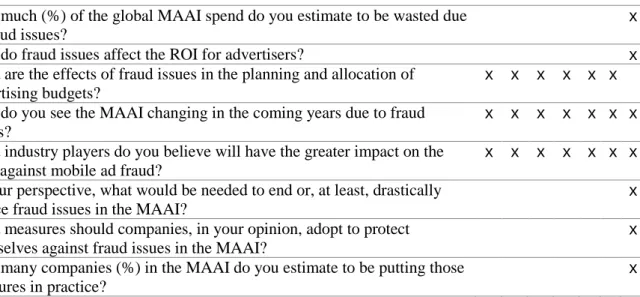
The conceptual map developed from the frame of reference earlier presented resulted in the construction of seven interview guides (Table 1, Appendix I). The interviews were mainly based on a single session per participant, each lasting between 20 minutes and 1 hour, depending on the length of the guide; the interview with HMA’s COO was a two-session exception, since not only was she the main informant, but was actively involved in the different business fronts, with regular interactions with customers, suppliers and other partner companies – factors that justified the choice of a longer set of questions.
18
After collecting the data, MAXQDA was used to assist the analysis in three phases: first, summarising was used to condense the meaning of each interviewee’s answers and to tackle the main themes emerging from the interviews; second, primary and secondary data were subject to a process of categorization; third, data was unitized (Saunders et al., 2015).
4.3. Data quality and analysis
Concerning reliability and validity (Saunders et al., 2015), the use of secondary data and interviews was planned and executed with rigor in mind, ensuring the reliability and trustworthiness of all the secondary sources; and the careful planning and execution of primary data collection, with the necessary transmission of credibility and confidence to the interviewees. This process included not only a deep investigation of the research topic prior to interview design, but also the pre-test of the guides with field experts.
5. CASE STUDY –THE CASE OF HANG MY ADS
The chapter that follows presents the case study’s results, according to the research framework that guided the data collection: it first includes a mapping of the MAAE at the light of the interviewees perceptions; an explanation of the fraud issues that affect the business within the MAAE follows; the results from the inquiry over adaptation processes between advertisers and publishers are then presented; and finally, the chapter is closed with an overview of the effects of fraud in the MAAE.
5.1. Mapping of the network of the MAAE
The interviewees’ perceptions over the way the network of the MAAE is organized reveals three levels of market players: advertisers (clients), intermediates and publishers (suppliers). All interviewees consider the app developers to be on top of the chain, followed by the intermediary players – usually ad agencies (which in turn contract advertising services to ad networks) or directly ad networks. The ad network then uses a multitude of traffic sources to serve an ad, such as: directly integrated apps; publishers (also known as affiliates); platforms like ad exchanges, RTBs or DSPs; and/ or other networks (a practice known as re-brokering).
Advertisers are responsible for managing budget allocation, with the campaigns’ goals and the necessary metrics to achieve them in mind; they are also responsible for negotiating promotion terms, playing a fundamental role in deciding and implementing performance models. On the other end of the chain, publishers are accountable for a deep knowledge of their traffic sources and for the best management strategy of their users, so to meet as much as
19
possible the advertiser requirements; however, this might not always be the case, as some publishers are more concerned in maximizing the profits of their promotion placements, with little concerns over quality achieved. Ad networks serve as mediators between the first and the former, monitoring in real-time what is being delivered and optimizing performance towards the best fit between client requirements and publisher capabilities, ultimately achieving an optimal ROI for the campaign.
While the two HMA account managers consider the agencies that manage most big app developers’ campaigns to be the main players within the industry, the company’s co-founders name the traffic sources as the most important players, for they have the power to dictate the standards for real, fraud-clean and quality traffic across the industry.
In other markets and business areas a huge importance is given to the client, but I believe specifically in digital advertising an equal importance should be assigned to both [client and supplier], because you can’t have one without the other. I would even say that often the most important ends up being the relationship with the publisher and having good and legitimate traffic sources; good clients will eventually follow… Having good publishers comes with achieving good clients, more than the other way around. (HMA’s COO) By operating as an intermediary between advertisers and publishers, HMA relies on different strategies towards relationship management: on one end, clients have the financial power and require some work at the level of expectations management; on the other, publishers require a careful management of how their traffic is monetized. On either side, a uniform but personal approach is pursued, not only when it comes to new business opportunities, but also when it comes to daily account-management: the attribution of a dedicated point of contact to each business relationship is a standard policy; nevertheless, the importance of the partner may dictate higher levels of attention and flexibility towards day-to-day business and negotiations.
Regarding market factors, major challenges posed by the MAAE are highlighted: lack of transparency, often linked to re-brokering the chain; lack of regulation, making it harder to standardize processes and seek for specialized support; and the threat of fraud, in terms of detection and prevention. Other challenges are related with the increased growth of analytics (and the strict quality and user behavior metrics that emerge from this trend); the fierce competition between companies (especially ad networks); the difficulties in finding traffic sources in certain geographies; and the full understanding of the implications and potentialities
20
that different ad formats present, combined with the potential – still to be explored – offered by cross-media strategies.
The interviewees consider that the lack of regulation is justified by the industry being relatively recent, explaining that the industry is still at a self-regulation stage, where companies adjust themselves to a mix of different laws, from different countries, often at the light of what applies to other industries’ services. The lack of specialized entities combined with the fact that business takes place in the cloud, make it even harder to apply any concrete laws and creates huge uncertainty for companies. Regarding fraud specific legislation, the AFSP representative explains why fraud is not covered by industry-specific legislation:
There’s no specific thing you could put in a law or something... there have been law cases and we’ve been asked to testify (…) in some cases, but in general it’s a tricky thing, because it’s very difficult to define what fraud is and what is not in concrete legal terms. Also, technically it’s not possible to see that the same person installed an app, for example; nobody has that technology and even if we had, for privacy reasons it wouldn’t be allowed to use it. We’re only looking at assumptions. (AFSP)
Considered the industry challenge with the heaviest impact on inter-company business, fraud is highly linked to the termination of advertiser-publisher partnerships and to the creation of great instability, as a consequence of seriously damaging credibility and trust across the ecosystem.
On the other hand, challenges such as the most suited ad formats to use dictate the ways companies search for new business partners; and challenges such as the tight competition require companies to undergo major efforts to stand-out in the map (be it at the level of their service processes, at the level of anti-fraud strategies, etc).
5.2. Fraud issues within the MAAE
Major issues are associated with fraud. First, the issue of the lack of transparency in the industry has great impact on how fraud develops: mobile is by nature very complex and hard to track, a challenge amplified by complex value chains that inflate performances and “create opportunities and financial incentives for fraud to happen in the first place” (Forrester Consulting, 2017). Hence, re-brokering emerges as one of the greatest cracks through which fraudsters exploit the advertising chain and sell bot traffic as human traffic:
21
The network places the ads with publishers that it has direct relationships with, but cannot itself fulfill the entire ad campaign. (…) So the networks brokers with other networks who have access to supply (sub-publishers). (…) In some cases, the re-brokering happens more than once. And in the re-brokering process (…) traffic quality can suffer. (Koetsier, 2017) Second, not only fraud is never fully identified, but is constantly getting more sophisticated. Yet, most advertisers are still unable to identify common and easily traceable frauds, underestimating its impact on advertising efforts (Forrester Consulting, 2017). Another major issue has to do with the lack of incentives to fight fraud: frauds that steal organic installs are the best in the market in terms of user quality metrics; by looking at this data and prioritising – without knowing it – fraudulent sources over legitimate ones, advertisers are not only paying for installs that otherwise would be free – for being organic –, but are also allowing little space for legitimate networks to compete.
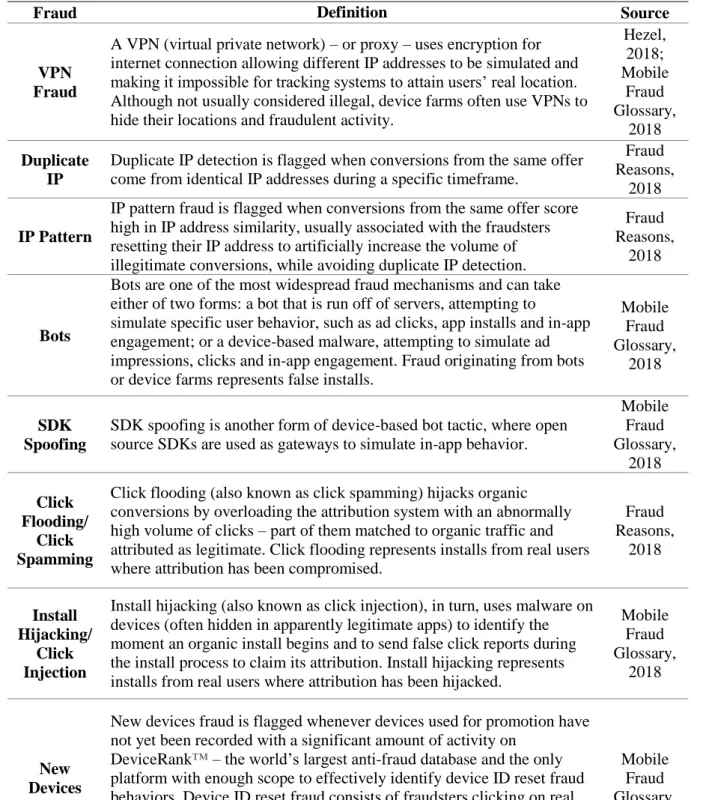
The major fraud behaviors identified within the MAAE vary between simpler and older forms of fraud – like the use of VPNs and proxies; the duplication of IPs and other IP anomalies; the use of emulator/ bots, and device farms; click flooding/ click spam and install hijacking/ click injection – to more complex and recent forms – such as new device fraud; contribution rate; and SDK spoofing. A summarising table of the major fraud forms affecting the MAAE is presented at Table 2 (Appendix II).
The most common fraud types HMA deals with are VPNs, install hijacking and click spamming. For the managing partners, fraud is a highly relevant topic that requires companies to constantly and quickly react and adapt:
The issue of fraud is very relevant to the industry. It’s vital that companies act swiftly to the new types of fraud that emerge – the challenge lies not only in prevention, but also in adaptation. (…) Companies must adapt very fast if they want to survive and continue to be known for the best reasons in the market.
At HMA this issue is also very relevant. We end up investing in anti-fraud software solutions, adapting our platform to automatically reject conversions that we believe to be fraudulent, reacting more promptly and containing the problem. (HMA’s COO)
Because of damaging past experiences with fraud, and a great concern over the impact it may have over their business, HMA has a clear strategy for prevention and defense against fraud, by combining real-time data analysis with manual analysis/ validation. Besides from constantly analysing the data provided by the MMPs and the third-party fraud detection tool
22
integrated with their platform, the platform itself holds some in-house developed capabilities for fraud detection and campaign measurement. In terms of campaign and traffic sources management, rules that cover the allocation of budgets to sources in the beginning and long-term stages of the campaigns, help keep track of quality and play a great role in preventing major issues should any fraud be spotted. Nevertheless, the company’s COO notes that such measure is simultaneously beneficial and limiting since “with so much prevention, sometimes we end up stagnating a bit to avoid bad traffic, instead of increasing revenues”.
HMA’s CTO points out to an important dilemma: although it should be very easy for an ad network to bet exclusively on serious and clean traffic, the industry is still at a point where the fraudsters score best in quality than the real users, and therefore are often given priority over legitimate networks. In such a scenario, an ad network that chooses to completely eradicate fraudulent sources may put its chances of survival at risk since the misled expectations of the advertisers lead to misled decisions over which sources to allocate budget to. The dilemma lies in the fact that the fraudulent installs the advertiser (mistakenly) chooses to pay for, are, in fact, organic installs they would never need to pay for – creating a wasted investment gap. Fortunately, the trend is starting to change.
All publishers compete for the best results; some of them use doping, achieving outstanding results and forcing others to do the same to avoid being left behind. Slowly, we’re starting to see advertisers finally distinguishing between traffic sources and increasingly valuing those publishers that are clean from fraud as opposed to those that present them with great (often false) numbers. (HMA’s CTO)
5.3. Adaptation processes
The data survey on how fraud issues affect the intercompany adaptation processes uses a single concept from the research framework – adaptations – that is adapted according to the interviewee context: publisher (supplier) or advertiser (client).
5.3.1. Adaptation processes by publishers
When asked about the major challenges or struggles faced when working with an advertiser, both HMA’s COO and AM reveal feeling difficulties when trying to make the company stand out against competing ad networks; furthermore, they link this with the challenge of establishing trust at the beginning of a new collaboration: on the one hand, as publishers, they try to show the prospective client the ways the company differentiates itself through its working processes, its anti-fraud mechanisms, and the outcomes they achieve by