R. bras. Fís. Tecnol. apl., Ponta Grossa, v. 5, n. 1, p. 42-53, mai./jun. 2018. Página | 42
https://periodicos.utfpr.edu.br/rbfta
Synthesis of (Bi,Pb)-2223 superconductor
powder by Pechini method
ABSTRACT
Guilherme Botega Torsoni
orcid.org/0000-0001-7178-2191
Instituto Federal de Mato Grosso do Sul (IFMS), Naviraí, Mato Grosso do Sul, Brasil.
Cicero Rafael Cena
orcid.org/0000-0001-8766-6144
Universidade Federal do Mato Grosso do Sul (UFMS), Campo Grande, Mato Grosso do Sul, Brasil.
Gustavo Quereza de Freitas
orcid.org/0000-0001-5321-7009
Instituto Federal Goiano (IFGoiano), Rio Verde, Goias, Brasil.
Claudio Luis Carvalho
carvalho²dfq.feis.unesp.br
orcid.org/0000-0003-0354-6765
Universidade Estadual Paulista (UNESP), Ilha Solteira, São Paulo, Brasil.
In this paper, we present a detailed route of synthesis to produce ceramic superconductor Bi1,6Pb0,4Sr2Ca2Cu3Ox (Bi,Pb)-2223 powder by Pechini method. The obtained polymeric
precursor solution was produced by using inexpensive chemical reagents, which showed a great stability for three weeks with high concentration of BPSCCO inorganic ions. The crystallization kinetic of BPSCCO powder was investigated by thermal analysis (DSC/TGA) and X-ray diffraction (XRD) techniques. The thermal treatment of the BPSCCO powder at different temperatures showed that complex phase equilibrium occurs to the system. The three superconductor phases seems to coexist in a large range of temperature, the Bi-2201 phase was crystallized around 500 oC and then, after 840 oC the desirable (Bi,Pb)-2223 phase appears with coexistence of the Bi-2212 phase at low quantity. Finally, the powder morphology was characterized by scanning electron microscopy (SEM), the results point to a typical plate like formation of the grains.
Página | 43
INTRODUCTION
Extensive studies have been made in new routes to synthesized oxide superconductors, mainly focused on improve the superconductor properties, such as higher critical temperature (Tc) and great electrical current density (Jc)
(OHARA et al., 2015; SAFRAN et al., 2015; FREITAS et al., 2016-a). The BSCCO system - Bi2Sr2Can-1CunO4+2n+y (n = 1, 2, 3 or 4), is one of the main high
temperature superconductors, and have been extensively investigated for technological applications and basic studies in materials science since its discovery by Maeda et al. (1988). The BSCCO system presents three different crystallographic phases with superconductor properties. In general, the Bi2Sr2Ca1Cu2Ox (Bi-2212) is the most studied composition, because it´s present
great superconductor properties and a relatively facile synthesis compared with other systems. The Bi-2212 have been produced by a large variety of techniques and different morphologies, such as films, bulk, wires, tapes and fibers (FREITAS
et al., 2015; CENA et al., 2017 FREITAS et al., 2016-b). Although, the
Bi2Sr2Ca2Cu3Ox (Bi-2223) superconductor phase is well known as a difficult
stoichiometry to obtain, mainly due to an unstable phase equilibria, what makes it less explored for many research groups, who are dedicated to produce superconductor materials for basic studies and applications (PANDEY et al., 1990). However, the Bi-2223 is one of the most suitable for technological applications due to its higher critical current density (Jc) and critical temperature (Tc), when compared with the Bi-2212.
Regarding the superconductor phases of the BSCCO system, the Bi-2201 is the more common and stable phase, with Tc around -253 oC, presenting low crystallization temperature between 400 oC and 650 oC. The Bi-2212, considered a stable phase, exhibits Tc usually around -188 oC and its crystallization occur between 730 oC and 840 oC (WONG et al., 1992; MAJEWSKI, 1997). Finally, the Bi-2223 phase, with Tc around -165 oC, it is considered an unstable phase, because presents a short crystallization temperature range between 840 oC and 850 oC. Moreover, there is a complex multiphase equilibrium involved during the phase formation, that usually drives the system to secondary phases formation, such as (Ca,Sr)2CuO3, CuO and Ca2PbO4, and disturbs the aligning and coupling of
superconductor plates (WANG et al., 1998; JIANG et al., 2001). Some studies, devoted to produce pure Bi-2223 phase have shown that the kinetic and stability of the phase formation can be improved by doping the system with lead ions (Pb+). The Pb ions replace Bi ions in the C-site, extending the crystallographic structure, and facilitating, the growth of new plane of Cu and Ca (TAKANO et al., 1988; TAKEDA et al., 1989).
Extensive studies have been made in new routes to synthesized oxide superconductors in the past few decades, mainly focused on improve the superconductor properties, such as higher critical temperature (Tc) and great electrical current density (Jc) (OHARA et al., 2015; SAFRAN et al., 2015; FREITAS
et al., 2015). In this context, there is many advantages of produce (Bi,Pb)-2223 by
Pechini method (LESSING, 1989), such as, (i) the method is able to produce thinner powder from a homogeneous reagent mixture, thereby increasing the reactivity of the powder; (ii) the low cost and simple laboratory facilities are required; (iii) great potential to produce many types of samples, such as thin films, nanoparticles, nanofibers, from a polymeric resin; and finally (iv) there is a
Página | 44
facility to introduce others ions in the structure or even produce composite materials for basic studies and/or applications.
In this work, we present a detailed route for processing (Bi,Pb)-2223 powder by Pechini method. The dynamic viscosity studies of the resulting polymeric resin were performed to investigate the solution stability. The BPSCCO dried powder was studied by thermal analysis (TA), and after thermal treated at different temperatures, the phase evolution, microstructure and crystallographic phase formation of the samples were studied by X-ray diffraction (XRD) and scanning electron microscopy (SEM), respectively.
EXPERIMENTAL DETAILS
The BPSCCO powder with nominal composition Bi1,6Pb0,4Sr2Ca2Cu3Ox was
obtained by Pechini method (LIMA et al, 2014). As starting materials was employed carbonates (Bi2CO5, SrCO3, CuCO3, CaCO3, PbCO3) all purchased from
VETEC Chemical Company Ltd. A stable resin was obtained by dissolving, separately, the starting materials in deionized water and citric acid (C8H8O7) (AC)
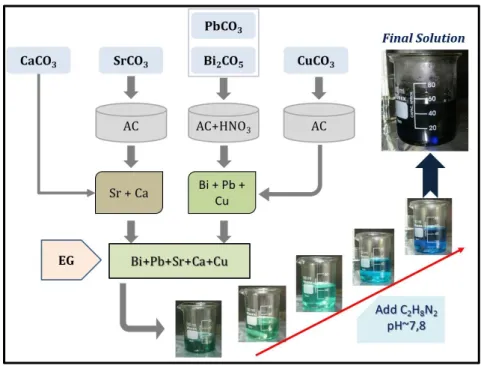
at room temperature. The metallic ion/citric acid ratio employed was 1/3. The ion solutions mixtures followed the steps described in the Figure 1. Then, ethylene glycol (C2H6O7) (EG) was added to the solution (citric
acid/ethylene glycol = 60:40 mol%) and polymerized by heating up to 80 oC during 30 minutes. The final pH was ajusted, by adding few drops of ethylenediamine (C2H8N2), between 7,0 and 8,0. The pH adjust was necessary to
improve the resin stability, as result the resin coloration changes from light green to a dark blue.
Figura 1- Schematic experimental route to produce (Bi,Pb)-2223 polymeric resin by Pechini method
Página | 45
Finally, the resin was dried at 220 oC/ 1 h, and then termal treated at 500 oC/ 1 h by using a conventional electric furnace. The dried powder was grounded in an agate mortar and then, it was submitted to additional thermal treatment at different temperatures (220 oC, 500 oC, 632 oC, 705 oC, 743 oC and 850 oC), as described bellow.
The rheological properties were evaluated in a Brokfield rotameter, model DV-II+Pro, with concentric cylindrical symmetry, by measuring the dynamic viscosity in different temperatures. The thermal decomposition behavior of the as-burnt powder was examined by simultaneous Differential Thermal Analysis/Thermogravimetry (DTA/TG) in nitrogen atmosphere with heating rate of 10 oC/ min on the TA SDT instrument, model Q600. The phase identification of the calcined powders was performed using X-ray diffraction (XRD), in a Shimadzu diffractometer, model XRD-6000, with CuKα 1.54056 Å. Finally, the thermal treated samples morphology and chemical composition were evaluated by Scanning Electron Microscopy with dispersive energy detector (SEM-EDS) on the Carl Zeiss EVO-LS15 microscopy.
RESULTS AND DISCUSSION
The dynamic viscosity studies performed as function of temperature, Figure 2, showed a typical exponential decay of Newtonian fluids. The same behavior was observed to the resin after 45 days, suggesting a great stability. A stable resin is very important to potential applications, it guarantees the reproducibility of the samples during long period of time. The viscosity of the resin at room temperature was around 200 cP, and density of 1.28 g/ml.
Figura 2- Rheological characterization of the BPSCCO polymeric resin produced by Pechini method. Dynamic viscosity behaviour as prepared and after 45 days
Source: The Author.
The thermal analysis measurements of the BPSCCO powder, previously treated at 500 oC/ 1 h, are showed in Figure 3. The TG data analysis revealed a small weight loss around 1,25 % between 200 oC and 450 oC, probably due to remaining organic material weakly bounded from polymeric chains. A second
0 10 20 30 40 50 60 200 400 600 800 1000 Day Zero After 45 Days D in am ic V is co si ty ( cP )
Temperature (
oC)
Página | 46
weight loss of around 17 % associated with carbonate thermal degradation was observed in two stages, a more pronounced one after 600 oC, a second small shoulder observed after 750 oC. The derivative curve, calculated from DSC curve, is also showed inset. From the DSC data and also based on XRD analysis, Figure 4, the first peak observed between 600 – 700 °C was assigned as Bi2Sr2-xCuO6
(Bi-2201), CaCO3 and SrCO3 phases formation. By increasing the temperature of
thermal treatment, the Ca2PbO4 phase formation was observed between 700 –
730 °C. Then, the Bi-2212 phase was formed from reaction between the Bi-2201, CaCO3, SrCO3 phases and Cu ions, corresponding to the third peak observed
around 740 °C. Finally, around 820 °C the Ca2PbO4 seem to decompose in CaO
and PbO, after that, upon 840 oC there is a tendency to crystallize the (Bi,Pb)-2223 from Bi-2212, CaCO3 and CuO reaction. It is in agreement to reported by
Rao et al. (1996).
Figura 3- TGA/DSC results of BPSCCO powder, previously thermal treated at 500 oC/ 1 h. The derivative DSC curve inset
Source: The Author.
X-ray diffraction (XRD) patterns of the BPSCCO powder after thermal treatment at different temperatures are shown in Figure 4. The phase identification in the XRD patterns was performed by using crystallographic data reference from the ICSD (Inorganic Crystallographic Structure Database). At Figure 4(a), a wide amorphous band, between 20o and 35o, related with short range ordering associated with a non-crystallized material could be evidenced, the presence of small diffractions peaks were assigned to Bi2CaO4 phase
formation. The superconductor phase Bi-2201 formation could be identified by increasing the temperature of thermal treatment, between 500 oC and 632 oC, Figure 4(b) and Figure 4(c) respectively (TORARDI et al., 1988). Although, some peaks associated with secondary phases such as SrCO3 e CaCO3 were also
identified. These secondary phases correspond to an unreacted precursor material, that should react at higher temperatures with other elements to form another Bi-superconductor phase, the same behavior was also observed by Peng
et al. (1998). By increasing the temperature of thermal treatment to 705 oC, Figure 4(d), the sample showed a remarkable presence of Ca2PbO4 phase, this
150 300 450 600 750 900 80 85 90 95 100
Temperature (
oC)
W ei g h t L o ss ( % ) -24 -18 -12 -6 0 H ea t F lo w ( W /g ) 600 650 700 750 800 850 900 Derivative curve 2 2 2 3 + C O2 Ca 2 Pb O4 = C aO + Pb O Ca 2 Pb O4 ; C O2 e O 2 Bi 2 Sr2 C u O6 ; ( C a1-x Srx )C O3 2 2 1 2 + C O2Página | 47
phase is considered as a secondary phase, but at 743 oC, Figure 4(e), it recombines with other phases to form the Bi-2212 phase (SUNSHINE et al., 1988). Finally, the XRD results observed to the powder treated at 849 oC, Figure 4(f), showed the crystallization of the desirable phase (Bi,Pb) -2223, but with coexistence of Bi-2212 (YAKHMI et al., 1993).
Figura 4- XRD powder diffraction at different temperatures of thermal treatment: (a) 220
o
C, (b) 500 oC, (c) 632 oC, (d) 705 oC, (e) 743 oC and (f) 850 oC, during 1 hour. The peaks were indexed as: 1) CaBi2O4; 2) Bi-2201; 3) SrCO3; 4) CaCO3; 5) Bi2CuO4; 6) Ca2PbO4; 7)
Bi-2212; 8) (Bi,Pb)-2223 phases
Source: The Author.
Images obtained by scanning electron microscopy (SEM) of the treated powders are shown in Figure 5. The changes on powder morphology could be successfully evidenced. As evidenced by DRX analysis, the presence of the organic material at the sample treated at 220 oC were characterized by a smooth surface, Figure 5(a). By increasing the temperature of thermal treatment the organic compounds degraded, remaining just the inorganic content, which ones react to from the crystalline phases. Then, the initial smooth surface observed at 220 oC, evolves to small grain morphology typical of ceramic materials at intermediary temperature range. Finally, the morphology presents a plate-like grains structure above 743 oC, characteristic of Bi-superconductor phase, exhibiting a grain size distribution around 800 nm at 850 oC. 1 11 1 1 1 1 1 2 2 2 22 22222 2 2 2 2 22 2 2 2 22 222 3 3 3 3 3 3 3 4 4 3 3 3 3 3 2 2 22 2 22 2 2 2 2 2 5 5 22 5 5 5 5 4 4 6 6 6 6 6 6 6 6 66 6 66 6 66 3 3 2 2 2 2 2 2 2 5 52 2 6 6 6 6 6 6 7 77 7 7 7 7 7 7 7 7 7 7 7 7 7 8 8 8 8 8 8 8 8 7 7 777 7 7 7 7 77 7 7
10
20
30
40
50
(d)
(a)
(c)
(b)
Int
ens
it
y (
a.u
.)
2 (degree)
(e)
(f)
Página | 48
Figura 5- SEM images of treated powder during 1 hour at different temperatures (a) 220
oC, (b) 500 oC, (c) 632 oC, (d) 705 oC, (e) 743 oC and (f) 850 oC.
Source: The Author.
Finally, quantitative/qualitative results from Energy Dispersive X-ray Spectrometry - EDS, are presented at Table 1.
Tabela 1- Atomic percentage of elements in the samples determined by EDS analysis Temperature 220 oC 500 oC 632 oC 705 oC 743 oC 849 oC
Element Atom % Atom % Atom % Atom % Atom % Atom %
Bi (M) 0,56 3,40 7,78 5,63 6,36 6,94 Sr (L) 0,51 7,52 11,22 10,07 11,04 8,32 Ca (K) 0,55 8,84 11,18 9,74 10,94 14,28 Cu (K) 0,25 10,93 5,33 9,00 12,41 20,75 O (K) 15,21 48,09 64,41 65,56 59,52 49,70 C (K) 53,59 21,22 0,00 0,00 0,00 0,00 N (K) 29,33 0,00 0,00 0,00 0,00 0,00
Source: The Author.
As discussed above at low temperature treatment (~220 oC) the presence of organic compounds could be confirmed by the large presence of nitrogen and carbon in the powder. By increasing the temperature of thermal treatment, the organic material has been removed, as observed on TGA analysis, remaining just a small amount of carbon atoms at 500 oC. Above 500 oC remains just the inorganic compounds that react to form the crystalline phases. The amounts of Bi
Página | 49
and Sr in the stoichiometry did not changed substantially by increasing the temperature, however, the amounts of Ca and Cu present considerable variation, as expected because there is an evolution of the superconductor phase (from Bi-2201 to (Bi,Pb)-2223). The Pb ions could not be evidenced at EDS analysis probably by its low content in the material, and also experimental difficulties to measure samples with irregular surfaces with quantitative precision.
CONCLUSIONS
The Pechini method presented a great potential to produce thinner BPSCCO powders, with grain size around 800 nm, from polymeric solution. The crystallization kinetics study, based on TG/DSC and XRD results, are in accordance with the literature reports to the system produced by sol-gel method. The thermal treatment of the powder indicated formation of three superconducting phases Bi-2201, Bi-2212 and (Bi,Pb)-2223. The results showed that by add Pb ions in the BSCCO precursor can induce the (Bi,Pb)-222 phase formation, providing an easy and low cost route to produce superconductor materials for academic studies.
Página | 50
Síntese do supercondutor BSCCO (2223)
pelo método de Pechini
RESUMO
Neste trabalho, apresentamos uma rota detalhada para preparação de pós-cerâmicos
supercondutores do sistema Bi1,6Pb0,4Sr2Ca2Cu3Ox (Bi-2223) utilizando o método de
Pechini. A cinética de cristalização do pó BSCCO foi estudada pelas técnicas de análise térmica e difração de raios-x. Os resultados observados revelaram a ocorrência de uma complexa cinética de formação fase no sistema, marcado pela coexistência das três fases supercondutoras do sistema BSCCO em um grande intervalo de temperaturas do
tratamento térmico. A formação de fases cristalinas teve seu início em torno de 500 oC
com a formação da fase Bi-2201, e com o acréscimo da temperatura ocorreu a formação
da fase Bi-2212, a qual irá coexitir com a fase desejada Bi-2223, formada após 840 oC.
Finalmente, a caracterização morfologica das amostras foi realizada em um Microscopio Eletrônico de Varredura, os resultados mostraram a formação de uma estrutura de grãos cerâmicos do tipo placa típica do BSCCO.
Página | 51
Síntesis del superconductor BSCCO(2223)
por el método de Pechini
RESUMEN
En este trabajo, presentamos una ruta detallada para la preparación de polvos cerámicos superconductores del sistema Bi1,6Pb0,4Sr2Ca2Cu3Ox (Bi-2223) utilizando el método de Pechini. La cinética de cristalización del polvo BSCCO fue estudiada por las técnicas de análisis térmico y difracción de rayos-x. Los resultados observados revelaron la ocurrencia de una compleja cinética de formación fase en el sistema, marcado por la coexistencia de las tres fases superconductoras del sistema BSCCO en un gran intervalo de temperaturas del tratamiento térmico. La formación de fases cristalinas tuvo su inicio alrededor de 500 oC con la formación de la fase Bi-2201, y con el aumento de la temperatura ocurrió la formación de la fase Bi-2212, la cual coexistir con la fase deseada Bi-2223, formada después de 840 oC. Finalmente, la caracterización morfológica de las muestras fue realizada en un Microscopio Electrónico de Barrido, los resultados mostraron la formación de una estructura de granos cerámicos del tipo placa típica del BSCCO.
Página | 52
REFERENCES
CENA, C.R. et al. BSCCO superconductor micro/nanofibers produced by solution blow-spinning technique, Ceramics International, v. 43, p. 7663-7667, 2017. FREITAS, G.Q. et al. Construção de junções Josephson do tipo ponte obtidas manualmente em uma pastilha de Bi1.6Pb0.6Sr2.0Ca2.0Cu3Ox, Revista Brasileira de Física Tecnológica Aplicada, v. 02, p. 14-21, 2015.
FREITAS, G.Q. et al. Estudo das propriedades elétricas e magnéticas de filmes finos supercondutores do sistema BSCCO tratados termicamente em um forno de microondas, Revista Brasileira de Física Tecnológica Aplicada, v. 03, p. 35-43, 2016-a.
FREITAS, G.Q. et al. Preparation and characterization of a homemade Josephson junction prepared from a thin film sintered in a domestic microwave oven, Materials Research, v. 19, p. 295-299, 2016-b.
JIANG, J. et al. Evolution of core density of Ag-Clad Bi-2223 tapes during process, IEEE Transactions on Applied Superconductivity, v. 11, p. 3561-3564, 2001. LESSING, P.A. Mixed-cation oxide powders via polymeric precursors. Ceramic Bulletin, v. 68, p. 1002-1007, 1989.
LIMA, R.G. et al. Synthesis of Bi-based superconductor by microwave-assisted hydrothermal method, Journal of Physics, v. 507, p. 1-4, 2014.
MAEDA, H. et al. A new high-Tc oxide superconductor without a rare-earth element, Japanese Journal of Applied Physics, v. 27, p. 209-210, 1988.
MAJEWSKI, P. Phase diagram studies in the system Bi-Pb-Sr-Ca-Cu-O-Ag. Superconductor Science & Technology, v. 10, p. 453-67, 1997.
OHARA, H. et al. Critical current enhancement of BSCCO tapes in stacked conductors with ferromagnetic sheets, IEEE Transactions on Applied Superconductivity, v. 25, p. 1-4, 2015.
PANDEY, D. et al. On the formation of the 2223 phase in Bi-Pb-Sr-Ca-Cu-O system using Pb0,2SrCa(CO3)2,2 precursors, Solid State Communications, v. 76, p. 655-658, 1990.
Página | 53
PENG, Z.S. et al. Synthesis and Properties of the Bi-Based Superconducting Powder Prepared by the Pechini Process, Journal of Superconductivity, v. 11, p. 749-754, 1998.
RAO, G.V.R. et al. Synthesis of (BiPb)(2)Sr2Ca2Cu3Oy superconductors by the sol-gel process, Journal of Solid State Chemistry, v. 126, p. 55-64, 1996.
SAFRAN, S. et al. Mechanical, microstructural and magnetic properties of the bulk BSCCO superconductor prepared by two different methods, Journal of Materials Science: Materials in Electronics, v. 26, p. 2622-2628, 2015.
SUNSHINE, S. A. et al. Structure and physical properties of single crystals of the 84-K superconductor Bi2,2Sr2Ca0,8Cu2O8, Physical Review B, v. 38, p. 893-896, 1988.
TAKANO, M. et al. High-tc phase promoted and stabilized in the Bi,Pb-Sr-Ca-Cu-O system, Japanese Journal of Applied Physics Part 2-Letters, v. 27, p. 1041-1043, 1988.
TAKEDA, Y. et al. Annealing effects on the Pb-doped 2223 phase under various temperatures and oxygen pressures, Physica C, v. 159, p. 789-793, 1989.
TORARDI, C.C. et al. Structures of the superconducting oxides Tl2Ba2CuO6 and Bi2Sr2CuO6, Physical Review B, v. 38, p. 225-231, 1988.
YAKHMI, J.V. et al. On the influence of ageing on the structural and superconducting characteristics of (Bi,Pb)2Sr2Ca2Cu3O10, Applied Physics Communications, v. 12, p. 75-91, 1993.
WANG, W.G. et al. Effect of (Pb,Bi)(3)Sr2Ca2CuOy phase on critical current density of Ag/(Bi,Pb)(2)Sr2Ca2Cu3O10 tapes, Physica C, v. 297, p.1-9, 1998. WONGNG, W. et al. Phase formation of high-tc superconducting oxides in the Bi-Pb-Sr-Ca-Cu-O glass, American Ceramic Society Bulletin, v. 71, p. 1261-1266, 1992.
Recebido: 20 de dezembro de 2017. Aprovado: 01 de junho de 2018. DOI:
Como citar: TORSONI, G.B. et al. Synthesis of (Bi,Pb)-2223 superconductor powder by Pechini method, Revista Brasileira de Física Tecnológica Aplicada, Ponta Grossa, v. 5, n.1, p. 42-53, mai./jun.. 2018.
Contato: Guilherme Botega Torsoni: [email protected]
Direito autoral: Este artigo está licenciado sob os termos da Licença Creative Commons-Atribuição 4.0 Internacional.