Antimicrobial distribution and costs in primary care
Distribuição e custo de antimicrobianos na Atenção Primária Distribución y costo de antimicrobianos en la Atención Primaria
Harryson Kleyn de Sousa Lima1
Herica Emilia Félix de Carvalho1
Álvaro Francisco Lopes de Sousa2,3
Maria Eliete Batista Moura1
Denise Andrade2
Andréia Rodrigues Moura da Costa Valle1
Corresponding author
Herica Emilia Félix de Carvalho http://orcid.org/0000-0002-5913-8886 E-mail: [email protected]
DOI:
http://dx.doi.org/10.1590/1982-0194201800014
1Universidade Federal do Piauí, Teresina, PI, Brazil.
2Escola de Enfermagem de Ribeirão Preto, Universidade de São Paulo, Ribeirão Preto, SP, Brazil. 3Instituto de Medicina e Higiene Tropical, Universidade Nova de Lisboa, Lisbon, Portugal.
Confl icts of interest: there are no confl icts of interest to declare. Abstract
Objective: To analyze antimicrobial distribution and costs in primary care of a capital city in the Northeast region of Brazil.
Methods: Cross-sectional, analytical study, developed in the city of Teresina, in the state of Piauí, Brazil. Data cover the period from June 2015 to July 2016. Descriptive statistics and the Kruskal-Wallis test were calculated to compare the medians of the independent data distributions.
Results: A total of 1,651,516 antimicrobials were distributed in 15 different types, with amoxicillin (500mg) being the most distributed (75%) in psychosocial care centers, and in the basic health units (47%). The total cost for the period was 98,705.00 BRL. There were no statistically signifi cant differences among the costs medians in each zone of the studied municipality.
Conclusion: These drugs are irregularly distributed among the units, according to the demand. The supply does not follow a specifi c protocol, and a possible increase or reduction in demand is not investigated.
Resumo
Objetivo: Analisar a distribuição e custos de antimicrobianos na Atenção Primária de uma capital da Região Nordeste do Brasil.
Método: Estudo transversal, analítico, desenvolvido em Teresina, Piauí, Brasil. Os dados contemplam o período de junho de 2015 a julho de 2016. Calculou-se estatísticas descritivas e o Teste de Kruskal-Wallis para comparar as medianas das distribuições de dados independentes.
Resultados: Foram distribuídos 1.651.516 antimicrobianos de 15 tipos diferentes dos quais a amoxicilina (500mg) foi o mais distribuído (75%) nos Centros de Atenção Psicossocial e nas Unidades Básicas de Saúde (47%). O custo total no período foi de 98.705,00 reais. Não houve diferenças estatisticamente signifi cante entre as medianas dos custos em cada zona do município estudado.
Conclusão: A distribuição desses medicamentos é realizada de forma irregular entre as unidades, de acordo com a demanda. O fornecimento não segue protocolo específi co, e não se investiga um possível aumento na demanda ou redução.
Resumen
Objetivo: Analizar la distribución y costos de antimicrobianos en Atención Primaria de una capital del Noreste de Brasil.
Método: Estudio transversal, analítico, desarrollado en Teresina, Piauí, Brasil. Datos obtenidos entre junio de 2015 y julio de 2016. Se aplicó estadística descriptiva y el Test de Kruskal-Wallis para comparar las medianas de las distribuciones de datos independientes.
Resultados: Fueron distribuidos 1.651.516 antimicrobianos de 15 tipos diferentes, de los cuales la amoxicilina (500mg) fue el más entregado (75%) en Centros de Atención Psicosocial y en Unidades Básicas de Salud (47%). El costo total durante el período fue de 98.705,00 Reales. No hubo diferencia estadísticamente signifi cativa entre las medianas de costos en cada zona del municipio estudiado.
Conclusión: La distribución de estos medicamentos se realiza de manera irregular entre las unidades, de acuerdo a la demanda. La provisión no cumple protocolos específi cos, y no se investiga un posible aumento o reducción de demanda.
Keywords
Anti-infective agents; Good distribution practices; Primary health care; Infection control
Descritores
Anti-Infecciosos; Boas práticas de distribuição; Atenção primária à saúde; Controle de infecções
Descriptores
Antiinfecciosos; Buenas prácticas de distribución; Primary health care; Control de infecciones
Submitted
February 2, 2018
Accepted
February 23, 2018
How to cite:
Introduction
Antimicrobials are one of the most frequently dis-tributed and used drugs in health services, account-ing for almost a third of medical prescriptions. They are considered one of the most remarkable drugs to impact not only on the patient being treated, but on the whole ecosystem in which he/she is inserted,(1)
because these drugs irrational use has contributed significantly to antimicrobial resistance (AMR), a global threat to public health.
The AMR phenomenon is complex, but it is a natural biological process that arose with the use of antibiotics in the treatment of infections, and was enhanced with the irrational use of antimicrobials. It is understood as the ability of microorganisms to multiply even in the presence of high concentrations of antimicrobials,(2,3) and is related to the use of this
medicine in all environments, either at home, in (primary, secondary or tertiary) healthcare settings, or in other sectors of activities, such as agriculture.
Data from a multicenter study in 28 European countries point to an association between increased antimicrobial resistance and managerial quality of the government, suggesting that countries where the quality control of this class of drugs in humans and in other animals is poor show increased rates of microbial resistance and dissemination.(4)
Although hospital care is heavily responsible for increased AMR, the literature provides evidence that primary care can lead to an irrational distri-bution of antimicrobials, increasing costs and con-tributing to increased resistance. In addition, due to the large number of units that provide outpatient care in Brazil, it is believed that antimicrobial use can be compared to that of hospitals. For instance, a study carried out in the state of Rio de Janeiro, Brazil, found that most antimicrobial costs came from primary rather than hospital care.(5)
The non-hospital environment in Brazil does not have a specific surveillance system on the ra-tional use of drugs, including antimicrobials, which limits monitoring and controlling this drug, and fa-vors its empirically exacerbated use. In addition, an irregular and non-directed distribution can lead to AMR and potentiate unnecessary expenses. Thus,
the analysis of the distribution and costs related to the use of antimicrobials in primary care becomes pertinent because it characterizes its representative-ness in the context explored.
Therefore, the objective of this study was to analyze the distribution and costs of antimicro-bials used in primary care in a capital city of the Northeast region of Brazil.
Methods
This is a cross-sectional, analytical, retrospective collection study carried out in the city of Teresina, capital city of the state of Piauí. The database used was that of the essential medicines distribution cen-ter of the Pharmaceutical Assistance Management, linked to the Municipal Health Foundation (FMS) of Teresina, which is in charge of the Pharmaceutical Assistance Cycle, including planning, receiving, storing and distribution of medicines, medical-hos-pital supplies, and medical-dental products to basic health units (UBS) and psychosocial care centers (CAPS) under the responsibility of FMS.(6)
In the municipality, UBSs are subdivided into zones, namely: the East/Southeast Zone, which com-prises 36 UBSs; the North Zone, with 25 units; and the Southern Zone, with 27. CAPS are divided into three models, each with its particularities: four CAPS II, one CAPS III, one CAPS AD and one CAPS for children and adolescents.(6) Of the four models, only
the CAPS for children and adolescents did not receive antimicrobials during the study period. Therefore, CAPS models II, III and AD were part of the study.
Among the models of CAPS studied, CAPS II are for daily care of adults with severe and persistent mental disorders in their coverage population. CAPS III are for adult daily and nocturnal care, seven days a week, serving the reference population who has severe and persistent mental disorders, and CAPS AD units are for alcohol and drug users, for daily care for the population with disorders result-ing from the use and dependence on psychoactive substances such as alcohol and other drugs.(6)
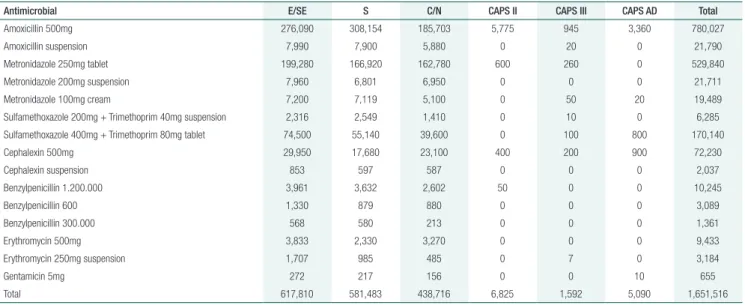
Table 1. Amount of antimicrobials distributed to primary care units according to the service demand (n=1,651,516)
Antimicrobial E/SE S C/N CAPS II CAPS III CAPS AD Total
Amoxicillin 500mg 276,090 308,154 185,703 5,775 945 3,360 780,027 Amoxicillin suspension 7,990 7,900 5,880 0 20 0 21,790 Metronidazole 250mg tablet 199,280 166,920 162,780 600 260 0 529,840 Metronidazole 200mg suspension 7,960 6,801 6,950 0 0 0 21,711 Metronidazole 100mg cream 7,200 7,119 5,100 0 50 20 19,489 Sulfamethoxazole 200mg + Trimethoprim 40mg suspension 2,316 2,549 1,410 0 10 0 6,285 Sulfamethoxazole 400mg + Trimethoprim 80mg tablet 74,500 55,140 39,600 0 100 800 170,140 Cephalexin 500mg 29,950 17,680 23,100 400 200 900 72,230
Cephalexin suspension 853 597 587 0 0 0 2,037
Benzylpenicillin 1.200.000 3,961 3,632 2,602 50 0 0 10,245
Benzylpenicillin 600 1,330 879 880 0 0 0 3,089
Benzylpenicillin 300.000 568 580 213 0 0 0 1,361
Erythromycin 500mg 3,833 2,330 3,270 0 0 0 9,433
Erythromycin 250mg suspension 1,707 985 485 0 7 0 3,184
Gentamicin 5mg 272 217 156 0 0 10 655
Total 617,810 581,483 438,716 6,825 1,592 5,090 1,651,516
Notes: E/SE: East/Southeast; C/N: Center/North; S: South. CAPS: psychosocial care center
were investigated in this study. The temporal cut-off is based on Ordinance no. 04/2015, dated July 9, 2015,(7) issued by the Municipal Health
Department of Teresina-PI, which determines that the minimum filing time of a prescription for con-trol purposes is two years, so according to the esti-mated period of data collection (January 2017), the period described above was defined.
A form with information about the distribu-tion of antimicrobial drugs was used to collect the data, which contained information on the amount of these drugs distributed per month, by zone, by UBS and by CAPS; the name; and the cost of these distributed products. The form was validated (face-content) by field experts, and tested in a pilot phase.
Data were processed in the software Statistical Package for the Social Sciences (SPSS), version 21.0. Descriptive statistics were calculated for quantitative variables, and frequencies for qualita-tive variables, as well as the Kruskal-Wallis test to compare the medians of independent data distribu-tions (distribudistribu-tions formed by data from different sources: different units).
The study complied with the principles of Resolution no. 466, of December 12, 2012, and was approved with the report no. 1.806.553. To guarantee the anonymity of the health units evalu-ated in the study, only their initials were used.
Results
In the period comprised for the research (14 months), 1,651,516 antimicrobials were distributed to prima-ry care units in the capital city. Of these, 1,638,009 belonged to the UBS and 13,507 to the CAPS.
The area of the city that received the most amount of medications was the Eastern/Southeastern. As for CAPS units, CAPS II received the most part. The three antimicrobials most widely distributed in the UBS divided by zones were: Amoxicillin (500mg) in tab-lets, Metronidazole (250mg), and the combination of Sulfamethoxazole + Trimethoprim (400mg + 80mg) in tablets. Amoxicillin (500 mg) is the antimicrobial that is in evidence in the CAPS, as shown in table 1.
A total of 2,590.71 BRL was spent in the CAPS units of the city, and 98,705.00 BRL with antimi-crobials distributed in the UBS units of the three city zones analyzed (Figure 1) (Table 2).
Discussion
The distribution of antimicrobials in the primary health care network of the municipality studied is irregularly performed among the health units, and does not follow a specific protocol. It was noticed that it relies on each zone’s demand, without a sys-tem of analysis to guide the distribution. This situa-tion involves an exacerbated use of the drug, which burdens the health care system due to the search of broad-spectrum antimicrobials to supply the demand that was not met with the previous drug, as well as the consequences to the patient’s clinical evolution because it increases healing time of in-fection, and potentiates the need for other levels of health care.
Brazil was ranked by the Intercontinental Marketing Services Health (IMS Health) as one of the nations representing two-thirds of global phar-maceutical growth, with antimicrobials being a wide portion of that percentage, representing one of the most used drugs in the country. This motivated the Brazilian Health Regulatory Agency (ANVISA) to extend the measures for regulation and control related to sales, by demanding prescriptions for this class of drugs, which had been, thus far, sold free-ly; to require some data in the prescription, such as information about the patient, the issuer, the drug, and the prescription’s date of issue; to insert them in the list of drugs when establishing guide-lines regarding the distribution of drugs included in the Brazilian List of Essential Drugs (RENAME)
CAPS ad
1400.00
1200.00
1000.00
800.00
600.00
400.00
200.00
0.00
AMO PEN CEF ERI
Antimicrobial
Number of drugs
GEN MET SUL/TRI
CAPS III CAPS II
232.93
644.31
444.82 182.34 50.40
100.80 19.59 61.27 187.53
41.88 61.72 12.69 482.43
68.00
AMO: amoxicillin; PEN: benzylpenicillin; CEF: cephalexin; ERI: erythromycin; GEN: gentamycin; MET: metronidazole; SUL/TRI: sulfamethoxazole and trimethoprim
Figure 1. Costs with antimicrobials in the Psychosocial Care Centers in the period of the study (n=13,507)
Table 2. Costs of antimicrobials at the basic health units that showed the highest distribution in the study period according to the city zone
City zone Antimicrobial UBS UBS UBS p value*
East/ Southeast
SAT CSR PMR 0.932
Amoxicillin 1,892.15 3,264.53 2,508.07 Benzylpenicillin 4,159.16 2,058.38 4,780.85 Cephalexin 555.12 442.23 650.08 Erythromycin 223.86 - 139.86 Gentamycin 30.89 97.35 61.74 Metronidazole 2,977.01 2,506.19 2,450.10 Sulfamethoxazole
and trimethoprim
385.41 331.32 260.97
Total 10,223.6 8,7 10,851.61
South CSKm-7 CSVID VJWB 0.904
Amoxicillin 8,397.66 5,537.80 3,752.75 Benzylpenicillin 3,355.55 3,873.53 3,796.44 Cephalexin 423.02 601.94 568.67 Erythromycin 275.64 - 559.72 Gentamycin - - 411.43 Metronidazole 2,778.66 5,595.80 2,252.01 Sulfamethoxazole
and trimethoprim
691.28 730.66 290.63
Total 15,921.81 16,339.73 11,631.65
Center/North CSMC CSAM VAF 0.911
Amoxicillin 3,916.35 3,403.14 3,431.92 Benzylpenicillin 890.35 1.907.78 2.438.97 Cephalexin 367.33 215.74 267.61 Erythromycin - - 288.34 Gentamycin - 97.35 94.19 Metronidazole 2,248.56 2,963.51 1,574.42 Sulfamethoxazole
and trimethoprim
372.44 248.97 309.57
Total 7,795.03 8,836.49 8,405.02
Notes: SAT: Satellite. CSR: Centro de Saúde do Renascença. PMR: Padre Mário Rocchi. CSKm-7: Centro de Saúde do km-7. CSVID: Centro de Saúde da Vila Irmã Dulce. VJWB: Vermelha - Dr. José Wilson Batista. CSMC: Centro de Saúde de Santa Maria da Codipi. CSAM: Centro de Saúde da Àgua Mineral. VAF: Vila Anita Ferraz.
and in the Municipal List of Drugs (REMUME), among other regulations involving products con-taining antimicrobials in their composition.(8)
Drugs are still one of the main therapeutic in-struments in the health-disease process, reflecting a historically hospital-based and curative care model. Pharmacological treatment of infectious diseases is a valuable ally in healing. However, irrational use and consequent antimicrobial resistance may hin-der therapy progression. Therefore, its prescription, distribution, and disposal are necessary activities at all levels of health care, and are part of the set of ser-vices and actions called pharmaceutical assistance.(9)
The cycle of pharmaceutical assistance in prima-ry care in Brazil consists of the selection of med-icines, programming, acquisition, storage, mate-rial management, drug distribution, and disposal, respectively. The distribution stage consists of the supply of drugs to the health units in adequate quantities, with quality and timing. Purchase and distribution are performed through the regular and automatic, fund-to-fund transfer of federal resourc-es, in the form of an added incentive to the Basic Care Price Ceiling.(10,11)
The use of drugs, in general, is influenced by a number of factors, such as demographic structure, morbidity profile, socioeconomic, behavioral and cultural factors, characteristics of the pharmaceuti-cal market, and government policies directed to the sector.(12)
The authors of this study found that the distri-bution of antimicrobials in the city studied is per-formed only according to the demand of the health units. Thus, it is possible to state that the areas of activity of the units are related and have repercus-sions on the profile of drug use, which is influenced by social, population and economic issues. For in-stance, a study carried out in the same city showed that respiratory infections were the most frequent-ly diagnosed in the UBSs (52.2%), and that their treatment involved empirical antibiotic therapy in 95.5% of the time, with no previous request of antimicrobial culture, and emphasis on the use of amoxicillin (85%).(13) This approach aims at the
prevention of more severe complications, such as rheumatic fever and/or periamiglossal abscesses,
and has a direct impact on antimicrobial use and distribution.
Studies of UBS pharmacies in three other Brazilian municipalities support the information that amoxicillin is the predominant antimicrobial drug among the most prescribed drugs.(13-15) This
profile of high consumption is due to its broad spectrum characteristics, low toxicity, oral admin-istration, good tolerability, and great experience of clinical use favoring its selection in the basic care units.(13,16) Amoxicillin is a beta-lactam antibiotic
that has a bactericidal action against gram-positive and gram-negative microorganisms, being indicat-ed for upper airways infections and urinary tract infections, clinical conditions that are prevalent in primary care.(17)
Studies in Ghana and Nigeria also show amox-icillin as the most prescribed drug (26.7%; 18.2% respectively), followed by metronidazole (25.4%; 20.1%). Together, these drugs are considered the main antimicrobial agents used in primary care in these countries.(18,19) Metronidazole is an
antimicro-bial with bactericidal activity against gram-negative anaerobic bacilli, all anaerobic cocci, and sporulated Gram-positive bacilli. It is recommended in wounds to control the odor caused by anaerobic bacteria,(20)
besides the treatment of some protozoal infections (Giardia lamblia, Trichomonas vaginalis), which justifies its high demand in primary care.(21)
In the case of distribution of antimicrobials to the CAPS, this data is scarce in the literature, reinforcing the pioneer character of this study. These centers are health units dedicated to special-ized psychosocial health care and often use spe-cific drugs for the treatment of mental disorders. However, the care provided in these establishments demands the integration of mental and physical care, that is, the user needs treatment for the disor-der, but should also have his/her other needs met, such as an infection, so that resolute and holistic assistance is provided.(22)
In terms of costs, pharmaceutical costs with an-tibiotics for primary care are high, a finding that is supported by other studies in Malaysia(23) and in
the United States of America.(24) According to data
Administration (SIASG), from 2006 to 2013 there was a significant increase in pharmaceutical expen-ditures by the Brazilian government, with total ex-penditure tripled (2.72 times), while the amounts purchased only doubled (1.99) during the same pe-riod.(25) The irrational use related to uncertainty in
the diagnosis and the lack of devices to specify the appropriate therapy, as well as the lack of a system of surveillance of community infections in Brazil can be pointed out as factors that collaborate for the irrational use of antimicrobials, and consequently impact on high costs and unnecessary expenses.(26-28)
The management of community-based infec-tions in primary care is still empirically conducted, based on the observation of signs and symptoms presented by the patient, rather than on the bacte-rial culture or antibiogram.(29) The lack of Brazilian
legislation and regulations aimed at the prevention and control of infection in out-of-hospital envi-ronments that may guide clinical practice require adaptations of professionals, which may result in unnecessary interventions and high expenditures to the health system.(30)
This study has some limitations. The first regards the fact that it was performed in a single municipali-ty, which makes it difficult to generalize its findings. The use of secondary data that may be imprecise should also be considered. It is worth emphasizing the need for replication of studies of this magnitude in other Brazilian regions in order to consolidate the profile of the distribution of antimicrobials in Brazil and subsidize interventions at the local and national levels for the rational distribution of these drugs.
Conclusion
The analysis of antimicrobial distribution and costs in primary care of the municipality studied present-ed an irregular distribution baspresent-ed on the demand presented by each zone of the municipality. The capital city does not have any specific protocol or system to investigate a possible increase or reduc-tion in demand. The costs are proporreduc-tional to the drug distribution, so if there is no distribution
sys-tematization, there is no financial management of expenditures.
Acknowledgments
The authors thank the Federal University of Piauí – UFPI for the research funding provided through the Undergraduate Research Mentorship Program – PIBIC (PICCS1331-2016).
Collaborations
Lima HKS, Carvalho HEF, Sousa AFL, Moura MEB, Andrade D, and Valle ARMC declare that they contributed with the project design, data anal-ysis, and interpretation, relevant critical review of the intellectual content and approval of the final version to be published.
References
1. Silveira TS, Carpes AD, Zimmerman B, Krause LMF, Santos RCV, Costenaro RGS. Prevalence of dispensation of antimicrobial use in pediatric primary health network in the city of Santa Maria/RS. Disciplinarum Scientia. 2012; 13(2): 173-180. https://www.periodicos. unifra.br/index.php/disciplinarumS/article/download/1004/948
2. Mckenna M. Antibiotic resistance: the last resort. Nature. 2013; 499(1): 394-6. doi: 10.1038/499394a.
3. Centers for Disease Control and Prevention. CDC principles of appropriate antibiotic use. Washington, 2012. http://www.cdc.gov/ getsmart/campaign-materials/info-sheets/adult-approp-summary. html
4. Collignon P, Athukorala PC, Senanayake S, Khan F. Antimicrobial Resistance: The Major Contribution of Poor Governance and Corruption to This Growing Problem. PloS One. 2015; 10(3): 116-26.
5. Brandão CM, Guerra Júnior AA, Cherchiglia ML, Andrade EI, Almeida AM, Silva GD, et al. Gastos do Ministério da Saúde do Brasil com medicamentos de alto custo: uma análise centrada no paciente. Value Health. 2011; 14(5): 71-7.
6. Teresina (Estado) Secretaria Municipal de Saúde. Unidades de Saúde [Internet]. Teresina: FMS; 2016. [citado 2018 Fev 22]. Disponível em: http://www.fms.teresina.pi.gov.br/
8. Lima SIV, Diniz RS, Egito ES, Azevedo PR, Oliveira AG, Araujo IB. Rationality of Antimicrobial Prescriptions in Community Pharmacy Users. PloS One. 2015; 10(10): e0141615.
9. Sartor VB, Freitas SFT. Model for the evaluation of drug-dispensing services in primary health care. Rev Saúde Pública. 2014; 48(5): 827-36.
10. Brasil. Departamento de Atenção Básica. Política nacional de medicamentos 2001. Brasília (DF): Ministério da Saúde; 2001.
11. Brasil. Ministério da Saúde. Secretaria de Ciência, Tecnologia e Insumos Estratégicos. Departamento de Assistência Farmacêutica e Insumos Estratégicos. Assistência farmacêutica na atenção básica: instruções técnicas para sua organização. 2nd ed. Brasília(DF): Ministeerio da Saúde; 2006.
12. Oliveira NS, Xavier RM, Araújo PS. Análise do perfil de utilização de medicamentos em uma unidade de saúde da família, Salvador, Bahia. Rev Cienc Farm Basica Apl. 2012; 33(2):283-9.
13. Oliveira LB, Valle ARM, Magalhães RL, Andrade DF, Sousa AF, Queiroz AA. Prevalence of community infections diagnosed in the family health strategy. Rev enferm UFPE. 2016; 10(Supl. 1): 325-6.
14. Paganotti AM, Reis RA, Crozatti MT, Silva AT, Fegadolli C. Prescrição de antibióticos a crianças atendidas no inverno em Unidade de Saúde de município paulista. J Basic Appl Pharm Sci. 2013; 34(3): 441-7.
15. Deuschle VC, Deuschle RA, Marques UC. Avaliação da prevalência da dispensação de antimicrobianos na farmácia pública do município de Cruz Alta – RS. Rev Eletr Farmácia. 2015;12(2):1-15.
16. Gillies M, Ranakusuma A, Hoffmann T, Thorning S, McGuire T, Glasziou P et a. Common harms from amoxicillin: a systematic review and meta-analysis of randomized placebo-controlled trials for any indication. CMAJ. 2015; 187(1):21-31.
17. Brunton LL, Keith L, Parker CV. Manual de farmacologia e terapêutica. Porto Alegre: AMGH: McGraw-Hill; 2010.
18. Ahiabu MA, Tersbøl BP, Biritwum R, Bygbjerg IC, Magnussen P. A retrospective audit of antibiotic prescriptions in primary health-care facilities in Eastern Region, Ghana. Health Policy Plan. 2016; 31(2): 250-8.
19. Adisa R, Fakeye TO, Aindero VO. Evaluation of prescription pattern and patients’ opinion on healthcare practices in selected primary healthcare facilities in Ibadan, South-Western Nigeria. Afr Health Sci. 2015; 15(4): 1318-29.
20. Castro DL, Santos VL. Controlling wound odor with metronidazole: a systematic review. Rev Esc Enferm USP. 2015; 49(5): 858-63.
21. Howland RD, Mycek MJ. Farmacologia Ilustrada. 3rd ed. Porto Alegre: Artmed; 2007.
22. Rodrigues EdaS, Moreira MI. A interlocução da saúde mental com atenção básica no município de Vitoria/ES. Saude Soc. 2012; 21(3): 599-611.
23. Shamsuddin S, Akkawi ME, Zaidi ST, Ming LC, Manan MM. Antimicrobial drug use in primary healthcare clinics: a retrospective evaluation. Int J Infect Dis. 2016; 52:16-22.
24. Roberts RR, Hota B, Ahmad I, Scott RD, Foster SD, Abbasi F, et al. Hospital and societal costs of antimicrobial-resistant infections in a Chicago teaching hospital: implications for antibiotic stewardship. Clin Infect Dis. 2009; 49(8):1175-84.
25. Luz TC, Castro CG, Torres RM, Wettermark B. Trends in medicines procurement by the Brazilian federal government from 2006 to 2013. PLoS One. 2017; 12(4):e174616.
26. Means AR, Weaver MR, Burnett SM, Mbonye MK, McClelland SNRS. Correlates of inappropriate prescribing of antibiotics to patients with malaria in Uganda. PLoS One. 2014; 9(2):e0090179.
27. Silverman M, Povitz M, Sontrop JM, Li L, Richard L, Cejic S et al. Antibiotic prescribing for nonbacterial acute upper respiratory infections in elderly persons. Ann Intern Med. 2017; 166(11): 765-74.
28. Sousa AF, Queiroz AA, Oliveira LB, Valle AR, Moura ME. Social representations of community-acquired infection by primary care professionals. Acta Paul Enferm. 2015; 28(5): 454-9.
29. Shang J, Ma C, Poghosyan L, Dowding D, Stone P. The prevalence of infections and patient risk factors in home health care: a systematic review. Am J Infect Control. 2014; 42(5): 479-84.