
Verónica Catarina Ferreira Amado
Licenciada em Bioquímica
“One
-
pot” enzymatic conversion of CO
2to
methanol
Dissertação para obtenção do Grau de Mestre em Biotecnologia
Orientador: Susana Barreiros, Professora Associada com Agregação
Universidade Nova de Lisboa
Co-orientador: Alexandre Paiva, Investigador Doutorado
Universidade Nova de Lisboa
Júri:
Presidente: Prof. Doutor Carlos Alberto Gomes Salgueiro Arguente: Doutora Ana Sofia Diogo Ferreira
Vogal: Prof. Doutora Susana Filipe Barreiros
“One
-
pot” enzymatic conversion of CO
2to methanol
Copyright Verónica Catarina Ferreira Amado, FCT/UNL, UNL
Ao meu irmão Rafael
AGRADECIMENTOS
Gostaria de agradecer a todos aqueles que me apoiaram nesta jornada e que, de algum modo contribuíram para a realização desta tese.
Quero expressar a mais sincera gratidão aos meus orientadores. Em primeiro lugar à minha orientadora Prof. Doutora Susana Barreiros por todo o interesse e entusiasmo que demonstrou no meu trabalho, por todas as críticas científicas que tanto o enriqueceram, e por estar sempre disponível para discutir o mesmo. Gostaria de agradecer também ao meu co-orientador o Doutor Alexandre Paiva pela paciência, concelhos dados, discussão de ideias e alternativas, pelo espírito crítico sempre incisivo em pontos fulcrais e também pelos momentos de descontracção.
À Rita Craveiro que me acompanhou sempre em primeira mão, me apresentou o sol-gel, por toda a (enorme) paciência para me aconselhar e animar nos dias menos bons, por todos os conselhos dados sempre na perspectiva de enriquecer o trabalho desenvolvido e ajuda em todos os estágios do trabalho.
À Doutora Marta Corvo pela realização dos espectros de NMR a alta pressão tal como em na preciosa ajuda para a interpretação dos mesmos e ao Prof. Doutor Eurico Cabrita por me possibilitar a realização dos mesmos.
Gostaria de agradecer também a todos os meus colegas do Lab. 427 e os seus associados, foram não só colegas de trabalho como uma autêntica família, em que cresci como pessoa e profissional. À Sílvia por ter sempre uma palavra amiga e de ânimo, à Carmen por ser sempre tão alegre e alegrar todos à sua volta (e pelas maravilhosas tortilhas também), à Rita R. pelas palavras amigas, à Tânia por ser das melhores pessoas que eu conheço, à Sónia pela amizade ,ao Pedro e ao Ricardo pela alegria, à Amanda e Gabi por partilharem comigo o que é o vosso Brasil.
Aos meus companheiros nesta jornada que é tentar realizar uma dissertação Mariana, Cristina, José e Ekaterina, por todos os momentos de companheirismo, diversão, pânico e entreajuda.
Quero também deixar um beijinho aos novos combatentes, Michael, Luiza, Francisca, Verónica e Kevin, muito boa sorte para todos e que consigam chegar onde desejam.
Finalmente, agradeço à minha família, à minha mãe e pai, por tantas vezes me consolarem e darem força para seguir em frente, sem vocês nunca teria conseguido. À minha irmã por ser quem é sempre refilona, ao meu irmão por me receber sempre com um sorriso que me aquece o coração, e ao meu avô por me dar força para continuar. Ao Jacinto por tantas vezes me ouvir, ralhar comigo, e puxar por mim para dar o meu melhor.
ABSTRACT
Methanol is a substance of high industrial interest due to its various applications. It can be a raw material for chemicals, a solvent, or an alternative fuel. In the scientific community and in industry, different methods for methanol production are under development, with predominance of heterogeneous catalysis at high pressures and temperatures.
The main goal of this work is the transformation of CO2 into valuable products, namely methanol, and to quantify it. A biocatalytic system composed of three oxido-reductases was used to catalyse the production of methanol from CO2.
The catalysed reactions were performed in aqueous medium but also in an alternative solvent, ionic liquid (IL) [BMIM][BF4], in order to study the influence of the medium on methanol production.
For methanol quantification/detection, different methods were used, namely ultraviolet/visible spectroscopy (UV/Vis), Headspace Gas Chromatography (HS-GC), Nuclear Magnetic Resonance (NMR) and High Pressure Nuclear Magnetic Resonance (HP-NMR).
Different parameters that influence the catalysis were evaluated, such as:
The reaction medium, either aqueous buffer or IL;
Form of the enzyme, either free or immobilized in a sol-gel matrix;
The effect of the immobilization matrix on the reaction medium.
In aqueous medium, it was observed a number of side reactions (phosphate buffer reacting with the cofactor NADH and Tris buffer reacting with CO2). The parameters of pH were also found to be crucial. The aqueous medium that gave the best conversion of NADH was TBS buffer medium.
When using an IL medium, a judicious choice was also needed, since the IL to be used must be able to give a good response for methanol when using HS-GC, and also it must be able to dissolve the cofactor NADH so that the biocatalysts are able to convert CO2. [BMIM][BF4] combines these requirements and therefore it was used in this work. Although methanol production was not directly verified, indirect measurements indicate its production, namely NADH consumption (enzymes’ cofactor) and CO2 (raw material) conversion.
RESUMO
O metanol é uma substância de elevado interesse industrial devido às suas várias aplicações. Pode ser utilizado como matéria-prima para a produção de químicos, como solvente, ou como combustível alternativo. Actualmente estão a ser desenvolvidos diferentes métodos de produção de metanol, predominando a catálise heterogénea recorrendo a elevadas temperaturas e pressões.
O principal objectivo deste trabalho consiste na conversão de CO2 em compostos de valor, nomeadamente metanol, e respectiva quantificação. Um sistema biocatalítico composto por três oxido--redutases foi utilizado para catalisar a produção de metanol a partir de CO2.
As reacções catalisadas foram realizadas em meio aquoso, e também num meio alternativo, líquido iónico (LI) [BMIM][BF4], de forma a estudar a influência do meio na produção de metanol.
Para a quantificação/detecção de metanol, foram utilizados diferentes métodos, nomeadamente a espectroscopia no ultravioleta visível (UV/Vis), Cromatografia Gasosa de “Headspace” (HS-GC), Ressonância Magnética Nuclear (RMN) e Ressonância Magnética Nuclear a Alta Pressão (HP-NMR).
Foram avaliados diferentes aspectos que influenciam a catálise, nomeadamente:
O meio reaccional, quer tampão aquoso, quer um líquido iónico;
Forma da enzima, ou livre, ou imobilizada numa matriz sol-gel;
O efeito da matriz de imobilização no meio reaccional.
Em meio aquoso, verificou-se a existência de reacções laterais (tampão fosfato a reagir com o cofactor NADH, e o tampão Tris a reagir com CO2). Os parâmetros de pH revelaram também cruciais. O meio aquoso em que se verificaram as melhores conversões de NADH foi o tampão TBS.
Quando se utiliza um LI como solvente, é necessário fazer uma escolha criteriosa desse LI, pois o mesmo tem de dar uma boa resposta para o metanol em análise por HS-GC, e tem também de ser capaz de dissolver o cofactor NADH para que os biocatalizadores possam converter o CO2. O LI [BMIM][BF4] satisfaz estes requisitos e portanto foi o escolhido. Embora a produção de metanol não tenha sido quantificada directamente, foi-o indirectamente, através do consumo do NADH (cofactor das enzimas) e do CO2 (matéria prima).
TABLE OF CONTENTS
AGRADECIMENTOS ... vi
Abstract ... vii
Resumo ... ix
Table of Contents ... xi
List of Figures ... xiii
List of Tables ... xvii
ABBREVIATIONS: ... xix
1. INTRODUCTION ... 1
1.1. Carbon Dioxide (CO2) ... 3
1.2. Methanol ... 7
1.3. CO2 to methanol ... 12
1.4. Enzymatic conversion of CO2 to methanol ... 14
1.5. Ionic liquid (IL) ... 16
1.6. Biocatalysis ... 18
1.6.1. Enzymes – Oxido-reductases ... 19
1.6.2. Formate Dehydrogenase (FateDH) ... 22
1.6.3. Formaldehyde Dehydrogenase (FaldDH) ... 24
1.6.4. Alcohol Dehydrogenase (ADH) ... 26
1.7. Biocatalysis in ILs ... 29
1.8. Characterization Methods ... 31
1.8.1. HeadSpace Gas Chromatography (HS-GC) ... 31
1.8.2. Nuclear Magnetic Resonance (NMR) ... 32
2. MATERIALS AND METHODS ... 35
2.1. Sol-Gel immobilization ... 37
2.2. Lowry Method ... 38
2.3. Quantifying CO2 reduction to methanol - Aqueous medium ... 39
2.4.1. High pressure Batch Experiments ... 42
2.5. HP-NMR ... 43
3. RESULTS AND DISCUSSION ... 45
3.1. Aqueous medium ... 47
3.1.1. Initial experiments - Proof of concept ... 47
3.1.2. Buffer selection ... 50
3.1.3. Study of enzyme activity- TBS Buffer ... 55
3.1.4. Non-immobilized Enzymes ... 57
3.1.5. Effect of temperature ... 59
3.2. Ionic Liquid Medium ... 60
3.2.1. HS-GC - Screening of different ionic liquids ... 61
3.2.2. Calibration Method ... 63
3.2.3. Methanol conversion to formaldehyde ... 64
3.3. NMR ... 68
3.3.1. HP-NMR ... 70
4. CONCLUSIONS AND FUTURE WORK ... 75
5. REFERENCES ... 79
6. APPENDIX ... 91
6.1. Buffer Preparation ... 93
6.2. Ionic Liquid Structures ... 94
LIST OF FIGURES
Figure 1.1 – Carbon emissions from fossil fuels between 1900 and 2009 [3]. ... 4
Figure 1.2 – Carbon cycle [2]. ... 4
Figure 1.3 – Phase diagram for carbon dioxide [8]. ... 6
Figure 1.4 – Examples of methanol based chemicals [12]. ... 7
Figure 1.5 – Production of renewable methanol [13]. ... 9
Figure 1.6 – Historic methanol and oil contract prices ... 10
Figure 1.7 – Global methanol consumption (2010) [20] and production (2012) [21] by region. ... 10
Figure 1.8 – Methanol Net Exports]. ... 11
Figure 1.9 – Methanol metabolism in humans, based on [23,24]. ... 11
Figure 1.10 – Bioconversion of CO2 to methanol, catalysed by FateDH, FaldDH and ADH... 14
Figure 1.11 – CO2 reduction to methanol by co-immobilized enzymes with in situ regeneration of NADH ... 15
Figure 1.12 – (a) Conversion of methanol in biodiesel, catalysed by a lipase. (b) The enzymatic transformation of CO2 in methanol, coupled with the in situ regeneration of cofactor NADH. ... 16
Figure 1.13 – Ionic Liquids applications [41]. ... 17
Figure 1.14 – Conversion of CO2 to methanol catalysed by oxido-reductases – formate (FateDH), formaldehyde (FaldDH) and alcohol (ADH) dehydrogenases. ... 20
Figure 1.15 – Oxidation – reduction reaction between the coenzyme - NADH, and a subtract, catalysed by oxido-reductases (EC 1). ... 21
Figure 1.16 – Oxidation of formate to CO2 catalysed by FateDH, using NAD+ as cofactor [75]. ... 23
Figure 1.17 – Representation of FateDH from Candida boidinii; (a) with the different subunits in blue and red; (b) with the “NAD biding domains” in the colours yellow and magenta and the “catalytic domains” in beige. ... 24
Figure 1.18 – Representation of FaldDH from Pseudomonas putida, with NAD represented in pink, zinc atoms in purple; (a) with the different subunits in yellow, green, blue and red; (b) with the “NAD biding domains” in the colours cyan, orange, green and black and the “catalytic domains” in beige.. ... 25
Figure 1.19 – Representation of NAD(H) binding to the active site, and the zinc (purple) binding site. ... 26
Figure 1.20 – Oxidation of an alcohol in to an aldehyde or a ketone catalysed by ADH, using NAD+ as cofactor ... 27
Figure 1.22 – Model of the active site of ADH [91] ... 29
Figure 1.23 – Residual activity of YADH at different imidazole concentrations [95]. ... 30
Figure 1.24 – HS-GC system components with the experimental procedure... 32
Figure 1.25 – Splitting of two energy levels from nuclei with Spin (I) = ½, by action of a magnetic field (B0), with direction indicated (↑↑↑) ... 33
Figure 2.1 – Experimental set-up for the reactions in aqueous medium. ... 39
Figure 2.2 – UV/Visible absorption spectra of NAD+ and NADH [107]. ... 40
Figure 2.3 – Chromatograph Trace GC Ultra, with a TriPlus Autosampler headspace injector. ... 40
Figure 2.4 – High-pressure vessel. ... 43
Figure 2.5 – Schematic representation of the experimental apparatus used for the batch experiments. ... 43
Figure 3.1 – NADH conversion over time by enzymes immobilized in sol-gel, from before the incubation (-48 h) to 6 h after starting bubbling the CO2 ... 48
Figure 3.2 – NADH conversion in different aqueous media, from before the incubation (-48 h) to 6 h without CO2 bubbling. ... 51
Figure 3.3 – NADH conversion in different aqueous media over time, from before the incubation (-48 h) to 6 h after bubbling with CO2 started. ... 51
Figure 3.4 – Mechanism proposed to the NADH decomposition in phosphate-based buffer. ... 52
Figure 3.5 – NADH conversion in TBS buffer over time to evaluate the matrix effect, from before the incubation (-48 h) to 6 h after starting bubbling the CO2. ... 54
Figure 3.6 – NADH conversion by enzymes immobilized in sol-gel matrix and in TBS buffer over time ... 56
Figure 3.7 – NADH conversion by FateDH+FaldDH+ADH immobilized in sol-gel matrix and in TBS buffer. ... 57
Figure 3.8 – NADH conversion over time for different amounts of non-immobilized FateDH starting from different NADH concentrations ... 58
Figure 3.9 – NADH conversion by enzymes immobilized in sol-gel matrix at 37ºC in TBS. ... 60
Figure 3.10 – Chromatogram from HG-GC analysis of methanol in different ionic liquids. ... 62
Figure 3.11 – Calibration curve for methanol in [BMIM][BF4] with 7.5% (v/v) of TBS buffer ... 64
Figure 3.12 – Methanol oxidation to formaldehyde catalyzed by ADH, with the reduction of NAD+. 65 Figure 3.13 – Chromatogram from HG-GC analysis of the methanol conversion (24 h) by non-immobilized ADH in [BMIM][BF4] with 7.5% (v/v) of TBS buffer ... 66
Figure 3.17 – 1H NMR (400 MHz) spectrum in [BMIM][BF4] with TBS of FateDH with NADH. .... 69
Figure 3.18 –13C NMR (100 MHz) spectrum in Tris-d 11 of FateDH+FaldDH+ADH with NADH. .... 70
Figure 3.19 –13C NMR (100 MHz) spectra in Tris-d 11 of (a) formic acid (after CO2 depressurization) at 25ºC; (b) pressurized tube with CO2 at 25ºC and (c) FateDH+FaldDH+ADH with NADH and after 65 h from the pressurized with 13CO 2 at 37ºC ... 71
Figure 3.20 – 13C NMR (100 MHz) spectrum in Tris-d 11 FateDH+FaldDH+ADH with NADH and after 15minutes from the pressurized with 13CO 2 at 37ºC. ... 72
Figure 3.21 – Proton attribution in NADH molecule. ... 72
Figure 3.22 –1H NMR (400 MHz) spectrum of NADH in Tris-d 11 at 25ºC. ... 73
Figure 3.23 – 1H NMR (400 MHz) spectrum in Tris-d 11 of FateDH with NADH and after 50 hours (a); 23hours (b) and 5.5 hours (c) from the pressurized with 13CO 2 at 25ºC. ... 74
Figure 3.24 – 1H NMR (400 MHz) spectrum in Tris-d11 of FateDH+FaldDH+ADH with NADH and after 65 hours (a); 49hours (b); 12 hours (c) and 15minutes (d) from the pressurized with 13CO 2 at 37ºC. ... 74
Figure 4.1 – Schematic representation of the experimental apparatus used for the batch experiments 78 Figure 6.1 –Aliquat ® 336 ... 94
Figure 6.2 – [BMIM][Ac] ... 94
Figure 6.3 – [BMIM][BF4] ... 94
Figure 6.4 –[BMIM] [DCA] ... 94
LIST OF TABLES
Table 1.1 - Classification of enzymes by the type of chemical reaction catalysed [16]. ... 18
Table 1.2 - Examples of enzymatic reaction with oxido-reductases in ionic liquid medium ... 30
Table 2.1 – Method parameters for the TRACE GC Ultra and TriPlus HS Injector ... 41
Table 3.1 – Reactions with incubation (48 hours at 4ºC) in sodium phosphate buffer 0.1 M at pH 7. 48 Table 3.2 – Stability test of NADH in buffer without sol-gel matrix. ... 50
Table 3.3 - Sol-gel matrix effect in NADH quantification in TBS buffer. ... 53
Table 3.4 – NADH conversion in TBS buffer. ... 55
Table 3.5 – NADH conversion in TBS buffer by immobilized enzymes at 37ºC. ... 59
Table 3.6- Methanol response in HS-GC with different ionic liquid. ... 62
Table 3.7 – Methanol peak areas in different ionic liquid after enzymatic conversion by ADH. ... 63
Table 3.8 – Methanol conversion (24h) by non-immobilized ADH in [BMIM][BF4] in all the cases the [MeOH]initial was of 100 mM.. ... 65
Table 3.9 – Methanol conversion/production (24h) by immobilized ADH and FateDH+FaldDH+ADH in [BMIM][BF4] medium.In the control and when only ADH were used the [MeOH]initial was of 100 mM. ... 66
Table 3.10 - Methanol conversion (24h) by immobilized FateDH+FaldDH+ADH in [BMIM][BF4] medium. In all the cases the [MeOH]initial was of 100 mM. ... 67
ABBREVIATIONS:
ADH – Alcohol dehydrogenase AldDH – Aldehyde dehydrogenase
Aliquat® 336 – Tricaprylylmethylammonium chloride [BMIM] [Ac] – 1-Butyl-3-methylimidazolium acetate
[BMIM] [BF4] – 1-Butyl-3-methylimidazolium tetrafluoroborate [BMIM] [Cl] – 1-Butyl-3-methylimidazolium chloride
[BMIM] [NTF2] - 1-Butyl-3-methylimidazolium bis(trifluoromethylsulfonyl)imide [BMIM] [DCA] –1-Butyl-3-methylimidazolium dicyanamide
[BMIM] [OTf] - 1-Butyl-3-methylimidazolium trifluoromethanesulfonate [BMIM ] [PF6] – 1-Butyl-3-methylimidazolium hexafluorophosphate BSA – Bovine Serum Albumin
CO2 – Carbon Dioxide DME – Dimethyl ether
[EMIM][EtSO4] – 1-Ethyl-3-methylimidazolium ethyl sulphate [Et3NMe] [MeSO4] – Triethylmethylammonium methyl sulphate FaldDH – Formaldehyde dehydrogenase
FAME - Fatty Acid Methyl Esters FateDH – Formate dehydrogenase FID - Flame Ionization Detector GDH – Glutamate dehydrogenase
HLADH – Horse liver alcohol dehydrogenase HPLC - High Pressure Liquid Chromatography
HP-NMR – High Pressure Nuclear Magnetic Resonance HS-GC – Headspace gas chromatography
IL – Ionic Liquid
LB-ADH – Alcohol dehydrogenase from Lactobacillus brevis MDH – Methanol dehydrogenase
[MIm] [BF4] – 1-Methylimidazolium tetrafluoroborate [MIm] [Cl] – 1-Methylimidazolium chloride
[MMIM][MeSO4] – 1-Methyl-3-methylimidazolium methyl sulphate MOPS – 3-(N-morpholino)propanesulfonic acid
m-PEG - Methoxy-poly(ethylene) glycol MTBE – Methyl tert-butyl ether
NaCl – Sodium chloride
NAD+–β-Nicotinamide adenine dinucleotide
NADH –β-Nicotinamide adenine dinucleotide, reduced disodium salt hydrate NMR – Nuclear Magnetic Resonance
PDB – Protein Data Bank PHB – Poly-β-Hydroxybutyrate
PIPES – 1,4-Piperazinediethanesulfonic acid PQQ – Pyrroloquinolinequinone
RTIL – Room Temperature Ionic Liquid SSL – Split/splitless
TBADH – Alcohol dehydrogenase from Thermoanaerobacter brockii TBS – Tris-buffered Saline
Tris – 2-Amino-2-hydroxymethyl-propane-1,3-diol TEOS – Tetraethoxysilane
TMOS – Tetramethylsilane
UV/Vis – Ultraviolet/visible spectroscopy Sc-CO2– Supercritical carbon dioxide SSL – Split/splitless
1.
INTRODUCTION
At the present time, the world has an increasing demand for energy, whether it is for transportation, electricity or heating, obtained mainly through fossil fuels such as oil, natural gas and coal, overcoming in 2009 80% of the energy needs worldwide [1].
The energy demand in the future will increase, not only by the increase of the world’s population, that is expected to be between 8 to 10 billion in 2050 [2], but also by the increase of the average life expectancy, but also by the high life style standard driven by the economic development of the countries.
Nonetheless, fossil fuels that are currently being used for energy supply are limited resources and highly pollutant, increasing the CO2 emissions every day by their combustion.
To minimize the environmental footprint caused by CO2 emissions there are already some strategies that use CO2 as a building block for the production of fuels or solvents such as methanol, which is less harmful for the environment. By using processes that take place at milder temperatures and use alternative solvents there will be less energy consumption, which translates into less CO2 emissions. By using solvents that are recyclable, there is also a prevention of the waste instead of remediating it.
1.1.
C
ARBOND
IOXIDE(CO
2)
In the last few years, the carbon dioxide (CO2) emissions are increasing in a daily basis, as is demonstrated in Figure 1.1, contributing to the greenhouse effect, so a great effort is being made in order to reduce its emissions.
CO2 is managed in nature by photosynthesis, in which plants convert atmospheric CO2 with water and sunlight in to organic compounds [1]. Carbon moves through atmosphere, oceans, sediments, soils, geological formations and living creatures, so it is present in nature in all this forms, as it represented in Figure 1.2.
Before the industrial era, the atmospheric CO2 concentration was stable around 280 ppm, but with the combustion of carbon-based fossil fuels such as coal or oil this concentration increased until the current value of 393 ppm [2].
Figure 1.1 –Carbon emissions from fossil fuels between 1900 and 2009 [3].
Figure 1.2 – Carbon cycle [2].
0 5000 10000 15000 20000 25000 30000 35000
1900 1910 1920 1930 1940 1950 1960 1970 1980 1990 2000
T
er
agram
s
of
C
arbon
D
iox
ide
Year
to the atmosphere, they need to be regulated in the future. In consequence of that, some companies began “trading credits” in CO2 emissions [1,4] – carbon quotes started by the Kyoto Protocol [1,2], corresponding to one tonne of carbon dioxide prevented from entering the atmosphere. In this system, CO2 has a “negative value” and when used as a raw material, allows one to theoretically reduce the cost of the process or product. This has led to an enhancement in the research and development on processes or products that consume and transform CO2 [4].
The increase of CO2 emissions has serious environmental consequences. Especially it has an impact in the increase of the global temperatures as well in the marine environment, by the defrosting of the glaciers, acidification and rise of the water level and the possible change in the marine currents. Mitigation of CO2 harmful effects is then a necessity, not only by diminishing the industrial emissions, but also in the smaller sources such as office and home heating, cooking, and most importantly the transportation sector [1].
One of the strategies to reduce CO2 emissions is to use CO2 as a feedstock material for the production of a liquid fuel [5], by reducing the amount of emitted CO2 to the atmosphere [6], or to capture CO2 by compressing and sequestrate it underground in geological formation, depleted oil, gas reservoirs or in the ocean [2].
Capture of CO2 from gas streams can be performed through both chemical and physical processes, including absorption into a liquid solution, adsorption onto suitable solids, cryogenic separation, and permeation through membranes. Nevertheless, this has high-energy requirements for the regeneration step and limited loadings. Also the purification to eliminate pollutants (H2S and SOx) is necessary [1].
CO2 is the most abundant C1 compound and an important energy source [6]. It is used as a solvent and as a raw material, and it is studied since 1950 [4]. It presents unique characteristics such as non-flammability, relatively non-toxicity, it is relatively inert, and it is also safer than most of current organic solvents [4,7]. Its properties of pressure, volume, dielectric constant and temperature are highly studied.
Most of the CO2 employed today in processes is collected from the effluent of ammonia plants or derived from naturally occurring deposits, being its utilization considered as pollution preventing [4]. CO2 also finds applications in the most varied industrial processes, such as caffeine and aroma extraction from coffee beans [4,8], dry cleaning, polymer impregnation [9], as solvent for chain polymerizations and foaming polymeric materials that are applied mainly for purposes of insulation [4].
volume or shape, adapting both to fit its container. These properties are related with the different intermolecular forces between the atoms in the different physical states, namely Van der Waals forces, permanent dipole interactions, and the strongest one - hydrogen bonds. These interactions also have influence in the substance physical properties, e.g. the ebullition temperature, that enhances with the strength of the intermolecular forces between matter.
Carbon dioxide is a gas at atmospheric pressure and temperature, and, by pressurization and heating, it reaches the critical point, which is for a pure substance, the highest temperature and pressure at which vapour and liquid phases coexist at equilibrium. When CO2 has a temperature and pressure above 31ºC and 73.8 bar respectively (Figure 1.3), corresponding to its critical point, it becomes a supercritical fluid (sc-CO2). A supercritical fluid has properties similar to a gas, such as low viscosity and high diffusivity rates, and has the density similar to a liquid [8,10]. Sc-CO2 finds applications in various areas [8].
Figure 1.3 –Phase diagram for carbon dioxide [8].
The density and the viscosity at conditions near to the critical point change drastically by changing the pressure and temperature [7], so by depressurization it is possible to fractionate different products and even precipitate them [4], which is why supercritical fluids find so many applications as extraction solvents. CO2 is inert towards oxidation, so it can be used as solvent in oxidation reactions [4]. It is also a highly stable molecule [6,11], being necessary energy to convert it into other synthetic hydrocarbons [11].
pressure is directly proportional to temperature. Sc-CO2 has also a low dielectric constant, so it is non-polar and has poor solvent power for non-polar compounds [4].
1.2.
M
ETHANOLMethanol is a hydrocarbon, and the simplest of alcohols. It has properties such as high volatility, it is colourless, flammable and polar [12]. In the chemical industry (annual production of more than 40 Mt in 2007 [6]) it can be used as solvent, as an intermediate raw material for chemicals [12,13], (Figure 1.4), in biodiesel production (Figure 1.12 a) ) and also as a hydrogen carrier [13]. It is also used as a gasoline oxygenated additive (octane number of 10) and as an alternative to fossil fuel [2], making it a product of added value.
Figure 1.4 –Examples of methanol based chemicals [12].
Methyl tert-butyl ether (MTBE) Primary alcohol Acetic acid Methyl prop-2-enoate 2-Methylpropene Prop-2-enoic acid * * * Dimethyl ether (DME) Ethene Propene Dimethyl sulfate Water Sulfuric acid 1,4-Benzenedicarboxylic acid 1,4-Diacetyl benzoate * Formaldehyde Ammonia Hydrochloric acid Amine Methyl formate Cloromethane (*) CO – Carbon monixide
H2– Molecular hydrogen
Methanol was first obtained as a by-product of the destructive distillation of wood, so it is often called “wood alcohol” [1,2]. Nowadays it is mainly produced from synthesis gases, also called syngas (CO/H2 with a small amount of CO2) [6,12,14] using as source natural gas (75%), coal [13,14] or biomass. The conversion of synthesis gas to methanol has been commercially accomplished since World War II [1], using heterogeneous catalysis and by a two-step process in which the raw-material (natural gas, coal or biomass) is converted to synthesis gas by steam reforming [1,5], CO2 reforming or partial oxidation, followed by either Fischer-Tropsch synthesis of hydrocarbons or methanol synthesis [5]. This process is highly efficient, but it is only economically viable if it is conducted on a large scale, due to the high cost of the syngas production [5]. Another route for methanol transformation is a one-step process in which methane or natural gas is oxidized with oxygen or other oxidizing species [5].
The raw material selection for the production of methanol is determined by its price. As an example, the United States of America is the second larger producer of natural gas, so they use it to produce methanol [2]; China has less natural gas [15] but is the main producer of coal, so they use coal as a raw material to methanol production [1,2].
Methanol can also be produced from fuel gases (like carbon dioxide, CO2) prevenient from fossil fuel-fire power plants, cement factories or the atmosphere [13].
The production of methanol by CO2 reduction uses traditionally heterogeneous catalysis, through photo catalysts and electrocatalyts [5], and has the disadvantages of using high temperatures and pressures [2,5], and external electric or luminous energy, but both selectivity and yields are usually low [5].
If methanol is produced using renewable energy, it is called renewable methanol and its production process is summarized in Figure 1.5. The world's first renewable methanol production plant is operated by Carbon Recycling International (CRI), that uses CO2 flue gas and electricity from a geothermal power plant to make renewable methanol [1].
Some historic perspective on the catalytic process of methanol production and utilization is presented below [16]:
1920 - Methanol synthesis, high pressure process – Zn, Cr oxide catalysts [16];
1970 - Methanol synthesis, low pressure, (Imperial Chemical Industries Ltd - ICI) – Cu-Zn-Al oxide catalysts [16];
1960 – Production of acetic acid from methanol (carbonylation) – Co catalyst [16];
1970 – Production of acetic acid from methanol (carbonylation, low pressure process, Monsanto) – Rh catalyst [16];
Figure 1.5 –Production of renewable methanol [13].
Figure 1.6 shows the variation of methanol price over the past years, which is affected by different aspects, such as methanol demand, price of the raw material (natural gas mainly), shipping and finally the production capacity and efficiency of the same [2]. The current price of methanol from the company Methanex (world's largest supplier of methanol) is about 532 US$/tonne in North America and 390 €/tonne in Europe [17].
Methanol prices closely follow crude oil prices (Figure 1.6), because it is a substitute for oil-driven fuels. However, methanol is mainly produced from natural gas since it has a lower cost, however is snot a renewable energy source.
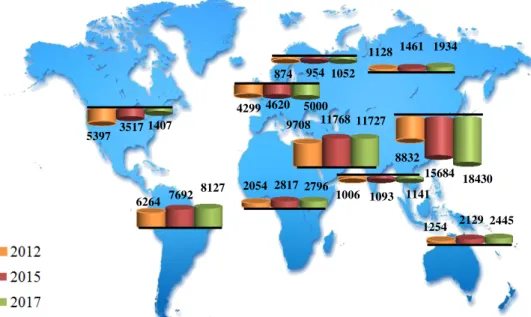
In 2013, the global methanol demand is expected to be around 65 million tonnes [18]. The main consumer and producer of methanol is China, more than 41% as it is possible to observe in Figure 1.7. In China methanol production occurs mainly via syngas, with the abundant feedstock – coal [1,6] and blended it with gasoline as an alternative fuel to the scarce oil or natural gas [15].
Figure 1.6 – Historic methanol and oil contract prices (data are averages for the period shown) [19], data from IHS Chemical.
Figure 1.7 –Global methanol consumption (2010) [20] and production (2012) [21] by region.
41% 13% 12% 12% 6% 7% 3% 3% 3%
Methanol Consumption-2010
China Westem Europa Asia (ex. China)
USA Middle East
Central & Eastem Europe Japan Central/South America Other 48% 8% 8% 6% 5% 25%
Methanol Production -2012
Figure 1.8 – Methanol Net Exports (difference between total values of exports and imports) in thousands of tonnes by region. Positive values indicate that is a mainly exporter region and negative values indicate a mainly importer region. Adapted from [22].
One of methanol applications is in the automobile industry, being used in traditional vehicles without any modifications, normally in a mixture of 85% methanol with 15% gasoline named M85 [13]. When it is essentially pure methanol, it is called M100. This is a cleaner energy compared to other fuels [14], and it is adequate fuel for fuel cells, by its oxidation to CO2 and hydrogen [2] and it is the simplest, safest and easiest way to store and transport liquid oxygenated hydrocarbon [2,13], since it is easier to handle when compared to hydrogen gas [13]. Regarding to its toxicity for humans, methanol by itself is not highly toxic but when consumed via oral, cutaneous or inhalation, it can cause methanol poisoning. Since in the human organism the formation of formaldehyde and formic acid from methanol catalysed by a alcohol (ADH) and formaldehyde (FaldDH) dehydrogenase occurs (Figure 1.9), resulting in metabolic acidosis, blindness, cardiovascular instability, and eventually death [23,24]. The intoxication can occur from the ingestion of contaminated alcohol beverages, with added methanol to adulter them, since methanol is much cheaper than ethanol [23]. Methanol can also be unintentionally formed during the fermentation of beverages with high pectin content.
Figure 1.9 –Methanol metabolism in humans, based on [23,24].
6264 7692
8127
5397 3517 1407
8832
15684 18430
1254 2129 2445
9708 11768 11727
2054 2817 2796 4299 4620 5000
874 954 1052
1006 1093 1141
In the human organism, the formate produced by the methanol metabolization (Figure 1.9) is slowly eliminated, mainly by its oxidation to CO2 [24]. So to prevent formate accumulation one therapeutic strategy is to inhibit the enzyme (ADH) with substances like fomepizole, or by adding another substrate that competes with methanol for enzyme binding site, such as ethanol [23], which produces a less toxic metabolite, acetaldehyde [25].
There has been much effort put into the development of methanol detection sensors, that are produced with ADH, to detect methanol in commercial beverages, such as a sensor for alcohols and aldehydes with ADH encapsulated in silica [26], as well as a sensor for formaldehyde analysis developed with a different dehydrogenase, recombinant formaldehyde dehydrogenase, FaldDH [27].
1.3.
CO
2 TO METHANOLAs it was said before CO2 is the most oxidized form of carbon [5], so it is in the lower energy level, and to chemically convert it without using a catalyst, additional energy is needed.
Carbon dioxide can be converted to other compounds using several approaches, namely:
heterogeneous and homogeneous catalysis [6,16];
electrochemical[6,11] ;
photochemical [6,11];
thermochemical [11];
enzymatic catalysis [6].
Because CO2 is rather inert, its chemical transformations are thermodynamically highly unfavourable [5]. For example, the non-catalysed conversion of CO2 to methanol, has a Gibbs free energy value (∆G) of 3.30 kJ/mol (Eq. 2), being nonspontaneous. A large input of energy is required to overcome the energy barrier from the raw material lowest energy state, for its transformation into useful chemicals.
The thermodynamics of the main reactions of the methanol production via carbon monoxide and carbon dioxide hydrogenation (Eq. 1 and 2) with water - gas shift reaction (Eq. 3), in industry are showed below, Gibbs free energy (∆G) and enthalpy (H) at 25ºC and 1.013 bar.
Hydrogenation reactions are exothermic, having negative enthalpy (H) values. The, CO hydrogenation is a spontaneous and exothermic reaction, with a Gibbs free energy value (∆G) of – 25.34 kJ/mol, and a enthalpy value of - 90.8 kJ/mol. In industry, to avoid the accumulation of a large amount of reaction heat, the water - gas shift reaction (Eq. 3) occurs as a side reaction in conventional processes, consuming water from the carbon dioxide hydrogenation (Eq. 2) (driving force into the non-spontaneous carbon dioxide hydrogenation).
CO + 2 H2 → CH3OH H = - 90.8 kJ/mol [5,6,12] ∆G = - 25.34 kJ/mol [14] (1) CO2 + 3 H2 → CH3OH + H2O H = - 49.6 kJ/mol [5,6,12] ∆G = 3.30 kJ/mol [14] (2) CO + H2O → CO2 + H2 H = - 41.2 kJ/mol [6] ∆G = - 28.6 kJ/mol [14] (3)
In this work, a different strategy was used, taking advantage of enzymatic catalysis (Figure 1.10) in order to overcome these thermodynamic energy barriers, without the use of high temperatures. The first enzymatic approach to this process was developed by Kuwabata et. al. [29] where the reduction of carbon dioxide to methanol is performed with formate dehydrogenase (FateDH) and methanol dehydrogenase (MDH) with electron mediators. Obert and Dave [30] studied a multi-enzymatic system with formate, formaldehyde and alcohol dehydrogenases (FateDH, FaldDH, ADH) in an aqueous medium, using β-Nicotinamide adenine dinucleotide in its reduced form (NADH) as electron donor [30]. More recently, other authors used this system with different matrix, as will be explained in the following sections (section 1.4 - Enzymatic conversion of CO2 to methanol) [31–34]. The enzymatic reduction of CO2 to methanol can also be accomplished by photochemical NADH regeneration, by a processes such as production of methanol from formaldehyde catalysed by ADH [35], using hydrogen carbonate (HCO3-) as reagent to methanol production, catalysed by the enzymes FateDH, aldehyde dehydrogenase (AldDH) and ADH [36], and with photochemichal NADH regeneration.
1.4.
E
NZYMATIC CONVERSION OFCO
2 TO METHANOLIn the present work, a biocatalytic system that uses carbon dioxide (CO2) as reactant for the production of methanol, was studied. The reduction of CO2 is catalysed by three oxido-reductases, which are dependent on the cofactor β-Nicotinamide adenine dinucleotide in its reduced form (NADH); formate (FateDH), formaldehyde (FaldDH) and alcohol (ADH) dehydrogenases. The enzymes are co-immobilized in a sol-gel matrix, and catalyse the sequential reduction of CO2 to formate, formaldehyde, and methanol, presented in Figure 1.10.
Figure 1.10 –Bioconversion of CO2 to methanol, catalysed by FateDH, FaldDH and ADH.
This has been a widely studied strategy to convert CO2 in a product of interest, such as is methanol.
In 1994, Kuwabata, et. al. [29], studied the electrochemical conversion of carbon dioxide to methanol using methyl viologen (MV2+) or pyrroloquinolinequinone (PQQ) as an electron mediator and two enzymes FateDH and methanol dehydrogenase (MDH) as catalysts, the first enzyme reduces CO2 to formate and the second enzyme reduces formate in formaldehyde and finally to methanol.
In 1999 Obert and Dave [30] performed the reduction of CO2 to methanol, with the multi-enzymatic system, FateDH, FaldDH and ADH in aqueous medium, using NADH as electron donnor with the enzymes in solution and immobilized in an sol-gel matrix, the higher yields being respectively 21.0 % with 100 µmol NADH and 91.2% with 50 µmol NADH.
The same multi enzymatic system was used by El-Zahab, et. al. [31], with the addition of the in situ enzymatic cofactor regeneration (NADH), by adding a fourth enzyme, glutamate dehydrogenase (GDH), and glutamate, to the system used by Obert and Dave [30] and immobilizing the enzymes in polystyrene particles, (Figure 1.11) with an accumulated methanol yield of 127%, after 11 cycles of reusing.
CO
2Formate Formaldehyde Methanol
NADH NAD+ NADH NAD+ NADH NAD+
Figure 1.11 – CO2 reduction to methanol by co-immobilized enzymes with in situ regeneration of NADH [39], performed by El-Zahab, et. al. [31].
Sun, et. al. (2009) [32] also used different matrices to immobilize the multi-enzymatic system with the three enzymes, by the entrapment in titania particles having a methanol production yield up to 60%. To enhance enzyme stability and reactivity Xu, et. al. [33], immobilized the three enzymes in a composite of sol-gel silica with alginate, and in 2012 Dibenedetto, et. al. [34], used this method coupled with the independent photocatalytic NADH regeneration, achieving a yields of approximately 95 % in the first utilization.
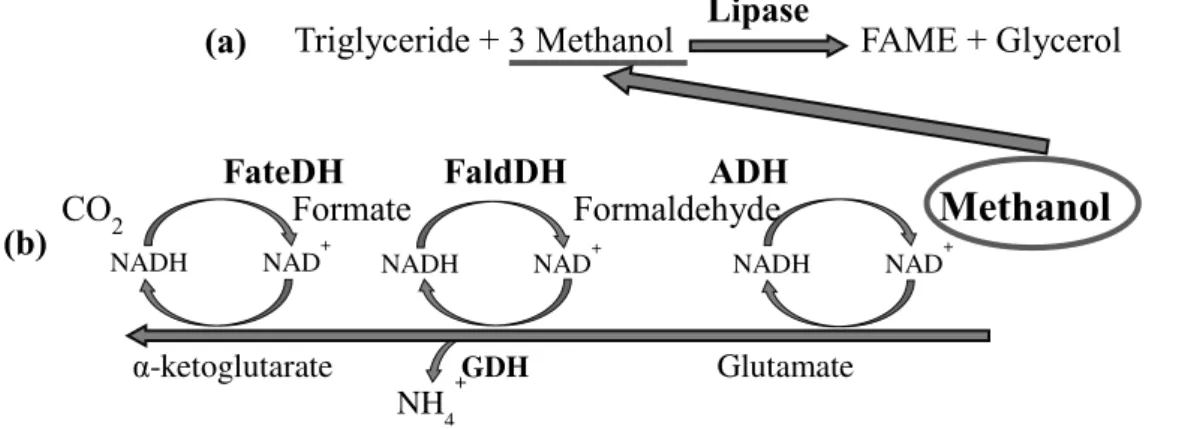
Previous work with the biocatalytic system under study, was developed within our laboratory, using ionic liquid [EMIM][EtSO4] as the reaction medium. The biodiesel transesterification reaction was coupled with the CO2 reduction to methanol, and its quantification was made indirectly by the production of fatty acid methyl esters (FAME), commonly known as biodiesel. An estimative of production of 0.7 mg/mL of methanol was achieved, with the enzymatic regeneration of the cofactor, NADH, also performed by adding a fourth enzyme glutamate dehydrogenase (GDH) and glutamate (Figure 1.12).
In the present work, the strategy is to reduce CO2 into a liquid fuel, using the multi-enzymatic system described above. Also, ionic liquid is used as the reaction solvent, which is advantageous since the quantity of carbon dioxide dissolved in this reaction medium is enhanced and the separation is easier [40].
Figure 1.12 – (a) Conversion of methanol in biodiesel, catalysed by a lipase. (b) The enzymatic transformation of CO2 in methanol, coupled with the in situ regeneration of cofactor NADH.
1.5.
I
ONIC LIQUID(IL)
In this work, an alternative solvent was used, as a reaction medium for the byocatalytic system under study. A brief introduction of Ionic liquids (ILs) is presented here.
Ionic liquids are organic salts composed of cations and anions, which are liquid below a threshold temperature, normally 100ºC [40–42] and when they are liquid at room temperature are named room temperature ionic liquid (RTIL) [9,43]. This is due to a non-efficient ion packing, of their structures [9].
ILs are able to dissolve both organic and inorganic species [41,44] and are ‘tailored solvents’, because with the different combinations of anions and cations [44] it is easy to change their properties than for organic solvents. [9,41,43]. They can be consider possible “green” solvents since they are not volatile and it may be feasible to recycle and repeatedly reuse [9,41],in comparison with organic solvents [43], although their synthetic process is not normally an environmentally friendly one.
ILs have a very attractive of properties. One of them is their water miscibility, which varies from immiscible to fully miscible [10,40] being mainly determined by the anion [10]. Other parameter from IL is the polarity, is also dependent on its ionic species, polarity decreases with the increase of anion size [10]. Their vapour pressure is considered as negligible [9,41,44], so they are non-volatile [42] [41,43]. They are also chemically stable and non-flammable [44]. This is useful to remove volatile products, such as methanol, for example. They can even be used in vacuum processes [43], sublimation, distillation or supercritical extraction [40].
Another important property of the ionic liquid is their high viscosity, as a result of the strong
CO
2Formate Formaldehyde
Methanol
NADH NAD+ NADH NAD+ NADH NAD+
FateDH FaldDH ADH
α-ketoglutarate GDH Glutamate
Triglyceride + 3 Methanol
Lipase
FAME + Glycerol
NH4+
(a)
25 ºC). The viscosity is mainly dependent of the alkyl chain length of the cation, being directly proportional to it [43].
ILs different properties enables its applications on diverse areas, exemplified in Figure 1.13..
Figure 1.13 –Ionic Liquids applications [41].
Regarding CO2 solubility, ILs can dissolve carbon dioxide but the opposite phenomenon is not observed [40,45]. If CO2 is at is supercritical fluid form (sc-CO2), it has a high solubility in ionic liquid, with mole fraction of more than 0.6 [46]. [EMIM][EtSO4] is an example of an IL than can dissolve a molar fraction of CO2 (XCO2) of 0.421 ,at a temperature of 40ºC and pressure of 92.68 bar
[45]. IL [BMIM] [BF4] at temperature of 40ºC and at pressure of 100 bar presents XCO2 of ca. 0.72,
and for the same temperature but at a pressure of 10 bar, XCO2 of only 0.1 [47].
1.6.
B
IOCATALYSISIn the biocatalytic system under study, where the reduction of CO2 to methanol takes place (Figure 1.10) the biological catalysts used are three oxido-reductases – FateDH, FAldDH and ADH with the enzyme classification – EC 1 by the classification system of the Enzyme Commission.
In catalysis, a molecule accelerates a chemical reaction by lowering the activation energy required to the reaction- the catalyst. It forms a chemical bond with the reacting molecules, allowing them to react to a product, and detaches from the catalyst without being chemically altered in the process. The catalyst may be an atomic specie, molecules or larger structures such as zeolites or enzymes. In biocatalysis specifically, natural catalysts are used, such as an isolated enzyme or a microorganism in a fermentative process to perform chemical transformations.
The main enzymes used in biocatalysis are divided in six groups, represented in Table 1.1.The
enzymes used for the bioconversion of CO2 to methanol are members of the group of oxido- -reductases, commonly known as dehydrogenases or oxidases. Dehydrogenases use substances called
coenzymes, to catalyse the electron transfer from one molecule (reductant) to another (oxidant).
Table 1.1 - Classification of enzymes by the type of chemical reaction catalysed [16].
Type of chemical reaction catalysed Enzyme type Enzyme classification
Oxidation – reduction Oxido-reductases EC 1
Transfer of functional groups Transferases EC 2
Hydrolysis Hydrolases EC 3
Addition and elimination Lyases EC 4
Isomerization Isomerases EC 5
Carbon bond formation Ligases EC 6
One alternative to biocatalytic systems that use enzymes as catalysts (Figure 1.10), are systems where the catalysts are microorganisms, and this presents several advantages and disadvantages. One of the advantages of using microorganisms is to replace multi-step processes by the conversion of a starting material into the end product through a metabolic pathway. Also there is no need of recovery or purification of intermediate products like NADH [16,48] or enzymes [48] and processes such as cofactor regeneration can be carried out by the living cell [16].
Regarding enzymes, their potential is still not totally explored, with a estimative of only less than 1% of the microorganisms in the environment were cultured and had their enzymes identified. Although many enzymes are commercially available to this date, some are less expensive than others, depending if they are already from recombinant sources and on the degree of difficulty of their isolation [49], since they are normally highly specific [49,50]. The majority of the enzymes that are used do not require cofactors (hydrolases, transferases, lyases and isomerases) [16], however their activity can be limited by inhibition [50].
Compared with microorganisms, enzymes also have the advantage of not dispensing resources for biomass production, and do not require careful conductions to keep them alive [16]. Enzymes work in a wider range of temperature, pH, solvent (up to working in almost aqueous free environments) and pressure [10,16], and enable the conversions to take place under much more concentrated conditions [16].
Nonetheless, when dissolved in the reaction medium it is difficult to retain enzyme activity [49]. A solution for this problem can be enzyme immobilization, in which an interaction between the enzyme and the carrier occurs [49], through covalently or non-covalently bonding. The immobilization of enzymes onto solid materials can be traced back to the 1950s [51], and in the past years the major focus was the development of robust enzymes that are not only active but also stable and selective in hostile conditions [51]. The immobilization enables continuous processing and reutilization of the biocatalyst [16,49] and confers some protection to the enzyme core when exposed to organic solvents [49,51].
E
NZYMES–
O
XIDO-
REDUCTASES1.6.1.
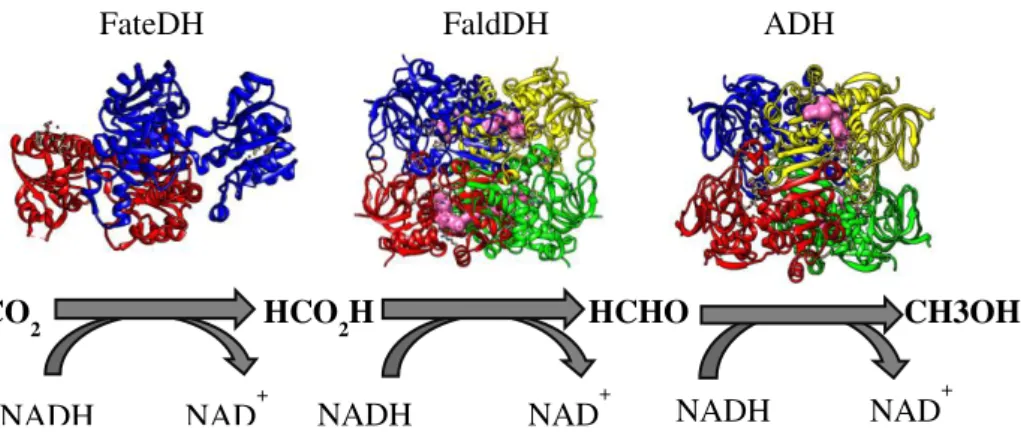
In this work, three NADH dependent oxido-reductases were used in a “one-pot” system with formate, formaldehyde and alcohol dehydrogenase, for the catalytic reduction of CO2 to methanol. Figure 1.14 describes the oxidation–reduction reactions between the different substrates and the cofactor, NADH.
Enzymes are normally proteins and they have high catalytic power and specificity. With dimensions much larger than the dimensions of the substrates, only some catalytic residues bind to the substrate (and the cofactor, if any) by multiple weak attractions, and carry out the reaction. These active structures are defined as the enzymes’ active site.
Figure 1.14 – Conversion of CO2 to methanol catalysed by oxido-reductases – formate (FateDH), formaldehyde (FaldDH) and alcohol (ADH) dehydrogenases.
The flexibility of the enzymes enables a close contact between the enzyme and the substrate is necessary to their interaction, leading to the active sites being markedly modified by the binding of substrate. The arrangement of the atoms in an active site also determinates the specificity of binding.
Oxido-reductases are structurally divided in two domains, mainly the “NAD binding domain” and “catalytic domain”. The “NAD binding domain’’ displays a Rossmann fold structure with a spatially conserved area [52,53], two units (βαβαβ) arranged in a supersecondary structure [54] responsible for recognition and binding of the NADH or NAD+ molecules in an active conformation. The “catalytic domain” contains the amino acid residues essential for catalysis, correctly oriented in the active site and is specific for the particular enzyme [53].
The reduction of the cofactor NADH by the oxido-reductases proceeds as follows, with the respective reaction in the Figure 1.15, more specifically:
cofactor and substrate bind to an enzyme;
the substrate is reduced, while the cofactor is oxidized;
the cofactor and product dissociate from the enzyme [39,55]. NADH NAD+
FateDH FaldDH ADH
CO2 HCO2H HCHO CH3OH
Figure 1.15 – Oxidation – reduction reaction between the coenzyme - NADH, and a subtract, catalysed by oxido-reductases (EC 1). Adapted from Matsuda, et. al. [39].
In industry, oxido-reductases can catalyse reactions that conventional chemical catalysts fail to [56]. For example they have the ability to work in mild conditions and tolerate impurities such as sulphur compounds (from the combustion gases) that are toxic to some chemical catalysts. However, to regulate and optimize oxido-reductase activity, some important parameters need to be controlled like temperature, pH and ionic strength (I) of the media. A theoretical study from Baskaya, et. al. [28] indicates that the most sensitive parameter in the specific case of methanol production is pH. For pH values lower than 6, there is a favourable reaction for methanol production, and the opposite occurs for pH values higher than 6 [28]. Nevertheless, it must be noted that NADH is unstable at low pH [57–59]. From the work of Baskaya et. al. [28], it is also known that the production of methanol should be favoured by conducting the redox reactions at low pH and low ionic strength, combined with high temperatures. The values for G were obtained with ionic strength (I), pH and temperature ranging from 50 to 225 mM, 4 to 37ºC and pH 2 to 7, respectively. The lowest G value is -127.11 kJ/mol for I of 50mM, pH 2 and a temperature of 37ºC [28].
In this specific work, with the enzymes used FateDH, FaldDH and ADH and the catalysed reactions, it is not possible to use these pH and ionic strength parameters, because the low pH and high temperature can have denaturation effects, and the pH can be more difficultly controlled at low ionic strength [28]. A solution for this, may be enzyme engineering, with the utilization of whole cells and combined systems [28,60].
One of the major challenges that the biocatalytic system under study presents, are the low reaction yields and rates, making it not suitable to an industrial scale system for CO2 conversion [28]. There are many reasons for the low yields of this system. For example, if the reaction is conducted in an aqueous medium, enzymatic deactivation can occur by the formation of carbonic acid from the contact of the reactant, CO2, with water. Activity of the enzymes can also be challenged by the
reaction of the enzymes amine groups with CO2, and the formation of carbamates [10] and other species such as CO32−, HCO3−, and H2CO3, that also have an impact in the pH [28], so a buffered medium must be used.
Oxido-reductases are also known to be active in non-aqueous solvents, but their immobilization is necessary in some cases, to stabilize the enzyme [39].
This study also presents the drawback of using NADH as electron donor, 3 moles of NADH per mole of methanol produced. As the cofactor is relatively expensive, its regeneration is mandatory. To render an economically feasible enzyme-catalysed reduction [55], several methods were developed to recycling NADH and can be classified into several categories for instance:
chemical regeneration [34,61–64], with catalyst such as sodium dithionite [34] and ruthenium (II) and rhodium (III) complexes [61];
enzymatic regeneration [31,39,56,61–70] mainly by the following oxido-reductases: o GDH with glutamate as subtract [31];
o ADH with ethanol as subtract [62]; o NADH oxidase [63];
o lactate dehydrogenase with lactic acid as subtract [65]; o FateDH with formic acid [66];
o glucose dehydrogenase [67] and glucose-6-P dehydrogenase[68].
microbial regeneration [37,56,62–64,71], with microorganisms as Geotrichum candidum [71] and Methylosinus trichosporium IMV 3011 [37];
photochemical regeneration [34,39,56,61–64,69] with photocatalyst such as siO2-supported quantum dots [56], transition metal systems [34] and carbon nitrate [69];
electrochemical [31,34,39,56,61–65,69,70,72–74] using as an example glassy carbon [64] or gold electrodes [72], vanadium-silica xerogels [70] rhodium mediators [73] and carbon nanofibers cathode [74].
F
ORMATED
EHYDROGENASE(F
ATEDH)
1.6.2.
Figure 1.16 –Oxidation of formate to CO2 catalysed by FateDH, using NAD+ as cofactor [75].
Formate dehydrogenase is classified as EC 1.2.1.2 [52,76–78] by the classification system of the Enzyme Commission. It is possibly the most suitable model for investigating the general mechanism of catalysis involving hydride transfer [52,76]. It is also a catalyst to coenzyme regeneration [55,66,76], and in laboratory and pilot scale it is used for the production of bulk drug substances and agricultural products [52], and in fine organic and asymmetrical synthesis for production of highly value products [52,76]. It is also in high demand from the pharmaceutical and agrochemical industries [52].
FateDH plays a key role in some organisms. In methylotrophs microorganisms, it catalyses the terminal step of catabolism of C1 compounds [76], having an important role in the energy supply [52,76] and as supplier of reducing equivalents. Methylotropic bacterium oxidizes methanol to CO2 both through cyclic mechanisms or by chain dehydrogenases, although methylotropic yeasts oxidizes methanol to CO2 via formaldehyde [76]. In prokaryotes and eukaryotes it is involved in methanol metabolism and in plants as a stress response [52,66].
FateDH is normally a homodimeric enzyme [52,76,79] (Figure 1.17 (a)) and does not contain metal ions or prosthetic groups [52,76]. It is active over a wide pH range (pH 5.5–11.0) [52,66], and can therefore be combined with almost any other dehydrogenase [52]. In the microorganism Pseudomonas sp., FateDH is constituted by 393 amino acid residues [53,76]with a molecular mass of 86 kDa [53]. FateDH from E. Coli it is a 79 kDa polypeptide, is a component of the anaerobic formate hydrogen lyase complex [80].
The dimeric FateDH used in this work (Figure 1.17 (a)) is from the microorganism Candida boidinii and has 364 amino acids residues [52], corresponding to a molecular mass of 36 kDa per subunit [76,79], with a molecular mass of 74 kDa [79] for the two subunits. Its thermal inactivation temperature is 55ºC [52,76], with an isoelectric point (pI) of 5.4 [76], a pH optimum between 7.5 and 8.5 [79], a KmNAD+ of 90 µM and Kmformate of 13 mM at 30ºC and at pH 7.5 [76]. Each subunit possess an independent active centre, and are non-metal containing enzymes[76,78].
The FateDH monomer from Candida boidinii contains of 15 α-helices and 13 β-strands [52] that are arranged into two domains [52,76], called the ‘‘NAD binding domain’’ and ‘‘catalytic domain’’. They are linked by two long helices, and are separated by a deep cleft where the active site is located [52].
The “NAD binding domain” with the residues N119 to S313 (Figure 1.17 (b)) displays a Rossmann fold structure (see 1.6.1 Oxido-reductases). The “catalytic domain” is formed by the remaining residues and has a flavodoxin-like topology [52]. The active site residues are located on the base of the cleft between the two domains, presented in Figure 1.17, with the conserved residues N119, V123, T256, D282, H311, S313, and G314 [52]. The residues R258 and N119 bind formate in the active site, and formate can be fixed between H311 and the nicotinamide ring [52]. The nicotinamide ring contacts with residues D282 and S313, and R174 binds the phosphate linker in NAD+. The adenine ring can also interact with H232 and Y196 [52].
Figure 1.17 –Representation of FateDH from Candida boidinii; (a) with the different subunits in blue and red; (b) with the “NAD biding domains” in the colours yellow and magenta and the “catalytic domains” in beige. Structures from Protein data Bank (PDB) ID: 2J6I [52]. Sructures were produced using the program UCSF Chimera version 1.7.
F
ORMALDEHYDED
EHYDROGENASE(F
ALDDH)
1.6.3.
Formaldehyde dehydrogenase (FaldDH) is the intermediate enzyme in the biocatalytic system described in Figure 1.14, catalysing the reduction of formate to formaldehyde, and in some organisms the reverse reaction to metabolize the toxic compound - formaldehyde [24,27,81], that can damage
FaldDH is classified as EC 1.2.1.46 [81,83] by the classification system of the Enzyme Commission. And it is a member of the zinc-containing medium-chain dehydrogenase/reductases family, in which ADH is also included [81,83,84].
The majority of the FaldDH requires NAD+ and glutathione to perform the chemical reactions [81,85]. As examples FaldDH from the liver of organisms such as humans, rats [85], bovines [86] and Candida boidinii [79] are glutathione dependents.
The dimeric FaldDH from Candida boidinii has a molecular mass of 80 kDa [79]and from bovine liver haves a molecular mass of 82 kDa [86]. The FaldDH used in this work is from the microorganism Pseudomonas sp. and does not require the addition of the glutathione cofactor [81,83,87]. Another unique characteristic of this enzyme is that it is a nicotinoprotein, having an intrinsic tightly bound β-nicotinamide adenine dinucleotide or β-nicotinamide adenine dinucleotide phosphate in their reduced or oxidised forms (NAD(P)(H)) [81,83]. It catalyses the oxidation and reduction of aldehydes, without the release of cofactor from the enzyme to the media [83]. FaldDH from Pseudomonas putida is a homotetramer of identical subunits, in each subunit the two domains present are separated by a cleft, containing the “NAD binding domain” and the “catalytic domain” being the last one responsible for subtract binding and specificity [81,83].
The FaldDH tetramer from Pseudomonas putida, can be considered to be a dimer of dimers, because each dimer is composed of two subunits (Figure 1.18 (a)). Each subunit haves 398 amino acid residues [81,83] arranged in 17 α-helices and 16 β-strands [83], a molecular mass of 42 kDa [81,83] and two zinc ions [81,83,87], one catalytic and the other structural. The tetramer has a total molecular mass of 170 kDa [81,83], is thermal stable until 40ºC, an pI of 5.3, is active from pH 5 to 10, an optimum pH of 8.9 [85], a KmNAD+ of 56 µM and Kmformaldehyde of 67 µM at 25ºC and at pH 7.8 [88].
Figure 1.18 – Representation of FaldDH from Pseudomonas putida, with NAD represented in pink, zinc atoms in purple; (a) with the different subunits in yellow, green, blue and red; (b) with the “NAD biding domains” in the colours cyan, orange, green and black and the “catalytic domains” in beige. Structures from PDB ID: 1KOL [83]. Structures were produced using the program UCSF Chimera version 1.7.
As well in FateDH, the “NAD binding domain” from FaldDH contains a Rossmann fold structure, composed by a smaller domain of 167 residues, from the residues L171 to Q337 [81,83], Figure 1.18 (b). The “catalytic domain” is the larger domain with 231 residues, it is contained between residues S1 to I170 and between residues T338 to A398 [81,83].
Two zinc ions per subunit are bound to the ligands within the “catalytic domain”. The catalytic zinc is bound to a water molecule and three protein ligands from the catalytic domain the C46, H67 and D169, Figure 1.19. The structural zinc is bound to four protein ligands from the catalytic domain. The ligands are sulphur atoms from four cysteines. The cysteines are C97, C100, C103 and C111 [81,83], Figure 1.19.
The NAD(H) molecule is connected to the protein surface through six hydrogen bonds, Figure 1.19. Three hydrogen bonds exist between the carboxyamide group of the nicotinamide ring and the protein residues T338, G336, P299. Another three hydrogen bonds exist between the hydroxyl group of nicotinamide ribose and the protein side-chain S48, and two hydrogen bonds with H51. There are more hydrogen bounds between the NADH and the protein surface namely with the residues G47, V197, R222, D217, R267 and H269 [81,83].
Figure 1.19 – Representation of NAD(H) binding to the active site, and the zinc (purple) binding site. Structures from PDB ID: 1KOL [83]. Structure produced using the program UCSF Chimera version 1.7.
defence against alcohol poisoning, catalysing the oxidation of a primary alcohol into an aldehyde or a secondary alcohol to a ketone [89–91], (Figure 1.20), using NAD+ as cofactor. A scheme of the methanol detoxification in humans is in Figure 1.9.
Figure 1.20 – Oxidation of an alcohol in to an aldehyde or a ketone catalysed by ADH, using NAD+ as cofactor [91]. R1 and R2 are stand for alkyl groups.
Alcohol dehydrogenase is classified as EC 1.1.1.1 [91] by the classification system of the Enzyme Commission. As FaldDH is a member of the zinc-containing medium-chain dehydrogenase/reductases family [81,83,84,91].
ADH is a isoenzyme [91], from 4 diverging groups of organisms: vertebrates, plants, eukaryotic microorganisms and prokaryotic bacteria [91].
The homotetrametic ADH (4 identical subunits) [92], has a pI between 5.4 and 5.8, an optimum pH between 8.6 and 9.0 and a molecular mass of 141 to 151 kDa. Ethanol is the best subtract to the enzyme, indeed the methanol activity of the enzyme at pH 8.8 is only 0.07% of its ethanol activity [91].
Figure 1.21 – Representation of ADH from Saccharomyces cerevisiae, , with a NAD analogue represented in pink, zinc atoms in purple; with the different subunits in in yellow, green, blue and red; Structures from Protein data Bank (PDB) ID: 2HCY [93]. Structures were produced using the program UCSF Chimera version 1.7.
Each subunit is constituted with 347 amino acid residues, with a molecular mass of 36 kDa and 2 Zn atoms, one with a structural play and the other catalytic [91]. The total molecular weight of proximally 150kDa [92]. In relation to its properties it has an optimum temperature and pH of 35ºC and 7.5 [94] and a KmNAD+ of 4.6 mM at 25ºC and a pH 8.2. [88].
The catalytic zinc is bound in the “catalytic domain” to C46, H67 and C174, and the structural zinc is bound to cysteines C 97, C100, C103 and C101 [91]. Also in Figure 1.22 is represented a model of the active site from ADH.
Figure 1.22 –Model of the active site of ADH [91].
1.7.
B
IOCATALYSIS INIL
SThe most common ionic liquids for biocatalysis are the imidazolium based ionic liquids [43], but when water is present they can dissociate into independent cations and anions, affecting protein stability as described in the Hofmeister series [10].
1-alkyl-3-methylimidazolium ionic liquids, (abbreviated [Cnmim]+, where n number of carbon atoms in a linear alkyl chain, or [Xmim] (where X is M, E, P,B, etc. for a1,2,3,4,ect. carbon atoms in a linear alkyl chain), are unreactive with water and are the most widely used for biocatalysts. They are polar solvents and they are miscible with other polar solvents, enabling an increase of the solubility of polar compounds, like methanol, leading to faster reactions and changes in selectivity [41,43].
Zhang et. al. studied the negative effect of IL[BMIM][PF6] on the activity of YADH (Yeast Alcohol Dehydrogenase) (Figure 1.23) [95]. The authors studied the effect of:
resulting F- from hydrolysis in a basic medium;
ions Cl- and Br-;
impurities in the ionic liquid;
imidazole cation [95];
Figure 1.23 – Residual activity of YADH at different imidazole concentrations [95].
Oxido-reductases retain its activity in non-aqueous solvent, namely when suspended in ionic liquids [43], but immobilization is necessary for some cases to stabilize the enzyme [39]. Table 1.2 presents some examples of oxido-reductases reactions in different ILs.
Table 1.2 - Examples of enzymatic reaction with oxido-reductases in ionic liquid medium
Ionic liquid
Enzyme
%(v/v)
Enzyme activity (%) * Reference
[MMIM][MeSO4] FateDH 75 in buffer 98 [42]
[Et3NMe] [MeSO4] FateDH 75 in buffer 55 [42]
[BMIM] [OTf] FateDH 25 in buffer 38 [42]
[BMIM][OTf] YADH 25 in buffer < 5 [42]
[MIm] [Cl] TBADH 0.3mM 30 [96]
[MIm][BF4] TBADH 0.3mM 40 [96]
[BMIM][BF4] TBADH 700mM 0.1 [96]
[BMIM][Cl] TBADH 700mM 0.06 [96]
[BMIM][BF4] and
[BMIM][OTf] HLADH 0.4mg/ml 0 [97]
[BMIM][NTF2] LB-ADH Biphasic system --- [98]
![Figure 1.5 – Production of renewable methanol [13].](https://thumb-eu.123doks.com/thumbv2/123dok_br/16670976.742716/29.892.193.696.96.450/figure-production-renewable-methanol.webp)
![Figure 1.6 – Historic methanol and oil contract prices (data are averages for the period shown) [19], data from IHS Chemical](https://thumb-eu.123doks.com/thumbv2/123dok_br/16670976.742716/30.892.208.688.103.382/figure-historic-methanol-contract-prices-averages-period-chemical.webp)
![Figure 1.11 – CO 2 reduction to methanol by co-immobilized enzymes with in situ regeneration of NADH [39], performed by El-Zahab, et](https://thumb-eu.123doks.com/thumbv2/123dok_br/16670976.742716/35.892.232.667.107.431/figure-reduction-methanol-immobilized-enzymes-regeneration-performed-zahab.webp)
![Table 1.1 - Classification of enzymes by the type of chemical reaction catalysed [16]](https://thumb-eu.123doks.com/thumbv2/123dok_br/16670976.742716/38.892.168.765.606.808/table-classification-enzymes-type-chemical-reaction-catalysed.webp)

![Figure 1.16 – Oxidation of formate to CO 2 catalysed by FateDH, using NAD + as cofactor [75]](https://thumb-eu.123doks.com/thumbv2/123dok_br/16670976.742716/43.892.259.691.108.290/figure-oxidation-formate-catalysed-fatedh-using-nad-cofactor.webp)

