Received October 21, 2010 and accepted March 11, 2011. Corresponding author: [email protected]
Use of conditioners in the production of Tifton 85 grass hay
Deise Dalazen Castagnara1, João Paulo Ames1, Marcela Abbado Neres1, Paulo Sérgio Rabello de Oliveira1, Francieli Batista Silva1, Eduardo Eustáquio Mesquita1, José Renato
Stangarlin1, Gilmar Franzener1
1Universidade Estadual do Oeste do Paraná – Centro de Ciências Agrárias – CCA, Campus de Marechal Cândido Rondon. Rua
Pernambuco,1777 , Caixa Postal 91, Marechal Cândido Rondon – PR, 85960-000.
ABSTRACT - The objectives of this study were to estimate the curve of dehydration, bromatological composition and occurrence of fungi in Tifton 85 grass, submitted to four methods of dehydration. The curves of dehydration were studied in a completely randomized design with a 4 × 11 factorial scheme with four drying systems (1 conditioning + 1 turn-over; 2 conditionings + 1 turn-over; no conditioning + 1 turn-over and no conditioning + 2 turn-overs) and 11 sampling times (0, 3, 15, 18, 21, 24, 39, 42, 45 and 47 hours after the cutting), with six replicates. For the bromatological composition and fungi occurrence, the experimental design was completely randomized in a 4 × 3 factorial scheme with the four drying methods of Tifton 85 grass and three periods of evaluation (before the cutting, at the time of the baling and 30 days after storage) with six replicates. It was found that after the first hour after cutting and at the end of the period of dehydration, Tifton 85 plants that were treated with conditioners showed higher levels of dry matter. Stored hay that was treated with conditioners presented higher levels of acid detergent insoluble protein. Until baling, the drying methods did not alter the crude protein content of hay; however, after storage, the hay submitted only to turn-over showed crude protein content higher (13.90%) than those submitted to conditioners (9.94%). There was an increase in the occurrence of fungi after storage, but the application of conditioners and one turn-over resulted in lower CUF/g, compared with other treatments, enhancing the effect of conditioners on accelerating the dehydration rate and obtaining better hay storage conditions.
Key Words: conservation, crude protein, dehydration, storage fungus
ISSN 1806-9290 www.sbz.org.br
Introduction
Conserved forages such as hay and silage can have their food value changed greatly because of the procedures adopted for their production and preservation, as well as chemical and microbiological phenomena that occur in the process (Jobim et al., 2007). For Reis et al. (2001), in addition to age and species of forage plants, the main factors that influence the obtention of a high quality hay is cutting management, which aims at rapid dehydration, and expertise to overcome the obstacles presented by environmental factors. These factors directly interfere with the chemical and sanitary quality of hay, as well as losses in production (Domingues, 2009). Muck & Shinners (2001) indicate the need for research to understand the processes that affect the quality of hay during production and storage and develop practical ways to reduce losses and improve quality. According to Rotz (1995), the majority of losses occurrs in the first 30 days of storage. The fungi population undergoes accented changes with decrease of those genera typical of the field, such as Fusarium and Cladosporium
and increase of Aspergillus and Penicillium during
storage (Hlodversson & Kaspersson, 1986).
Mower conditioners are widely used for plant dehydration and hay production, and their acquisition by producers has been growing every year, in order to reduce the risk of losses from rainfall through the acceleration of the dehydration process. The conditioners have emerged in the 40’s with the aim of aiding at plant dehydration by crushing the stems. There are conditioners on the market today with free swinging flail fingers and rollers. This acceleration causes a beneficial effect in the final stage of dehydration, when the removal of moisture is slower because it happens through the cuticle (Moser, 1995). However, the mechanical injuries on the plant can cause changes in bromatological composition and digestibility of forage, making it necessary to evaluate its effects on the final composition of the hay produced.
In this sense, this experiment aimed to assess the rates of dehydration, bromatological composition and occurrence of fungi in Tifton 85 hay produced under different methods of dehydration.
Material and Methods
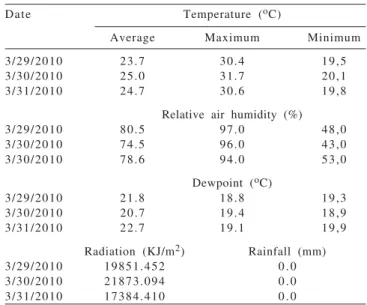
The experiment was conducted under field conditions at the Fazenda Experimental Antônio Carlos dos Santos Pessoa, in the Universidade Estadual do Oeste do Paraná, campus of Marechal Cândido Rondon, having as coordinates latitude 24º 33 ' 40'' S, longitude 54º 04' 12 '' W and altitude of 420 m. The local climate, classified according to Koppen Cfa, is subtropical with rainfall well distributed during the year and hot summers. The average temperatures of the coldest quarter vary from 17 to 18°C, while the warmest ones vary from 28 to 29 °C and annual average temperature varies from 22 to 23°C. The total average annual rainfall for the region ranges from 1,600 to 1,800 mm, with the wettest quarter showing totals ranging from 400 to 500 mm (IAPAR, 2006). During growth and drying of plants, climatic conditions were favorable (Figure 1; Table 1).
The experimental area is classified as Oxisol (EMBRAPA, 2006) and has the following chemical characteristics: pH in water-5,70; P (Mehlich) -10.78 mg/dm3;
K (Mehlich) - 0, 13 cmolc/dm3; Ca2+ (KCl mol/L1 1) -5.21 cmolc/dm3; Mg2+ (KCl 1 mol/L) - 0.91 cmol
c/dm3; Al3+
(KCl 1 mol/L) - 0.00 cmolc/dm3; H + Al (calcium acetate
0.5 mol/L) - 4.14 cmolc/dm3; SB - 6.15 cmolc/dm3; CTC -10.29 cmolc/dm3; V - 59.77%; organic matter (Boyocus Method) - 30.07 g/dm3 and clay - 65%.
The experiment was installed in a field of hay production in 2004 implanted with Cynodon sp. cv. Tifton 85, and has
an area of 1.3 hectares, managed exclusively for hay production. At the moment of cutting, Tifton 85 showed regrowth age of 42 days and plants had an average height of 35 cm.
The cut of the experimental area was performed at 2 p.m. on 3/29/2010, with the help of a rotary mower and at
10 cm from the soil. Conditioning was done two hours after cutting with the aid of tractor conditioner with free swinging flail fingers, while the turning over was performed at 5 p.m. and 11 p.m., after cutting, with the aid of a tractor rake.
For determination of the drying curves, a completely randomized design in a 4 × 10 factorial scheme, composed of four methods for the dehydration of hay: 1 passage of conditioner + 1 turn-over (1 cond. + 1 turn-over); 2 passages of conditioner + 1 turn-over (2 cond. + 1 turn-over); no conditioner + 1 turn-over (1 turn-over) and no conditioner + 2 turn-overs (2 turn-overs) and 10 sampling times (0, 3, 15, 18, 21, 24, 39 , 42, 45 and 47 hours after harvest), with six replicates. Collection times corresponded to the following times: 1st day (cut day): time 0 = 2 p.m., time 3 = 5 p.m.; 2nd
day: time 15 = 8 a.m., time 18 = 11 a.m., time 21 = 2 p.m., time 24 = 5 p.m.; 3rd day: time 39 = 8 a.m., time 42 = 11 a.m., time
45 = 2 p.m., and time 47 = 4 p.m.
The production of dry matter (DM) and leaf:stem relation were studied according to a randomized design with four treatments and six replications. For the bromatological composition and occurrence of fungi, the experimental design was completely randomized in a 4 × 3 factorial scheme with four methods for the dehydration of hay and three sampling periods (before the cut, at the time of baling and 30 days after storage) with six replicates.
The sampling for the determination of MS production was performed before the mower passing with a square of 1 m² randomly placed in each plot. Samples were separated into two sub samplings, from which the first one was destined to the evaluation of the bromatological composition and the second one was separated into leaves (leaf lamina)
Date Temperature (oC)
Average Maximum Minimum
3/29/2010 23.7 30.4 19,5
3/30/2010 25.0 31.7 20,1
3/31/2010 24.7 30.6 19,8
Relative air humidity (%)
3/29/2010 80.5 97.0 48,0
3/30/2010 74.5 96.0 43,0
3/30/2010 78.6 94.0 53,0
Dewpoint (oC)
3/29/2010 21.8 18.8 19,3
3/30/2010 20 .7 19.4 18,9
3/31/2010 22.7 19.1 19,9
Radiation (KJ/m2) Rainfall (mm)
3/29/2010 19851.452 0 . 0
3/30/2010 21873.094 0 . 0
3/31/2010 17384.410 0 . 0
Table 1 - Climatic data on the dates for the cutting and drying of the Tifton 85 plants (Marechal Cândido Rondon, March of 2010)
analysis through the SAEG software (1997), and averages were compared by using the Tukey test at 5% of probability.
Results and Discussion
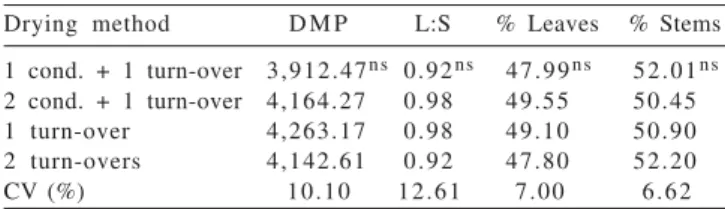
There was no statistical difference between treatments for DM yield and leaf:stem relation (p<0.05) (Table 2). These results confirm the uniformity of the field of Tifton 85 and validate the design used for the experiment (completely randomized). The average production of MS in Tifton 85 was 4,370.63 kg/ha. Alvim et al. (1999) concluded that Tifton 85 grass can be used in cut intervals of four to six weeks, from October to March in Coronel Pacheco - MG, because besides the high DM yield, CP concentration remains high. Rocha et al. (2000) obtained average yields of 2,630 kg/ha when studying three cuts of Tifton 85 with application of 100 kg/ha of nitrogen. As for the components of forage produced, the leaf/stem ratio was 0.95, with an average participation of leaves at 48.60%, and stems at 50.40%. Moreira & Reis (2007) obtained stem ratio of 0.94 in areas of Tifton 85, values very close to those obtained in this research.
The plant dehydration in the field for prolonged periods can lead to loss of nonstructural carbohydrates due to excessive breathing and loss of leaves. According to Collins (1995), hay with drying periods exceeding seven days is not approppiate for animal consumption. After the cut (Figure 2), the plants started to dehydrate and the results fit the polynomial regression model of degree 4. After three hours of dehydration, there were differences between the drying methods, with a faster rate of dehydration in the plots where Tifton 85 received the treatment with conditioner. However, in the beginning of each morning, the DM levels among the drying methods were very close, with an increase of moisture, which is due to the accumulated dew at night. According to Rotz (1995) rehydration of the plants with dew occurs when it is absorbed by the internal tissues, and the rate of distribution within the plants is related to cuticle and stems (culms + sheaths). All samples were separated
and packed in paper bags, weighed and placed in an oven with ventilation force and maintained at a temperature of 55 °C for 72 hours for drying. The leaf:stem relation was calculated using the ratio of dry weight of leaves and dry weight of stems.
For the determination of the drying curves, samples of 300 g from each plot were collected (according to the established times), selected and dried separately using the same methodology applied to other samples. After 47 hours of dehydration at the time of baling, new sampling was performed to determine the bromatological composition. After sampling the material was baled mechanically, in rectangular bundles with an average weight of 12 kg, stored in identical conditions of temperature, light and humidity in the shed, protected from rain and insolation. Storage time consisted of a period of 30 days, then the bundles were opened and a new sampling was conducted to determine the bromatological composition and occurrence of fungi. After drying, samples for evaluation of bromatological composition were ground in a Willey mill, with 30-mesh sieve, and stored in plastic bags, properly identified, to assess the levels of crude protein (CP) according to AOAC (1990), neutral detergent fiber (NDF), acid detergent fiber (ADF) according to Van Soest et al. (1991), neutral detergent insoluble protein (NDIP - expressed as% of CP), acid detergent insoluble protein (ADIP -expressed as % of CP), lignin, hemicellulose and cellulose (Silva & Queiroz, 2006).
Fungi were isolated by inducing growth of mycelium on PDA culture medium (200 g potato, 20 g dextrose, 15 g agar and 1,000 mL of distilled water), by induced sporulation or direct isolation of signals (reproductive structures) of the pathogen from the samples collected (Fernandez, 1993; Mehta & Silva-Hanlin, 1997). From the observation using a stereoscopic microscope (magnifying glass), semi-permanent slides of all fungal structures found in both symptomatic and in middle of the cultivation were prepared. These structures were transferred, using a needle or dagger for the microscope slides with lactophenol cotton blue stain, covered with glass coverslips, sealed with varnish and observed on an optical microscope for fungi identification, with the help of specific identification keys (Barnett & Hunter , 1987, Carmichael et al. 1980; Samson et al. 1995; Guarro et al., 1999).
The data reffering to the MS content of Tifton 85 over the dehydration times were subjected to regression analysis to obtain the curves of dehydration. Data from bromatological composition were submitted to statistical
Drying method D M P L:S % Leaves % Stems
1 cond. + 1 turn-over 3,912.47ns 0.92ns 47.99ns 52.01ns
2 cond. + 1 turn-over 4,164.27 0.98 49.55 50.45 1 turn-over 4,263.17 0.98 49.10 50.90 2 turn-overs 4,142.61 0.92 47.80 52.20
CV (%) 10.10 12.61 7.00 6.62
ns Not significant by Tukey test at 5% probability.
thickness, leaf:stem relation, stem thickness and the use of conditioners. Results allow to infer that the use of conditioners or the more intense management with rake can promote rehydration of Tifton 85, because from time 3 (17 p.m. of the first day of dehydration) for time 15 (8 a.m. of the 2nd day of dehydration), bigger decrease in DM was
observed in the materials that underwent conditioning and two turn-overs compared with the material that underwent only one turn-over (Table 3). Likewise, time 24 (17 p.m. of the 2nd day of dehydration) for time 39 (8 a.m. of the 3rd day of dehydration), the conditioned material decreased more sharply in the DM content compared with the materials submitted only to turn-overs (Table 3).
After the drying of the dew, at the second collection of the 2nd day of dehydration (18 hours after the cutting), the
hay derived from the conditioned forages once more showed higher DM contents; however at the end of the drying period (45 and 47 h after cut) the DM contents became closer (Table 3). At the time of baling (47 h after cutting), only the material submitted to two conditionings showed DM contents above 80%, recommended for the hay storage (Pupo, 1995). The differences in the DM contents at the moment of baling can lead to differences in the quality of the hay stored, causing increases in the respiration rate and favoring the occurrence of fungi and loss of nutritional quality of the hay stored with lower levels of DM. Even in
the stored hay there are losses, mainly due to fermentation and the action of humidity. The losses occur because the starch and sugars of the forage are transformed into water and carbon dioxide gas through fermentation processes. However, these losses can be reduced if the hay is stored with appropriate content of DM and protected from humidity and rain, because those care impede or attenuate the fermentation and the temperature rise.
The use of conditioners as accelerator of the dehydration rate should be evaluated not only for accelerating the rate of dehydration, but also for the nutritional quality of the hay produced, since the injuries caused by the implementation in plants may affect their bromatological composition. However, it is known that the most severe effects occur with the use of conditioners on the plants under conditions of high humidity or rainfall during the period of dehydration, which was not observed in the experiment.
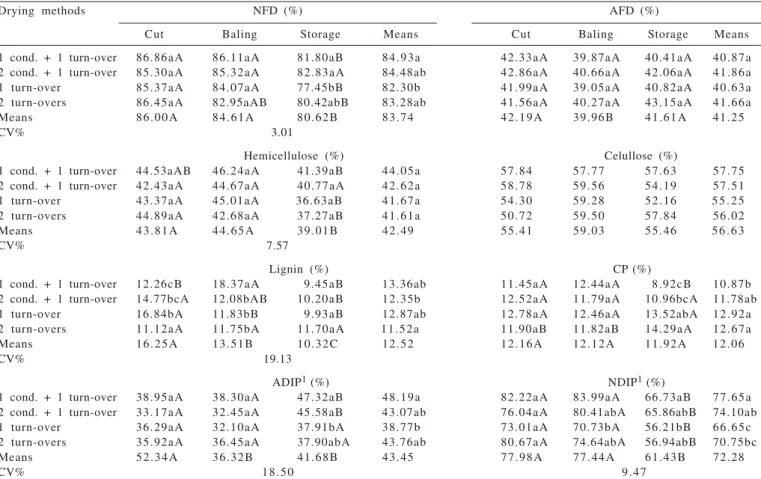
At the moment of the cutting, Tifton 85 grass had similar values of NDF on different methods of drying, with an average of 86.00% (Table 4). These values are high and may affect the intake and digestibility by animals, but results from other research studies show that the species of
Cynodon presents high concentration of NDF even when
harvested in the vegetative stage (Oliveira et al., 2000; Ribeiro et al ., 2001; Reis et al., 2003). The fiber content is used as a negative index of diet quality, as it represents the least digestible fraction of the food. However, fiber is required for normal metabolism and functioning of the rumen, so the fiber quality is an important factor in the diet of ruminants, particularly in lactating dairy cows (Matos, 1989).
After storage, NDF values were on average 80.62% with a higher content in the hay with passages of conditioner (p<0.05). Scheffer-Basso et al. (2008) obtained NDF values of 73.6% for Tifton 85 fertilized with pig slurry.
The ADF values did not differ between treatments (p>0.05) or between cuts, with an average of 41.25% (Table 4). Scheffer-Basso et al. (2008) obtained in Tifton 85 ADF values ranging from 43.5 to 41.5% for assessments conducted in January and February. Reis et al. (2003) obtained 41.8% of ADF for Coast-cross grass at the beginning of flowering.
Means followed by different letters in the column differ by Tukey test at 5% of probability.
Drying methods Dehydration times (h)
0 3 1 5 1 8 2 1 2 4 3 9 4 2 4 5 4 7
1 cond. + 1 turn-over 30.00a 41.16a 33.83a 55.00a 72.66a 73.83a 54.33a 71.16b 78.50a 76.16b 2 cond. + 1 turn-over 28.50a 39.33a 32.16ab 47.50b 72.50a 72.50a 55.16a 76.33a 75.33ab 80.33a 1 turn-over 27.00a 29.16b 29.33bc 37.00c 60.16b 69.00b 52.50ab 68.83b 73.50bc 72.66c 2 turn-overs 28.16a 31.50b 28.50c 36.50c 61.50b 65.66b 50.66b 69.66b 71.33c 73.83bc Table 3 - Dry matter content of Tifton 85 under four drying methods for hay production at the different period of dehydration
The hemicellulose levels did not differ between the drying methods at all times evaluated, but in general, a tendency of decrease with storage was observed (Table 4). The hemicellulose is a heterogeneous collection of amorphous polysaccharides with much lower degree of polymerization cellulose (Van Soest, 1994) and its digestibility varies depending on the quantities of monomers (xylose, arabinose and galacturonic acid) that form the molecule (Ladeira et al., 2002).
The values of cellulose (Table 4) were on average 56.63%, and according to Van Soest (1994), the cellulose is a major constituent of the cell wall and its contents can vary from 20 to 40%.
The values obtained were high, due to the age of forage regrowth (42 days), time of the year and the higher proportion of stems in relation to leaf shown at the time of cutting. The hemicellulose contents did not differ between the drying methods in the three periods evaluated, but when the comparison was made between periods, the values were lower after the storage in the material that only underwent turn-overs with rake.
Lignin is a constituent of the cell wall that has a negative influence on the degradation of tissues (Engels & Jung, 2002; Lacerda et al., 2006). The values of lignin showed an average of 12.52%, with reduction after storage. Reis et al. (2003) obtained 8.2% lignin for Coast-cross grass. At the time of cutting and baling, CP levels showed no significant differences (p>0.05) between drying methods (Table 4). However, after storage, the materials submitted only to turn-overs showed CP contents higher than the ones submitted to conditioning. Regarding the evaluation periods for the drying method with a conditioning, reduction in CP content after storage was observed, whereas an opposite behavior was observed in the hay produced with two turn-overs with rake (Table 4). The double turn-over tools with rake did not increase the rate of dehydration or compromised forage quality in comparison with a single turn-over, thus the recommendation of a single turn-over, when weather conditions are favorable for drying. It is important to emphasize that turning over must be done in the early hours of drying, resulting in acceleration in the rate of dehydration, which is not recommended in the final
Drying methods NFD (%) AFD (%)
Cut Baling Storage Means Cut Baling Storage Means
1 cond. + 1 turn-over 86.86aA 86.11aA 81.80aB 84.93a 42.33aA 39.87aA 40.41aA 40.87a 2 cond. + 1 turn-over 85.30aA 85.32aA 82.83aA 84.48ab 42.86aA 40.66aA 42.06aA 41.86a
1 turn-over 85.37aA 84.07aA 77.45bB 82.30b 41.99aA 39.05aA 40.82aA 40.63a
2 turn-overs 86.45aA 82.95aAB 80.42abB 83.28ab 41.56aA 40.27aA 43.15aA 41.66a
Means 86.00A 84.61A 80.62B 83.74 42.19A 39.96B 41.61A 41.25
CV% 3.01
Hemicellulose (%) Celullose (%)
1 cond. + 1 turn-over 44.53aAB 46.24aA 41.39aB 44.05a 57.84 57.77 57.63 57.75
2 cond. + 1 turn-over 42.43aA 44.67aA 40.77aA 42.62a 58.78 59.56 54.19 57.51
1 turn-over 43.37aA 45.01aA 36.63aB 41.67a 54.30 59.28 52.16 55 . 2 5
2 turn-overs 44.89aA 42.68aA 37.27aB 41.61a 50.72 59.50 57.84 56.02
Means 43.81A 44.65A 39.01B 42.49 55.41 59.03 55.46 56 . 6 3
CV% 7.57
Lignin (%) CP (%)
1 cond. + 1 turn-over 12.26cB 18.37aA 9.45aB 13.36ab 11.45aA 12.44aA 8.92cB 10.87b 2 cond. + 1 turn-over 14.77bcA 12.08bAB 10.20aB 12.35b 12.52aA 11.79aA 10.96bcA 11.78ab
1 turn-over 16.84bA 11.83bB 9.93aB 12.87ab 12.78aA 12.46aA 13.52abA 12.92a
2 turn-overs 11.12aA 11.75bA 11.70aA 11.52a 11.90aB 11.82aB 14.29aA 12.67a
Means 16.25A 13.51B 10.32C 12.52 12.16A 12.12A 11.92A 12.06
CV% 19.13
ADIP1 (%) NDIP1 (%)
1 cond. + 1 turn-over 38.95aA 38.30aA 47.32aB 48.19a 82.22aA 83.99aA 66.73aB 77.65a 2 cond. + 1 turn-over 33.17aA 32.45aA 45.58aB 43.07ab 76.04aA 80.41abA 65.86abB 74.10ab
1 turn-over 36.29aA 32.10aA 37.91bA 38.77b 73.01aA 70.73bA 56.21bB 66.65c
2 turn-overs 35.92aA 36.45aA 37.90abA 43.76ab 80.67aA 74.64abA 56.94abB 70.75bc
Means 52.34A 36.32B 41.68B 43.45 77.98A 77.44A 61.43B 72.28
CV% 18.50 9.47
Values followed by the same capital letters on the row and lowercase on the columns do not differ by Tukey test at 5%.
NDF = neutral detergent fiber, ADF = acid detergent fiber, CP = crude protein, NDIP = neutral detergent insoluble protein, ADIP = acid detergent insoluble protein, Values expressed as % of crude protein.
stages of drying, when the plasma membrane has already lost its permeability and the water is more strongly retained. The evaluation of the potential availability of nitrogen compounds of foods has received special attention in tropical conditions due to the high association with the organic matrix of the cell wall, an association that compromises the accessibility of these compounds by rumen microorganisms (Henriques et al. 2007).
ADIP was influenced by the drying methods and the evaluation periods (p<0.05), so that only after the storage differences were observed between the methods of drying, with worst results achieve by the method that used a single turn-over. For NDIP, there was effect of drying methods and evaluation periods (p<0.05). The time of baling and after storage, higher values of PIDN were observed in the hay produced with one conditioning and one turn-over in comparison with the one that underwent only one turn-over (Table 4). For all drying methods there was a reduction in the values of NDIP with storage (Table 4). These results suggest that the use of conditioners for the production of Tifton 85 hay can increase the amount of unavailable protein, impairing the nutritional value of conserved forages under this method. However, the results are still insufficient to ensure such statement, more detailed studies are needed to quantify and characterize these variables. Aguiar et al. (2006), studying tropical grass hay found values of NDIP ranging from 45.45 to 54.66%, while Gobbi et al. (2005), in the evaluation of Brachiaria decumbens Stapf hay,
found the value of 48.8% of total nitrogen linked to cell wall, and 24.8% of the nitrogen linked to the ADF.
The importance of knowing the change in the content of ADIP is because nitrogen presented in this form remains unavailable for the animal (AFRC, 1995) and is indicative of the fraction of nitrogen compounds not degradable in the rumen. However, recent studies conducted in tropical conditions showed complete absence of relationship between the fraction of non-degradable nitrogenous compounds in the rumen and ADIP, and the possibility of part of this latter being digestible in the intestine (Detmann et al., 2004). ADIP values at the time of cutting
and baling did not differ between treatments (P>0.05). The differences were observed after storage with their rise through the use of conditioners (Table 4). According to Reis et al. (1995), nitrogen retention can vary depending on the moisture content of stored forage. Avila et al. (2009) reported about the immobilization of nitrogen by mycelial fungi growing in silages of Mombaça grass, and according to Guim et al. (2002), this immobilization of nitrogen would be held by the hyphas of filamentous fungi.
The studies on quantification and assessment of genera and species of fungi in hay have been carried out in ammoniated hay or straw with urea or ammonia (Reis et al., 1991, Reis et al., 1997, Almeida et al., 2006). For the total population of fungus, there was a significant interaction of factors (p<0.05). At the unfolding of the evaluation times collected for each drying method, we observed a higher population of fungi in the hay after storage, whereas, when comparing the methods of drying, there was significant difference between them only after storage, with the occurrence of lower fungi population in the hay submitted to two conditionings (Table 5). This result is due to higher DM of the hay resulting from this drying method, which, by causing injury to stems, favored the acceleration of dehydration rate in the final stage of dehydration, when the moisture removal is slower, because it happens through the cuticle (Moser, 1995). The use of this technique provided the hay with a higher content of DM in the baling, limiting the development of fungus; however, this hay showed, after storage, lower levels of CP. Nascimento et al. (2000), when studying the development of fungi on alfalfa hay under different methods of dehydration, saw significant occurrence of fungi in the material that underwent slower dehydration and lower incidence of solar radiation. Also, according to Gregory (1963), during the drying on field there is the occurrence of a highly diverse population of microorganisms, some living in the air, plants and soil; and this diversity of present propagules suggests that different types of micro flora can develop later on, according to the conditions that will prevail in bales at any time.
Values followed by the same capital letters on the row and lowercase letters on the column do not differ by Tukey test at 5%.
Drying methods Cut Baling Storage Means
1 cond. + 1 turn-over 1.43(27.5x10²)aB 1.43(19.33x10²)aB 2.39(258.66x10²)aA 1.75(35.05x10²)a
2 cond. + 1 turn-over 1.40(27.83x10²)aB 1.27(29.16x10²)aB 1.63(58.33x10²)bA 1.43(105.22x10²)b
1 turn-over 1.31(21.50x10²)aB 1.53(36.83x10²)aB 2.54(397.00x10²)aA 1.80(151.77x10²)a
2 turn-overs 1.34(23.00x10²)aB 1.48(32.00x10²)aB 2.50(342.66x10²)aA 1.77(132.55x10²)a
Means 1.37(24.95x10²)B 1.43(29.33x10²)B 2.27(264.17x10²)A
CV% 11.05
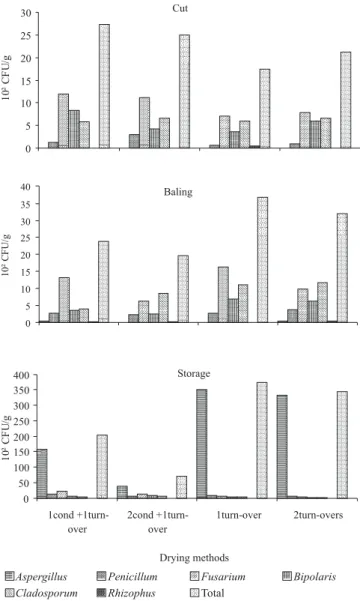
The population of Cladosporium found in hay varied as for storage times, with lower population after storage (Figure 3). The results are consistent with Nascimento et al. (2000) because, according to the author, this represents a genus of saprophytic fungi, which tends to disappear over the course of the storage period.
Conclusions
Tifton 85 dehydrated with the use of conditioners presents higher drying rate and lower incidence of fungi after 30 days of storage, in spite of the lower crude protein. Further detailed research is necessary in order to quantify and qualify the effects of the use of conditioners on the time for the forage baling and on the nutritional composition of the hay produced.
References
AGRICULTURAL AND FOOD RESEARCH COUNCIL - AFRC.
Energy and protein requirements of ruminants. Farnham Royal: CAB International, 1995. 59p.
AGUIAR, E.M.; COSTA LIMA, G.F.; SANTOS, M.V.F. et al. Rendimento e composição químico-bromatológica de fenos triturados de gramíneas tropicais. Revista Brasileira de Zootecnia, v.35, n.6, p.2226-2233, 2006.
ALMEIDA, J.C.C.; PÁDUA, F.R.; NEPUMUCENO, D.D. et al. Ocorrência de fungos no feno de grama-batatais (Paspalum notatum) em função da dose de uréia, período de tratamento e
teor de umidade. Livestock Research for Rural Development, v.18, n.6, p.1-6, 2006. Available at: <http://www.lrrd.org/lrrd18/ 6/carv18080.htm>. Sept. 3, 2008.
ALVIM, M.J.; XAVIER, D.F.; VERNEQUE, R.S. et al. Resposta do tifton 85 a doses de nitrogênio e intervalos de cortes. Pesquisa Agropecuária Brasileira, v.34, n.12, p.2345-2352, 1999. ASSOCIATION OF OFFICIAL ANALYTICAL CHEMISTS - AOAC.
Official methods of analysis. 15.ed. Virginia: Arlington, 1990. 1117p.
ÁVILA, C.L.S.; PINTO, J.C.; FIGUEIREDO, H.C.P. et al. Estabilidade aeróbia de silagens de capim-mombaça tratadas com
Lactobacillus buchneri. Revista Brasileira de Zootecnia, v.38, n.5, p.779-787, 2009.
BARNETT, H.L.; HUNTER, B.B. Illustrated genera of imperfect fungi. New York: Macmillan Publishing Company, 1987. 218p.
CARMICHAEL, J.W.; KENDRICK, W.B.; CONNERS, I.L. et al. Genera of Hyphomycetes. Manitoba: Hignell Printing, 1980. 386p. COLLINS, C.A. Hay preservation effects on yield and quality.
In: Post-harvest physiology and preservation of forages. MOORE, K.J.; KRAL, D.M.; VINEY, M.K. (Eds). Madison, Wisconsin: American Society of Agronomy, 1995. p.67-90. DETMANN, E.; ZERVOUDAKIS, J.T.; CABRAL, L.S. et al.
Validação de equações preditivas do potencial de degradação da fibra em detergente neutro em gramíneas tropicais. Revista Brasileira de Zootecnia, v.33, n.6, p.1866-1875, 2004. DOMINGUES, J.L. Uso de volumosos conservados na alimentação
de eqüinos. Revista Brasileira de Zootecnia, v.38, supl., p.259-269, 2009.
EMPRESA BRASILEIRA DE PESQUISA AGROPECUÁRIA -EMBRAPA. Centro Nacional de Pesquisa de Solos. Sistema brasileiro de classificação de solos. 2.ed. Rio de Janeiro, 2006. 306p.
The genera of fungi observed were Aspergillus, Penicillium, Fusarium, Bipolaris, Cladosporium and Rhizopus (Figure 3). At cutting and baling, fungi of the
genera F u s a r i u m, C l a d o s p o r i u m and B i p o l a r i s
prevailed; and after storage, besides the increase in the total number of colonies, there was an increase in the number of colonies of Aspergillus and reduction in
the number of colonies of fungi found in the early stages (cutting and baling). Reis et al. (1997) observed in
Cynodon dactylon hay increase in the fungi gender Aspergillus with increased moisture in the hay. Storage
fungi such as Aspergillus can serve as a biological
indicator of storage conditions, and its quantification in conserved forages is fundamental, once it represents a potent producer of mycotoxins (Moser, 1995), occurring more often in hot and humid environments.
EMPRESA BRASILEIRA DE PESQUISA AGROPECUÁRIA -EMBRAPA, Sistema Brasileiro de Classificação de Solos. Brasília, 2006. 412p.
FERNANDEZ, M.R. Manual para laboratório de fitopatologia. Passo Fundo: EMBRAPA-CNPT, 1993. 128p.
GOBBI, K.F.; GARCIA, R.; PEREIRA, O.G.; BERNARDINO, F.S. et al. Composição química e digestibilidade in vitro do feno de B r a c h i a r i a d e c u m b e n s Stapf. tratado com uréia. Revista Brasileira Zootecnia, v.34, n.3, p.720-725, 2005.
GREGORY, P.H. Microbial and biochemical changes during the moulding of hay. Journal of Genetic Microbiology, v.33,
n.1, p.147-174, 1963.
GUARRO, J.; GENÉ, J.; STCHIGEL, A.M. Developments in fungal taxonomy. C l i n i c a l M i c ro b i o l o g y R e v i e w s, v.12, n.3,
p.454-500, 1999.
GUIM, A.; ANDRADE, P.; ITURRINO-SCHOCKEN, R.P. et al. Estabilidade aeróbica de silagens de capim-elefante (Pennisetum purpureum, Schum) emurchecido e tratado com inoculante
microbiano. Revista Brasileira de Zootecnia, v.31, n.6,
p.2176-2185, 2002.
HENRIQUES, L.T.; VASQUES, H.M.; PEREIRA, O. Frações dos compostos nitrogenados associados à parede celular em forragens tropicais. Arquivos Brasileiros de Medicina Veterinária e Zootecnia, v.59, n.1, p.258-263, 2007.
HLODVERSSON, R., KASPERSSON, A. Nutrient losses during deterioration of hay in relation to changes in biochemical composition and microbial growth. Animal Feed Science Technology, v.15, n.2, p.149-165, 1986.
INSTITUTO AGRONÔMICO DO PARANÁ - IAPAR [2006].
Cartas climáticas do Paraná. Available at: <http://200.201.27.14/
Site/Sma/Cartas_Climaticas/Classificação_ Climaticas.htm>. Accessed on: Sept. 3, 2008.
JOBIM, C.C.; NUSSIO, L.G.; REIS, R.A.; SCHMIDT, P. Avanços metodológicos na avaliação da qualidade da forragem conservada. Revista Brasileira de Zootecnia, v.36, supl.
p.101-119, 2007.
JUNG, H.G.; ENGELS, F.M. Alfalfa stem tissues: cell, wall deposition, composition and degradability. C rop Science,
v.24, n.2, p.524-534, 2002
LACERDA, R.S.; GOMIDE, C.A.; FUKUSHIMA, R.S.; HERLING, V.R. Lignin concentration in oat (Avena byzantina L.) aerial
part as mensured by four analytical methods. Brazilian Journal Veterinary Research: Animal Science, v.43, n.3,
p.400-407, 2006.
LADEIRA, M.M.; RODRIGUEZ, N.M.; BORGES, I. et al. Avaliação do feno de Arachis pintoi utilizando o ensaio de digestibilidade
i n v i v o. R e v i s t a B r a s i l e i r a d e Z o o t e c n i a, v. 3 1 , n . 6 ,
p.2350-2356, 2002.
MATOS, L.L. Utilização de fibra pelos ruminantes. In: MINI SIMPÓSIODO COLÉGIO BRASILEIRO DE NURTIÇÃO ANIMAL, 2., 1989, Campinas. Anais... Campinas: CBNA,
1989. p.8-10.
MENEZES, M.; SILVA-HANLIN, D.M.W. Guia prático para fungos fitopatogênicos. Recife: UFRPE, 1997. 106p.
MOREIRA, A.L.; REIS, R.A. Técnica da sobressemeadura de forrageiras de inverno sobre o capim-tifton 85. Boletim Indústria Animal, v.64, n.3, p.197-206, 2007.
MOSER, L.E. Post-harvest physiological changes in forage plants. In: MOORE, K.J.; KRAL, D.M.; VINEY, M.K. (Eds).
Post-harvest physiology and preservation of forages. Madison, Wisconsin: American Society of Agronomy, 1995. p.1-19. MUCK, R.E.; SHINNERS, K.J. Conserved forages (silage and hay):
Progress and Priorities. In: INTERNATIONAL GRASSLAND CONGRESS, 29., 2001, São Pedro. Proceedings… Piracicaba:
Brazilian Society of Animal Husbandry, 2001. p.753-763.
NASCIMENTO, J.M.; COSTA, C.; SILVEIRA, A.C. Influência do método de fenação e tempo de armazenamento sobre a composição bromatológica e ocorrência de fungos no feno de alfafa (Medicago sativa, L. cv. Flórida 77). Revista Brasileira de Zootecnia, v.29 n.3, p.669-677, 2000.
OLIVEIRA, M.A.; PEREIRA, O.G.; HUAMAN, C.A.M. et al. Características morfogênicas e estruturais do capim bermuda “Tifton 85” (Cynodon spp.) em diferentes idades de rebrota. Revista Brasileira de Zootecnia, v.29, n.6, p.1939-1948, 2 0 0 0 .
PUPO, N.I.H. Manual de pastagens e forrageiras: formação, conservação, utilização. Campinas: Instituto Campineiro de Ensino Agrícola, 1995. 343p.
REIS, R.A.; BERCHIELLI, T.T.; ANDRADE, P. et al. Valor nutritivo do feno de capim coast-cross (Cynodon dactylon L.
Pers) submetido à amonização. Ars Veterinária, v.19, n.2, p.143-149, 2003.
REIS, R.A.; GARCIA, R.; QUEIROZ, A.C. Efeitos da amonização sobre a qualidade dos fenos de gramíneas tropicais. Pesquisa Agropecuária Brasileira, v.26, n.8, p.1183-1191, 1991. REIS, R.A.; PANIZZI, R.C.; ROSA, B. Efeito da amonização sobre
a ocorrência de fungos, composição química e digestibilidade
in vitro de fenos de grama seda (Cynodon dactylon (L.) Pers).
R e v i s t a B r a s i l e i r a d e Z o o t e c n i a, v.26, n.3, p.454-460, 1 9 9 7 .
REIS, R.A.; RODRIGUES L.R.A.; PEDROSO, P. Avaliação de fontes de amônia para o tratamento de volumosos de baixa qualidade. R e v i s t a B r a s i l e i r a d e Z o o t e c n i a, v. 2 4 , n . 4 , p.487-493, 1995.
REIS, R.A.; SOLLENBERGER, L.E.; URBANO, D. Impacto f overseeding cool-season annual forages on spring regrowth of Tifton 85 bermudagrass. In: INTERNATIONAL GRASSLAND CONGRESS, 19., 2001, São Pedro. Proceedings… São Pedro: Brazilian Society of Animal Husbandry, 2001. p.295-297. RIBEIRO, K.G.; PEREIRA, O.G.; VALADARES FILHO, S.C. et
al. Caracterização das frações que constituem as proteínas e os carboidratos, e respectivas taxas de digestão, do feno de capim tifton-85 de diferentes idades de rebrota. R e v i s t a Brasileira de Zootecnia, v.30, n.2, p.589-595, 2001. ROCHA, G.P.; EVANGELISTA, A.R.; LIMA, J.A. Nitrogênio na
produção de matéria seca, teor e rendimento de proteína bruta de gramíneas tropicais. P a s t u r a s Tro p i c a l e s, v.22, n.1, p.4-8, 2000.
ROTZ, C.A. Field curing of forage. In: MOORE, K.J.; KRAL, D.M.; VINEY, M.K. (Eds). Post-harvest physiology and p re s e r v a t i o n o f f o r a g e s. Madison: American Society of Agronomy, 1995. p.39-66.
UNIVERSIDADE FEDERAL DE VIÇOSA – UFV. Sistema para análises estatísticas e genética – SAEG. versão 7.0. Viçosa,
MG, 1997. (CD-ROM).
SAMSON, R.A.; HOEKSTRA, E.S.; FRISVAD, J.C. et al.
Introduction to food-borne fungi. Baarn: CBS, 1995. 322p. SCHEFFER-BASSO, S.M.; ELLWANGER, M.F.; SCHERER, C.V. et al. Resposta de pastagens perenes à adubação com chorum suíno: cultivar Tifton 85. Revista Brasileira Zootecnia, v.37, n.11, p.1940-1946, 2008.
SILVA, D.J.; QUEIROZ, A.C. Análise de alimentos: métodos químicos e biológicos. Viçosa, MG: UFV, 2006. 235p. VAN SOEST, P.J. Nutritional ecology of the ruminant. Ithaca:
Constock Publishing Associates, 1994. 476p.