An Acad Bras Cienc (2016) 88 (3) Anais da Academia Brasileira de Ciências (2016) 88(3): 1569-1575
(Annals of the Brazilian Academy of Sciences)
Printed version ISSN 0001-3765 / Online version ISSN 1678-2690 http://dx.doi.org/10.1590/0001-3765201620150883
www.scielo.br/aabc
Correspondence to: Débora Pires Paula E-mail: [email protected]
Artificial tritrophic exposure system for environmental
risk analysis on aphidophagous predators
DéborA P. PAulA1
, lucAs M. De souzA1
, DAviD A. Andow2
, Alex A.T. corTês De sousA1
, cArMen s.s. Pires1
and eDison r. sujii1
1
Embrapa Genetic Resources and Biotechnology, Parque Estação Biológica, Avenida W5 Norte (final), 70770-917 Brasília, DF, Brasil
2Department of Entomology, University of Minnesota, 219 Hodson Hall, 1980 Folwell Ave., St. Paul, MN, 55108, USA
Manuscript received on December 11, 2015; accepted for publication on March 18, 2016
AbsTrAcT
We evaluated an artificial tritrophic exposure system for use in ecotoxicological evaluations of environmental stressors on aphidophagous predators. It consists of an acrylic tube with a Parafilm M sachet containing
liquid aphid diet, into which can be added environmental stressors. Immature Cycloneda sanguinea, Harmonia axyridis and Chrysoperla externa, and adult H. axyridis were reared on Myzus persicae. Larval and pupal development and survival of all species and reproductive parameters of H. axyridis were similar to published results. The system provides a suitable tritrophic exposure route, enables ex-ante evaluation of stressors, and improves the accuracy of the assessment.
Key words: beneficial insects, biosafety, ecotoxicology, exposure routes.
inTroDucTion
Insect non-target predators can be exposed to environmental stressors, such as Bt entomotoxins
in genetically modified (GM) plants, directly by
consumption of parts of the GM plant or indirectly by predation on herbivores that themselves had fed on a GM plant (Groot and Dicke 2002, Romeis et al. 2006, Lövei et al. 2009). An ecotoxicological evaluation of effects on predators is often made by: a) exposing them to GM plant parts (such as pollen) or to an herbivore that fed on the GM plant, or b) by inoculating (or spraying) an environmental
stressor on artificial diets or on predator food. In the first case, the environmental risk assessment is
constrained to occur after the development of the technological product (e.g. GM plant) containing the environmental stressor, and in the second case, by the power of the ecological inferences
that can be made using artificial exposure routes
An Acad Bras Cienc (2016) 88 (3)
1570 DÉBORA P. PAULA et al.
MATeriAls AnD MeTHoDs
PreParation of the SyStem
The system (Douglas and van Emden, 2007)
was made with transparent acrylic tubes (2.5 cm
diameter x 2.5 cm height, wall thickness 0.35 cm)
with two layers of parafilm M on one end forming a
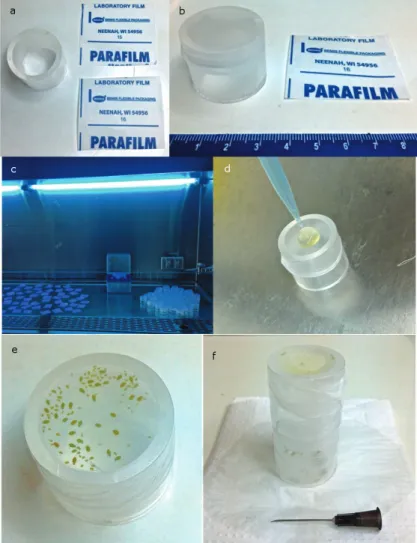
Figure 1 - Artificial tritrophic system for rearing aphids and aphidophagous predators: a) Tube and two Parafilm M pieces; b) Tube with one parafilm layer attached and a second parafilm piece, ruler with scale in cm; c) Sterilization of the system components by UV irradiation in a laminar flow hood; d) Pipetting of the diet onto the parafilm layer attached to the tube; e) Completed artificial aphid feeding system containing M. persicae feeding from the lower parafilm layer inside the tube; f) Aphid transfer to a tube with new diet. First the old and new tube are coupled together using a parafilm strip, then the diet is drained from the old tube by making holes with a needle and putting it upside down on absorbent paper. The aphids move from the old tube to the new one.
sachet, inside of which was 150 to 500 µl of liquid
diet for rearing aphids (Dadd and Mittler 1966).
An Acad Bras Cienc (2016) 88 (3)
ARTIFICIAL TRITROPHIC SYSTEM FOR RISK ANALYSIS 1571
radiation for 30 to 40 min in a laminar flow hood (Fig. 1c). The liquid diet was sterilized by filtration using a filter (pore size of 0.22 µm) coupled to a plastic syringe in a laminar flow hood. The feeding tubes were finished inside a laminar flow hood by pipetting (with sterilized tips) the filtered diet on the sterilized layer of parafilm attached to the tube (Fig. 1d), and covering it with the sterilized face of the second parafilm piece, after stretching it in
both directions. When the tubes were finished, M.
persicae aphids were carefully transferred into them using a paint-brush (#2).
rearing PredatorS in the artificial tritroPhic SyStem
Green peach aphid, Myzus persicae (Hemiptera: Aphididae), and the predaceous ladybird beetles,
Cycloneda sanguinea and Harmonia axyridis
(Coleoptera: Coccinellidae), and green lacewing,
Chrysoperla externa (Neuroptera: Chrysopidae),
were obtained from laboratory colonies and reared in growth chambers at 25±2°C and 16:8 LD, based on Paula et al. (2015) and Carvalho and Souza (2009). Unfed, recently emerged (<24 h) coccinellid and chrysopid neonates were individually (10 replicates each species) transferred to the system containing
M. persicae aphids that had fed on the diet for at least 24 h and reared in a growth chamber at 25±2°C and 16:8 LD. The predator larvae were transferred daily to new tubes containing aphids feeding on the diet. Development time and survival (larval and pupal) were measured. Recently emerged adults (<24 h) were individually weighed and sexed.In addition, unfed recently (<24 h) emerged H. axyridis couples
(n ≥ 10) were individually transferred to the system
containing 100 M. persicae aphids and reared for 20 days, as mentioned previously. The number of eggs laid and egg development time were recorded. Comparisons between our experimental values and published values were made using Welch’s
t-test (assuming unequal sample size and unequal
variance) with a Bonferroni correction for the
P-value when there were multiple comparisons.
resulTs AnD Discussion
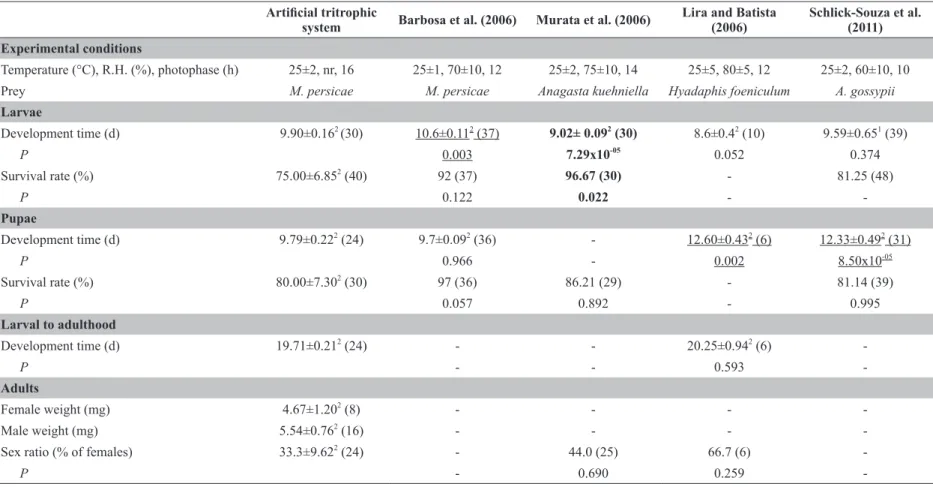
Overall the system provided suitable conditions for rearing the predator species (Tables I to III). Although we noted many differences in the biological parameter values compared to published values, there were no consistent differences, indicating that the performance of the predators in the system was within the normal range of variation of other rearing systems. Therefore, the system can be used in ecotoxicological tests as a tritrophic route of exposure for aphidophagous predators to several kinds of environmental stressors that can be added directly in the aphid diet, such as Bt proteins (Paula et al. 2015), dsRNAi and entomopathogenic agents (e.g., bacteria).
The main advantages of using this system are a) independence of the aphid from its host plant, enabling evaluation of an environmental stressor early in the development of a GM plant, and b) control of the exposure of the environmental stressor, in terms of concentration, homogeneity
and constancy over time. In the first case, early
ecotoxicological tests can provide a basis to optimize an intended technology (e.g., to produce
an entomotoxin that is more species-specific) or
even support the decision making process of continuing investments in development or not. In the second case, the control of exposure of an environmental stressor has fundamental relevance to risk analysis as it provides higher accuracy and precision in the estimation of potential effects by reducing extraneous sources of variability within and across treatments, thereby reducing residual error caused by varied expression of the stressor in the GM plant in response to the environment conditions, tissue type, developmental stage, or difference in variety/cultivar (genetic background)
An
Acad Bras Cienc
(2016)
88
(3)
1572
DÉBORA
P
. P
AULA
et al.
TAble i
biological parameter values (average ± sD or se) for Cycloneda sanguinea immatures reared in the artificial tritrophic system and compared with the published
literature. Parentheses are number individuals tested, and P is the bonferroni P-value that the literature value differs from the artificial tritrophic system. The
parameters that differed from the artificial tritrophic system are in bold when the published value was better and underlined when worse. Artificial tritrophic
system santa-cecília et al. (2001) isikber and copland (2002) Funichello (2010) souza et al. (2013) experimental conditions
Temperature (°C), R.H. (%), photophase (h) 25±2, nr, 16 25±2, 70±10, 12 22,5±1, 60±5, 16 25±1, 70±5, 12 25±2, 60±10, 12
Prey M. persicae Schizaphis graminum M. persicae A. gossypii A. gossypii
larvae
Development time (d) 9.33±0.122
(56) 8.35±0.322
(8) 8.1±0.21
(10) 10.02±0.362
(40) 10.58±1.991 (40)
P 0.083 6.24x10⁻¹²
0.232 0.002
Survival rate (%) 73.42±4.972
(72) 80 (16) 77 (13) 95 (40) 100 (40)
P 0.944 0.998 0.010 4.10x10⁻⁴
Pupae
Weight (mg) 13.38±0.562 (55) 15.0±1.482 (16) - -
-P 0.319 - -
An
Acad Bras Cienc
(2016)
88
(3)
AR
TIFICIAL
TRITROPHIC SYSTEM FOR RISK
ANAL
YSIS
1573
TAble ii
biological parameter values (average ± sD or se) for Harmonia axyridis reared in the artificial tritrophic system and compared with the published literature.
Parentheses are number of individuals tested, and P is the bonferroni P-value that the literature value differs from the artificial tritrophic system. The parameters
that differed from the artificial tritrophic system are in bold when the published value was better and underlined when worse. Artificial tritrophic
system lamana and Miller (1998) stathas et al. (2001) Matos and obrycki (2006) chen et al. (2012) experimental conditions
Temperature (°C), R.H. (%), photophase (h) 25±2, nr, 16 26±2, 50-70, 16 25±1, 65±1, 16 24±1, nr,16 25±0,5, 66±5, 16
Prey M. persicae Acyrthosiphon pisum A. fabae M. lythri Chaitophorus populeti
larvae
Development time (days) 11.20±0.122
(103) 10.2±1.01
(142) - 13.3±0.22
(24) 9.3±0.581
(30)
P 3.29x10⁻¹⁰
- 8.72x10⁻¹¹ 0
Survival rate (%) 73.81±3.922
(126) 86.2 (142) 88.7 (30) - 90 (30)
P 0.050 0.395 - 0.158
Pupae
Development time (d) 4.59±0.172 (27) 4.5±0.31 (142) - 4.6±0.12 (24) 5.1 ± 0.461 (30)
P 0.918 - 1 0.036
Survival rate (%) 82.35±6.542
(34) - 100 (30) -
-P - 0.022 -
-Weight (mg) 23.87±0.552
(68) - - -
-larval to adulthood
Development time (d) 14.36±0.162
(28) - - 17.8±0.22
(24)
-P - - 1.45x10⁻¹⁶
-Adults
Female weight (mg) 23.43±0.642
(14) - - - 27.0 ± 2.241
(10)
P - - - 0.001
Male weight (mg) 20.61±0.732
(18) - - - 24.8 ± 1.471
(10)
P - - - 5.45x10⁻⁵
Sex ratio (% of females) 39.29±9.232 (28) - - - 55.0
reproduction
Preoviposition period (d) 6.05±0.332
(20) - 7.2±1.121
(30) - 7.4 ± 1.741
(10)
P - 0 - 1.63x10-08
Daily fecundity (eggs per female) 40.59±4.322 (20) - - - 24.4 ± 4.861 (10)
P - - - 0.002
Eclosion rate (%) 43.43±6.882
(20) - - -
-Development time (d) 2.34±0.162
(20) 2.8± 0.301
(142) - -
-P 0.010 - -
An
Acad Bras Cienc
(2016)
88
(3)
1574
DÉBORA
P
. P
AULA
et al.
TAble iii
biological parameter values (average ± sD or se) for Chrysoperla externa immatures reared in the artificial tritrophic system and compared with the published
literature. Parentheses are number of individuals tested, and P is the bonferroni P-value that the literature value differs from the artificial tritrophic system. The
parameters that differed from the artificial tritrophic system are in bold when the published value was better and underlined when worse. Artificial tritrophic
system barbosa et al. (2006) Murata et al. (2006) lira and batista (2006) schlick-souza et al. (2011) experimental conditions
Temperature (°C), R.H. (%), photophase (h) 25±2, nr, 16 25±1, 70±10, 12 25±2, 75±10, 14 25±5, 80±5, 12 25±2, 60±10, 10
Prey M. persicae M. persicae Anagasta kuehniella Hyadaphis foeniculum A. gossypii
larvae
Development time (d) 9.90±0.162
(30) 10.6±0.112
(37) 9.02± 0.092
(30) 8.6±0.42
(10) 9.59±0.651
(39)
P 0.003 7.29x10-05 0.052 0.374
Survival rate (%) 75.00±6.852
(40) 92 (37) 96.67 (30) - 81.25 (48)
P 0.122 0.022 -
-Pupae
Development time (d) 9.79±0.222
(24) 9.7±0.092
(36) - 12.60±0.432
(6) 12.33±0.492 (31)
P 0.966 - 0.002 8.50x10-05
Survival rate (%) 80.00±7.302
(30) 97 (36) 86.21 (29) - 81.14 (39)
P 0.057 0.892 - 0.995
larval to adulthood
Development time (d) 19.71±0.212 (24) - - 20.25±0.942 (6)
-P - - 0.593
-Adults
Female weight (mg) 4.67±1.202
(8) - - -
-Male weight (mg) 5.54±0.762
(16) - - -
-Sex ratio (% of females) 33.3±9.622 (24) - 44.0 (25) 66.7 (6)
-P - 0.690 0.259
An Acad Bras Cienc (2016) 88 (3)
ARTIFICIAL TRITROPHIC SYSTEM FOR RISK ANALYSIS 1575
AcKnoWleDGMenTs
We thank Bruna Lima for preparing the diet and artificial system and collecting aphids from the
field; Dr. Brígida de Souza, Elaine Louzada and Jander Souza from the Universidade Federal de
Lavras for providing the Ch. externa to rear at
Embrapa Cenargen; and Juã Pereira for permitting
the collection of M. persicae from his farm.
reFerences
BARBOSA LR, CARVALHO CF, SOUZA B AND AUAD AM. 2006. Influência da densidade de Myzus persicae (Sulzer) sobre alguns aspectos biológicos e capacidade predatória de Chrysoperla externa (Hagen). Acta Sci Agron 28(2): 227-231.
CARVALHO CF AND SOUZA B. 2009. Métodos de criação e produção de crisopídeos. In: Controle biológico de pragas, produção massal e controle de qualidade. Bueno VHP, Editora UFL, Lavras-MG, p. 77-115.
CHEN J, QIN QJ, LIU S AND HE YZ. 2012. Effect of six diets on development and fecundity of Harmonia axyridis (Pallas) (Coleoptera: Coccinellidae). African Entomology 20(1): 85-90.
DADD RH AND MITTLER TE. 1966. Permanent culture of an aphid on a totally synthetic diet. Experientia 22: 832-833. DOUGLAS AE AND VAN EMDEN HF. 2007. Nutrition and
Symbiosis. Chapter 5. In: Van Emden HF and Harrington R (Eds), Aphis as crop pests. p. 105-134.
FUNICHELLO M. 2010. Aspectos biológicos de Cycloneda sanguinea (L.) (Coleoptera: Coccinellidae) e de Aphis gossypii Glover (Hemiptera: Aphididae), criados nas cultivares Deltaopal e Nuopal (Bollgard I). Dissertação de mestrado, UNESP, Fac. Ciências Agrárias e Veterinárias, 56 p. (Unpublished).
GROOT AT AND DICKE M. 2002. Insect-resistant transgen-ic plants in a multi-trophtransgen-ic context. Plant J 31: 387-406. HILBECK A, ANDOW DA, ARPAIA S, BIRCH ANE,
FONTES EMG, LöVEI GL, SUJII ER, WHEATLEY RE AND UNDERWOOD E. 2006. Methodology to support non-target and biodiversity risk assessment. In: Environmental risk assessment of genetically modified organisms, methodologies for assessing Bt cotton in Brazil. Chapter 5. Edited by Hilbeck A, Andow DA and Fontes EMG. CABI Publishing, 373 p.
IşIKBER AA AND COPLAND MJW. 2002. Effects of various aphid foods on Cycloneda sanguinea. Entomol Exp Appl102: 93-97.
LAMANA ML AND MILLER JC. 1998. Temperature-dependent development in an Oregon population of Harmonia axyridis (Coleoptera: Coccinallidae). Environ Entomol 27(4): 1001-1005.
LIRA RS AND BATISTA JL. 2006. Aspectos biológicos de Chrysoperla externa alimentados com pulgões da erva-doce. Rev Biol Ciênc Terra 6(2): 20-35.
LöVEI GL, ANDOW DA AND ARPAIA S. 2009. Transgenic insecticidal crops and natural enemies: a detailed review of laboratory studies. Environ. Entomol. 38: 293-306. MATOS B AND OBRYCKI JJ. 2006. Prey suitability of
Galerucella calmariensis L. (Coleoptera: Chrysomelidae) and Myzus lythri (Schrank) (Homoptera: Aphididae) for development of three predatory species. Environ Entomol 35(2): 345-350.
MURATA AT, CAETANO AC, BORTOLI AS AND BRITO CH. 2006. Capacidade de consumo de Chrysoperla externa (Hagen, 1861) (Neuroptera: Chrysopidae) em diferentes presas. Caatinga 19(3): 304-309.
PAULA DP, ANDOW DA, BELLINATI A, TIMBó RV, SOUZA LM, PIRES CSS AND SUJII Er. 2015. Limita-tions in dose-response and surrogate species methodolo-gies for risk assessment of Cry toxins on arthropod natural enemies. Ecotoxicology 25(3): 601-607.
ROMEIS J, MEISSLE M AND BIGLER F. 2006. Transgenic crops expressing Bacillus thuringiensis toxins and biological control. Nat Biotech 24: 63-71.
ROMEIS J et al. 2008. Assessment of risk of insect-resistant transgenic crops to non-target arthropods. Nat. Biotech. 26: 203-208.
SANTA-CECíLIA LVc, GONçALVES-GERVáSIO RCR, TôRRES RMS AND NASCIMENTO FB. 2001. Aspec-tos biológicos e consumo alimentar de larvas de Cyclone-da sanguinea (Linnaeus, 1763) (Coleoptera: Coccinelidae) alimentadas com Schizaphis graminum (Rondani, 1852) (Hemiptera: Aphididae). Ciênc Agrotec 25(6): 1273-1278. SCHLICK-SOUZA EC, TOSCANO LC, SOUZA-SCHLICK GD, MARUYAMA WI AND PERES AJA. 2011. Desenvolvimento larval de Chrysoperla externa alimentada com Aphis gossypii provenientes de três cultivares de algodoeiro. Agrarian 4(13): 182-188. SOUZA LM, BELINATTI AR, PAGANELLA MB, PAULA
DP, PIRES CSS AND SUJII ER. 2013. Desenvolvimento de dieta artificial para Cycloneda sanguinea (Coleoptera: Coccinellidae). Boletim de Pesquisa e Desenvolvimento, 294, 18 p.